
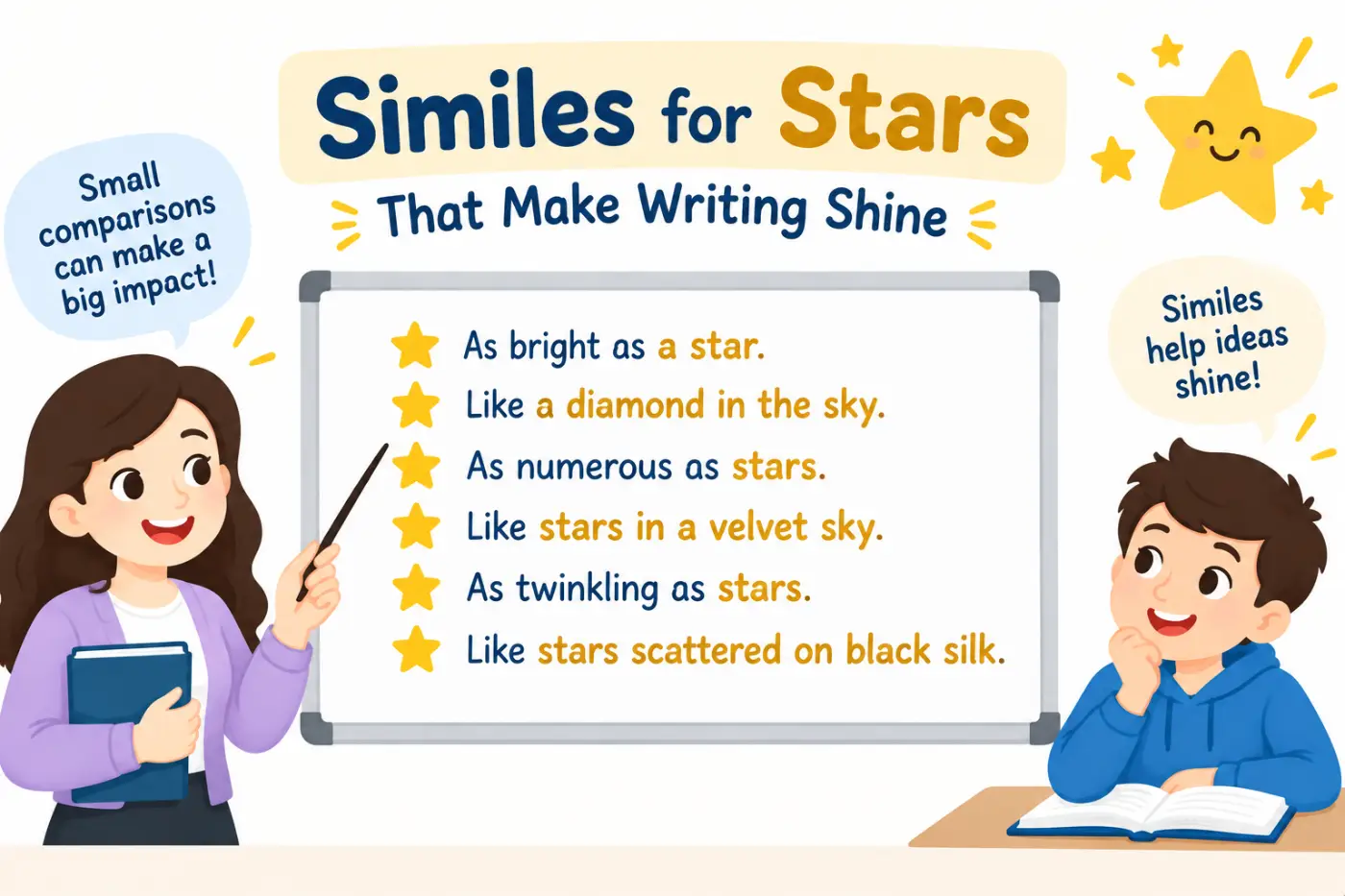
Finding the right comparison can turn a plain sentence into an image readers can almost see. If you’re searching for similes for stars you probably want more than a list of phrases. You want comparisons that make stars feel bright mysterious beautiful distant magical or alive. A good simile gives the reader a picture without making the sentence feel forced.
Stars are naturally rich subjects for figurative language. They can resemble diamonds scattered across black velvet. They can seem as bright as sparks from a distant fire or as gentle as candles glowing through darkness. The best comparison depends on the mood you’re trying to create.
This collection gives you a wide range of fresh comparisons for stars. You’ll find simple choices for students as well as more imaginative options for poems stories descriptions captions and personal writing. You’ll also learn how similes differ from metaphors and how to choose a comparison that actually fits the feeling of your sentence.
Quick Definition
A simile compares two different things using words such as like or as. Comparisons for stars can describe their brightness shape color movement distance or emotional effect. For example the stars were like diamonds scattered across a dark sky creates a clear visual image while adding beauty and sparkle to the description.
Quick Answer
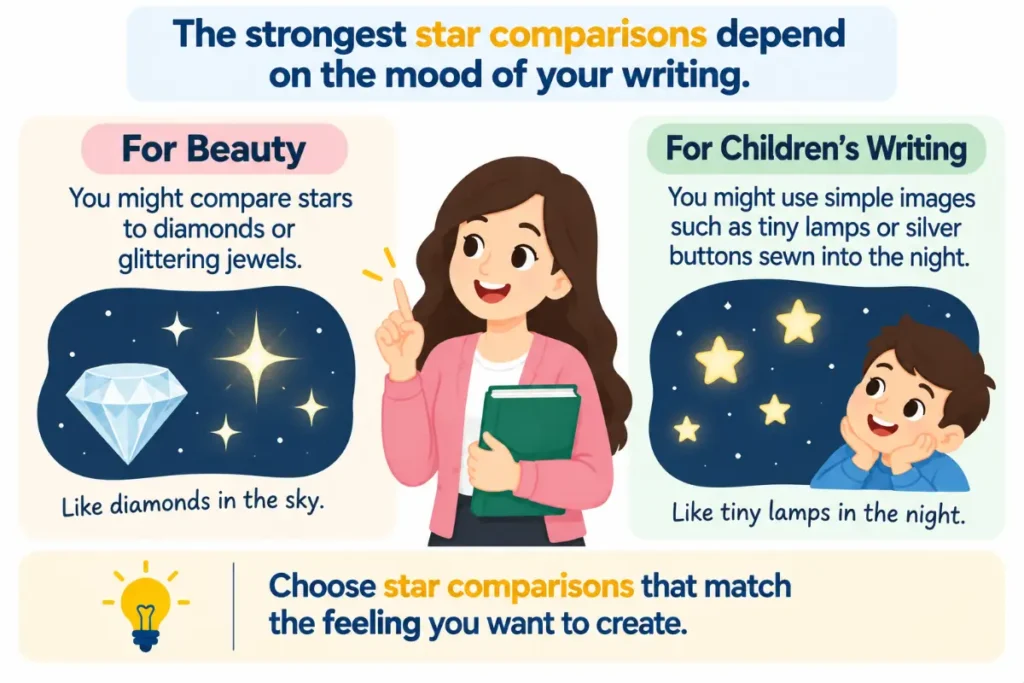
The strongest star comparisons depend on the mood of your writing. For beauty you might compare stars to diamonds or glittering jewels. For children’s writing you might use simple images such as tiny lamps or silver buttons sewn into the night.
A good simile should create a picture quickly. It shouldn’t feel like a decoration added just to make a sentence sound fancy.
The Best Similes for Stars
Here are some versatile comparisons that work in many types of writing.
- The stars were like diamonds scattered across black velvet.
- The stars twinkled like tiny candles in the distance.
- The stars shone like silver coins beneath the moon.
- The stars looked like glitter sprinkled across a dark blanket.
- The stars were as bright as sparks from a distant fire.
- The stars glittered like jewels in a royal crown.
- The stars appeared like tiny lanterns hanging in the sky.
- The stars were as delicate as drops of silver paint.
- The stars sparkled like pieces of glass catching sunlight.
- The stars looked like fireflies trapped above the earth.
Each comparison creates a slightly different picture. Diamonds suggest value and brilliance. Candles suggest warmth. Lanterns suggest guidance. Fireflies suggest movement and wonder.
That difference matters. A strong writer doesn’t simply choose the prettiest comparison. The writer chooses the image that matches the emotion of the scene.
Beautiful Similes for Stars
Stars have been associated with beauty for centuries because their light stands out against the darkness. If your goal is to create an elegant or romantic image you can lean into jewels flowers light and delicate objects.
- The stars were like diamonds sewn into a midnight dress.
- The stars sparkled like jewels scattered across silk.
- The stars glowed like pearls against a sheet of dark blue.
- The stars were as beautiful as tiny crystals floating above the world.
- The stars shimmered like silver beads on a velvet curtain.
- The stars looked like golden dust sprinkled across the heavens.
- The stars gleamed like polished gems beneath the moon.
- The stars were like delicate pearls resting on black satin.
- The stars glittered like treasure hidden in a dark cave.
- The stars shone like tiny jewels in an endless crown.
Notice how these examples rely on familiar objects. Readers already know what diamonds pearls jewels and silk look like. The comparison gives them a mental shortcut.
You can also make a beautiful simile more personal. Instead of saying the stars were like diamonds you might write the stars were like diamonds my grandmother used to keep in an old wooden box. Suddenly the image carries memory as well as beauty.
Similes for Bright Stars
Sometimes you want the reader to notice how strongly a star shines. In that case comparisons involving fire sparks lamps mirrors and polished objects can work especially well.
- The stars shone like sparks rising from a giant fire.
- The brightest star burned like a tiny torch in the night.
- The stars glittered like mirrors catching the last light of day.
- The stars were as bright as candles in a dark room.
- The stars flashed like sparks from a blacksmith’s hammer.
- The stars shone like lamps scattered across a distant road.
- The stars gleamed like polished silver under a dark sky.
- The stars glowed like embers refusing to die.
- The stars were like tiny fires burning at the edge of the universe.
- The stars sparkled like sunlight caught inside pieces of crystal.
Brightness doesn’t always have to mean harsh light. An ember can suggest a softer glow. A candle can suggest warmth. A torch can suggest strength. A spark can suggest sudden brilliance.
Choose the image according to the kind of brightness you want readers to imagine.
Similes for Twinkling Stars
Twinkling stars create a different challenge because you’re describing movement rather than simple brightness. Comparisons to blinking lights fireflies dancing jewels and candle flames can make the movement easier to picture.
- The stars twinkled like fireflies dancing in a summer field.
- The stars blinked like tiny lights in a distant window.
- The stars flickered like candles touched by a gentle breeze.
- The stars sparkled like diamonds shaken inside a velvet box.
- The stars winked like playful eyes across the night.
- The stars danced like fireflies above a quiet meadow.
- The stars flickered like sparks carried by the wind.
- The stars shimmered like sequins moving beneath soft light.
- The stars blinked like distant lamps along a dark road.
- The stars trembled like tiny flames in the night.
Words such as twinkled blinked flickered shimmered and sparkled don’t create exactly the same effect. Twinkling often feels cheerful. Flickering can feel unstable. Shimmering feels soft. Winking can give the stars a playful personality.
That is why verb choice matters almost as much as the comparison itself.
Similes for Stars in the Night Sky
A night sky gives you a large visual space to work with. You can compare the stars to objects scattered across fabric or lights spread across a huge landscape.
- The stars were like diamonds scattered across a black ocean.
- The stars looked like lanterns floating in an endless sea of darkness.
- The stars were like grains of salt sprinkled over black cloth.
- The stars appeared like tiny windows glowing in a distant city.
- The stars were as numerous as grains of sand across a beach.
- The stars stretched across the sky like lights along a country road.
- The stars looked like silver dust scattered over dark velvet.
- The stars were like beads sewn into a giant blue blanket.
- The stars glittered like distant villages seen from a mountain.
- The stars appeared like scattered sparks across an enormous fireplace.
These comparisons work because they give scale to something that can otherwise feel difficult to describe. The sky is enormous. A comparison gives the reader something familiar to use as a reference point.
Romantic Similes for Stars
Stars often appear in romantic writing because they create a quiet setting for emotion. If you’re writing a love poem or romantic scene you can connect them with eyes jewelry memories promises and gentle light.
- Her eyes shone like stars on a cloudless night.
- The stars above us were like diamonds watching over our conversation.
- The night glittered like a necklace laid across the sky.
- The stars were like tiny promises scattered through the darkness.
- His smile was as warm as starlight on a quiet evening.
- The stars shimmered like jewels around a royal crown.
- The sky looked like a dark canvas sprinkled with the memories of a thousand dreams.
- The stars were like distant candles keeping us company.
- Her eyes sparkled like stars reflected in a calm lake.
- The stars seemed like quiet witnesses to our first kiss.
Romantic comparisons work best when they feel connected to the scene. If two characters are standing beside a lake you can compare the stars to reflections on water. If they’re walking through a city you might compare the stars to distant windows.
The setting gives your simile roots.
Similes for Stars in Poetry
Poetry gives you more freedom. You don’t always need to describe stars realistically. You can use comparisons to explore emotion memory loneliness hope time or dreams.
- The stars were like old stories whispered across the darkness.
- The stars burned like questions no one could answer.
- The stars were like scattered thoughts inside the mind of the night.
- The stars trembled like lonely voices calling from far away.
- The stars were like tiny hopes refusing to disappear.
- The stars shone like memories that time could never erase.
- The stars drifted above us like dreams waiting to be remembered.
- The stars were like silver tears caught in the folds of the sky.
- The stars flickered like distant hearts beating in the darkness.
- The stars were as patient as old storytellers watching the earth below.
Poetry benefits from emotional comparisons because stars already carry strong cultural associations. They can represent hope and loneliness.
The key is restraint. One powerful comparison can do more than five ordinary ones.
Similes for Stars for Students
Students often need clear figurative language that is easy to understand and easy to use correctly. The best examples usually compare stars with familiar objects.
- The stars were like tiny diamonds in the sky.
- The stars twinkled like little lights.
- The stars looked like fireflies above the trees.
- The stars shone like candles in the darkness.
- The stars were as bright as small lamps.
- The stars glittered like pieces of glass.
- The stars looked like silver dots on black paper.
- The stars were like buttons sewn onto a dark blanket.
- The stars twinkled like tiny eyes.
- The stars were as bright as sparks from a fire.
These examples are simple without being dull. They also demonstrate an important lesson about similes. You don’t need complicated vocabulary to create a strong image.
A clear comparison that readers instantly understand can be more effective than an elaborate comparison that makes them stop and figure out what you mean.
Similes for Stars in Stories
Story writing gives you more room to connect the sky with the mood of a scene. A peaceful scene might need a gentle comparison while a frightening scene might need something darker.
For a peaceful moment you could write:
The stars glowed like candles around a sleeping village.
For a lonely scene you could write:
The stars hung above him like distant eyes that could never answer.
For an adventurous scene you could write:
The stars stretched ahead like lanterns guiding the travelers through the wilderness.
For a magical scene you could write:
The stars shimmered like enchanted jewels scattered by an invisible hand.
For a sad scene you could write:
The stars flickered like fading memories in the back of her mind.
The comparison should support the scene instead of competing with it. If your character is frightened you probably don’t want a cheerful image of playful fireflies. If the scene is romantic you may not want a comparison that sounds cold or threatening.
Similes for Stars About Mystery
The night sky can feel mysterious because stars are distant and impossible to touch. Comparisons involving eyes secrets doors questions and hidden lights can create that mood.
- The stars watched like silent eyes from beyond the clouds.
- The stars were like secret windows into another world.
- The stars glimmered like clues in an ancient mystery.
- The stars appeared like distant eyes hidden in the darkness.
- The stars were like unanswered questions scattered across the sky.
- The stars flickered like secret signals from a distant place.
- The stars looked like tiny doors opening into the unknown.
- The stars were as mysterious as whispers behind a closed door.
- The stars shone like clues left behind by an unseen traveler.
- The stars hovered like silent witnesses above the sleeping earth.
These comparisons are useful when you want the sky to feel thoughtful rather than simply beautiful.
Similes for Stars About Hope
Stars can also represent hope because their light remains visible against darkness. This makes them useful in inspirational writing and emotional storytelling.
- The stars were like tiny hopes shining through the darkness.
- The stars glowed like candles in a long night.
- The stars were like distant promises that tomorrow could be better.
- The stars shone like small victories against the dark.
- The stars appeared like guiding lights for a lost traveler.
- The stars were as comforting as a familiar voice in the dark.
- The stars glittered like signs that darkness never lasts forever.
- The stars were like little sparks of courage in an endless night.
- The stars shone like reminders to keep moving forward.
- The stars looked like tiny windows where hope could enter.
Hope based comparisons work because they turn physical light into an emotional idea. The reader sees the stars while also understanding what they represent.
That is one of the strongest uses of figurative language. The image has two layers. You can picture it literally while feeling its deeper meaning.
Similes for Stars About Distance
Stars are incredibly far away from us. You can use that distance to express separation between people places dreams or memories.
- The stars were like distant lights beyond the reach of human hands.
- The stars seemed as far away as forgotten dreams.
- The stars were like tiny islands floating in an endless sea.
- The stars looked like lamps on a road no one could reach.
- The stars were as distant as memories from childhood.
- The stars shimmered like lights at the far end of a dark tunnel.
- The stars were like distant homes seen from across a valley.
- The stars appeared as unreachable as dreams beyond the horizon.
- The stars hung like tiny jewels far beyond the earth.
- The stars were like whispers coming from another world.
Distance can create beauty but it can also create loneliness. The same sky can therefore support very different emotional scenes.
Similes for Stars for Children
Children often respond well to comparisons involving toys animals candy lights and familiar objects. These images are easy to picture and can make descriptive writing more playful.
- The stars were like glitter sprinkled across the sky.
- The stars looked like tiny buttons on a giant blanket.
- The stars twinkled like fireflies playing hide and seek.
- The stars were like little lamps hanging from an invisible ceiling.
- The stars sparkled like sugar crystals in the moonlight.
- The stars looked like golden stickers on a dark wall.
- The stars were like tiny beads scattered across blue cloth.
- The stars blinked like friendly eyes saying hello.
- The stars danced like fireflies above the trees.
- The stars were as bright as tiny flashlights.
These comparisons can also help young writers understand the basic structure of a simile. The sentence compares two different things while using like or as to make the connection clear.
How To Write Your Own Star Similes
You don’t need to memorize a huge collection of comparisons. Once you understand the process you can create your own.
Start by deciding what you want the reader to notice. Is the star bright? Is it tiny? Does it seem lonely?
Next choose a familiar object that shares that quality.
If the star is bright you might choose a diamond or spark.
Then connect the two ideas using like or as.
The star shone like a diamond.
The star was as bright as a spark.
The stars moved like fireflies.
Finally read the sentence aloud. Does the comparison feel natural? Can you picture it immediately? Does it fit the mood?
If the answer is yes you probably have a strong simile.
Simile Versus Metaphor
A simile and a metaphor both create comparisons but they do it differently.
A simile usually uses like or as.
The stars were like diamonds.
A metaphor makes the comparison directly.
The stars were diamonds scattered across the sky.
Neither approach is automatically better. The choice depends on the effect you want.
Similes often feel softer and more explicit. The reader knows exactly what two things are being compared. Metaphors can feel stronger because they present the comparison as a direct image.
Compare these two sentences.
The stars were like candles in the darkness.
The stars were candles in the darkness.
The first creates a clear comparison. The second turns the stars into part of the image itself.
Understanding this distinction helps you avoid calling every comparison a simile. If your sentence uses like or as to compare two different things it is usually functioning as a simile.
How To Choose The Right Comparison
A good comparison isn’t just pretty. It should serve the sentence.
- Match the mood. A romantic scene needs a different image from a scary scene.
- Match the brightness. Use sparks or lamps for strong light and embers or candles for softer light.
- Match the movement. Fireflies and flames work well for twinkling or flickering.
- Match the size. Tiny objects such as beads and grains can emphasize how small stars appear from earth.
- Match the setting. A comparison involving water works naturally beside a lake or ocean.
- Match the character. A child might compare stars to stickers while an astronomer might use a more precise image.
- Avoid tired comparisons when originality matters. Diamonds are familiar and effective but a fresh comparison can make your writing stand out.
- Keep the image understandable. Readers shouldn’t need a dictionary to understand your comparison.
- Avoid mixing unrelated images. One clear image is usually stronger than several competing ones.
- Read the sentence aloud. If it sounds awkward when spoken it may need revision.
Common Mistakes With Star Similes
Using A Comparison That Does Not Fit
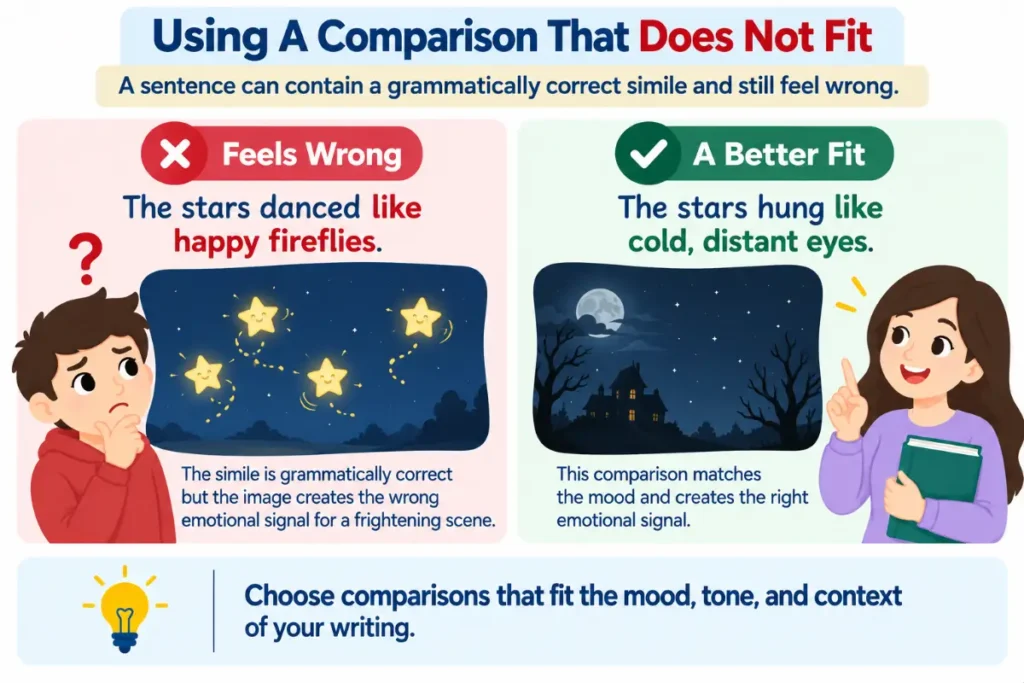
A sentence can contain a grammatically correct simile and still feel wrong.
For example a frightening scene may not benefit from saying the stars danced like happy fireflies. The image creates the wrong emotional signal.
Choose an image that supports the feeling of the scene.
Using Too Many Similes
One paragraph doesn’t need five comparisons for the same object. Too many images can make the writing feel crowded.
If you write that the stars were diamonds candles fireflies jewels and lamps all within a few sentences the reader may lose the central image.
Pick the strongest one and let it breathe.
Explaining The Simile Too Much
A strong comparison usually speaks for itself.
The stars were like diamonds scattered across black velvet because diamonds are shiny and black velvet is dark and smooth is unnecessary.
Trust the reader to understand a clear image.
Choosing An Unfamiliar Comparison
Creative writing rewards originality but originality shouldn’t come at the expense of clarity.
If readers can’t picture the object you use for comparison the simile loses much of its power.
Confusing Simile With Personification
Personification gives human traits to something that isn’t human.
The stars smiled down on the village is personification.
The stars were like smiling eyes above the village is a simile.
A sentence can contain both devices but they aren’t the same technique.
Related Figurative Language
Understanding a few nearby literary terms can make your writing stronger.
Metaphor
A metaphor compares two things directly without using like or as.
The stars were jewels scattered across the sky.
Personification
Personification gives human qualities to something nonhuman.
The stars watched over the sleeping town.
Imagery
Imagery uses descriptive language to help readers experience a scene through sight sound touch smell taste or movement.
The stars glittered above the silent lake creates visual imagery.
Hyperbole
Hyperbole uses deliberate exaggeration.
The stars seemed bright enough to light the whole world.
The statement isn’t meant as a literal scientific claim.
Alliteration
Alliteration repeats similar beginning sounds.
Silver stars silently shimmered.
This technique can create rhythm when used carefully.
Symbolism
Symbolism gives an object a deeper meaning beyond its literal role.
Stars can symbolize hope guidance dreams memory or distance depending on the context.
Analogy
An analogy explains an idea by comparing it with another situation that helps clarify the meaning.
An analogy is usually more explanatory than a simple poetic simile.
Imagined Comparison
Creative writers sometimes build extended comparisons that continue across several sentences. This can create a richer scene but requires consistency.
These devices can work together. A single passage might use a simile for visual detail then personification for emotion and symbolism for deeper meaning.
Real Life Usage Examples
Daily Conversation
People don’t usually use elaborate literary comparisons in casual conversation but simple images can sound natural.
The stars looked like little lights tonight.
Those stars were as bright as glitter.
These examples are easy to understand and don’t sound overly dramatic.
Workplace Writing
Figurative language has a smaller role in professional writing but can work in speeches presentations creative campaigns and personal messages.
The stars above the city looked like tiny lamps scattered across a dark room.
The image can add warmth to a travel story or personal reflection.
Academic Writing
Academic writing usually values precision over decorative language. Still a controlled comparison can appear in literary analysis or descriptive research writing.
The poem presents the stars as distant lights that resemble scattered jewels.
The comparison helps explain imagery rather than simply decorating the sentence.
News And Journalism
Straight news writing tends to avoid heavy figurative language. Feature writing and human interest stories have more freedom.
The stars appeared like tiny lanterns above the quiet town.
The image can help readers visualize a scene without overwhelming the factual reporting.
Literature And Storytelling
Creative stories offer the greatest freedom.
The stars flickered like nervous fireflies above the empty road.
The comparison immediately creates movement and mood. The word nervous also gives the scene an emotional quality.
Expert Editor Insight
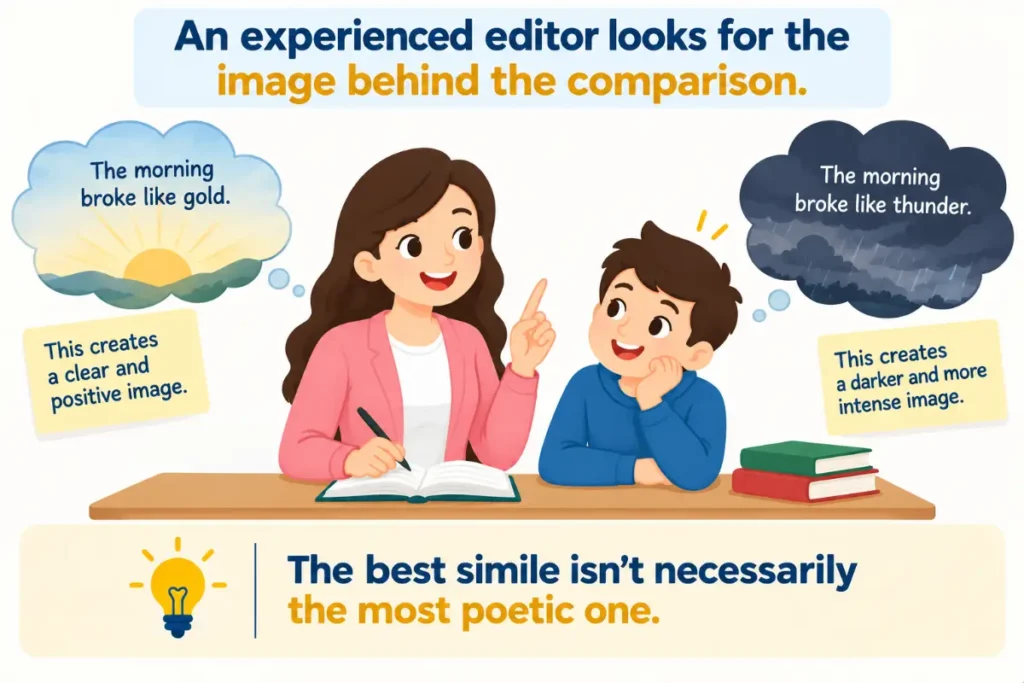
An experienced editor looks for the image behind the comparison. The best simile isn’t necessarily the most poetic one. It’s the one that gives the reader a clear picture while supporting the mood and purpose of the passage. Native writers often choose familiar objects because readers can visualize them instantly. Editors also watch for repetition. If every description compares stars to diamonds the writing can start to feel predictable. A stronger approach is to choose the image based on the scene and then remove any comparison that doesn’t earn its place.
Conclusion
similes for stars can turn a simple description of the night sky into something readers can see and feel. The strongest comparisons depend on the mood you want to create. Diamonds and jewels suggest beauty while candles and embers suggest warmth. Fireflies can suggest movement while distant eyes or windows can create mystery.
The best simile doesn’t need complicated vocabulary. It needs a clear image that fits the scene. Think about the quality you want to show then choose a familiar object that shares that quality. Finally read the sentence aloud and remove anything that feels forced.
A simple comparison can be memorable when it feels natural. Let the image do the work and give your reader a reason to look up at the stars in a new way.
FAQs
What is a good simile for stars?
A strong general choice is the stars were like diamonds scattered across black velvet. It creates an immediate picture of bright points against a dark background. For a softer mood you could compare them to candles. For a playful mood fireflies work well. The best comparison depends on the feeling you want the reader to experience.
How do you describe stars in a simile?
Start with the quality you want to describe. Stars can be bright tiny distant twinkling colorful or mysterious. Then choose a familiar object that shares that quality. For example bright stars can be like sparks while twinkling stars can be like fireflies. The goal is to make the reader picture the stars more clearly.
What is a simple simile for stars?
A simple example is the stars were like diamonds in the sky. It’s easy to understand and works well for school writing and basic descriptive sentences. Another simple option is the stars twinkled like fireflies. Both examples use familiar objects and clearly show how a simile creates a visual comparison.
What is a poetic comparison for stars?
A poetic comparison can connect stars with ideas such as hope memory dreams or loneliness. For example the stars were like tiny hopes shining through the darkness gives the physical image an emotional meaning. Poetic comparisons work best when the image fits the larger mood instead of appearing only to make the writing sound fancy.
Can stars be compared to diamonds?
Yes. Comparing stars to diamonds is one of the most familiar ways to describe their brightness and sparkle. The comparison works because diamonds are associated with brilliance and beauty while the dark sky provides a strong visual contrast. Still writers should vary their imagery when possible so the description doesn’t sound predictable.
What is a simile for twinkling stars?
A useful example is the stars twinkled like fireflies dancing in a summer field. Fireflies work particularly well because they provide both light and movement. You can also compare twinkling stars to candles flickering in a breeze or tiny lamps blinking across a distant landscape. Choose the comparison that matches the mood of your scene.
How can I make a star simile more original?
Start with the emotion or quality behind the image instead of reaching immediately for familiar words such as diamonds. Think about what the stars remind you of in the setting. They might resemble windows in a distant city tiny holes in dark fabric or sparks floating above a quiet fire. Personal observations often produce fresher comparisons.
What is the difference between a star simile and a metaphor?
A simile makes a comparison using words such as like or as. For example the stars were like diamonds is a simile. A metaphor makes the comparison directly by saying the stars were diamonds. Both can create strong imagery. The main difference is the grammatical structure used to connect the two ideas.

Idioms, Expressions & Figurative Language
Mason Ellsworth is an American language writer with a passion for English expressions, figurative language, and everyday communication. He explains idioms, similes, popular phrases, and commonly misunderstood expressions in a straightforward, engaging style that helps readers improve both their writing and spoken English.