

Has Run vs Has Ran is one of the most common grammar questions English learners ask. The confusion happens because both run and ran come from the same verb. They look similar and both describe actions in the past. Still only one works after helping verbs like has have and had.
The correct form is has run. The phrase has ran breaks a basic grammar rule because ran is the simple past tense not the past participle.
Once you understand the difference between simple past and present perfect tense this mistake becomes easy to avoid. This guide explains the grammar in plain English. You will learn the rule see real examples understand common mistakes and discover simple memory tricks that make the correct form stick.
Short Answer
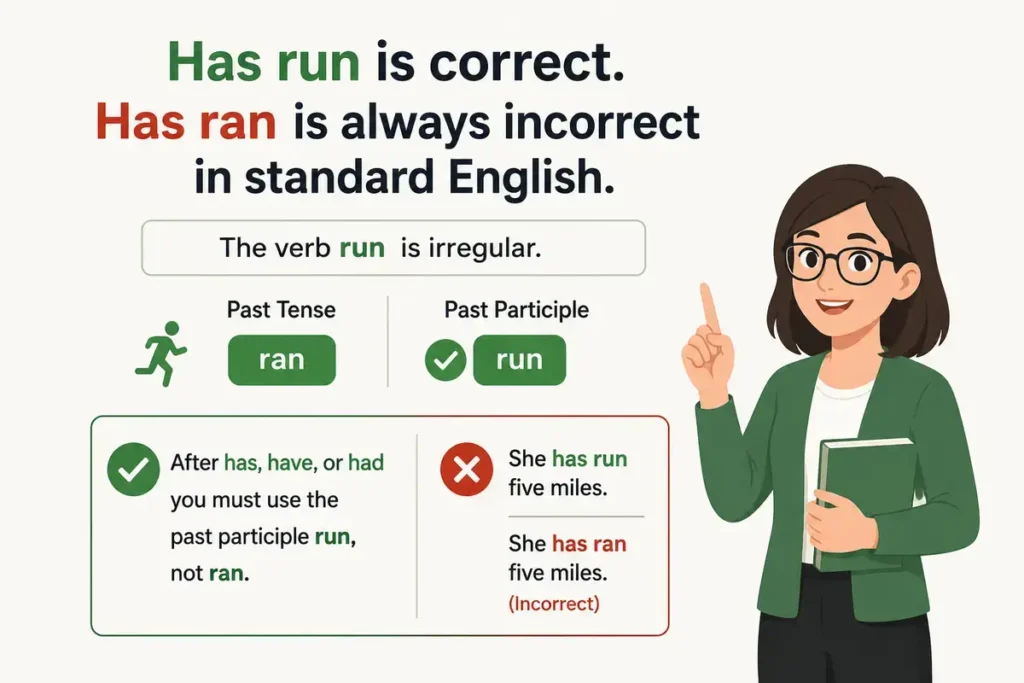
Has run is correct. Has ran is always incorrect in standard English. The verb run is irregular. Its past tense is ran and its past participle is run. After has have or had you must use the past participle run not ran.
Table Of Contents
- Has Run Vs Has Ran Quick Answer.
- Why Has Run Is Correct.
- Why Has Ran Is Incorrect.
- Understanding Run Ran And Run.
- What Is The Present Perfect Tense.
- When To Use Has Run.
- When To Use Ran.
- Comparison Table.
- Real World Examples.
- Common Mistakes.
- Memory Tricks.
- Related Grammar Rules.
- Frequently Asked Questions.
- Key Takeaways.
- Conclusion.
Why Has Run Is Correct
English uses different verb forms for different tenses. Some verbs simply add ed. Others change completely. The verb run belongs to the second group. It is an irregular verb.
Here are its three main forms.
| Base Form | Past Tense | Past Participle |
|---|---|---|
| run | ran | run |
This table explains everything. the present perfect tense always follows this pattern.
Has or Have plus Past Participle.
That means the correct sentence is.
She has run every morning this week.
Not.
She has ran every morning this week.
The helping verb has requires the past participle. The past participle of run is run.
Why Has Ran Is Incorrect
Many people naturally say has ran because ran sounds like the past form of run. In everyday conversation, some regional dialects also use it. That does not make it correct in standard English.
- Professional writers, teachers, editors, publishers, and style guides all agree on the rule.
- After has, have, or had, use the past participle.
That means these are correct.
Correct
- I have run five miles today.
- She has run three successful businesses.
- They had run out of time.
Incorrect
- I have ran five miles today.
- She has ran three successful businesses.
- They had ran out of time.
- This mistake appears often because English irregular verbs do not follow one simple pattern.
- Each verb has its own forms that must be learned.
Understanding Run Ran And Run
Many grammar mistakes disappear once you understand the job each verb form performs.
Run
Run is the base form.
Examples
- I run every evening.
- They run a successful company.
- Children run around the playground.
- In these examples, run describes present actions or habits.
Ran
Ran is the simple past tense.
- Use it for actions that started and finished in the past.
Examples
- I ran five miles yesterday.
- She ran home after school.
- They ran the business for ten years.
- Each sentence talks about a completed action.
Run
Run is also the past participle.
- Use it after helping verbs.
Examples
- I have run several marathons.
- She has run this department since January.
- They had run out of money before the trip ended.
- The helping verb changes the tense.
- The past participle completes it.
What Is The Present Perfect Tense
The present perfect connects the past with the present.
- The action happened before now but still matters now.
The structure is simple:
- Has or Have + Past Participle
Examples
- She has finished her homework.
- They have written a report.
- He has driven across the country.
Notice something important.
- Every sentence uses a past participle after the helping verb.
- The same rule applies to run.
Correct
- He has run every marathon in the city.
Incorrect
He has ran every marathon in the city.
How Present Perfect Differs From Simple Past
Many learners mix these two tenses because both describe past actions. The difference is not difficult once you see them side by side.
| Simple Past | Present Perfect |
|---|---|
| I ran yesterday. | I have run three times this week. |
| She ran home. | She has run home before dinner. |
| They ran the store last year. | They have run the store since 2019. |
The simple past usually mentions a finished time.
Yesterday.
Last week.
Last year.
An hour ago.
The present perfect usually focuses on experience results or actions connected to the present.
When To Use Has Run
Use has run with singular subjects like he she or it.
It also works with singular nouns.
Examples.
The athlete has run faster than anyone else this season.
The company has run several successful campaigns.
My brother has run this restaurant for twenty years.
The software has run without problems all week.
Each sentence follows the same grammar pattern.
Subject.
Helping verb.
Past participle.
Time Expressions That Often Appear With Has Run
The present perfect commonly appears with certain time expressions.
Examples include.
Already.
Yet.
Just.
Recently.
Since.
For.
So far.
Lately.
Ever.
Never.
Examples.
She has already run the report.
He has just run another test.
The engine has run perfectly so far.
Our team has run this event for years.
The patient has never run after surgery.
These expressions often signal that the present perfect is the right tense.
Why Native Speakers Still Make This Mistake
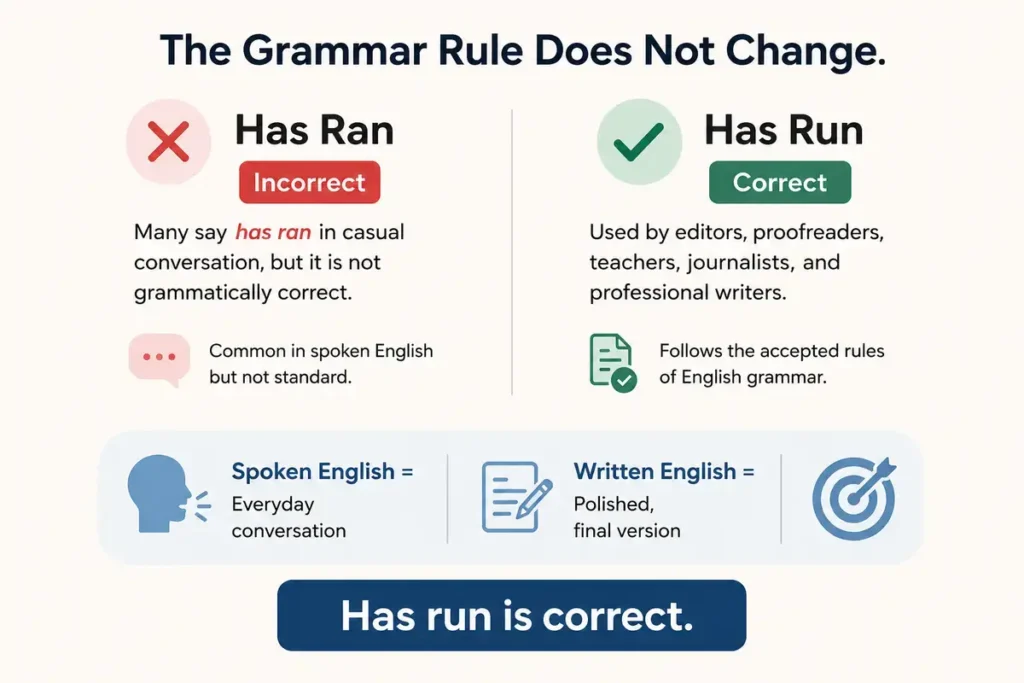
Many native English speakers say has ran in casual conversation. That can confuse learners because hearing something often makes it seem correct.
Regional speech does not always follow standard grammar.
Editors proofreaders teachers journalists and professional writers consistently use has run because it follows the accepted rules of English grammar.
Think of spoken English as everyday conversation. Think of written English as the polished final version. The grammar rule does not change.
Has run is correct.
Has ran is not.
A Quick Test
Choose the correct sentence.
A. She has ran every marathon in Boston.
B. She has run every marathon in Boston.
- The answer is B.
Now try another.
A. He ran to school yesterday.
B. He run to school yesterday.
- The answer is A because the sentence uses the simple past tense.
Notice how the correct verb changes with the helping verb.
- No helping verb? Use ran.
- Helping verb present? Use run.
- That single idea solves almost every confusion involving this verb.
When To Use Ran
Use ran only as the simple past tense. It describes an action that started and finished in the past.
- The action has no direct connection to the present.
Examples
- I ran five miles yesterday.
- She ran to catch the train.
- They ran the family business for twenty years.
- The dog ran across the field.
- My grandfather ran a small grocery store.
- Each sentence refers to a completed event.
A good question to ask yourself is this:
- Can I add a finished time such as yesterday, last night, last year, or two hours ago?
- If the answer is yes, the simple past is often the correct choice.
Examples With Finished Time
That is the key difference.
Yesterday I ran before breakfast.
She ran home after work.
The children ran outside when school ended.
The manager ran the meeting last Monday.
Our team ran several tests last week.
Notice that none of these sentences uses a helping verb like has, have, or had.
Comparison Table
| Situation | Correct Form | Example |
|---|---|---|
| Present habit | Run | I run every morning. |
| Finished action in the past | Ran | I ran yesterday. |
| Present perfect | Has run | She has run three races this year. |
| Present perfect plural | Have run | They have run this business since 2018. |
| Past perfect | Had run | We had run out of food before help arrived. |
| Future perfect | Will have run | She will have run ten miles by noon. |
This table covers nearly every situation you will meet in everyday English.
Present Perfect Versus Simple Past
These two tenses often cause confusion because both describe past actions.
- The difference is in the speaker’s focus.
- The simple past focuses on a finished event.
- The present perfect focuses on experience, results, or something that still matters now.
Compare these examples.
- I ran five miles yesterday.
- The action happened yesterday and is complete.
- I have run five miles today.
- The action happened today, and today is not finished yet.
- She ran the company from 2010 to 2020.
- The time period is complete.
- She has run the company since 2020.
- She still manages the company now.
- Small changes in wording can completely change the correct tense.
Real Life Examples Of Has Run
These examples show how native speakers use the present perfect.
- The restaurant has run smoothly since the new manager arrived.
- My neighbor has run every local marathon.
- She has run several successful marketing campaigns.
- The software has run without errors all day.
- He has run this repair shop for more than thirty years.
- Our school has run the same program for decades.
- The athlete has run faster every season.
- The machine has run continuously since this morning.
- The company has run thousands of safety inspections.
- The charity has run many community events.
Each example connects a past action with the present.
Real Life Examples Of Ran
Now compare them with simple past sentences.
- The restaurant ran out of fresh bread yesterday.
- My neighbor ran a marathon last weekend.
- She ran the marketing campaign in 2023.
- The software ran perfectly during the demonstration.
- He ran his first business in college.
- Our school ran a fundraiser last spring.
- The athlete ran faster than everyone else yesterday.
- The machine ran for eight hours before stopping.
- The company ran several advertisements during the holiday season.
- The charity ran a food drive last month.
Examples In Everyday Conversation
Correct Examples With Has Run
- She has run this office since January.
- He has run out of coffee again.
- Our team has run into the same problem twice.
- The engine has run perfectly.
- I have run every report you requested.
Correct Examples With Ran
- She ran this office before retiring.
- He ran out of coffee yesterday.
- Our team ran into trouble during the project.
- The engine ran well last week.
- I ran every report yesterday afternoon.
Incorrect Examples
- She has ran this office since January.
- He has ran out of coffee.
- Our team has ran into trouble.
- The engine has ran perfectly.
- I have ran every report.
Why This Mistake Happens
Many English mistakes come from patterns our brains expect to see.
Regular verbs usually work like this.
Walk.
Walked.
Walked.
Play.
Played.
Played.
Need.
Needed.
Needed.
Irregular verbs do not follow one pattern.
Run.
Ran.
Run.
Because the past tense changes to ran many people naturally expect the past participle to stay the same. English does not work that way. Many common irregular verbs have different past tense and past participle forms.
Other Irregular Verbs That Follow A Similar Pattern
| Base Form | Past Tense | Past Participle |
|---|---|---|
| Begin | Began | Begun |
| Drink | Drank | Drunk |
| Ring | Rang | Rung |
| Sing | Sang | Sung |
| Swim | Swam | Swum |
| Write | Wrote | Written |
These verbs remind us that English irregular verbs cannot always be predicted. Learning their three principal forms is the easiest solution.
Common Mistakes
Common Mistakes With Has Run And Ran
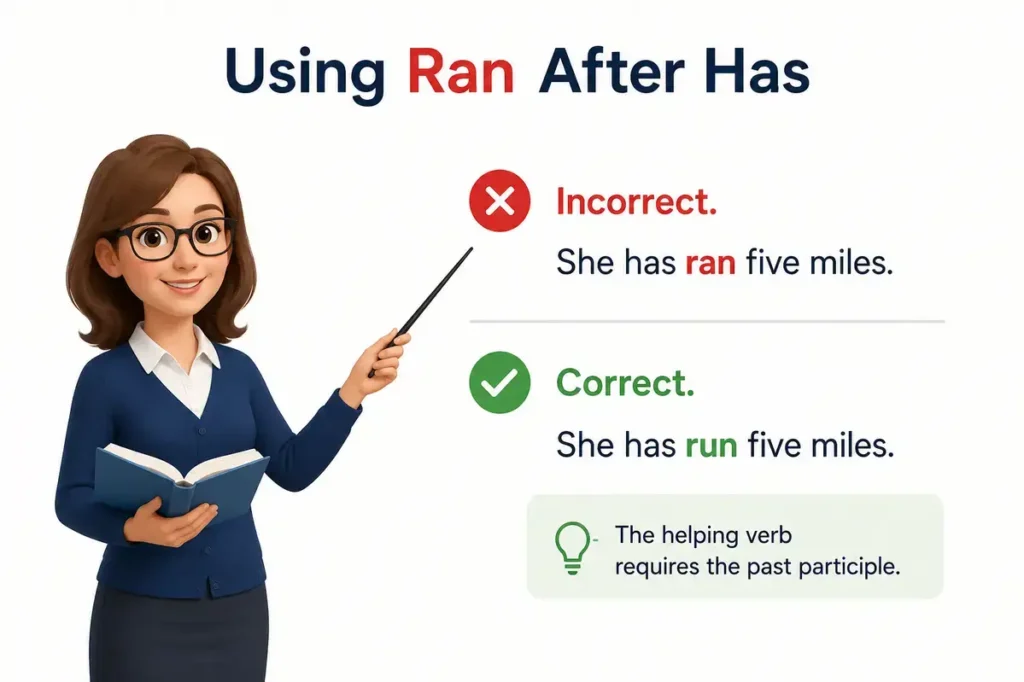
Using Ran After Has
Incorrect
- She has ran five miles.
Correct
- She has run five miles.
Why it is wrong
- The helping verb has requires the past participle.
Using Run Instead Of Ran
Incorrect
- Yesterday I run five miles.
Correct
- Yesterday I ran five miles.
Why it is wrong
- The sentence describes a completed action in the past.
Mixing Time Expressions
Incorrect
- I have run yesterday.
Correct
- I ran yesterday.
Why it is wrong
- Yesterday points to a finished time, so the simple past is required.
Forgetting The Helping Verb
Incorrect
- She run three miles today.
Correct
- She has run three miles today.
Why it is wrong
- The helping verb completes the present perfect tense.
Professional Writing Tips
Professional editors rarely memorize grammar rules one by one.
Instead, they recognize sentence patterns.
- When you see has, have, or had, your brain should automatically expect a past participle.
- That simple habit eliminates many grammar mistakes.
- Editors also read complete sentences instead of isolated words.
For example:
- The athlete has run five races this season.
The helping verb immediately signals the correct verb form.
This pattern applies across English.
- Has written.
- Has driven.
- Has run.
The structure stays the same even though the verbs change.
Memory Trick
Think of this sentence:
- Has Have Had Need The Third Form.
That simple phrase reminds you to use the past participle every time.
Now connect it to the verb:
- Run.
- Ran.
- Run.
The third form is run.
If you remember only one thing from this guide, remember this:
- Has always chooses the third form.
Another Easy Memory Trick
Imagine three doors.
- The first door says Today. Behind it stands run.
- The second door says Yesterday. Behind it stands ran.
- The third door says Has Have Had. Behind it stands run again.
This picture helps many learners remember the correct form without thinking about complicated grammar terms.
Related Grammar Rules
Learning one irregular verb often helps you master many others.
Compare these pairs:
- Use has done, not has did.
- Say has seen, not has saw.
Each sentence follows exactly the same grammar pattern.
Once you recognize that pattern, your confidence grows with every sentence you write.
Has Run In American And British English
- There is no difference between American English and British English.
- Both varieties use has run.
- Both consider has ran incorrect in standard grammar.
- Pronunciation may vary slightly from one region to another, but the grammar rule stays exactly the same.
- That consistency makes this rule easy to apply anywhere English is written or spoken.
Formal And Informal Writing
The rule does not change based on style.
Formal Writing
- The company has run multiple safety audits this year.
Academic Writing
- The experiment has run successfully under controlled conditions.
Business Writing
- Our team has run extensive quality checks.
Casual Conversation
No exceptions exist in standard English.
He has run to the store.
Every situation uses the same verb form.
Key Takeaways
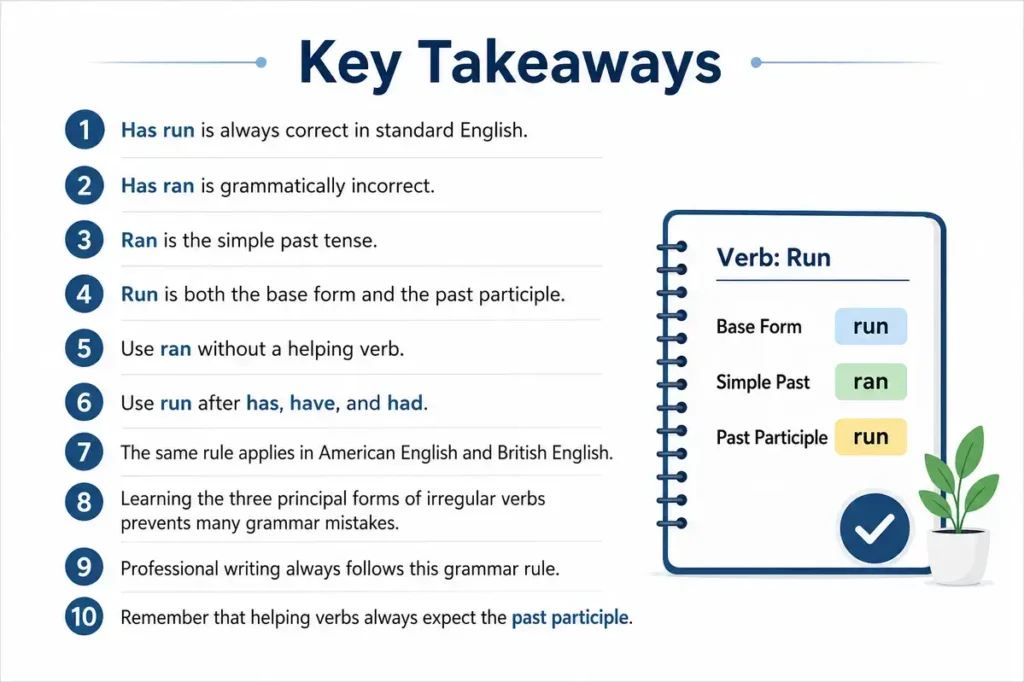
- Has run is always correct in standard English.
- Has ran is grammatically incorrect.
- Ran is the simple past tense.
- Run is both the base form and the past participle.
- Use ran without a helping verb.
- Use run after has have and had.
- The same rule applies in American English and British English.
- Learning the three principal forms of irregular verbs prevents many grammar mistakes.
- Professional writing always follows this grammar rule.
- Remember that helping verbs always expect the past participle.
Final Comparison
| Grammar Situation | Correct Form | Incorrect Form |
|---|---|---|
| Present tense | I run every day. | I ran every day. |
| Simple past | I ran yesterday. | I run yesterday. |
| Present perfect | I have run today. | I have ran today. |
| Present perfect singular | She has run home. | She has ran home. |
| Past perfect | They had run away. | They had ran away. |
| Future perfect | He will have run ten miles. | He will have ran ten miles. |
This table summarizes the entire grammar rule in one place.
Related Grammar Notes
Understanding Has Run vs Has Ran also makes other irregular verbs much easier to use correctly.
Compare these examples.
Correct.
She has written three books.
Incorrect.
She has wrote three books.
Correct.
They have gone home.
Incorrect.
They have went home.
Correct.
He has spoken to the manager.
Incorrect.
He has spoke to the manager.
Correct.
We have seen that movie.
Incorrect.
We have saw that movie.
Every example follows the same pattern.
Helping verb.
Past participle.
Once you recognize that pattern you will make far fewer grammar mistakes.
Common Editing Advice
Professional editors rarely think about individual verb forms while proofreading. Instead they scan for sentence patterns. When they see has have or had they immediately expect the past participle. That habit catches mistakes quickly. Reading your work aloud also helps. If a sentence sounds awkward after a helping verb check the verb form. Many grammar errors become obvious once you hear them.
Conclusion
The answer to Has Run vs Has Ran is simple once you understand how irregular verbs work. Has run is the correct form because run is the past participle. Has ran is incorrect because ran is the simple past tense and cannot follow the helping verb has. The verb forms are easy to remember.
Ran. Use ran for actions that happened and finished in the past.
Run. Use run after has have and had to form the perfect tenses.
This single grammar rule improves everyday writing business communication academic work and professional editing. It also helps you avoid one of the most common mistakes English learners and even native speakers sometimes make. If you remember one sentence let it be this. Has Have Had Always Need The Third Form. Apply that rule consistently and choosing between Has Run vs Has Ran will never be a problem again.
Frequently Asked Questions
Is Has Run Or Has Ran Correct?
Has run is correct. Has ran is incorrect in standard English grammar. The helping verb has always takes the past participle. The past participle of run is run.
Why Do People Say Has Ran?
Many people learn English by listening before studying grammar. In some regional dialects people say has ran in everyday conversation. Standard English does not accept that form in professional writing academic work or formal speech.
Is Ran Ever Correct?
Yes. Ran is correct as the simple past tense.
Examples.
I ran to school yesterday.
She ran a successful business.
They ran out of time.
Each action happened and ended in the past.
Can I Say Have Ran?
No. The correct phrase is have run.
Correct.
We have run several tests.
Incorrect.
We have ran several tests.
The same rule applies to has have and had.
Is Had Ran Correct?
No. The correct phrase is had run.
Correct.
They had run out of money before help arrived.
Incorrect.
They had ran out of money before help arrived.
The helping verb had also requires the past participle.
What Is The Past Tense Of Run?
The past tense of run is ran.
Example.
She ran five miles yesterday.
Do not confuse the past tense with the past participle.
What Is The Past Participle Of Run?
The past participle is run.
Examples.
He has run every race this season.
They have run this company for years.
The past participle appears after helping verbs.
Why Is Run Both The Base Form And The Past Participle?
English has many irregular verbs. Some irregular verbs use the same word for the base form and the past participle.
Run.
Ran.
Run.
This pattern may seem unusual at first but it follows normal English grammar.
How Can I Remember The Correct Form?
Remember one simple sentence.
Has Have Had Always Need The Third Form.
Then memorize the three forms.
Run.
Ran.
Run.
Once those forms become familiar the mistake almost disappears.
Do Native English Speakers Make This Mistake?
Yes. Some native speakers say has ran in casual conversation because of local speech habits. Professional editors teachers publishers and grammar guides still use has run because it follows standard English.

English Grammar & Usage
Nathan Holloway is an American grammar writer and language researcher who specializes in English grammar, sentence structure, verb usage, and common writing mistakes. He enjoys breaking down confusing grammar rules into practical explanations with clear examples, making English easier for students, professionals, and everyday writers.