
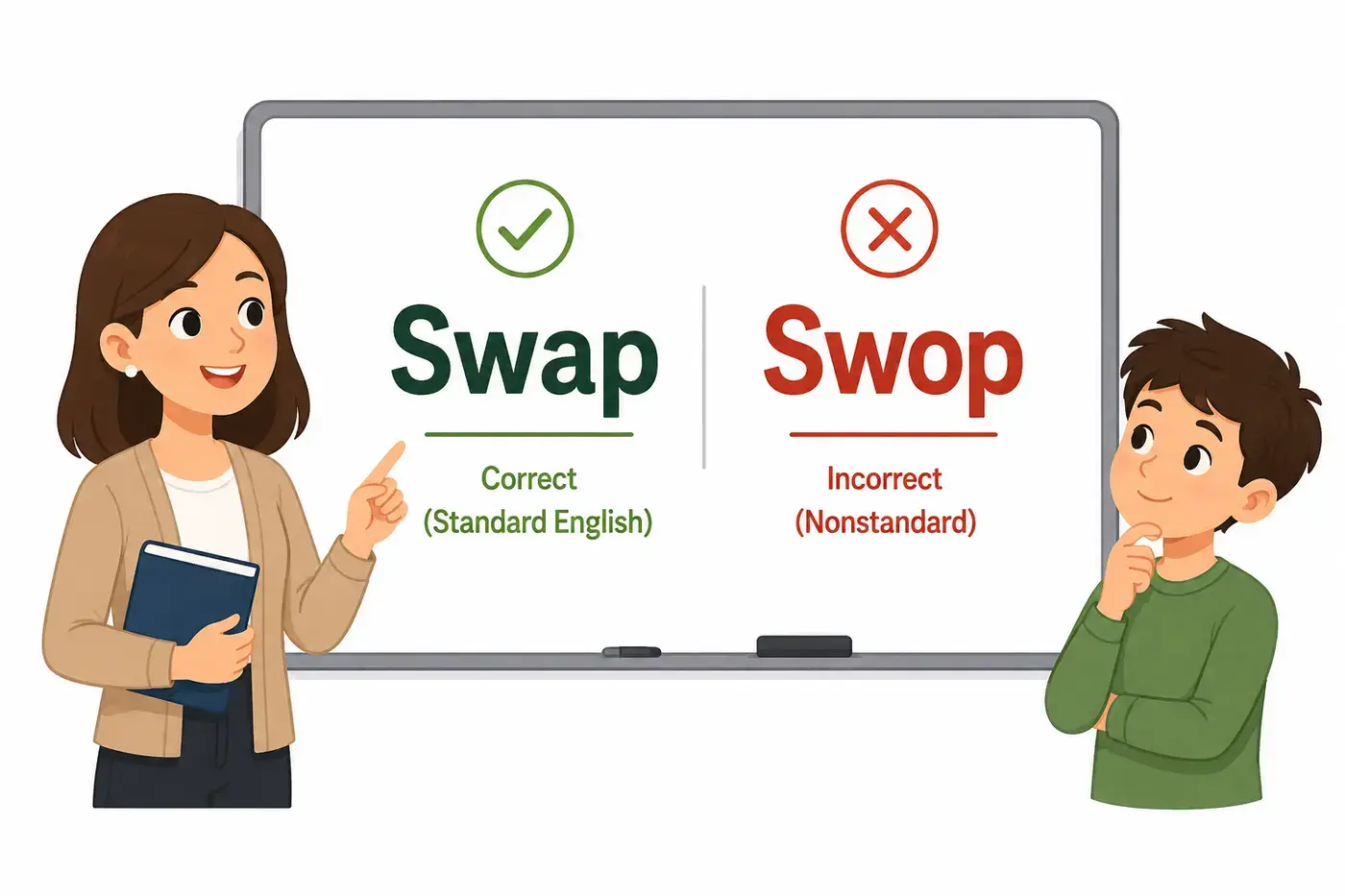
Swap vs Swop is a question that surprises many English learners and even native speakers. The two words look almost identical. They sound the same. Both describe the act of exchanging one thing for another. That naturally leads people to wonder if both spellings are correct or if one is simply a mistake.
The short answer is clear. Modern English overwhelmingly prefers swap. You will see it in dictionaries newspapers books business writing websites and everyday conversation. Swop has not disappeared completely but it belongs mostly to older British English and survives in limited contexts. Understanding the difference matters because spelling sends a message. Using the expected form makes your writing look polished and trustworthy. Choosing an outdated spelling can distract readers even if the meaning is still understood.
This guide explains the meaning of both words the history behind the spellings grammar rules pronunciation regional preferences real world examples common mistakes and practical tips that help you remember the correct choice every time.
Short Answer
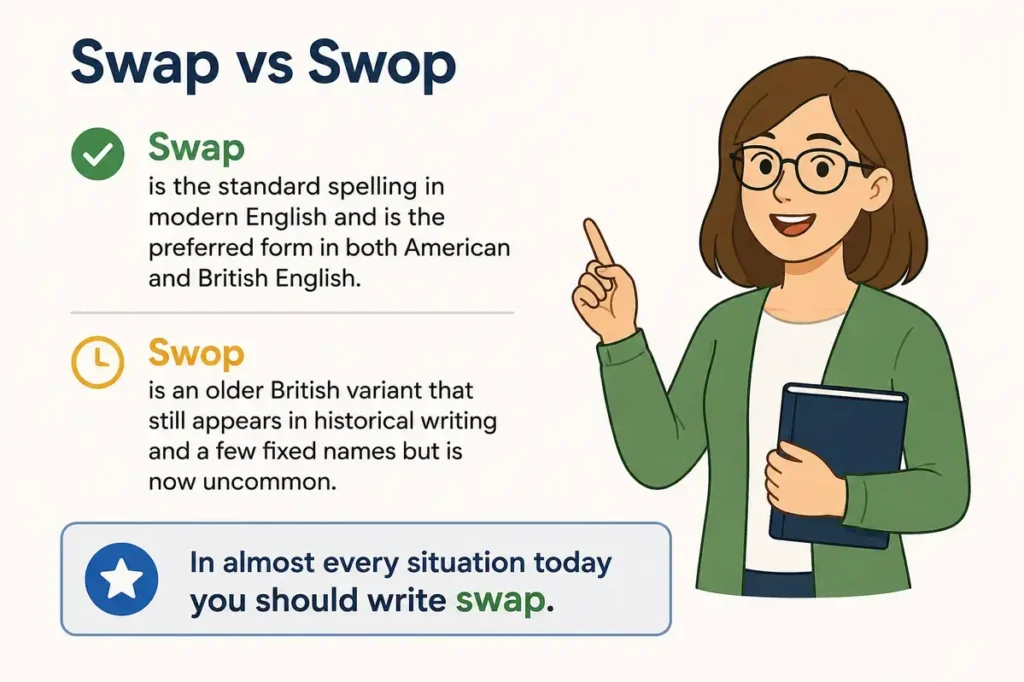
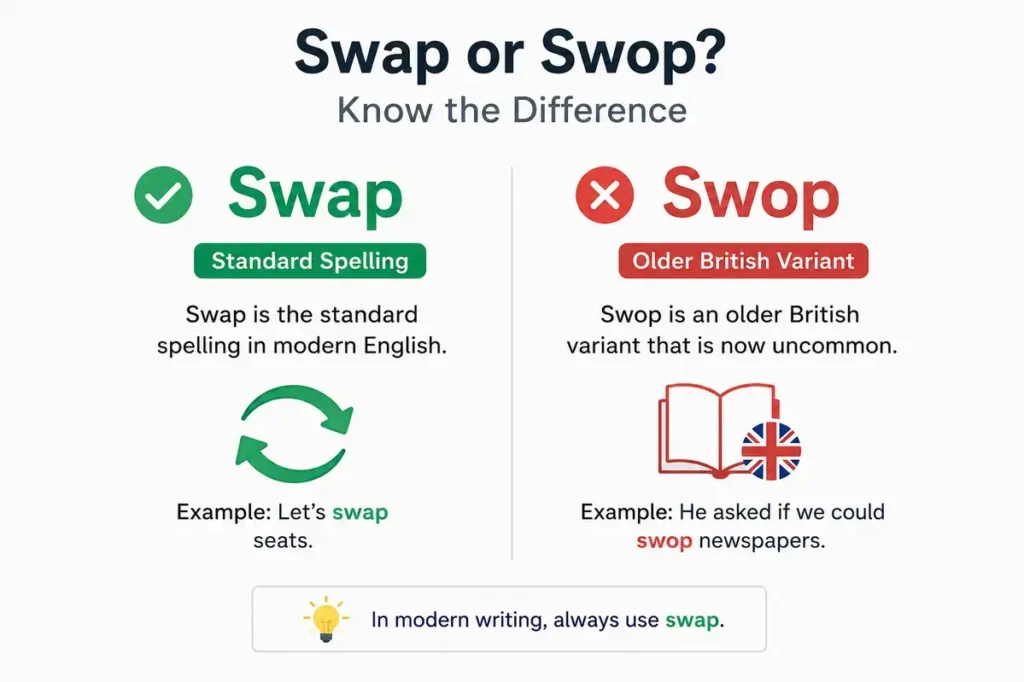
Swap is the standard spelling in modern English and is the preferred form in both American and British English. Swop is an older British variant that still appears in historical writing and a few fixed names but is now uncommon. In almost every situation today you should write swap.
Table Of Contents
- What Does Swap Mean.
- What Does Swop Mean.
- Swap Vs Swop At A Glance.
- Which Spelling Is Correct Today.
- Why Do Two Spellings Exist.
- American And British English Differences.
- Grammar Rules For Swap And Swop.
- Swap As A Verb.
- Swap As A Noun.
- Common Expressions With Swap.
- Real World Examples.
- Common Mistakes.
- Memory Tips.
- Related Grammar Notes.
- Frequently Asked Questions.
- Key Takeaways.
- Conclusion.
What Does Swap Mean
Swap means to exchange one thing for another. The exchange can involve physical objects ideas places jobs information or responsibilities. The key idea is that two people or groups trade something instead of giving it away permanently.
As a verb it describes the action of exchanging.
Examples.
We decided to swap seats before the movie started.
They swapped phone numbers after the meeting.
Can you swap shifts with me tomorrow.
As a noun it refers to the exchange itself.
Examples.
The classmates organized a book swap.
The toy swap helped families save money.
Our team made a player swap before the season began.
The meaning stays the same in everyday conversation business education sports and technology.
What Does Swop Mean
Swop carries the same meaning as swap. It also means to exchange one thing for another. The difference is not meaning. The difference is spelling and modern usage.
Today swop is considered an older spelling that appeared mainly in British English. It was much more common during the early and middle parts of the twentieth century. Over time swap became the preferred spelling across the English speaking world.
Modern dictionaries still recognize swop because it has historical value. That does not mean it is the best choice for current writing.
If you write for an international audience academic readers businesses publishers or online readers swap is almost always the expected spelling.
Swap Vs Swop At A Glance
| Feature | Swap | Swop |
|---|---|---|
| Meaning | Exchange something | Exchange something |
| Pronunciation | Same | Same |
| Modern English | Standard | Rare |
| American English | Standard | Almost never used |
| British English | Standard | Older variant |
| Business Writing | Preferred | Rare |
| Academic Writing | Preferred | Rare |
| Digital Content | Preferred | Rare |
| Dictionaries | Standard entry | Historical variant |
The table shows that the difference is about spelling preference rather than meaning.
Which Spelling Is Correct Today
For modern English the answer is simple.
Swap is the correct choice for almost every piece of writing.
Professional editors publishers journalists teachers and businesses almost always use swap. Major dictionaries list it as the primary spelling because it reflects current usage.
You may still come across swop in older books historical newspapers archived documents or a few British publications from earlier decades. Seeing it there does not make it wrong. It simply reflects the spelling conventions of another period.
Think of it as similar to older spellings that gradually faded as language became more standardized. English changes over time and spelling often changes with it.
If your goal is clear modern communication choose swap every time unless you are intentionally preserving historical language.
Why Do Two Spellings Exist
English spelling has never remained completely fixed. Many words have existed in more than one form before one spelling eventually became dominant. The history of swap and swop follows that pattern.
Early English writers often experimented with spelling because there was no single authority controlling written language. Regional pronunciation printing practices and personal habits influenced the words that appeared in books and newspapers. Both swap and swop developed as accepted spellings for the same spoken word. For many years readers could encounter either version without much confusion.
As dictionaries became more influential and publishing standards became more consistent one spelling slowly gained the advantage. That spelling was swap. Today publishers and style guides overwhelmingly recommend swap because it reflects modern English usage across different countries.
American And British English Differences
Many spelling questions come from genuine differences between American and British English.
Think about words like these.
| American English | British English |
|---|---|
| Color | Colour |
| Center | Centre |
| Organize | Organise |
| Traveler | Traveller |
Those are true regional spelling differences.
Swap and swop are different.
American English uses swap almost exclusively.
Modern British English also strongly favors swap.
Older British English used swop more often than American English did but that preference has faded over the years.
That means this is not really a modern American versus British spelling difference. Instead it is a difference between current English and historical English.
If you are writing for readers in the United States Canada Australia New Zealand Britain or an international audience swap remains the safest and most natural choice.
Why Modern Writers Prefer Swap
Professional editors value consistency. Readers also expect familiar spelling because familiar words are easier to process. Every unexpected spelling creates a tiny pause. That pause interrupts the reading experience.
Using swap keeps your writing smooth because readers instantly recognize it.
This matters in every type of content.
Academic papers.
Business emails.
Marketing copy.
News articles.
Blog posts.
Technical documentation.
Social media.
Books.
Professional writing succeeds when readers focus on the message instead of the spelling.
That is one reason swap became the dominant form.
Pronunciation
One interesting detail is that pronunciation does not help solve this spelling question. Both words are pronounced exactly the same.
Swap
Pronounced as.
SWOP.
The vowel sound matches words like top shop stop and crop in many accents. Because both spellings sound identical people sometimes assume both are equally common. Modern usage tells a different story. The pronunciation stayed the same while the preferred spelling gradually shifted toward swap.
Is Swop Wrong
Not exactly. Calling swop completely wrong would ignore its history. It appeared in respected British publications for many years and still appears in dictionaries as a recognized variant.
At the same time language changes. Modern English now treats swap as the standard spelling. That means swop feels old fashioned to many readers.
If your goal is clear modern communication choosing swap is the better decision. If your goal is historical accuracy or quoting an older source you may keep swop exactly as it originally appeared. That distinction explains why dictionaries continue to record the older spelling without recommending it for everyday writing.
Grammar Rules For Swap And Swop
The grammar behind swap is straightforward. Once you understand how the word works, using it becomes easy. Both swap and swop can function as verbs and nouns. The grammar does not change. Only the preferred spelling changes. In modern English, use swap in every grammatical form.
Examples.
I want to swap my ticket.
She swapped her laptop for a newer model.
We are swapping ideas during the meeting.
The card swap saved everyone money.
Each sentence follows normal English grammar. The word changes form just like many regular verbs.
Swap As A Verb
The most common use of swap is as a verb.
It describes the action of exchanging one thing for another.
Examples.
Can we swap seats.
The children swapped toys after lunch.
They swapped phone numbers before leaving.
Our neighbors swapped garden tools for the weekend.
In each example, two things are exchanged. Nothing is added or removed. One item replaces another.
You will often see swap followed by words like for or with.
Examples.
She swapped coffee for tea.
I swapped my afternoon shift with James.
Both patterns are correct. The sentence structure simply depends on what comes after the verb.
Swap As A Noun
Swap is also a noun.
As a noun, it refers to the exchange itself rather than the action.
Examples.
Our school held a book swap.
The clothing swap attracted hundreds of people.
The teams agreed to a player swap.
The company completed a stock swap.
Notice that swap stays singular or becomes plural like any regular noun.
Examples.
The neighborhood organized two swaps this year.
Several equipment swaps took place during the project.
Verb Forms Of Swap
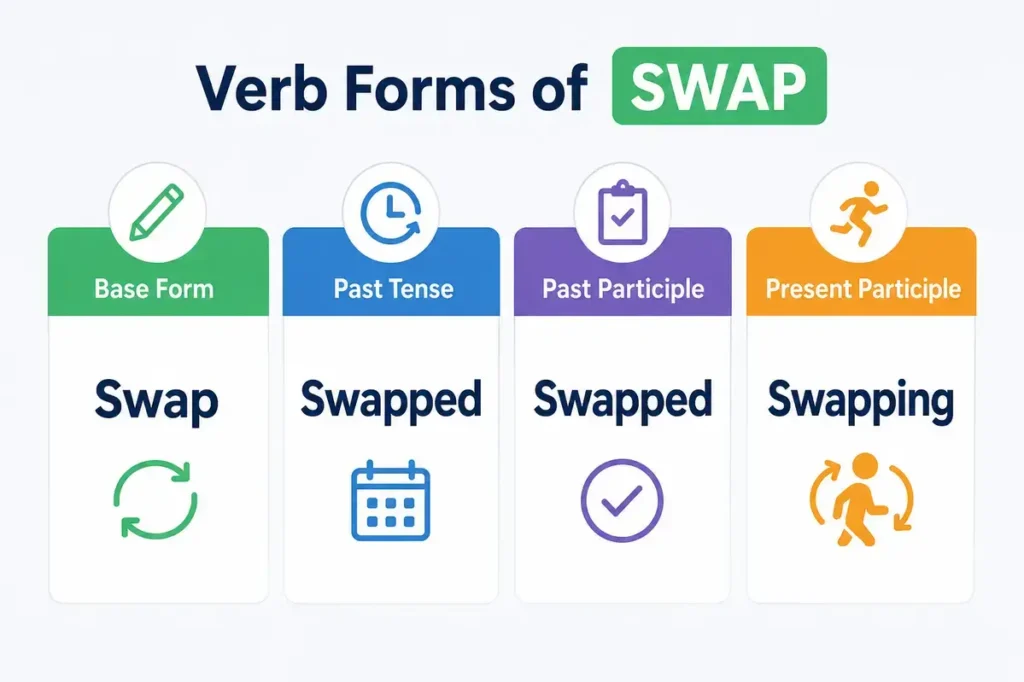
Like most regular English verbs, swap follows a predictable pattern.
| Base Form | Past Tense | Past Participle | Present Participle |
|---|---|---|---|
| Swap | Swapped | Swapped | Swapping |
Examples.
I swap books with my sister every month.
Yesterday we swapped offices.
They have swapped responsibilities.
She is swapping recipes with her friends.
Every form follows standard English spelling rules.
Common Sentence Patterns
Learning common sentence patterns makes the word feel natural.
Pattern One.
Swap something for something.
Example.
He swapped his old bicycle for a newer one.
Explanation.
The old bicycle was exchanged in return for another bicycle.
Pattern Two.
Swap something with someone.
Example.
I swapped seats with my brother.
Explanation.
Two people exchanged places.
Pattern Three.
Swap ideas.
Example.
The designers swapped ideas before starting the project.
Explanation.
Each person shared and exchanged thoughts.
Pattern Four.
Swap places.
Example.
The actors swapped places during rehearsal.
Explanation.
Each person moved into the other’s position.
These patterns appear every day in spoken and written English.
Common Expressions With Swap
The word swap appears in many familiar expressions.
Swap Places
Meaning.
Two people exchange positions.
Example.
The twins swapped places to surprise their teacher.
Explanation.
Each twin took the other’s place.
Swap Stories
Meaning.
Share experiences with each other.
Example.
We sat around the campfire and swapped stories.
Explanation.
Everyone took turns telling personal experiences.
Swap Ideas
Meaning.
Exchange opinions or suggestions.
Example.
The writers swapped ideas before outlining the article.
Explanation.
Each writer contributed different thoughts.
Swap Numbers
Meaning.
Exchange phone numbers.
Example.
They swapped numbers after the conference.
Explanation.
Each person received the other’s contact information.
Swap Roles
Meaning.
Exchange responsibilities or positions.
Example.
The managers swapped roles for one day.
Explanation.
Each manager experienced the other’s job.
Swap Files
Meaning.
Exchange digital documents.
Example.
The engineers swapped files before the presentation.
Explanation.
Each person shared important documents.
Real Life Examples
Seeing real situations makes the difference much easier to remember.
At School
Correct.
Can we swap desks for today’s project.
Explanation.
The students exchanged desks.
At Work
Correct.
The employees swapped shifts before the holiday weekend.
Explanation.
Each employee agreed to work the other’s schedule.
At Home
Correct.
My sister and I swapped bedrooms.
Explanation.
Each person moved into the other’s room.
In Sports
Correct.
The teams completed a player swap.
Explanation.
Players were exchanged between teams.
In Technology
Correct.
We swapped hard drives during the repair.
Explanation.
One hard drive replaced another.
In Daily Conversation
Correct.
Let’s swap jackets for fun.
Explanation.
Each person wore the other’s jacket.
These examples sound natural because modern English consistently uses swap.
Common Mistakes
Many writers make the same mistakes when using swap and swop. Recognizing them helps you avoid them.
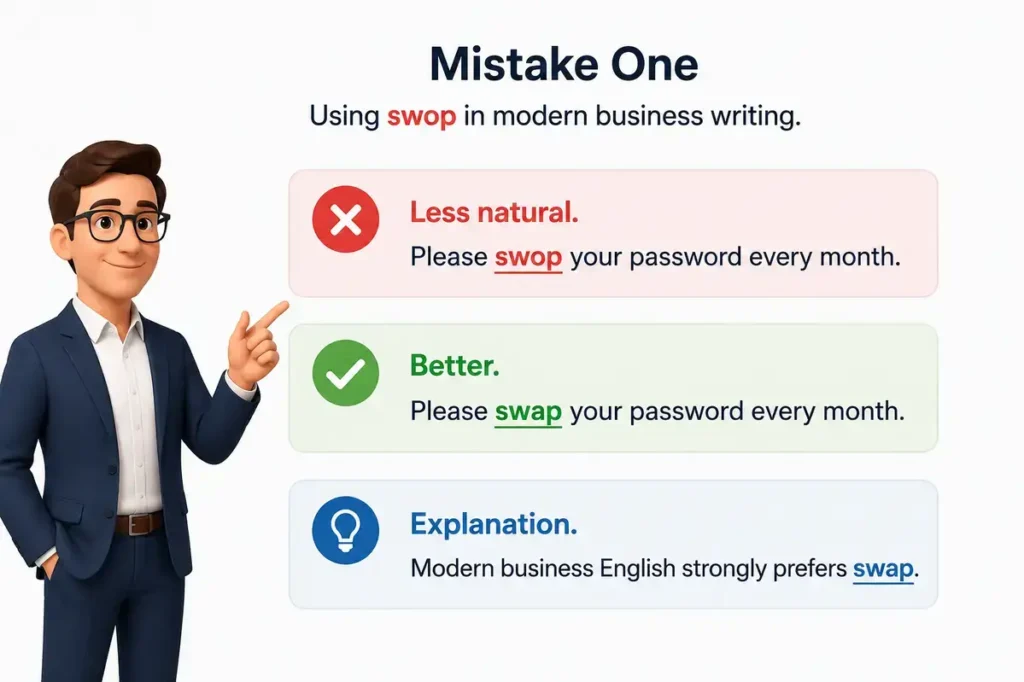
Mistake One
Using swop in modern business writing.
Less natural.
Please swop your password every month.
Better.
Please swap your password every month.
Explanation.
Modern business English strongly prefers swap.
Mistake Two
Thinking American English accepts swop.
Incorrect assumption.
American English almost never uses swop.
Use swap instead.
Mistake Three
Believing both spellings are equally common.
They are not.
Modern books, newspapers, websites, and professional publications overwhelmingly use swap.
Mistake Four
Assuming swop is a completely different word.
It is not.
Both words have the same meaning.
Only the preferred spelling has changed over time.
Mistake Five
Changing historical quotations.
Suppose an old British newspaper printed swop.
Do not modernize the quotation unless your style guide allows it.
Keep the original spelling because quotations should remain accurate.
Memory Tips
Simple memory tricks make the correct spelling stick.
Think About Everyday English
The words smartphone, workshop, teamwork, and laptop all appear in modern English.
Swap fits naturally beside today’s vocabulary.
It looks familiar because people see it every day.
Think About Technology
You often hear phrases like.
Swap files.
Swap memory.
Technology almost always uses swap.
That repeated exposure reinforces the modern spelling.
Remember The Letter A
The letter A appears in many common action words.
Pack.
Carry.
Pass.
Catch.
Swap.
Seeing the A helps connect the spelling with modern English.
Remember History
Think of swop as an old photograph.
It still exists.
People still recognize it.
Most people simply do not use it anymore.
That image makes the difference easy to remember.
Related Grammar And Usage Notes
Learning similar word pairs strengthens your understanding of English spelling patterns.
Adapt And Adopt
These words have different meanings.
Adapt means to adjust.
Adopt means to accept or take.
They are not interchangeable.
Advice And Advise
Advice is a noun.
Advise is a verb.
The spelling changes because the grammar changes.
Practice And Practise
American English uses practice for both noun and verb.
Traditional British English often uses practice as the noun and practise as the verb.
Unlike swap and swop, this difference still matters in modern British English.
License And Licence
American English uses license for both forms.
British English often uses licence as the noun and license as the verb.
Again, this remains an active regional distinction.
Swap And Exchange
These words are closely related.
Exchange sounds slightly more formal.
Swap sounds more conversational.
Examples.
We exchanged business cards.
We swapped baseball cards.
Both describe an exchange, but the tone changes slightly.
Does Swap Sound Informal
Many people assume swap belongs only in casual conversation.
That is not true.
The word appears comfortably in formal writing, business communication, journalism, education, finance, and technology.
For example.
The companies completed an asset swap.
The banks announced a currency swap.
The researchers swapped data sets. Professional writers choose swap because it is clear, direct, and widely understood.
Key Takeaways
- Swap is the standard spelling in modern English.
- Swop is an older British variant that is now uncommon.
- Both words have exactly the same meaning and pronunciation.
- American English uses swap almost exclusively.
- Modern British English also strongly prefers swap.
- Use swap in business writing, academic work, websites, emails, and everyday communication.
- Keep swop only when quoting historical material or preserving an original title or name.
- Choosing swap makes your writing look current, natural, and professional.
Final Verdict
If your question is Swap vs Swop, the answer is simple.
Use swap.
It is the spelling readers expect. It appears in modern dictionaries, newspapers, books, business documents, academic writing, websites, and everyday conversation across the English speaking world.
Swop is not a different word. It is an older spelling that gradually fell out of regular use. You may still see it in historical British publications, archived newspapers, or a few proper names, but those situations are exceptions rather than the rule.
Good writing is not about choosing unusual spellings. It is about communicating clearly. Using familiar language helps readers stay focused on your message instead of your word choice.
When you write an email, publish an article, complete an assignment, or create professional content, swap is the spelling that fits modern English.
Conclusion
The debate over Swap vs Swop is much simpler than it first appears. Both spellings share the same meaning and pronunciation, but they do not share the same place in modern English.
Today, swap is the standard spelling in American English, British English, and every major variety of modern English. It is the form used by publishers, educators, journalists, businesses, and professional editors because it matches current language standards and reader expectations.
Swop still has historical value. It reminds us that English spelling has changed over time and that older forms do not disappear overnight. You may encounter it in older books, archived newspapers, or original quotations, but those examples reflect the language of an earlier period rather than current usage.
For almost every situation, the best choice is swap. It is clear, familiar, and widely accepted. Using it helps your writing sound natural and professional while avoiding unnecessary distractions for your readers.
Remember one simple rule. If you are writing for today’s audience, choose swap. It is the spelling that belongs in modern English.
Frequently Asked Questions
Is Swap Or Swop Correct?
Swap is the correct spelling for modern English. It is the standard form in American English and modern British English. Swop is an older British spelling that still appears in historical sources and a small number of proper names.
Is Swop Still A Real Word?
Yes. Swop is a real word with historical use. Modern dictionaries still record it because it appeared in British English for many years. Even so, it is now rare and is not the preferred spelling for everyday writing.
Why Did Swop Become Swap?
English spelling gradually became more standardized. Over time, publishers, dictionaries, schools, and style guides favored swap. As a result, swap became the accepted spelling across the English speaking world.
Is Swop Wrong In British English?
Not completely. Older British writing often used swop. Today, British writers almost always choose swap, so using swop can make your writing look dated.
Do Swap And Swop Have Different Meanings?
No. Both words mean to exchange one thing for another. The only difference is the spelling and how commonly each form is used today.
How Do You Pronounce Swap And Swop?
Both words have the same pronunciation. They sound identical in normal speech, which is one reason people sometimes think both spellings are equally common.
Can I Use Swop In Academic Writing?
It is best to use swap. Academic writing follows modern spelling conventions, and swap is the expected form unless you are quoting an older source.
Which Spelling Should Students Learn?
Students should learn swap because it is the standard spelling used in schools, textbooks, dictionaries, exams, and professional writing.
Does Microsoft Word Accept Swop?
Some spell checkers and dictionaries still recognize swop because it is a historical variant. That does not mean it is the recommended spelling. In most situations, swap is still the better choice.
Is Swap Used In Computing?
Yes. Swap is a common technical term in computing. You will find expressions such as swap memory, swap file, swap space, and swap partition. These terms all use the modern spelling.

Confusing Words, Spelling & Word Choice
Claire Whitmore is a U.S.-based English editor who writes about commonly confused words, spelling differences, and word choice. Her work helps readers understand subtle distinctions between similar-looking words through simple definitions, practical examples, and modern usage guidance in both American and British English.