
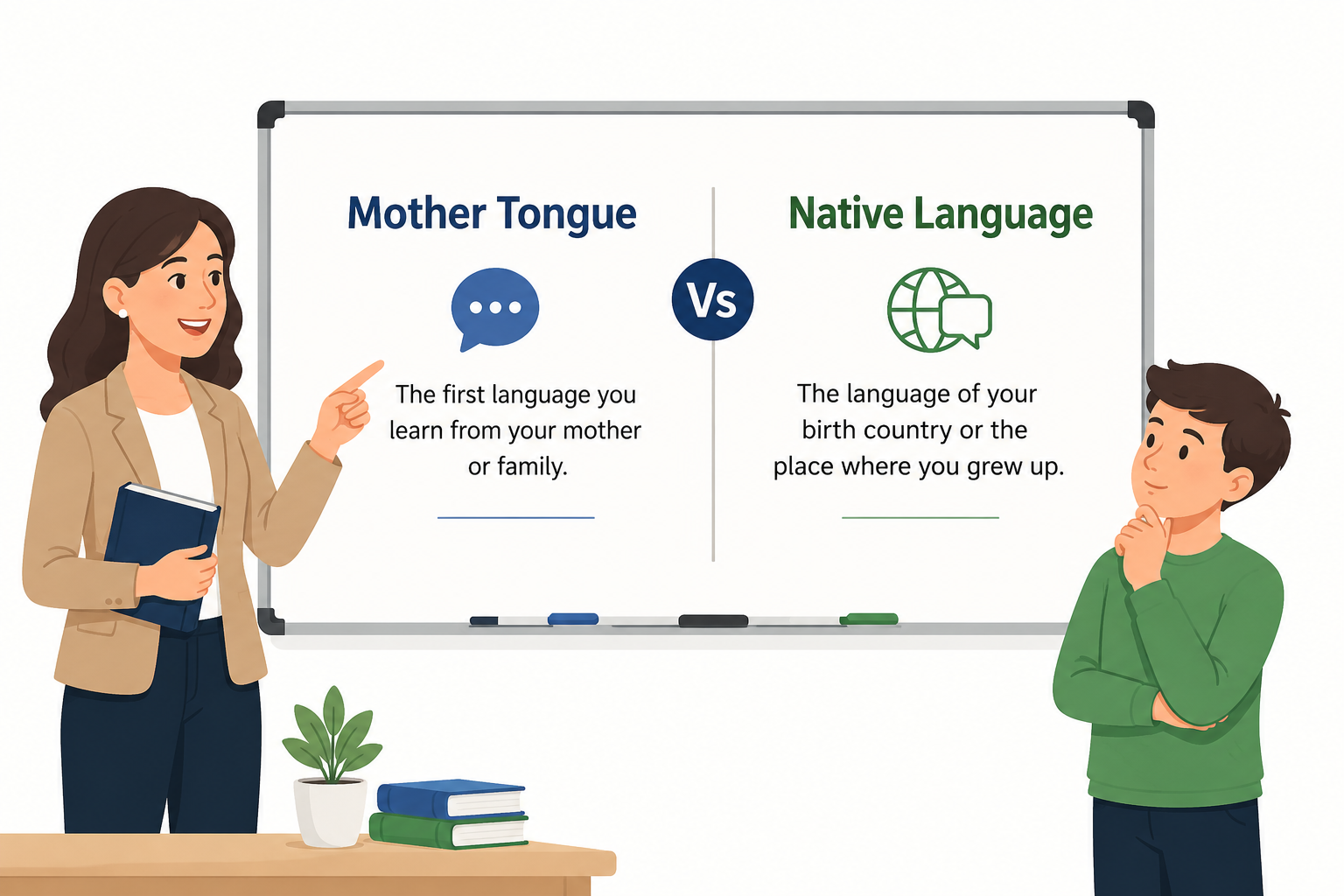
Mother Tongue vs Native Language is a comparison that confuses students writers teachers translators and even native English speakers. The two expressions appear in schools language learning books immigration forms research papers and everyday conversations. Since both seem to describe the first language a person learns many people assume they are completely interchangeable.
The reality is a little more nuanced. Language is deeply connected to family culture identity education and society. As families become more multilingual and children grow up hearing several languages at once the distinction between these expressions becomes more meaningful. A child might speak one language at home another at school and a third with friends. In situations like these choosing the right expression helps communicate your meaning more accurately.
This guide explains the difference in clear everyday English. You will learn what each term means how linguists use them where they overlap and when one expression works better than the other. You will also see practical examples common mistakes memory tips and professional writing advice. By the end you will know exactly which expression fits your sentence and why.
Short Answer
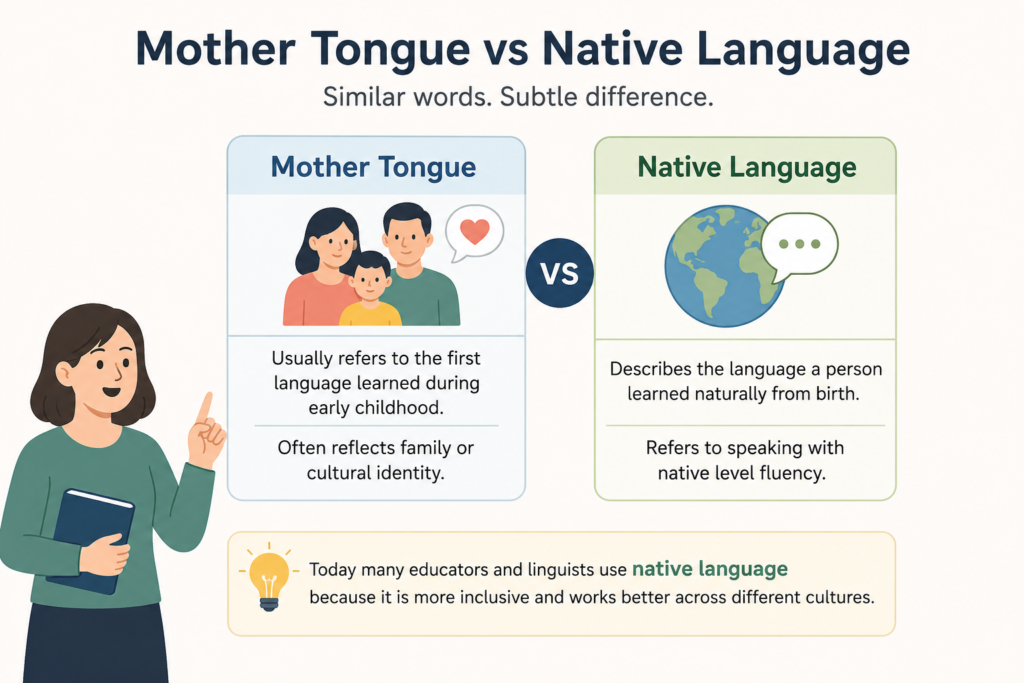
People often use Mother Tongue vs Native Language to mean the same thing. In many situations they do overlap. Still there is a subtle difference. Mother tongue usually refers to the first language learned during early childhood and often reflects family or cultural identity. Native language usually describes the language a person learned naturally from birth and speaks with native level fluency. Today many educators and linguists use native language because it is more inclusive and works better across different cultures.
Table Of Contents
- Short Answer.
- What Mother Tongue Means.
- What Native Language Means.
- Mother Tongue Vs Native Language Comparison.
- Are They Always The Same.
- Why The Difference Matters.
- Examples In Everyday English.
- Common Mistakes.
- Professional Writing Tips.
- Related Language Terms.
- Frequently Asked Questions.
- Key Takeaways.
- Conclusion.
What Does Mother Tongue Mean
Mother tongue refers to the first language a person learns during childhood. Traditionally it describes the language children acquire naturally from their parents or family members during their earliest years. Despite its name the expression does not literally mean a language learned only from a mother. It simply reflects an old way of describing the language first passed down within a family. For many people the mother tongue remains the language they know best throughout life. It often carries emotional value because it connects them to childhood traditions stories music and cultural identity.
Examples include.
- Spanish is Maria’s mother tongue because she learned it at home from infancy.
- My mother tongue is Arabic but I also speak English every day.
- Children often feel most comfortable expressing emotions in their mother tongue.
In everyday conversation these sentences sound natural and widely accepted.
What Does Native Language Mean
Native language describes a language someone learns naturally from birth or very early childhood. It focuses more on language acquisition and natural fluency than family heritage. Many modern linguists educators and government organizations prefer native language because it works well in multilingual societies and avoids assumptions about family structure. For example a child may hear English from one parent and French from another from the day they are born. Both languages can honestly be described as native languages.
Examples include.
- English is her native language.
- He writes like a native speaker because English is his native language.
- The survey asked participants to list their native language.
This expression is especially common in education language testing translation immigration and academic writing.
Mother Tongue Vs Native Language Comparison
The easiest way to understand the difference is to compare their focus.
| Feature | Mother Tongue | Native Language |
|---|---|---|
| Primary focus | Family and cultural background | Natural language acquisition |
| First learned language | Yes | Yes |
| Connected to identity | Strongly | Sometimes |
| Common in linguistics | Yes | Yes |
| Common in education | Yes | Very common |
| Used in official forms | Sometimes | Frequently |
| Can refer to multiple languages | Less often | More often |
| Common in modern research | Less common | More common |
The meanings overlap so much that people often use them interchangeably. The difference appears mainly when discussing multilingual families cultural identity or language acquisition.
Are Mother Tongue And Native Language Always The Same
No. For millions of people the two expressions describe exactly the same language. Someone raised in a home where only Italian was spoken would probably call Italian both their mother tongue and native language.
Life becomes more interesting in multilingual families.
Imagine a child growing up in Canada. One parent speaks Mandarin. The other speaks English. The child hears both languages every day from birth. Both can reasonably be described as native languages.
Now imagine another child whose parents speak Hindi at home but who starts speaking English almost exclusively after beginning school. That person may still consider Hindi their mother tongue because of family heritage while English eventually becomes the strongest language in daily life.
These situations explain why linguists sometimes distinguish between the two expressions instead of treating them as perfect synonyms.
Why The Difference Matters
Choosing the right term can make your writing clearer. If you are discussing family background cultural roots or heritage mother tongue often communicates the idea more naturally. If you are discussing language ability education language learning or fluency native language usually fits better.
Consider these examples.
Family identity.
My mother tongue is Korean because my family has spoken it for generations.
Language learning.
English is not my native language so I studied it for several years.
Academic research.
Participants reported their native language before completing the language assessment.
Cultural discussion.
Parents often hope their children continue speaking their mother tongue at home.
Each sentence sounds more precise because the expression matches the context.
Why Many Organizations Prefer Native Language
Over the past few decades many universities researchers and international organizations have gradually shifted toward using native language in formal communication.
Several reasons explain this trend. First it avoids implying that language comes mainly from the mother. Children often learn language from fathers grandparents siblings caregivers and entire communities. Second it better reflects multilingual childhoods. Millions of children grow up hearing two or even three languages from birth.
Third it focuses on language acquisition instead of family relationships. That does not make mother tongue incorrect. It remains widely accepted in education culture literature and everyday conversation. The choice depends on context rather than correctness.
Real Life Examples
These examples show how the expressions appear in natural English.
Example one.
My mother tongue is Portuguese but I learned English in college.
Explanation.
The speaker emphasizes family language and cultural background.
Example two.
English is not my native language so I sometimes make grammar mistakes.
Explanation.
The focus is language proficiency rather than family identity.
Example three.
The school encourages children to maintain their mother tongue while learning English.
Explanation.
This sentence highlights cultural preservation.
Example four.
Applicants should list their native language on the registration form.
Explanation.
Official documents often prefer native language because it is more neutral.
Example five.
Although French was his mother tongue he now speaks German every day.
Explanation.
The sentence distinguishes childhood language from current daily language.
Can Someone Have More Than One Mother Tongue
Yes. Modern linguistics recognizes that many children acquire two or more languages naturally from infancy.
For example a child raised by a Japanese speaking parent and a Spanish speaking parent may learn both languages at the same time. Neither language comes first in any meaningful way. Many researchers describe both as mother tongues or native languages because they develop naturally during early childhood. This reflects how multilingual families live today rather than older assumptions about learning only one first language.
Grammar Behind Mother Tongue And Native Language
Both expressions are noun phrases. They perform the same grammatical job in a sentence even though they describe language from slightly different perspectives.
Look at these examples.
My mother tongue is Turkish.
French is her native language.
In both sentences the expression works as the subject complement after the verb is.
They can also appear after different verbs.
She speaks her mother tongue at home.
He forgot much of his native language after moving abroad.
Both expressions function naturally because English treats them as standard noun phrases.
Pronunciation
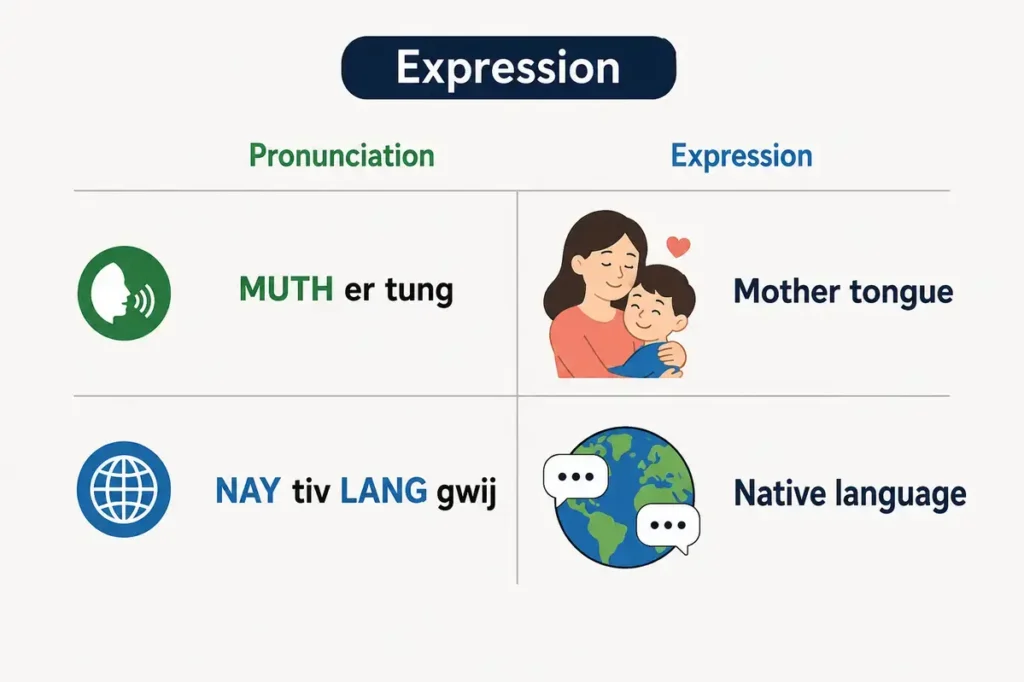
Understanding pronunciation helps learners recognize these expressions during conversations.
| Expression | Pronunciation |
|---|---|
| Mother tongue | MUTH er tung |
| Native language | NAY tiv LANG gwij |
Both expressions are easy to pronounce and commonly heard in classrooms universities workplaces and international meetings.
Word Origins
Knowing where these expressions came from makes their meanings easier to remember.
Origin Of Mother Tongue
Mother tongue is centuries old.
The expression appeared long before modern linguistics existed. Across many cultures people believed children learned language primarily from their mothers because mothers often spent the most time caring for young children. Over time the expression became a metaphor for the first language learned at home. It no longer literally refers to a mother. Instead it represents the language naturally passed from one generation to the next. Today people still use the expression because it carries strong cultural and emotional meaning.
Origin Of Native Language
Native comes from a Latin word meaning born. Native language therefore means the language someone acquires naturally from birth or early childhood. Unlike mother tongue this expression focuses on how a language develops rather than who teaches it. That difference explains why modern linguistics often prefers native language in academic research.
Mother Tongue Vs Native Language In Everyday English
Most native English speakers understand both expressions immediately. Still one may sound more natural than the other depending on the situation.
Talking About Family
Mother tongue usually sounds warmer and more personal.
My mother tongue is Bengali.
She teaches her children their mother tongue.
The focus is family heritage and cultural identity.
Talking About Language Ability
Native language often sounds more precise.
English is my native language.
His native language influences his pronunciation.
The focus is fluency and language development.
Talking About Education
Schools may use either expression. Some educational systems still say mother tongue education because the emphasis is preserving heritage languages. Others use native language instruction because it includes multilingual learners more easily.
Talking About Immigration
Government forms often ask for your native language. This wording is simple clear and widely understood across different cultures.
Mother Tongue Vs Native Language In American English
In the United States native language appears more often in education official documents language testing and professional writing. Mother tongue is still common but usually appears in conversations about culture identity bilingual families literature and heritage. If you are writing for an American audience native language often sounds slightly more modern and neutral.
Mother Tongue Vs Native Language In British English
British English accepts both expressions. Many schools universities and public organizations still use mother tongue especially when discussing multilingual education and cultural preservation.
Native language is also extremely common especially in research papers and language learning materials. There is no strict American British difference. The preference depends more on context than geography.
Formal And Informal Usage
Both expressions work in formal and informal English.
Informal Conversation
My mother tongue is Urdu. English is my native language. Both sound completely natural.
Formal Writing
Researchers examined how children develop literacy in their native language. Schools should support students who speak different mother tongues. Again the choice depends on what the writer wants to emphasize.
Which Expression Should You Use
Ask yourself one simple question. Are you talking mainly about cultural identity or natural language ability. If the focus is family culture traditions or heritage mother tongue usually communicates your meaning more clearly.
If the focus is language acquisition fluency education translation or official documentation native language is often the better choice. Neither expression is wrong. Good writers simply choose the one that best matches the situation.
Examples With Explanations
Example.
Spanish is my mother tongue.
Explanation.
The speaker emphasizes childhood family language.
Example.
Spanish is my native language.
Explanation.
The speaker emphasizes first language ability.
Example.
She wants her children to keep their mother tongue alive.
Explanation.
The focus is cultural identity across generations.
Example.
Applicants should indicate their native language.
Explanation.
Official forms prefer neutral wording.
Example.
His native language helped him learn Italian faster.
Explanation.
The discussion centers on language learning rather than family history.
Example.
Many grandparents enjoy telling stories in their mother tongue.
Explanation.
The emphasis is emotional connection and family tradition.

Common Mistakes
Many learners misunderstand these expressions because they seem almost identical. Here are the mistakes editors see most often.
Thinking One Is Correct And The Other Is Wrong
This is the biggest misunderstanding. Both expressions are correct. The difference comes from emphasis not grammar.
Assuming Mother Tongue Means Language Learned Only From Your Mother
It does not. The expression is historical. It simply refers to the first language learned during childhood.
Assuming Everyone Has Only One Native Language
Not anymore. Many children grow up bilingual from birth. Both languages can honestly be called native languages.
Mixing Heritage Language With Native Language
These expressions sometimes overlap but they are not always identical. Someone may inherit a family language but rarely speak it. In that case the heritage language may still be important culturally even if another language becomes dominant.
Professional Editing Tips
Professional editors usually look at context before choosing either expression. If an article discusses language learning native language often creates greater precision. If an article discusses identity family traditions or preserving culture mother tongue often creates a stronger emotional connection. Consistency also matters.
Avoid switching back and forth without a reason. Choose one expression that best fits your topic and stay consistent throughout your writing.
Memory Trick
A simple memory trick makes the distinction easy. Think of mother tongue as the language connected to your roots. Think of native language as the language connected to natural development. Roots remind you of family history. Natural reminds you of language acquisition. This small mental picture helps many learners remember the difference instantly.
Related Language Terms
Understanding nearby terms helps prevent confusion.
| Term | Meaning |
|---|---|
| First language | The earliest language learned during childhood |
| Native speaker | Someone who learned a language naturally from early childhood |
| Heritage language | A family language passed through generations |
| Second language | A language learned after the first language |
| Foreign language | A language mainly learned outside the local community |
| Bilingual | A person who uses two languages |
| Multilingual | A person who uses several languages |
These terms often appear together in language learning books research papers and educational materials.
Mother Tongue And Heritage Language
People often confuse these two expressions. They are related but not always identical. A heritage language is a language connected to family ancestry. A mother tongue is usually the first language learned naturally during childhood. Imagine parents who speak Greek at home but raise their child almost entirely in English.
Greek may become the child’s heritage language while English becomes the strongest native language used every day. Modern multilingual families make these situations increasingly common.
Mother Tongue And First Language
First language is another expression that frequently appears in linguistics. In many situations first language and native language mean exactly the same thing. Researchers often use first language because it sounds completely neutral and describes language acquisition without emphasizing culture or family.
You may see abbreviations like L1 for first language and L2 for second language in academic writing. These abbreviations are standard across linguistics language teaching and translation studies.
Why Context Always Matters
English contains many words that share similar meanings. Choosing the best one depends on the message you want readers to understand. Mother tongue highlights belonging. Native language highlights natural acquisition. First language highlights learning order.
Heritage language highlights ancestry. The differences may seem small at first. Still they help writers communicate with greater precision and confidence.
People Also Ask
Is Mother Tongue The Same As Native Language
Most of the time yes. Both expressions usually describe the first language learned during early childhood. The difference is in emphasis. Mother tongue often highlights family culture and identity. Native language usually highlights natural language acquisition and fluency.
Which Term Is More Common Today
Native language has become more common in education research translation and official documents. Mother tongue remains widely used in discussions about culture heritage literature and multilingual families.
Can Someone Have Two Native Languages
Yes.
Many children grow up hearing two languages from birth. If both develop naturally during early childhood both can be considered native languages.
Can Someone Have Two Mother Tongues
Yes.
Modern linguistics accepts that children raised bilingually from infancy may have two mother tongues. This situation is increasingly common around the world.
Is Mother Tongue Outdated
No.
The expression is still correct and widely understood. Some organizations simply prefer native language because it is more inclusive and focuses on language acquisition instead of family relationships.
Which Expression Should Students Use
Use the expression that best matches your purpose.
For school assignments about language learning native language is often the safest choice.
For discussions about culture family traditions or identity mother tongue may communicate your idea more naturally.
Mother Tongue Vs Native Language In Professional Writing
Professional writers rarely choose words by habit. They choose the expression that gives readers the clearest meaning.
Editors usually ask one simple question.
What is the article actually discussing.
If the topic is language learning testing translation pronunciation or education native language usually fits best.
If the topic is family heritage childhood traditions cultural preservation or identity mother tongue often creates a stronger connection.
This approach makes writing more precise without making it more complicated.
Examples From Everyday Life
These examples show how context changes the best choice.
A teacher says.
Please write your native language on the registration form.
The focus is collecting language information.
A parent says.
I want my children to keep their mother tongue.
The focus is preserving culture and family identity.
A researcher writes.
Children usually acquire their native language naturally during early childhood.
The focus is language development.
A community leader says.
Our festival celebrates every mother tongue spoken in our community.
The focus is cultural diversity.
Each sentence sounds natural because the expression matches the purpose.
How Translators View These Expressions
Professional translators know that these expressions are not always perfect substitutes.
Some languages have only one common expression for the first language learned in childhood.
Others clearly separate cultural identity from language ability.
Because of this translators always consider the audience before choosing the best English expression.
This is one reason native language appears frequently in international documents. It creates fewer cultural assumptions and works well across different countries.
Tips For Students And Writers
If you are still unsure which expression to use these simple guidelines can help.
- Use mother tongue when discussing family language culture traditions or identity.
- Use native language when discussing education language learning fluency translation or official documents.
- Stay consistent throughout your writing.
- Think about your audience before choosing one expression.
- Remember that both expressions are correct in standard English.
Key Takeaways
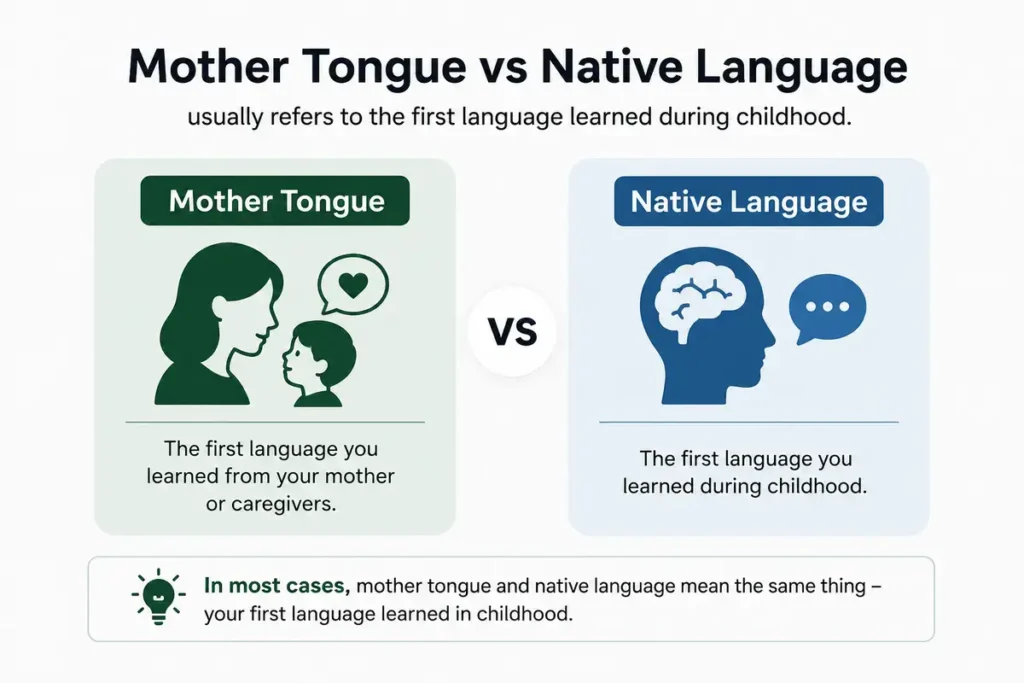
- Mother Tongue vs Native Language usually refers to the first language learned during childhood.
- Mother tongue emphasizes family culture heritage and identity.
- Native language emphasizes natural language acquisition and fluency.
- Both expressions are correct in standard English.
- Native language is more common in education research and official documents.
- Mother tongue remains popular in discussions about culture literature and family traditions.
- Many bilingual children have more than one native language or mother tongue.
- Context determines which expression communicates your meaning more clearly.
Conclusion
Mother Tongue vs Native Language is not a question of right or wrong. It is a question of emphasis. Both expressions usually describe the language learned during early childhood. The difference appears when you look more closely at what the speaker wants to highlight. Mother tongue points toward family heritage cultural identity and tradition. Native language points toward natural language development fluency and language acquisition.
That distinction has become more important as multilingual communities continue to grow around the world. Children today often learn two or more languages from birth. Families move across countries. Schools teach students from many linguistic backgrounds. As a result modern educators researchers and government organizations often prefer native language because it works well across different situations and cultures. Still mother tongue remains an important and respected expression. It carries emotional meaning that native language sometimes cannot fully capture. It reminds people of childhood conversations family stories songs traditions and the language that shaped their earliest experiences.
For most everyday writing you cannot go wrong with either expression. The best choice depends on your message. If you are discussing identity and heritage mother tongue is often the stronger option. If you are discussing education fluency translation or language learning native language is usually the clearer choice. Once you understand that simple distinction you can use both expressions naturally and confidently in conversation professional writing academic work and everyday communication.
Frequently Asked Questions
What Is The Difference Between Mother Tongue Vs Native Language?
Mother tongue usually emphasizes the language connected to family heritage and early childhood. Native language usually emphasizes the language naturally acquired from birth or early childhood. In many situations both expressions refer to the same language.
Which Expression Is Better In Academic Writing?
Native language is often preferred because it is more neutral and fits discussions about language acquisition education and research.
Is Mother Tongue Still Correct English?
Yes. It remains a standard English expression and appears in books schools newspapers and everyday conversation around the world.
Can My Native Language Change?
Generally no. Your native language is the language or languages acquired naturally during early childhood. You may become more fluent in another language later but that does not usually change your native language.
Can I Forget My Mother Tongue?
Yes. People who move to another country at a young age sometimes lose fluency in their first language through lack of regular use. Even then it may still be considered their mother tongue because it was their earliest language.
Is First Language The Same As Native Language?
In most situations yes. Many linguists use first language and native language interchangeably. Some prefer first language because it is completely neutral.
Why Do Some Forms Ask For Native Language Instead Of Mother Tongue?
Many organizations choose native language because it is clear internationally and better reflects multilingual families and different cultural backgrounds.
Which Expression Sounds More Natural In Everyday Conversation?
Both sound natural. The choice depends on context. Native language is common in conversations about learning languages. Mother tongue is common in conversations about family culture and heritage.
Do Native Speakers Use Both Expressions?
Yes. Both expressions are part of standard English and are understood by native speakers throughout the English speaking world.
Is One More Polite Than The Other?
No. Neither expression is more polite. They simply highlight different aspects of a person’s linguistic background.

Confusing Words, Spelling & Word Choice
Claire Whitmore is a U.S.-based English editor who writes about commonly confused words, spelling differences, and word choice. Her work helps readers understand subtle distinctions between similar-looking words through simple definitions, practical examples, and modern usage guidance in both American and British English.