
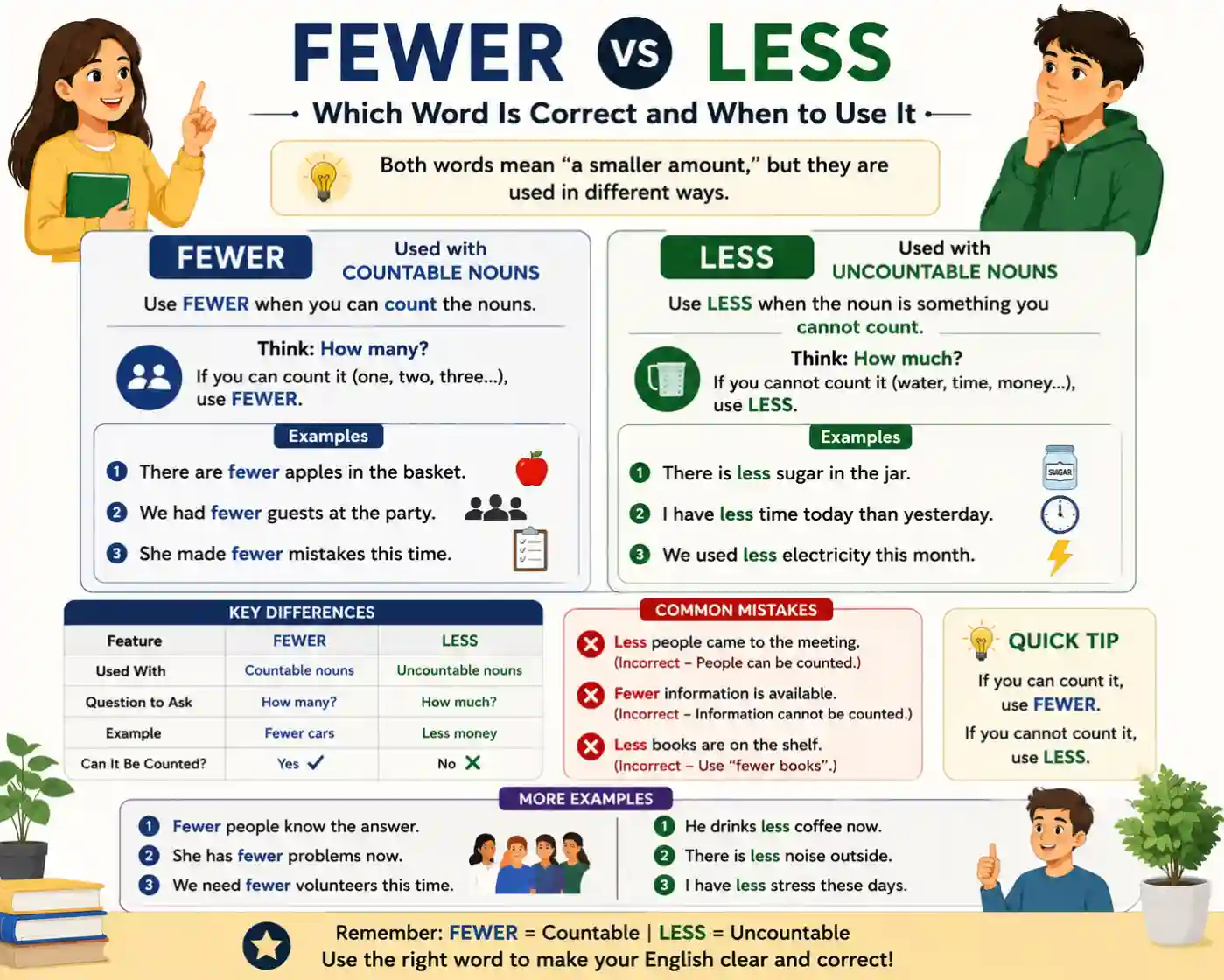
Fewer vs Less can confuse even experienced writers because both words refer to a smaller amount of something. They often appear in similar sentences, and many people use them interchangeably in everyday conversation. However, traditional English grammar gives each word a distinct purpose.
The easiest way to tell them apart is to ask one question. Can you count the individual items? If the answer is yes, use fewer. If the answer is no, use less. This simple guideline will help you avoid one of the most common grammar mistakes in English.
Modern English includes a few exceptions where less is accepted with numbers, measurements, time, and money. Understanding both the general rule and these exceptions will make your writing more accurate, natural, and professional.
Short Answer
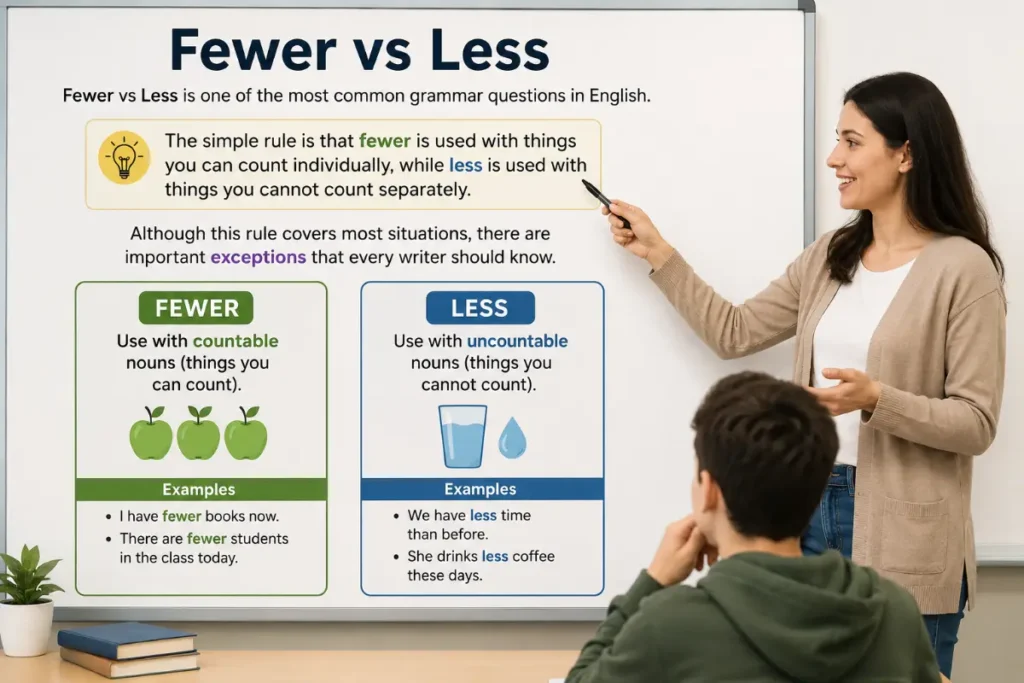
Fewer vs Less is one of the most common grammar questions in English. The simple rule is that fewer is used with things you can count individually, while less is used with things you cannot count separately. Although this rule covers most situations, there are important exceptions that every writer should know.
Table of Contents
- What Do Fewer and Less Mean
- Fewer vs Less Comparison Table
- The Main Grammar Rule
- When to Use Fewer
- When to Use Less
- Countable and Uncountable Nouns
- Real-Life Examples
- Common Mistakes
- Memory Tricks
- Professional Writing Tips
What Do Fewer and Less Mean
Although both words indicate a smaller quantity, they describe different types of nouns.
What Does Fewer Mean
Fewer is used with countable nouns.
Countable nouns are things you can count one by one.
Examples include:
- Books
- Apples
- Students
- Cars
- Chairs
- Cookies
- Phones
- Houses
Example:
- There are fewer students in class today.
Explanation:
You can count each student individually, so fewer is correct.
What Does Less Mean
Less is used with uncountable nouns.
Uncountable nouns cannot normally be counted as separate individual items.
Examples include:
- Water
- Milk
- Sugar
- Time
- Money
- Traffic
- Advice
- Information
Example:
- We have less time than yesterday.
Explanation:
Time is treated as one quantity rather than individual units.
Fewer vs Less Comparison Table
| Feature | Fewer | Less |
|---|---|---|
| Countable nouns | Yes | No |
| Uncountable nouns | No | Yes |
| Individual items | Yes | No |
| Quantities | Sometimes | Yes |
| Formal writing | Preferred | Preferred |
| Everyday conversation | Common | Very common |
The Main Grammar Rule
The easiest way to remember the difference is to ask one simple question.
Can I count the items individually?
If yes, use fewer.
If no, use less.
Examples:
- Fewer books.
- Fewer chairs.
- Fewer emails.
- Less water.
- Less patience.
- Less information.
This rule works correctly in most everyday situations.
Understanding Countable Nouns
Countable nouns have singular and plural forms.
Examples:
- One apple.
- Two apples.
- Ten apples.
Because each apple is counted individually, use fewer.
More examples:
- Fewer pencils.
- Fewer employees.
- Fewer mistakes.
- Fewer tickets.
- Fewer visitors.
- Fewer questions.
Example:
- We received fewer applications this year.
Explanation:
Each application is counted separately.
Understanding Uncountable Nouns
Uncountable nouns describe things viewed as a whole rather than individual pieces.
Examples:
- Air.
- Water.
- Happiness.
- Knowledge.
- Furniture.
- Rice.
- Bread.
- Music.
Because these nouns are treated as one quantity, use less.
Examples:
- Less water.
- Less traffic.
- Less homework.
- Less stress.
- Less energy.
- Less noise.
Example:
- We experienced less traffic this morning.
Explanation:
Traffic represents overall congestion, not individual vehicles.
When to Use Fewer
Choose fewer whenever you’re talking about things you can count.
Use it with:
- People.
- Animals.
- Objects.
- Events.
- Mistakes.
- Opportunities.
- Emails.
- Trees.
- Buildings.
- Coins.
Examples
- Fewer cars were parked outside today.
Explanation:
Cars can be counted individually.
- We made fewer mistakes this time.
Explanation:
Each mistake is countable.
- There are fewer cookies left.
Explanation:
Cookies are individual items.
- Fewer guests attended the wedding.
Explanation:
Each guest is counted separately.
- Our team completed fewer projects this month.
Explanation:
Projects are countable.
- The library bought fewer books this year.
Explanation:
Books are counted one by one.
- Fewer birds visited the garden.
Explanation:
Each bird represents one countable object.
- The company hired fewer employees.
Explanation:
Employees are individual people.
When to Use Less
Choose less for things treated as a whole amount.
Common examples include:
- Time.
- Water.
- Money.
- Sand.
- Work.
- Traffic.
- Fuel.
- Coffee.
- Electricity.
- Pollution.
Examples
- We need less sugar.
Explanation:
Sugar is treated as one substance.
- She spends less money now.
Explanation:
Money is viewed as one amount.
- We have less time today.
Explanation:
Time is considered one quantity.
- This car uses less fuel.
Explanation:
Fuel is uncountable.
- There is less pollution after the new law.
Explanation:
Pollution is not counted individually.
- He drinks less coffee now.
Explanation:
Coffee is treated as one substance.
- We experienced less stress after the deadline.
Explanation:
Stress is uncountable.
- They produce less waste.
Explanation:
Waste is viewed as one overall quantity.
Why People Confuse Fewer and Less
Several factors make these words confusing.
- Both describe smaller quantities.
- Both often appear before plural-looking expressions.
- Native speakers frequently use less in casual speech.
- Some exceptions break the standard grammar rule.
- Supermarkets and advertisements often use less where editors recommend fewer.
For example, many grocery stores display signs saying:
- 10 items or less.
Traditional grammar recommends:
- 10 items or fewer.
Despite this, the first version has become widely accepted in everyday English.
Real-Life Examples
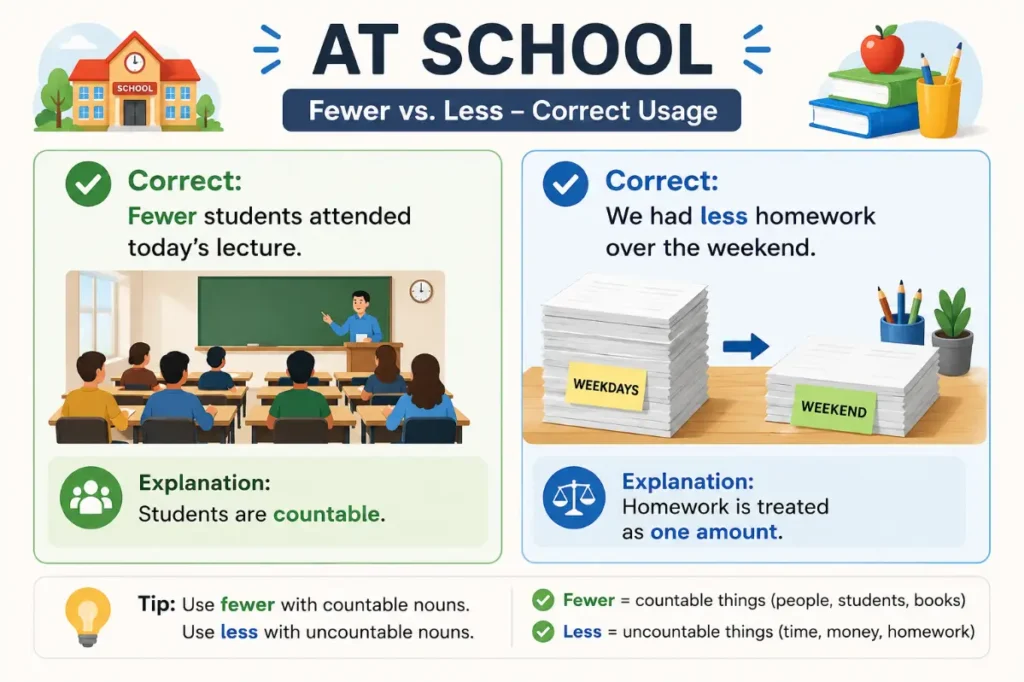
At School
Correct:
- Fewer students attended today’s lecture.
Explanation:
Students are countable.
Correct:
- We had less homework over the weekend.
Explanation:
Homework is treated as one amount.
At Work
Correct:
- The company received fewer complaints.
Explanation:
Each complaint can be counted.
Correct:
- Employees now spend less time in meetings.
Explanation:
Time is uncountable.
At Home
Correct:
- There are fewer dishes in the sink.
Explanation:
Each dish can be counted.
Correct:
- We use less electricity during the summer.
Explanation:
Electricity is an uncountable resource.
During Shopping
Correct:
- I bought fewer apples this week.
Explanation:
Apples are countable.
Correct:
- I spent less money than last week.
Explanation:
Money is viewed as one amount.
Common Mistakes
Many writers repeat the same grammar errors.
Mistake One
Incorrect:
- Less books.
Correct:
- Fewer books.
Reason:
Books are countable.
Mistake Two
Incorrect:
- Fewer water bottles of milk.
Correct:
- Less milk.
Reason:
Milk is uncountable.
Mistake Three
Incorrect:
- Less chairs.
Correct:
- Fewer chairs.
Reason:
Chairs can be counted.
Mistake Four
Incorrect:
- Fewer patience.
Correct:
- Less patience.
Reason:
Patience is an abstract, uncountable noun.
Mistake Five
Incorrect:
- Less employees.
Correct:
- Fewer employees.
Reason:
Employees are countable people.
Memory Tricks
These simple tricks make the rule easy to remember.
Trick One
Think of the letter F in Fewer.
F reminds you of Five.
If you can count to five, use fewer.
Example:
- Five books.
- Five apples.
- Five students.
Since you can count them, fewer is correct.
Trick Two
Think of Less as one large amount.
Examples include:
- Less water.
- Less sand.
- Less air.
- Less time.
You normally measure these rather than count them individually.
Trick Three
Ask yourself one question.
Can I count it one by one?
- Yes → Fewer.
- No → Less.
This simple question solves most grammar problems involving these words.
Professional Writing Tips
Editors and professional writers follow a few simple habits.
- Use fewer with countable nouns.
- Use less with uncountable nouns.
- Read your sentence aloud to check if the noun represents individual items or one overall quantity.
- Follow the traditional rule in academic, business, and professional writing.
- Remember that everyday speech sometimes ignores the rule, but careful writing usually follows it.
Using the correct word improves clarity, strengthens your grammar, and makes your writing sound more polished and professional.
Exceptions to the Rule
The basic rule works most of the time, but English has several well established exceptions. These exceptions often surprise learners because less is used even though a number appears in the sentence.
Understanding these exceptions will help you write naturally while still following standard grammar.
Time
Use less when referring to an amount of time.
Examples
- The meeting lasted less than an hour.
Explanation:
An hour is treated as one period of time.
- She finished the project in less than two weeks.
Explanation:
Two weeks represent one duration.
Money
Use less for amounts of money.
Examples
- The jacket costs less than fifty dollars.
Explanation:
Money is viewed as one amount.
- They spent less than one thousand dollars on the renovation.
Explanation:
The total amount of money matters, not the individual bills or coins.
Distance
Use less with measurements of distance.
Examples
- The hotel is less than five miles away.
- The airport is less than two kilometers from here.
Explanation:
The measurement is treated as one unit of distance.
Weight
Use less with measurements of weight.
Examples
- The package weighs less than ten pounds.
- This suitcase weighs less than twenty kilograms.
Explanation:
Weight is measured as a single quantity.
Percentages
Percentages often use less because they refer to part of a whole.
Examples
- Less than 20 percent of the students were absent.
- Less than half the population supported the proposal.
Explanation:
The percentage represents a portion rather than individual items.
Numbers That Represent One Quantity
Sometimes a plural noun follows a number, but the entire phrase acts as one amount.
Examples
- Less than five years.
- Less than ten dollars.
- Less than fifty miles.
- Less than three hours.
Although years, dollars, miles, and hours are countable nouns, they are treated as single measurements in these expressions.
Fewer and Less in Everyday Conversation
Native speakers do not always follow the traditional grammar rule.
For example, you may hear:
- There were less people at the party.
- I have less friends now.
These sentences are common in casual conversation, but they are considered incorrect in formal writing.
The preferred versions are:
- There were fewer people at the party.
- I have fewer friends now.
Fewer and Less in Formal Writing
Academic, business, legal, and professional writing usually follows the traditional distinction.
Use fewer with countable nouns.
Examples
- Fewer applicants met the requirements.
- The report contained fewer errors.
- We received fewer customer complaints.
Use less with uncountable nouns.
Examples
- Less evidence was available.
- The company used less energy.
- The project required less funding.
Following these conventions improves clarity and demonstrates strong grammar skills.
Pronunciation
Although their meanings differ, these words are easy to pronounce.
| Word | IPA | Simple Pronunciation |
|---|---|---|
| Fewer | /ˈfjuːər/ | FYOO er |
| Less | /les/ | LESS |
The pronunciation is straightforward, so confusion usually comes from grammar rather than speech.
Word Origin
Fewer
Fewer comes from the Old English word fēawe, meaning a smaller number.
For centuries, it has been linked with countable things.
Less
Less comes from the Old English word lǣssa, meaning smaller or not as much.
Its meaning naturally developed to describe quantities that are not counted individually.
Their different origins explain why English uses them with different types of nouns today.
American and British English
American and British English follow the same grammar rule.
Both recommend:
- Fewer with countable nouns.
- Less with uncountable nouns.
However, everyday speech in both varieties often uses less more broadly.
For example:
- Less people attended.
Many native speakers say this casually, but editors in both American and British English generally recommend:
- Fewer people attended.
Formal vs Informal Usage
Formal Writing
Choose the grammatically precise word.
Examples
- Fewer visitors entered the museum.
- Less water was wasted during the project.
Informal Conversation
People often use less in situations where fewer is technically correct.
Examples
- Less cars on the road today.
Although common in speech, careful writing should use:
- Fewer cars on the road today.
Common Expressions
Expressions with Fewer
- Fewer mistakes.
- Fewer people.
- Fewer opportunities.
- Fewer questions.
- Fewer visitors.
- Fewer choices.
- Fewer problems.
- Fewer interruptions.
Expressions with Less
- Less time.
- Less money.
- Less stress.
- Less work.
- Less traffic.
- Less noise.
- Less pollution.
- Less effort.
- Less information.
- Less experience.
These combinations appear frequently in everyday English.
Quick Practice Quiz
Choose the correct word before checking the answer.
1. We need ______ water.
Answer:
Less
Reason:
Water is uncountable.
2. There were ______ cars on the highway.
Answer:
Fewer
Reason:
Cars are countable.
3. She has ______ patience than before.
Answer:
Less
Reason:
Patience is an abstract, uncountable noun.
4. We received ______ applications this year.
Answer:
Fewer
Reason:
Applications are counted individually.
5. The trip took ______ than three hours.
Answer:
Less
Reason:
Time is treated as one amount.
6. There were ______ errors in the report.
Answer:
Fewer
Reason:
Errors are countable.
7. He drinks ______ coffee now.
Answer:
Less
Reason:
Coffee is an uncountable substance.
8. The team scored ______ goals this season.
Answer:
Fewer
Reason:
Goals can be counted one by one.
Related Grammar Notes
Many English word pairs cause confusion because they have similar meanings but different grammar rules.
Examples include:
- Farther vs Further.
- Affect vs Effect.
- Advice vs Advise.
- Then vs Than.
- Who vs Whom.
- Between vs Among.
- Much vs Many.
- Number vs Amount.
- Lay vs Lie.
- Each vs Every.
Learning these pairs together helps strengthen your grammar and improve your writing.
People Also Ask
Is it fewer people or less people?
Fewer people is correct because people are countable individuals.
Why do grocery stores say “10 items or less”?
The phrase has become common in everyday English, but many grammar experts recommend 10 items or fewer because items can be counted.
Can less ever be used with countable nouns?
Yes. Less is standard with measurements such as time, money, distance, and weight, even though numbers appear in the expression.
Which word is more common?
Less appears more frequently because it is used with many everyday quantities and in several common exceptions.
Do native English speakers always follow the rule?
No. Many native speakers use less with countable nouns in casual speech, but formal writing usually follows the traditional distinction.
Key Takeaways
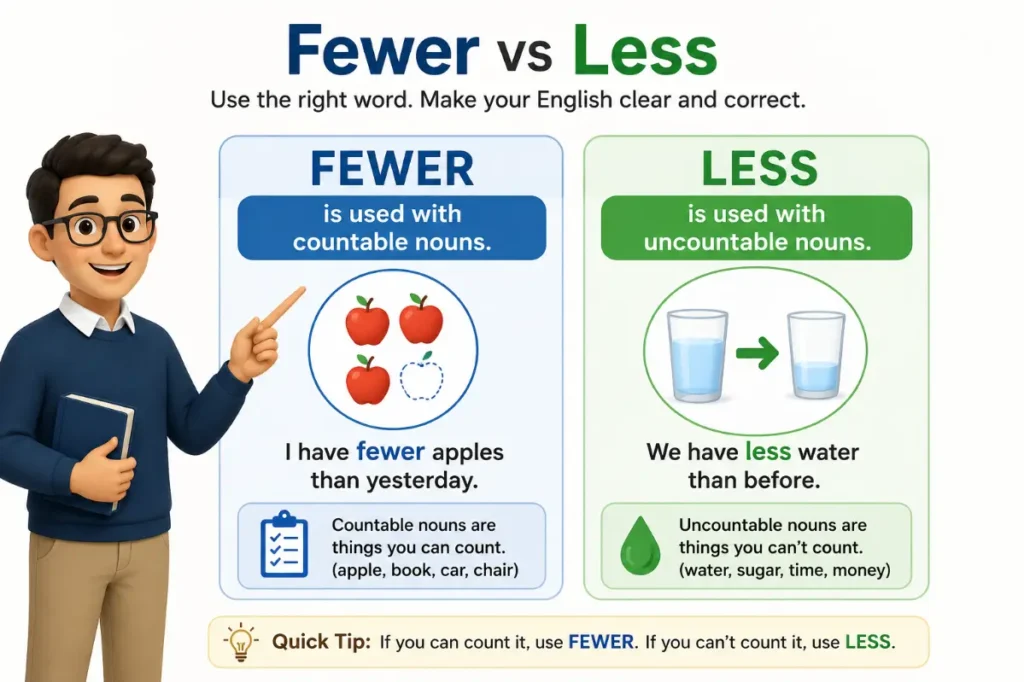
- Fewer is used with countable nouns.
- Less is used with uncountable nouns.
- Use less for time, money, distance, weight, and other measurements.
- Ask yourself if you can count the noun one by one.
- Academic and professional writing generally follows the traditional rule.
- Casual conversation is often more flexible, but precise writing benefits from choosing the correct word.
- Learning the common exceptions helps you sound more natural and confident.
Conclusion
Understanding Fewer vs Less is easier once you know the difference between countable and uncountable nouns. Use fewer for things you can count individually, such as books, people, or cars. Use less for things treated as one quantity, such as water, time, money, or information. While English includes a few well established exceptions for measurements and amounts, the basic rule applies in most situations.
Whenever you’re unsure, ask yourself one simple question: Can I count it one by one? If the answer is yes, choose fewer. If the answer is no, choose less. Following this habit will help you write with greater confidence, accuracy, and clarity in school, at work, and in everyday communication.
Frequently Asked Questions
What is the easiest way to remember Fewer vs Less?
Ask yourself if the noun can be counted one by one. If it can, use fewer. If it cannot, use less.
Is it fewer or less mistakes?
Fewer mistakes is correct because each mistake is an individual countable item.
Why is “10 items or less” so common?
It became popular through everyday usage and retail signs. Although widely understood, many editors still prefer 10 items or fewer.
Can I use less with numbers?
Yes. Less is correct when numbers represent measurements of time, money, distance, weight, or percentages.
Is less people grammatically correct?
In formal English, no. The correct phrase is fewer people because people are countable.
Do American and British English use the same rule?
Yes. Both varieties recommend fewer for countable nouns and less for uncountable nouns, although casual speech is often less strict.
Which word should I use in academic writing?
Follow the traditional grammar rule. Use fewer for countable nouns and less for uncountable nouns unless an accepted exception applies.
Can fewer be used with money?
Generally, no. Money is usually treated as one amount, so less money is the correct expression.
What are the most common exceptions?
The most common exceptions involve time, money, distance, weight, percentages, and measurements, where less is standard.
Does using the correct word really matter?
Yes. Choosing the correct word makes your writing clearer, more professional, and grammatically accurate, especially in formal and academic contexts.

Confusing Words, Spelling & Word Choice
Claire Whitmore is a U.S.-based English editor who writes about commonly confused words, spelling differences, and word choice. Her work helps readers understand subtle distinctions between similar-looking words through simple definitions, practical examples, and modern usage guidance in both American and British English.