
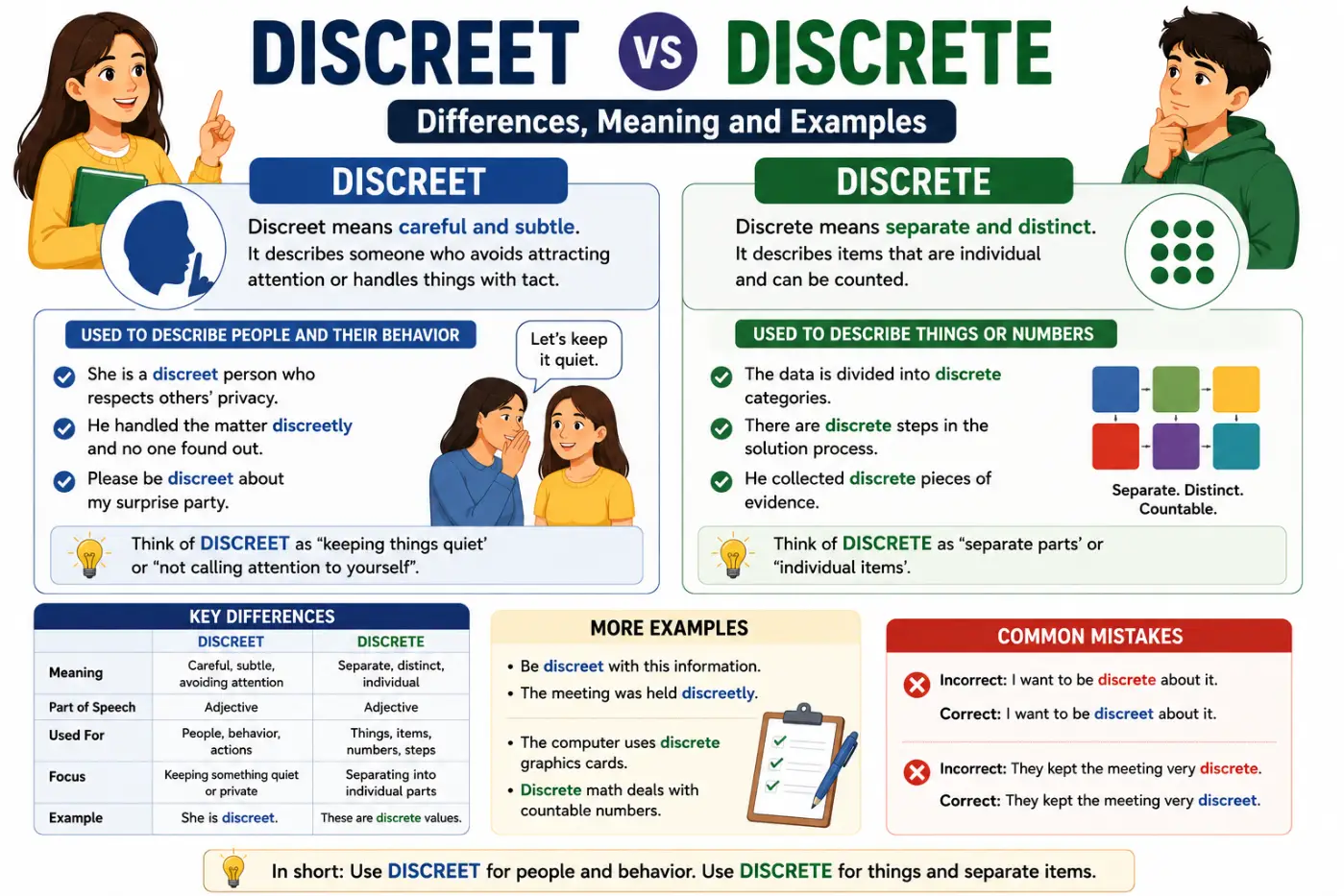
Discreet vs Discrete is one of the easiest word pairs to confuse in English. The spellings differ by only one letter, the pronunciations are very similar, and both appear frequently in academic writing, business communication, journalism, and everyday conversations.
Many English learners and native speakers accidentally write discrete information when they mean discreet information, or describe a person as discrete instead of discreet. Although spellcheck may catch some errors, it cannot always recognize which word fits your sentence because both are correct English words.
The good news is that once you understand their meanings, the difference becomes easy to remember. One word relates to privacy and careful behavior, while the other relates to things that are separate from each other.
Short Answer
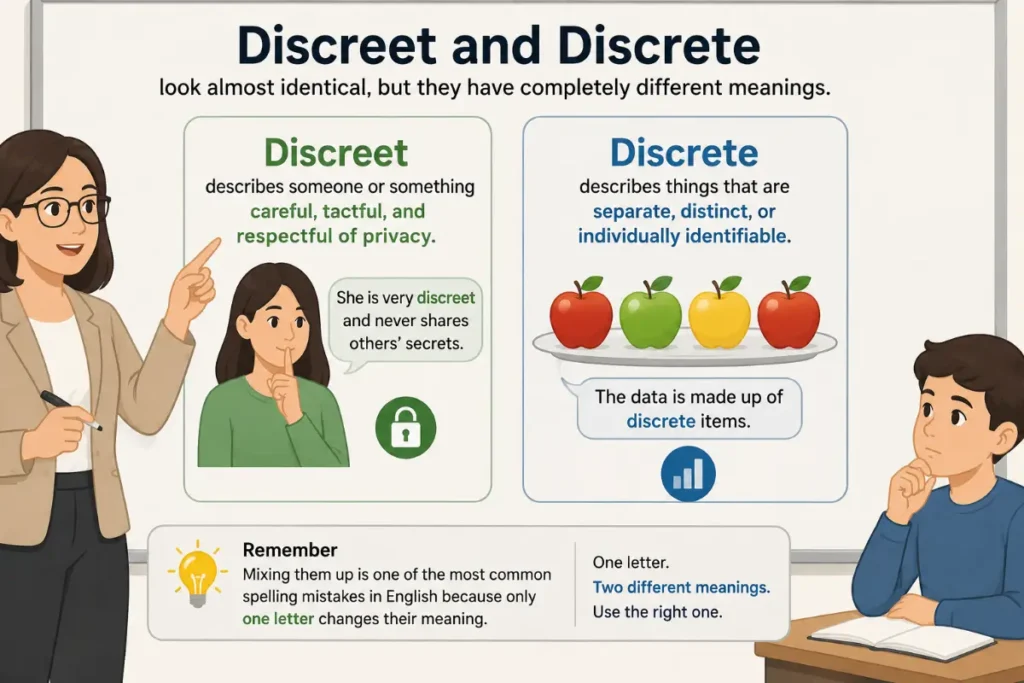
Discreet and discrete look almost identical, but they have completely different meanings. Discreet describes someone or something careful, tactful, and respectful of privacy. Discrete describes things that are separate, distinct, or individually identifiable. Mixing them up is one of the most common spelling mistakes in English because only one letter changes their meaning.
Table of Contents
- Short Answer
- What Does Discreet Mean
- What Does Discrete Mean
- Discreet vs Discrete Comparison Table
- The Main Differences
- Pronunciation Guide
- Word Origins
- Grammar Rules
- When to Use Discreet
- When to Use Discrete
- Sentence Examples
- Professional Writing Tips
- Common Mistakes
- Memory Tricks
- Related Grammar Notes
- Frequently Asked Questions
- Key Takeaways
- Conclusion
What Does Discreet Mean
Discreet is an adjective that describes someone or something that acts with caution, good judgment, tact, or respect for privacy.
A discreet person knows how to handle sensitive situations without drawing unnecessary attention. The word often appears when discussing confidential information, personal matters, diplomacy, customer service, journalism, healthcare, and professional communication.
Definition
Discreet means:
- Careful about what you say or do.
- Respectful of another person’s privacy.
- Tactful and thoughtful.
- Not likely to attract attention.
Examples
- She remained discreet about her friend’s personal problems.
Here, discreet means she respected someone’s privacy instead of sharing confidential details.
- The lawyer handled the case in a discreet manner.
This shows professional judgment and confidentiality.
- They chose a discreet entrance to avoid the cameras.
The entrance attracted very little attention.
- Our customer support team provides discreet assistance.
The company promises privacy and professional handling of sensitive issues.
- Please be discreet when discussing employee salaries.
The speaker asks others to avoid revealing private information.
Common Words That Pair With Discreet
Writers often use discreet with certain nouns because they naturally fit together.
| Discreet + Noun | Meaning |
|---|---|
| discreet conversation | private discussion |
| discreet service | confidential service |
| discreet inquiry | careful investigation |
| discreet assistance | private help |
| discreet location | hidden or quiet place |
| discreet reminder | gentle reminder |
| discreet behavior | tactful actions |
| discreet approach | careful method |
What Does Discrete Mean
Discrete is also an adjective, but it has an entirely different meaning.
It describes things that are separate, distinct, individual, or independent rather than connected together.
The word appears frequently in mathematics, computer science, engineering, statistics, economics, linguistics, education, and scientific writing.
Definition
Discrete means:
- Separate from something else.
- Distinct and individually identifiable.
- Independent rather than continuous.
Examples
- The study examined five discrete groups of participants.
Each group was separate from the others.
- The software contains several discrete modules.
Each module functions independently.
- The project consists of three discrete phases.
The problems are independent rather than connected.
5. The scientist analyzed discrete data points.
Each data point stands alone.
Common Words That Pair With Discrete
| Discrete + Noun | Meaning |
|---|---|
| discrete variables | separate mathematical values |
| discrete data | individual values |
| discrete units | separate components |
| discrete categories | distinct groups |
| discrete stages | independent phases |
| discrete system | system with separate parts |
| discrete signals | individual signals |
| discrete elements | separate pieces |
Discreet vs Discrete Comparison Table
| Feature | Discreet | Discrete |
|---|---|---|
| Meaning | Careful and private | Separate and distinct |
| Part of Speech | Adjective | Adjective |
| Used for | People, behavior, communication | Objects, ideas, numbers, groups |
| Common Context | Privacy, tact, confidentiality | Math, science, technology, organization |
| Opposite | Indiscreet | Continuous |
| Example | She was discreet. | The data is discrete. |
The Main Differences
Although only one letter separates these words, their meanings belong to completely different ideas.
Discreet Is About Privacy
Think of discreet whenever someone behaves carefully or respectfully.
Examples include:
- A nurse protecting patient information.
- A lawyer keeping client details confidential.
- A friend keeping a secret.
- A hotel offering discreet services.
- A manager discussing employee performance privately.
Every example involves caution, tact, or confidentiality.
Discrete Is About Separation
Think of discrete whenever individual parts remain separate.
Examples include:
- Separate chapters in a book.
- Independent departments within a company.
- Different categories in a survey.
- Individual computer files.
- Separate mathematical values.
Every example focuses on distinct parts instead of privacy.
Pronunciation Guide
Although they look similar, careful pronunciation helps distinguish them.
| Word | IPA | Simple Pronunciation |
|---|---|---|
| Discreet | /dɪˈskriːt/ | dih SKREET |
| Discrete | /dɪˈskriːt/ | dih SKREET |
Interestingly, both words are pronounced exactly the same.
That makes them homophones, which explains why they are so frequently confused in writing.
The only difference appears in spelling and meaning.
Are Discreet and Discrete Homophones
Yes.
Homophones are words that sound identical but have different spellings and meanings.
Other common homophones include:
| Word Pair | Difference |
|---|---|
| Their and There | Possession versus location |
| Brake and Break | Stop versus damage |
| Flour and Flower | Baking ingredient versus plant |
| Principal and Principle | Person versus rule |
| Discreet and Discrete | Private versus separate |
Because the pronunciation is identical, readers must rely entirely on context.
Word Origins
Learning where words came from often makes them easier to remember.
Origin of Discreet
Discreet comes from the Latin word discretus, meaning to separate or distinguish wisely. Over time, English speakers associated the word with good judgment, careful decisions, and tactful behavior. Eventually, its modern meaning centered on privacy and thoughtful communication.
Origin of Discrete
Discrete comes from the same Latin root but kept its original sense of separate or distinct. Mathematics and science later adopted the word to describe values, objects, or systems that remain individually separate. Although both words share the same historical origin, centuries of language development gave them very different meanings.
Grammar Rules
Both discreet and discrete are adjectives. That means they describe nouns.
Rule One
Use discreet to describe people, actions, conversations, services, behavior, or anything involving privacy.
Correct:
- She gave a discreet reply.
Here, the reply was careful and tactful.
Correct:
- The doctor remained discreet.
The doctor’s behavior respected confidentiality.
Incorrect:
She gave a discrete reply.
This incorrectly suggests the reply was separate rather than private.
Rule Two
Use discrete to describe separate objects, categories, units, groups, numbers, or stages.
Correct:
- The survey included four discrete categories.
Each category stands independently.
Correct:
- The engineer designed three discrete components.
The components are separate parts.
Incorrect:
The engineer designed three discreet components.
This incorrectly implies the components are private or secret.
When to Use Discreet
Choose discreet whenever your sentence involves:
- Privacy.
- Confidentiality.
- Diplomacy.
- Tact.
- Careful behavior.
- Professional judgment.
- Sensitive information.
- Avoiding attention.
Examples
- The receptionist spoke in a discreet voice.
She intentionally protected the guest’s privacy.
- We appreciate your discreet handling of customer complaints.
The employee treated customers respectfully and confidentially.
- He made a discreet exit after the meeting.
He left without attracting unnecessary attention.
- Our financial advisor offers discreet consultations.
Clients can discuss private financial matters safely.
- The detective conducted a discreet investigation.
The investigation remained hidden from public attention.
When to Use Discrete
Choose discrete whenever your sentence refers to:
- Separate parts.
- Individual units.
- Independent stages.
- Mathematical concepts.
- Scientific classifications.
- Technology.
- Data analysis.
- Distinct categories.
Examples
- The report contains six discrete sections.
Each section covers a different topic.
- The machine has four discrete components.
Each part performs a unique function.
4. The training program includes discrete learning modules.
Every module can be completed independently.
- The organization operates through several discrete departments.
Each department has its own responsibilities.
Real Life Examples of Discreet vs Discrete
Seeing both words side by side makes the difference much easier to remember.
| Correct Sentence | Why It Is Correct |
|---|---|
| The banker remained discreet about the client’s finances. | Privacy is involved. |
| The report contains five discrete sections. | The sections are separate. |
| Please be discreet during the interview. | Careful behavior is required. |
| The experiment measured discrete variables. | The variables are individual values. |
| She gave a discreet smile. | The smile was subtle and restrained. |
| The software has discrete functions. | Each function operates independently. |
Professional Writing Tips
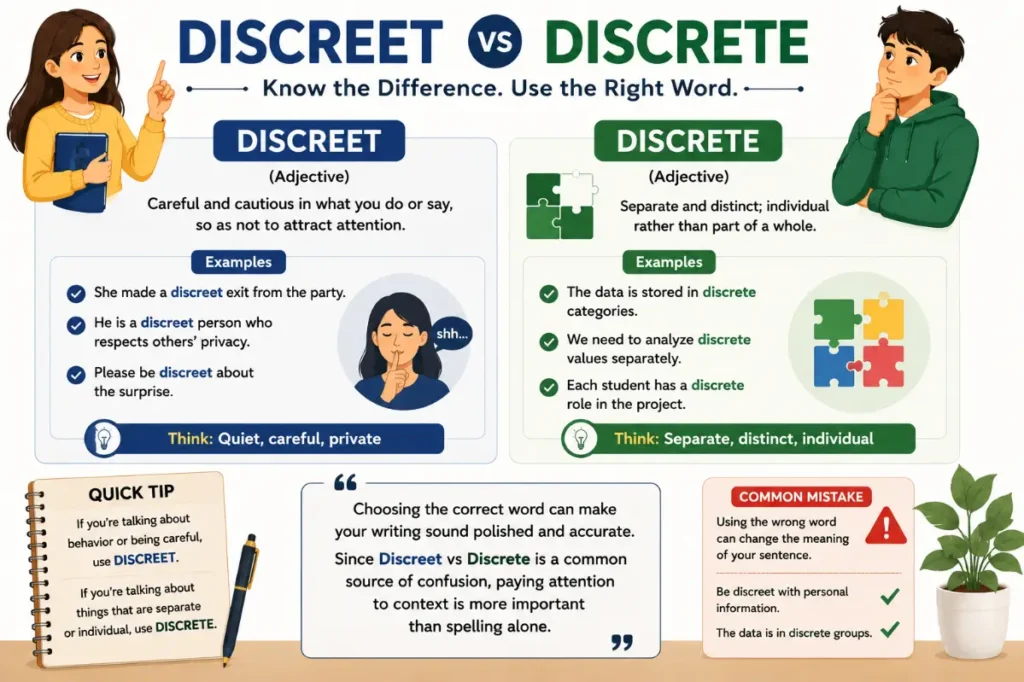
Choosing the correct word can make your writing sound polished and accurate. Since Discreet vs Discrete is a common source of confusion, paying attention to context is more important than spelling alone.
A simple question can usually help you decide.
Ask yourself:
- Am I talking about privacy or careful behavior?
If yes, use discreet.
Example:
The attorney remained discreet throughout the investigation.
The attorney protected confidential information and acted with professional judgment.
- Am I talking about separate or independent things?
If yes, use discrete.
Example:
The software consists of several discrete applications.
Each application works as an independent unit.
Professional editors often use this quick test because it eliminates almost every mistake.
Using Discreet in Business Writing
Business communication frequently involves confidential information. As a result, discreet appears much more often than discrete in emails, reports, customer service, and management.
Examples
- We offer discreet delivery for sensitive products.
Customers receive privacy during shipping.
- Our HR department handles complaints in a discreet manner.
Employee concerns remain confidential.
- The executive gave a discreet response to reporters.
The response avoided revealing private information.
- Please be discreet when discussing merger negotiations.
Sensitive company information should remain private.
- Customer records are managed with discreet care.
The emphasis is on confidentiality.
Using Discrete in Business Writing
Although less common, discrete appears when discussing systems, departments, projects, or processes.
Examples
- The organization has five discrete business units.
Each unit operates independently.
- The project contains three discrete phases.
Every phase has its own objectives.
- Marketing and accounting remain discrete departments.
Each department performs different functions.
4.The application includes several discrete security layers.
Each layer serves a different purpose.
Using Discreet in Academic Writing
In humanities, psychology, communication, sociology, education, and law, discreet usually describes behavior rather than objects.
Examples
- Teachers should remain discreet when discussing student records.
Student privacy is protected.
- Researchers handled participant identities in a discreet manner.
Confidential information remained secure.
- Counselors must be discreet with personal information.
Professional ethics require confidentiality.
- Journalists should exercise discreet judgment when protecting anonymous sources.
Responsible reporting respects privacy.
- Healthcare workers are expected to remain discreet.
Medical information is confidential.
Using Discrete in Academic Writing
Science, engineering, mathematics, economics, linguistics, and computer science use discrete regularly.
Examples
- The experiment measured discrete variables.
Each variable represents an individual value.
- The language contains discrete sound units.
Each location is separate.
3.The graph displays discrete values instead of continuous measurements.
Individual numbers appear rather than uninterrupted values.
- The professor explained discrete probability distributions.
The probabilities involve separate outcomes.
Using Discreet in Everyday Conversation
Although people rarely discuss grammar, they frequently use discreet without realizing it.
Examples
- She gave me a discreet signal across the room.
The signal avoided attracting attention.
- He asked a discreet question.
The question respected someone’s privacy.
- They found a discreet restaurant for their meeting.
The location offered privacy.
- She wore a discreet necklace.
The jewelry was elegant without being flashy.
- Please be discreet around the children.
The speaker asks for careful behavior.
Using Discrete in Everyday Conversation
Outside technical subjects, discrete appears less frequently but still has many practical uses.
Examples
- The vacation included three discrete destinations.
Each destination was separate.
- Their house has discrete living spaces.
The spaces are independent.
- We divided the project into discrete tasks.
Every task can be completed separately.
- The recipe has several discrete steps.
Each step follows independently.
- The museum contains discrete exhibition rooms.
Each room displays different collections.
Common Mistakes
Because both words sound exactly alike, writers often substitute one for the other.
Here are the mistakes that appear most often.
Mistake One
Incorrect:
The lawyer remained discrete about the case.
Correct:
The lawyer remained discreet about the case.
The sentence describes careful behavior and confidentiality.
Mistake Two
Incorrect:
The project has three discreet stages.
Correct:
The project has three discrete stages.
The stages are separate parts.
Mistake Three
Incorrect:
Please keep these documents discrete.
Correct:
Please keep these documents discreet.
The request concerns privacy.
Mistake Four
Incorrect:
The report contains six discreet sections.
Correct:
The report contains six discrete sections.
The sections are separate.
Mistake Five
Incorrect:
She made a discrete phone call.
Correct:
She made a discreet phone call.
The phone call was private.
Why People Confuse These Words
Several reasons explain why these words cause so many mistakes.
- They differ by only one letter.
- Their pronunciation is identical.
- Both are adjectives.
- Both come from the same Latin root.
- Spellcheck often fails because both words are correctly spelled.
- Many people learn them through reading instead of formal grammar instruction.
Memory Tricks
Simple memory tricks can help you remember the difference for life.
Trick One
Discreet has two Es.
Think of the two Es as standing for Extra Care.
Extra Care means privacy, caution, and tact.
Example:
A discreet doctor protects patient information.
Trick Two
Discrete contains the word crest without the second e.
Think of separate mountain peaks.
Each peak stands alone.
Just like discrete objects.
Trick Three
Remember these short phrases.
Discreet equals careful.
Discrete equals separate.
This works almost every time.
Trick Four
Imagine two situations.
A lawyer protecting a client’s secrets.
Think discreet.
Five independent computer files.
Think discrete.
Quick Test
Fill in the blank before checking the answers.
- The company promised ______ customer service.
- The study analyzed five ______ variables.
- Please remain ______ during the discussion.
- The machine contains several ______ parts.
- She made a ______ request.
Answers
- discreet
Customer privacy is involved.
- discrete
The variables are separate.
- discreet
The behavior should be careful.
- discrete
The parts are independent.
- discreet
The request was private or tactful.
Related Grammar and Usage Notes
Learning similar word pairs helps strengthen your vocabulary.
Affect vs Effect
Affect usually functions as a verb.
Effect usually functions as a noun.
Example:
The weather affected attendance.
The effect was noticeable.
Complement vs Compliment
Complement means something completes another thing.
Compliment means praise.
Example:
Her shoes complement the dress.
He paid her a compliment.
Principal vs Principle
Principal refers to a person or primary thing.
Principle means a rule or belief.
Example:
The principal welcomed new students.
Honesty is an important principle.
Stationary vs Stationery
Stationary means not moving.
Stationery refers to writing materials.
Example:
The train remained stationary.
She bought elegant stationery.
Like Discreet vs Discrete, these pairs look similar but have completely different meanings.
Advanced Grammar Notes
Both words function only as adjectives.
They cannot normally be used as verbs.
Correct:
The manager was discreet.
Correct:
The departments are discrete.
Neither word changes its spelling between American and British English.
Both forms are identical in the United States, Canada, Australia, and the United Kingdom.
The meaning also remains the same across all major English dialects.
Real Life Examples
Workplace
The CEO gave a discreet answer during the interview.
The CEO avoided revealing confidential information.
The company consists of four discrete divisions.
Each division operates independently.
School
The teacher remained discreet about the student’s grades.
Student privacy was protected.
The course includes several discrete learning units.
Each unit covers a different topic.
Healthcare
Doctors must remain discreet when discussing medical records.
Medical ethics require confidentiality.
The treatment plan contains several discrete stages.
Each stage builds on the previous one while remaining clearly defined.
Technology
Engineers created discrete circuits for the prototype.
Each circuit performs a separate function.
Support staff handled the complaint in a discreet manner.
The customer’s personal information remained protected.
Daily Life
She chose a discreet perfume.
The scent was subtle rather than overpowering.
The apartment has discrete storage areas.
Each storage space serves a different purpose.
Practice Exercise
Choose the correct word.
- The detective conducted a ______ investigation.
Answer: discreet
The investigation avoided public attention.
- The software includes several ______ modules.
Answer: discrete
Each module works independently.
- The nurse remained ______ throughout the conversation.
Answer: discreet
The nurse protected patient privacy.
- The report divides the information into ______ sections.
Answer: discrete
The sections are separate.
- Please be ______ when discussing family matters.
Answer: discreet
The speaker asks for tact and confidentiality.
Key Takeaways
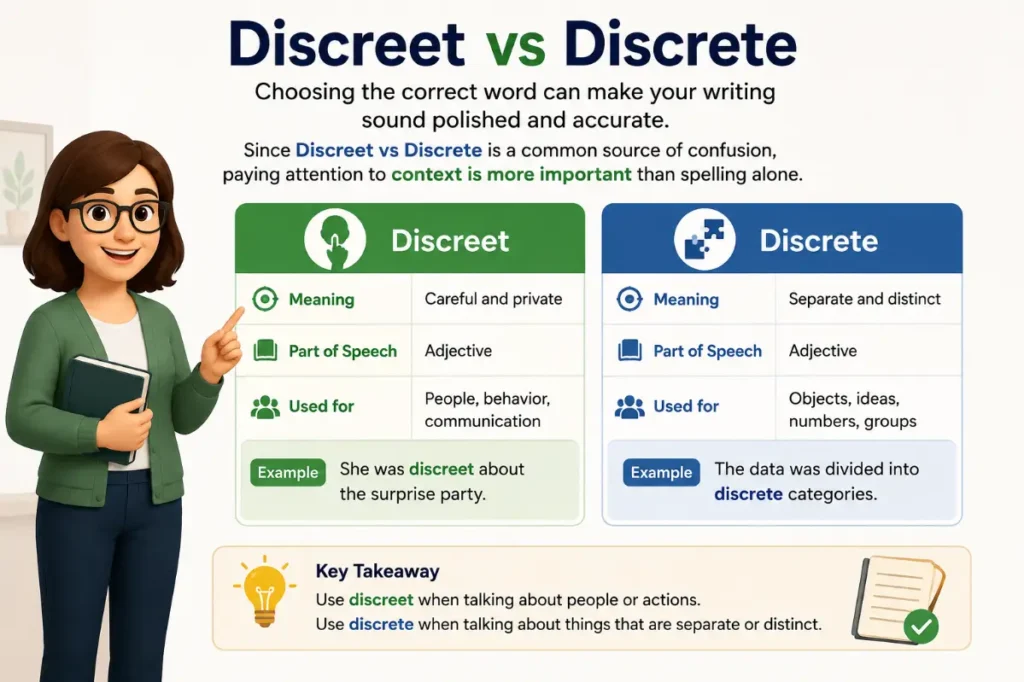
- Discreet means careful, private, tactful, or respectful of confidentiality.
- Discrete means separate, distinct, or independent.
- Both words are adjectives.
- Both words are pronounced exactly the same.
- They are homophones but not synonyms.
- Use discreet for people, conversations, behavior, services, and confidential situations.
- Use discrete for groups, categories, numbers, systems, stages, variables, and independent parts.
- If your sentence involves privacy, choose discreet.
- If your sentence involves separation, choose discrete.
- Remember the shortcut:
Conclusion
Although Discreet vs Discrete differs by only one letter, the meanings are entirely different. Discreet describes careful, tactful, and private behavior, while discrete refers to things that are separate, distinct, or individually identifiable.
The easiest way to choose the correct word is to focus on the context. If your sentence involves confidentiality, good judgment, or avoiding unnecessary attention, discreet is the right choice. If it describes separate categories, independent parts, stages, variables, or systems, discrete is the correct word.
Because both words are pronounced the same, they are easy to confuse in writing. Taking a moment to think about the meaning instead of the spelling can prevent one of the most common vocabulary mistakes in English.
Frequently Asked Questions
1. What is the difference between Discreet vs Discrete?
The difference is simple. Discreet means careful, private, or tactful, while discrete means separate, distinct, or independent. Use discreet when talking about confidentiality or good judgment. Use discrete when talking about things that exist as separate parts.
2. Is discreet the same as private?
Not exactly. Discreet often includes the idea of privacy, but it also suggests good judgment, tact, and careful behavior.
Example:
The receptionist was discreet when answering questions.
She protected the guest’s privacy while behaving professionally.
3. Is discrete used mainly in mathematics?
No. Although discrete is common in mathematics, statistics, and computer science, it is also widely used in business, engineering, education, and everyday writing.
Examples include:
- Discrete departments.
- Discrete stages.
- Discrete categories.
- Discrete systems.
- Discrete components.
4. Are discreet and discrete pronounced differently?
No.
Both words are pronounced exactly the same.
Pronunciation:
dih SKREET
Because they sound identical, they are considered homophones. Their spelling and meaning are the only differences.
5. Can I use discreet and discrete interchangeably?
No.
Although the words look and sound alike, they are never interchangeable because they express completely different ideas.
Incorrect:
The lawyer remained discrete.
Correct:
The lawyer remained discreet.
Incorrect:
The report has five discreet sections.
Correct:
The report has five discrete sections.
6. Which word is more common in everyday English?
Discreet appears more often in everyday conversation because people frequently discuss privacy, manners, customer service, relationships, and professional behavior.
Discrete appears more often in technical subjects such as mathematics, computing, engineering, economics, and scientific writing.
7. What is an easy way to remember the difference?
A simple memory trick is:
Discreet equals careful.
Discrete equals separate.
Another trick is to remember that discreet has two E letters. Think of them as standing for Extra Etiquette or Extra Care, reminding you that the word relates to tact and privacy.
8. Is discreet positive or negative?
Almost always positive.
Calling someone discreet is usually a compliment because it suggests they can be trusted with sensitive information and know how to behave appropriately.
Example:
She is a discreet financial advisor.
This suggests professionalism and trustworthiness.
9. What is the opposite of discreet?
The opposite of discreet is indiscreet.
Examples:
Discreet employee.
Indiscreet employee.
A discreet employee protects confidential information.
An indiscreet employee shares information that should remain private.
10. What is the opposite of discrete?
The opposite of discrete is usually continuous.
Example:
Discrete data consists of separate values.
Continuous data can include any value within a range.

Confusing Words, Spelling & Word Choice
Claire Whitmore is a U.S.-based English editor who writes about commonly confused words, spelling differences, and word choice. Her work helps readers understand subtle distinctions between similar-looking words through simple definitions, practical examples, and modern usage guidance in both American and British English.