
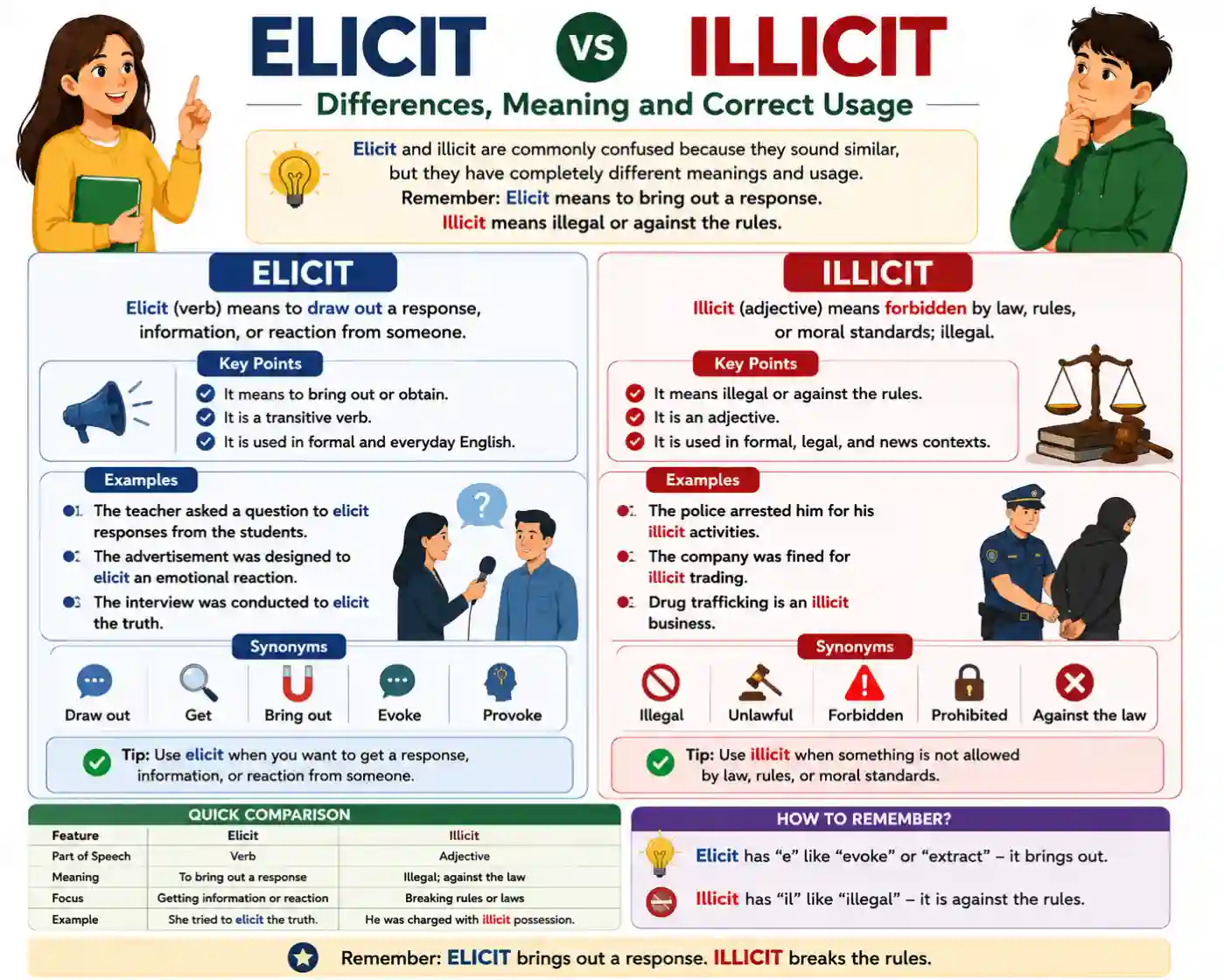
Elicit vs Illicit is one of the easiest word pairs to misspell because the words sound almost identical. Many writers accidentally replace one with the other, especially when typing quickly. Since both are real English words, spell check often fails to catch the mistake.
Using the wrong word can completely change the meaning of a sentence. Writing that someone elicited drugs instead of illicit drugs creates a confusing sentence, while saying someone illicited information is simply incorrect because that verb does not exist.
The good news is that the difference is easy to remember once you understand the meaning and grammar of each word. This guide explains both words in plain English with clear examples, comparison tables, grammar rules, pronunciation guidance, and practical writing tips. By the end, you’ll know exactly when to use each one with confidence.
Short Answer
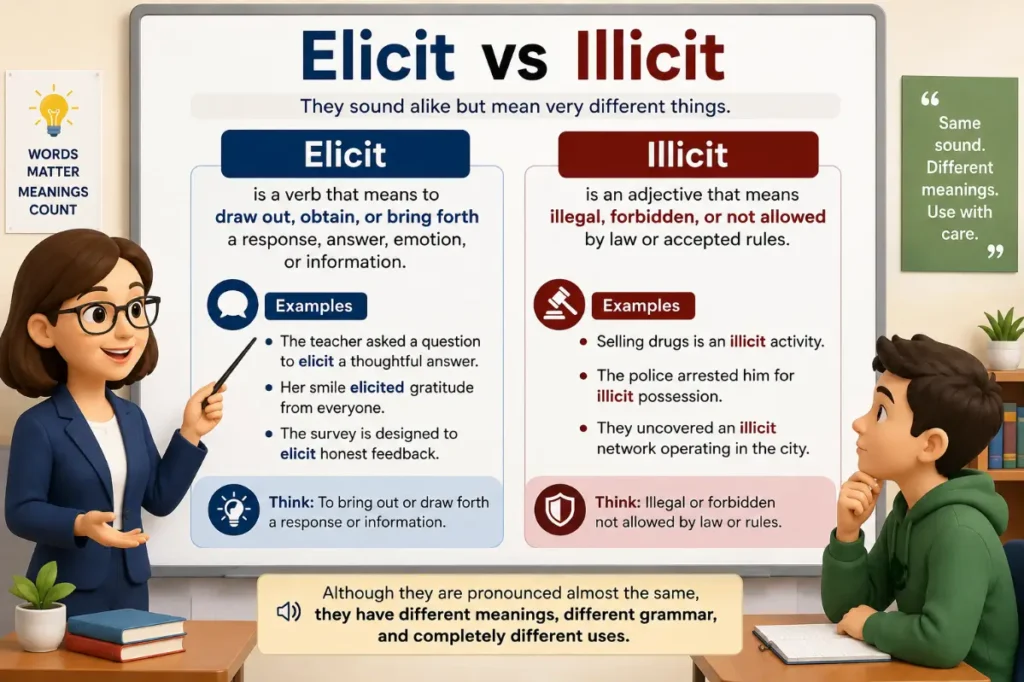
Elicit is a verb that means to draw out, obtain, or bring forth a response, answer, emotion, or information. Illicit is an adjective that means illegal, forbidden, or not allowed by law or accepted rules. Although they are pronounced almost the same, they have different meanings, different grammar, and completely different uses.
Table of Contents
- What Does Elicit Mean
- What Does Illicit Mean
- Elicit vs Illicit Comparison Table
- Key Differences
- Pronunciation
- Parts of Speech
- Grammar Rules
- Real Life Examples
- Common Collocations
- Why People Confuse These Words
- Common Mistakes
- Memory Tips
- Professional Writing Tips
- Related Grammar Notes
- Frequently Asked Questions
- Key Takeaways
- Conclusion
What Does Elicit Mean
Elicit is a verb that means to bring out, draw out, obtain, or receive a response, reaction, feeling, answer, or information from another person. It describes an action rather than a description.
People often use elicit when talking about asking questions, encouraging discussion, gathering opinions, or causing an emotional reaction.
Definition
Elicit (verb): To obtain or draw out information, a response, an emotion, or another reaction from someone.
Examples of Elicit
The teacher elicited thoughtful answers from the students.
The survey elicited valuable customer feedback.
His speech elicited loud applause.
The detective elicited important information during the interview.
The comedian elicited laughter from the audience.
The advertisement elicited an emotional response.
The therapist elicited childhood memories.
The lawyer tried to elicit the truth from the witness.
Her question elicited complete silence.
The article elicited thousands of online comments.
Common Collocations with Elicit
| Common Combination | Example |
|---|---|
| Elicit a response | The teacher elicited a response from every student. |
| Elicit information | Detectives elicited information from witnesses. |
| Elicit feedback | The company elicited customer feedback. |
| Elicit emotions | The movie elicited strong emotions. |
| Elicit laughter | His joke elicited laughter. |
| Elicit sympathy | Her story elicited sympathy. |
| Elicit opinions | The discussion elicited different opinions. |
| Elicit ideas | The workshop elicited creative ideas. |
| Elicit reactions | The announcement elicited mixed reactions. |
| Elicit a confession | The questioning elicited a confession. |
What Does Illicit Mean
Illicit is an adjective that means illegal, unlawful, forbidden, or not permitted by law or accepted rules. Unlike elicit, it describes a person, activity, object, or situation instead of expressing an action.
The word commonly appears in legal, financial, criminal, political, and news writing.
Definition
Illicit (adjective): Not allowed by law, official regulations, or accepted standards.
Examples of Illicit
Police discovered illicit drugs during the investigation.
Authorities shut down an illicit gambling operation.
The report exposed illicit financial activities.
Customs officers seized illicit goods.
The government increased efforts to stop illicit trade.
Investigators uncovered illicit payments.
Officials targeted illicit weapons trafficking.
The company denied involvement in illicit business practices.
The investigation revealed an illicit money transfer network.
The novel tells the story of an illicit relationship.
Common Collocations with Illicit
| Common Combination | Example |
|---|---|
| Illicit drugs | Police seized illicit drugs. |
| Illicit trade | Governments continue fighting illicit trade. |
| Illicit activity | Officials investigated illicit activity. |
| Illicit business | Authorities exposed an illicit business. |
| Illicit payments | Auditors found illicit payments. |
| Illicit goods | Customs officers intercepted illicit goods. |
| Illicit income | The investigation focused on illicit income. |
| Illicit market | Officials shut down an illicit market. |
| Illicit weapons | Police uncovered illicit weapons. |
| Illicit funds | Investigators tracked illicit funds. |
Elicit vs Illicit Comparison Table
| Feature | Elicit | Illicit |
|---|---|---|
| Part of Speech | Verb | Adjective |
| Meaning | To draw out or obtain | Illegal or forbidden |
| Function | Shows an action | Describes something |
| Pronunciation | /ɪˈlɪsɪt/ | /ɪˈlɪsɪt/ |
| Used Before a Noun | No | Yes |
| Takes an Object | Yes | No |
| Common Context | Communication and responses | Law, crime, and regulations |
Key Differences
Understanding the grammatical role of each word makes choosing the correct one much easier.
Elicit always functions as a verb. It describes the act of obtaining something such as information, opinions, answers, emotions, or reactions from another person.
Illicit always functions as an adjective. It describes something that is illegal, unauthorized, or forbidden.
If your sentence needs an action, elicit is usually the correct choice.
If your sentence needs a describing word, illicit is usually the correct choice.
Compare these examples.
The interviewer elicited honest answers from the candidate.
Police discovered illicit drugs during the search.
The survey elicited useful feedback.
Authorities investigated illicit financial transactions.
Pronunciation
One reason these words are often confused is that they are pronounced almost exactly the same.
Elicit
Pronunciation: ih LIS it
IPA: /ɪˈlɪsɪt/
Illicit
Pronunciation: ih LIS it
IPA: /ɪˈlɪsɪt/
Because pronunciation offers almost no clue, understanding the meaning is the only reliable way to choose the correct spelling.
Parts of Speech
Knowing each word’s grammatical role helps eliminate confusion.
Elicit
Part of speech: Verb
Examples:
She elicited a thoughtful response.
The discussion elicited several new ideas.
The interview elicited important information.
Illicit
Part of speech: Adjective
Examples:
The police investigated illicit trade.
Officials discovered illicit payments.
The organization opposed illicit business practices.
Grammar Rules
Use elicit when someone draws out information, emotions, opinions, reactions, or answers.
Correct:
The teacher elicited thoughtful responses.
Correct:
The reporter elicited new information.
Use illicit when describing something illegal or prohibited.
Correct:
Police confiscated illicit substances.
Correct:
Officials uncovered illicit financial activities.
Never use illicit as a verb.
Incorrect:
The detective illicit a confession.
Correct:
The detective elicited a confession.
Never use elicit as an adjective.
Incorrect:
Police seized elicit drugs.
Correct:
Police seized illicit drugs.
Real Life Examples
Teachers often elicit answers instead of giving students every solution immediately because active participation improves learning.
Doctors ask careful questions to elicit information about a patient’s symptoms before making a diagnosis.
Interviewers try to elicit honest responses by asking open ended questions.
A powerful speech may elicit applause, laughter, or even tears from an audience.
Police departments regularly investigate illicit drug trafficking and organized crime.
Governments work together to reduce illicit trade across international borders.
Auditors examine financial records to identify illicit transactions.
News organizations frequently report on illicit business activities involving fraud or corruption.
Financial investigators monitor illicit money transfers to prevent money laundering.
Why People Confuse Elicit and Illicit
The confusion between Elicit vs Illicit comes from several factors. Even native English speakers occasionally choose the wrong spelling because the two words sound almost identical.
They Have the Same Pronunciation
Both words are pronounced /ɪˈlɪsɪt/.
Since there is almost no difference in the way they sound, many people rely on memory when spelling them. That often leads to mistakes in emails, reports, school assignments, and even published articles.
They Differ by Only One Letter
Compare the spellings.
Elicit
Illicit
Only the first vowel changes, making it easy to type the wrong word without noticing.
Both Are Common in Formal Writing
These words frequently appear in academic writing, journalism, legal documents, business reports, and government publications. Because they are often seen in similar contexts, many writers assume they are related in meaning. In reality, they have completely different definitions.
Spell Check May Not Help
One reason this mistake is so common is that both words are correctly spelled English words.
For example:
Incorrect:
The interview illicit useful information.
Every word is spelled correctly, but the sentence is grammatically wrong because illicit cannot function as a verb.
Always proofread for meaning instead of relying only on spell checking software.
More Examples of Elicit
These examples show how elicit works in different situations.
The teacher elicited thoughtful answers from every student.
The customer survey elicited honest feedback.
The manager’s speech elicited enthusiastic applause.
The doctor’s questions elicited important details about the patient’s condition.
The journalist hoped to elicit an honest response during the interview.
The charity campaign elicited generous donations.
The movie elicited strong emotions from viewers.
The comedian elicited laughter throughout the performance.
The therapist elicited childhood memories during the session.
The discussion elicited several creative ideas.
The announcement elicited mixed reactions.
Her apology elicited sympathy from the audience.
More Examples of Illicit
The following sentences show how illicit describes something unlawful or forbidden.
Police uncovered an illicit drug operation.
Authorities investigated illicit financial transactions.
The report revealed illicit payments.
Customs officers seized illicit goods.
Officials closed an illicit gambling business.
The organization fought illicit wildlife trafficking.
Investigators discovered illicit weapons sales.
The government strengthened laws against illicit trade.
The company denied involvement in illicit business activities.
The investigation focused on illicit money transfers.
The agency monitored illicit online marketplaces.
The documentary examined illicit international trade.
Side by Side Sentence Comparison
Looking at both words together makes the difference easier to remember.
| Elicit | Illicit |
|---|---|
| The teacher elicited answers from students. | Police discovered illicit drugs. |
| The survey elicited customer feedback. | Officials investigated illicit trade. |
| His speech elicited applause. | Authorities seized illicit goods. |
| The interview elicited useful information. | The report exposed illicit payments. |
| The discussion elicited new ideas. | Customs officers intercepted illicit imports. |
| The therapist elicited emotional responses. | Investigators tracked illicit funds. |
| The lawyer elicited testimony from the witness. | Police dismantled an illicit network. |
Notice the pattern.
Elicit is followed by something that someone gives or expresses.
Illicit comes before a noun that it describes.
Common Mistakes
Many writers make the same errors repeatedly.
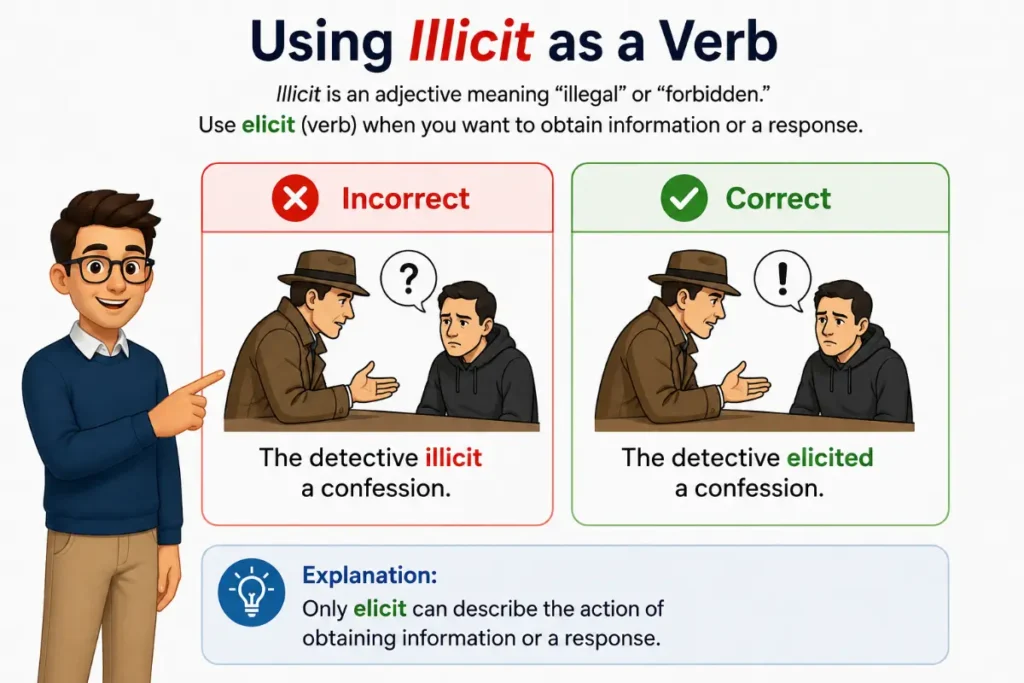
Using Illicit as a Verb
Incorrect:
The detective illicit a confession.
Correct:
The detective elicited a confession.
Explanation:
Only elicit can describe the action of obtaining information or a response.
Using Elicit as an Adjective
Incorrect:
Police discovered elicit substances.
Correct:
Police discovered illicit substances.
Explanation:
Substances are being described, so an adjective is required.
Confusing Meaning Because of Pronunciation
Incorrect:
The survey illicited honest feedback.
Correct:
The survey elicited honest feedback.
Explanation:
The survey obtained feedback. It did not describe something illegal.
Assuming Both Words Mean Illegal
Some learners mistakenly believe elicit is another spelling of illicit.
That is incorrect.
Elicit relates to obtaining something.
Illicit relates to something unlawful.
Choosing the Wrong Word While Typing Quickly
Because the pronunciation is nearly identical, fast typing often produces the wrong spelling. Reading your work one final time can catch these mistakes before publishing.
Memory Tips
Simple memory tricks can help you remember the difference for life.
Elicit Means Extract
Both words begin with the letter E.
Elicit
Extract
If someone extracts information, they elicit it.
Example:
The interviewer extracted information.
The interviewer elicited information.
The meanings are very similar.
Illicit Means Illegal
Both words begin with IL.
Illicit
Illegal
Whenever you see illicit, think of something against the law.
Example:
Illicit drugs.
Illegal drugs.
The connection is immediate and easy to remember.
Ask Yourself One Question
Before choosing the word, ask:
Am I talking about obtaining something from someone?
If yes, choose elicit.
Or ask:
Am I describing something unlawful?
If yes, choose illicit.
This simple habit prevents nearly every mistake.
Visual Memory Trick
Imagine two scenes.
In the first scene, a teacher asks a question and students raise their hands with answers.
The teacher elicits responses.
In the second scene, police officers discover illegal products during a search.
They find illicit goods.
Associating each word with a different picture makes the meanings much easier to remember.
Professional Writing Tips
Professional editors rarely confuse these words because they focus on grammar instead of pronunciation.
The easiest method is to identify the part of speech before writing.
If the sentence needs a verb, elicit is usually correct.
If the sentence needs an adjective, illicit is usually correct.
Another helpful technique is substitution.
Replace elicit with obtain.
If the sentence still makes sense, you probably selected the correct word.
Example:
The interviewer elicited useful information.
The interviewer obtained useful information.
Both sentences have the same meaning.
Now replace illicit with illegal.
Police discovered illicit goods.
Police discovered illegal goods.
Again, both sentences work naturally.
This quick substitution test is an effective proofreading habit for formal writing.
Common Word Partners
Certain words naturally appear with elicit.
| Elicit | Example |
|---|---|
| Response | The question elicited a response. |
| Information | Detectives elicited information. |
| Feedback | The survey elicited feedback. |
| Opinion | The debate elicited opinions. |
| Emotion | The speech elicited emotion. |
| Reaction | The announcement elicited reactions. |
| Laughter | The joke elicited laughter. |
| Smile | Her kindness elicited a smile. |
| Confession | The questioning elicited a confession. |
| Ideas | The workshop elicited new ideas. |
Likewise, certain nouns commonly follow illicit.
| Illicit | Example |
|---|---|
| Drugs | Police seized illicit drugs. |
| Trade | Governments fight illicit trade. |
| Activity | Officials investigated illicit activity. |
| Business | Authorities exposed illicit business. |
| Goods | Customs intercepted illicit goods. |
| Payments | Auditors discovered illicit payments. |
| Funds | Investigators tracked illicit funds. |
| Market | Police shut down an illicit market. |
| Income | Authorities examined illicit income. |
| Weapons | Officials seized illicit weapons. |
Related Grammar Notes
Learning other confusing word pairs helps strengthen your vocabulary and proofreading skills.
Affect is usually a verb, while effect is usually a noun.
Complement means something completes another thing, while compliment means praise.
Principal can refer to the head of a school or something most important, while principle means a rule or belief.
Accept means to receive something, while except means excluding something.
Then relates to time, while than is used when making comparisons.
Like Elicit vs Illicit, each of these pairs has similar spelling or pronunciation but completely different meanings and grammatical functions.
In the final part, you’ll find advanced usage notes, practice exercises with answers, frequently asked questions, key takeaways, and a comprehensive conclusion.
Advanced Usage Notes
Understanding the basic difference between Elicit vs Illicit is enough for everyday writing, but advanced writers also pay attention to context, tone, and grammar. These details help produce clear, professional, and accurate communication.
Elicit Often Appears in Positive and Neutral Contexts
The verb elicit usually describes communication, learning, research, psychology, medicine, journalism, and business. It often refers to obtaining information, emotions, or reactions without implying anything illegal or dishonest.
Examples include interviews, classroom discussions, customer surveys, medical consultations, and scientific studies.
Examples:
The teacher elicited thoughtful responses from the class.
The researcher elicited valuable data during the experiment.
The counselor elicited honest emotions through careful questioning.
Although elicit can appear in legal investigations or police interviews, the word itself simply means “to obtain” or “draw out.”
Illicit Usually Appears in Legal or Criminal Contexts
The adjective illicit most commonly appears in discussions involving crime, law enforcement, finance, customs, and government regulation.
Examples:
Illicit weapons trade.
Illicit business practices.
The word suggests that something violates a law, regulation, or accepted rule.
Formal and Informal Usage
Both words are accepted in formal and informal English, but they appear much more often in formal writing.
You are likely to see elicit in:
Academic articles.
Business reports.
Medical writing.
Psychology textbooks.
Research papers.
News interviews.
You are likely to see illicit in:
Crime reports.
Legal documents.
Government publications.
Financial investigations.
International trade reports.
American and British English
There is no significant difference between American and British English for these words.
Both varieties use:
Elicit as a verb meaning “draw out.”
Illicit as an adjective meaning “illegal.”
The spelling and meaning remain the same in both countries.
Practice Sentences
Choose the correct word before checking the answers.
The survey __________ valuable customer feedback.
Police seized __________ substances during the investigation.
The therapist tried to __________ childhood memories.
Authorities investigated __________ financial transactions.
His speech __________ loud applause.
Customs officers stopped __________ imports.
The reporter hoped to __________ honest answers.
The investigation uncovered an __________ gambling operation.
The teacher __________ several thoughtful responses.
Officials worked together to reduce __________ trade.
Answer Key
The survey elicited valuable customer feedback.
Police seized illicit substances during the investigation.
The therapist tried to elicit childhood memories.
Authorities investigated illicit financial transactions.
His speech elicited loud applause.
Customs officers stopped illicit imports.
The reporter hoped to elicit honest answers.
The investigation uncovered an illicit gambling operation.
The teacher elicited several thoughtful responses.
Officials worked together to reduce illicit trade.
Quick Self Test
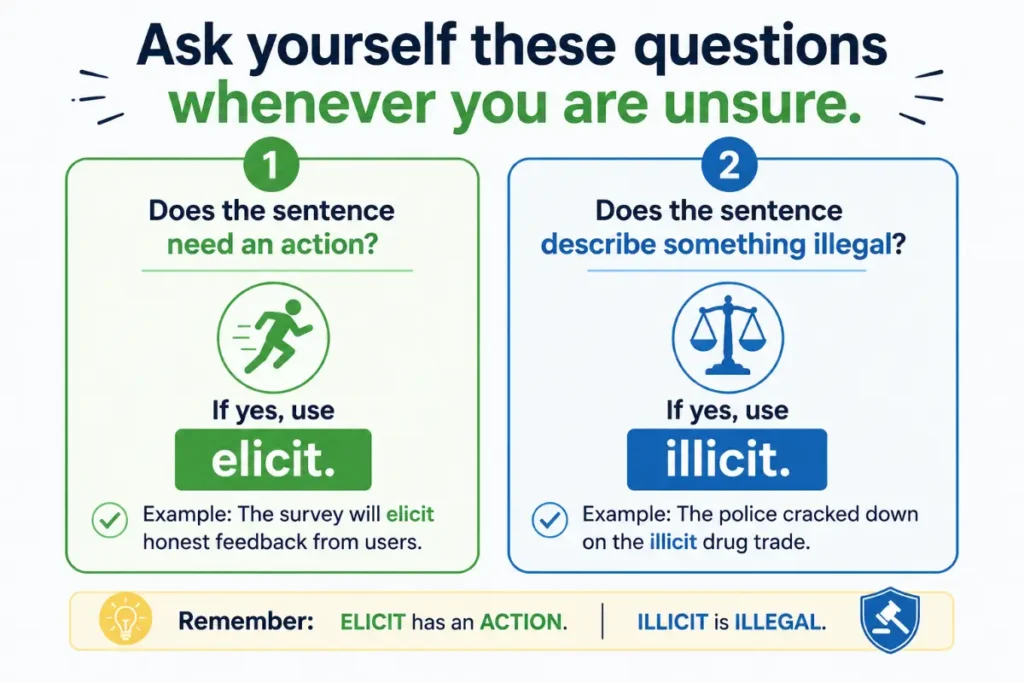
Ask yourself these questions whenever you are unsure.
Does the sentence need an action?
If yes, use elicit.
Does the sentence describe something illegal?
If yes, use illicit.
Can you replace the word with obtain?
If yes, elicit is probably correct.
Can you replace the word with illegal?
If yes, illicit is probably correct.
Conclusion
Understanding Elicit vs Illicit becomes much easier once you recognize that these words belong to different parts of speech and express completely different ideas. Elicit is a verb that means to draw out or obtain information, responses, emotions, or ideas from someone. Illicit is an adjective that describes something illegal, forbidden, or unauthorized.
Although they share the same pronunciation, their meanings never overlap. Paying attention to the role each word plays in a sentence is the simplest way to avoid mistakes. If you can replace the word with obtain, choose elicit. If you can replace it with illegal, choose illicit.
With regular reading, careful proofreading, and the memory tricks in this guide, you’ll be able to use both words accurately and confidently in academic writing, professional communication, and everyday English.
Frequently Asked Questions
Is elicit the same as illicit?
No. Elicit vs Illicit are completely different words. Elicit means to obtain or draw out information, emotions, or responses, while illicit means illegal or forbidden.
Which is correct, elicit information or illicit information?
Elicit information is correct because information is something that can be obtained. Illicit information would only make sense if the information itself were illegal, which is uncommon and depends on the context.
Is illicit always illegal?
Most of the time, yes. Illicit usually refers to something that violates the law. In some contexts, it may also describe something that is socially unacceptable or forbidden by rules rather than by law.
Is elicit always a verb?
Yes. Elicit functions as a verb and describes the action of drawing out or obtaining something from another person.
Is illicit a noun?
No. Illicit is an adjective. It describes nouns but is not itself a noun.
Why do people confuse elicit and illicit?
They sound almost identical and differ by only one letter. Since both are correctly spelled English words, spelling checkers often fail to detect the mistake.
How can I remember the difference?
Remember that Elicit starts with E, just like Extract. Illicit starts with IL, just like Illegal.
Can I use elicit in business writing?
Yes. It is commonly used in professional writing.
Examples include:
The survey elicited customer feedback.
The meeting elicited several useful suggestions.
Can illicit describe relationships?
Yes. An illicit relationship is one considered unlawful, secret, or socially unacceptable depending on the context.

Confusing Words, Spelling & Word Choice
Claire Whitmore is a U.S.-based English editor who writes about commonly confused words, spelling differences, and word choice. Her work helps readers understand subtle distinctions between similar-looking words through simple definitions, practical examples, and modern usage guidance in both American and British English.