
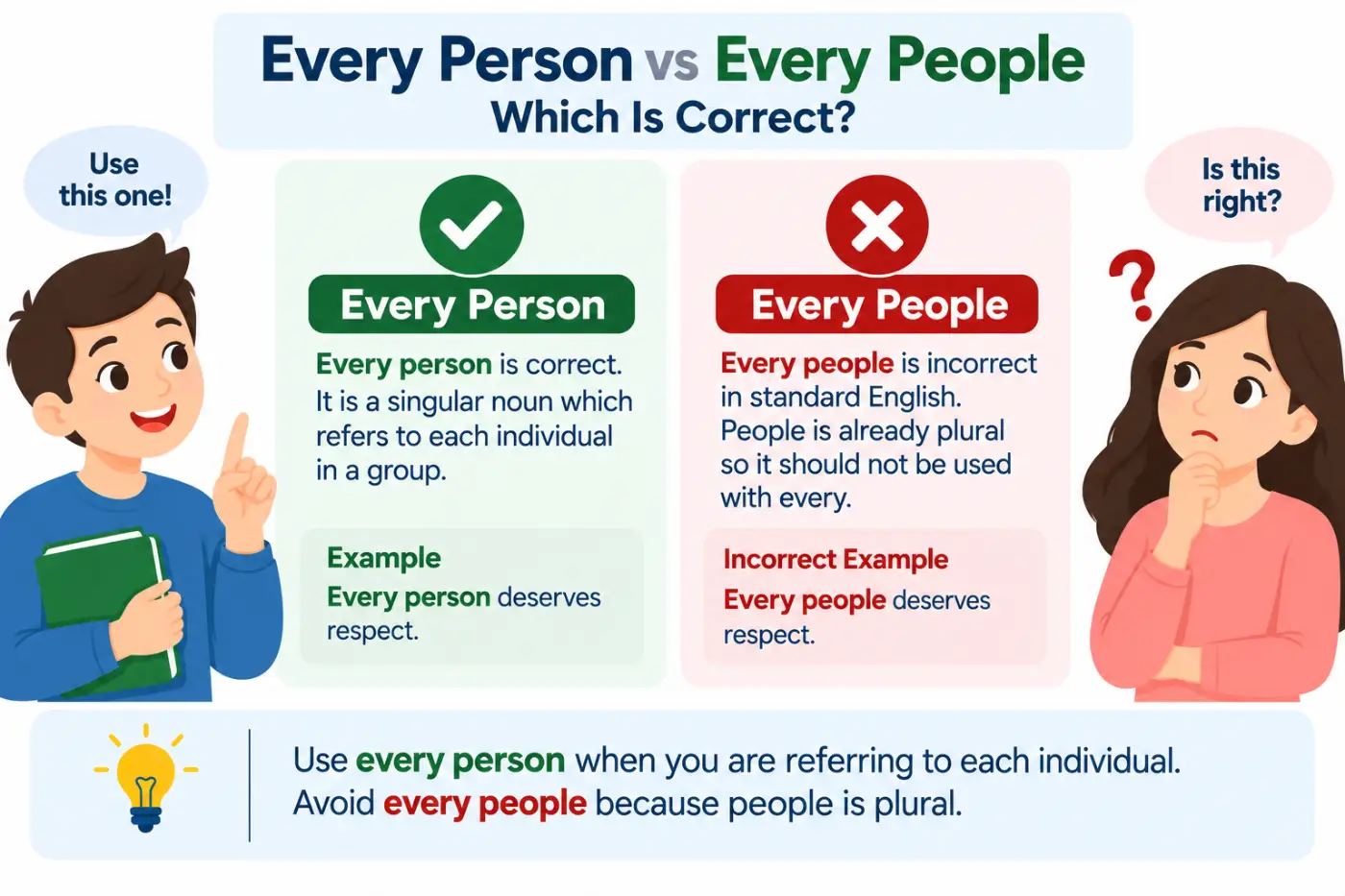
every person vs every people can be confusing because person and people both refer to human beings. The difference becomes clear once you look at the grammar. Every person is correct when you mean each individual member of a group. Every people is generally incorrect because every normally takes a singular count noun.
The confusion often comes from the meaning rather than the grammar. People is the ordinary plural of person so it may seem logical to put it after every when you want to talk about many individuals. English doesn’t work that way. Every already carries the idea of looking at members one by one so the noun that follows it normally stays singular.
Once you understand this pattern you can apply it to many other expressions. You’ll see why we say every student rather than every students and every employee rather than every employees. You’ll also learn when all people works better and why every people can sometimes appear in specialized contexts where people has a different meaning.
Short Answer
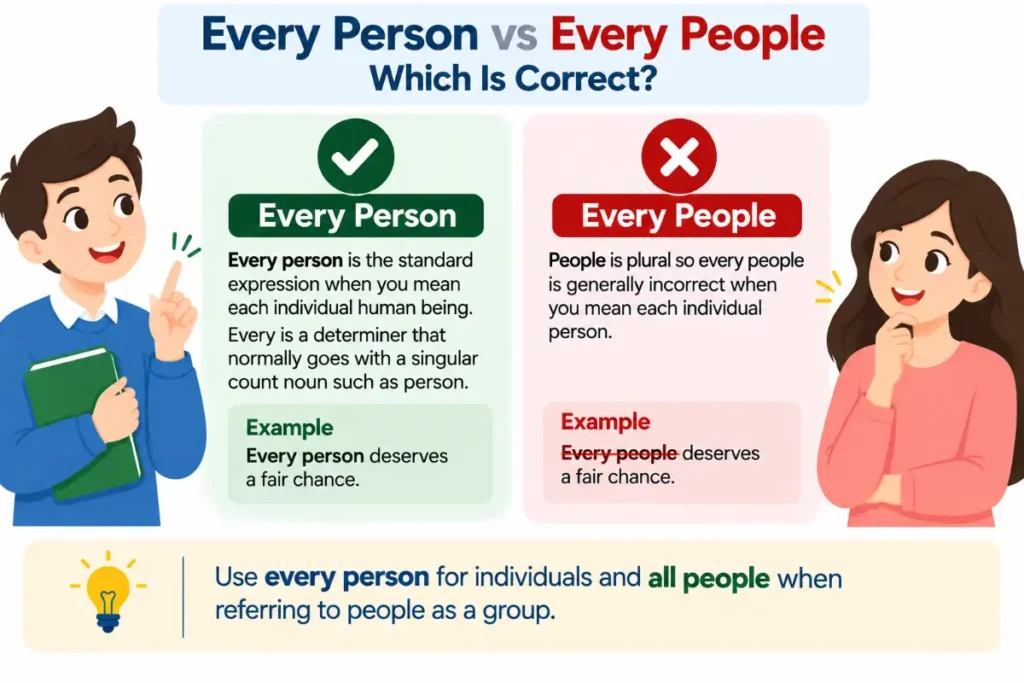
Every person is the standard expression when you mean each individual human being. Every is a determiner that normally goes with a singular count noun such as person. People is plural so every people is generally incorrect when you mean each individual person. Use every person for individuals and all people when referring to people as a group.
Table Of Contents
- The basic grammar rule.
- Why every person is correct.
- Why every people usually sounds wrong.
- The difference between every and all.
- Person and people explained.
- Singular and plural agreement.
- Real life examples.
- Common mistakes.
- Special uses of people.
- Memory tips.
- Related grammar patterns.
- American English usage.
- Formal writing guidance.
- FAQs.
- Key takeaways.
- Conclusion.
The Basic Grammar Rule
The easiest rule is this. Every normally takes a singular count noun.
That gives us expressions such as every person every student every house every book and every employee. Although these phrases refer to more than one individual across the whole group the noun immediately following every remains singular.
Consider these examples.
- Every person deserves respect.
- Every student needs a textbook.
- Every employee received an email.
- Every house on the street has a number.
- Every child needs support.
The meaning can involve an entire group. The grammar still treats each member separately.
This is the central reason every person is correct. Person is a singular count noun and fits the grammatical pattern required by every.
People is different because it is normally plural. The phrase every people therefore creates a mismatch in standard English when the intended meaning is each person.
Why Every Person Is Correct
The word every has a distributive meaning. In simple terms it looks at members of a group individually rather than treating the group as one unit.
Imagine a classroom with twenty students. If you say every student completed the assignment you are talking about the twenty students one by one. You aren’t saying that the students acted as one single unit.
The same idea applies to people.
Every person in the room received a ticket.
The sentence refers to each individual person in the room. Since every already provides that individual focus the noun after it stays singular.
You can think of the structure like this.
Every + singular count noun
That pattern produces:
Every person.
Every applicant.
The noun doesn’t become plural simply because the overall meaning covers a large number of people.
Why Every People Usually Sounds Wrong
People is normally the plural form of person. Standard English therefore doesn’t usually place it directly after every.
The phrase every people may sound understandable because the listener can guess the intended meaning. However understanding a phrase doesn’t make its grammar standard.
For example:
Every people should have equal rights.
A reader may understand that the writer means all people. Yet the natural expression would be:
All people should have equal rights.
Or:
Every person should have equal rights.
The choice depends on the intended meaning.
Use every person when you want to emphasize individuals. Use all people when you want to refer to people collectively.
That distinction is more useful than simply memorizing one phrase as right and the other as wrong.
Every Person Or Every People
The difference between every person or every people becomes much easier when you focus on what every does to the noun that follows it.
| Expression | Grammar | Typical Meaning | Standard Usage | Example |
|---|---|---|---|---|
| Every person | Every plus singular count noun | Each individual | Standard | Every person has a choice. |
| Every people | Every plus plural noun | Usually intended to mean all people | Generally nonstandard for this meaning | Every people should have a voice. |
| All people | All plus plural noun | People collectively | Standard | All people deserve dignity. |
| Each person | Each plus singular count noun | Each individual separately | Standard | Each person received a form. |
| Everyone | Singular indefinite pronoun | Every individual person | Standard | Everyone agreed with the decision. |
The table reveals an important point. Every and all don’t behave in the same way.
Every works naturally with a singular count noun. All can work with a plural noun.
That is why we say every person but all people.
The Difference Between Every And All
Every and all can sometimes express similar ideas but they organize those ideas differently.
Every focuses on individual members.
All focuses on the group as a whole.
Compare these sentences.
Every person in the office received a message.
All people in the office received a message.
The first sentence gives stronger attention to each individual. The second treats the people collectively.
In ordinary English the second sentence may sound less natural if you’re talking about a specific office group. You might simply say all the people in the office received a message.
The important grammar pattern remains clear.
Every + singular noun
All + plural noun
This pattern extends far beyond people.
Every book was checked.
All books were checked.
Every student passed.
All students passed.
Every employee attended.
All employees attended.
The meaning can overlap. The grammar doesn’t.
Person And People Explained
Person is a singular count noun.
You can say one person two people three people and several people. You can also say one person and another person when discussing individuals separately.
People is normally the plural noun used for two or more human beings.
For example:
One person entered the room.
Two people entered the room.
Ten people entered the room.
The ordinary plural pattern is therefore person to people rather than person to persons in everyday English.
However persons does have legitimate uses in some formal and legal contexts. A notice might refer to authorized persons or injured persons. That specialized use doesn’t change the normal distinction between person and people.
The key point for this grammar question is simple. Person is singular. People is normally plural. Every normally requires the singular form that follows it.
How Every Works With Singular Nouns
Every belongs to a group of words called determiners. It identifies members within a group and gives the sentence a distributive meaning.
You can use it with many singular count nouns.
Every morning begins with a new opportunity.
Every decision has consequences.
Notice the nouns after every. Morning customer dog student and decision are all singular.
The same structure applies to person.
Every person has a unique perspective.
The verb also matters. Because the noun phrase every person is grammatically singular the verb should normally be singular too.
Every person is welcome.
Every person has a right to speak.
A common mistake is to let the plural meaning influence the verb.
Every person are welcome.
That form is incorrect in standard English.
The correct sentence is:
Every person is welcome.
This is an example of grammatical agreement. The verb agrees with the singular noun phrase every person rather than with the imagined number of people in the group.
Singular Meaning Within A Larger Group
One of the most useful ideas here is that a singular noun can represent many individuals when it follows every.
Suppose a company has five hundred employees.
You can say:
Every employee received training.
The word employee is singular even though five hundred people are included in the statement.
The same thing happens with every person.
Every person at the event received a badge.
The event could contain hundreds or thousands of people. The noun person remains singular because every distributes the action across individuals.
This is why changing person to people isn’t necessary.
Every already tells the reader that the statement applies to each member of the group.
When To Use All People
Use all people when you want to describe people collectively.
For example:
All people deserve basic dignity.
All people should have access to fair treatment.
The phrase is grammatical because all can modify a plural noun.
Still, native speakers often choose more specific wording when the group is known.
All the people at the meeting agreed.
All the people in the building were asked to leave.
The phrase all people can sound broad because it may refer to humanity as a whole. Context determines the natural choice.
When To Use Everyone
Everyone is another useful alternative.
Everyone is grammatically singular even though it refers to many individuals.
For example:
Everyone is ready.
Everyone was invited.
This creates an interesting contrast.
Every person is ready.
Everyone is ready.
Both sentences refer to each individual. The first uses a determiner plus noun. The second uses an indefinite pronoun.
The verb remains singular in both cases.
That means you should not write:
Everyone are ready.
The standard form is:
Everyone is ready.
Learning this pattern helps reinforce the grammar behind every person.
Every Person Or Each Person
Every person and each person are close in meaning. Both can refer to individuals within a group.
Every often presents the group as a complete set.
Each can place slightly more emphasis on individual members.
Compare:
Every person in the class received a certificate.
Each person in the class received a certificate.
Both sentences are correct. The difference is subtle and depends on context and emphasis.
In many everyday situations you can use either expression without creating a meaningful change in the message.
The same singular noun rule applies to both.
Each person.
Every person.
Not:
Each people.
Not:
Every people.
Grammar Agreement With Every Person
The singular nature of every person affects more than the noun.
It also affects the verb.
Every person needs support.
Every person is responsible for following the rules.
The verb forms needs has was and is are singular.
This can feel strange because the sentence may describe hundreds of individuals. Don’t let the size of the group change the grammatical number of the noun phrase.
A useful test is to replace every person with each person. If the sentence still works with a singular verb then your agreement is probably correct.
Every person has a voice.
Each person has a voice.
Both use singular has.
Real Life Examples
Daily Conversation
Every person at the table ordered something different.
This sentence focuses on the individual choices made by people at the table.
I think every person should get a chance to speak.
Here the speaker expresses a general belief that applies individually to members of a group.
Workplace Communication
Every person on the team needs to complete the training before Friday.
The expression works well because each employee is expected to complete the requirement.
Every person involved in the project has received the updated schedule.
The singular verb has correctly agrees with the phrase every person.
Academic Writing
Every person in the study completed the same task under controlled conditions.
This sentence describes individual participants while maintaining standard grammatical agreement.
The researcher considered how every person responded to the question.
Here the phrase emphasizes individual responses rather than treating the participants as one collective unit.
Formal Writing
Every person has the right to review the relevant information.
The phrase sounds natural in formal writing because the writer is making a statement about individuals.
Every person who enters the facility must follow the posted rules.
The singular verb must agrees with every person.
Social Situations
Every person at the party seemed to know someone there.
The sentence describes individuals while referring to a larger social group.
Every person I met had a different story.
The singular form keeps the grammar correct even though the sentence refers to multiple people.
Common Mistakes
Using Every People
Incorrect:
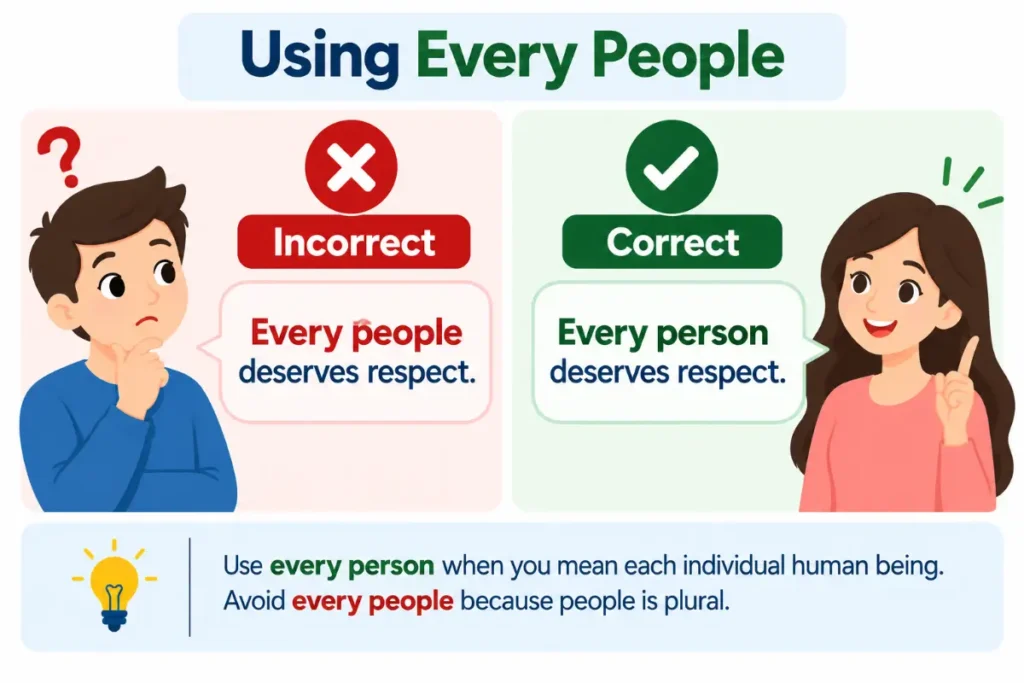
Every people deserves respect.
Correct:
Every person deserves respect.
The problem is that every normally takes a singular count noun. Replace people with person when you mean each individual.
Using Every Persons
Incorrect:
Every persons must sign the form.
Correct:
Every person must sign the form.
Adding s to person creates another plural form that doesn’t fit the grammar of every.
Using Every Person With A Plural Verb
Incorrect:
Every person are welcome.
Correct:
Every person is welcome.
The entire noun phrase is grammatically singular so the verb should normally be singular too.
Using All Person
Incorrect:
All person should receive the information.
Correct:
All people should receive the information.
All normally works with a plural noun when referring to people collectively.
Confusing Everyone With Every People
Incorrect:
Every people was invited.
Better:
Everyone was invited.
Or:
Every person was invited.
Everyone is already a pronoun meaning every person. It doesn’t need the plural noun people after it.
Why The Mistake Happens
The error often comes from a logical but misleading thought process.
A writer thinks:
Many people are involved.
Then:
Every means many.
Then:
Every people must mean many people.
The problem is that every doesn’t simply mean many. It distributes a statement across individual members.
Think about the difference between these ideas.
Every person received a card.
All people received cards.
The first statement looks at each individual. The second treats the group collectively.
This distinction appears throughout English grammar.
Every house has a door.
All houses have doors.
Every child needs care.
All children need care.
Every customer received a receipt.
All customers received receipts.
The same pattern works with person and people.
Special Uses Of People
There is one important qualification. People can sometimes function as a count noun meaning a nation or ethnic group.
For example:
The region contains several distinct peoples.
Here peoples refers to separate cultural or ethnic communities. In this specialized sense people has a different grammatical meaning from the ordinary plural of person.
That distinction helps explain why you may occasionally encounter phrases involving every and people in historical anthropological or political writing.
A sentence such as:
Every people develops its own traditions.
can appear in specialized writing where people means a distinct ethnic or national community.
This is not the ordinary everyday use. In normal American English if you mean each individual human being you should use every person.
This distinction is worth knowing because language depends on meaning. A phrase that looks unusual in everyday English can sometimes have a legitimate specialized interpretation.
American English Usage
American English strongly favors every person when the intended meaning is each individual human being.
The expression appears naturally in conversation professional writing education journalism and formal documents. Native speakers generally understand the singular structure without consciously thinking about the grammar rule.
For collective reference American speakers commonly use all people all the people everyone or everybody depending on context.
For example:
Everyone deserves a fair chance.
All people deserve dignity.
Every person deserves a fair chance.
All three can be grammatical. The choice depends on emphasis and context.
Every people is not the normal American English expression for this meaning.
British English Usage
British English follows the same core grammar rule.
Every person is standard.
All people is standard.
Everyone is standard.
Every people is generally not used to mean each individual person.
There is no major British American difference that changes this particular rule. Writers in both varieties generally keep every with a singular count noun.
Australian And Canadian English
Australian and Canadian English also follow the same basic structure.
Every person is the normal form when referring to individual human beings. All people and everyone provide common alternatives for collective or general reference.
Regional vocabulary differences can appear across English varieties but they don’t create a different rule for this construction.
If you’re writing for an international English speaking audience you can safely follow the same core pattern.
Formal And Informal Writing
Every person works in both formal and informal English.
In a casual conversation you might say:
Every person there knew about the problem.
In formal writing you might say:
Every person who participates in the program must comply with the applicable requirements.
The grammar stays the same.
In casual speech everyone may sound more natural because it is shorter.
Everyone deserves respect.
In a formal document every person may be useful when the writer wants to make the individual focus especially clear.
Neither form is inherently informal or formal. Context determines the best choice.
Memory Tips
A simple memory trick can save you from this mistake.
Think:
Every one person.
The phrase isn’t written that way in normal English but the mental image helps you remember the grammar. Every points toward one member at a time.
Another useful trick is to pair every with a singular noun.
Every person.
Every customer.
Then pair all with a plural noun.
All people.
All customers.
This creates a clean mental contrast.
Every goes one by one.
All gathers the group together.
Once that distinction becomes automatic the choice gets much easier.
Related Grammar Patterns
The same grammar principle appears in many common expressions.
Every Student
Every student needs a notebook.
Not every students.
Every Employee
Every employee receives an identification card.
Not every employees.
Every Child
Every child deserves a safe environment.
Not every children.
Every Member
Every member has access to the system.
Not every members.
Every Customer
Every customer received a confirmation email.
Not every customers.
These examples reinforce the larger rule.
Every And Numbers
Every can also work with certain expressions involving numbers.
For example:
Every two weeks.
Every four years.
This is a different structure because the number phrase creates a time or frequency expression. It doesn’t change the basic rule that every normally combines with a singular count noun when it directly modifies a noun.
You can say:
Every second person received a prize.
Here person remains singular.
You can also say:
Every five people received a table.
This is a useful construction because five people forms a unit of five. Every modifies the entire quantity phrase rather than directly treating people as an ordinary noun after every.
That is why seeing every and people together doesn’t always mean the phrase is wrong.
The structure matters.
Every People In Specialized Contexts
The specialized plural use of peoples deserves one more look because it can create genuine exceptions to an oversimplified grammar rule.
When peoples means distinct populations or nations a writer can discuss several peoples as separate communities.
For example:
The historian studied the customs of several indigenous peoples.
Here peoples doesn’t mean individual humans. It refers to distinct communities or cultural groups.
A specialized writer might use every people in a sentence referring to each such community. The construction is uncommon in everyday American English but can appear in academic historical anthropological or political contexts.
So the safest rule is not simply never use every people under any circumstances.
Instead ask what people means in the sentence.
If people means individual human beings use every person.
If people means distinct populations or communities the grammar may work differently depending on the construction.
That distinction gives you a more accurate understanding of English than memorizing a blanket prohibition.
Expert Editor Insight
An experienced editor would usually correct every people to every person when the writer means each individual human being. The quickest editing test is to replace the phrase with each person. If the meaning stays intact then the singular form is almost certainly what the sentence needs. Editors also check the verb because every person takes singular agreement. When the intended meaning is collective they may recommend all people or everyone instead.
Key Takeaways
- Every person is the standard expression when you mean each individual human being.
- Every normally takes a singular count noun.
- Person is singular while people is normally plural.
- Every person normally takes a singular verb such as is has needs or was.
- Use all people when referring to people collectively.
- Use everyone or everybody when a pronoun is more natural.
- Every people is generally incorrect for the ordinary meaning of each person.
- People can have a specialized meaning referring to distinct populations or communities. That use can create different grammatical possibilities.
- The fastest editing test is to ask if you mean each individual. If you do then every person is usually the right choice.
Conclusion
every person or every people has a straightforward answer for normal English. Use every person when you mean each individual human being. Every works with the singular noun person while people is normally plural. If you want to describe people collectively then all people or all the people is usually the better choice.
The key is understanding the meaning behind the grammar instead of memorizing a single phrase. Every focuses on members one at a time while all can treat a group collectively. Everyone offers another natural option when you want a pronoun.
For an easy memory trick connect every with one. Every person means each person. That simple association will help you choose the correct form quickly in conversation schoolwork workplace writing and formal English.
FAQs
Is every person grammatically correct?
Yes. Every person is grammatically correct and means each individual person within a group. Every normally combines with a singular count noun so person fits the pattern. The verb should also normally be singular. For example every person has a voice is correct. The phrase works naturally in casual conversation academic writing professional communication and formal documents.
Is every people grammatically correct?
Every people is generally incorrect when you mean each individual person. People is normally the plural form of person and every usually requires a singular count noun. However people can have a specialized meaning referring to distinct populations or cultural groups. In that context unusual constructions involving every people can appear in specialized writing.
Why is every person correct instead of every people?
Every person is correct because every has a distributive meaning and normally modifies a singular count noun. It focuses on members individually. Person is singular while people is normally plural. If you want to refer to people collectively use all people or all the people. If you want to emphasize individuals use every person or each person.
Can I say every people in formal English?
You generally shouldn’t use every people in formal English when you mean each individual person. Use every person instead. Formal writing makes grammatical precision especially important so the standard construction is the safer choice. Every people may appear in specialized academic contexts when people refers to distinct cultural or national groups but that meaning is different from the ordinary plural of person.
Is every person singular or plural?
Every person is grammatically singular. The phrase can refer to many individuals but the noun phrase takes singular agreement. For example every person is invited is correct. You wouldn’t normally write every person are invited. The fact that the sentence may describe a large group doesn’t change the grammatical number created by every person.
What is the difference between every person and all people?
Every person emphasizes individuals separately while all people generally refers to people as a collective group. Both can refer to a large number of humans. Every person follows the pattern every plus singular noun. All people follows the pattern all plus plural noun. The choice depends on the emphasis you want in the sentence.
Is everyone the same as every person?
Everyone and every person often have nearly the same meaning. Both can refer to each individual within a group. The main grammatical difference is that everyone is an indefinite pronoun while every person contains a determiner and a noun. Both take singular verbs. You can say everyone is ready or every person is ready.
Can every be followed by a plural noun?
Every normally takes a singular count noun when it directly modifies the noun. You say every person every student and every book. However English can contain structures such as every five people where a number creates a larger unit. This doesn’t contradict the basic rule. The grammatical structure determines how every relates to the following words.
Should I use every person in professional writing?
Yes. Every person is completely appropriate in professional writing when you mean each individual. It is clear and grammatically standard. You can use it in workplace policies reports emails presentations and formal documents. If you mean a group collectively all people or all the people may be more natural. Everyone can also work well when the context is clear.
What should I say instead of every people?
Use every person when you mean each individual. Use all the people when referring to a specific group. These alternatives cover the normal meanings that a writer may intend when they mistakenly choose every people.

English Grammar & Usage
Nathan Holloway is an American grammar writer and language researcher who specializes in English grammar, sentence structure, verb usage, and common writing mistakes. He enjoys breaking down confusing grammar rules into practical explanations with clear examples, making English easier for students, professionals, and everyday writers.