
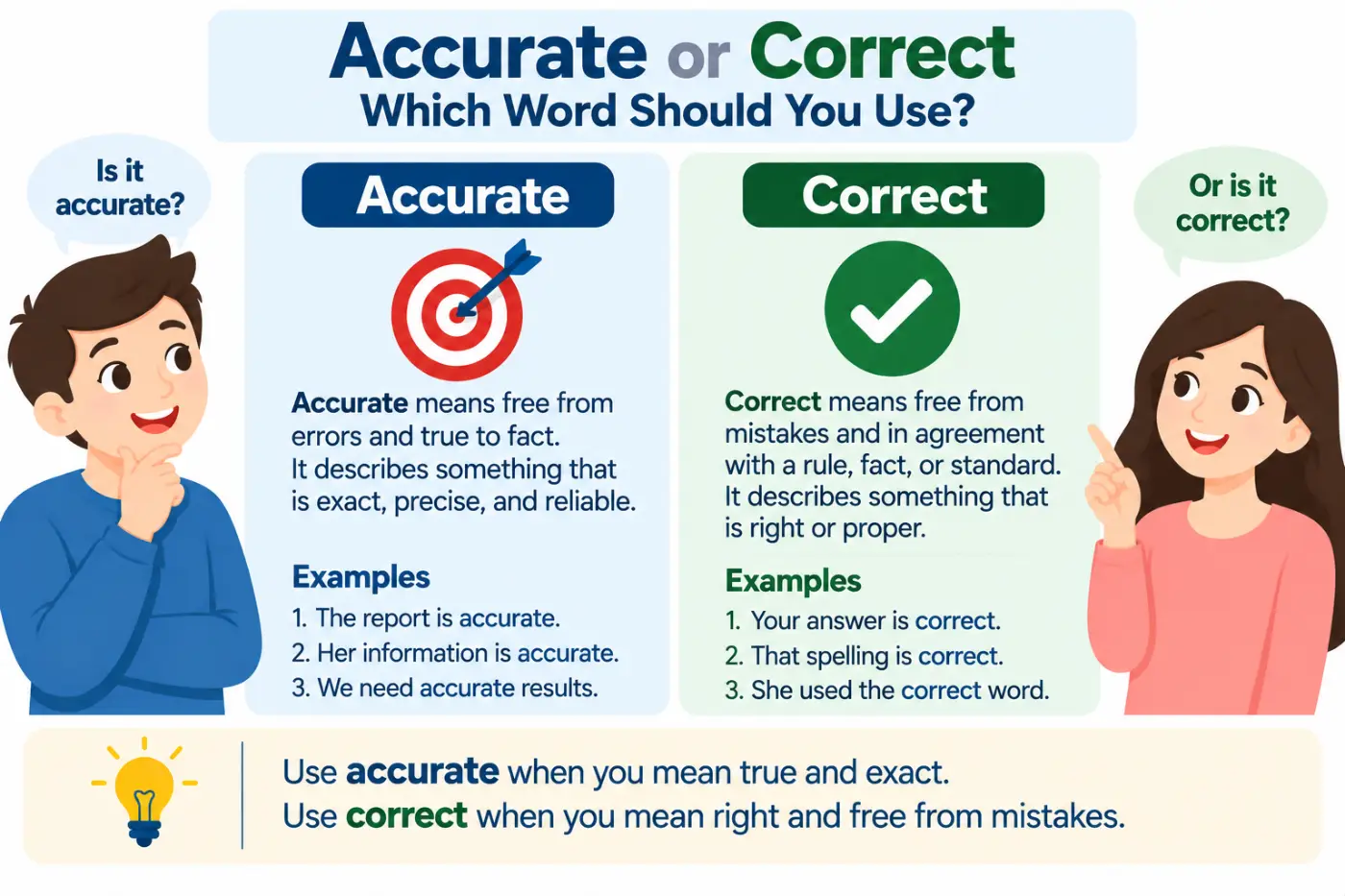
Accurate vs. correct can be a tricky choice because both words describe something that is right or free from errors. You can describe information as accurate or correct, and both words can work when talking about an answer. However, they emphasize different things. Accurate focuses on truth, precision, or closeness to the actual value, while correct emphasizes meeting a fact, rule, standard, or accepted answer.
These meanings often overlap, which is why people sometimes use the words interchangeably. The context usually determines which one sounds more natural. For example, a measurement is accurate when it closely matches the real value. A grammar answer is correct when it follows the accepted rules. Understanding this distinction helps you choose more precise language, especially in academic, professional, and everyday writing.
This guide explores the meanings, grammar patterns, pronunciation, word origins, and common uses of accurate and correct. You’ll also discover when the two words can replace each other, where their meanings differ, and how to choose the best word to make your sentences clearer.
Short Answer
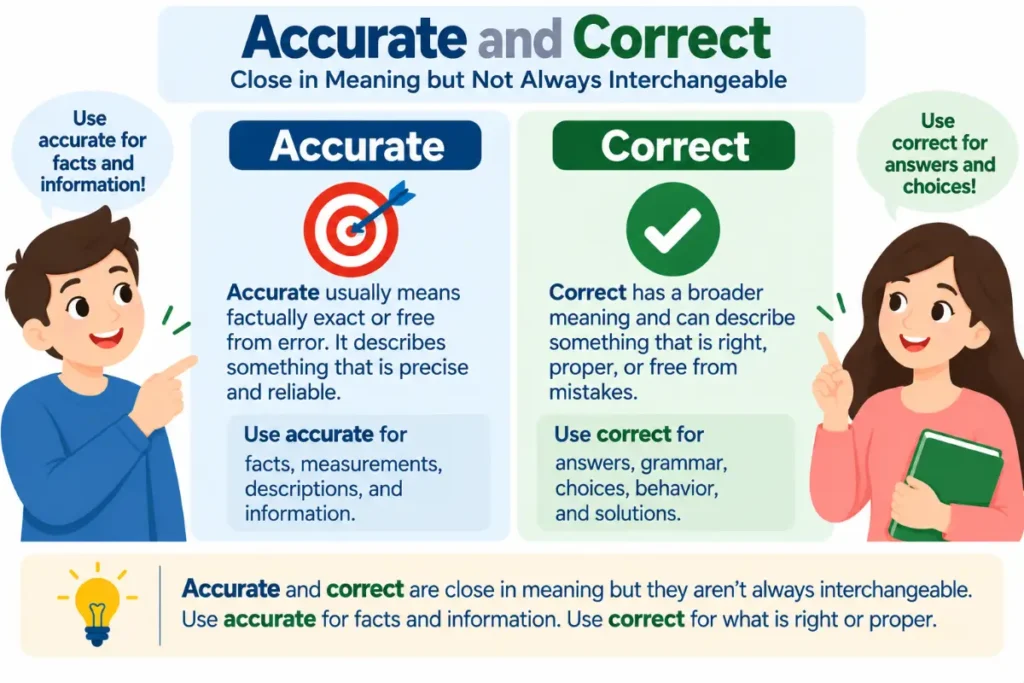
Accurate and correct are close in meaning but they aren’t always interchangeable. Accurate usually means factually exact or free from error. Correct has a broader meaning and can describe something that is right proper or free from mistakes. Use accurate for facts measurements descriptions and information. Use correct for answers grammar choices behavior and solutions.
Table Of Contents
- Quick Answer
- Meaning Of Accurate
- Meaning Of Correct
- Accurate Or Correct In Context
- Key Differences Between The Words
- When Accurate Is The Better Choice
- When Correct Is The Better Choice
- When Both Words Work
- Comparison Table
- Grammar And Part Of Speech
- Pronunciation Guide
- Common Mistakes
- Sentence Examples
- Real Life Usage
- Related Words And Expressions
- Formal And Informal Usage
- American And British English
- Memory Tips
- Expert Editor Insight
- FAQs
- Key Takeaways
- Conclusion
Quick Answer
The simplest distinction is this. Accurate describes something that matches the facts or a real value closely. Correct describes something that agrees with the facts rules standards or expected answer.
Consider two examples.
The weather forecast was accurate.
Your answer was correct.
The forecast was accurate because it closely matched what actually happened. The answer was correct because it matched the accepted solution.
There is plenty of overlap. Still the focus changes slightly.
Meaning Of Accurate
Accurate is an adjective that means correct in facts details measurements or representation. It suggests a close match with reality.
If someone gives an accurate description of a person they describe that person faithfully. If a scale gives an accurate measurement its reading is close to the actual value and If a report contains accurate information its claims match the available facts.
Accuracy often involves precision.
Consider this sentence.
The map provides an accurate picture of the area.
The word accurate tells you that the map represents the area faithfully. The emphasis falls on how closely the representation matches reality.
Accurate can describe information.
The article contains accurate information.
It can describe measurements.
The instrument produced an accurate reading.
It can describe predictions.
Her prediction was surprisingly accurate.
It can also describe descriptions.
That isn’t an accurate description of what happened.
The common thread is a relationship between a statement or representation and reality.
What Accurate Usually Suggests
Accurate often carries one or more of these ideas.
- Factual truth.
- Precision.
- Exact measurement.
- Faithful representation.
- Reliable description.
- Close agreement with reality.
That makes the word especially useful in science business journalism research engineering statistics reporting and technical writing.
Accuracy can sometimes exist on a scale. A measurement can be highly accurate fairly accurate or less accurate. This idea of degree is especially clear when people discuss instruments data forecasts and estimates.
Meaning Of Correct
Correct is an adjective that generally means right or free from error. It can refer to facts answers behavior grammar spelling decisions methods or standards.
For example:
Your answer is correct.
That sentence says the answer agrees with the accepted solution.
You can also say:
Your spelling is correct.
The spelling follows the accepted standard.
Correct has a wider range than accurate. It can describe something that is factually right but can also describe something that follows a rule or expected standard.
Consider this example.
Please use the correct form of the verb.
The word correct works naturally because the issue involves a grammatical rule.
You might also say:
She gave me the correct address.
The address is correct because it identifies the intended location.
Correct can also describe behavior.
The teacher corrected his behavior.
Here the idea has nothing to do with measurement or factual precision. It concerns what is considered right or appropriate.
What Correct Usually Suggests
Correct commonly expresses these ideas.
- Free from error.
- Right according to facts.
- Right according to a rule.
- Appropriate for a situation.
- Accepted by a standard.
- The intended choice.
This broad meaning explains why correct appears in many different situations.
Accurate Or Correct In Context
The choice becomes easier when you focus on what you’re evaluating.
If you’re checking a number against a real measurement accurate is often the natural choice.
The temperature reading is accurate.
If you’re checking an answer against a solution correct usually sounds more natural.
The answer is correct.
If you’re checking a grammar form correct is usually better.
That sentence is grammatically correct.
If you’re describing information that matches verified facts accurate is often stronger.
The report contains accurate data.
If you’re identifying the right option among several choices correct works well.
Choose the correct answer.
These examples show an important pattern. Accurate tends to ask how closely something matches reality. Correct tends to ask if something is right.
Key Differences Between The Words
Difference In Meaning
Accurate emphasizes exactness or factual agreement. Correct emphasizes being right or free from error.
A statement can be correct because it gives the right answer. A statement can be accurate because its details closely match reality.
Difference In Scope
Correct has a broader range of meanings. It can describe facts rules manners choices procedures and behavior.
Accurate has a narrower focus. It commonly describes information measurements descriptions representations estimates and predictions.
Difference In Context
Scientific and technical contexts often favor accurate when discussing measurements data calculations and instruments.
Educational contexts often favor correct when discussing answers spelling grammar and solutions.
Difference In Precision
Accuracy often involves closeness to a real value.
Correctness often involves agreement with an accepted answer rule or standard.
This distinction matters in technical fields. A measurement may be precise but not accurate if it repeatedly gives a value that is far from the true value. Precision and accuracy are related concepts but they aren’t identical.
Difference In Tone
Both words work in formal and informal English. Neither sounds unusually technical by itself.
Accurate can sound more analytical when discussing data or measurements. Correct can sound more direct when judging an answer or choice.
When Accurate Is The Better Choice
Use accurate when you want to emphasize factual reliability or closeness to reality.
Facts And Information
The journalist provided accurate information.
Here accurate tells the reader that the information matches the facts.
Measurements
The device gives accurate measurements.
This is a natural use because measurement can be compared with a real value.
Data
We need accurate data before making the decision.
The focus is on the reliability of the data.
Descriptions
That isn’t an accurate description of the event.
The description doesn’t faithfully represent what happened.
Predictions
The forecast was accurate.
The forecast matched the actual outcome closely.
Estimates
The estimate was remarkably accurate.
The estimate came close to the final value.
Representations
The diagram is an accurate representation of the machine.
The diagram faithfully reflects the actual machine.
When Correct Is The Better Choice
Use correct when you’re talking about rules answers choices standards or actions.
Answers
She gave the correct answer.
This is probably the clearest everyday example.
Grammar
Your sentence is grammatically correct.
The sentence follows accepted grammar rules.
Spelling
The spelling is correct.
The form follows the accepted spelling standard.
Information
The information is correct.
This means the information isn’t false or mistaken. Accurate could also work when the focus is factual reliability.
Decisions
You made the correct decision.
The decision was the right choice for the situation.
Behavior
He corrected the student’s behavior.
Here correct has a different grammatical role and means to make something right or acceptable.
Instructions
Follow the correct procedure.
The procedure is the one required or appropriate for the situation.
When Both Words Work
Some sentences can naturally use either word.
Consider:
The information is accurate.
The information is correct.
Both sentences say the information agrees with reality. Accurate adds a slight emphasis on factual precision. Correct simply says the information is right.
Another example is:
Her answer was accurate.
Her answer was correct.
Both can work if the answer contains factual information. However correct usually sounds more natural when you’re talking about an answer to a question or test.
Now consider:
The report is accurate.
The report is correct.
Both are possible. Accurate suggests that the report faithfully reflects the facts. Correct suggests that the report contains no wrong information.
Context controls the nuance.
Comparison Table
| Feature | Accurate | Correct |
|---|---|---|
| Core meaning | Factually exact or close to reality | Right or free from error |
| Main focus | Accuracy and factual precision | Rightness and conformity |
| Common use | Data measurements descriptions forecasts | Answers grammar spelling choices |
| Part of speech | Adjective | Adjective |
| Can describe facts | Yes | Yes |
| Can describe measurements | Yes | Sometimes but accurate is usually stronger |
| Can describe grammar | Sometimes but correct is more natural | Yes |
| Can describe behavior | Rarely | Yes |
| Formality | Neutral to formal | Neutral to formal |
| Common opposite | Inaccurate | Incorrect or wrong |
| Example | The measurement is accurate. | The answer is correct. |
Grammar And Part Of Speech
Both accurate and correct are adjectives.
They can appear before nouns.
She gave an accurate description.
He chose the correct answer.
They can also appear after linking verbs.
The information is accurate.
The answer is correct.
Accurate With Nouns
Accurate commonly modifies nouns connected with facts or representation.
Common combinations include:
- Accurate information.
- Accurate data.
- Accurate measurements.
- Accurate records.
- Accurate estimates.
- Accurate predictions.
- Accurate descriptions.
- Accurate calculations.
These combinations are especially common in professional and academic writing.
Correct With Nouns
Correct frequently modifies nouns involving rules choices answers or procedures.
Common combinations include:
- Correct answer.
- Correct spelling.
- Correct grammar.
- Correct pronunciation.
- Correct choice.
- Correct procedure.
- Correct method.
- Correct version.
The word can also modify nouns involving factual information.
We have the correct address.
They entered the correct date.
Adverb Forms
The adverb of accurate is accurately.
The machine measures temperature accurately.
The adverb of correct is correctly.
She answered the question correctly.
These forms follow the same basic distinction. Accurately often focuses on factual precision while correctly often focuses on doing something in the right way.
Comparative Forms
Accurate can take more and most.
The new instrument is more accurate.
This is the most accurate estimate so far.
Correct can also take more and most in some contexts but more correct isn’t always the natural choice. Native speakers often use more accurate when discussing degree of accuracy. With correct the expression is more context dependent.
Pronunciation Guide
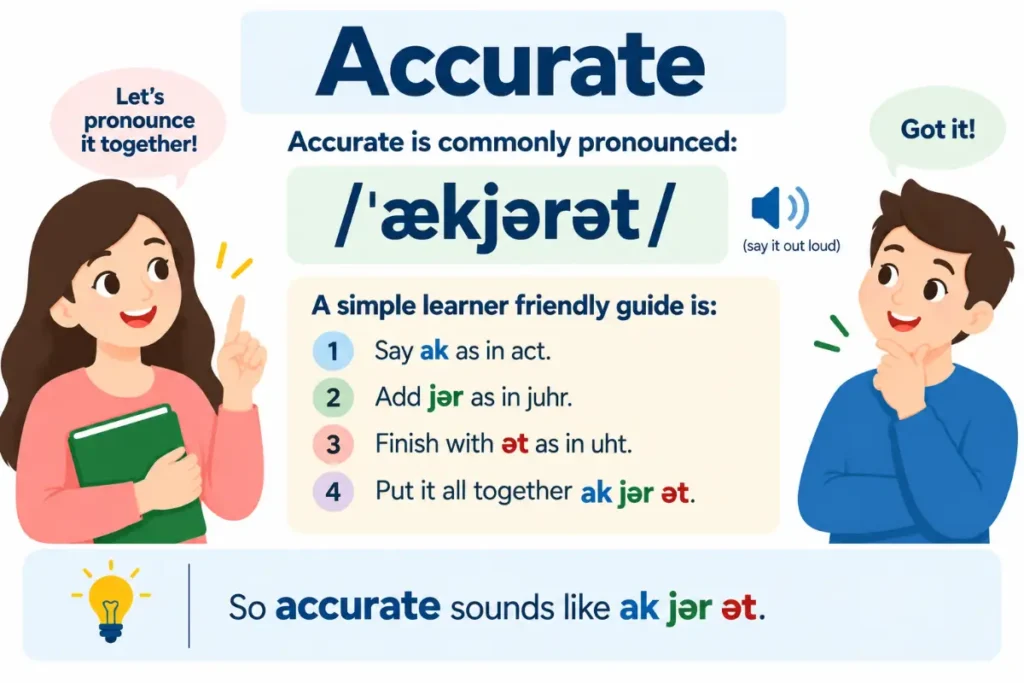
Accurate
Accurate is commonly pronounced:
/ˈækjərət/
A simple learner friendly guide is:
AK yur ut.
The primary stress falls on the first syllable.
The word has three syllables in common American pronunciation.
Correct
Correct is commonly pronounced:
/kəˈrɛkt/
A simple learner friendly guide is:
kuh REKT.
The stress falls on the second syllable.
The final sound is a clear kt combination.
Pronunciation can vary slightly across speakers and accents. The main stress pattern remains the most useful point for learners.
Common Mistakes
Using Accurate For Every Situation
Some writers assume accurate always sounds more sophisticated than correct. That isn’t true.
You wouldn’t normally say:
She gave the accurate answer.
The sentence isn’t necessarily impossible but correct answer is much more natural when discussing a question with an accepted solution.
Using Correct For Measurements
Correct can describe a measurement in some contexts but accurate is often more precise when the focus is closeness to a real value.
The instrument produced an accurate measurement.
This tells the reader exactly what quality you’re discussing.
Treating The Words As Perfect Synonyms
The words overlap but they don’t have identical meanings.
Calling them interchangeable in every sentence can make writing sound awkward or less precise.
Confusing Accurate With Precise
Accuracy and precision aren’t the same concept.
A measurement can be precise because repeated readings are very close to each other. Yet those readings can still be inaccurate if they are far from the true value.
This distinction matters in science engineering statistics and measurement based work.
Using Correct When You Mean Factual Accuracy
Correct is perfectly acceptable for factual information but accurate can be a better choice when you want to emphasize reliable detail.
The database contains accurate records.
That sentence focuses on the quality of the information rather than simply saying the records aren’t wrong.
Sentence Examples
Examples With Accurate
- The scientist recorded accurate measurements during the experiment.
The adjective emphasizes the reliability of the measurements.
- We need accurate information before making a final decision.
The information should match the facts.
- Her description of the accident was accurate.
Her account closely represented what happened.
- The weather forecast proved accurate.
The forecast matched the actual weather.
- The map gives an accurate picture of the region.
The map represents the real area faithfully.
- The accountant prepared an accurate report.
The report contains reliable factual details.
- This scale isn’t accurate enough for laboratory work.
The scale doesn’t measure the true value closely enough.
- The estimate was surprisingly accurate.
The estimate came close to the eventual result.
- The database needs accurate records.
The records should reflect the facts correctly and reliably.
- His memory of the conversation was remarkably accurate.
His recollection closely matched what actually happened.
Examples With Correct
- You selected the correct answer.
The answer matches the accepted solution.
- Please use the correct spelling.
The requested spelling follows the standard form.
- Her grammar is correct.
Her sentence follows accepted grammatical rules.
- He entered the correct address.
The address identifies the intended location.
- We finally found the correct file.
The file is the one we needed.
- That’s the correct way to solve the problem.
The method follows the accepted solution.
- She made the correct choice.
Her decision was the appropriate one.
- Your pronunciation is correct.
The pronunciation follows the accepted form.
- The teacher showed us the correct procedure.
The procedure is the required or accepted method.
- Please make sure the date is correct.
The date contains no error.
Real Life Usage
Daily Conversation
In everyday speech correct often appears when people confirm answers choices or details.
That’s correct.
You have the correct number.
Accurate is common when people discuss information or predictions.
Your description is accurate.
That prediction was pretty accurate.
Workplace Communication
Professional writing uses both words frequently.
The team needs accurate sales data before preparing the report.
Please confirm that the client information is correct.
The first sentence focuses on reliable data. The second focuses on the absence of an error.
Academic Writing
Academic work often uses accurate for data research findings measurements and descriptions.
The study relies on accurate measurements.
Researchers must maintain accurate records.
Correct commonly appears when discussing methods answers interpretations or grammatical form.
The student selected the correct answer.
The calculation is correct.
News And Journalism
Journalists often need accurate information because published claims should reflect verified facts.
The report provides accurate details about the event.
Correct can appear when a previous mistake needs to be fixed.
The newspaper later published the correct figure.
Literature And Storytelling
Both words can appear naturally in narrative writing.
Her memory of the old house was surprisingly accurate.
He finally discovered the correct path through the forest.
The first example focuses on faithful memory. The second focuses on the right choice.
Formal And Informal Usage
Both words are suitable for formal writing.
Accurate works particularly well in technical reports academic research business analysis journalism and scientific writing.
Correct works naturally in academic writing business communication instructions educational material and everyday conversation.
You don’t need to avoid either word in professional writing. The better approach is to choose the word that expresses the intended meaning most precisely.
Compare these sentences.
The report contains accurate financial data.
The report contains correct financial data.
Both can work. Accurate places more emphasis on factual reliability. Correct simply states that the data isn’t wrong.
The difference may seem small but good editing often depends on these small choices.
American And British English
American and British English use accurate and correct in essentially the same way.
There isn’t a major regional distinction in spelling or basic meaning. Both varieties use accurate for factual precision and correct for rightness or conformity to a rule.
Australian and Canadian English follow the same general pattern.
The important distinction is semantic rather than regional. You don’t need a different rule simply because your audience is from another major English speaking variety.
Memory Tips
A simple memory trick can help you choose between the two words.
Think of accurate as connected to actual.
Both ideas point toward reality and factual precision.
Think of correct as connected to rules and answers.
If you’re checking data against reality think accurate.
If you’re checking an answer against a rule or expected solution think correct.
You can also ask yourself a quick question.
Am I asking how closely this matches reality.
If yes accurate may be the better choice.
Am I asking if this is the right answer or accepted form.
If yes correct is usually the better choice.
This isn’t an absolute grammar rule. It’s a practical editing test that helps you choose naturally in most everyday situations.
Related Words And Expressions
Exact
Exact means completely precise or matching a specific value or detail.
The exact amount was $500.
Exact often suggests a higher level of precision than accurate.
Precise
Precise means expressed or measured with great exactness.
The instructions are precise.
Precision and accuracy overlap but describe different qualities.
Right
Right is a broad everyday alternative to correct.
You chose the right answer.
It sounds natural in casual conversation.
Incorrect
Incorrect means not correct or containing an error.
The answer is incorrect.
It directly contrasts with correct.
Inaccurate
Inaccurate means not accurate or not closely matching the facts.
The report contains inaccurate information.
It directly contrasts with accurate.
Exactness
Exactness refers to the quality of being exact.
The exactness of the measurement matters.
Precision
Precision describes fine detail or consistency in measurement or expression.
The instrument offers excellent precision.
Precision isn’t automatically the same as accuracy.
Reliability
Reliability refers to how dependable something is.
The reliability of the data needs further review.
Reliable information can be accurate but the concepts aren’t identical.
Accuracy And Correctness In Professional Writing
Professional writers often need to distinguish factual reliability from compliance with a standard.
Imagine you’re editing a financial report.
You might check that the figures are accurate.
Then you might check that the report follows the company’s correct formatting requirements.
Those are different editorial tasks.
A similar distinction appears in technical documentation. The information needs to be accurate because users depend on factual details. The instructions also need to be correct because they should follow the intended procedure.
This distinction can make workplace writing more precise.
Instead of using correct as a general compliment for every type of quality consider what you’re actually evaluating.
If the issue involves truth or factual detail choose accurate when it expresses that idea best.
If the issue involves rules choices methods or accepted forms choose correct.
Accurate And Correct In Grammar Questions
Grammar creates a particularly clear distinction.
You normally say:
This sentence is grammatically correct.
You can say:
This sentence is accurate.
But the second sentence usually means something different. It suggests that the sentence accurately describes a fact or situation rather than simply following grammar rules.
Consider:
The sentence The meeting starts at nine is grammatically correct.
If the meeting really starts at nine then the sentence is also accurate.
The two qualities can exist together.
A sentence can be grammatically correct but factually inaccurate.
The meeting starts at ten is grammatically correct but inaccurate if the meeting actually starts at nine.
This example captures the distinction beautifully. Grammar determines correctness. Reality determines accuracy.
Accurate And Correct In Data And Research
Research writing often benefits from careful word choice.
Suppose a researcher records a temperature.
An accurate reading is close to the true temperature.
A correct calculation follows the required mathematical method and produces the accepted result.
The terms can overlap because a calculation can also be accurate. Still the focus differs.
Accuracy generally concerns correspondence with reality. Correctness often concerns agreement with an accepted method result or rule.
Researchers also distinguish accuracy from precision for good reason. Repeated measurements can cluster tightly while remaining offset from the true value. That is why professional technical writing should avoid treating these terms as interchangeable labels.
How Editors Choose Between Them
An experienced editor usually looks at the noun being modified before deciding.
If the noun is data measurement estimate description prediction record or representation accurate is often a strong fit.
If the noun is answer spelling grammar choice method procedure version or solution correct is often the natural choice.
There are exceptions because English depends heavily on context.
The best editing decision isn’t always the word that appears most often with a particular noun. Meaning comes first.
A useful test is to replace the adjective with a short phrase.
If you mean matches reality closely then accurate is probably right.
If you mean is the right one or follows the rule then correct is probably right.
That simple test can prevent many awkward choices.
Expert Editor Insight
A professional editor wouldn’t treat accurate and correct as interchangeable synonyms in every sentence. The practical distinction is more useful than a rigid rule. Accurate points toward factual precision and correspondence with reality while correct points toward rightness and conformity to a fact rule standard or expected answer. When editing a sentence I first identify what is being judged and then ask what standard is being used. That approach produces more natural writing than choosing a word simply because it sounds more formal.
Key Takeaways
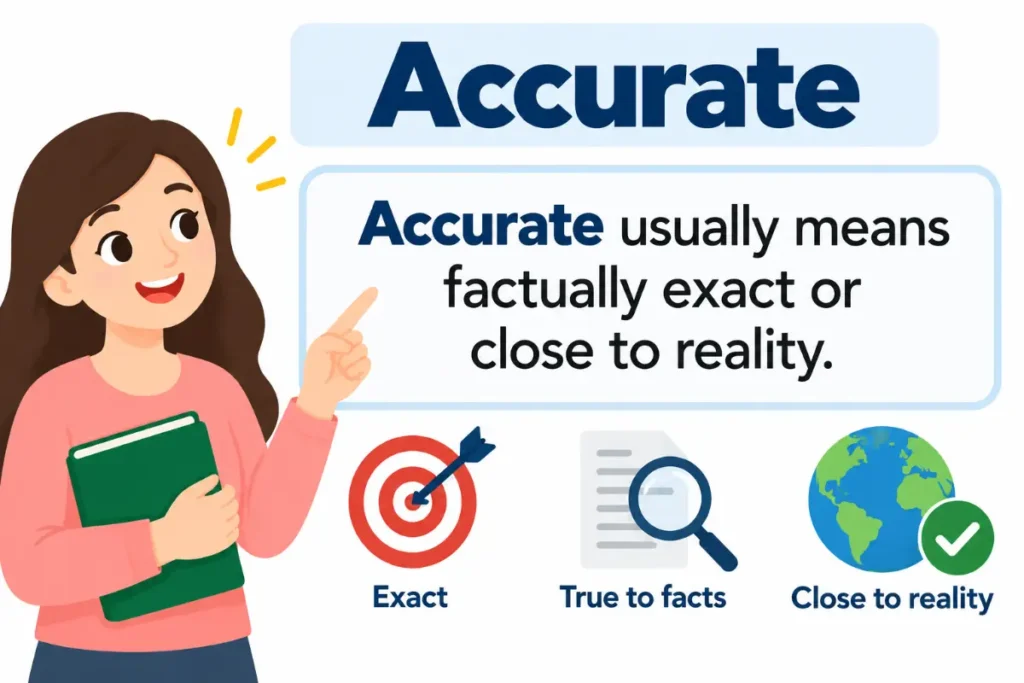
- Accurate usually means factually exact or close to reality.
- Correct usually means right or free from error.
- Accurate commonly describes data measurements descriptions estimates predictions and records.
- Correct commonly describes answers spelling grammar choices procedures and solutions.
- Both words can describe factual information.
- Accurate is closely related to factual precision.
- Correct has a broader meaning connected with rules standards and accepted answers.
- Accuracy and precision aren’t identical.
- The direct opposite of accurate is inaccurate.
- The direct opposite of correct is incorrect or wrong.
- Both words are standard in American English and British English.
- Choose the word based on what you’re actually evaluating.
Conclusion
Accurate vs. Correct is not a choice between a good word and a bad one. Both are standard English adjectives, but they emphasize different aspects of being right. Accurate focuses on factual precision and how closely something matches reality. Correct focuses on meeting the facts, rules, standards, or expectations.
Use accurate when describing information, data, measurements, estimates, predictions, or factual records. Use correct for answers, spelling, grammar, choices, procedures, and methods that need to follow a rule or meet a standard. In some situations, both words work because accuracy and correctness can overlap.
An easy way to remember the difference is to think of accurate as matching reality and correct as meeting a rule or giving the right answer. Keeping this distinction in mind makes it easier to choose the right word for your sentence.
FAQs
Is Forward or Forwards Correct?
Both forward and forwards are correct in modern English. They can describe movement toward the front or progress toward a later point. American English generally prefers forward, while British English commonly uses both forms. If you’re writing for an American audience, forward is usually the safest choice.
Is Forward or Forwards More Common in American English?
American English generally favors forward when the word functions as an adverb. Common examples include “step forward,” “move forward,” and “I look forward to hearing from you.” Although forwards is also used in American English, it is less common in these everyday expressions.
Is Forwards Wrong in American English?
No. Forwards is a valid English word that American readers readily understand. However, American English typically favors forward as an adverb. When writing for a US audience, forward is generally the preferred option unless you’re following a particular style or preserving a quotation.
Do British People Say Forward or Forwards?
British speakers use both forms. Forwards is common when describing physical movement, as in “step forwards” or “move forwards.” However, forward is equally standard in many contexts. The choice often depends on personal preference, context, and editorial style, so forwards should not be considered incorrect in British English.
Should I Write Look Forward or Look Forwards?
The standard expression is look forward to. For example, “I look forward to hearing from you” is a widely accepted phrase in professional emails and everyday communication. This construction is common in both American and British English, making it the best choice for formal writing.
What Is the Difference Between Forward and Forwards?
When used as adverbs, forward and forwards generally have the same meaning. Both can describe movement toward the front or progress toward a later stage. The main difference is regional preference: American English generally favors forward, while British English commonly accepts both forms.
Is Forward an Adverb or an Adjective?
Forward can function as an adverb, an adjective, or a verb, depending on the sentence.
- Adverb: “Please move forward.”
- Adjective: “The forward section is reserved for passengers.”
- Verb: “Please forward the email to your manager.”
Its grammatical role depends on how it is used in context.
Can Forwards Be a Noun?
Yes. Forwards can be the plural form of the sports noun forward, referring to players who occupy forward positions on a team. For example, “The team has three forwards.” This use is different from the adverb forwards, which describes movement toward the front.
Which Form Should I Use in an American Essay?
Use forward in most cases, particularly when it functions as an adverb. Expressions such as “move forward,” “step forward,” and “look forward to hearing from you” are standard choices in American English. However, forwards remains correct when used as a plural noun in sports contexts.
Is Forward Used in British English?
Yes. Forward is widely used in British English and is not exclusive to American English. British writers may use either forward or forwards, depending on the context and their preferred style. Both “move forward” and “move forwards” are acceptable in British English.
What Is the Opposite of Forward?
The most direct opposites are backward and backwards. Both describe movement toward the rear or, figuratively, a return to an earlier stage. American English generally favors backward, while British English commonly uses both forms. For example, “Take a step backward” and “Take a step backwards” are both grammatically correct.
Why Does British English Add an S to Forwards?
English has several adverbs that exist in both shorter and -s forms, including forward/forwards, backward/backwards, and toward/towards. These are accepted variants rather than a correct form and an incorrect one. British English commonly retains the longer forms in everyday usage, while American English generally favors the shorter alternatives.

Confusing Words, Spelling & Word Choice
Claire Whitmore is a U.S.-based English editor who writes about commonly confused words, spelling differences, and word choice. Her work helps readers understand subtle distinctions between similar-looking words through simple definitions, practical examples, and modern usage guidance in both American and British English.