
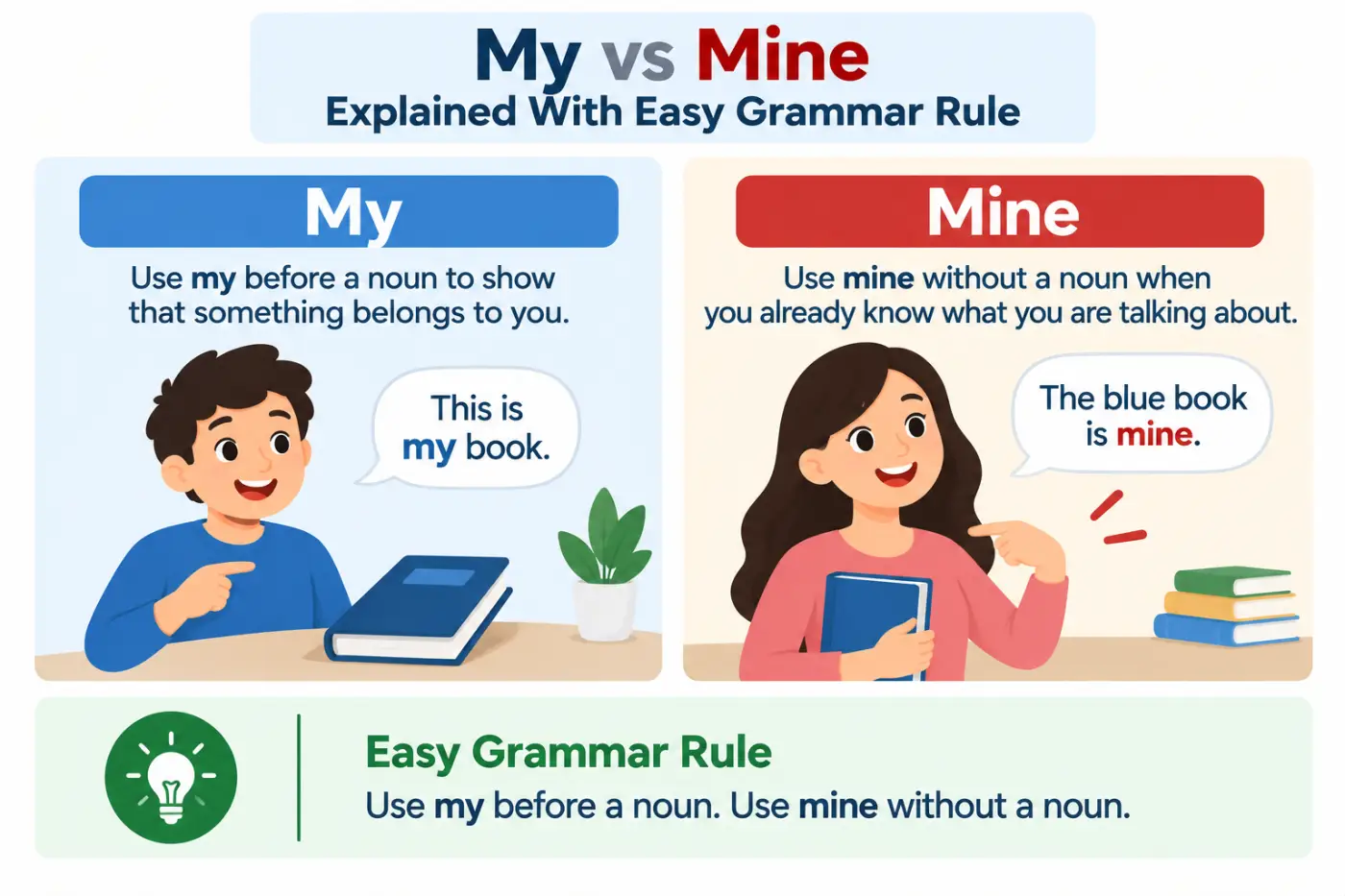
My vs Mine can confuse English learners because both words show that something belongs to someone. They have the same basic connection to possession but they don’t fit into the same grammatical position. If you say This is my or This is mine the second sentence is correct because mine can stand on its own while my needs a noun after it.
The difference becomes much easier once you look at what comes next. My is a possessive determiner that comes before a noun. Mine is a possessive pronoun that replaces a noun phrase. Native speakers use both forms constantly in American English so learning this distinction will help your writing and everyday speech sound much more natural.
You don’t need to memorize a complicated grammar rule. Think about the word that follows the possessive form. If a noun comes directly after it use my. If no noun follows because the ownership is already clear use mine. That small test solves most problems immediately.
Short Answer
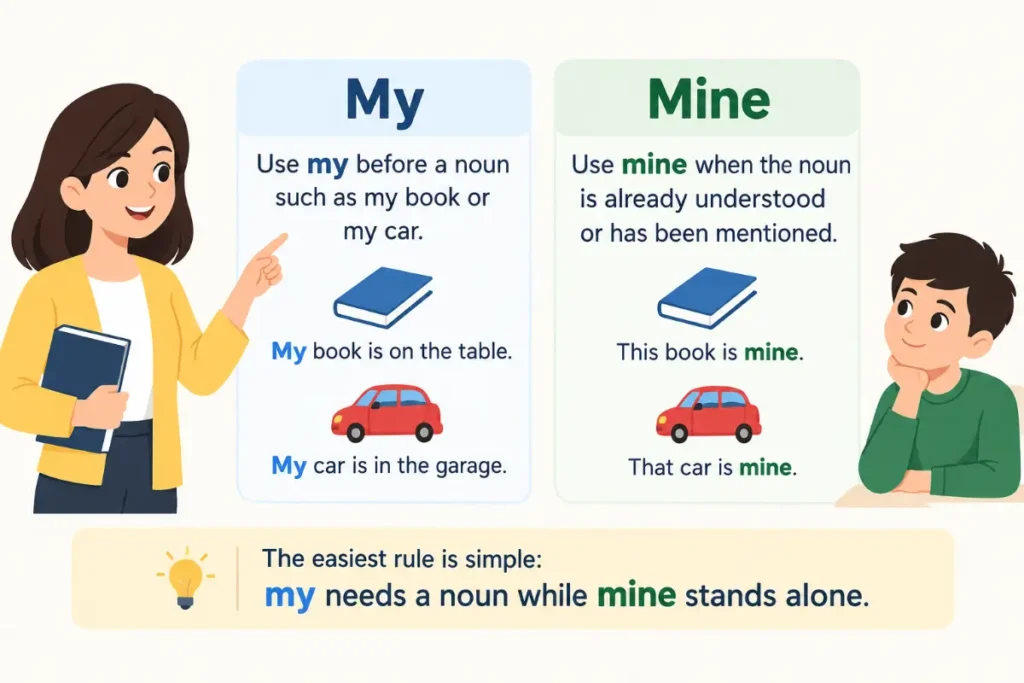
My and mine both show possession but they work differently in a sentence. Use my before a noun such as my book or my car. Use mine when the noun is already understood or has been mentioned such as This book is mine. The easiest rule is simple: my needs a noun while mine stands alone.
Table Of Contents
- Quick grammar rule.
- What my means.
- What mine means.
- The main difference.
- How my works before nouns.
- How mine replaces noun phrases.
- Examples in everyday English.
- Common mistakes.
- Pronunciation guide.
- Grammar patterns.
- Formal and informal usage.
- American and British English.
- Memory tricks.
- Related possessive words.
- Expert editor insight.
- FAQs.
- Key takeaways.
- Conclusion.
Quick Grammar Rule
The quickest way to remember the difference is to look at what comes after the word.
My comes directly before a noun.
My phone is on the table.
Mine replaces the phrase that contains the noun.
The phone is mine.
You can think of my as a word that points toward a noun. Mine carries the possession idea by itself.
This distinction also explains why you can’t normally use my alone.
Incorrect: This book is my.
Correct: This book is mine.
Likewise you normally don’t put mine directly before a noun.
Incorrect: Mine book is on the desk.
Correct: My book is on the desk.
Once you understand this pattern you can apply it to many other possessive pairs such as your and yours or our and ours.
Meaning And Definition
What My Means
My shows that something belongs to or is connected with the speaker. It normally comes before a noun.
My is traditionally classified as a possessive determiner. Some grammar references use the term possessive adjective because it modifies a noun. The term possessive determiner is more precise in many modern grammar systems.
Consider this sentence.
My sister lives in Chicago.
The word my identifies whose sister the speaker means. It doesn’t stand by itself. It works with sister to create the noun phrase my sister.
Here are more examples.
My computer needs an update.
My idea worked.
In every example my appears before a noun.
The noun doesn’t have to describe a physical object. It can refer to a person idea event feeling or abstract concept.
My decision was difficult.
My goal is simple.
The same grammatical rule applies.
What Mine Means
Mine expresses possession without placing a noun immediately after it. It is a possessive pronoun.
For example:
That jacket is mine.
The word mine tells us that the jacket belongs to the speaker. We don’t need to repeat the noun phrase my jacket because the meaning is already clear.
Compare these sentences.
That is my jacket.
That jacket is mine.
Both sentences communicate ownership. The first uses my before jacket. The second uses mine after the noun.
Mine can also appear as the subject of a sentence.
Mine is the blue car.
Here mine means my car. The noun car is understood from context.
This is why mine can sometimes feel longer or more independent than my. It carries the possessive meaning without needing a noun directly after it.
The Main Difference
The central difference isn’t meaning. Both forms can express possession.
The difference is grammatical function.
- My comes before a noun.
- Mine replaces a noun phrase.
- My cannot normally stand alone in standard English.
- Mine can stand alone.
- My is followed by a noun.
- Mine is commonly used after a linking verb or as an independent noun phrase.
Compare these pairs.
My house is large.
The large house is mine.
My answer was correct.
The correct answer was mine.
My seat is near the window.
That seat is mine.
My dog likes to sleep outside.
The dog is mine.
The ownership stays the same. The grammatical structure changes.
This pattern appears across English possessive forms. Understanding it gives you a foundation for other pairs too.
How My Works Before Nouns
My favorite blue shirt is clean.
Notice that adjectives can appear between my and the noun. The key point is that my belongs to the noun phrase and helps identify the owner.
You can also use my before singular and plural nouns.
My brother is here.
My books are missing.
The noun can also be uncountable.
My can introduce a noun phrase that contains several words.
The word my still performs the same grammatical job. It identifies the relationship between the speaker and the noun phrase.
One useful point for learners is that my doesn’t change based on the gender or number of the noun.
The possessive form stays my.
How Mine Replaces Noun Phrases
Mine has a different job. It replaces a noun phrase that would otherwise contain my.
Look at this exchange.
Whose notebook is this?
It’s mine.
The complete meaning is It’s my notebook but repeating notebook isn’t necessary.
Mine can make sentences shorter and more natural when the object has already been identified.
Your car is faster than mine.
Here mine means my car.
Her house is bigger than mine.
Mine means my house.
Their team played better than ours.
This sentence shows that English has a family of possessive pronouns. Mine works in the same general pattern as yours ours his hers and theirs.
Mine can also appear as a subject.
Your idea sounds good but mine may work better.
In this sentence mine means my idea.
The noun disappears because the listener already understands it.
My vs Mine In Everyday English
The distinction becomes very clear in ordinary conversations.
Imagine two people looking at phones.
Person A says:
Is that your phone?
Person B says:
No. It’s my phone.
Or:
No. It’s mine.
Both are grammatical. The first repeats the noun. The second avoids repetition.
Now imagine someone asks:
Whose keys are these?
You could answer:
They’re my keys.
Or more naturally:
They’re mine.
This flexibility is one reason possessive pronouns are useful. They allow speakers to avoid repeating information that everyone already understands.
Another example involves food.
This is my sandwich.
That sandwich is mine.
The meaning remains almost identical but the grammatical structure changes.
The choice depends on the position of the possessive form rather than on a different kind of ownership.
Sentence Examples
Here are natural examples that show how the two forms work.
- My laptop is on the kitchen table.
My comes before laptop because laptop is the noun being identified.
- That laptop is mine.
Mine replaces my laptop because the noun has already been mentioned or is obvious.
- My sister works at a local hospital.
My comes before sister.
- The blue jacket is mine.
Mine tells us that the blue jacket belongs to the speaker.
- I forgot my wallet at home.
My introduces wallet.
- You can use the seat beside mine.
Mine refers to my seat without repeating the noun.
- My answer wasn’t very clear.
My comes before answer.
- Your answer is different from mine.
Mine means my answer.
- My children love reading.
My comes before children.
- Their children are older than mine.
Mine means my children.
- I brought my notebook to class.
The noun notebook follows my.
- I think this notebook is mine.
Mine stands alone after the linking verb is.
- My office is on the second floor.
My identifies the office as belonging to the speaker.
- The office on the second floor is mine.
Mine replaces my office.
- My opinion hasn’t changed.
My comes before opinion.
- Your opinion is different from mine.
Mine means my opinion.
These examples show a reliable pattern. The words communicate the same basic idea of possession but they occupy different grammatical positions.
Common Mistakes
Using My Alone
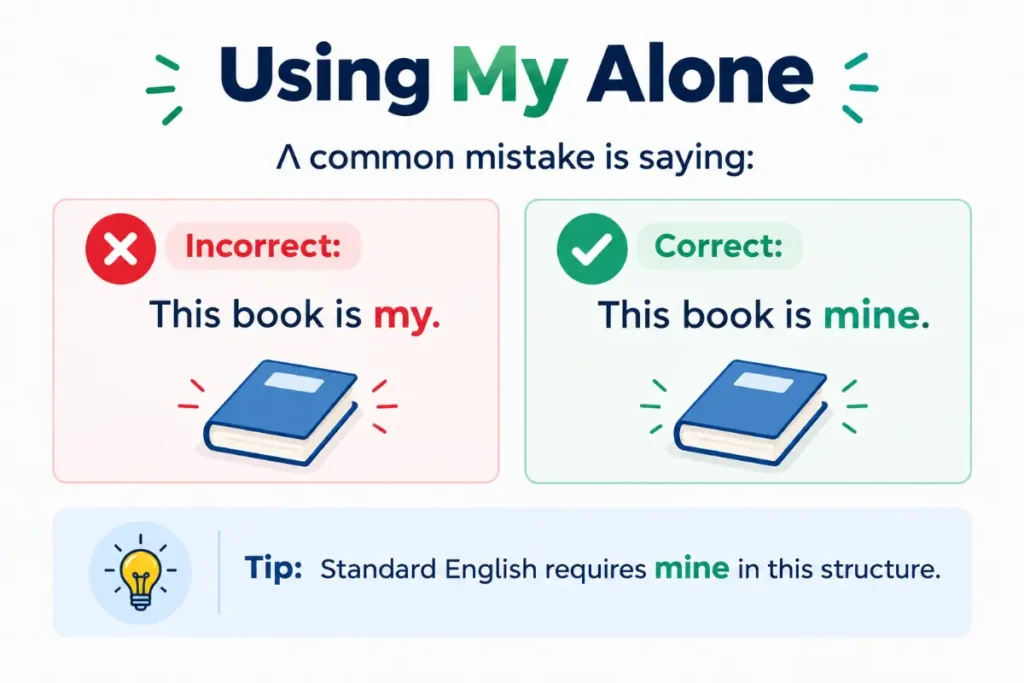
A common mistake is saying:
This book is my.
Standard English requires mine in this structure.
Correct:
This book is mine.
The problem happens because learners recognize my as the possessive form and try to use it everywhere possession appears.
Putting Mine Before A Noun
Another mistake is writing:
Mine car is outside.
The correct sentence is:
My car is outside.
Mine doesn’t normally function as a determiner before a noun.
Confusing Mine With Me
Mine and me have completely different grammatical functions.
Me is an object pronoun.
Mine is a possessive pronoun.
Compare:
She called me.
The book is mine.
The first sentence describes someone receiving an action. The second expresses ownership.
Using My After A Linking Verb
Learners sometimes transfer the structure of another language and write:
That phone is my.
Standard English uses mine.
That phone is mine.
Repeating The Noun Unnecessarily
English allows both structures but repeating the noun can sound clumsy when the listener already knows what you’re talking about.
This is my car and that is your car.
This is my car and that is yours.
The second version is often smoother because yours replaces your car.
Pronunciation Guide
My is pronounced /maɪ/.
It rhymes with words such as sky high and try.
Mine is pronounced /maɪn/.
It has the same main vowel sound as my but adds a final n sound.
The difference is easy to hear when you say them slowly.
My.
Mine.
The spelling also reflects the sound difference. My ends with the long i sound. Mine has the same vowel followed by n.
In natural speech my can become very short and unstressed.
My brother is here.
The possessive form may sound lighter than the emphasized word my.
Mine often receives more stress because it can stand alone.
That one’s mine.
For learners the key pronunciation point is simple. Don’t add an n sound to my. Don’t drop the n from mine.
Grammar Patterns To Remember
Several sentence patterns make the distinction especially easy.
My Plus Noun
My plus noun is one of the most common patterns.
The noun can have adjectives.
My new house is small.
My first job started early.
Noun Plus Be Plus Mine
Mine often appears after forms of be.
The book is mine.
Those shoes are mine.
That seat is mine.
The documents are mine.
The same structure works with different subjects.
This one is mine.
That one is mine.
These are mine.
Those are mine.
Possessive Determiners And Possessive Pronouns
The technical grammar terms can make this topic sound harder than it is.
A possessive determiner comes before a noun.
My car.
Your car.
Her car.
Our car.
Their car.
A possessive pronoun stands in place of the noun phrase.
Mine.
Yours.
Hers.
Ours.
Theirs.
His can work in both structures because English doesn’t change the form.
His car is outside.
The car is his.
The basic pattern looks like this.
| Possessive Determiner | Possessive Pronoun | Example |
|---|---|---|
| My | Mine | My book is new. The book is mine. |
| Your | Yours | Your phone is ringing. The phone is yours. |
| His | His | His coat is black. The coat is his. |
| Her | Hers | Her bag is here. The bag is hers. |
| Our | Ours | Our house is nearby. The house is ours. |
| Their | Theirs | Their car is outside. The car is theirs. |
This table reveals an important pattern. The possessive determiner normally needs a noun. The possessive pronoun doesn’t.
Possession With Of
English also has another common structure using of.
The color of my car is red.
A friend of mine called yesterday.
The second pattern is especially useful.
A friend of mine.
A colleague of mine.
An old teacher of mine.
This structure means one of my friends or one of my colleagues. It doesn’t mean that mine changes into a different kind of word. Mine remains a possessive pronoun.
Notice the difference between these forms.
My friend called me.
A friend of mine called me.
Both are correct. The second construction often sounds natural when introducing someone as one person among several people connected to the speaker.
Formal And Informal Usage
Both my and mine are standard English forms. Neither one is limited to casual speech.
You can use them in everyday conversation.
My car is outside.
That car is mine.
You can also use them in formal writing.
My research focuses on language learning.
The final decision was mine.
Academic writing uses possessive forms naturally too.
My analysis supports the proposed explanation.
The responsibility for the decision was mine.
There is no reason to avoid either word in formal writing. The main concern is grammatical accuracy and clear meaning.
American English And British English
American and British English use my and mine in essentially the same way.
The grammatical distinction does not change across these varieties.
An American speaker might say:
That is my book.
A British speaker can use the same structure.
That is my book.
Likewise:
That book is mine.
The possessive forms remain standard in both varieties.
Australian English and Canadian English follow the same basic pattern as well. There isn’t a major regional spelling difference to learn here.
Pronunciation can vary slightly among accents but the grammatical roles remain stable.
Memory Tips
A simple memory trick can make this distinction almost automatic.
My Needs A Noun
Think of my as a word that needs a partner.
My book.
My idea.
The noun comes next.
Mine Can Stand Alone
Think of mine as independent.
The book is mine.
The car is mine.
The house is mine.
The idea is mine.
No noun follows mine directly.
Use The Question Test
Ask yourself what you want to say.
If the answer contains a noun immediately after the possessive word use my.
If the noun has already been mentioned and you don’t need to repeat it use mine.
For example:
Whose pen is this?
It’s mine.
If you want to name the object again:
It’s my pen.
This test works quickly in conversation.
Connect Mine With Ownership
Mine contains an n sound. You can think of that final sound as giving the word enough strength to stand alone.
This isn’t a linguistic rule. It’s simply a memory aid.
My And Mine In Questions
Questions often make the difference especially clear.
Is this my seat?
Here my comes before seat.
Is this mine?
Here mine stands alone because seat is understood.
You can also ask:
Is that my jacket?
Is that jacket mine?
Both are correct but the sentence structures differ.
Another useful question is:
Whose phone is this?
The answer can be:
It’s my phone.
Or:
It’s mine.
The second response is often shorter because the noun phone has already appeared in the question.
My And Mine In Comparisons
Possessive pronouns become especially useful when comparing things.
My car is newer than yours.
Your house is larger than mine.
Their team is stronger than ours.
Her answer was clearer than his.
The pattern avoids unnecessary repetition.
Instead of saying:
Your house is larger than my house.
You can say:
Your house is larger than mine.
Both are grammatical. The second version is more concise.
This is one reason possessive pronouns matter in polished writing. They allow you to keep a sentence clear without repeating the same noun.
My And Mine In Workplace Writing
Possessive forms appear frequently in professional communication.
Please send the document to my office.
That account is mine.
My department will review the request.
The final responsibility is mine.
The grammar doesn’t become different just because the setting is professional.
However clear writing often benefits from avoiding unnecessary repetition.
For example:
My proposal is stronger than your proposal.
My proposal is stronger than yours.
The second sentence is shorter and usually sounds more natural.
In business writing this kind of small improvement can make communication cleaner.
My And Mine In Academic Writing
Academic writers use possessive forms when identifying research ideas arguments responsibilities and sources of information.
My analysis focuses on sentence structure.
The interpretation presented here is mine.
My argument differs from the earlier position.
The final conclusion is mine.
The choice depends on sentence structure rather than academic formality.
One point is worth remembering. Possessive language can sometimes sound overly personal in academic writing depending on the discipline and context. That is a style question rather than a grammar problem. My and mine themselves are completely grammatical.
Why Learners Confuse These Words
The confusion usually comes from their shared meaning.
Both words communicate possession. A learner may therefore assume they can be swapped freely.
English doesn’t work that way.
Many grammatical forms have related meanings but different positions. Consider I and me. Both refer to the speaker but they cannot appear in exactly the same places.
My and mine follow a similar principle.
Another source of confusion is that some languages express possession with a single form instead of separate forms. Learners may transfer that structure into English and use my where native speakers expect mine.
The solution isn’t memorizing dozens of examples. Learn the structural rule.
My comes before the noun.
Mine replaces the noun phrase.
That distinction gives you a reliable framework.
Expert Editor Insight
An experienced editor usually checks possessive words by looking at the structure around them rather than treating my and mine as interchangeable vocabulary. If a noun immediately follows the word then my is normally the right choice. If the noun has already been identified and the possessive form stands alone then mine is usually appropriate. Grammar tools may flag incorrect combinations but understanding the sentence structure is more useful than relying on automatic correction alone.
Key Takeaways
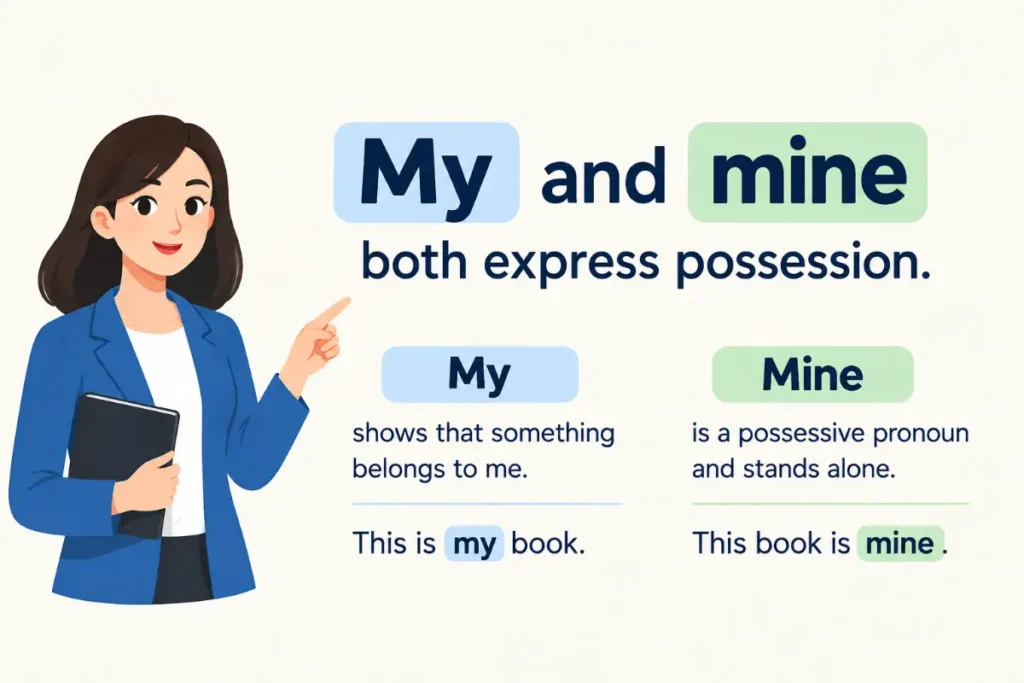
- My and mine both express possession.
- My normally comes before a noun.
- Mine replaces a noun phrase.
- My book is correct.
- The book is mine is correct.
- My cannot normally stand alone as a possessive form.
- Mine doesn’t normally come directly before a noun.
- Both forms are standard in American English.
- Both forms are also standard in British Canadian and Australian English.
- The easiest memory rule is my needs a noun while mine can stand alone.
Conclusion
My vs Mine becomes simple once you focus on sentence structure instead of meaning alone. My comes before a noun as in my car or my idea. Mine replaces the noun phrase as in the car is mine or the idea is mine. Both forms express possession but they perform different grammatical jobs.
The easiest way to remember the distinction is to look at what follows the possessive word. If a noun comes next use my. If the noun is already understood and the possessive form stands alone use mine. This same pattern also helps you understand pairs such as your and yours or our and ours.
When you’re proofreading check the word immediately after the possessive form. My needs a noun. Mine doesn’t. That quick test can catch most errors before they reach the page and will make your English sound more natural and precise.
FAQs
What is the difference between my and mine?
My comes before a noun and identifies the person who owns or is connected with that noun. Mine stands alone and replaces a noun phrase that would otherwise contain my. For example my book uses my before the noun while the book is mine uses mine without repeating the noun phrase.
Is my a possessive pronoun?
In many modern grammar descriptions my is called a possessive determiner because it comes before and determines a noun. Some traditional grammar systems call it a possessive adjective. The important practical point is that my normally needs a noun after it while mine functions as a possessive pronoun and can stand alone.
Can I say this book is my?
No. Standard English requires mine in that sentence. You should say this book is mine. The word my needs to come before a noun such as my book. Once the noun is already understood you can use mine instead. This structural rule applies regardless of how formal or informal the sentence is.
Can mine come before a noun?
Normally no. You shouldn’t say mine car or mine house in standard English. Use my before a noun instead. Say my car and my house. Mine is normally used without a following noun because it replaces a noun phrase. For example the car is mine means the same basic thing as the car is my car.
Is mine more formal than my?
Neither word is inherently more formal. Both are standard English forms used in conversation professional writing academic work and other settings. The choice depends on grammar rather than formality. Use my before a noun and mine when the noun phrase has been replaced. Context determines the style but not the basic grammatical distinction.
How do you remember the difference between my and mine?
Use the simple rule my needs a noun while mine can stand alone. Say my phone because phone follows the possessive determiner. Say the phone is mine because mine replaces my phone. You can also ask yourself if the noun is being stated directly. If it is use my. If it is understood use mine.
Are my and mine pronounced differently?
Yes. My is pronounced /maɪ/ while mine is pronounced /maɪn/. Both contain the same main vowel sound but mine has a final n sound. My rhymes with sky and try. Mine rhymes with fine and line. In fast speech my can sound very short because it is often unstressed.
Is mine always used after a noun?
No. Mine often appears after a noun phrase and a form of be such as the book is mine. However it can also act as a noun phrase on its own. For example mine is the larger one. In that sentence the listener understands the missing noun from context. Mine doesn’t require a noun directly before it.

English Grammar & Usage
Nathan Holloway is an American grammar writer and language researcher who specializes in English grammar, sentence structure, verb usage, and common writing mistakes. He enjoys breaking down confusing grammar rules into practical explanations with clear examples, making English easier for students, professionals, and everyday writers.