
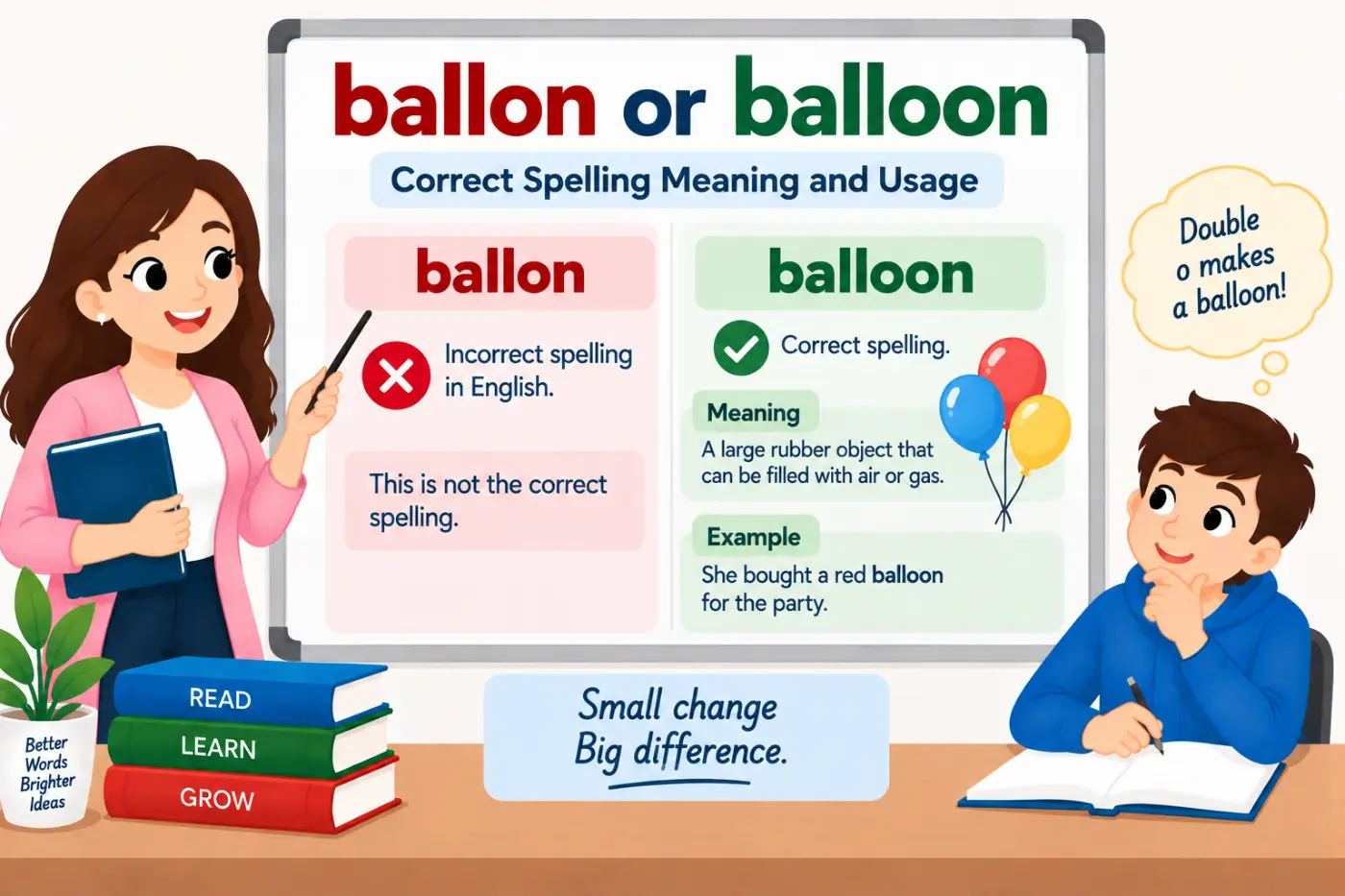
Ballon or balloon is an easy spelling mistake to make because the two forms look almost identical. The correct spelling is balloon. The form ballon is normally incorrect in standard American English when you mean the familiar inflatable object or a hot air aircraft.
The confusion often comes from the unusual letter pattern. The word contains two l letters followed by two o letters. When people type quickly they may drop one letter and produce the shorter form. Another reason is that English contains many words where doubled letters are not strongly noticeable in speech. You hear the word clearly but the pronunciation does not remind you to write every repeated letter.
The correct form has several meanings and uses. It can be a noun for an inflatable object or aircraft and it can also work as a verb meaning to expand or swell. This guide explains the spelling difference meaning pronunciation grammar word origin regional usage common mistakes and natural examples so you can use the word confidently.
Short Answer
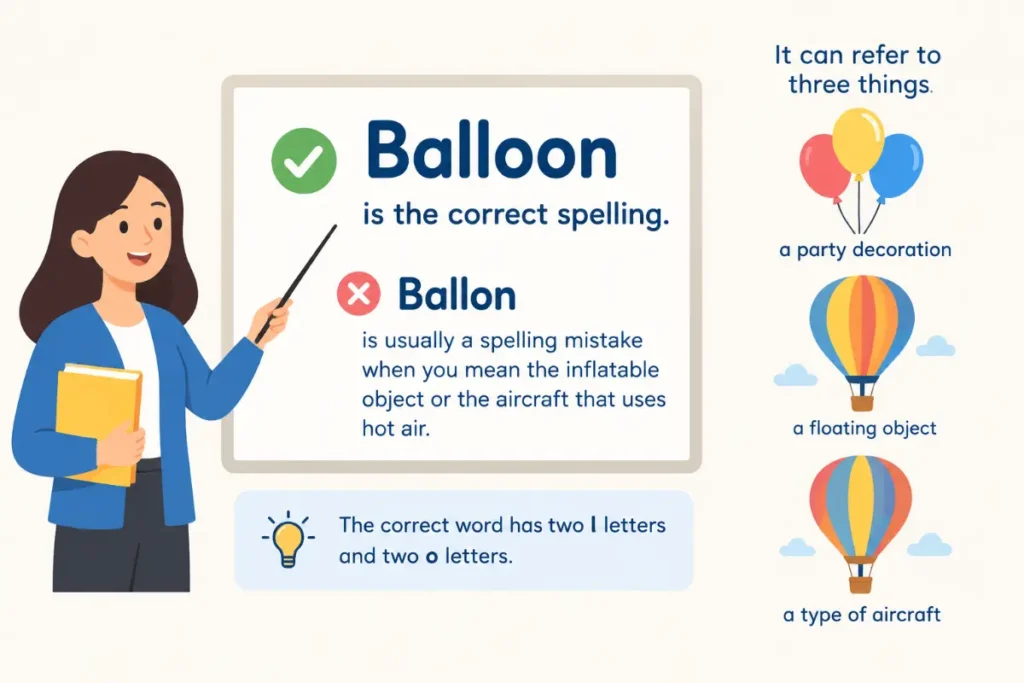
Balloon is the correct standard English spelling. Ballon is usually a spelling mistake when you mean the inflatable object or the aircraft that uses hot air. The correct word has two l letters and two o letters. It can refer to a party decoration a floating object or a type of aircraft.
Table of Contents
- Quick Answer
- Meaning of the Two Forms
- Why the Spelling Causes Confusion
- Key Differences
- Which Spelling Is Correct
- Sentence Examples
- Common Spelling Mistakes
- Pronunciation Guide
- Etymology and Word Origin
- Regional Usage
- Grammar and Part of Speech
- Different Meanings of Balloon
- Common Expressions
- Real Life Usage
- Related and Confused Words
- Memory Tips
- Expert Editor Insight
- FAQs
- Key Takeaways
- Conclusion
Meaning of the Two Forms
Meaning of Ballon
Ballon is not normally the standard English spelling for the word most people mean in this comparison. If someone writes about a birthday decoration and types ballon the intended word is almost certainly balloon.
The shorter spelling can appear for several reasons. A writer may type too quickly. A learner may remember the general sound but not the repeated letters. Someone working across languages may also encounter related words that use different spelling patterns.
There is another important detail. Similar forms can exist in other languages or specialized contexts. For example French uses ballon for a ball or balloon depending on context. That foreign language spelling does not make ballon the standard spelling of the English word.
So context matters. If you are writing ordinary English for an American audience and you mean the object that floats or can be filled with air use balloon.
Meaning of Balloon
Balloon is a noun and a verb.
As a noun it commonly means a flexible object filled with air or another gas. Children may play with balloons at parties and people often use them for decoration.
The word can also describe a large aircraft that rises because heated air or a lighter than air gas provides lift.
For example:
The balloon floated above the crowd.
The second major use is figurative or descriptive. A person can say that a cost ballooned when it increased very quickly.
For example:
The project cost ballooned after several unexpected delays.
Here the word is a verb. It doesn’t mean that an actual balloon appeared. Instead it creates a vivid image of something expanding rapidly.
That figurative use is common in journalism business writing and everyday speech.
Why the Spelling Causes Confusion
The spelling looks simple until you have to type it from memory. The word has several repeated letters in a row and that creates a natural trap.
The first challenge is the double l.
Many English words contain double consonants but speakers don’t pronounce the letters individually. When you hear balloon you hear one l sound rather than a separate sound for each written l. A learner who relies heavily on sound may therefore write only one.
The second challenge is the double o.
The two o letters are part of the established spelling and help create the long vowel sound. English spelling has many vowel patterns that cannot be predicted perfectly from pronunciation.
Typing habits also play a role. Repeated letters are easy to omit when someone is writing quickly on a phone keyboard. The error can survive proofreading because the incorrect form still looks plausible.
There is also a cross language factor. English learners may have seen related words in another language where the spelling is ballon or a similar form. That can create interference when switching back to English.
The best solution is not to rely on pronunciation alone. Learn the complete spelling and connect it with familiar related words.
Key Differences
- Spelling. Balloon has two l letters and two o letters. Ballon has one l and is normally incorrect in standard English for this meaning.
- Meaning. Balloon has established English meanings related to inflatable objects aircraft and rapid expansion.
- Grammar. Balloon can function as both a noun and a verb.
- Pronunciation. The word has two syllables with the main stress on the second syllable.
- Formality. Balloon works in casual speech professional writing journalism academic writing and literature.
- Context. You can use it for parties weather science aviation economics business and everyday conversation.
- Regional usage. The standard spelling remains balloon across major English varieties.
- Standard usage. Balloon is the accepted English form for the meanings discussed here.
- Foreign language influence. Ballon can be legitimate in other languages but that does not make it the standard English spelling.
The difference is therefore mainly a spelling issue rather than a difference between two English words with separate meanings.
Which Spelling Is Correct?
Balloon is the correct standard English spelling for the common word referring to an inflatable object or a lighter than air aircraft.
A dictionary based approach makes the distinction clear. Standard English dictionaries recognize balloon as a noun and verb. The spelling contains the double l and double o pattern.
Ballon should not be used as an alternative spelling in normal American English.
One reason the error can feel convincing is that English has many words ending in on and many words containing a single l. The shorter version therefore looks possible even though established usage says otherwise.
A professional editor would correct ballon to balloon when the intended meaning is clear.
There is no need to change the spelling based on American versus British English. Both varieties use balloon.
Sentence Examples
The following examples show how the correct word works in different situations.
- We bought a dozen balloons for the birthday party.
- The red balloon floated toward the ceiling.
- A large balloon appeared above the city during the festival.
- She tied the balloon to the back of the chair.
- The children watched the balloon disappear into the sky.
- The researchers used a balloon to collect measurements from the atmosphere.
- The hot air balloon landed safely in an open field.
- The company saw its expenses balloon after the unexpected changes.
- The crowd released hundreds of balloons at the end of the celebration.
- His confidence ballooned after he received the good news.
Notice that the word can describe something physical or something that grows rapidly. The surrounding words tell you which meaning applies.
Here are examples showing the common spelling error for correction purposes.
- Incorrect: We decorated the room with colorful ballon.Correct: We decorated the room with colorful balloons.
- Incorrect: The ballon floated above the trees.Correct: The balloon floated above the trees.
- Incorrect: They watched a hot air ballon rise into the sky.Correct: They watched a hot air balloon rise into the sky.
- Incorrect: She bought a ballon for her son.Correct: She bought a balloon for her son.
- Incorrect: The price began to ballon rapidly.Correct: The price began to balloon rapidly.
The incorrect form is useful to recognize because it appears often in quick writing. It should not be treated as the normal English spelling.
Common Spelling Mistakes
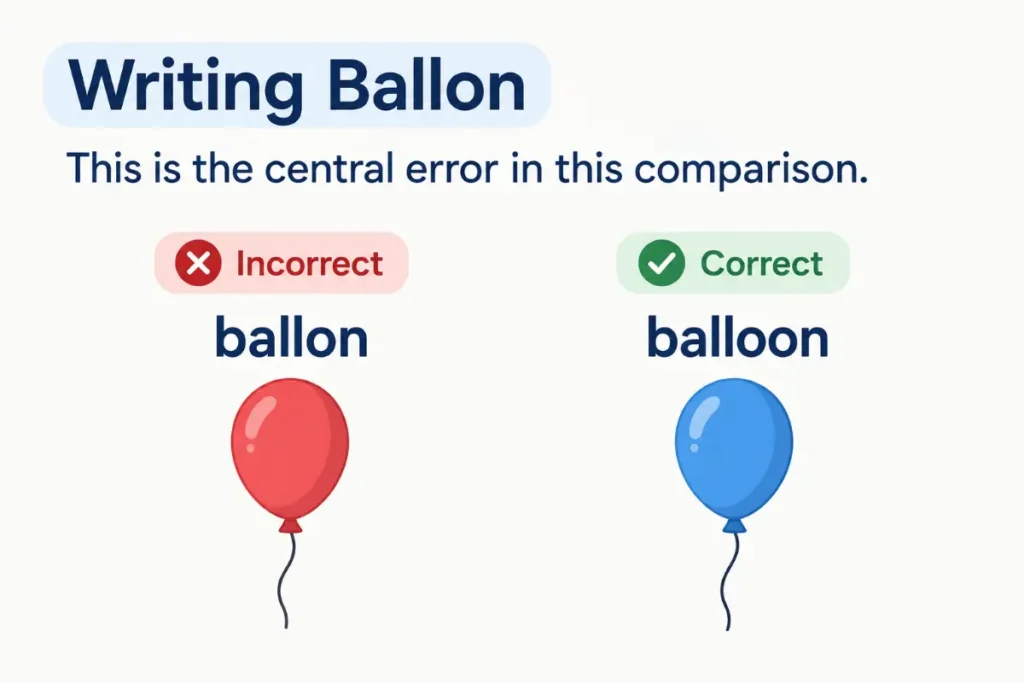
Writing Ballon
This is the central error in this comparison.
Incorrect: ballon
Correct: balloon
The writer has dropped one l and one o from the standard spelling.
Writing Baloon
This form is also common because the writer remembers the two o letters but forgets the double l.
Incorrect: baloon
Correct: balloon
The easiest way to catch this error is to look at the middle of the word.
Writing Baloon
Some writers may remember the first l but still struggle with the complete pattern.
Incorrect: baloon
Correct: balloon
The word needs both repeated letter pairs.
Writing Balloon With One O
A writer may produce a form such as ballon while trying to simplify the spelling.
The correct form keeps the double o.
Confusing English With Another Language
Language learners can encounter similar forms in French and other languages. That experience may influence English spelling.
This is a normal example of language transfer. The brain stores patterns from one language and can sometimes apply them to another language by mistake.
Pronunciation Guide
The standard American English pronunciation is commonly represented as /bəˈluːn/.
The word has two syllables. The stronger stress falls on the second syllable.
The first syllable has a relaxed vowel sound while the second contains the long oo sound.
The pronunciation can make the spelling seem easier than it really is. You don’t hear two separate l sounds simply because the spelling contains two l letters. The same applies to the two o letters.
This is why spelling from sound alone can cause trouble.
A useful learning method is to connect the visual form with the meaning. Imagine a party balloon while looking at the spelling. Then say the word naturally. Combining meaning sound and written form creates a stronger memory than repeating letters without context.
Another useful trick is to remember that the word has two repeated pairs.
ll
oo
Those two pairs are the visual heart of the spelling.
Etymology and Word Origin
The history of balloon is interesting because the word entered English through French and is connected to the older European word family associated with a ball.
French has the word ballon and related forms. English adopted balloon and developed the spelling and pronunciation used today.
The historical connection with ball makes sense because early uses of the word were connected with round inflated objects. Over time the meaning expanded as balloon technology developed.
The word later became strongly associated with lighter than air aircraft. Hot air balloons and gas balloons became important parts of the history of aviation and scientific exploration.
The verb use developed from the physical image of something expanding like a balloon. That figurative meaning now appears frequently in modern English.
For example:
Housing costs ballooned.
The budget ballooned.
The crowd ballooned in size.
In each case the speaker compares rapid growth with the way an inflated balloon expands.
Etymology also explains why the English word resembles French ballon. Similar spelling does not mean the two forms are interchangeable inside English sentences.
Regional Usage
American English
Balloon is the standard spelling in American English.
It is common in everyday conversation and appears in many fields. People talk about birthday balloons weather balloons hot air balloons and ballooning costs.
The verb form is also familiar.
Prices ballooned unexpectedly.
The spelling remains the same in both noun and verb uses.
British English
British English also uses balloon as the standard spelling.
There is no major British alternative that changes the word to ballon. A British writer discussing a party decoration or aircraft would normally use balloon.
Australian English
Australian English follows the same standard spelling. Balloon appears in everyday language education media aviation and general writing.
The shorter form is not a normal regional spelling variant.
Canadian English
Canadian English also uses balloon. The spelling is stable across ordinary Canadian usage.
This is not a case where American and British spelling conventions create different forms. The standard spelling is the same across these major varieties.
Grammar and Part of Speech
Balloon can be a noun or a verb.
As a noun it names an object or aircraft.
The balloon rose above the field.
Here balloon is the subject of the sentence.
It can also work as the object.
The child held a balloon.
In this sentence balloon receives the action of held.
The plural is balloons.
One balloon.
Several balloons.
As a verb balloon means to expand rapidly or increase greatly.
The budget ballooned.
The verb can describe physical expansion or figurative growth.
The noun and verb uses are easy to distinguish from context.
Verb Forms
The base form is balloon.
The third person singular form is balloons.
The past tense is ballooned.
The present participle is ballooning.
Examples include:
The costs ballooned last year.
The expenses are ballooning again.
The number of visitors ballooned during the event.
The verb is especially useful when describing sudden or dramatic growth.
Using Balloon as a Modifier
Balloon can also appear in compound expressions.
Common examples include hot air balloon weather balloon balloon ride and balloon animal.
In these expressions balloon helps identify the type of object or activity.
A hot air balloon rises because heated air inside the envelope is less dense than the surrounding air. A weather balloon carries instruments used to gather atmospheric information.
Different Meanings of Balloon
An Inflatable Object
The most familiar meaning is a flexible object filled with air or another gas.
Children often play with balloons at parties. Decorators also use them for events celebrations and public displays.
A Hot Air Aircraft
A balloon can also be an aircraft that rises because the air inside the envelope is heated or because a lighter than air gas provides lift.
Hot air balloon is one of the most familiar expressions in this area.
A Weather Balloon
A weather balloon carries scientific equipment into the atmosphere. These instruments can gather information about conditions at different altitudes.
This is a technical use but the spelling remains exactly the same.
A Rapid Increase
As a verb balloon means to grow or increase rapidly.
The project budget ballooned.
This use is common in news reporting and business writing because it gives readers a strong image of uncontrolled growth.
A Speech or Thought Bubble
In cartoons and visual storytelling a balloon can refer to a speech balloon or thought balloon. The shape contains dialogue or thoughts.
This meaning is especially common in discussions of comics.
Common Expressions With Balloon
Hot Air Balloon
A hot air balloon is an aircraft that rises when air inside its envelope is heated.
Example:
We watched a hot air balloon cross the valley.
Weather Balloon
A weather balloon carries instruments into the atmosphere for observation and measurement.
Example:
The weather balloon reached a high altitude before returning toward the ground.
Balloon Animal
A balloon animal is a figure created by twisting an inflated balloon into shapes.
Example:
The entertainer made a balloon animal for each child.
Balloon Ride
A balloon ride is a trip in a balloon aircraft.
Example:
They booked a balloon ride over the countryside.
Balloon Payment
In finance a balloon payment is a large payment due at the end of certain loan arrangements.
This meaning is completely different from a party balloon but uses the same imagery. The final payment is large compared with earlier payments.
Balloon Up
As a verb phrase balloon up can describe something swelling or becoming larger.
Example:
The material ballooned up after the pressure increased.
The exact phrasing depends on context and style.
Why The Double Letters Matter
The most practical spelling lesson here is simple. Don’t try to spell the word only from what you hear.
English spelling often preserves patterns that pronunciation doesn’t reveal clearly. Balloon is a good example because the repeated letters are visually important but not pronounced as separate letter names.
Think of the word in two parts.
bal
loon
That visual grouping helps many learners remember the double o.
You can also remember it as two pairs.
ll
oo
If you mentally check both pairs before finishing the word you are much less likely to write the shorter form.
This technique works well during proofreading. Instead of reading the sentence only for meaning read difficult words visually. Words with repeated letters deserve a second glance.
Ballon or Balloon in Formal Writing
For formal English always use balloon when you mean the standard English noun or verb.
This applies to school assignments professional emails reports academic writing business documents and published material.
For example:
Good: The researchers launched a weather balloon.
Not standard: The researchers launched a weather ballon.
A spelling error can look small but it affects the overall impression of a document. Readers often notice familiar words more quickly than writers expect.
In technical writing precision matters even more. A document may be copied into software instructions educational materials or professional reports. Using the established spelling keeps terminology consistent.
The same principle applies to related compounds such as ballooning balloonist and ballooning costs.
Real Life Usage Examples
Daily Conversation
- I need to buy balloons for the party.
- Look at that balloon floating over the park.
These examples use the most familiar everyday meaning.
Workplace Communication
- The project costs ballooned after the schedule changed.
- We need to explain why the budget ballooned this quarter.
Here the verb describes rapid financial growth.
Academic Writing
- Researchers used a weather balloon to gather atmospheric data.
- The study examines the development of balloon flight.
Academic writing may use the word in science history engineering or aviation contexts.
News Writing
- A hot air balloon landed safely after drifting away from its planned route.
- Housing costs ballooned during the period covered by the report.
The noun and verb forms are both useful in journalism.
Literature and Storytelling
- The little balloon disappeared into the blue sky.
- Her hopes ballooned when she heard the good news.
The second example uses the word figuratively. The writer creates an image of something expanding rapidly.
Related and Confused Words
Baloon
Baloon is a common misspelling. It usually results from dropping one l.
Ballon
Ballon is another common misspelling in English. It can also be a legitimate spelling in other languages such as French but that does not make it standard English.
Ball
Ball is historically related to the word family but has its own modern meaning and uses.
Inflate
Inflate means to fill something with air or gas or to make something larger.
A balloon can be inflated.
Deflate
Deflate means to release air or gas from something or to reduce its size.
A balloon can deflate.
Expand
Expand means to become larger or make something larger.
The verb balloon can express a rapid type of expansion.
Grow
Grow is a broad term for increasing in size amount or degree.
Costs can grow or balloon. Balloon usually suggests a more dramatic increase.
Blimp
A blimp is a type of airship. It is not simply another word for every type of balloon.
Understanding these related terms helps you choose the precise word instead of treating similar vocabulary as interchangeable.
Memory Tips
The easiest memory trick is to remember that balloon contains two l letters and two o letters.
Picture a real balloon and imagine the spelling written across it.
Another useful method is to connect the word with ballooning.
If you know ballooning has the double l and double o pattern then the base word becomes easier to recall.
You can also use a rhythm.
Two l letters. Two o letters.
That short pattern is easier to remember than memorizing the entire word as an unrelated sequence.
If you regularly type the word for work or school you can also create a simple proofreading habit. Whenever you see balloon on the page check the two repeated pairs.
This takes only a second.
Expert Editor Insight
An experienced editor would treat ballon as a straightforward spelling error in standard English when the intended meaning is the common noun or verb. The mistake is easy to miss because the shorter version looks plausible and the repeated letters are not clearly represented in pronunciation. Editors also watch for language transfer because learners may encounter ballon in other languages. A useful editing habit is to check repeated letter patterns visually rather than trusting the sound of a familiar word. Spellcheck tools can catch many instances but a quick human review remains valuable when context matters.
Key Takeaways
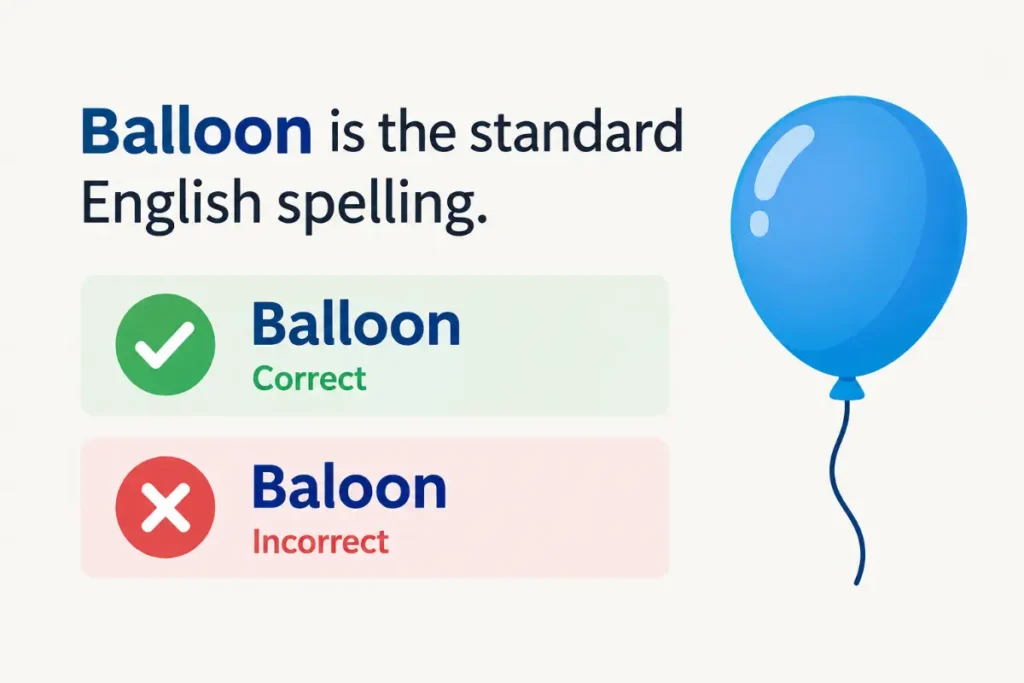
- Balloon is the standard English spelling.
- Ballon is normally a spelling mistake in English when you mean the common noun or verb.
- The correct form contains two l letters and two o letters.
- Balloon can function as both a noun and a verb.
- As a noun it can refer to an inflatable object or a lighter than air aircraft.
- As a verb it can mean to increase or expand rapidly.
- American British Canadian and Australian English use the same standard spelling.
- Ballon can be legitimate in another language but that doesn’t make it standard English.
- The easiest memory trick is to remember the two repeated pairs.
- Always use balloon in polished English writing when you mean the standard English word.
Conclusion
Ballon or balloon has a clear answer for standard English. Balloon is the correct spelling when you mean the familiar inflatable object the aircraft or the verb describing rapid growth. The shorter form is generally a spelling mistake in English.
The word is useful far beyond birthday parties. You’ll find it in aviation science weather research finance journalism business writing and everyday conversation. It can work as a noun or verb and its meaning becomes clear from the surrounding sentence.
The easiest way to remember the spelling is to picture the two repeated pairs in the middle of the word. Keep ll and oo together and you’ll avoid the most common mistake. When proofreading give repeated letters a quick visual check before you submit or publish your writing.
FAQs
Is ballon a correct English spelling?
Ballon is not normally the correct English spelling for the common word referring to an inflatable object or lighter than air aircraft. The standard English form is balloon with two l letters and two o letters. Ballon can appear as a legitimate form in other languages or special names but that does not make it the standard English spelling.
What is the difference between ballon and balloon?
The main difference is spelling. Balloon is the standard English form while ballon is generally a misspelling in English when referring to the same object. The correct form can be a noun or a verb. As a noun it can refer to an inflatable object or aircraft. As a verb it can mean to expand rapidly.
Why do people spell balloon as ballon?
People often leave out repeated letters when typing quickly. The pronunciation also doesn’t clearly signal that the spelling contains two l letters and two o letters. Language transfer can contribute too because similar forms occur in other languages. The safest approach is to remember the two repeated pairs and connect the word with related forms such as ballooning.
How do you pronounce balloon?
Balloon is commonly pronounced with two syllables and the strongest stress on the second syllable. The first syllable has a relaxed vowel while the second contains the long oo sound. The pronunciation doesn’t require you to pronounce the repeated letters separately. Learning the sound together with the visual spelling can help prevent the common mistake.
Is balloon a noun or a verb?
Balloon can be both a noun and a verb. As a noun it can refer to an inflatable object or a type of aircraft. As a verb it means to expand or increase rapidly. For example the balloon rose into the sky uses the noun while the costs ballooned unexpectedly uses the verb.
Is balloon the same in American and British English?
Yes. American and British English use balloon as the standard spelling. The same form is also used in Canadian and Australian English. This means you don’t need to choose a regional spelling. If you mean the common inflatable object aircraft or rapid increase use the standard form with two l letters and two o letters.
Can balloon be used as a verb?
Yes. Balloon works as a verb when something grows or increases rapidly. For example the project budget ballooned after several changes. The expression is often figurative and creates an image of something becoming larger quickly. This use is common in everyday speech as well as business journalism and other forms of modern writing.
What is a simple way to remember the spelling?
Remember two pairs of repeated letters. The standard form has two l letters followed by two o letters. You can think of it as a word containing ll and oo. Another useful trick is to connect the noun with related forms such as ballooning. Visualizing the spelling while saying the word can also strengthen your memory.

Confusing Words, Spelling & Word Choice
Claire Whitmore is a U.S.-based English editor who writes about commonly confused words, spelling differences, and word choice. Her work helps readers understand subtle distinctions between similar-looking words through simple definitions, practical examples, and modern usage guidance in both American and British English.