
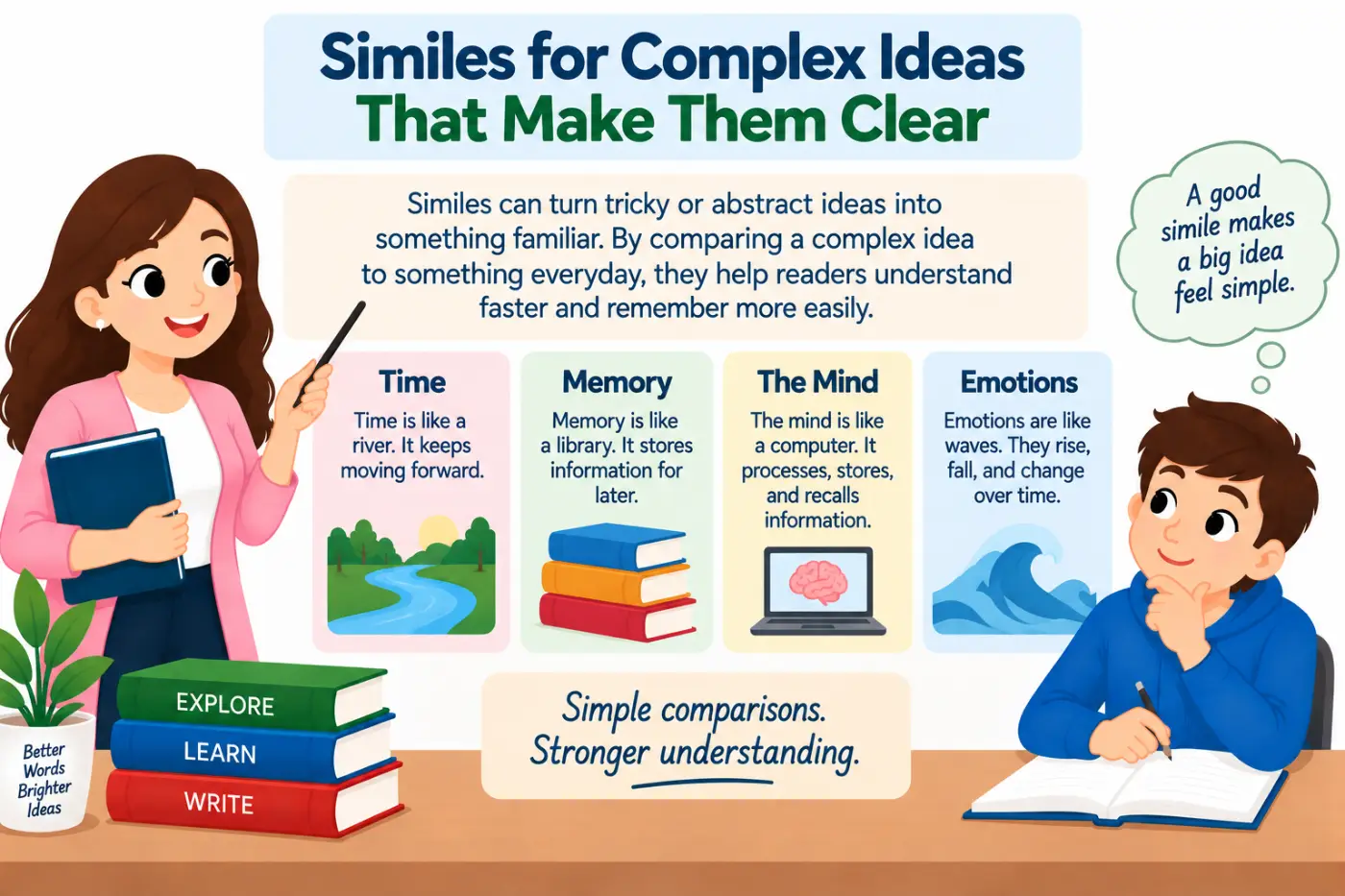
Similes for complex ideas can turn a difficult thought into something you can almost see. A concept such as uncertainty, grief, identity, justice, memory, ambition, or social pressure may be hard to explain directly. A well chosen comparison gives that invisible idea a shape. Instead of asking readers to wrestle with an abstract explanation, you give them a familiar image they can understand immediately.
The trick is choosing the right image. A complicated idea shouldn’t be compared with something equally complicated. If you’re explaining uncertainty, a foggy road may work because most people understand the feeling of seeing only a short distance ahead. If you’re explaining a difficult decision, a fork in the road can create an instant picture of choice and consequence.
Good comparisons also add emotion. They can make an essay more memorable, give a speech greater force, or help a teacher explain an abstract lesson. Below you’ll find 120 original examples grouped by meaning. Each one includes a short explanation and a sample sentence so you can see how the comparison works in real writing.
Short Answer
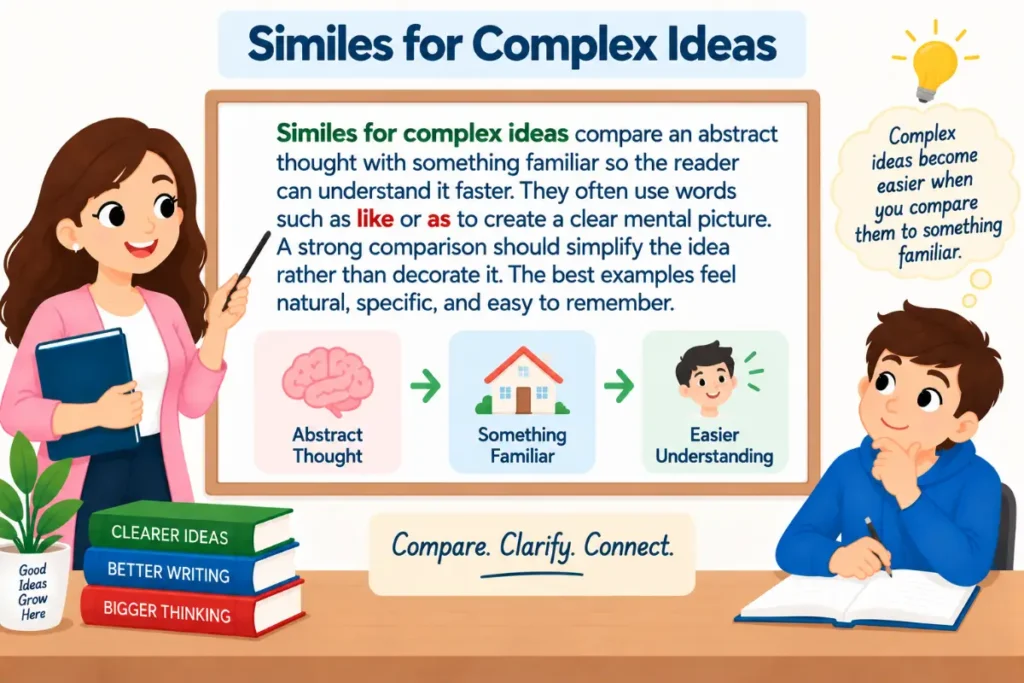
Similes for complex ideas compare an abstract thought with something familiar so the reader can understand it faster. They often use words such as like or as to create a clear mental picture. A strong comparison should simplify the idea rather than decorate it. The best examples feel natural, specific, and easy to remember.
Table of Contents
- Why Similes Help Explain Difficult Ideas
- How to Build a Strong Simile
- Similes for Confusion and Uncertainty
- Similes for Knowledge and Understanding
- Similes for Learning and Growth
- Similes for Problems and Challenges
- Similes for Decision Making
- Similes for Emotions
- Similes for Memory
- Similes for Time
- Similes for Change
- Similes for Relationships
- Similes for Communication
- Similes for Creativity
- Similes for Success and Failure
- Similes for Society and Human Behavior
- Similes for Identity and Self Discovery
- Common Mistakes to Avoid
- Memory Tips for Creating Better Similes
- Related Usage Notes
- FAQs
- Key Takeaways
- Conclusion
Why Similes Help Explain Difficult Ideas
Abstract ideas have no physical shape. You can touch a book but you can’t touch regret.
That gap creates a problem for writers. Readers understand concrete objects quickly because they have direct experience with them. Abstract concepts require mental work.
A simile bridges that gap.
When you say an idea is like a tangled knot, the reader immediately understands that the idea contains several connected parts that are difficult to separate. When you compare patience to a slow growing tree, the reader can picture progress that takes time.
A strong comparison does three jobs.
- It gives an abstract idea a concrete image.
- It helps the reader understand the relationship between different parts of the idea.
- It makes the explanation easier to remember.
This makes similes useful in essays, speeches, stories, classroom explanations, presentations, articles, and everyday conversation.
How to Build a Strong Simile
The easiest method is to identify the quality you want to explain first.
Suppose the idea is uncertainty. Ask yourself what familiar experience feels uncertain. A dark hallway works because you can move forward without knowing exactly what lies ahead.
Then connect the two ideas using like or as.
Uncertainty is like walking through a dark hallway.
That sentence works because both experiences share a clear quality. You don’t know what comes next.
Avoid comparisons that have no meaningful connection. A random image may sound creative but still leave the reader confused.
A useful simile should make the reader think, I understand what you mean.
Similes for Confusion and Uncertainty
1. Confusion is like a room full of mirrors.
The image suggests too many reflections and no obvious direction.
Example: His thoughts were like a room full of mirrors, each idea reflecting another.
2. Uncertainty is like walking through fog.
Fog limits what you can see ahead.
Example: Starting the new job felt like walking through fog because nothing seemed predictable.
3. A complicated question is like a locked box with several keys.
The comparison suggests that one answer may not solve everything.
Example: The ethical problem was like a locked box with several keys.
4. Conflicting opinions are like radios playing different stations.
Each voice competes for attention.
Example: The meeting felt like radios playing different stations.
5. Confusion is like tangled headphones.
The more you pull without care, the worse the problem can become.
Example: His explanation was like tangled headphones that became harder to understand with every attempt to fix them.
6. Uncertainty is like standing at the edge of a bridge in heavy mist.
You know a path exists but cannot see its full shape.
Example: Her decision felt like standing at the edge of a bridge in heavy mist.
7. A difficult concept is like a puzzle missing its picture.
You have pieces but lack the full view.
Example: The theory seemed like a puzzle missing its picture.
8. Doubt is like a small stone inside a shoe.
It may seem minor but keeps demanding attention.
Example: One unanswered question was like a small stone inside his shoe.
9. Conflicting evidence is like footprints crossing in fresh snow.
Different directions make the story harder to follow.
Example: The evidence was like footprints crossing in fresh snow.
10. An unclear argument is like a road with faded signs.
The reader can move forward but doesn’t know where the argument is going.
Example: The essay felt like a road with faded signs.
Similes for Knowledge and Understanding
11. Understanding is like turning on a lamp.
The idea becomes visible once the missing knowledge appears.
Example: Her explanation was like turning on a lamp in a dark room.
12. Knowledge is like a map.
It helps you understand where you are and where you can go.
Example: Knowledge is like a map when you’re facing an unfamiliar problem.
13. Insight is like finding the missing piece of a puzzle.
One discovery can make the whole picture clearer.
Example: His final observation was like finding the missing piece of a puzzle.
14. Understanding a theory is like learning the rules of a game.
Once the rules make sense, individual moves become easier to follow.
Example: Understanding the theory was like learning the rules of a complicated game.
15. New knowledge is like opening a window.
It gives you a wider view.
Example: The book was like opening a window onto a subject I had never studied.
16. Wisdom is like a compass.
It helps guide decisions without making every decision for you.
Example: Experience became like a compass when she faced difficult choices.
17. Understanding is like watching dawn arrive.
The answer may become clear gradually rather than all at once.
Example: His understanding was like watching dawn arrive slowly.
18. Learning a difficult subject is like climbing a staircase.
Each step builds on the previous one.
Example: Learning algebra felt like climbing a staircase one step at a time.
19. A useful explanation is like a clean window.
It removes obstacles between the reader and the idea.
Example: Her explanation was like a clean window through which everyone could see the problem.
20. A new perspective is like moving to a higher hill.
You can suddenly see connections that were hidden before.
Example: The new perspective was like moving to a higher hill.
Similes for Learning and Growth
21. Learning is like planting seeds.
Knowledge needs time and care before it becomes useful.
Example: Learning a language is like planting seeds that slowly become a garden.
22. Personal growth is like a tree adding rings.
Development can happen quietly over many years.
Example: His growth was like a tree adding rings season after season.
23. Practice is like sharpening a blade.
Repeated effort improves performance.
Example: Practice is like sharpening a blade until the skill becomes precise.
24. Education is like building a bridge.
Each new skill connects you to new possibilities.
Example: Education is like building a bridge toward opportunities that once seemed distant.
25. Learning from mistakes is like turning scars into road signs.
Past failures can guide future decisions.
Example: Her mistakes became like road signs pointing away from old habits.
26. Experience is like weathering a mountain.
Time exposes you to conditions that shape your strength.
Example: Experience was like weathering a mountain through changing seasons.
27. Curiosity is like a door that keeps opening.
One question often leads to another.
Example: Curiosity is like a door that keeps opening into another room.
28. Progress is like filling a jar with grains of sand.
Small actions eventually create a visible result.
Example: Progress was like filling a jar with grains of sand one handful at a time.
29. Confidence is like a muscle.
It becomes stronger through repeated use.
Example: Confidence is like a muscle that grows with practice.
30. A new skill is like a new path through a forest.
The first attempts may feel difficult but the route becomes clearer with use.
Example: Learning to code felt like creating a new path through a forest.
Similes for Problems and Challenges
31. A difficult problem is like a knot.
Several parts may be connected and pulling one can affect another.
Example: The budget problem was like a knot that needed patience to untangle.
32. A major challenge is like climbing a steep hill.
The effort is demanding but the destination remains possible.
Example: Starting the business was like climbing a steep hill.
33. A hidden problem is like a leak behind a wall.
You may see the damage before you see the cause.
Example: The conflict was like a leak behind a wall.
34. Stress is like carrying a backpack filled with stones.
The burden becomes heavier as more worries accumulate.
Example: His responsibilities felt like carrying a backpack filled with stones.
35. A complex problem is like a machine with hundreds of gears.
Changing one part can affect many others.
Example: The economy is like a machine with hundreds of gears.
36. A difficult decision is like balancing a glass on a narrow ledge.
Small changes can have large consequences.
Example: Choosing between the two offers felt like balancing a glass on a narrow ledge.
37. An unresolved issue is like a door left slightly open.
It keeps drawing attention because it hasn’t been fully closed.
Example: The disagreement was like a door left slightly open.
38. A crisis is like a storm arriving without warning.
Conditions can change quickly and demand action.
Example: The sudden shortage was like a storm arriving without warning.
39. A recurring problem is like a weed in a garden.
Removing the surface growth doesn’t always remove the cause.
Example: The argument was like a weed that kept returning.
40. A major obstacle is like a wall across a narrow road.
You cannot simply continue without addressing it.
Example: Lack of funding was like a wall across a narrow road.
Similes for Decision Making
41. A decision is like choosing a trail at a fork in the woods.
Each option leads somewhere different.
Example: Choosing a career was like choosing a trail at a fork in the woods.
42. A difficult choice is like holding two doors open.
You must eventually commit to one direction.
Example: The decision felt like holding two doors open while trying to choose.
43. Decision making is like weighing stones.
You compare the importance and consequences of different choices.
Example: She approached the decision like weighing stones in her hands.
44. A major choice is like planting a tree.
Its consequences may last for years.
Example: Choosing where to live was like planting a tree whose shade would shape the future.
45. Risk is like stepping onto thin ice.
You can move forward but must understand the danger.
Example: Investing all the money felt like stepping onto thin ice.
46. A safe choice is like walking on a well lit path.
The risks are easier to see.
Example: The conservative option was like walking on a well lit path.
47. A difficult dilemma is like choosing between two bridges.
Both options can lead somewhere but each carries different risks.
Example: The ethical dilemma was like choosing between two bridges in a storm.
48. A rushed decision is like driving with fogged windows.
You act before you can see clearly.
Example: Making the decision without checking the facts was like driving with fogged windows.
49. Careful planning is like studying a map before a long trip.
Preparation reveals possible routes and problems.
Example: Planning the project was like studying a map before a long trip.
50. Regret is like looking through a rear window while driving forward.
You can see the past but cannot return to it safely.
Example: Regret is like looking through a rear window while driving forward.
Similes for Emotions
51. Anxiety is like a phone that never stops vibrating.
The mind keeps demanding attention.
Example: His anxiety was like a phone that never stopped vibrating.
52. Hope is like a candle in a dark room.
It may be small but it changes how the darkness feels.
Example: Her hope was like a candle in a dark room.
53. Anger is like water behind a dam.
Pressure builds until it needs an outlet.
Example: His anger was like water behind a dam.
54. Grief is like an empty chair at the dinner table.
The absence remains visible even when nobody speaks about it.
Example: Grief was like an empty chair at the dinner table.
55. Happiness is like sunlight through a window.
It can change the atmosphere without making a sound.
Example: Her laughter was like sunlight through a window.
56. Fear is like a shadow that grows at night.
It can appear larger when certainty disappears.
Example: His fear was like a shadow that grew after sunset.
57. Loneliness is like being surrounded by voices you cannot join.
People may be present while connection is missing.
Example: Her loneliness was like being surrounded by voices she could not join.
58. Jealousy is like smoke in a closed room.
It affects everything around it.
Example: Jealousy was like smoke filling the room.
59. Peace is like still water after a storm.
It suggests calm after emotional disturbance.
Example: After the argument ended, peace felt like still water after a storm.
60. Excitement is like a spark near dry grass.
A small event can quickly create intense energy.
Example: The announcement was like a spark near dry grass.
Similes for Memory
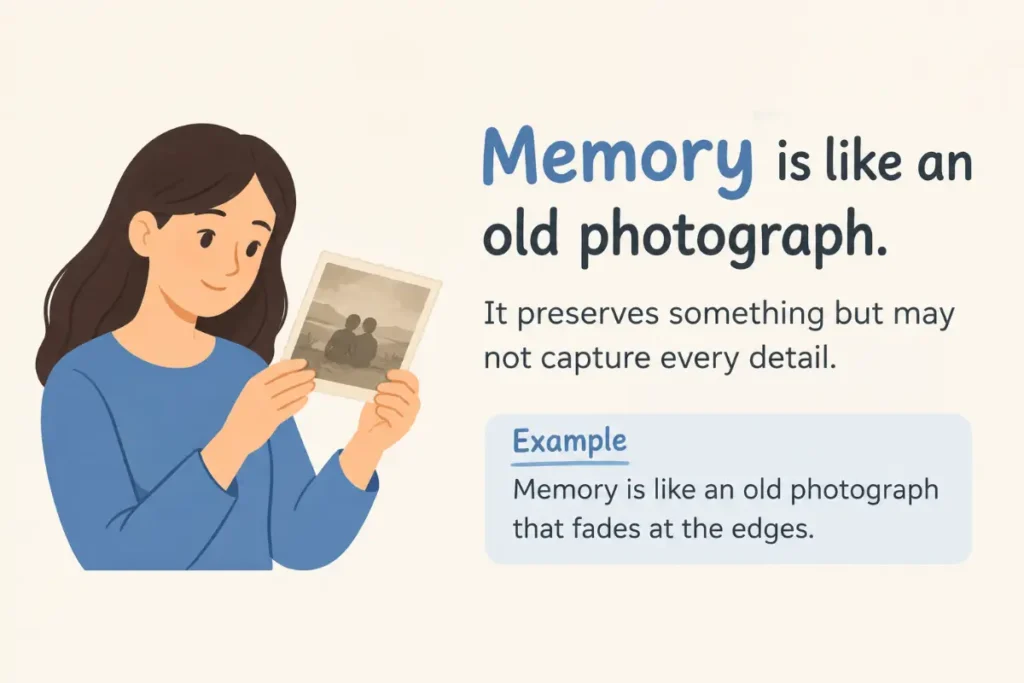
61. Memory is like an old photograph.
It preserves something but may not capture every detail.
Example: Memory is like an old photograph that fades at the edges.
62. Childhood is like a book with worn pages.
Repeated recollection can make some moments feel familiar.
Example: Childhood memories are like a book with worn pages.
63. Forgetting is like an eraser slowly passing over a drawing.
Details can disappear gradually.
Example: Forgetting was like an eraser slowly passing over a drawing.
64. A vivid memory is like a song you haven’t heard in years.
One trigger can bring it back quickly.
Example: The smell of bread was like a song from childhood.
65. Memory is like a house with hidden rooms.
Some experiences remain out of reach until something brings them forward.
Example: Memory is like a house with hidden rooms.
66. A painful memory is like a bruise beneath clothing.
It may not be visible but can still hurt when touched.
Example: The memory was like a bruise beneath clothing.
67. Nostalgia is like opening an old drawer.
Forgotten feelings can return with familiar objects.
Example: Nostalgia was like opening an old drawer.
68. A forgotten detail is like a coin under furniture.
It may remain there until something shifts.
Example: The forgotten fact was like a coin under furniture.
69. Memory can be like a river.
Some parts remain clear while others become difficult to trace.
Example: His memory was like a river changing course over time.
70. A shared memory is like a photograph held by two people.
Both people connect to the same moment.
Example: Their shared memory was like a photograph held between them.
Similes for Time
71. Time is like a river.
It continues moving even when you stand still.
Example: Time is like a river that never waits for anyone.
72. A year is like a long road.
It contains many stages before reaching the end.
Example: The year felt like a long road filled with unexpected turns.
73. A moment is like a falling leaf.
It appears briefly before disappearing.
Example: The quiet moment was like a falling leaf.
74. Waiting is like watching paint dry.
The passage of time can feel unusually slow.
Example: Waiting for the decision felt like watching paint dry.
75. Childhood is like a short summer.
It can feel long while you live it and brief when you remember it.
Example: Childhood is like a short summer remembered from winter.
76. The future is like an unopened letter.
You know something is coming but don’t know its contents.
Example: The future is like an unopened letter.
77. The past is like a distant shoreline.
You can see it but cannot step back into it.
Example: The past is like a distant shoreline.
78. A deadline is like a train approaching the station.
The opportunity to act becomes smaller as time passes.
Example: The deadline was like a train approaching the station.
79. A long friendship is like an old clock.
It carries marks of time and keeps moving.
Example: Their friendship was like an old clock that had survived many years.
80. A fleeting opportunity is like a door closing in the wind.
It may disappear before you are ready.
Example: The opportunity was like a door closing in the wind.
Similes for Change
81. Change is like the seasons.
It arrives gradually and reshapes the environment.
Example: Change is like the seasons because nothing stays exactly the same.
82. Personal transformation is like a caterpillar becoming a butterfly.
The final form can look very different from the beginning.
Example: Her transformation was like a caterpillar becoming a butterfly.
83. Small change is like a pebble dropped into water.
A tiny action can create wider effects.
Example: One kind decision was like a pebble dropped into water.
84. Social change is like a river changing its course.
The direction can shift slowly but dramatically.
Example: Social change is like a river changing its course.
85. A new habit is like a path through grass.
Repeated use makes the path easier to follow.
Example: A new habit is like a path through grass that becomes clearer with repetition.
86. Sudden change is like a door opening during a storm.
The environment can shift instantly.
Example: The news was like a door opening during a storm.
87. Adaptation is like changing sails when the wind shifts.
You respond to conditions without abandoning the destination.
Example: Adaptation is like changing sails when the wind shifts.
88. Growth is like adding floors to a house.
Each stage builds on what already exists.
Example: Professional growth is like adding floors to a house.
89. A fresh start is like a blank notebook.
It creates space for something new.
Example: The new job felt like a blank notebook.
90. Recovery is like rebuilding a bridge one piece at a time.
Progress may be slow but each part restores connection.
Example: Recovery was like rebuilding a bridge one piece at a time.
Similes for Relationships
91. Trust is like glass.
It can be strong but difficult to restore after serious damage.
Example: Trust is like glass because one major break can change everything.
92. Friendship is like a garden.
It needs attention to remain healthy.
Example: Friendship is like a garden that needs regular care.
93. A strong relationship is like a bridge.
It connects two people across differences.
Example: Their relationship was like a bridge over a deep divide.
94. Communication is like a two way street.
Both sides need to participate.
Example: Communication is like a two way street.
95. A fragile relationship is like a thread.
Too much pressure can break it.
Example: Their connection felt like a thread stretched too tightly.
96. Shared values are like common roots.
They give a relationship stability.
Example: Their shared values were like common roots beneath the surface.
97. Misunderstanding is like a crack in a window.
A small break can affect how everything looks.
Example: The misunderstanding was like a crack in a window.
98. Respect is like a foundation.
A relationship becomes unstable without it.
Example: Respect is like a foundation beneath a house.
99. Forgiveness is like opening a locked gate.
It can allow movement after conflict.
Example: Forgiveness was like opening a locked gate.
100. A lasting friendship is like a well worn path.
Years of shared experience make the connection familiar.
Example: Their friendship was like a well worn path through a familiar forest.
Similes for Communication
101. A clear explanation is like a straight road.
The reader can follow the direction without unnecessary turns.
Example: Her explanation was like a straight road through a complicated subject.
102. Poor communication is like a broken telephone line.
The message may not arrive as intended.
Example: Their disagreement grew because communication was like a broken telephone line.
103. A metaphor is like a bridge between two ideas.
It connects something familiar with something abstract.
Example: The comparison was like a bridge between two difficult ideas.
104. A good example is like a window.
It lets the reader see an abstract idea in action.
Example: The example was like a window into the theory.
105. A strong argument is like a well built staircase.
Each point supports the next.
Example: Her argument was like a well built staircase.
106. A vague statement is like a blurred photograph.
The general shape is visible but important details are missing.
Example: His answer was like a blurred photograph.
107. Listening is like opening a door.
It gives another person space to enter the conversation.
Example: Listening is like opening a door to another person’s perspective.
108. A powerful speech is like a bell in a quiet room.
It captures attention immediately.
Example: Her opening sentence was like a bell in a quiet room.
109. A difficult explanation is like a recipe without measurements.
The reader has ingredients but lacks enough guidance.
Example: The instructions were like a recipe without measurements.
110. Good writing is like a clean path.
The reader can move through the ideas without unnecessary obstacles.
Example: Good writing is like a clean path through a dense forest.
Similes for Creativity
111. Creativity is like a spark in dry wood.
One small idea can start something much larger.
Example: Creativity is like a spark in dry wood.
112. Imagination is like a window facing an unknown city.
It lets you picture possibilities you haven’t experienced.
Example: Imagination is like a window facing an unknown city.
113. An original idea is like a new color on a familiar painting.
It changes the whole impression.
Example: Her idea was like a new color added to a familiar painting.
114. Creativity is like mixing ingredients in a kitchen.
Old elements can become something new when combined differently.
Example: Creativity is like mixing familiar ingredients in an unexpected way.
115. Inspiration is like rain on dry soil.
It can awaken ideas that were waiting beneath the surface.
Example: The conversation was like rain on dry soil.
Similes for Success and Failure
116. Success is like reaching the top of a staircase.
The result becomes visible after repeated effort.
Example: Success was like reaching the top of a staircase after many small steps.
117. Failure is like a detour on a long road.
It changes the route but doesn’t necessarily end the trip.
Example: Failure was like a detour that forced him to find another route.
118. Persistence is like water wearing down stone.
Small efforts can produce major results over time.
Example: Persistence is like water wearing down stone.
119. Achievement is like a harvest.
The result comes after preparation and sustained effort.
Example: The award felt like a harvest after years of work.
120. A setback is like falling one step on a staircase.
You lose some progress but can still continue upward.
Example: The failed project was like falling one step on a staircase.
Similes for Society and Human Behavior
Human behavior often involves systems that are too large to explain with one simple definition. Comparisons can make those systems easier to picture.
Society can be like a woven fabric because individual actions become part of a larger structure. A community can be like a neighborhood garden because different people contribute different things while sharing the same environment.
Social pressure can be like a current in a river. You may swim against it but doing so requires extra effort. Tradition can be like an old road because generations may continue using it even after newer routes appear.
Public opinion can be like weather because it can change quickly and affect everyone in the same environment. A rumor can be like a spark in dry grass because one small statement can spread rapidly.
Group behavior can be like a flock changing direction because individuals often respond to the movement of people around them. Cultural identity can be like a house built from many rooms because it can contain history language family values and personal experience at the same time.
These comparisons help readers understand that human systems are rarely controlled by one force. They are shaped by many connected influences.
Similes for Identity and Self Discovery
Identity can be difficult to explain because it develops through memory experience relationships values and personal choices.
A person’s identity can be like a mosaic made from many small pieces. No single piece explains the whole picture.
Self discovery can be like exploring an unfamiliar house. Each room reveals something that was already part of the structure but had not yet been examined.
Personal identity can also be like handwriting. It develops through many influences but eventually becomes recognizably your own.
Growing into yourself can be like tuning an instrument. You gradually adjust what feels out of place until the sound becomes more natural.
Self knowledge can be like looking into a clear pond. The deeper you look the more detail you can see.
These comparisons work well in personal essays because they give abstract ideas about identity a concrete visual form.
Common Mistakes to Avoid
Making the comparison too complicated
A simile should clarify the idea. If the comparison requires a paragraph of explanation before the reader understands it then the image may be too complex.
Choose something familiar.
Using an image that does not match the idea
A comparison should share an important quality with the concept.
For example uncertainty can reasonably be compared with fog because both involve limited visibility. Comparing uncertainty with a hammer gives the reader no obvious connection.
Repeating the same image
Writers often rely heavily on roads, storms, mirrors, bridges, and journeys. These images can work but using them repeatedly makes writing predictable.
Try finding fresh concrete objects and situations.
Mixing several comparisons
One sentence should usually have one main comparison.
If an idea is a storm, a maze, a bridge, and a burning building in the same sentence the reader has too many images to process.
Explaining the comparison too much
Let the image do some of the work.
If you write that anxiety is like a phone that never stops vibrating then immediately spend five sentences explaining what a phone does the effect becomes weaker.
Choosing beauty over accuracy
A beautiful comparison can still be a poor comparison if it doesn’t explain the idea.
Accuracy should come first. Style should strengthen the explanation rather than hide its weakness.
Memory Tips for Creating Better Similes
The fastest way to create a useful comparison is to ask five questions.
- What does the idea feel like?
- What ordinary object creates the same feeling?
- What everyday situation has the same pattern?
- What natural event behaves in a similar way?
- What would a child immediately understand?
For uncertainty you might think of fog.
For memory you might think of an old photograph.
The key is not to search for the fanciest image. Search for the clearest one.
A useful comparison often comes from ordinary life. Kitchen tables, windows, shoes, roads, clocks, gardens, rain, doors, books, bridges, and tools can explain surprisingly difficult ideas because readers already understand how those things behave.
Related Usage Notes
A simile is a figure of speech that explicitly compares two different things. The comparison often uses like or as.
A metaphor also compares two things but usually does so more directly.
For example:
Simile: Fear is like a shadow.
Metaphor: Fear is a shadow.
Both create an image but the grammatical structure differs.
Analogy is broader. It can develop a comparison across several sentences to explain how one system resembles another.
For example a teacher might compare a computer processor with a person solving a problem. The processor and person are not literally the same but the comparison helps explain how information is handled.
When writing an essay use a simile when you need a quick image. Use an analogy when the reader needs a deeper explanation of how several parts relate.
A strong writer also knows when not to use a comparison. Some technical definitions are clearer when stated directly. If precision matters more than imagery, give the literal explanation first and use a simile afterward.
Key Takeaways
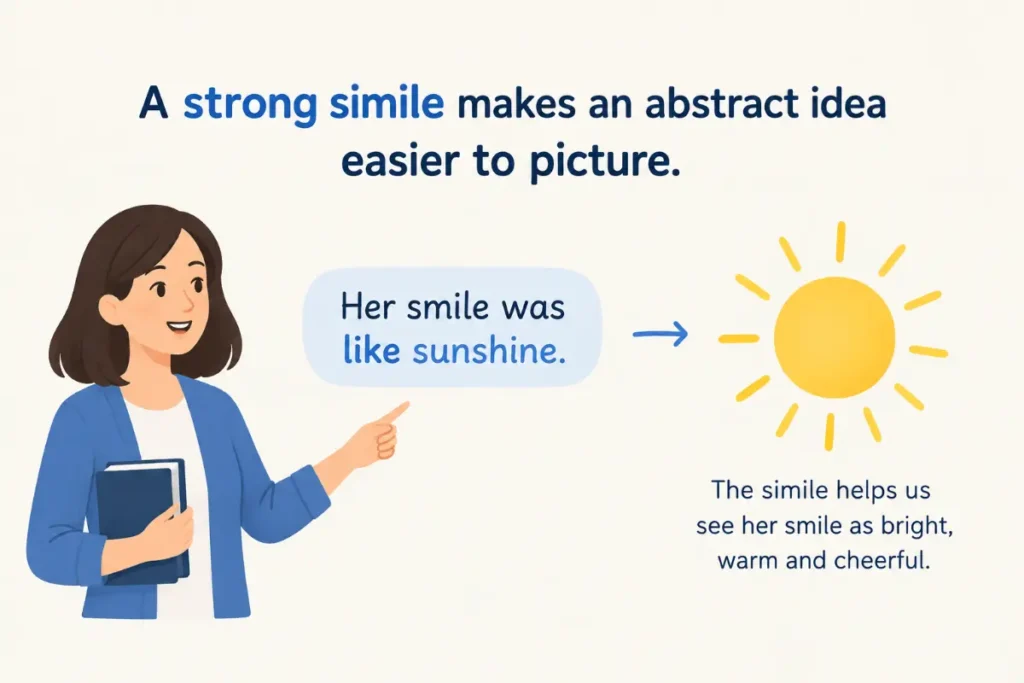
- A strong simile makes an abstract idea easier to picture.
- The best comparison uses a familiar object, event, or experience.
- A simile commonly uses like or as to connect two ideas.
- Clarity matters more than cleverness.
- One precise comparison can be stronger than several weak ones.
- Avoid mixing too many images in one sentence.
- Use concrete images that share a real quality with the abstract concept.
- In formal writing, make sure the comparison supports the main point.
- Use metaphors and analogies when they fit the purpose better.
- Read the sentence aloud. If the comparison feels forced, replace it with a simpler image.
Conclusion
Similes for complex ideas give difficult thoughts a shape that readers can recognize. Instead of explaining uncertainty only through abstract language, you can compare it with fog. Instead of describing persistence through a long definition, you can compare it with water slowly wearing down stone.
The most effective comparisons are simple, specific, and connected to real experience. They don’t exist just to make writing sound clever. They help readers understand emotion, change, learning, memory, relationships, decisions, and other abstract subjects more quickly.
When creating your own comparison, start with the central quality of the idea. Then look for an ordinary object or experience that be haves in the same way. If the reader can picture it immediately and understand your point without extra explanation, you’ve probably found a strong simile.
FAQs
What are similes for complex ideas?
Similes for complex ideas are comparisons that connect an abstract concept with a familiar object, event, experience, or situation. They help readers understand ideas that are difficult to visualize. For example, comparing uncertainty to walking through fog gives the reader an immediate picture of limited knowledge and an unclear future.
How do similes make difficult ideas easier to understand?
A simile gives an abstract concept a concrete image. Readers already understand familiar experiences such as walking through fog, carrying a heavy bag, opening a door, or watching a candle burn. Connecting those experiences with an abstract idea reduces the mental effort needed to understand the explanation.
Can I use these comparisons in an essay?
Yes. Similes can work well in personal essays, persuasive writing, literary analysis, speeches, and reflective assignments. Choose comparisons that directly support your point. Avoid adding one simply to make a paragraph sound decorative. A useful comparison should clarify the idea and fit the tone of the assignment.
How do I create my own simile for an abstract idea?
Start by identifying the main quality of the idea. Ask what familiar object or experience has the same quality. Then connect the two with like or as. For example, if your idea is pressure, think about something that feels heavy. You might compare pressure to carrying a backpack filled with stones.
What is the difference between a simile and a metaphor?
A simile makes an explicit comparison and commonly uses like or as. For example, hope is like a candle in a dark room is a simile. A metaphor makes the comparison directly by saying hope is a candle in a dark room. Both can create vivid images but they use different grammatical structures.
What makes a simile effective?
An effective simile has a clear connection between the two things being compared. The image should be familiar enough for the reader to understand quickly. It should also add something useful rather than simply sound attractive. The strongest comparisons often explain emotion, behavior, structure, or change through an ordinary experience.
Can a simile explain a scientific or technical idea?
Yes, but precision should come first. A comparison can help introduce a difficult technical concept to beginners. For example, you might compare a computer network to a system of roads. After using the comparison, explain the actual technical process clearly. Never allow the image to replace an accurate definition when exact details matter.
How many similes should I use in an essay?
There is no fixed number that works for every essay. One strong comparison can be more effective than several weak ones. Use a simile when it improves understanding or adds meaningful emphasis. If every paragraph contains a comparison the writing may start to feel forced. Let the subject and purpose determine the number.
Are simple similes better than complicated ones?
Often they are. A simple comparison can communicate an abstract idea in seconds. Complicated comparisons can work in literary writing but they require more interpretation. For teaching, academic explanation, speeches, and general nonfiction, a familiar image is usually the safer choice because readers can understand it without stopping to decode the comparison.
Can similes make writing more emotional?
Yes. A carefully chosen comparison can give an emotion a physical shape. Saying grief is like an empty chair at the dinner table can make absence feel visible. Saying anxiety is like a phone that never stops vibrating can communicate constant mental pressure. The emotional effect comes from the relationship between the image and the idea.

Idioms, Expressions & Figurative Language
Mason Ellsworth is an American language writer with a passion for English expressions, figurative language, and everyday communication. He explains idioms, similes, popular phrases, and commonly misunderstood expressions in a straightforward, engaging style that helps readers improve both their writing and spoken English.