
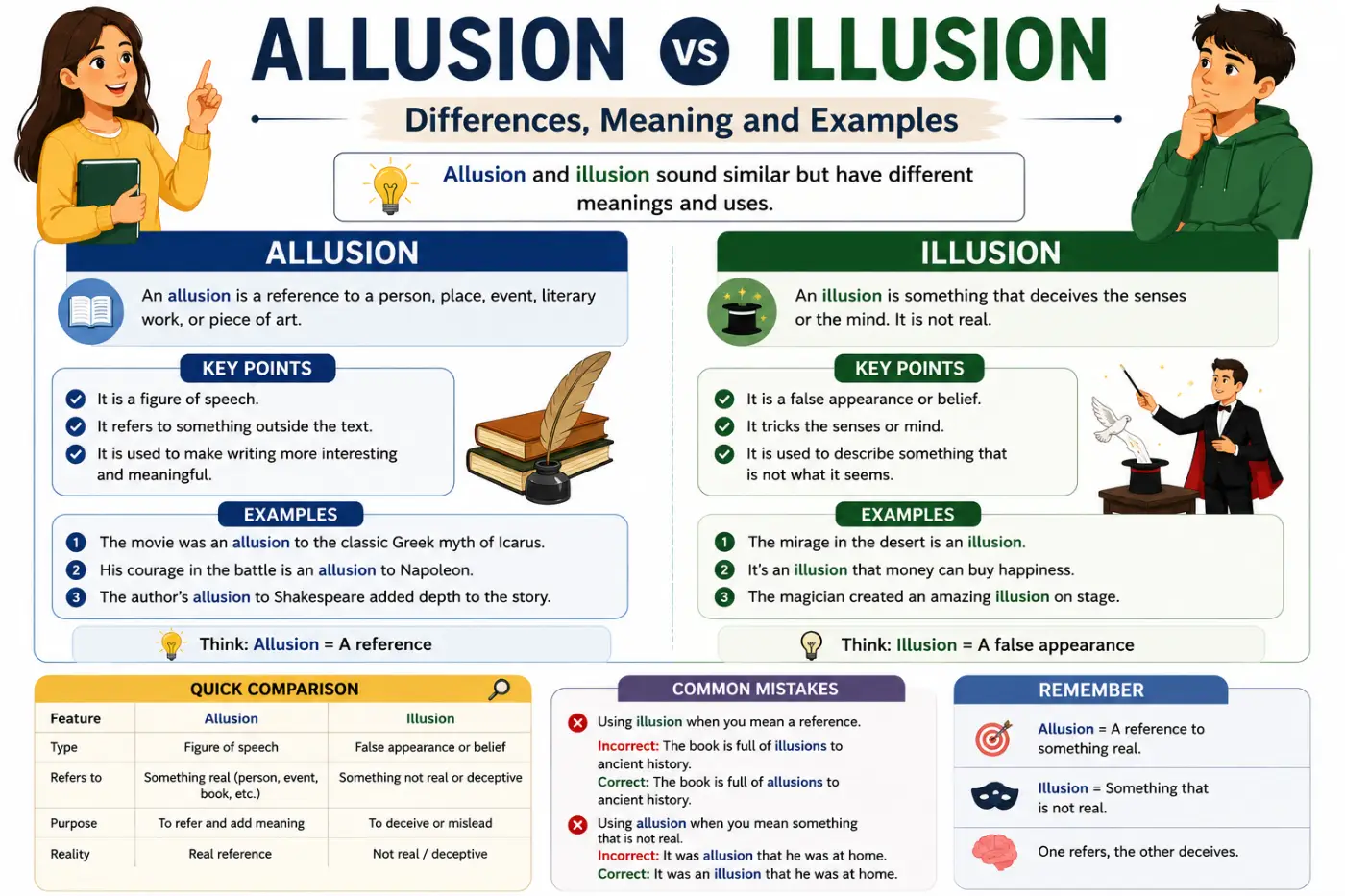
Allusion vs Illusion confuses many English learners and even experienced writers. The words differ by only one letter, share a similar pronunciation, and often appear in literature, journalism, speeches, and everyday conversations. Despite these similarities, they describe very different ideas.
If you use allusion when you mean illusion, your sentence can lose its intended meaning. Imagine describing a magician’s trick as an allusion. Readers would expect a literary reference instead of a visual deception. On the other hand, calling a reference to Greek mythology an illusion would suggest something fake instead of a clever mention.
Understanding this difference improves your writing, strengthens your vocabulary, and helps you communicate more precisely. In this guide, you will learn what each word means, how to pronounce it, when to use it, common mistakes to avoid, and practical examples that make the distinction easy to remember.
Short Answer
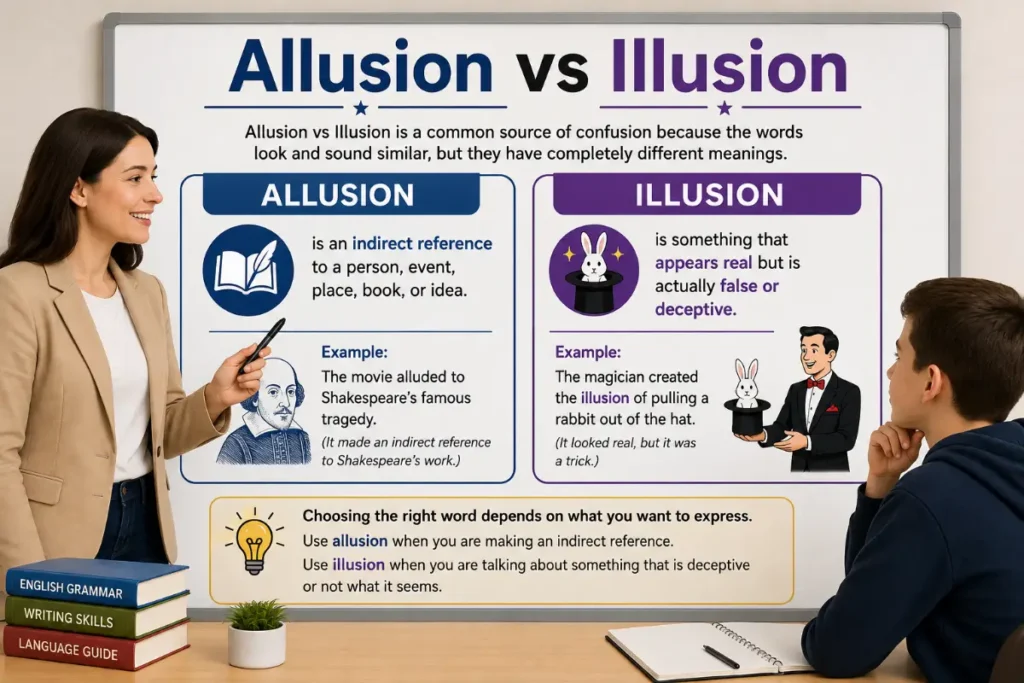
Allusion vs Illusion is a common source of confusion because the words look and sound similar, but they have completely different meanings. Allusion is an indirect reference to a person, event, place, book, or idea. Illusion is something that appears real but is actually false or deceptive. Choosing the right word depends on what you want to express.
Table Of Contents
- What Does Allusion Mean
- What Does Illusion Mean
- Pronunciation Guide
- Allusion Vs Illusion Comparison Table
- Key Differences Between Allusion And Illusion
- When To Use Allusion
- When To Use Illusion
- Grammar And Usage Rules
- Real Life Examples
- Common Mistakes
- Professional Writing Tips
What Does Allusion Mean
An allusion is an indirect reference to something that the writer or speaker expects the audience to recognize. The reference is usually brief and does not explain the topic in detail. An allusion can point to a famous person, a historical event, a movie, a religious story, a myth, a song, or another well known idea.
Definition
Allusion means an indirect or passing reference to a person, place, event, literary work, or cultural idea.
Simple Examples
- Her speech contained an allusion to Martin Luther King Jr.
Explanation. The speaker mentioned an idea connected to Martin Luther King Jr. without explaining his entire history.
- The novel includes an allusion to Greek mythology.
Explanation. The author briefly refers to a well known myth instead of retelling it.
- His joke was an allusion to a famous television show.
Explanation. People who know the show understand the hidden reference.
- The advertisement made an allusion to a classic fairy tale.
Explanation. The commercial hints at the story without directly describing it.
Common Sources Of Allusions
- Literature.
- History.
- Religion.
- Mythology.
- Movies.
- Songs.
- Famous speeches.
- Popular culture.
What Does Illusion Mean
An illusion is something that deceives your senses or creates a false impression. An illusion makes you believe something is true even though reality is different. Illusions are common in magic shows, psychology, photography, art, architecture, and everyday life.
Definition
Illusion means a false appearance, misleading perception, or deceptive image.
Simple Examples
- The magician created the illusion that the rabbit disappeared.
Explanation. The rabbit only seemed to disappear.
- Heat on the road produced the illusion of water.
Explanation. The water was not actually there.
- Mirrors created the illusion of a larger room.
Explanation. The room looked bigger than it really was.
- Social media can create the illusion of a perfect life.
Explanation. The appearance may not reflect reality.
Pronunciation Guide
| Word | Pronunciation | Sounds Like | Meaning |
|---|---|---|---|
| Allusion | uh LOO zhuhn | a loo zhun | An indirect reference |
| Illusion | ih LOO zhuhn | i loo zhun | A false appearance |
Pronunciation Tip
The middle and ending sounds are almost identical. The biggest difference is the first vowel sound.
Allusion begins with the sound uh.
Illusion begins with the sound ih.
Although the pronunciation differs slightly, the meanings are much farther apart than the sounds.
Allusion Vs Illusion Comparison Table
| Feature | Allusion | Illusion |
|---|---|---|
| Meaning | An indirect reference | A false appearance |
| Used For | Literature, speeches, writing | Magic, vision, psychology |
| Purpose | Connect ideas | Deceive or mislead perception |
| Related To | Communication | Perception |
| Can Be Intentional | Yes | Yes or naturally occurring |
| Common Contexts | Books, essays, speeches | Magic shows, art, science, daily life |
| Part Of Speech | Noun | Noun |
Key Differences Between Allusion And Illusion
Understanding the differences becomes easier when you compare what each word actually does.
Allusion Refers To A Reference
An allusion points readers or listeners toward another idea.
Example.
The author’s allusion to Shakespeare added depth to the story.
Explanation. Shakespeare is referenced without being discussed in detail.
Illusion Refers To Something That Is Not Real
An illusion changes what people believe they see or understand.
Example.
The curved mirror created the illusion of extra space.
Explanation. The space only appeared larger.
Allusion Depends On Shared Knowledge
An allusion works only if the audience recognizes the reference.
Example.
Calling someone Einstein is an allusion to intelligence.
Explanation. People understand the comparison because Einstein is widely known.
Illusion Depends On Perception
An illusion changes what someone experiences through sight, hearing, or belief.
Example.
The stage lighting produced the illusion that the actor was floating.
Explanation. Clever lighting fooled the audience.
Allusion Enriches Writing
Writers often use allusions to create deeper meaning without adding lengthy explanations.
Example.
The politician made an allusion to the Boston Tea Party.
Explanation. The audience connects the speech to history.
Illusion Creates A False Impression
Illusions often entertain or mislead.
Example.
The artist painted shadows that created the illusion of movement.
Explanation. The painting remains still, but it appears alive.
When To Use Allusion
Use allusion when referring indirectly to something your audience probably recognizes.
Common situations include the following.
- Literary analysis.
Example.
The poem contains an allusion to the Garden of Eden.
Explanation. The poem hints at the biblical story.
- Public speaking.
Example.
The speaker made an allusion to the moon landing.
Explanation. The audience understands the historical reference.
- Journalism.
Example.
The article included an allusion to Watergate.
Explanation. The writer briefly mentions the famous political scandal.
- Everyday conversation.
Example.
His comment was an allusion to our high school days.
Explanation. The speaker indirectly referred to shared memories.
When To Use Illusion
Use illusion when something appears different from reality. Common situations include the following.
- Magic performances.
Example.
The illusion amazed the audience.
Explanation. The trick looked impossible.
- Optical science.
Example.
The picture creates an illusion of depth.
Explanation. A flat image appears three dimensional.
- Psychology.
Example.
People sometimes live under the illusion that success comes without effort.
Explanation. The belief is inaccurate.
- Interior design.
Example.
Bright colors create the illusion of more space.
Explanation. The room only appears larger.
Grammar And Usage Rules
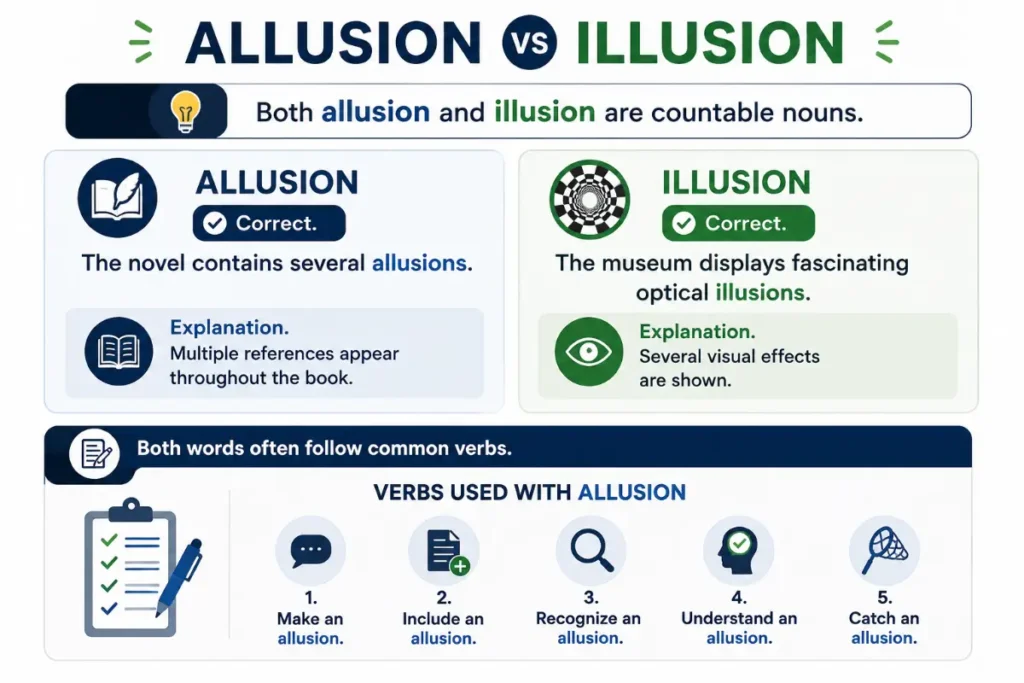
Both allusion and illusion are countable nouns.
Correct.
The novel contains several allusions.
Explanation. Multiple references appear throughout the book.
Correct.
The museum displays fascinating optical illusions.
Explanation. Several visual effects are shown.
Both words often follow common verbs.
Verbs Used With Allusion
- Make an allusion.
- Include an allusion.
- Recognize an allusion.
- Understand an allusion.
- Catch an allusion.
Examples.
The professor made an allusion to ancient Rome.
Readers immediately recognized the allusion.
The editor removed the allusion because it confused readers.
Verbs Used With Illusion
- Create an illusion.
- Break the illusion.
- Maintain the illusion.
- Destroy the illusion.
- Produce an illusion.
Examples.
The mirrors created an illusion of endless space.
The mistake broke the illusion.
The lighting maintained the illusion throughout the performance.
Real Life Examples
In Literature
“The novel makes an allusion to the Odyssey.”
Explanation. Readers familiar with the classic epic recognize the connection.
In Movies
“The director used lighting to create the illusion that the hallway never ended.”
Explanation. Camera techniques changed the audience’s perception.
In Advertising
“The commercial includes an allusion to a famous superhero.”
Explanation. Viewers understand the hidden reference without hearing the character’s name.
In Education
“The teacher explained the biblical allusion before discussing the poem.”
Explanation. Students needed background knowledge to understand the text.
In Science
“The experiment demonstrated an optical illusion.”
Explanation. Participants saw something that differed from reality.
In Everyday Conversation
“She was under the illusion that everyone agreed with her.”
Explanation. Her belief was incorrect.
Common Mistakes
Mistake One
Incorrect.
The magician performed an allusion.
Correct.
The magician performed an illusion.
Explanation. Magic tricks create false appearances, not literary references.
Mistake Two
Incorrect.
The writer used an illusion to Greek mythology.
Correct.
The writer used an allusion to Greek mythology.
Explanation. Writers refer to myths through allusions.
Mistake Three
Incorrect.
The painting contains several illusions to famous novels.
Correct.
The painting contains several allusions to famous novels.
Explanation. References require the word allusions.
Mistake Four
Incorrect.
His speech created an allusion that everything was perfect.
Correct.
His speech created the illusion that everything was perfect.
Explanation. A false impression is an illusion.
Professional Writing Tips
- Ask yourself if the sentence is referring to something or deceiving the senses. If it refers to another work, event, or person, choose allusion. If it describes a false appearance or mistaken belief, choose illusion.
- Consider your audience. An allusion succeeds only when readers recognize the reference. If the reference is too obscure, many readers may miss your point.
- Avoid replacing one word with the other simply because they sound alike. They belong to different ideas and cannot be used interchangeably.
- Read the sentence aloud. If you are talking about literature, history, culture, or famous people, allusion is usually the correct choice. If you are describing something that looks real but is not, illusion is almost always the right word.
- In professional writing, use allusions sparingly. Too many references can make your content difficult for readers who do not share the same background knowledge. A clear explanation is often more effective than an obscure allusion.
Memory Tips
Learning Allusion vs Illusion becomes much easier if you connect each word with a simple idea instead of memorizing dictionary definitions.
Memory Tip One
Think of allusion as alluding to something.
If you allude to a famous person or story, you are making an indirect reference.
Example.
The author made an allusion to Cinderella.
Explanation. The writer hinted at the fairy tale instead of explaining it.
Memory Tip Two
Think of illusion as something that looks real but is not.
An illusion tricks your eyes or your mind.
Example.
The mirror created the illusion of another doorway.
Explanation. The doorway only appeared to exist.
Memory Tip Three
Remember this sentence. Allusion points somewhere. Illusion fools someone. The first word is about communication. The second word is about perception.
Memory Tip Four
Picture a classroom and a magic show. A literature teacher talks about Shakespeare without naming every play. That is an allusion. A magician makes a coin disappear. That is an illusion. These two images make the meanings much easier to remember.
Word Origins
Knowing where words come from often makes them easier to understand.
Origin Of Allusion
Allusion comes from the Latin word alludere, meaning to play with or to refer indirectly. Over time, English speakers used the word to describe indirect references in writing and speech.
Origin Of Illusion
Illusion comes from the Latin word illusio, meaning mockery, deception, or trick. The meaning later expanded to include anything that creates a false impression. Although both words share Latin roots, they developed very different meanings in English.
US Vs UK Usage
There is no meaningful difference between American English and British English for these words.
| Feature | American English | British English |
|---|---|---|
| Allusion | Allusion | Allusion |
| Illusion | Illusion | Illusion |
| Meaning | Same | Same |
| Pronunciation | Very similar | Very similar |
| Usage | Same | Same |
Both forms are standard in newspapers, books, universities, academic writing, and professional communication across English speaking countries.
Formal Vs Informal Usage
Both words work well in formal and informal English.
Formal Examples
The speech contained an allusion to classical literature. The experiment demonstrated a visual illusion. These sentences are appropriate for essays, research papers, reports, and presentations.
Informal Examples
That movie made an allusion to Star Wars. The trick gave me the illusion that the table was floating. These examples sound natural in everyday conversation.
Related Grammar And Usage Notes
Many learners confuse allusion and illusion with other similar looking words.
Allude Vs Allusion
Allude is the verb.
Allusion is the noun.
Examples.
The speaker alluded to the economic crisis.
Explanation. The action is expressed with the verb.
The speech included an allusion to the economic crisis.
Explanation. The reference itself is the noun.
Illude
You may occasionally see illude in historical texts. It is an extremely rare verb and is almost never used in modern English. Today, writers simply use phrases such as create an illusion or give the illusion instead.
Delusion Vs Illusion
These words are also different. An illusion is a false appearance or misleading perception. A delusion is a false belief that a person continues to hold despite strong evidence against it.
Examples.
The mirrors created an illusion of endless space.
Explanation. The eyes are deceived.
He lived under the delusion that he could never fail.
Explanation. The mistaken belief existed in his mind.
Similar Confusing Words
Many English words look alike but have different meanings.
| Word Pair | Main Difference |
|---|---|
| Allusion vs Illusion | Reference versus false appearance |
| Affect vs Effect | Verb versus noun in most situations |
| Accept vs Except | Receive versus exclude |
| Complement vs Compliment | Complete versus praise |
| Elicit vs Illicit | Draw out versus illegal |
| Principal vs Principle | Person or main versus rule |
| Stationary vs Stationery | Not moving versus writing paper |
| Council vs Counsel | Governing group versus advice |
Learning these pairs improves vocabulary and reduces common writing mistakes.
People Also Ask
Is allusion the same as illusion
No.
An allusion is an indirect reference to something well known.
An illusion is something that appears real but is not.
Why do people confuse allusion and illusion
They have similar spellings, similar pronunciation, and both come from Latin. Their meanings, however, are completely different.
Can allusion and illusion be used interchangeably
No.
Replacing one with the other changes the meaning of the sentence.
Is an optical illusion an allusion
No.
An optical illusion is a visual effect that tricks the eyes.
An allusion is a reference in language or writing.
Can a speech contain an illusion
Usually, a speech contains allusions rather than illusions.
However, a speech can create the illusion that something is true if it gives a misleading impression.
The correct word depends on the intended meaning.
Key Takeaways
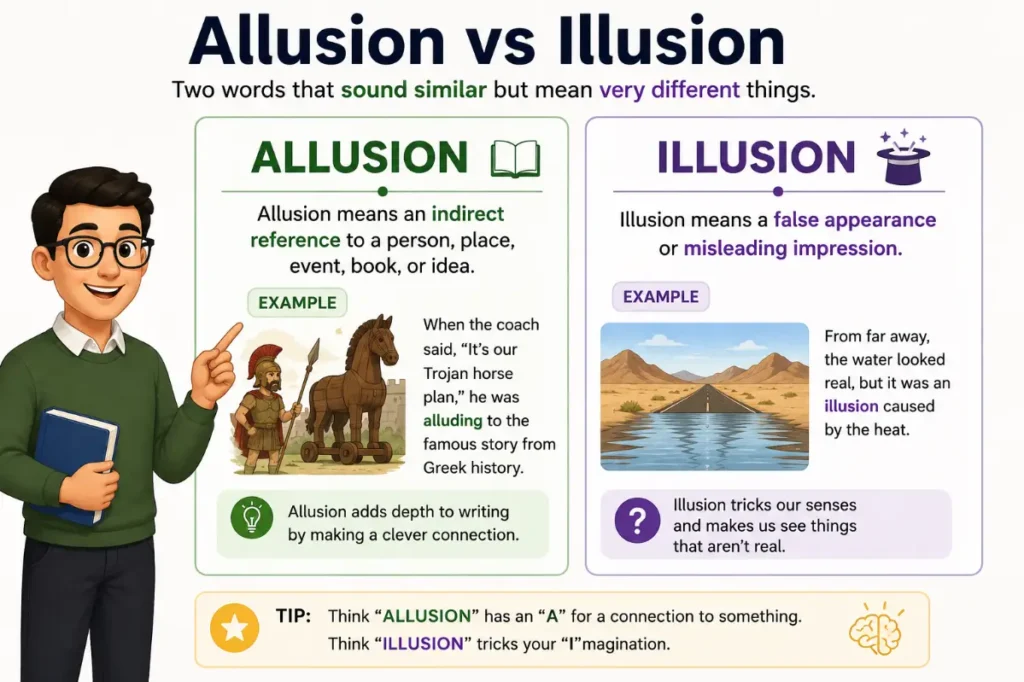
- Allusion means an indirect reference to a person, place, event, book, or idea.
- Illusion means a false appearance or misleading impression.
- An allusion depends on shared knowledge between the writer and the audience.
- An illusion depends on perception and makes something seem different from reality.
- Writers commonly use allusions in literature, speeches, journalism, and essays.
- Illusions commonly appear in magic, psychology, photography, architecture, science, and art.
- Although the words look and sound similar, they are never true synonyms.
- Choosing the correct word makes your writing clearer and more precise.
Conclusion
Understanding Allusion vs Illusion is easier once you focus on the purpose of each word. An allusion points readers toward a familiar person, event, book, or idea without explaining it directly. An illusion creates a false appearance or misleading impression that makes something seem different from reality.
Before choosing either word, ask a simple question. Am I referring to something well known, or am I describing something that only appears to be true? If you are making an indirect reference, use allusion. If you are talking about deception, mistaken perception, or something that looks real but is not, use illusion.
Mastering this distinction will make your writing more accurate, your communication more confident, and your understanding of English vocabulary much stronger. The more you read and practice these words in real sentences, the more naturally you will recognize the correct choice every time.
Frequently Asked Questions
What is the main difference between Allusion vs Illusion
An allusion is an indirect reference to something familiar, while an illusion is a false appearance or deceptive impression.
Is allusion used only in literature
No.
Although it is common in literature, allusions also appear in speeches, news articles, advertising, movies, conversations, and songs.
What is an example of an allusion
“The athlete was called Hercules.”
This is an allusion because it indirectly refers to the strong figure from Greek mythology.
What is an example of an illusion
“The desert road looked covered with water.”
This is an illusion because the water is not actually there.
Which word is more common in everyday English
Both are common, but they appear in different situations.
Allusion is frequent in writing and communication.
Illusion is common when discussing perception, magic, psychology, and visual effects.
How can I remember the difference between allusion and illusion
Remember this simple rule.
Allusion refers. Illusion deceives.
If the sentence points to another story or idea, choose allusion.
If it describes something that only appears real, choose illusion.
Can an allusion be direct
No.
A direct mention is not considered an allusion.
An allusion works because it is indirect and expects readers to recognize the reference.
Can an illusion exist without magic
Yes.
Natural optical effects, photography, mirrors, architecture, lighting, and even mistaken assumptions can create illusions.
Are allusions always intentional
Most allusions are intentional because writers and speakers deliberately include them to enrich meaning.
Why is Allusion vs Illusion important for writers
Understanding Allusion vs Illusion helps writers choose precise words, avoid embarrassing mistakes, and communicate ideas clearly. Using the correct term also strengthens academic writing, professional communication, and creative storytelling.

English Grammar & Usage
Nathan Holloway is an American grammar writer and language researcher who specializes in English grammar, sentence structure, verb usage, and common writing mistakes. He enjoys breaking down confusing grammar rules into practical explanations with clear examples, making English easier for students, professionals, and everyday writers.