
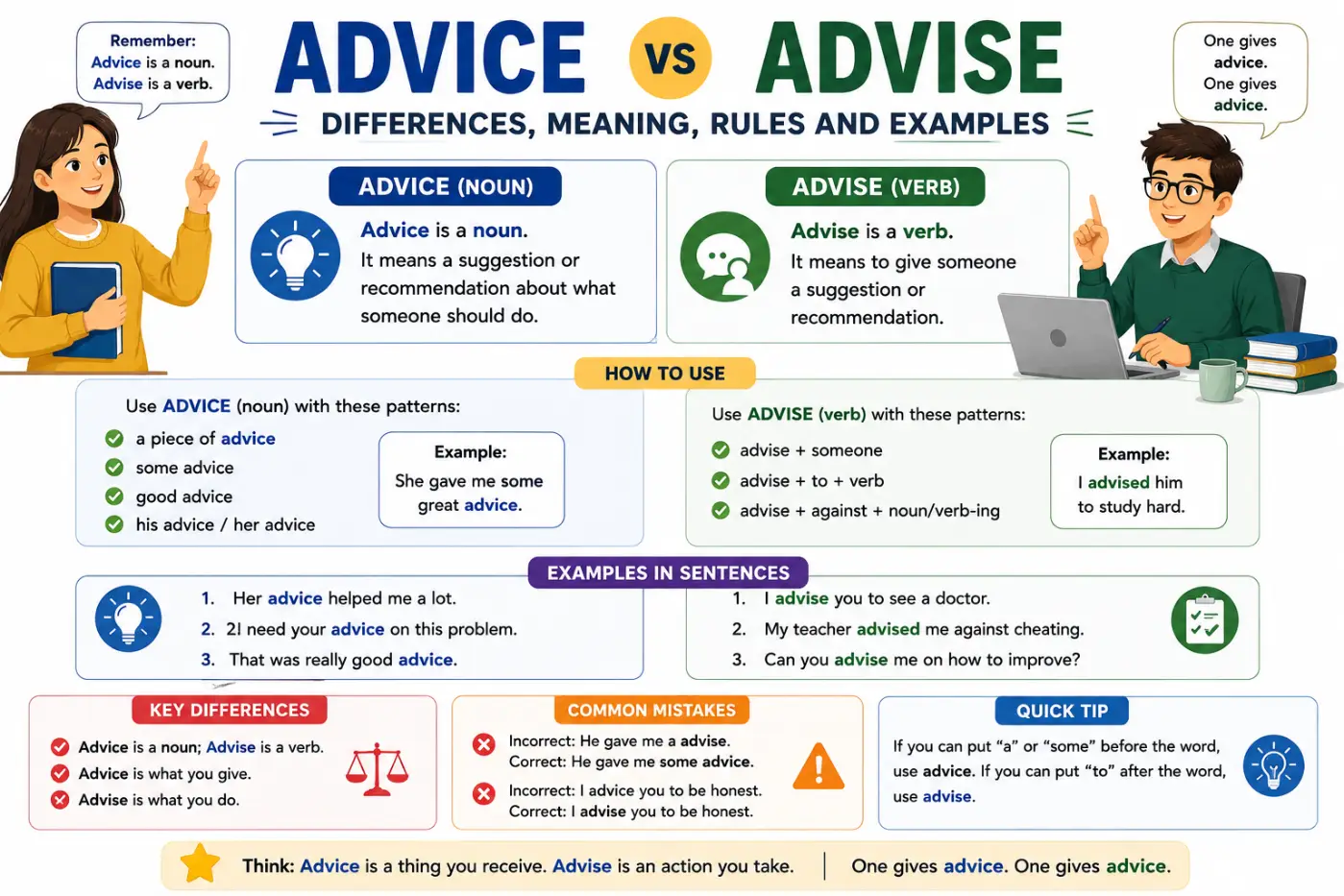
Advice vs Advise is one of the most commonly confused word pairs in English. The only visible difference is the final letter, yet changing c to s also changes the word’s pronunciation, grammar, and meaning. Many English learners, and even native speakers, accidentally use one when they mean the other.
The good news is that this mistake is easy to fix once you understand how each word works. One is a noun that names a thing, while the other is a verb that describes an action. Knowing this simple distinction will help you write more accurately, speak more confidently, and avoid one of the most common grammar mistakes in English.
This guide explains everything you need to know about Advice vs Advise, including meanings, pronunciation, grammar rules, examples, memory tricks, common mistakes, professional writing tips, and real-life usage.
Short Answer
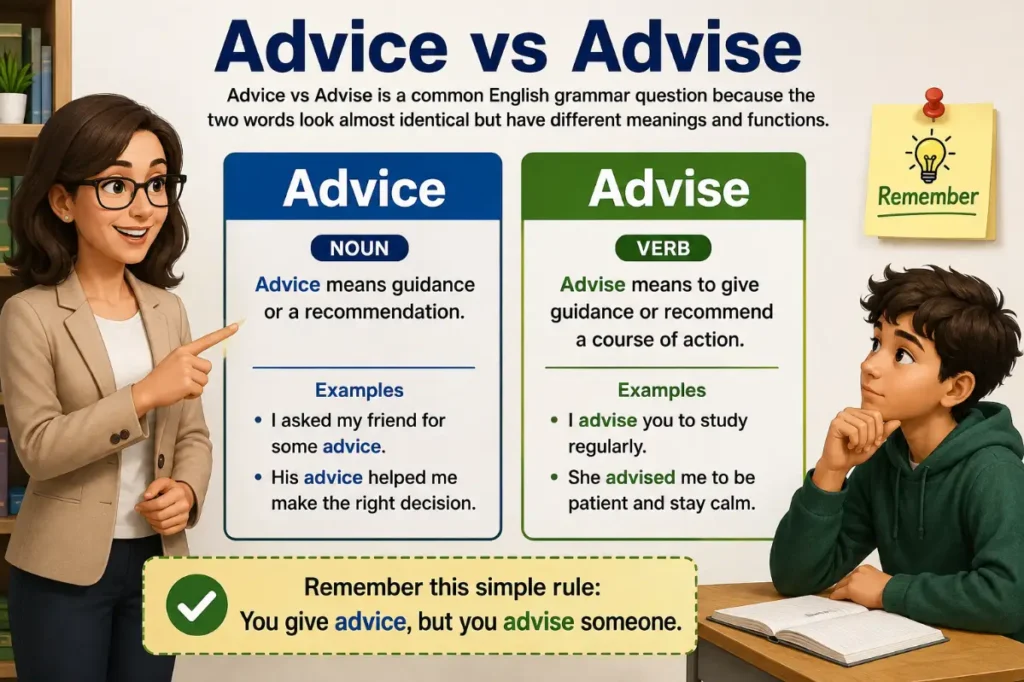
Advice vs Advise is a common English grammar question because the two words look almost identical but have different meanings and functions. Advice is a noun that means guidance or a recommendation, while advise is a verb that means to give guidance or recommend a course of action. Remember this simple rule: you give advice, but you advise someone.
Table of Contents
- What Does Advice Mean
- What Does Advise Mean
- Advice vs Advise Quick Comparison
- The Main Difference Between Advice and Advise
- When to Use Advice
- When to Use Advise
- Grammar Rules
- Pronunciation Differences
- Common Expressions
- Formal and Informal Usage
- Real-life Examples
- Common Mistakes
- Memory Tips
- Related Grammar Notes
- FAQs
What Does Advice Mean
Advice is a noun.
It means guidance, a recommendation, or an opinion offered to help someone make a decision or solve a problem.
Examples:
- Thank you for your advice.
- Her advice helped me find a better job.
- I always ask my parents for advice.
In every example, advice refers to the guidance itself.
You can receive advice.
You can ignore advice.
But you cannot advice someone because advice is not a verb.
Definition of Advice
Advice means an opinion or recommendation offered to help another person decide what to do.
Is Advice Countable
One important grammar rule is that advice is an uncountable noun.
Correct:
- She gave me good advice.
- I need some advice.
- They offered useful advice.
Incorrect:
- She gave me an advice.
- I have three advices.
- He shared many advices.
Since advice is uncountable, use words like:
- some advice
- good advice
- useful advice
- valuable advice
- a piece of advice
- a bit of advice
If you want to count it, say:
- one piece of advice
- two pieces of advice
Never say two advices.
What Does Advise Mean
Advise is a verb.
It means to give advice, recommend something, or suggest the best course of action.
Examples:
- I advise you to save money.
- Doctors advise patients to exercise regularly.
- The lawyer advised his client to remain silent.
Each sentence describes the action of giving guidance.
Definition of Advise
Advise means to recommend, suggest, or guide someone.
Because it is a verb, it changes form like other verbs.
Examples:
Present:
- I advise.
- We advise.
Past:
- She advised me yesterday.
Present participle:
- They are advising customers.
Past participle:
- He has advised many students.
Advice vs Advise Quick Comparison
| Feature | Advice | Advise |
|---|---|---|
| Part of speech | Noun | Verb |
| Meaning | Guidance or recommendation | To give guidance |
| Countable | No | Not applicable |
| Action word | No | Yes |
| Used after “give” | Yes | No |
| Used before “someone” | No | Yes |
This simple comparison highlights the biggest difference.
One names the guidance.
The other describes giving the guidance.
The Main Difference Between Advice and Advise
The easiest way to understand Advice vs Advise is to remember that they belong to different parts of speech.
Advice is something.
Advise is an action.
Compare these examples.
Example One
- My teacher gave me helpful advice.
Meaning:
The guidance itself is important.
Example Two
- My teacher advised me to study every day.
Meaning:
The teacher performed the action of giving guidance.
Notice how the sentence structure changes.
You give advice.
You advise someone.
Another comparison.
Correct:
- Can you give me some advice?
Correct:
- Can you advise me?
Incorrect:
- Can you advice me?
Incorrect:
- Can you give me some advise?
The last two examples confuse the noun and verb forms.
When to Use Advice
Use advice whenever you are talking about guidance, suggestions, recommendations, or opinions.
After Give
Examples:
- She gave me excellent advice.
- They gave useful advice.
- He always gives honest advice.
After Ask For
Examples:
- I asked for legal advice.
- We asked for medical advice.
- She asked for financial advice.
After Need
Examples:
- I need some advice.
- You need professional advice.
- They need expert advice.
With Adjectives
Examples:
- helpful advice
- useful advice
- practical advice
- sound advice
- expert advice
- honest advice
- professional advice
- friendly advice
Each adjective describes the quality of the guidance.
When to Use Advise
Use advise whenever someone is recommending, suggesting, or guiding another person.
Examples:
- I advise you to leave early.
- Experts advise eating more vegetables.
- Teachers advise students to read daily.
- Financial planners advise saving regularly.
Each sentence describes an action.
Someone is advising another person.
Common Sentence Patterns
Pattern One
Advise + person + to + verb
Examples:
- I advise you to wait.
- They advised us to leave.
- She advised him to apologize.
Pattern Two
Advise + against + noun or verb
Examples:
- Doctors advise against smoking.
- Experts advise against rushing.
- Lawyers advise against signing immediately.
This structure is very common in formal writing.
Grammar Rules
Understanding a few grammar rules makes Advice vs Advise much easier.
Rule One
Advice is always a noun.
Correct:
- Good advice is valuable.
Incorrect:
- Good advise is valuable.
Rule Two
Advise is always a verb.
Correct:
- I advise caution.
Incorrect:
- I advice caution.
Rule Three
Advice cannot be counted.
Correct:
- some advice
- useful advice
- a piece of advice
Incorrect:
- an advice
- many advices
- three advices
Rule Four
Advise changes form because it is a verb.
Examples:
- advise
- advises
- advised
- advising
Advice never changes form.
Pronunciation Differences
Although these words look similar, they are pronounced differently.
| Word | IPA | Sounds Like |
|---|---|---|
| Advice | /ədˈvaɪs/ | ends with “ice” |
| Advise | /ədˈvaɪz/ | ends with “eyes” |
Notice the final sound.
Advice ends with the S sound.
Advise ends with the Z sound.
Practice reading these aloud.
- Thank you for your advice.
- I advise you to be careful.
Listening to the ending sound is one of the fastest ways to remember the difference.
Word Origin
Both words come from the same historical root.
They entered English through Old French and ultimately trace back to the Latin word visum, meaning “to see” or “to consider.”
Over time, English developed two separate forms.
Advice became the noun.
Advise became the verb.
This noun and verb pattern appears in several English word pairs.
Examples include:
- device and devise
- practice and practice as a verb in American English is an exception because the spelling remains the same
- belief and believe
Learning these patterns makes English vocabulary easier to understand.
Common Expressions with Advice
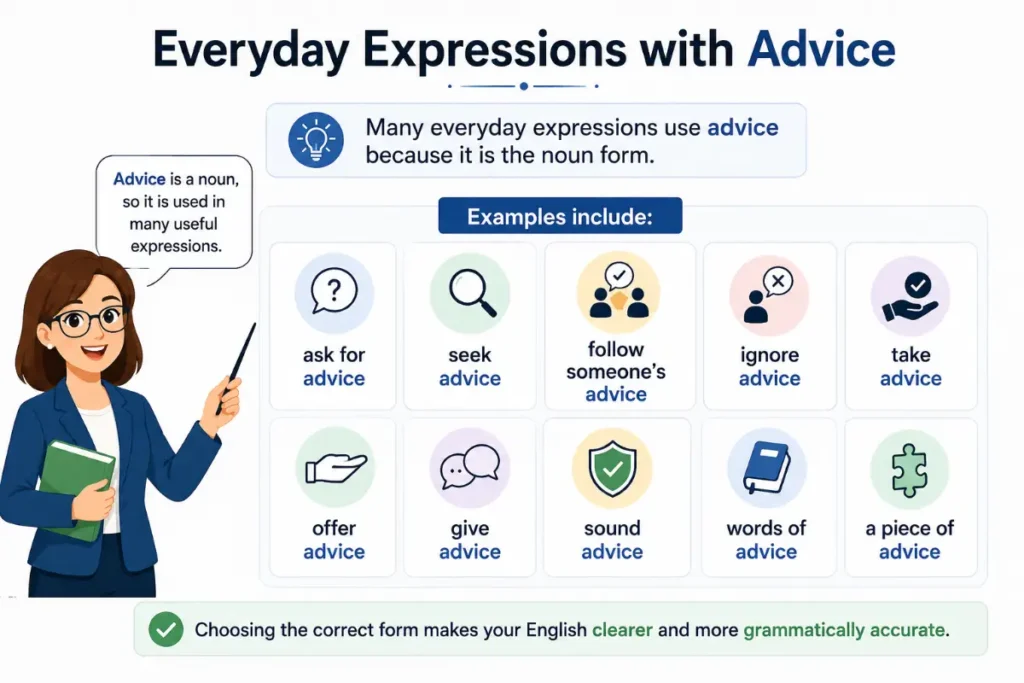
Many everyday expressions use advice because it is the noun form.
Examples include:
- ask for advice
- seek advice
- follow someone’s advice
- ignore advice
- take advice
- offer advice
- give advice
- sound advice
- words of advice
- a piece of advice
These expressions appear frequently in books, conversations, business writing, and news articles.
Formal and Informal Usage
Both advice and advise are appropriate in formal and informal English. The difference is not about formality. It is about grammar.
Formal Writing
In business, legal, academic, and professional writing, both words appear regularly.
Examples:
- We advise all applicants to submit their documents before the deadline.
- Please seek legal advice before signing the agreement.
- Financial advisors advise clients to diversify their investments.
These sentences follow standard English grammar and sound professional.
Informal Conversation
In daily conversations, people also use these words naturally.
Examples:
- Can you give me some advice?
- I advise you not to stay up so late.
- Thanks for your advice.
- My brother advised me to apply for the job.
The grammar stays the same regardless of the setting.
Advice vs Advise in American and British English
The distinction between advice and advise is exactly the same in American and British English.
Both varieties follow these rules:
- Advice is always the noun.
- Advise is always the verb.
The spelling does not change between the two forms of English.
Examples:
American English:
- The doctor advised me to rest.
- I followed his advice.
British English:
- The solicitor advised his client carefully.
- She appreciated the advice she received.
The grammar remains identical.
Comparison Table
| Feature | Advice | Advise |
|---|---|---|
| Part of speech | Noun | Verb |
| Meaning | Guidance | To give guidance |
| Can follow “give” | ✔ | |
| Can follow “ask for” | ✔ | |
| Can take tense changes | ✔ | |
| Plural form | No | Not applicable |
| Used with “to + verb” | ✔ | |
| Used after adjectives | ✔ | Sometimes |
This table summarizes the key differences at a glance.
Real Life Examples
At School
Teacher:
“I advise you to review the chapter before tomorrow’s test.”
Explanation: The teacher is giving guidance.
Student:
“Thank you for your advice.”
Explanation: The student refers to the guidance received.
At Work
Manager:
“I advise everyone to back up important files.”
Employee:
“That’s useful advice.”
The first sentence uses the verb.
The second uses the noun.
At the Doctor’s Office
Doctor:
“I advise drinking more water every day.”
Patient:
“I appreciate your advice.”
Again, the action uses advise, while the guidance itself is advice.
Financial Planning
Advisor:
“I advise investing regularly.”
Client:
“Your advice helped me create a budget.”
This pattern appears frequently in professional communication.
Sentence Pairs That Show the Difference
Compare these examples carefully.
Pair One
- She gave me valuable advice.
- She advised me to accept the offer.
The first names the guidance.
The second describes giving it.
Pair Two
- His advice changed my career.
- He advised me to change careers.
Again, one is the thing received.
The other is the action performed.
Pair Three
- We need professional advice.
- Experts advise hiring a qualified accountant.
Understanding these sentence patterns makes the difference much easier to remember.
Common Mistakes
Many English learners make the same mistakes when using Advice vs Advise.
Mistake 1
Using advise as a noun.
Incorrect:
- Thank you for your advise.
Correct:
- Thank you for your advice.
Mistake 2
Using advice as a verb.
Incorrect:
- She advised me well.
Correct:
- She advised me well.
Incorrect:
- She advice me well.
Only advise can function as a verb.
Mistake 3
Treating advice as countable.
Incorrect:
- He gave me an advice.
Correct:
- He gave me some advice.
Or
- He gave me a piece of advice.
Mistake 4
Writing advices.
Incorrect:
- She shared many advices.
Correct:
- She shared a lot of advice.
Or
- She shared several pieces of advice.
Mistake 5
Confusing pronunciation.
Some learners pronounce both words the same way.
Remember:
Advice ends with an S sound.
Advise ends with a Z sound.
Memory Tips
Simple memory tricks can help you remember the correct word every time.
Remember the Letter C
Advice ends with C.
Think of C for Counsel or Content.
It names the guidance.
Remember the Letter S
Advise ends with S.
Think of S for Speak or Suggest.
It describes an action.
Use the Question Test
Ask yourself:
Am I naming guidance?
Choose advice.
Am I describing the action of giving guidance?
Choose advise.
Remember This Sentence
People advise others by giving advice.
This single sentence includes both words correctly and helps reinforce the difference.
Professional Writing Tips
Correct usage is especially important in professional communication.
In Emails
Correct:
- I appreciate your advice.
Correct:
- I advise reviewing the proposal carefully.
Incorrect:
- I appreciate your advise.
In Academic Writing
Researchers often use advise when making recommendations.
Example:
- The authors advise additional research before drawing conclusions.
When referring to recommendations already given, use advice.
Example:
- The committee’s advice influenced the final decision.
In Business Writing
Business documents frequently contain both words.
Example:
- Our consultants advise clients on investment strategies.
- Clients benefit from expert financial advice.
Using the correct form improves credibility and professionalism.
Related Grammar and Usage Notes
Learning related word pairs can help prevent similar mistakes.
Practice vs Practise
In American English:
Practice is both the noun and the verb.
In British English:
Practice is the noun.
Practise is the verb.
Device vs Devise
Device is a noun.
Devise is a verb.
This follows the same noun and verb pattern as Advice vs Advise.
Belief vs Believe
Belief is the noun.
Believe is the verb.
Choice vs Choose
Choice is the noun.
Choose is the verb.
Recognizing these patterns makes English vocabulary easier to master.
Key Takeaways
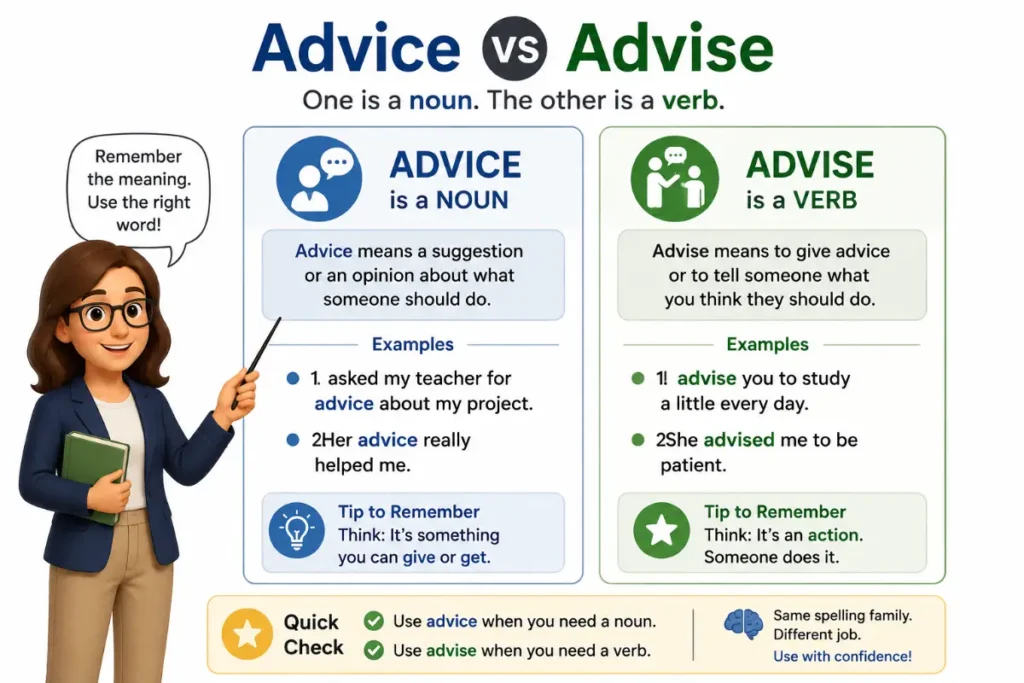
- Advice vs Advise is a noun versus verb comparison.
- Advice is always a noun.
- Advise is always a verb.
- Advice is an uncountable noun.
- Never write an advice or advices.
- Use advise + person + to + verb.
- Remember that advice ends with an S sound, while advise ends with a Z sound.
- The grammar rules are the same in American and British English.
- Choosing the correct word makes your writing clearer and more professional.
Conclusion
Understanding Advice vs Advise becomes simple once you remember that the two words belong to different parts of speech. Advice is the noun that refers to guidance, recommendations, or opinions, while advise is the verb that means to offer that guidance. Although they differ by only one letter, choosing the correct form makes a significant difference in grammar, pronunciation, and meaning.
Whenever you’re unsure, ask yourself one question. Are you talking about the guidance itself or the action of giving it? If it’s the guidance, use advice. If it’s the action, use advise. With this simple rule, along with the examples and memory tricks in this guide, you’ll use Advice vs Advise accurately and confidently in everyday conversations, professional writing, and academic work.
Frequently Asked Questions
What is the difference between Advice vs Advise?
Advice is a noun that means guidance or a recommendation. Advise is a verb that means to give guidance or recommend something.
Is advice a noun or a verb?
Advice is always a noun.
Is advise a noun?
No. Advise is always a verb.
Why is advice uncountable?
English treats advice as a mass noun, similar to information, knowledge, and furniture. Instead of saying an advice, say a piece of advice.
How do you use advise in a sentence?
Example:
- I advise you to read the instructions carefully.
Here, advise describes the action of giving guidance.
How do you use advice in a sentence?
Example:
- Your advice helped me solve the problem.
Here, advice refers to the guidance itself.
How do you remember the difference between Advice vs Advise?
Remember this sentence:
People advise others by giving advice.
It clearly shows the verb and noun forms.
Is there a pronunciation difference?
Yes.
Advice ends with an S sound.
Advise ends with a Z sound.
Do American and British English use different spellings?
No. Both American and British English use the same spellings and grammar rules for advice and advise.
What is the most common mistake?
The most common mistakes are writing an advice, advices, or using advice as a verb. Remember that advice is always a noun and advise is always a verb.

English Grammar & Usage
Nathan Holloway is an American grammar writer and language researcher who specializes in English grammar, sentence structure, verb usage, and common writing mistakes. He enjoys breaking down confusing grammar rules into practical explanations with clear examples, making English easier for students, professionals, and everyday writers.