
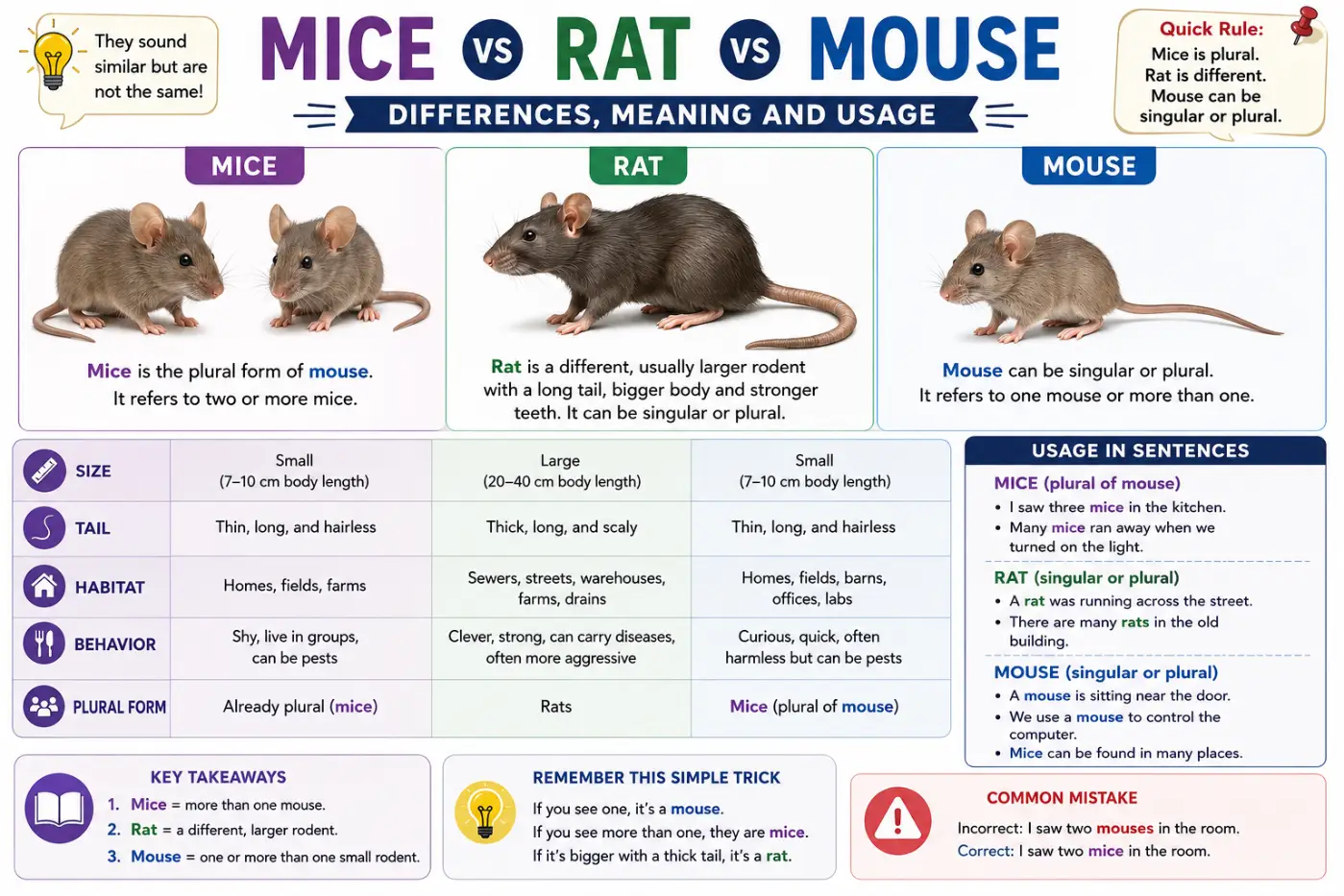
Mice vs Rat vs Mouse is a common English language question because these words are closely related but do not mean the same thing. Many people mistakenly believe that mouse and rat are singular and plural forms of the same animal. Others use mice when talking about rats or use rat to describe every small rodent they see.
The confusion becomes even greater because these animals often appear in similar environments, such as homes, farms, gardens, and cities. Although they belong to the same rodent family, they are different animals with distinct physical features, behaviors, and names.
Understanding the difference between Mice vs Rat vs Mouse is useful for everyday conversation, biology, writing, education, and even computer terminology. This guide explains the meanings, grammar rules, pronunciation, real-life examples, and common mistakes so you’ll always know which word to use.
Short Answer
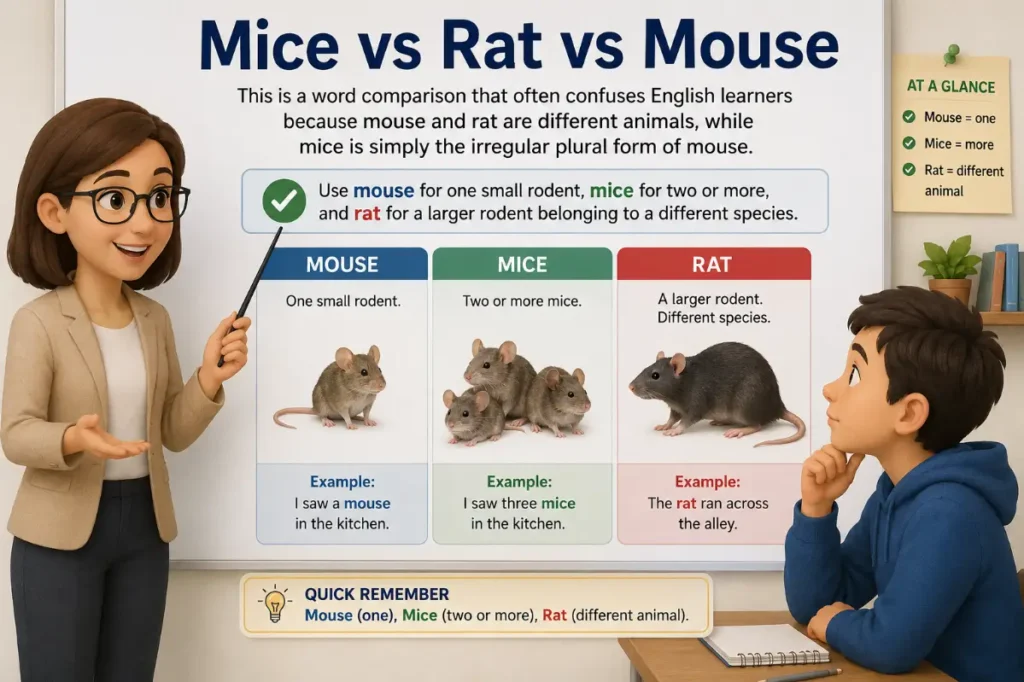
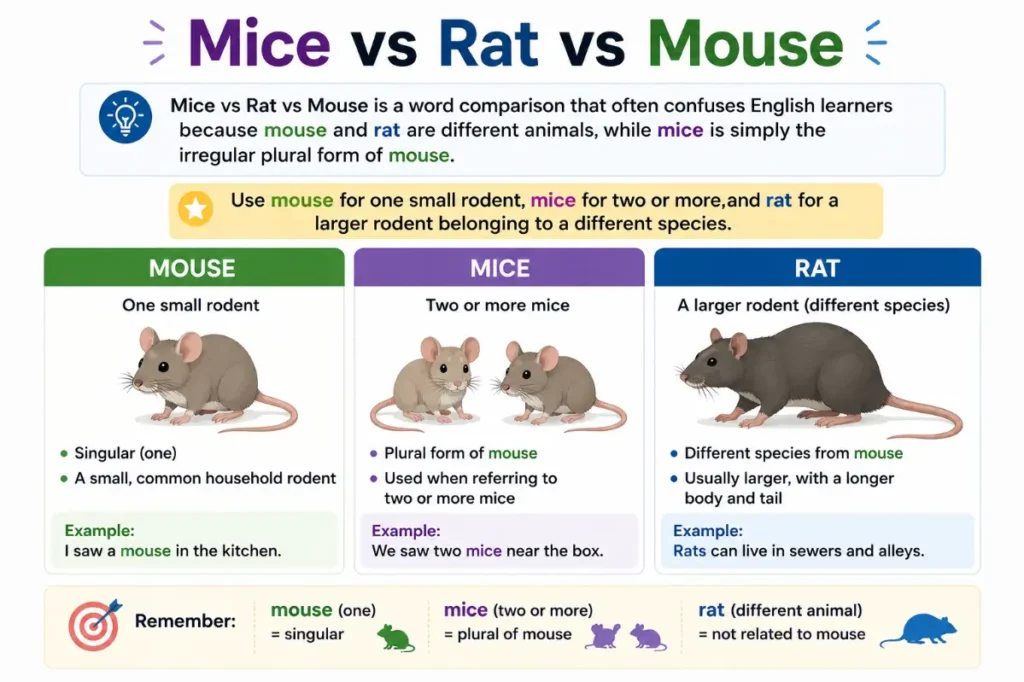
Mice vs Rat vs Mouse is a word comparison that often confuses English learners because mouse and rat are different animals, while mice is simply the irregular plural form of mouse. Use mouse for one small rodent, mice for two or more, and rat for a larger rodent belonging to a different species.
Table of Contents
- What Does Mouse Mean
- What Does Mice Mean
- What Does Rat Mean
- Mice vs Rat vs Mouse Quick Comparison
- The Main Difference Between Mouse and Rat
- Why Is the Plural of Mouse Mice
- Physical Differences Between Mice and Rats
- Grammar Rules
- Scientific Classification
- Everyday Usage
- Computer Mouse and Computer Mice
- Common Mistakes
- Memory Tips
- Related Vocabulary
- FAQs
What Does Mouse Mean
A mouse is a small rodent with a pointed nose, relatively large ears, small feet, and a long thin tail.
Examples:
- A mouse ran across the kitchen floor.
- The cat caught a mouse.
- We found a tiny mouse in the garage.
In each sentence, mouse refers to one animal.
Besides the animal, mouse also refers to the computer device used to move a cursor on a screen.
Examples:
- My wireless mouse stopped working.
- She bought a new computer mouse.
Although both meanings use the same word, the context makes the meaning clear.
What Does Mice Mean
Mice is the irregular plural form of mouse.
Examples:
- Several mice were hiding in the attic.
- Farmers often protect crops from mice.
- The laboratory keeps mice for scientific research.
Whenever you mean two or more mice, use mice, never mouses when referring to animals.
Correct:
- Three mice entered the shed.
Incorrect:
- Three mouses entered the shed.
The word mouses is sometimes used in specialized computer or technical contexts when talking about multiple computer devices, but mice remains the preferred plural for both animals and computer devices in most modern English.
What Does Rat Mean
A rat is another type of rodent, but it is generally larger than a mouse and belongs to a different species.
Examples:
- A rat was seen near the river.
- The old building had several rats.
- Brown rats are common in many cities.
Unlike mouse, the plural of rat follows the regular English rule.
Singular:
- rat
Plural:
- rats
Examples:
- One rat
- Two rats
- Five rats
Mice vs Rat vs Mouse Quick Comparison
| Feature | Mouse | Mice | Rat |
|---|---|---|---|
| Meaning | One mouse | More than one mouse | One or more rats depending on form |
| Singular | ✔ | ✔ | |
| Plural | ✔ | Rats | |
| Animal | ✔ | ✔ | ✔ |
| Computer device | ✔ | ✔ | No |
| Average size | Small | Small | Larger |
This quick comparison highlights the basic differences before we examine each word in greater detail.
The Main Difference Between Mouse and Rat
The biggest difference in Mice vs Rat vs Mouse is that mouse and rat are different animals, while mice simply means more than one mouse.
Think of it this way.
- Mouse = one small rodent.
- Mice = two or more mice.
- Rat = a different and generally larger rodent.
Compare these examples.
Correct:
- I saw one mouse.
- I saw three mice.
- I saw one rat.
- I saw four rats.
Incorrect:
- I saw one mice.
- I saw three mouse.
- I saw one mice rat.
The grammar becomes much easier when you remember that mice is only the plural form of mouse.
Why Is the Plural of Mouse Mice
English contains many irregular plural nouns. Instead of adding s, some words completely change their spelling.
Examples include:
| Singular | Plural |
|---|---|
| Mouse | Mice |
| Man | Men |
| Woman | Women |
| Goose | Geese |
| Tooth | Teeth |
| Foot | Feet |
| Louse | Lice |
These words developed hundreds of years ago in Old English and have remained unchanged.
Although they may seem unusual, native speakers naturally use these irregular plurals.
Physical Differences Between Mice and Rats
Understanding the physical characteristics makes it easier to choose the correct word.
Size
Mice are much smaller than rats.
Most mice measure only a few inches long without the tail.
Rats are considerably larger and heavier.
Ears
Mice have relatively large ears compared to their heads.
Rat ears appear smaller in proportion to the body.
Nose
A mouse usually has a pointed nose.
A rat typically has a broader, blunter nose.
Tail
Both animals have long tails.
However, a mouse tail is usually thinner.
A rat tail is thicker and stronger.
Body Shape
Mice have small, delicate bodies.
Rats have heavier, more muscular bodies.
These characteristics help identify the correct animal in real life.
Scientific Classification
Both mice and rats belong to the rodent family, but they are different species.
A common house mouse belongs to the genus Mus.
Many common rats belong to the genus Rattus.
Because they belong to different genera, they are not simply different sizes of the same animal.
This explains why English gives them different names.
Grammar Rules
Using these words correctly is mostly a matter of number.
Rule 1
Use mouse for one animal.
Correct:
- The mouse escaped.
Rule 2
Use mice for more than one.
Correct:
- The mice escaped.
Rule 3
Use rat for one rat.
Correct:
- The rat hid behind the box.
Rule 4
Use rats for more than one.
Correct:
- Several rats entered the building.
Rule 5
Never use mices.
Incorrect:
- Two mices.
Correct:
- Two mice.
Rule 6
Never use mouses when referring to animals.
Incorrect:
- Three mouses.
Correct:
- Three mice.
Pronunciation
| Word | IPA | Simple Pronunciation |
|---|---|---|
| Mouse | /maʊs/ | rhymes with house |
| Mice | /maɪs/ | rhymes with ice |
| Rat | /ræt/ | rhymes with cat |
Reading these words aloud helps you distinguish them.
Practice:
- One mouse.
- Two mice.
- One rat.
- Three rats.
Word Origin
The word mouse comes from the Old English mus.
Its plural gradually became mys, which eventually developed into mice.
The word rat entered English later from Germanic languages and kept the regular plural form by simply adding s.
This historical development explains why mouse has an irregular plural while rat does not.
Everyday Usage
People use these words in many situations besides biology.
Examples:
- The restaurant closed because inspectors found mice.
- The old warehouse had several rats.
- A mouse chewed through the food packaging.
- Scientists study mice to better understand human diseases.
Each sentence uses the correct word according to meaning and number.
Mouse as a Computer Device
The word mouse has another well known meaning.
It also refers to the handheld device used to control a computer.
Examples:
- My computer mouse isn’t responding.
- She bought a wireless mouse.
- I need a new gaming mouse.
Most style guides accept mice as the plural of computer mouse.
Examples:
- The office ordered twenty new mice.
Some technology companies occasionally use mouses, but this is uncommon and generally limited to technical documentation.
For everyday writing, mice remains the preferred plural.
Mice vs Rat vs Mouse in American and British English
The basic meanings of Mice vs Rat vs Mouse are the same in both American and British English. There are no spelling differences, and the grammar rules remain identical.
For example:
American English:
- We found a mouse in the basement.
British English:
- We found a mouse in the cellar.
The vocabulary around the animal may change depending on the region, but the words mouse, mice, and rat keep the same meanings.
Comparison Table
| Feature | Mouse | Mice | Rat |
|---|---|---|---|
| Meaning | One mouse | More than one mouse | One rat |
| Part of speech | Noun | Plural noun | Noun |
| Size | Small | Small | Larger |
| Plural form | Mice | Already plural | Rats |
| Scientific group | Genus Mus | Genus Mus | Commonly genus Rattus |
| Computer device | Yes | Yes | No |
| Common household pest | Yes | Yes | Yes |
This table summarizes the most important differences at a glance.
Real Life Examples
Around the House
- A mouse ran under the refrigerator.
Explanation: One small rodent was seen.
- We discovered several mice in the attic.
Usage: More than one mouse was found.
- A large rat was hiding behind the trash bin.
Explanation: The animal is larger and belongs to a different species.
At School
Teacher:
“What is the plural of mouse?”
Student:
“Mice.”
Explanation: This is the correct irregular plural.
At the Pet Store
- My daughter adopted two pet mice.
Explanation: More than one mouse.
- The store also sells pet rats.
Explanation: Rats are different animals and have a regular plural.
In Science
- Researchers studied laboratory mice.
Explanation: Mice are commonly used in scientific research because of their biological similarities to humans.
- Wild rats were monitored during the study.
Explanation: Rats are also used in research, but they remain a separate species.
In Technology
- My wireless mouse stopped working.
Explanation: Here, mouse refers to a computer accessory rather than an animal.
- The office purchased twenty new mice.
Explanation: Mice is widely accepted as the plural for computer mice.
Animal Characteristics
Although mice and rats belong to the rodent family, they behave differently.
Mice
Typical characteristics include:
- Small body
- Large ears
- Pointed nose
- Thin tail
- Curious behavior
- Excellent climbers
Rats
Typical characteristics include:
- Larger body
- Smaller ears relative to the head
- Blunter nose
- Thick tail
- Strong swimmers
- Greater intelligence and caution
Knowing these traits helps identify the correct animal in everyday situations.
Common Mistakes
Many English learners make similar mistakes when using Mice vs Rat vs Mouse.
Mistake 1
Using mouse as a plural.
Incorrect:
- I saw three mouse.
Correct:
- I saw three mice.
Mistake 2
Using mouses for animals.
Incorrect:
- Two mouses were eating the grain.
Correct:
- Two mice were eating the grain.
Mistake 3
Thinking a rat is simply a large mouse.
Incorrect idea:
“A rat is just an old mouse.”
Correct:
Rats and mice are different species of rodents.
Mistake 4
Using mice for rats.
Incorrect:
- There were huge mice in the sewer.
Correct:
- There were huge rats in the sewer.
Mistake 5
Calling every computer pointing device a “rat.”
Incorrect:
- I need a new computer rat.
Correct:
- I need a new computer mouse.
Memory Tips
These simple tricks can help you remember the differences.
Remember the Size
Mouse equals smaller.
Rat equals larger.
Think About the Plural
One mouse.
Two mice.
Never say mouses for animals.
Notice the Pattern
Mouse changes completely.
Rat simply adds s.
Mouse → Mice
Rat → Rats
Think of Famous Characters
Mickey Mouse reminds you that mouse is singular.
If there are several Mickey-like animals together, they become mice.
Professional Writing Tips
Choosing the correct word improves accuracy in reports, articles, and educational writing.
In Academic Writing
Always distinguish between mice and rats.
Correct:
- The experiment involved laboratory mice.
Incorrect:
- The experiment involved laboratory rats.
Only use the animal actually involved in the study.
In News Writing
Correct:
- Health officials discovered rats near the market.
Correct:
- Homeowners reported mice inside the walls.
Specific language improves credibility.
In Educational Writing
When teaching grammar, clearly explain that mice is the irregular plural of mouse, not another species.
Related Grammar and Usage Notes
Learning related words makes this topic easier to remember.
Mouse vs Mice
- One mouse
- Two mice
Rat vs Rats
- One rat
- Five rats
Mouse vs Rodent
Every mouse is a rodent.
Not every rodent is a mouse.
Rodents also include:
- Rats
- Squirrels
- Beavers
- Hamsters
- Guinea pigs
- Chipmunks
- Porcupines
Mouse vs Hamster
Both are small rodents.
However, hamsters have shorter tails, rounder bodies, and are usually kept as pets.
Rat vs Mouse as Metaphors
English sometimes uses these animals symbolically.
Examples:
- “Like rats leaving a sinking ship.”
This refers to people leaving a failing situation.
- “As quiet as a mouse.”
This describes someone who is very quiet.
These expressions rely on the characteristics traditionally associated with each animal.
Idioms and Expressions
Understanding common idioms helps you recognize these words beyond their literal meanings.
As Quiet as a Mouse
Meaning:
Very quiet.
Example:
- The children were as quiet as a mouse during the movie.
Smell a Rat
Meaning:
To suspect something is dishonest.
Example:
- I smell a rat. The numbers don’t match.
Play Cat and Mouse
Meaning:
To toy with someone before taking action.
Example:
- The detective played cat and mouse with the suspect.
Like Rats Leaving a Sinking Ship
Meaning:
People quickly abandoning a failing situation.
Example:
- Investors left the company like rats leaving a sinking ship.
Key Takeaways
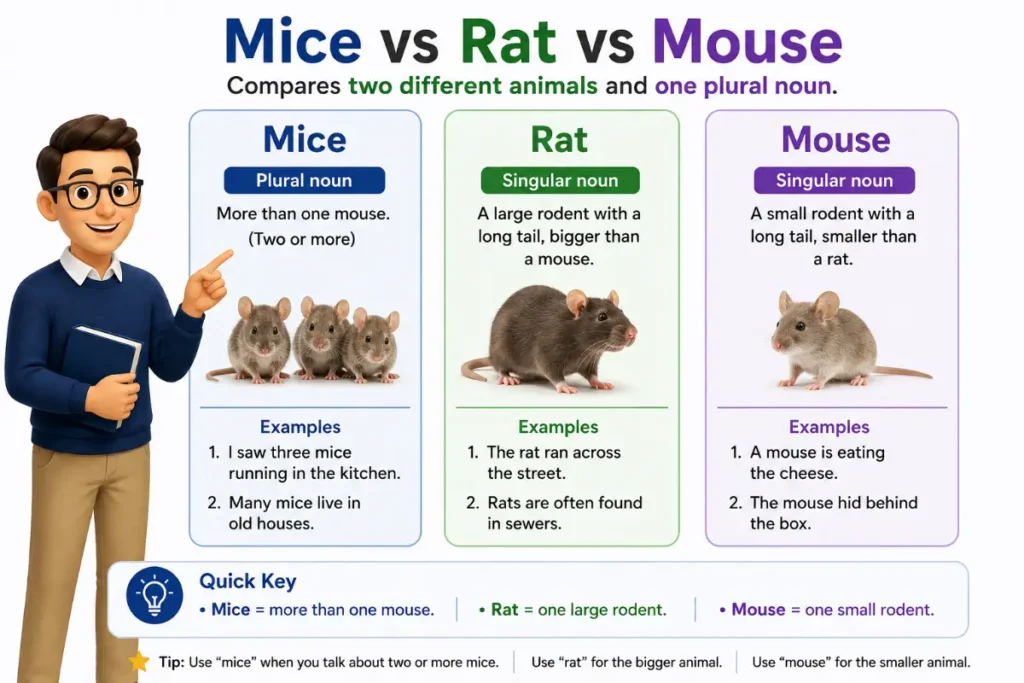
- Mice vs Rat vs Mouse compares two different animals and one plural noun.
- Mouse refers to one small rodent.
- Mice is the irregular plural of mouse.
- Rat is a different and generally larger rodent.
- The plural of rat is rats.
- Never use mouses for animals.
- Never use mices.
- The same grammar rules apply in American and British English.
- Mouse also refers to a computer pointing device.
- Context makes it easy to determine whether mouse refers to an animal or a computer accessory.
Conclusion
Understanding Mice vs Rat vs Mouse becomes simple once you separate grammar from biology. Mouse is the singular form, mice is its irregular plural, and rat is the name of a different rodent species. Although mice and rats belong to the same rodent family, they differ in size, appearance, behavior, and scientific classification.
By remembering that mouse changes to mice, while rat simply becomes rats, you can avoid common grammar mistakes and use each word confidently in conversation, writing, education, and professional communication. Whether you’re talking about household pests, laboratory animals, pets, or computer accessories, choosing the correct term makes your English more accurate, natural, and precise.
Frequently Asked Questions
What is the difference between Mice vs Rat vs Mouse?
Mouse refers to one small rodent, mice is the plural form of mouse, and rat is a different, generally larger rodent belonging to another genus.
Is mice the plural of rat?
No. Mice is only the plural of mouse. The plural of rat is rats.
Why is the plural of mouse mice instead of mouses?
Mouse is an irregular noun that comes from Old English. Its plural changed over time to mice, just as man became men and goose became geese.
Are rats and mice the same animal?
No. They belong to the same rodent family but are different animals with different sizes, behaviors, and scientific classifications.
Which is bigger, a mouse or a rat?
A rat is generally much larger, heavier, and stronger than a mouse.
Can I use mouses for computer devices?
Most dictionaries and style guides accept mice as the preferred plural for computer devices. Some technical documentation uses mouses, but it is much less common.
What is the plural of computer mouse?
In everyday English, the preferred plural is mice.
Is a mouse always smaller than a rat?
In most common situations, yes. While sizes vary among species, rats are generally larger than mice.
Do American and British English use different words?
No. Both varieties use mouse, mice, and rat in the same way.
What is the easiest way to remember Mice vs Rat vs Mouse?
Remember this simple pattern:
- One mouse
- Two mice
- One rat
- Two rats
Also remember that mice are not small rats. They are different animals.

English Grammar & Usage
Nathan Holloway is an American grammar writer and language researcher who specializes in English grammar, sentence structure, verb usage, and common writing mistakes. He enjoys breaking down confusing grammar rules into practical explanations with clear examples, making English easier for students, professionals, and everyday writers.