
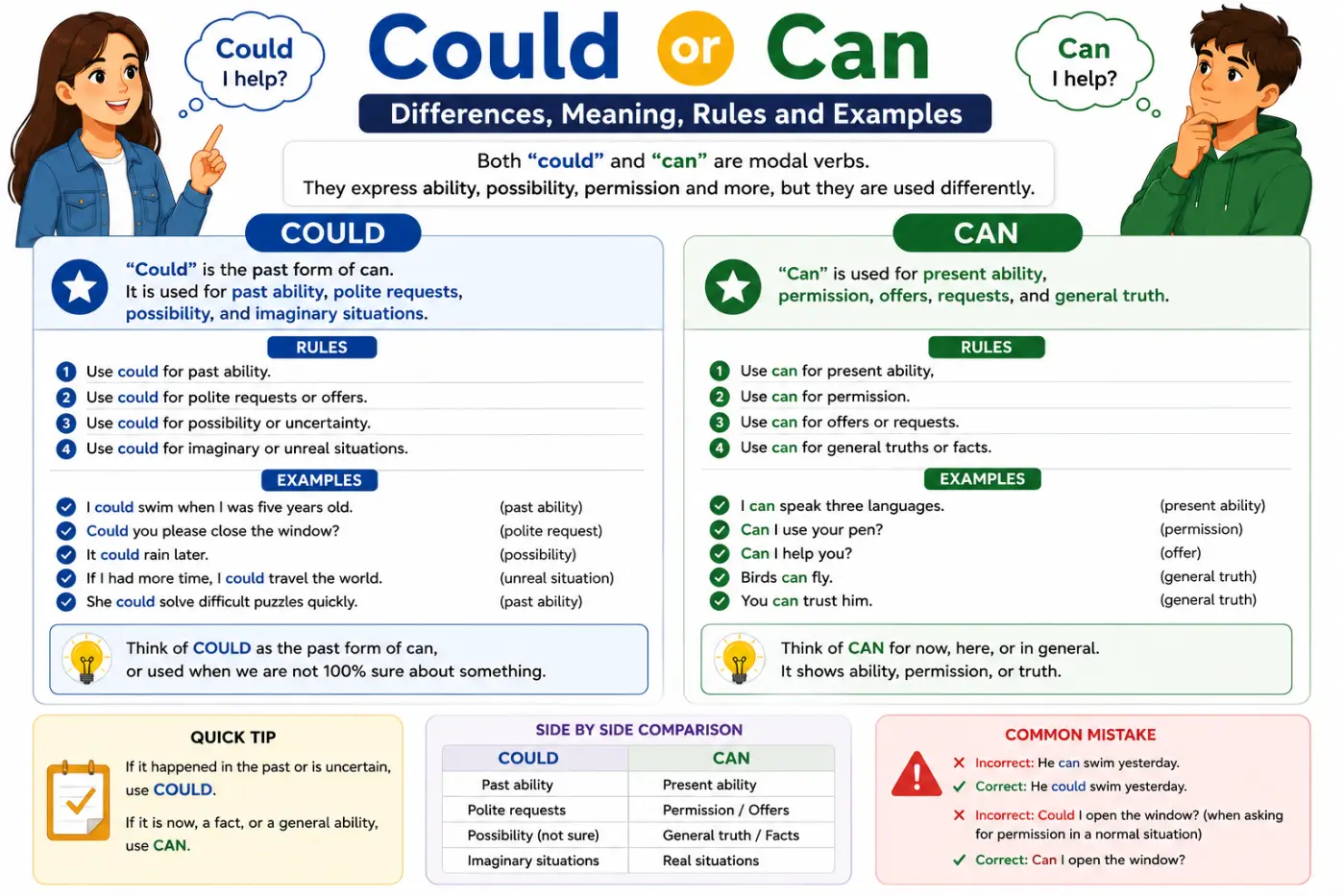
Could or Can is one of the most common grammar questions English learners ask. At first glance, these two words seem almost identical because they both appear in requests, conversations, and everyday writing. However, they are not always interchangeable.
The main difference is that can usually describes present ability or permission, while could often expresses past ability, polite requests, or possibility. In many situations, both are grammatically correct, but they create different meanings and tones.
Understanding the difference between Could or Can will improve your speaking, writing, and professional communication. This guide explains every important grammar rule, provides practical examples, highlights common mistakes, and answers the questions learners ask most often.
Short Answer
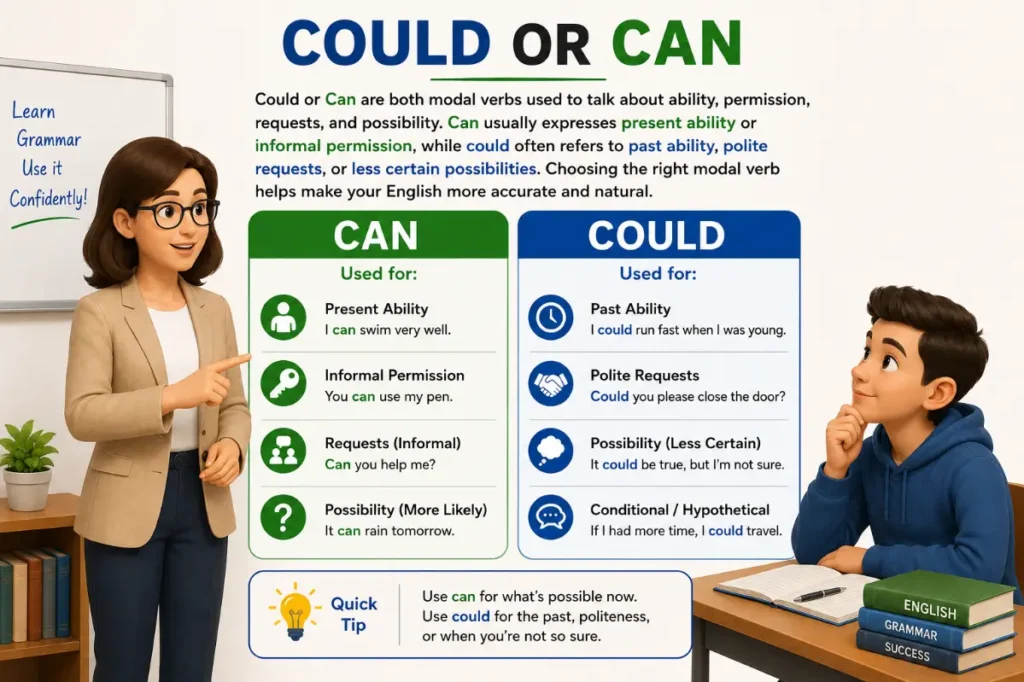
Could or Can are both modal verbs used to talk about ability, permission, requests, and possibility. Can usually expresses present ability or informal permission, while could often refers to past ability, polite requests, or less certain possibilities. Choosing the right modal verb helps make your English more accurate and natural.
Table of Contents
- What Does Can Mean
- What Does Could Mean
- Could or Can Quick Comparison
- The Main Difference Between Can and Could
- When to Use Can
- When to Use Could
- Ability Past and Present
- Requests and Permission
- Possibility
- Formal and Informal Usage
- Grammar Rules
- Everyday Examples
What Does Can Mean
Can is a modal verb used to express ability, capability, permission, and general possibility.
Examples:
- I can swim.
- She can solve difficult problems.
- You can leave now.
In the first two examples, can expresses ability.
In the third example, can gives permission.
Unlike ordinary verbs, can never changes its form.
Correct:
- He can drive.
- They can help us.
Incorrect:
- He cans drive.
- They caned help us.
What Does Could Mean
Could is also a modal verb. It has several important uses.
It commonly expresses:
- Past ability
- Polite requests
- Polite permission
- Possibility
- Hypothetical situations
Examples:
- I could swim when I was six.
- Could you help me?
- It could rain later.
- We could try another restaurant.
Each sentence uses could differently depending on the situation.
Could or Can Quick Comparison
| Feature | Can | Could |
|---|---|---|
| Present ability | ✔ | |
| Past ability | ✔ | |
| Informal permission | ✔ | Sometimes |
| Polite requests | ✔ | |
| General possibility | ✔ | ✔ |
| Hypothetical situations | ✔ | |
| Formal writing | Common | Very common |
| Everyday conversation | Very common | Very common |
This table offers a quick overview, but each use deserves a closer explanation.
The Main Difference Between Can and Could
The biggest difference between Could or Can is time and tone. Can usually refers to the present.
Examples:
- I can drive.
- She can speak French.
- They can finish today.
These describe current ability.
Could often refers to the past.
Examples:
- I could drive when I was sixteen.
- She could speak French as a child.
- They could finish quickly years ago.
Here, could describes ability in the past.
However, could is not limited to the past.
It also makes requests sound more polite.
Compare these examples.
- Can you help me?
Friendly and direct.
- Could you help me?
More polite and respectful.
Both are correct.
The difference is the tone.
When to Use Can
To Express Present Ability
This is the most common use of can.
Examples:
- I can cook.
- She can dance.
- They can solve the problem.
Explanation:
The speaker has the ability now.
To Describe Capability
Examples:
- A smartphone can store thousands of pictures.
- Eagles can fly very high.
- This software can translate dozens of languages.
These examples describe capability rather than learned ability.
To Give Informal Permission
Examples:
- You can leave early today.
- You can borrow my notebook.
- Students can use calculators.
These sentences allow someone to do something.
To Ask Permission Informally
Examples:
- Can I sit here?
- Can I ask a question?
- Can we start now?
Modern English speakers commonly use can this way.
When to Use Could
To Express Past Ability
Examples:
- I could ride a bicycle when I was five.
- She could read before starting school.
- My grandfather could repair almost anything.
Explanation:
These abilities existed in the past.
To Make Polite Requests
One of the most common uses of could is making requests.
Examples:
- Could you open the window?
- Could you repeat that?
- Could you explain the answer?
These sound more polite than similar sentences with can.
Compare them.
- Can you help me?
Friendly.
- Could you help me?
More courteous.
To Express Possibility
Examples:
- It could rain this evening.
- Prices could increase next year.
- We could miss the train.
These sentences describe possible events.
To Suggest Ideas
Examples:
- We could order pizza.
- You could try another route.
- They could ask for advice.
These suggestions sound gentle and friendly.
Ability Past and Present
One of the easiest ways to remember Could or Can is by thinking about time.
Present Ability
Examples:
- She can swim.
- He can speak German.
- I can drive.
These describe abilities that exist now.
Past Ability
Examples:
- She could swim before she started school.
- He could speak German as a teenager.
- I could drive at seventeen.
These describe abilities in the past.
Important Exception
When talking about one specific successful action in the past, English usually prefers was able to instead of could.
Correct:
- She was able to escape the building.
Less natural:
- She could escape the building.
However, could works well for general past abilities.
Correct:
- She could swim very well as a child.
Requests and Permission
This is another area where learners often confuse Could or Can.
Asking Someone to Do Something
Examples:
- Can you pass the salt?
Friendly.
- Could you pass the salt?
More polite.
Both are correct.
Asking Permission
Examples:
- Can I leave now?
Casual.
- Could I leave now?
More polite.
Although may remains the traditional formal choice for permission, could is widely accepted and sounds respectful.
Giving Permission
Examples:
- You can use my laptop.
Natural.
Using could to give permission is much less common.
Instead, English speakers usually choose can or may.
Possibility
Both modal verbs can describe possibility, but they are used differently.
Can for General Possibility
Examples:
- Winters can be very cold.
- Mistakes can happen.
- Traffic can become heavy.
These describe things that are generally possible.
Could for Specific Possibility
Examples:
- It could snow tomorrow.
- She could arrive late.
- We could lose the game.
These describe possible future events.
Notice the difference.
General possibility:
- Accidents can happen.
Specific future possibility:
- An accident could happen tonight.
Formal and Informal Usage
The difference between Could or Can often depends on the situation.
Informal English
Examples:
- Can you help me?
- Can I borrow your phone?
- Can we leave now?
These sound friendly and natural.
Formal English
Examples:
- Could you assist me with this report?
- Could I ask a question?
- Could you clarify your statement?
These sound more professional and respectful.
For customer service, interviews, business meetings, and academic settings, could is often the better choice.
Grammar Rules
A few simple grammar rules help avoid mistakes.
Rule 1
Always use the base form of the main verb.
Correct:
- She can drive.
- He could swim.
Incorrect:
- She can drives.
- He could swam.
Rule 2
Never use to after the modal verb.
Correct:
- She can leave.
- They could help.
Incorrect:
- She can to leave.
- They could to help.
Rule 3
Negative forms are simple.
- cannot
- can’t
- could not
- couldn’t
Examples:
- I can’t attend today.
- She couldn’t hear the announcement.
Rule 4
Questions begin with the modal verb.
Examples:
- Can you help?
- Could you help?
- Can I join?
- Could I speak with the manager?
Pronunciation
| Word | IPA | Simple Pronunciation |
|---|---|---|
| Can | /kæn/ or /kən/ | sounds like can |
| Could | /kʊd/ | sounds like good without the g |
In fast speech, can is often pronounced softly.
Word Origin
The word can comes from the Old English cunnan, meaning “to know” or “to be able.”
The word could developed as its historical past form. Over time, English speakers began using could not only for past ability but also for polite requests, suggestions, and possibility.
Today, both words function as independent modal verbs with several different meanings.
Could or Can in American and British English
The grammar rules for Could or Can are almost identical in American and British English. Both varieties use these modal verbs for ability, requests, permission, and possibility.
The main difference is style rather than grammar.
American English often uses can more frequently in everyday conversation.
Examples:
- Can you help me for a minute?
- Can I use your phone?
- Can we meet after lunch?
British English also uses can in casual speech, but could is often preferred in polite requests.
Examples:
- Could you tell me where the station is?
- Could I have another cup of tea?
- Could you send me the report?
Both versions of English accept either modal verb, but could usually sounds more courteous.
Comparison Table
| Situation | Can | Could |
|---|---|---|
| Present ability | ✔ | |
| Past ability | ✔ | |
| Informal permission | ✔ | ✔ |
| Formal requests | ✔ | |
| Friendly requests | ✔ | ✔ |
| General possibility | ✔ | |
| Specific possibility | Sometimes | ✔ |
| Suggestions | Sometimes | ✔ |
| Hypothetical situations | ✔ | |
| Everyday conversation | ✔ | ✔ |
This table summarizes the most common situations where each modal verb is used.
Real Life Examples
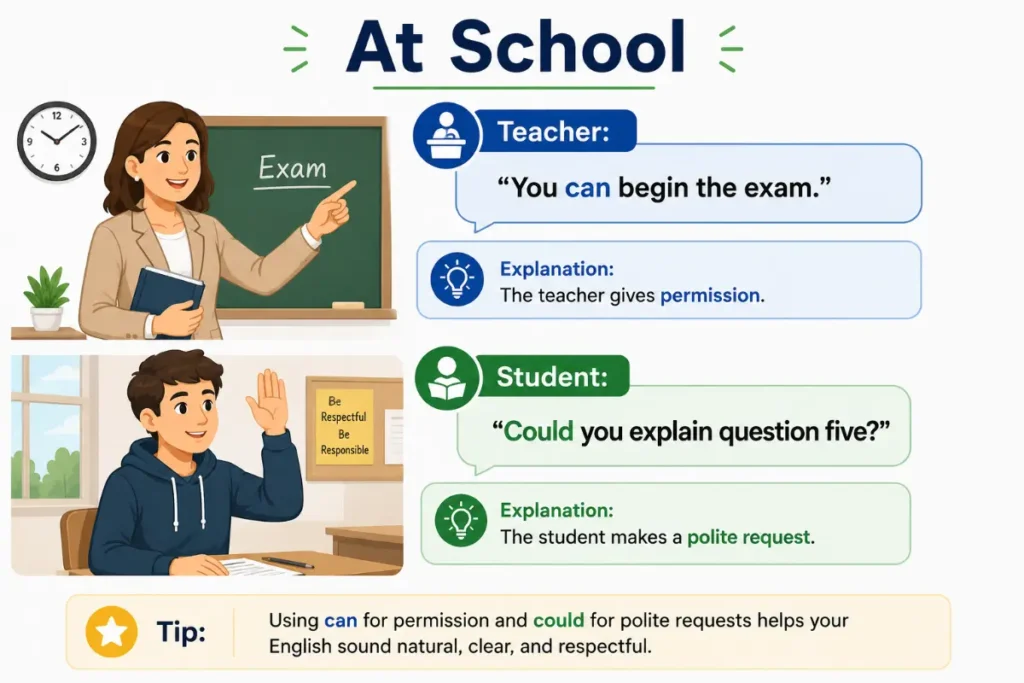
At School
Teacher:
“You can begin the exam.”
Explanation: The teacher gives permission.
Student:
“Could you explain question five?”
Explanation: The student makes a polite request.
At Work
Manager:
“You can work from home tomorrow.”
Explanation: Permission is given.
Employee:
“Could we discuss the project after lunch?”
Explanation: The employee politely makes a request.
At Home
Mother:
“You can watch television after dinner.”
Explanation: Permission is granted.
Child:
“Could you help me with my homework?”
Explanation: The child politely asks for help.
While Traveling
- We could visit the museum tomorrow.
- You can buy tickets online.
- Could you take our picture?
- Tourists can enter through this gate.
These examples show how naturally both modal verbs appear in daily conversations.
Everyday Conversation Examples
Understanding natural conversations makes grammar easier to remember.
Example 1
Friend:
“Can you drive us to the airport?”
The request sounds casual and friendly.
Example 2
Customer:
“Could you recommend a good restaurant?”
This sounds polite and respectful.
Example 3
Coach:
“You can finish the race.”
The coach expresses confidence in someone’s ability.
Example 4
Weather Forecast
“It could rain later this evening.”
The forecast describes a possible event.
Example 5
Family Discussion
“We could watch a movie tonight.”
This is a suggestion rather than a decision.
Common Mistakes
Many learners make the same mistakes when using Could or Can.
Mistake 1
Using could for present ability.
Incorrect:
- I could swim very well now.
Correct:
- I can swim very well now.
Explanation: Use can for present ability.
Mistake 2
Using can for past ability.
Incorrect:
- She can read when she was four.
Correct:
- She could read when she was four.
Mistake 3
Adding to after the modal verb.
Incorrect:
- She can to drive.
- They could to help.
Correct:
- She can drive.
- They could help.
Mistake 4
Using the wrong verb form.
Incorrect:
- He can drives.
- She could went.
Correct:
- He can drive.
- She could go.
Mistake 5
Thinking could always refers to the past.
Consider these examples.
- Could you help me?
This is a polite request in the present.
- It could rain tonight.
This refers to a future possibility.
Context determines the meaning.
Memory Tips
Simple memory tricks can help you remember the difference.
Think About Time
Can usually refers to the present.
Could often refers to the past.
Think About Politeness
When asking someone for help, could sounds more polite.
Example:
- Could you help me?
Remember Ability
Present ability uses can.
Past ability usually uses could.
Remember the Formula
Can + base verb
Could + base verb
Examples:
- Can she sing?
- Could he swim?
Never change the main verb after either modal verb.
Professional Writing Tips
Choosing the correct modal verb makes your writing clearer and more professional.
Business Emails
Direct:
- Can you send the report today?
More polite:
- Could you send the report today?
The second version is generally preferred in professional communication.
Customer Service
Example:
- Could you provide your order number?
This sounds respectful and courteous.
Academic Writing
Researchers often use could when discussing possible explanations.
Example:
- These results could suggest a change in consumer behavior.
Using could avoids making overly strong claims.
Related Grammar and Usage Notes
Understanding related modal verbs strengthens your grammar.
Can vs May
Can expresses ability or informal permission.
- Can I borrow your pen?
May expresses formal permission or possibility.
- May I borrow your pen?
Could vs May
Both express possibility.
- It could rain tonight.
- It may rain tonight.
May often suggests a slightly stronger possibility.
Could vs Might
Both express possibility.
- We could leave tomorrow.
- We might leave tomorrow.
Might usually sounds slightly less certain.
Can vs Be Able To
These often have the same meaning.
- She can speak Japanese.
- She is able to speak Japanese.
Could vs Was Able To
For general past ability, could works well.
- She could play the piano at age six.
For one successful action in the past, was able to is usually preferred.
- She was able to rescue the child.
Key Takeaways
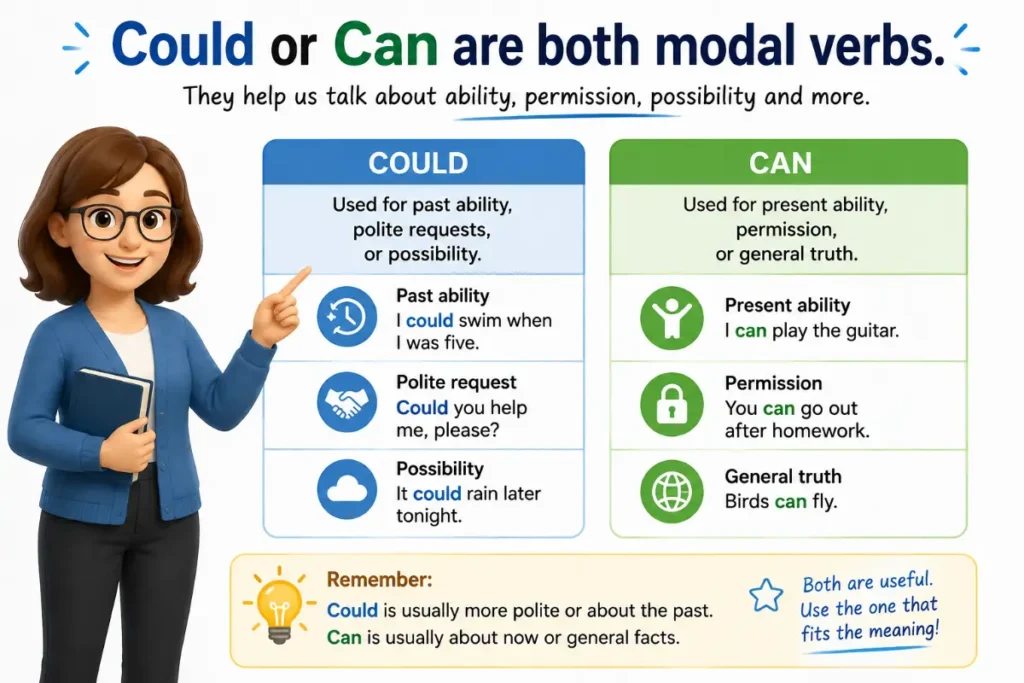
- Could or Can are both modal verbs.
- Can usually expresses present ability and informal permission.
- Could commonly expresses past ability, polite requests, suggestions, and possibility.
- Could sounds more polite than can in requests.
- Use can for abilities you have now.
- Use could for abilities you had in the past.
- Always use the base form of the main verb after both modal verbs.
- Never add to after can or could.
- Context determines the exact meaning.
Conclusion
Understanding Could or Can helps you communicate with greater confidence and accuracy. Although both modal verbs can appear in similar situations, they serve different purposes. Can is mainly used for present ability, capability, and everyday permission, while could is commonly used for past ability, polite requests, suggestions, and uncertain possibilities.
In everyday conversations, both words are natural, but choosing the right one improves clarity and tone. Use can when describing what someone is able to do now, and choose could when talking about past abilities, making respectful requests, or discussing possible situations. With regular practice and attention to context, using Could or Can correctly will become a natural part of your spoken and written English.
Frequently Asked Questions
What is the difference between Could or Can?
Can mainly expresses present ability, capability, or informal permission. Could usually expresses past ability, polite requests, suggestions, or possibility.
Is could more polite than can?
Yes. Could generally sounds more polite and respectful when making requests.
Can could describe present situations?
Yes. It can express present possibility, polite requests, and suggestions.
Example:
- Could you help me?
Should I use can or could for permission?
Both are acceptable. Can is common in everyday conversation, while could sounds more polite.
Can can talk about the past?
Not usually. Use could for general past ability.
Why do people say “Could you” instead of “Can you”?
Using could softens the request and makes it sound more courteous.
Is could the past tense of can?
Historically, yes. In modern English, could has developed several additional meanings beyond past ability.
Can both words express possibility?
Yes, but could is more common for discussing specific future possibilities.
Which is better in business writing?
Could is often preferred because it creates a more professional and polite tone.
What is the easiest way to remember Could or Can?
Remember this simple rule:
Can = Present ability
Could = Past ability or polite requests

English Grammar & Usage
Nathan Holloway is an American grammar writer and language researcher who specializes in English grammar, sentence structure, verb usage, and common writing mistakes. He enjoys breaking down confusing grammar rules into practical explanations with clear examples, making English easier for students, professionals, and everyday writers.