
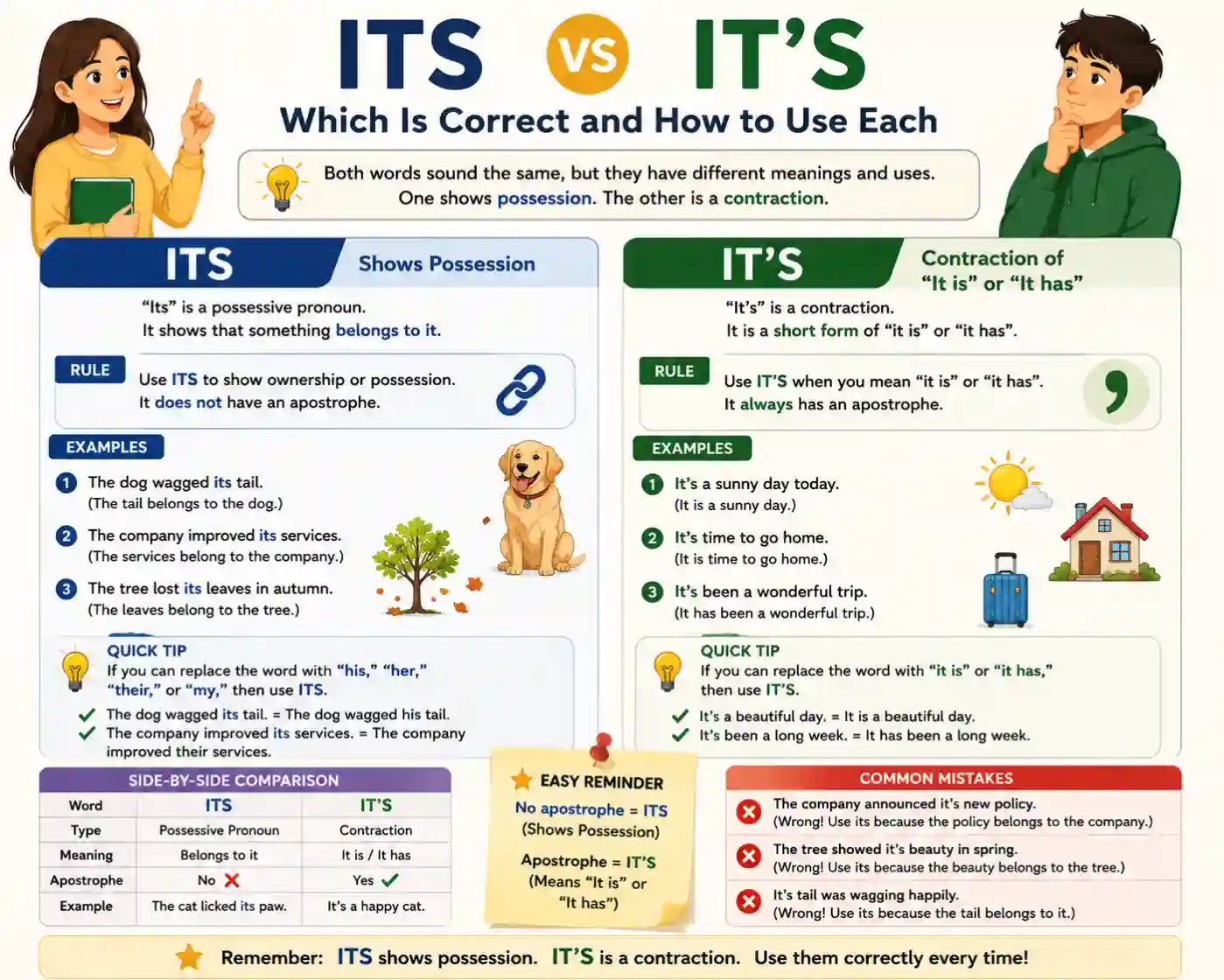
Its vs It’s confuses millions of English learners and even native speakers because the only visible difference is a single apostrophe. That tiny punctuation mark completely changes the meaning of the word. Using the wrong form can make your writing look careless, especially in school assignments, business emails, and professional documents.
The good news is that the rule is simple once you understand it. Its shows that something belongs to an animal, object, organization, or idea. It’s, on the other hand, is simply a shortened form of it is or it has. Learning this distinction will help you write with greater accuracy and confidence.
In this guide, you’ll learn the meanings of both words, the grammar rule behind them, practical examples, common mistakes, memory tricks, punctuation tips, and professional writing advice so you can choose the correct form every time.
Short Answer
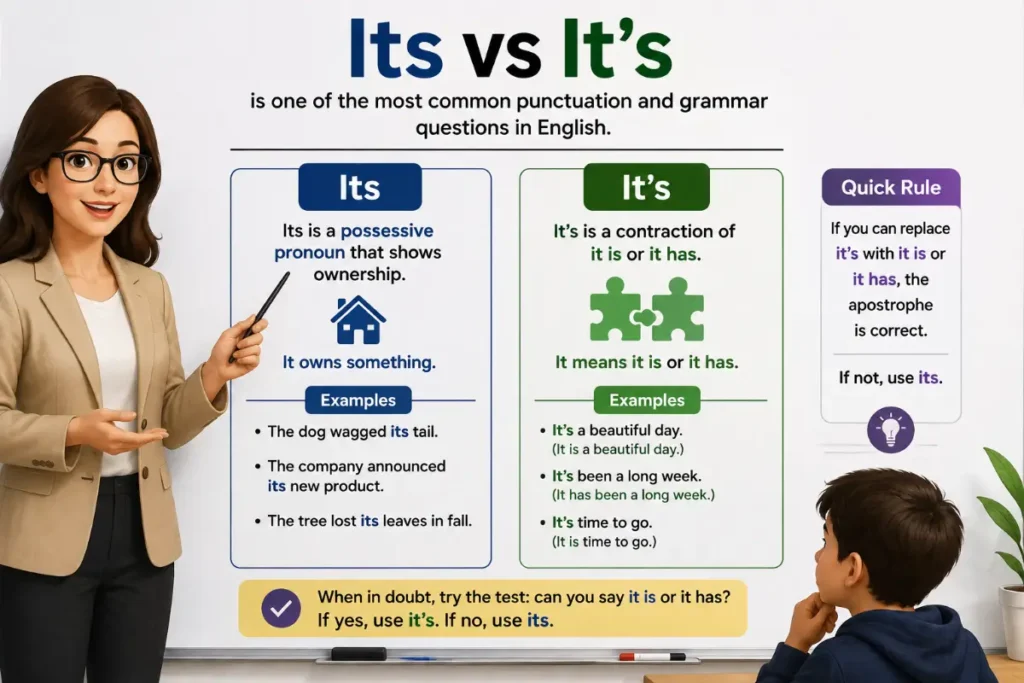
Its vs It’s is one of the most common punctuation and grammar questions in English. Its is a possessive pronoun that shows ownership, while it’s is a contraction of it is or it has. If you can replace it’s with it is or it has, the apostrophe is correct. If not, use its.
Table of Contents
- What Do Its and It’s Mean
- Its vs It’s Comparison Table
- The Main Difference
- When to Use Its
- When to Use It’s
- Why These Words Are Confusing
- Examples in Everyday English
- Common Mistakes
- Memory Tricks
- Professional Writing Tips
What Do Its and It’s Mean
Although these words look nearly identical, they perform completely different grammatical functions.
What Does Its Mean
Its is a possessive pronoun.
It shows that something belongs to an object, place, company, country, animal, or idea.
Think of it as meaning:
- Belonging to it.
- Owned by it.
- Associated with it.
Examples:
- The dog wagged its tail.
- The company changed its logo.
- The tree lost its leaves.
In each sentence, something belongs to the subject.
What Does It’s Mean
It’s is a contraction.
It stands for either:
- It is.
- It has.
Examples:
- It’s raining outside.
- It’s been a wonderful day.
Expanded versions:
- It is raining outside.
- It has been a wonderful day.
If the expanded sentence still makes sense, it’s is correct.
Its vs It’s Comparison Table
| Feature | Its | It’s |
|---|---|---|
| Part of speech | Possessive pronoun | Contraction |
| Shows ownership | Yes | No |
| Means “it is” | No | Yes |
| Means “it has” | No | Yes |
| Contains an apostrophe | No | Yes |
| Used before nouns | Often | Sometimes |
| Common in formal writing | Yes | Yes |
The Main Difference Between Its and It’s
The easiest way to tell them apart is by asking one simple question.
Can I replace the word with “it is” or “it has”?
If the answer is yes, use it’s.
If the answer is no, use its.
Examples:
- It’s cold today.
- It is cold today.
The sentence still works.
Correct answer:
- It’s
Now try another example.
- The bird spread its wings.
Can you say:
- The bird spread it is wings?
No.
Can you say:
- The bird spread it has wings?
No.
Correct answer:
- Its
This quick test solves almost every case.
Why People Confuse Its and It’s
Several factors make these words difficult.
- The spellings differ by only one apostrophe.
- Many possessive nouns use apostrophes, but its does not.
- The pronunciation is exactly the same.
- Autocorrect sometimes changes one form into the other.
- Writers often assume every possessive needs an apostrophe.
The biggest source of confusion is that English usually adds an apostrophe to show possession.
Examples:
- Sarah’s book.
- The teacher’s desk.
- The baby’s blanket.
Many people naturally expect it’s to be possessive too.
However, its is an exception because it belongs to the group of possessive pronouns.
Other possessive pronouns include:
- His.
- Hers.
- Yours.
- Ours.
- Theirs.
Notice that none of these words contain apostrophes.
Neither does its.
When to Use Its
Use its whenever you show ownership.
The owner can be:
- An animal.
- A country.
- A company.
- A machine.
- A building.
- A plant.
- An organization.
- An idea.
Examples
Animals
- The cat cleaned its paws.
Explanation:
The paws belong to the cat.
- The horse shook its head.
Explanation:
The head belongs to the horse.
Nature
- The tree dropped its leaves.
Explanation:
The leaves belong to the tree.
- The flower lost its petals.
Explanation:
The petals belong to the flower.
Businesses
- The company announced its new policy.
Explanation:
The policy belongs to the company.
- The university updated its website.
Explanation:
The website belongs to the university.
Objects
- The phone lost its signal.
Explanation:
The signal belongs to the phone.
- The computer restarted after its update.
Explanation:
The update belongs to the computer.
Countries
- Canada changed its immigration policy.
Explanation:
The policy belongs to Canada.
When to Use It’s
Use it’s whenever the sentence means it is or it has.
It Is
Examples
- It’s my favorite movie.
Expanded:
- It is my favorite movie.
Correct.
- It’s almost midnight.
Expanded:
- It is almost midnight.
Correct.
- It’s too late to leave.
Expanded:
- It is too late to leave.
Correct.
It Has
Examples
- It’s been raining all day.
Expanded:
- It has been raining all day.
Correct.
- It’s become much easier.
Expanded:
- It has become much easier.
Correct.
- It’s already finished.
Expanded:
- It has already finished.
Correct.
Quick Replacement Test
Whenever you’re unsure, expand the contraction.
Sentence:
- It’s a beautiful day.
Expansion:
- It is a beautiful day.
Works perfectly.
Sentence:
- The laptop needs it’s charger.
Expansion:
- The laptop needs it is charger.
Incorrect.
Correct sentence:
- The laptop needs its charger.
This simple method works almost every time.
Real Life Examples
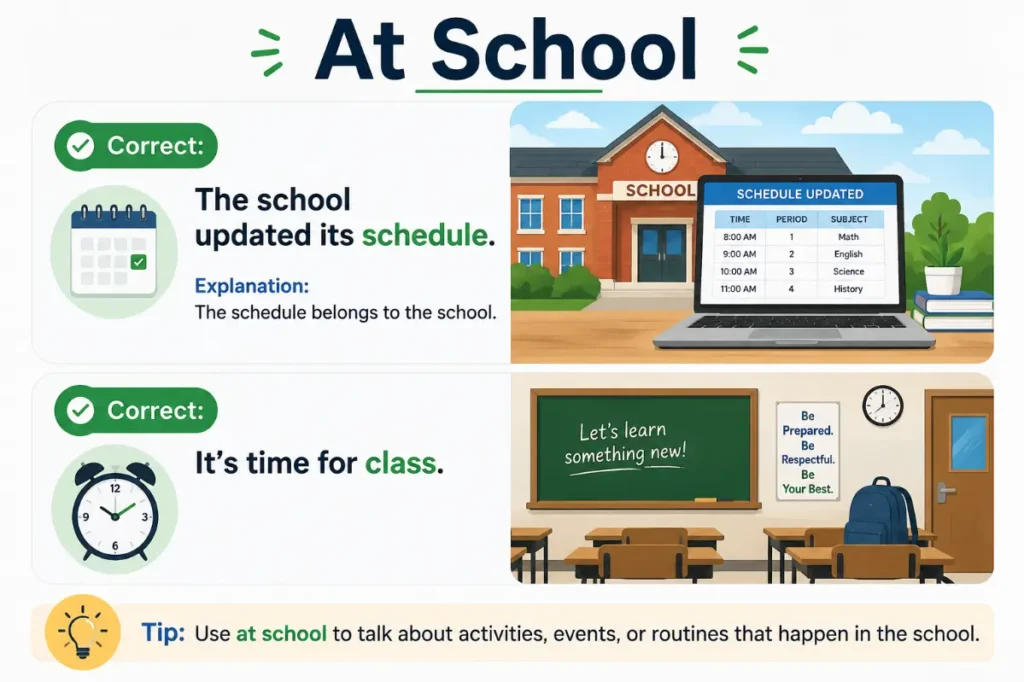
At School
Correct:
- The school updated its schedule.
Explanation:
The schedule belongs to the school.
Correct:
- It’s time for class.
Explanation:
The sentence means “It is time.”
At Work
Correct:
- The company celebrated its anniversary.
Explanation:
The anniversary belongs to the company.
Correct:
- It’s important to submit the report today.
Explanation:
The sentence means “It is important.”
At Home
Correct:
- The refrigerator stopped cooling because its motor failed.
Explanation:
The motor belongs to the refrigerator.
Correct:
- It’s getting warmer outside.
Explanation:
The sentence means “It is getting warmer.”
Traveling
Correct:
- The airplane lowered its landing gear.
Explanation:
The landing gear belongs to the airplane.
Correct:
- It’s going to be a long flight.
Explanation:
The sentence means “It is going to be a long flight.”
Its as a Possessive Pronoun
Unlike possessive nouns, possessive pronouns never need apostrophes.
Examples:
- My.
- Your.
- His.
- Her.
- Our.
- Their.
- Its.
Notice the pattern.
None of these words contain an apostrophe.
That is why its does not either.
Examples:
- Every country has its own traditions.
- Every business has its own culture.
- Every smartphone has its own features.
- Every child develops at its own pace.
Each sentence shows possession without using an apostrophe.
It’s as a Contraction
A contraction joins two words into one.
Examples include:
- Don’t = Do not.
- Can’t = Cannot.
- Isn’t = Is not.
- You’re = You are.
- They’ve = They have.
- It’s = It is or It has.
Whenever you see the apostrophe in it’s, think about the missing letter.
Examples:
- It is → It’s.
- It has → It’s.
The apostrophe replaces the omitted letter, just like it does in other contractions.
Common Mistakes
Many writers make these same errors.
Mistake One
Incorrect:
- The dog wagged it’s tail.
Correct:
- The dog wagged its tail.
Reason:
The tail belongs to the dog.
Mistake Two
Incorrect:
- Its raining outside.
Correct:
- It’s raining outside.
Reason:
The sentence means “It is raining.”
Mistake Three
Incorrect:
- The company changed it’s name.
Correct:
- The company changed its name.
Reason:
The name belongs to the company.
Mistake Four
Incorrect:
- Its been a great year.
Correct:
- It’s been a great year.
Reason:
The sentence means “It has been.”
Memory Tricks
These simple tricks can help you remember the difference instantly.
Trick One
Replace the word with it is.
If the sentence still makes sense, use it’s.
If it doesn’t, use its.
Trick Two
Remember that possessive pronouns never use apostrophes.
Examples include:
- His.
- Hers.
- Yours.
- Ours.
- Theirs.
- Its.
Trick Three
Think of the apostrophe as a shortcut.
When you see it’s, imagine the missing letters in it is or it has.
Professional Writing Tips
Professional editors often check its and it’s carefully because this mistake appears frequently in business writing.
Follow these habits to avoid errors.
- Expand it’s into it is or it has before finalizing your sentence.
- Use its only to show ownership.
- Proofread slowly because spellcheck may not catch the mistake.
- Remember that possessive pronouns never need apostrophes.
- Pay extra attention in emails, reports, resumes, and academic papers where punctuation errors can affect credibility.
Pronunciation
One reason people confuse its and it’s is that they are pronounced exactly the same.
| Word | IPA | Simple Pronunciation |
|---|---|---|
| Its | /ɪts/ | its |
| It’s | /ɪts/ | its |
Since both words sound identical, listeners rely on the context of the sentence to understand the intended meaning. In writing, however, the apostrophe makes a significant grammatical difference.
Word Origin
Understanding the history of these words helps explain why they follow different rules.
Origin of Its
The word its developed as the possessive form of it. In Early Modern English, writers sometimes used his as the possessive form of it before its became widely accepted.
Today, its is the standard possessive pronoun used for animals, objects, organizations, and ideas.
Origin of It’s
The word it’s appeared as a contraction of it is and later it has. Like other contractions in English, the apostrophe replaces omitted letters.
Examples:
- It is → It’s
- It has → It’s
This rule has remained unchanged for centuries.
Its vs It’s in American and British English
There is no difference between American and British English when it comes to this grammar rule.
Both varieties follow the same standard.
- Its shows possession.
- It’s means it is or it has.
Examples accepted in both countries:
- The museum changed its opening hours.
- It’s raining this morning.
Because the rule is universal, writers around the world use the same distinction.
Its vs It’s in Formal and Informal Writing
The grammar rule remains the same in every type of writing.
Formal Writing
Examples include:
- Academic papers.
- Business reports.
- Legal documents.
- Government publications.
- Professional emails.
Correct example:
- The organization updated its policies.
Correct example:
- It’s essential to follow company procedures.
Informal Writing
Examples include:
- Text messages.
- Social media posts.
- Personal emails.
- Online forums.
Even in casual writing, using the correct form improves clarity and credibility.
Real Life Examples
Business
Correct:
- The company launched its newest product.
Explanation:
The product belongs to the company.
Correct:
- It’s expected to sell quickly.
Explanation:
The sentence means “It is expected.”
Technology
Correct:
- The software received its latest update.
Explanation:
The update belongs to the software.
Correct:
- It’s working much faster now.
Explanation:
The sentence means “It is working.”
Nature
Correct:
- The bird built its nest in the tree.
Explanation:
The nest belongs to the bird.
Correct:
- It’s amazing how quickly birds learn.
Explanation:
The sentence means “It is amazing.”
Sports
Correct:
- The team changed its strategy.
Explanation:
The strategy belongs to the team.
Correct:
- It’s going to be a close game.
Explanation:
The sentence means “It is going to be.”
Travel
Correct:
- The hotel renovated its lobby.
Explanation:
The lobby belongs to the hotel.
Correct:
- It’s one of the best places to stay.
Explanation:
The sentence means “It is one of the best places.”
Common Expressions Using Its
These phrases naturally use its because they show ownership.
- Its purpose.
- Its history.
- Its future.
- Its value.
- Its importance.
- Its mission.
- Its goals.
- Its design.
- Its appearance.
- Its features.
- Its color.
- Its reputation.
- Its success.
- Its location.
Examples:
- Every company has its own culture.
- Every country protects its borders.
- Every smartphone has its own operating system.
Common Expressions Using It’s
These expressions always use the contraction.
- It’s time.
- It’s easy.
- It’s possible.
- It’s clear.
- It’s true.
- It’s important.
- It’s difficult.
- It’s been.
- It’s becoming.
- It’s likely.
- It’s necessary.
- It’s wonderful.
Examples:
- It’s important to proofread your work.
- It’s been a busy week.
- It’s never too late to learn.
Quick Practice Quiz
Choose the correct word before checking the answer.
1. The tree lost _____ leaves.
Answer:
Its
Reason:
The leaves belong to the tree.
2. _____ a beautiful afternoon.
Answer:
It’s
Reason:
The sentence means “It is.”
3. The company expanded _____ offices.
Answer:
Its
Reason:
The offices belong to the company.
4. _____ already been completed.
Answer:
It’s
Reason:
The sentence means “It has.”
5. Every nation protects _____ citizens.
Answer:
Its
Reason:
The citizens belong to the nation.
6. _____ going to rain tomorrow.
Answer:
It’s
Reason:
The sentence means “It is.”
7. The cat licked _____ paws.
Answer:
Its
Reason:
The paws belong to the cat.
8. _____ the best solution we have.
Answer:
It’s
Reason:
The sentence means “It is.”
Professional Editing Tips
Editors often spot this error immediately because it is one of the most common punctuation mistakes.
To avoid it:
- Read every sentence aloud.
- Expand it’s into it is or it has.
- If the expanded version sounds wrong, choose its.
- Remember that ownership never requires an apostrophe with possessive pronouns.
- Proofread slowly instead of relying only on spellcheck.
These habits will help you eliminate one of the most frequent grammar mistakes in English.
Related Grammar Notes
Learning similar grammar rules makes punctuation much easier.
Here are several word pairs that writers often confuse.
- Who’s vs Whose.
- Your vs You’re.
- Their vs They’re vs There.
- Whose vs Who’s.
- Then vs Than.
- Affect vs Effect.
- Farther vs Further.
- Lay vs Lie.
- To vs Too.
- Lose vs Loose.
Each pair involves similar spellings but different meanings or grammatical functions. Understanding them will improve both your writing and editing skills.
People Also Ask
Is its or it’s correct?
Both are correct, but they have different meanings. Its shows possession, while it’s is short for it is or it has.
Why doesn’t its have an apostrophe?
Because its is a possessive pronoun. Like his, hers, ours, yours, and theirs, possessive pronouns do not use apostrophes.
Can it’s show possession?
No. It’s never shows ownership. It is only a contraction for it is or it has.
Is this mistake common?
Yes. Confusing its and it’s is one of the most common punctuation errors in English.
What is the easiest way to remember the difference?
Replace it’s with it is or it has. If the sentence still makes sense, use it’s. Otherwise, use its.
Key Takeaways
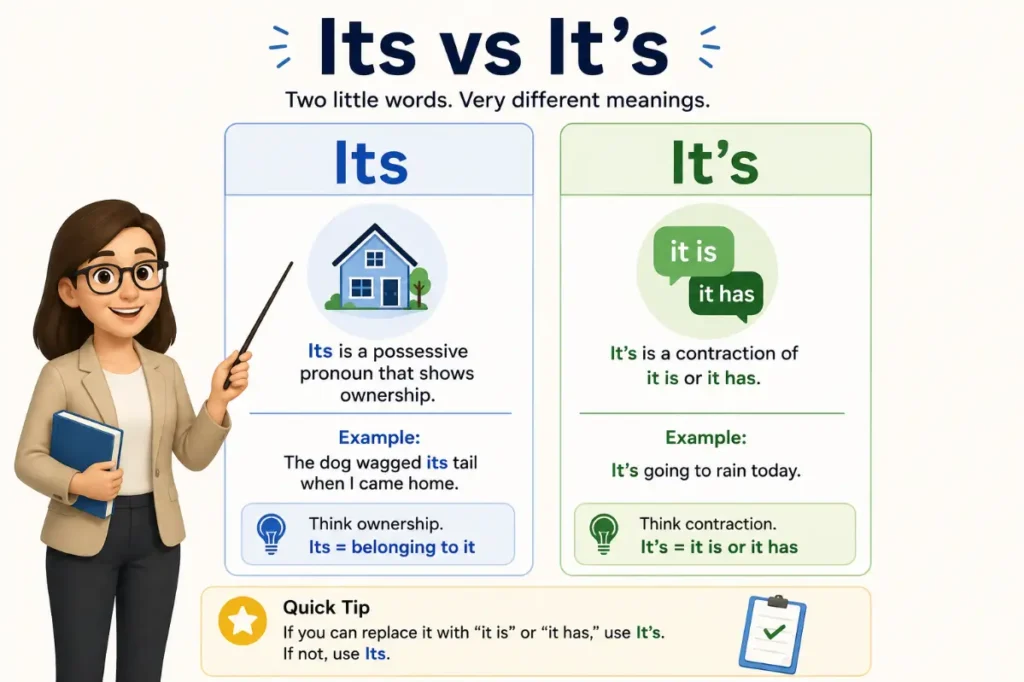
- Its is a possessive pronoun that shows ownership.
- It’s is a contraction of it is or it has.
- Possessive pronouns never use apostrophes.
- Always test it’s by expanding it into it is or it has.
- If the expanded sentence does not make sense, use its.
- This rule is the same in American and British English.
- Careful proofreading helps prevent one of the most common punctuation mistakes in English.
- Mastering this rule makes your writing clearer, more accurate, and more professional.
Conclusion
Understanding Its vs It’s is easier once you remember that the apostrophe signals a contraction, not possession. Its shows that something belongs to an animal, object, organization, or idea, while it’s simply means it is or it has.
The quickest way to choose the correct form is to expand it’s into it is or it has. If the sentence still works, the contraction is correct. If it does not, use its. Mastering this simple rule will help you avoid one of the most common punctuation mistakes and make your writing clearer, more accurate, and more professional.
Frequently Asked Questions
What is the main difference between Its vs It’s?
Its is a possessive pronoun that shows ownership, while it’s is a contraction meaning it is or it has.
Can I use it’s to show possession?
No. It’s never indicates possession. Always use its when something belongs to an animal, object, organization, or idea.
Why is its an exception to the apostrophe rule?
Unlike possessive nouns, possessive pronouns do not use apostrophes. This rule also applies to his, hers, ours, yours, theirs, and its.
How can I quickly check which word is correct?
Replace it’s with it is or it has. If the sentence still makes sense, use it’s. If it does not, choose its.
Is the rule different in British English?
No. American English and British English follow exactly the same grammar rule.
Why do spellcheck tools sometimes miss this mistake?
Because both its and it’s are correctly spelled words. Spellcheck cannot always determine which one fits the sentence.
Which word is used more often?
Both words are common, but they appear in different contexts. Its is frequent in descriptions of ownership, while it’s appears often in everyday conversation because contractions are common.
Can it’s mean it has?
Yes. For example, It’s been a great year means It has been a great year.
Is this rule tested in English exams?
Yes. Standardized tests, school exams, and professional writing assessments often include questions about its and it’s because they are commonly confused.
Why should I learn this rule?
Using its and it’s correctly improves clarity, strengthens your grammar, and makes your writing look polished in both academic and professional settings.

Confusing Words, Spelling & Word Choice
Claire Whitmore is a U.S.-based English editor who writes about commonly confused words, spelling differences, and word choice. Her work helps readers understand subtle distinctions between similar-looking words through simple definitions, practical examples, and modern usage guidance in both American and British English.