
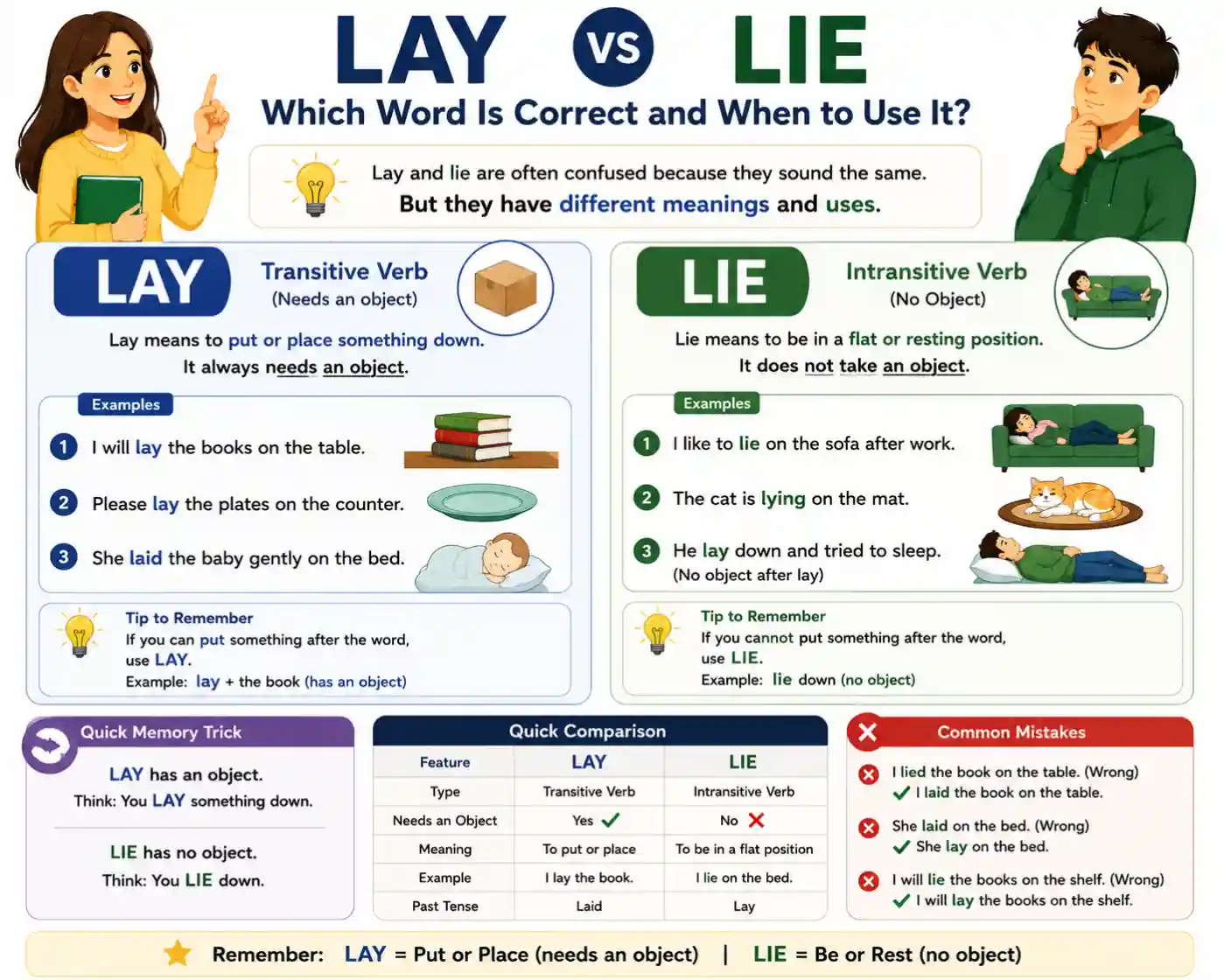
Lay vs Lie confuses millions of English learners and even many native speakers because the two verbs are closely related and share similar past tense forms. If you’ve ever wondered if you should write lay on the bed or lie on the bed, you’re asking one of the most common grammar questions in English.
The good news is that the rule is easier than it first appears. Lay means to place something somewhere, so an object receives the action. Lie means to rest or recline, so the subject performs the action without acting on anything else.
The confusion becomes greater because the past tense of lie is lay, which is identical to the present tense of lay. Once you understand the verb forms and learn a few simple memory tricks, choosing the correct word becomes much easier.
This guide explains the meanings of both verbs, their grammar rules, verb forms, pronunciation, real life examples, common mistakes, memory tips, and professional writing advice so you can use them confidently in everyday English.
Short Answer
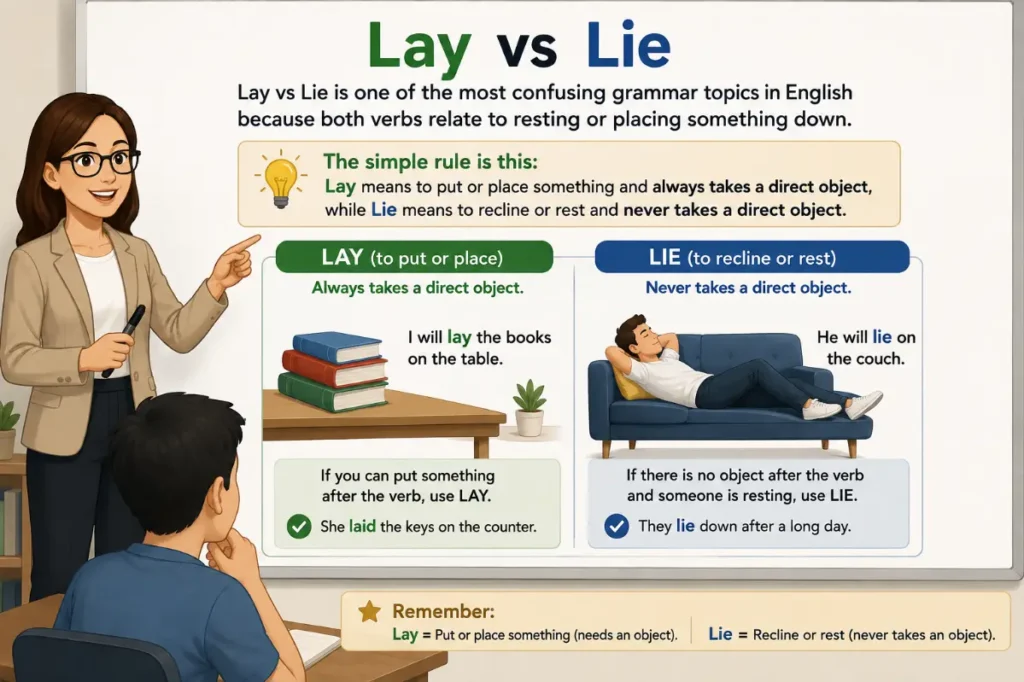
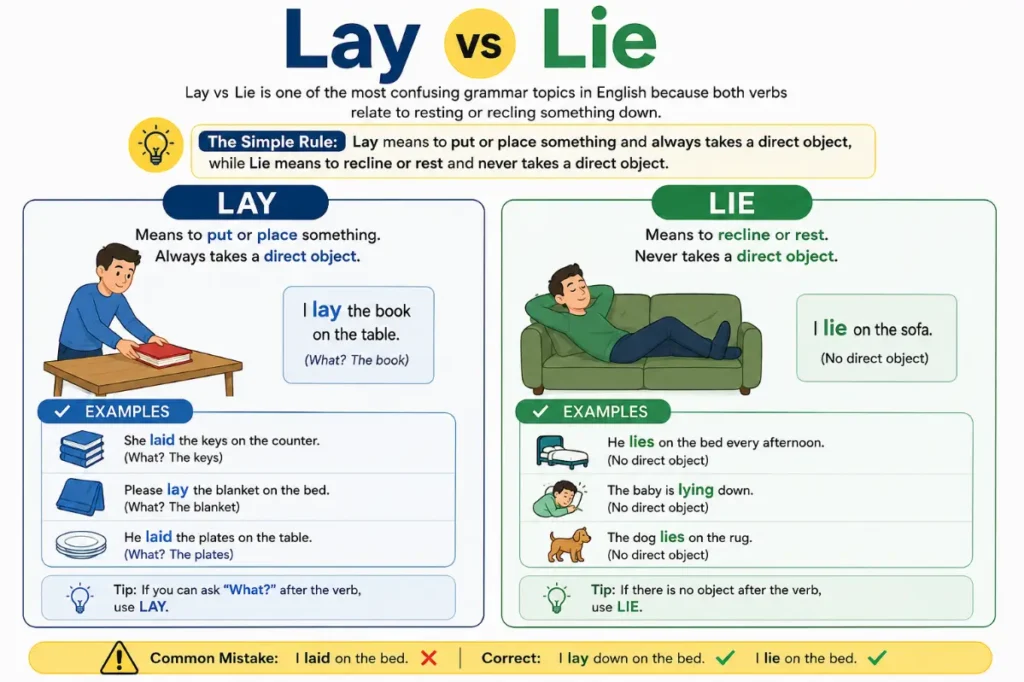
Lay vs Lie is one of the most confusing grammar topics in English because both verbs relate to resting or placing something down. The simple rule is this: lay means to put or place something and always takes a direct object, while lie means to recline or rest and never takes a direct object. Learning this difference will help you avoid one of the most common writing mistakes.
Table of Contents
- What Do Lay and Lie Mean
- Lay vs Lie Comparison Table
- The Main Difference Between Lay and Lie
- Verb Forms Explained
- When to Use Lay
- When to Use Lie
- Real Life Examples
- Common Mistakes
- Memory Tricks
- Professional Writing Tips
What Do Lay and Lie Mean
Although these words look similar, they perform different jobs in English grammar.
What Does Lay Mean
Lay means to put, place, or set something down.
Someone performs the action on another person or object.
Examples include:
- Lay the book on the desk.
- Lay the baby in the crib.
- Lay your keys on the table.
Notice that every sentence includes something receiving the action.
What Does Lie Mean
Lie means to rest, recline, or be in a flat position.
The subject performs the action alone.
Examples include:
- Lie on the couch.
- The cat likes to lie in the sun.
- I need to lie down for a while.
Nothing receives the action in these examples.
Lay vs Lie Comparison Table
| Feature | Lay | Lie |
|---|---|---|
| Meaning | Put or place something | Rest or recline |
| Needs an object | Yes | No |
| Type of verb | Transitive | Intransitive |
| Present tense | Lay | Lie |
| Past tense | Laid | Lay |
| Past participle | Laid | Lain |
| Present participle | Laying | Lying |
| Common use | Place an object | Rest yourself |
The Main Difference Between Lay and Lie
The easiest way to remember the rule is to ask one question.
Is something receiving the action?
If the answer is yes, use lay.
If the answer is no, use lie.
Examples
- Lay the blanket on the bed.
- Lay the phone on the desk.
- Lay the dishes in the sink.
Each sentence includes an object receiving the action.
Now compare them with these examples.
- Lie on the sofa.
- The dog is lying on the floor.
- The children lay quietly after the game.
These sentences describe someone resting instead of placing something.
Understanding Transitive and Intransitive Verbs
One reason Lay vs Lie causes confusion is that the verbs belong to different grammar categories.
Lay Is a Transitive Verb
A transitive verb requires a direct object.
Examples
- Lay the newspaper on the table.
- Lay your backpack near the door.
- Lay the cards face down.
Ask yourself:
“What is being laid?”
The newspaper.
The backpack.
The cards.
Each sentence answers the question.
Lie Is an Intransitive Verb
An intransitive verb never takes a direct object.
Examples
- Lie here for a few minutes.
- The baby is lying peacefully.
- We lay on the beach all afternoon.
No object receives the action.
The subject simply rests.
Verb Forms Explained
This is where many writers become confused.
Verb Forms of Lay
| Tense | Form |
|---|---|
| Base form | Lay |
| Present | Lay |
| Past | Laid |
| Past participle | Laid |
| Present participle | Laying |
Examples
- I lay the notebook on the desk every morning.
- Yesterday I laid the notebook on the desk.
- I have laid the notebook there before.
- She is laying fresh towels in the bathroom.
Verb Forms of Lie
| Tense | Form |
|---|---|
| Base form | Lie |
| Present | Lie |
| Past | Lay |
| Past participle | Lain |
| Present participle | Lying |
Examples
- I lie down after work.
- Yesterday I lay down early.
- I have lain awake all night.
- The baby is lying quietly.
Notice that lay appears as the past tense of lie, which is why these verbs confuse so many people.
Why People Mix Up Lay and Lie
Several factors contribute to the confusion.
- The words have similar meanings.
- Their spellings are almost identical.
- The past tense of lie is lay.
- Both verbs often appear in discussions about beds, couches, floors, and resting.
- Many native speakers use them incorrectly in everyday conversation.
Because of these similarities, even experienced writers occasionally pause before choosing the correct verb.
When to Use Lay
Choose lay anytime you are placing something somewhere.
Common situations include:
- Setting down a book.
- Putting dishes on a table.
- Placing a child in bed.
- Positioning tools.
- Arranging clothing.
- Setting food on a counter.
Examples
- Lay the folder on my desk.
Explanation
The folder receives the action.
- Please lay your jacket over the chair.
Explanation
The jacket is being placed somewhere.
- Lay the groceries on the kitchen counter.
Explanation
The groceries are the direct object.
- Lay your cards on the table.
Explanation
The cards receive the action.
- The nurse carefully laid the blanket over the patient.
Explanation
The blanket is placed onto the patient.
- She laid the flowers beside the photograph.
Explanation
The flowers are being positioned.
- Lay the phone beside your laptop.
Explanation
The phone receives the action.
Common Expressions Using Lay
Some familiar expressions naturally use lay.
- Lay the foundation.
- Lay the groundwork.
- Lay the table.
- Lay bricks.
- Lay carpet.
- Lay eggs.
- Lay blame.
- Lay flowers.
- Lay a plan.
- Lay a trap.
Examples
- Workers will lay the foundation tomorrow.
- The robin lays three eggs each spring.
- Let’s lay the table before dinner.
When to Use Lie
Choose lie when someone or something rests without acting on another object.
Use it for:
- Sleeping.
- Resting.
- Reclining.
- Relaxing.
- Remaining in one position.
Examples
- I want to lie down after lunch.
Explanation
No object receives the action.
- The cat lies beside the fireplace.
Explanation
The cat is resting.
- The children are lying on the grass.
Explanation
They are reclining.
- We lay on the beach all afternoon yesterday.
Explanation
This uses the past tense of lie.
- The old castle lies on top of the hill.
Explanation
The castle simply exists in that location.
- Please lie still during the examination.
Explanation
The person remains in one position.
Common Expressions Using Lie
Many English expressions use lie.
- Lie down.
- Lie awake.
- Lie flat.
- Lie peacefully.
- Lie quietly.
- Lie asleep.
- Lie in bed.
- Lie on the floor.
- Lie on the beach.
- Lie beneath the stars.
These expressions describe resting instead of placing something.
Real Life Examples
At Home
Correct
- Lay your shoes by the door.
Explanation
The shoes receive the action.
Correct
- Lie on the couch if you’re tired.
Explanation
The person rests.
At School
Correct
- Lay your homework on my desk.
Explanation
Homework is being placed somewhere.
Correct
- The students lay quietly during reading time.
Explanation
This is the past tense of lie.
At Work
Correct
- Lay the reports in the conference room.
Explanation
The reports receive the action.
Correct
- The manager needed to lie down after feeling dizzy.
Explanation
The manager is resting.
At the Doctor’s Office
Correct
- Please lie on the examination table.
Explanation
The patient reclines.
During Moving Day
Correct
- Lay each box near the wall.
Explanation
Boxes are being placed in a location.
Common Mistakes
Many writers make the same errors repeatedly.
Mistake One
Incorrect
- Lay on the bed and rest.
Correct
- Lie on the bed and rest.
Reason
Nobody is placing anything.
Mistake Two
Incorrect
- Lie the book on the shelf.
Correct
- Lay the book on the shelf.
Reason
The book receives the action.
Mistake Three
Incorrect
- Yesterday I laid on the couch all afternoon.
Correct
- Yesterday I lay on the couch all afternoon.
Reason
This sentence needs the past tense of lie.
Mistake Four
Incorrect
- I have laid awake all night.
Correct
- I have lain awake all night.
Reason
The past participle of lie is lain, not laid.
Memory Tricks
These simple techniques make the rule much easier to remember.
Trick One
Remember this phrase.
Lay something. Lie yourself.
If another object follows the verb, choose lay.
If nobody or nothing receives the action, choose lie.
Trick Two
Ask one question.
“What is receiving the action?”
If you can answer the question, use lay.
If you cannot, use lie.
Trick Three
Think of the word place.
Both place and lay involve putting something somewhere.
That connection helps many writers remember the correct choice.
Professional Writing Tips
Editors often use a quick checklist before choosing between these verbs.
- Look for a direct object.
- If an object receives the action, choose lay.
- If someone simply rests, choose lie.
- Double check the past tense because it causes the most confusion.
- Remember that laid belongs to lay, while lay belongs to the past tense of lie.
- Read the sentence aloud. The correct verb often sounds more natural once you know the rule.
Mastering these habits will make your writing clearer, more accurate, and more professional while helping you avoid one of English grammar’s most common mistakes.
Pronunciation
Although lay and lie are short words, they have different pronunciations.
| Word | IPA | Simple Pronunciation |
|---|---|---|
| Lay | /leɪ/ | LAY |
| Lie | /laɪ/ | LYE |
Because the sounds are different, pronunciation is usually not the source of confusion. The challenge comes from their grammar and verb forms.
Word Origin
The history of these verbs explains why they seem so closely connected.
Lay
Lay comes from the Old English word lecgan, meaning to put or to place. It has always referred to placing something somewhere.
Lie
Lie comes from the Old English word licgan, meaning to recline or to remain in a resting position. Over time, its meaning stayed largely the same.
Although these verbs have different origins, centuries of language change have made their forms look similar, especially because the past tense of lie is lay.
Lay vs Lie in American and British English
American English and British English follow the same grammar rule.
- Lay means to place something.
- Lie means to recline or rest.
The difference is not regional. It is a standard rule of English grammar used in both varieties.
The only difference is that informal speech in both countries sometimes ignores the rule.
For example, many native speakers casually say:
- I’m going to lay down for a while.
In formal writing, this should be:
- I’m going to lie down for a while.
Formal vs Informal Usage
In casual conversation, people sometimes use lay when lie is grammatically correct.
Examples
Informal speech:
- I’m going to lay down.
Formal writing:
- I’m going to lie down.
Although the informal version is common in everyday conversation, professional writing should follow the standard grammar rule.
Use correct forms in:
- School assignments.
- Business emails.
- Academic papers.
- News articles.
- Professional reports.
- Books.
- Official documents.
Lay vs Lie in Everyday Situations
At Home
- Lay the clean towels in the bathroom.
Explanation:
The towels receive the action.
- I’m going to lie on the sofa after dinner.
Explanation:
The speaker is resting.
During Travel
- Lay your suitcase beside the door.
Explanation:
The suitcase is being placed somewhere.
- We lay on the beach until sunset yesterday.
Explanation:
This is the past tense of lie.
At Work
- Lay the contract on my desk.
Explanation:
The contract receives the action.
- The manager had to lie down after the meeting.
Explanation:
The manager rests.
At School
- Lay your notebook on the teacher’s desk.
Explanation:
The notebook is placed somewhere.
- The students were lying quietly during story time.
Explanation:
The students were resting.
At the Gym
- Lay the weights back on the rack.
Explanation:
The weights receive the action.
- He likes to lie on the exercise mat after stretching.
Explanation:
He is reclining.
Common Expressions Using Lay
Many familiar expressions use lay because they involve placing something.
- Lay the foundation.
- Lay the groundwork.
- Lay the blame.
- Lay a brick.
- Lay a wreath.
- Lay flowers.
- Lay carpet.
- Lay out a plan.
- Lay down the law.
- Lay your cards on the table.
Examples
- The workers will lay the foundation next week.
- Let’s lay the table before our guests arrive.
- She laid flowers at the memorial.
Common Expressions Using Lie
These expressions describe resting or remaining somewhere.
- Lie down.
- Lie awake.
- Lie flat.
- Lie still.
- Lie asleep.
- Lie quietly.
- Lie on your back.
- Lie on your side.
- Lie beneath the stars.
- Let sleeping dogs lie.
Examples
- Please lie still during the scan.
- The children lay asleep by midnight.
- We love to lie beneath the stars during summer.
Quick Practice Quiz
Choose the correct word before reading the answer.
1. Please _____ your phone on the table.
Answer:
Lay
Reason:
The phone receives the action.
2. I need to _____ down after work.
Answer:
Lie
Reason:
The speaker is resting.
3. Yesterday we _____ on the beach for hours.
Answer:
Lay
Reason:
This is the past tense of lie.
4. She has _____ the books on the shelf.
Answer:
Laid
Reason:
This is the past participle of lay.
5. The baby is _____ peacefully.
Answer:
Lying
Reason:
The baby is resting.
6. The workers will _____ new flooring tomorrow.
Answer:
Lay
Reason:
The flooring receives the action.
7. He has _____ awake all night.
Answer:
Lain
Reason:
This is the past participle of lie.
8. Please _____ the blanket over the child.
Answer:
Lay
Reason:
The blanket receives the action.
Professional Writing Tips
Editors often rely on these simple habits.
- Find the direct object before choosing the verb.
- Remember that lay always acts on something.
- Remember that lie never takes a direct object.
- Double check the past tense before submitting your work.
- Learn the complete verb forms instead of memorizing only one tense.
- When proofreading, replace the verb with place. If place works, lay is usually correct.
Example
- Place the keys on the counter.
This means:
- Lay the keys on the counter.
The substitution confirms the correct choice.
Related Grammar Notes
Learning other commonly confused word pairs will improve your grammar skills.
Some useful comparisons include:
- Farther vs Further.
- Affect vs Effect.
- Advice vs Advise.
- Then vs Than.
- Less vs Fewer.
- Sit vs Set.
- Rise vs Raise.
- Who vs Whom.
- Among vs Between.
- Borrow vs Lend.
Many of these pairs involve transitive and intransitive verbs, just like Lay vs Lie.
People Also Ask
Why is Lay vs Lie so confusing?
The confusion comes from the fact that the past tense of lie is lay, which is identical to the present tense of lay. Their similar meanings also make the verbs easy to mix up.
Can I say “lay down” instead of “lie down”?
In informal conversation, many people say “lay down.” In standard English, lie down is correct unless you are placing something down.
Is “I laid on the couch” correct?
Not in standard grammar. The correct sentence is:
- I lay on the couch.
Because the speaker is resting, the verb is lie, whose past tense is lay.
Why is “laid” different from “lay”?
Laid is the past tense and past participle of lay, while lay is the past tense of lie.
Can lie ever take an object?
No. Lie is an intransitive verb and does not take a direct object.
Key Takeaways
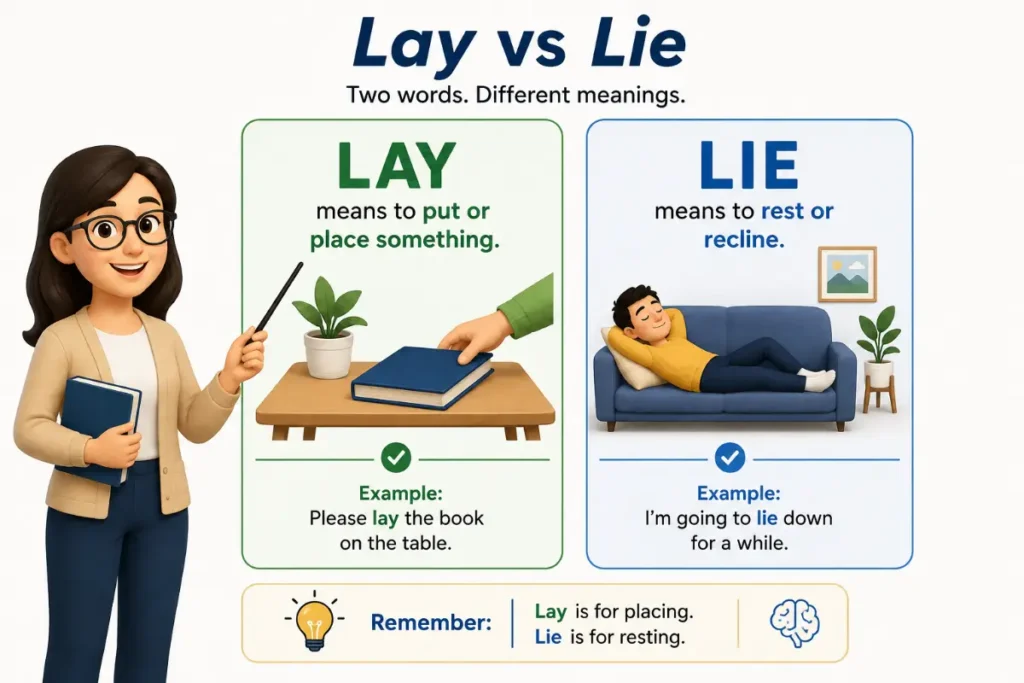
- Lay means to put or place something.
- Lie means to rest or recline.
- Lay always requires a direct object.
- Lie never requires a direct object.
- The past tense of lay is laid.
- The past tense of lie is lay.
- The past participle of lie is lain.
- The word lying is the present participle of lie.
- Replacing lay with place is a helpful memory trick.
- Mastering the verb forms makes choosing the correct word much easier.
Conclusion
Understanding Lay vs Lie becomes much easier once you remember one simple rule:
lay means to place something, while lie means to rest. The biggest source of confusion is that the past tense of lie is lay, but learning the complete verb forms helps eliminate that uncertainty.
Whenever you’re unsure, look for a direct object. If something receives the action, use lay. If no object is involved and the subject is simply resting or reclining, use lie. Following this approach will make your writing clearer, more accurate, and more professional in school, the workplace, and everyday communication.
Frequently Asked Questions
What is the main difference between Lay vs Lie?
Lay means to put or place something and always takes a direct object. Lie means to recline or rest and does not take a direct object.
How can I remember when to use lay or lie?
Remember this simple phrase: Lay something. Lie yourself. If something receives the action, use lay. If someone is simply resting, use lie.
Why is the past tense of lie “lay”?
English inherited these verb forms from Old English. Although they seem confusing today, they follow historical patterns that have remained part of the language for centuries.
Is “I’m going to lay down” grammatically correct?
In formal English, no. The correct sentence is I’m going to lie down because no object is receiving the action.
Is “The hen lays eggs” correct?
Yes. The hen places eggs, so lays is the correct form of lay.
Is “The dog is laying on the floor” correct?
Not in standard grammar. The correct sentence is The dog is lying on the floor because the dog is resting.
Do American and British English use different rules?
No. Both follow the same grammar rule for lay and lie, although informal speech sometimes ignores it.
What is the past participle of lie?
The past participle of lie is lain.
Example:
- She has lain awake for hours.
Which verb is more common in business writing?
Both appear regularly, but lay is more common because professional writing often describes placing documents, plans, equipment, or materials.
What is the easiest way to master Lay vs Lie?
Focus on the object. If the verb acts on something, choose lay. If someone simply rests or reclines, choose lie.

Confusing Words, Spelling & Word Choice
Claire Whitmore is a U.S.-based English editor who writes about commonly confused words, spelling differences, and word choice. Her work helps readers understand subtle distinctions between similar-looking words through simple definitions, practical examples, and modern usage guidance in both American and British English.