
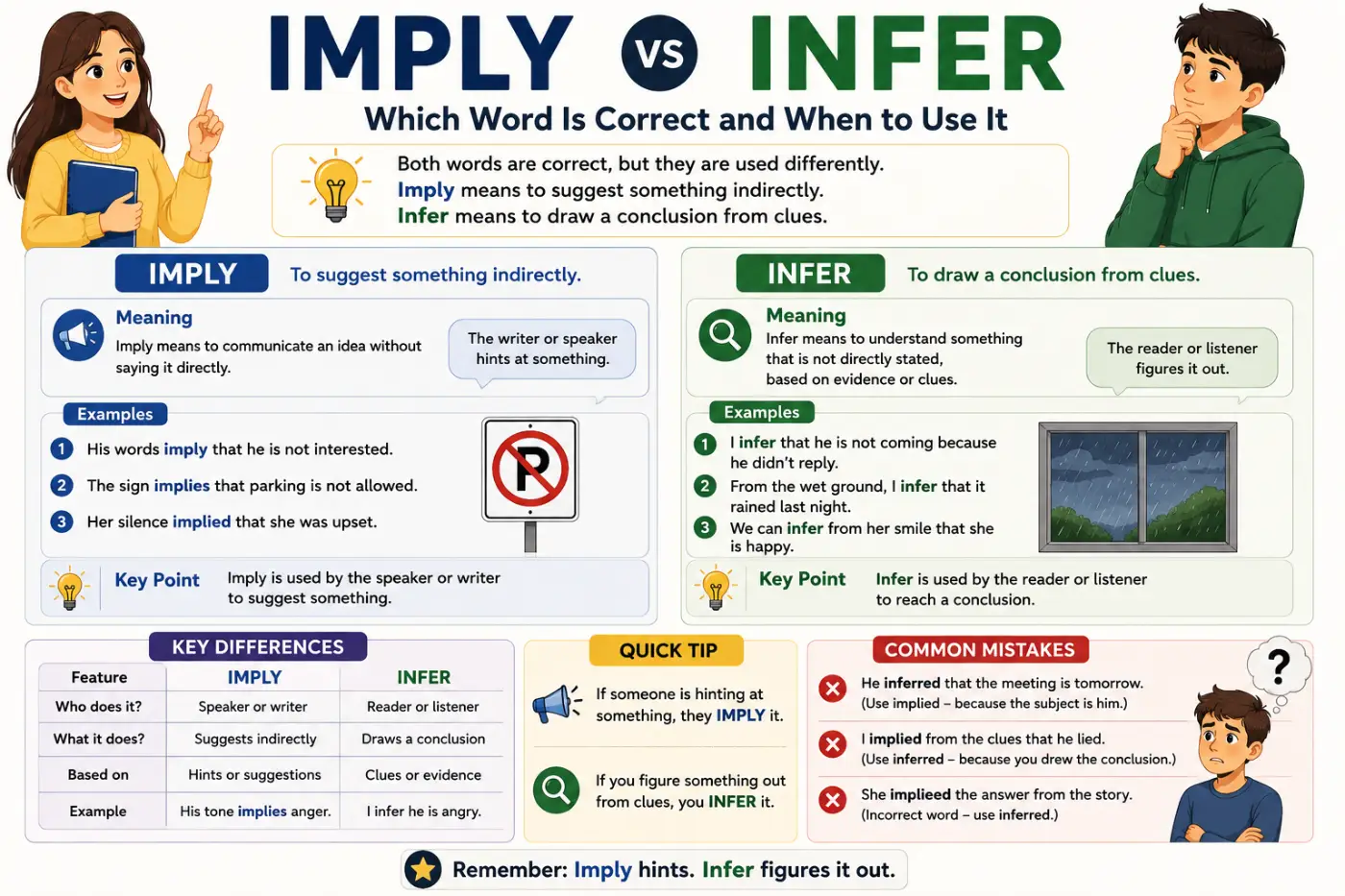
Imply vs Infer is one of the most frequently confused word pairs in English because both relate to understanding hidden meaning. They often appear in the same conversation, yet they describe two completely different actions. If you’ve ever wondered which word to use, you’re not alone.
The difference is actually simple once you know who is doing the action. A speaker, writer, or author implies something by hinting at it without saying it directly. A listener, reader, or audience infers the meaning by interpreting the clues that were provided.
Learning this distinction will help you write more accurately, understand conversations more clearly, and avoid one of the most common grammar mistakes in English. This guide explains the meanings of both words, their grammar rules, pronunciation, origins, real life examples, common mistakes, memory tricks, and professional writing tips so you can use each word with confidence.
Short Answer
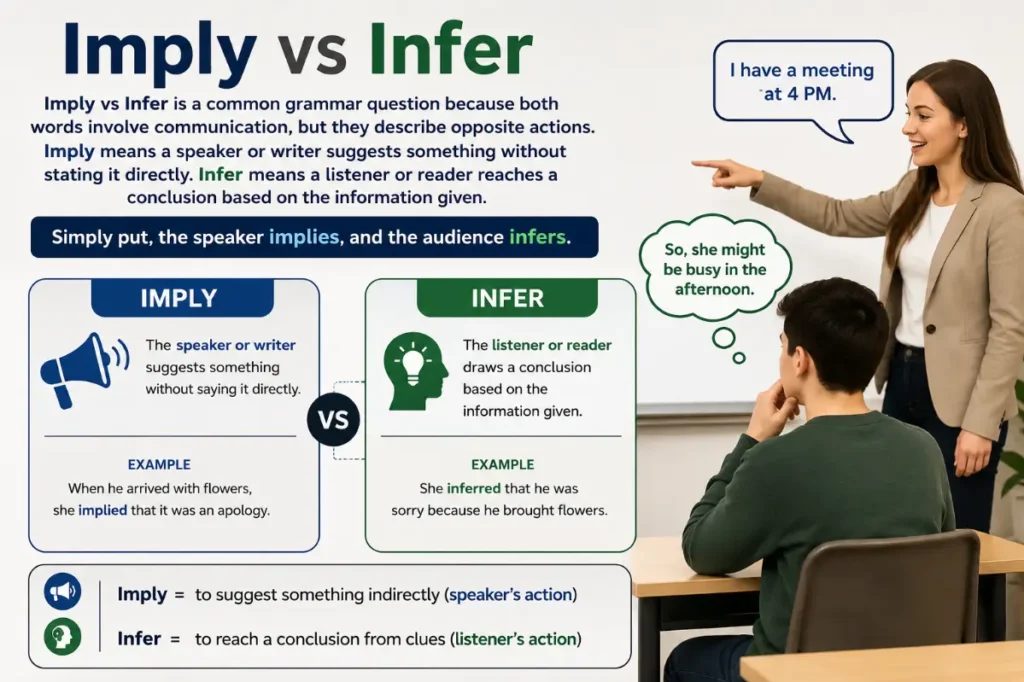
Imply vs Infer is a common grammar question because both words involve communication, but they describe opposite actions. Imply means a speaker or writer suggests something without stating it directly. Infer means a listener or reader reaches a conclusion based on the information given. Simply put, the speaker implies, and the audience infers.
Table of Contents
- What Do Imply and Infer Mean
- Imply vs Infer Comparison Table
- The Main Difference Between Imply and Infer
- When to Use Imply
- When to Use Infer
- Why These Words Are Often Confused
- Real Life Examples
- Common Mistakes
- Memory Tricks
- Professional Writing Tips
What Do Imply and Infer Mean
Although these words often appear together, they describe different parts of communication.
What Does Imply Mean
Imply means to suggest or hint at something without stating it directly.
The person speaking or writing leaves clues instead of expressing the message openly.
Examples include:
- A teacher hinting that students should study harder.
- A manager suggesting an employee improve punctuality.
- A friend giving subtle advice.
- An author hinting at a character’s true motives.
Example:
- The manager implied that deadlines would become stricter.
Explanation:
The manager did not say the rule directly but hinted at it.
What Does Infer Mean
Infer means to reach a conclusion based on evidence or clues.
The person listening, reading, or observing interprets the hidden meaning.
Examples include:
- Understanding an author’s message.
- Drawing conclusions from evidence.
- Reading between the lines.
- Understanding someone’s intentions from their actions.
Example:
- We inferred that the meeting had been canceled because no one arrived.
Explanation:
The conclusion came from observing the situation rather than hearing an announcement.
Imply vs Infer Comparison Table
| Feature | Imply | Infer |
|---|---|---|
| Action | Suggest | Conclude |
| Who performs it | Speaker or writer | Listener or reader |
| Direct statement | No | No |
| Based on clues | Gives clues | Uses clues |
| Communication stage | Sending a message | Receiving a message |
| Part of speech | Verb | Verb |
| Common in formal writing | Yes | Yes |
| Common in conversation | Yes | Yes |
The Main Difference Between Imply and Infer
The easiest way to remember these words is to focus on who is doing the action.
- The speaker implies.
- The listener infers.
Think of communication as a two step process.
- Someone gives a hint.
- Someone understands the hint.
The first action is imply.
The second action is infer.
Example:
- Sarah implied that she wanted to leave early.
- Her coworkers inferred that she had another appointment.
Sarah hinted at something.
Her coworkers figured out the meaning.
Why People Confuse Imply and Infer
These words confuse many English learners and native speakers for several reasons.
- Both involve hidden meaning.
- They often appear in the same sentence.
- Both deal with indirect communication.
- They describe opposite sides of the same conversation.
- Many people mistakenly think they are synonyms.
Remember this simple rule.
The message travels from the person who implies to the person who infers.
When to Use Imply
Use imply when someone hints, suggests, or communicates something indirectly.
Common situations include:
- Conversations.
- Emails.
- Speeches.
- Literature.
- Business meetings.
- News reports.
- Reviews.
- Everyday communication.
Examples
- The teacher implied that extra practice would improve grades.
Explanation:
The teacher hinted instead of giving a direct command.
- His smile implied approval.
Explanation:
The smile suggested approval without words.
- The advertisement implied that the product lasts longer.
Explanation:
The advertisement suggested a benefit rather than stating it directly.
- Her silence implied disagreement.
Explanation:
Silence communicated an unstated message.
- The article implied that changes were coming.
Explanation:
The writer hinted at future developments.
- His tone implied frustration.
Explanation:
The emotion was suggested through the way he spoke.
- The contract implied certain responsibilities.
Explanation:
The responsibilities were understood from the wording.
Common Expressions Using Imply
You will often see imply in these expressions.
- imply responsibility
- imply criticism
- imply approval
- imply guilt
- imply agreement
- imply blame
- imply intent
- imply support
- imply confidence
- imply meaning
Example:
- Her comments implied support for the proposal.
When to Use Infer
Use infer when someone reaches a conclusion from evidence, actions, or clues.
Common situations include:
- Reading books.
- Listening to conversations.
- Studying data.
- Observing behavior.
- Solving problems.
- Scientific research.
- Detective work.
- Everyday decision making.
Examples
- We inferred that traffic caused the delay.
Explanation:
The conclusion came from available evidence.
- Readers inferred the character’s true feelings.
Explanation:
The author never stated them directly.
- Scientists inferred that the climate had changed over centuries.
Explanation:
The conclusion came from research findings.
- I inferred that she was tired because she kept yawning.
Explanation:
The listener interpreted observable clues.
- Police inferred that the suspect knew the victim.
Explanation:
The conclusion was based on evidence.
- The audience inferred the ending before the final scene.
Explanation:
Viewers connected earlier clues.
Common Expressions Using Infer
Common combinations include:
- infer meaning
- infer intention
- infer motive
- infer conclusion
- infer relationship
- infer emotion
- infer cause
- infer purpose
- infer facts
- infer results
Example:
- Students inferred the author’s purpose from the passage.
Can Imply and Infer Ever Be Interchanged
No. Although they are closely related, they describe opposite actions.
Incorrect:
- The teacher inferred that homework was important.
Correct:
- The teacher implied that homework was important.
Reason:
Teachers usually communicate the message.
Students infer it.
Correct:
- Students inferred that homework was important.
Reason:
Students reached the conclusion.
Real Life Examples
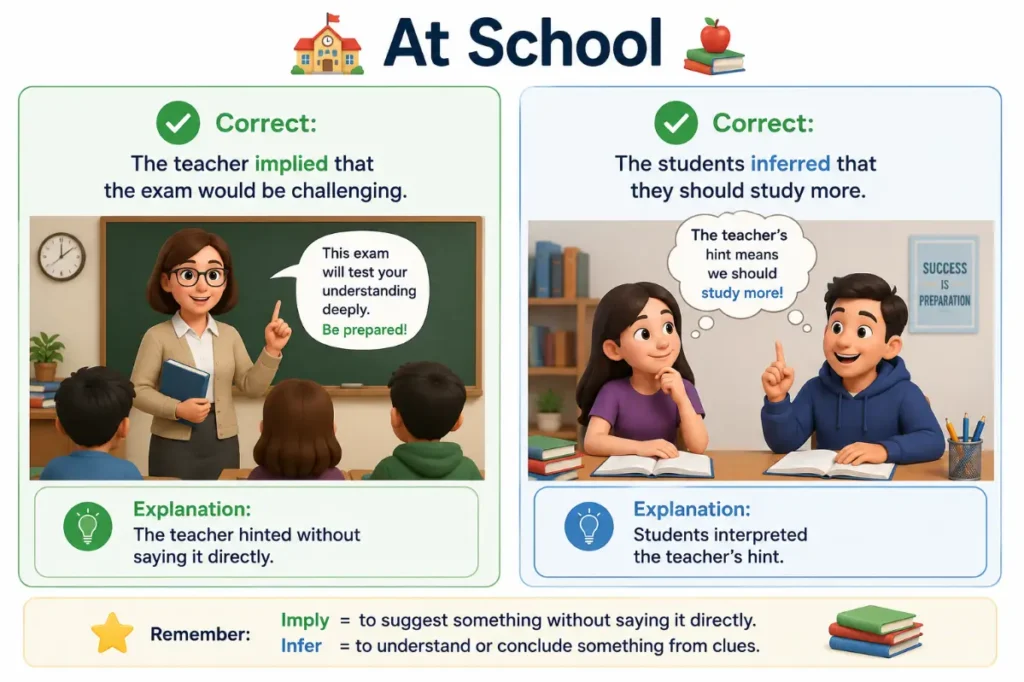
At School
Correct:
- The teacher implied that the exam would be challenging.
Explanation:
The teacher hinted without saying it directly.
Correct:
- The students inferred that they should study more.
Explanation:
Students interpreted the teacher’s hint.
At Work
Correct:
- The manager implied that the project needed faster progress.
Explanation:
The manager communicated indirectly.
Correct:
- Employees inferred that overtime might be necessary.
Explanation:
Employees drew a conclusion.
During a Conversation
Correct:
- His expression implied disappointment.
Explanation:
The facial expression suggested an emotion.
Correct:
- I inferred that he was unhappy.
Explanation:
The listener interpreted the expression.
Reading a Novel
Correct:
- The author implied that the villain had escaped.
Explanation:
The writer left clues.
Correct:
- Readers inferred that the villain survived.
Explanation:
Readers connected those clues.
Imply and Infer in Literature
Authors often rely on implication instead of direct explanation.
For example:
- A character avoids answering a question.
- The weather suddenly changes.
- A room becomes silent after one sentence.
The writer implies a deeper meaning.
The reader infers that meaning.
This technique encourages readers to think critically instead of receiving every detail directly.
Imply and Infer in Business Communication
These words frequently appear in professional settings.
Examples of imply
- The report implied financial improvement.
- The email implied urgency.
- The presentation implied confidence.
Examples of infer
- Investors inferred future growth.
- Clients inferred higher costs.
- Employees inferred upcoming changes.
Using these words correctly improves clarity in reports, presentations, and workplace communication.
Common Mistakes
Many writers reverse these two verbs.
Mistake One
Incorrect:
- I implied that the speaker was nervous.
Correct:
- I inferred that the speaker was nervous.
Reason:
The listener reached the conclusion.
Mistake Two
Incorrect:
- Her email inferred dissatisfaction.
Correct:
- Her email implied dissatisfaction.
Reason:
The email communicated the message.
Mistake Three
Incorrect:
- Readers implied the author’s opinion.
Correct:
- Readers inferred the author’s opinion.
Reason:
Readers interpret meaning.
Mistake Four
Incorrect:
- The scientist inferred that the report suggested errors.
Correct:
- The scientist inferred from the report that errors existed.
Reason:
Scientists reach conclusions based on evidence.
Memory Tricks
These simple tricks make the difference easy to remember.
Trick One
Think of the first letter.
- Imply = Issue a hint.
- Infer = Interpret a hint.
Trick Two
Remember the communication flow.
- Speaker implies.
- Listener infers.
Trick Three
Ask yourself this question.
Who is sending the message?
- The sender implies.
Who is understanding the message?
- The receiver infers.
Professional Writing Tips
Professional editors recommend keeping the roles separate.
Follow these habits.
- Use imply only for the person giving the message.
- Use infer only for the person receiving the message.
- Avoid treating the words as synonyms.
- Double check who performs the action before choosing the verb.
- In formal writing, this distinction is expected and improves clarity.
Keeping these roles clear will make your writing more precise, professional, and easier for readers to understand.
Pronunciation
Although imply and infer have different meanings, neither word is difficult to pronounce.
| Word | IPA | Simple Pronunciation |
|---|---|---|
| Imply | /ɪmˈplaɪ/ | im PLY |
| Infer | /ɪnˈfɝː/ | in FUR |
Stress falls on the second syllable in both words, making them easy to distinguish in speech.
Word Origin
Understanding the origins of these words makes their meanings easier to remember.
Origin of Imply
The word imply comes from the Latin implicare, meaning to involve, entangle, or fold into. Over time, it came to mean suggesting an idea indirectly rather than stating it openly.
Origin of Infer
The word infer comes from the Latin inferre, meaning to bring in, draw from, or conclude. In English, it developed the meaning of reaching a conclusion from evidence or reasoning.
Even though both words have Latin roots, they evolved to describe opposite sides of communication.
Imply vs Infer in American and British English
There is no significant difference between American and British English when using these words.
Both varieties follow the same grammar rule.
- A speaker or writer implies.
- A listener or reader infers.
Examples accepted in both forms of English include:
- The lawyer implied that more evidence existed.
- The jury inferred that the witness was telling the truth.
Whether you are writing for an American or British audience, the usage remains the same.
Formal vs Informal Usage
Both imply and infer are suitable for formal and informal communication.
Formal Writing
These words commonly appear in:
- Academic papers.
- Legal documents.
- Business reports.
- Research articles.
- News writing.
- Professional emails.
Example:
- The data implied a significant increase in demand.
- Researchers inferred a connection between the variables.
Informal Conversation
They also appear in everyday speech.
Examples:
- Are you implying I’m late?
- I inferred that you didn’t want to go.
The grammar rule stays the same regardless of the setting.
Imply vs Infer in Everyday Situations
Family Conversations
- Dad implied that we should leave early.
Explanation:
He hinted without giving a direct instruction.
- We inferred that traffic would be heavy.
Explanation:
The family reached a conclusion from his comment.
At School
- The professor implied that one chapter was especially important.
Explanation:
The professor gave a subtle hint.
- Students inferred that the chapter would appear on the exam.
Explanation:
The students interpreted the clue.
At Work
- The supervisor implied that deadlines would become stricter.
Explanation:
The message was indirect.
- Employees inferred that weekend work might be required.
Explanation:
The conclusion came from the supervisor’s comments.
Watching a Movie
- The director implied that the character survived.
Explanation:
The ending left clues instead of giving a direct answer.
- Viewers inferred that the character escaped.
Explanation:
The audience interpreted those clues.
Reading a News Story
- The article implied that new policies were being considered.
Explanation:
The journalist suggested an idea without stating it as fact.
- Readers inferred that changes would happen soon.
Explanation:
Readers connected the available information.
Imply vs Infer in Literature
Many authors intentionally rely on implication instead of direct explanation.
For example:
- A character quietly leaves the room after hearing unexpected news.
- A letter is torn into pieces without showing its contents.
- Two characters stop talking when another person enters.
The author implies a deeper meaning through actions and details.
The reader infers what those clues suggest.
This technique encourages readers to think critically and engage more deeply with the story.
Common Expressions
Expressions with Imply
- imply responsibility
- imply guilt
- imply criticism
- imply consent
- imply approval
- imply support
- imply trust
- imply meaning
- imply intention
- imply disrespect
Example:
- His apology implied responsibility for the mistake.
Expressions with Infer
- infer meaning
- infer intention
- infer motive
- infer emotion
- infer facts
- infer results
- infer conclusions
- infer relationships
- infer purpose
- infer evidence
Example:
- Readers inferred the author’s opinion from the final paragraph.
Quick Practice Quiz
Choose the correct word before checking the answer.
1. The speaker ______ that changes were coming.
Answer:
Implied
Reason:
The speaker communicated the message.
2. The audience ______ that new rules would be announced.
Answer:
Inferred
Reason:
The audience interpreted the speaker’s hint.
3. Her silence ______ disappointment.
Answer:
Implied
Reason:
Silence suggested a hidden message.
4. Detectives ______ that the suspect knew the victim.
Answer:
Inferred
Reason:
The conclusion came from evidence.
5. The advertisement ______ the product was environmentally friendly.
Answer:
Implied
Reason:
Advertisements often suggest benefits indirectly.
6. Readers ______ that the story would continue.
Answer:
Inferred
Reason:
Readers reached a conclusion from clues in the text.
7. The email ______ urgency without saying it directly.
Answer:
Implied
Reason:
The email communicated indirectly.
8. Scientists ______ that climate conditions had changed over time.
Answer:
Inferred
Reason:
Their conclusion came from research evidence.
Related Grammar Notes
If you enjoy learning commonly confused words, these comparisons can also improve your writing.
- Affect vs Effect.
- Farther vs Further.
- Advice vs Advise.
- Lay vs Lie.
- Then vs Than.
- Bring vs Take.
- Who vs Whom.
- Less vs Fewer.
- Accept vs Except.
- Compliment vs Complement.
Each pair involves words that look or sound similar but serve different grammatical purposes.
People Also Ask
What is the easiest way to remember Imply vs Infer?
Remember this simple rule: the speaker implies, and the listener infers. One person sends the message, and the other person interprets it.
Can imply and infer be used interchangeably?
No. Although they describe the same communication process, they represent opposite actions. Using them interchangeably creates a grammar mistake.
Is infer the same as assume?
Not exactly. Infer means reaching a conclusion based on evidence or clues, while assume means accepting something as true without enough evidence.
Can a book imply something?
Yes. Authors often imply themes, emotions, or character motivations through dialogue, actions, and descriptions rather than stating everything directly.
Can readers infer meaning?
Yes. Readers regularly infer meanings, themes, emotions, and motivations by interpreting clues provided in the text.
Key Takeaways
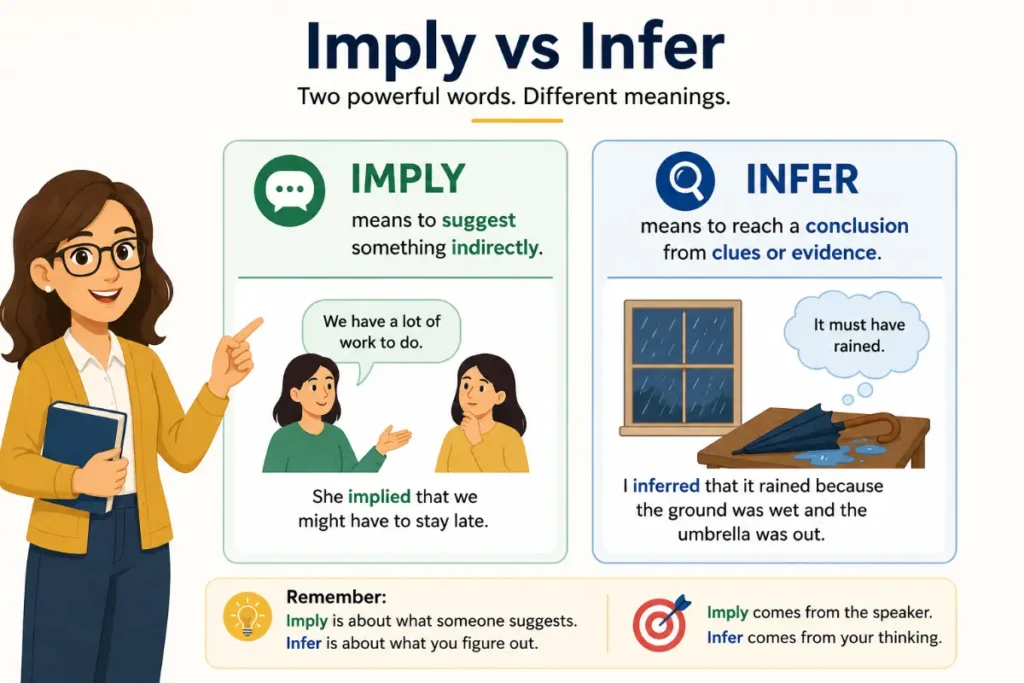
- Imply means to suggest something indirectly.
- Infer means to reach a conclusion from clues or evidence.
- The speaker, writer, or author implies.
- The listener, reader, or audience infers.
- The words describe opposite parts of the same communication process.
- They are never true synonyms.
- Remembering who performs the action helps you choose the correct word every time.
- Both words are appropriate in formal and informal English.
Conclusion
Understanding Imply vs Infer becomes simple once you remember that they describe opposite roles in communication. The person speaking or writing implies a message by suggesting it indirectly, while the person listening or reading infers the meaning by interpreting the available clues. Keeping this distinction in mind will help you avoid a common grammar mistake and make your writing more accurate.
Whenever you pause to choose between these two verbs, ask yourself one question: Who is performing the action? If someone is giving the hint, use imply. If someone is drawing the conclusion, use infer. This simple habit will help you use both words confidently in conversations, essays, emails, professional documents, and everyday communication.
Frequently Asked Questions
What is the main difference between Imply vs Infer?
The main difference is the direction of communication. A speaker or writer implies a message, while a listener or reader infers the meaning from the clues provided.
Why do people confuse imply and infer?
People confuse these words because they both involve indirect communication and often appear in the same situations. However, they describe opposite actions.
Is imply positive or negative?
Neither. Imply is neutral. It simply means suggesting something indirectly, regardless of whether the message is positive, negative, or factual.
Is infer the same as conclude?
Almost. Infer means reaching a conclusion based on evidence or clues, making it a specific type of conclusion supported by reasoning.
Can imply be used in academic writing?
Yes. Imply frequently appears in research papers, literary analysis, business reports, and professional communication.
Can infer be used in scientific writing?
Yes. Scientists regularly infer relationships, causes, and conclusions from observations, experiments, and collected data.
Is there a difference between American and British English?
No. Both American and British English use imply and infer in the same way.
How can I remember which word to use?
Think of the communication process. The sender implies the message, and the receiver infers its meaning.
Can someone imply something without speaking?
Yes. Facial expressions, body language, silence, actions, and tone of voice can all imply messages without using words.
What happens if I use imply instead of infer?
Many readers will understand your intended meaning, but the sentence will be grammatically incorrect. Using the correct word makes your writing clearer and more precise.

Confusing Words, Spelling & Word Choice
Claire Whitmore is a U.S.-based English editor who writes about commonly confused words, spelling differences, and word choice. Her work helps readers understand subtle distinctions between similar-looking words through simple definitions, practical examples, and modern usage guidance in both American and British English.