
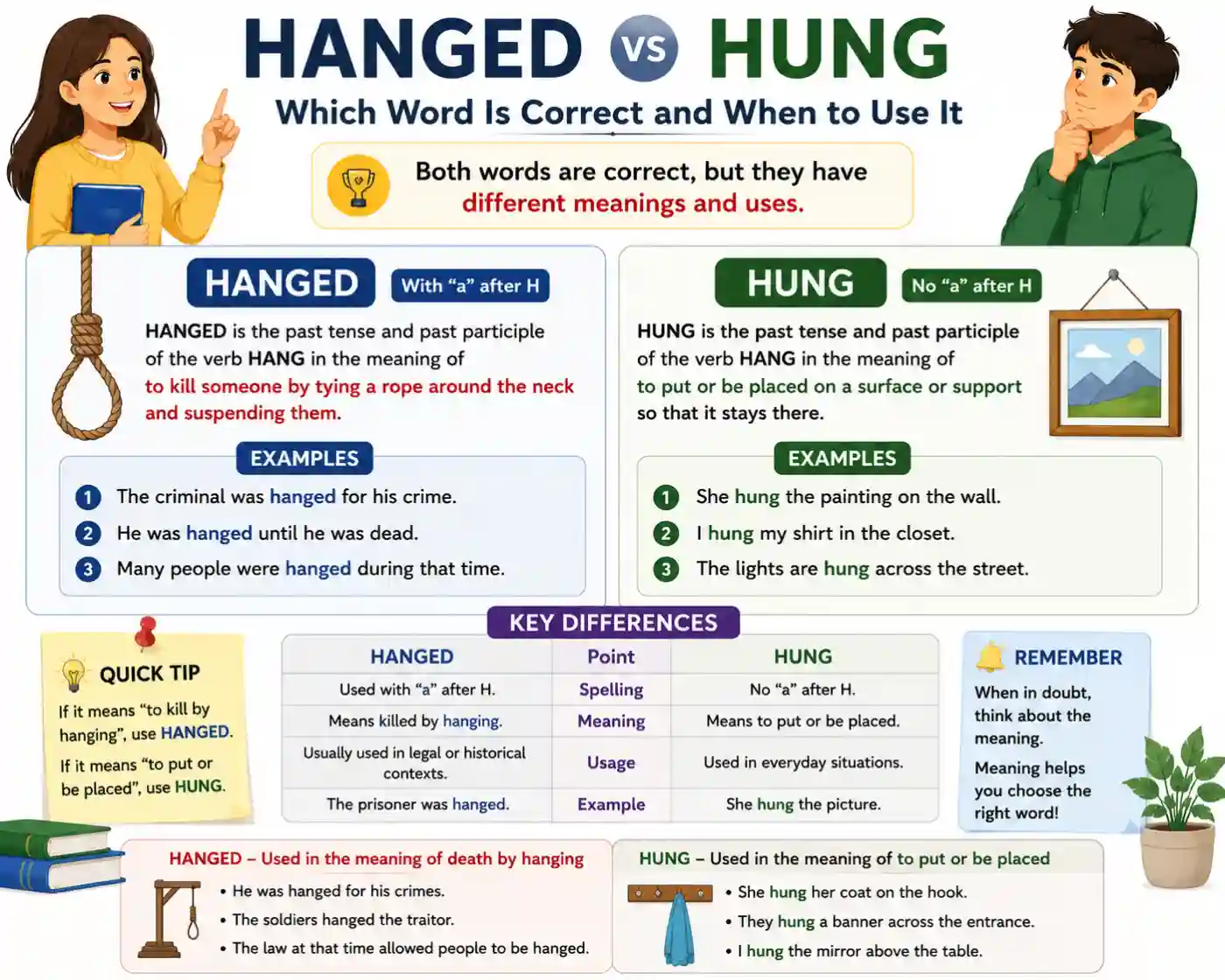
Many writers confuse Hanged and Hung because both words come from the same verb but apply to different situations. Many English learners and even native speakers wonder which form is correct, especially when writing or speaking formally.
The good news is that the rule is surprisingly simple. Modern English reserves hanged almost exclusively for executions by hanging, while it uses hung as the standard past tense and past participle for every other meaning of hang.
Although both words share the same origin, centuries of language development have given each one a specific role. Knowing the difference will help you avoid common mistakes and communicate with greater precision in everyday conversations, school assignments, business writing, and professional documents.
Short Answer
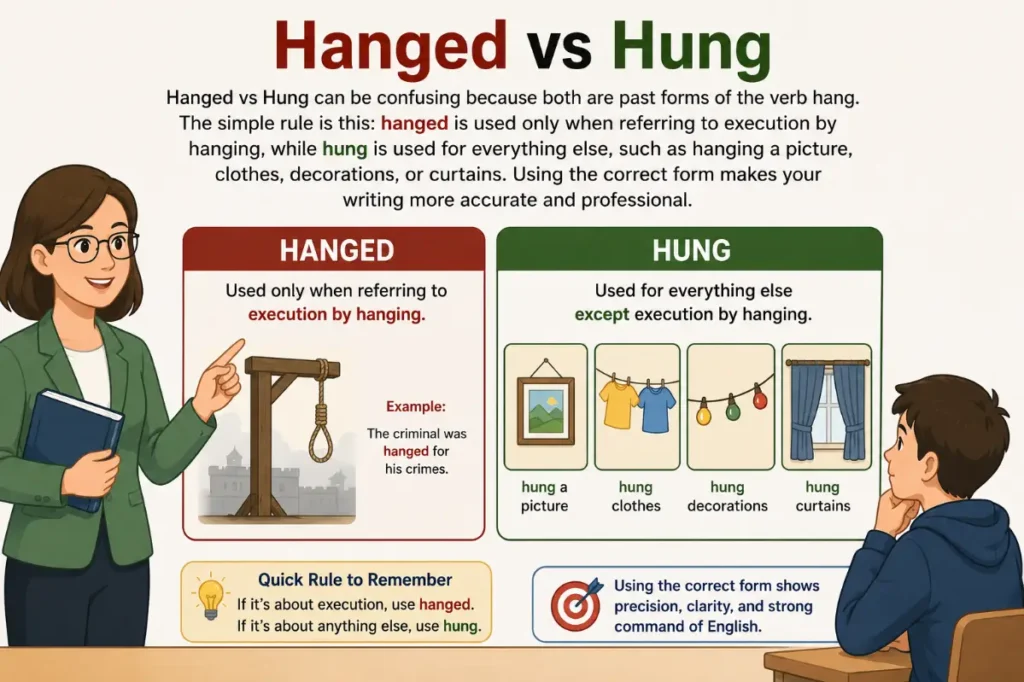
Hanged vs Hung can be confusing because both are past forms of the verb hang. Follow this simple rule. Use hanged only for execution by hanging. Use hung for everything else, including pictures, clothes, decorations, and curtains. Using the correct form makes your writing more accurate and professional.
Table of Contents
- What Do Hanged and Hung Mean
- Hanged vs Hung Comparison Table
- The Main Difference Between Hanged and Hung
- When to Use Hanged
- When to Use Hung
- Why People Confuse These Words
- Real Life Examples
- Common Mistakes
- Memory Tricks
- Professional Writing Tips
What Do Hanged and Hung Mean
Both hanged and hung come from the verb hang, but they have different meanings depending on the context.
What Does Hanged Mean
Use hanged as the past tense and past participle only when referring to the execution of a person by hanging.
Examples include:
- Legal executions.
- Historical executions.
- Death sentences carried out by hanging.
Example:
- The authorities hanged the prisoner for treason.
Explanation:
The sentence refers to a legal execution, so hanged is the correct word.
What Does Hung Mean
Hung is the standard past tense and past participle for every other meaning of hang.
It describes placing or suspending something from above.
Examples include:
- Hanging a painting.
- Hanging clothes.
- Hanging decorations.
- Hanging lights.
- Hanging a mirror.
- Hanging a coat.
Example:
- She hung the picture above the fireplace.
Explanation:
People hang the picture on a wall, so use hung because the sentence has nothing to do with an execution.
Hanged vs Hung Comparison Table
| Feature | Hanged | Hung |
|---|---|---|
| Refers to execution | Yes | No |
| Refers to objects | No | Yes |
| Used for decorations | No | Yes |
| Used for clothing | No | Yes |
| Used for artwork | No | Yes |
| Used in legal history | Yes | Rarely |
| Modern everyday English | Rare | Very common |
| Formal writing | Yes, for executions | Yes, for all other meanings |
The Main Difference Between Hanged and Hung
The easiest way to choose between these two words is to ask one simple question.
Is someone being executed by hanging?
If the answer is yes, use hanged.
If the answer is no, use hung.
Examples:
- She hung her jacket on the chair.
- They hung colorful lights around the garden.
- We hung our towels outside to dry.
This simple rule works in nearly every situation.
Why People Confuse Hanged and Hung
There are several reasons these words cause confusion.
- Both come from the same verb.
- Most English verbs have only one past tense.
- Many people rarely encounter hanged outside history books.
- Everyday conversation almost always uses hung.
Because hung appears so frequently, some writers mistakenly use it when referring to executions. Likewise, some learners overcorrect by using hanged for ordinary objects, which is also incorrect.
When to Use Hanged
Use hanged only when talking about someone who was executed by hanging.
Typical situations include:
- History.
- Criminal law.
- Literature.
- Historical fiction.
- News about historical events.
Examples
- The pirate was hanged after his capture.
Explanation:
The sentence describes an execution.
- Several prisoners were hanged in the eighteenth century.
Explanation:
The punishment was execution.
- The court ordered that the convicted murderer be hanged.
Explanation:
The legal sentence involved execution.
Common Expressions Using Hanged
These expressions almost always appear in legal or historical contexts.
- hanged for treason
- hanged for murder
- hanged by the neck
- publicly hanged
Example:
- The prisoner was hanged after the verdict.
The sentence clearly refers to capital punishment.
When to Use Hung
Use hung for every other meaning of hang.
Common situations include:
- Pictures.
- Paintings.
- Mirrors.
- Clothes.
- Curtains.
- Decorations.
- Jewelry.
- Towels.
- Signs.
- Flags.
Examples
- She hung the family photo in the hallway.
Explanation:
A photograph is displayed on a wall.
- We hung Christmas lights around the house.
Explanation:
The lights were suspended for decoration.
- He hung his coat by the door.
Explanation:
The coat was placed on a hook.
- They hung colorful banners across the street.
Explanation:
The banners were suspended overhead.
Common Expressions Using Hung
Many everyday English expressions use hung.
Examples include:
- hung on the wall
- hung out to dry
- hung from the ceiling
- hung by a thread
- hung around
- hung the phone up
- hung decorations
- hung the laundry
- hung a picture
- hung a mirror
These expressions never use hanged because they have nothing to do with execution.
Can Hung Ever Refer to a Person
Yes. Write hung whenever the sentence describes physical suspension rather than execution.
Examples:
- The climber hung from the rope.
- The child hung upside down from the monkey bars.
- The actor hung from the harness during the performance.
- The rescue worker hung from the helicopter.
Explanation:
These examples describe physical suspension, not capital punishment.
This is one of the most important distinctions to remember.
Compare these sentences:
- The criminal was hanged after the trial.
- The firefighter hung from the rescue cable.
The first sentence describes execution.
The second sentence describes physical suspension.
Real Life Examples
At Home
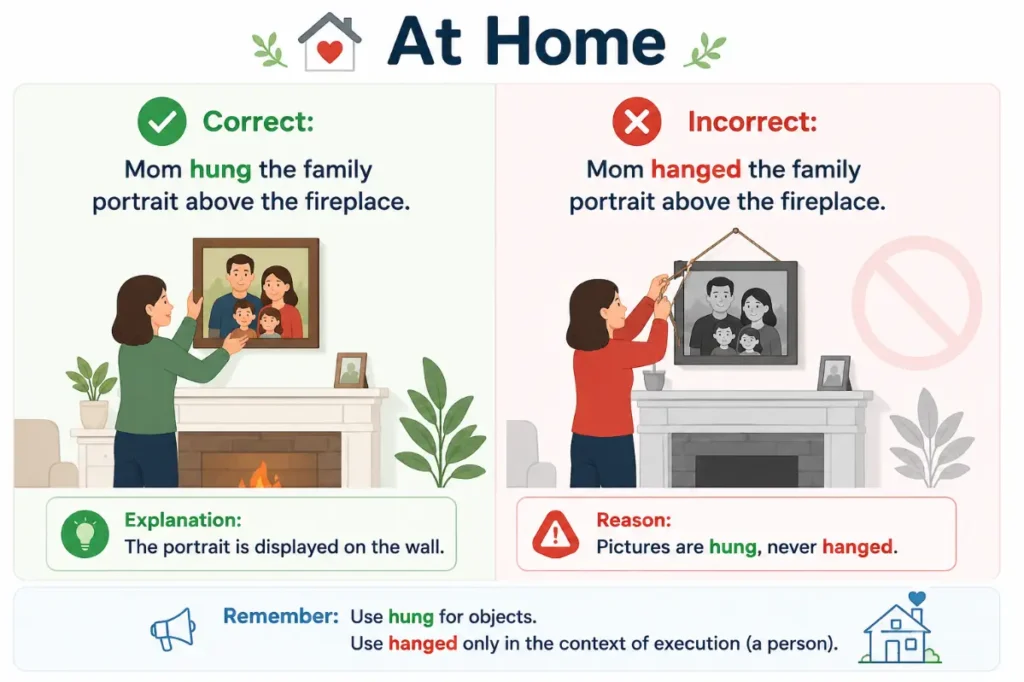
Correct:
- Mom hung the family portrait above the fireplace.
Explanation:
The portrait is displayed on the wall.
Incorrect:
- Mom hanged the family portrait above the fireplace.
Reason:
Pictures are hung, never hanged.
At School
Correct:
- The students hung their artwork in the classroom.
Explanation:
The artwork is displayed.
During a History Lesson
Correct:
- The rebels were hanged for treason.
Explanation:
The sentence refers to execution.
During Camping
Correct:
- We hung our lantern from a tree branch.
Explanation:
The lantern is suspended.
Hung as an Adjective
Hung can also function as an adjective in certain expressions.
Examples include:
- well hung curtains
- beautifully hung artwork
- freshly hung decorations
Example:
- The gallery featured beautifully hung paintings.
Here, hung describes the arrangement of the paintings.
Hanged as an Adjective
Unlike hung, hanged is rarely used as an adjective. When it does appear, it almost always relates to execution or historical references.
Examples:
- the hanged man
- the hanged prisoner
- the hanged outlaw
These phrases commonly appear in history books, literature, and legal discussions.
Common Mistakes
Many writers make the same errors.
- Using hung for an execution.
Incorrect:
- The criminal was hung.
Correct:
- The criminal was hanged.
Reason:
Executions always use hanged.
- Using hanged for household objects.
Incorrect:
- She hanged the curtains.
Correct:
- She hung the curtains.
Reason:
Curtains are suspended, not executed.
- Thinking hanged is simply an old-fashioned version of hung.
This is incorrect.
Modern English still reserves hanged for executions.
Memory Tricks
These simple tricks can help you remember the rule.
Trick One
Think of the letter E in Hanged.
E stands for Execution.
If someone is executed by hanging, use hanged.
Trick Two
Think of Hung as the everyday word.
Almost everything in your home is hung.
- Pictures.
- Clothes.
- Towels.
- Mirrors.
- Curtains.
- Decorations.
Trick Three
Ask yourself one question.
Did someone die by legal execution?
- Yes → Hanged.
- No → Hung.
Professional Writing Tips
Editors, teachers, and publishers generally follow the same rule. Keep these guidelines in mind.
- Reserve hanged for executions.
- Use hung for all ordinary situations.
- Avoid switching between the two without a reason.
- Follow the traditional distinction in academic and professional writing.
- When writing about history, check that executions always use hanged.
Using the correct form not only improves grammatical accuracy but also ensures your writing is clear, precise, and appropriate for the context.
Pronunciation
Although hanged and hung come from the same verb, English speakers pronounce them differently because each word has a different ending.
| Word | IPA | Simple Pronunciation |
|---|---|---|
| Hanged | /hæŋd/ | HANGD |
| Hung | /hʌŋ/ | HUNG |
The pronunciation itself does not tell you which word to use. Instead, the meaning of the sentence determines the correct choice.
Word Origin
Understanding the history of these words explains why English has two different past forms of the same verb. The verb hang comes from Old English hōn and hangian, meaning to suspend from above. For centuries, both hung and hanged appeared in many contexts.
Over time, English developed a special distinction.
- Hung became the regular past tense and past participle for ordinary actions.
- Hanged became the standard form used only for execution by hanging.
Major dictionaries and style guides have recommended this distinction for hundreds of years, and they continue to recommend it today.
Hanged vs Hung in American and British English
Both American and British English follow the same basic grammar rule.
American English
American English strongly prefers:
- Hanged for executions.
- Hung for everything else.
Example:
- She hung the new mirror yesterday.
British English
British English follows the same distinction.
Example:
- They hung colorful flags across the village.
Although vocabulary differs between American and British English in many areas, this grammar rule is consistent in both varieties.
Hanged vs Hung in Formal Writing
Professional editors almost always apply the traditional distinction.
Use hanged in:
- History books.
- Court records.
- Legal documents.
- Academic writing about capital punishment.
- Historical fiction.
Use hung in:
- Business writing.
- School assignments.
- Home improvement articles.
- Travel writing.
- Lifestyle blogs.
- News stories about everyday events.
Examples:
Correct:
- The portrait was hung in the entrance hall.
Correct:
- The convicted criminal was hanged in 1823.
Using the wrong word in these situations can make writing appear careless or historically inaccurate.
Hanged vs Hung in Everyday Conversation
In everyday conversation, hung appears much more often because most people rarely discuss executions.
Examples:
- I hung my backpack by the door.
- We hung lights on the porch.
- She hung the laundry outside.
- He hung his keys on the hook.
Most English speakers go months or even years without needing the word hanged.
That is why many learners instinctively use hung in every situation, even when talking about historical executions.
Examples in Everyday Life
Decorating a House
- They hung family photographs along the hallway.
Explanation:
The photographs are displayed on a wall.
Camping
- We hung our backpacks from tree branches to keep animals away.
Explanation:
The backpacks are suspended.
Museum
- The museum hung a famous painting near the entrance.
Explanation:
The painting is exhibited.
History Class
- The king ordered that the traitor be hanged.
Explanation:
The sentence refers to execution.
Rescue Mission
- The climber hung from the safety rope until help arrived.
Explanation:
The climber is suspended, not executed.
Hanged vs Hung in Literature
Writers carefully choose between these two forms because each carries a different meaning.
Example:
- The old lantern hung from the wooden beam.
Notice that every sentence about execution uses hanged, while every sentence about objects uses hung.
Special Cases and Exceptions
Although the rule is straightforward, a few situations deserve extra attention.
A Person Can Be Hung Without Being Executed
This surprises many learners.
Examples:
- The acrobat hung from the ceiling.
- The firefighter hung from the rescue helicopter.
- The child hung upside down from the playground bars.
These sentences describe physical position rather than execution.
Idioms Always Use Hung
Many English idioms include hung.
Examples:
- hung out to dry
- hung up on someone
- hung around
- hung by a thread
- hung in the balance
These expressions never use hanged.
Quick Practice Quiz
Choose the correct word before checking the answer.
1. She ______ the painting above the fireplace.
Answer:
Hung
Reason:
A painting is displayed.
2. The prisoner was ______ after the trial.
Answer:
Hanged
Reason:
The sentence refers to execution.
3. We ______ our coats by the entrance.
Answer:
Hung
Reason:
Coats are suspended.
4. The decorations were ______ from the ceiling.
Answer:
Hung
Reason:
Decorations are displayed.
5. Historical records say he was ______ for treason.
Answer:
Hanged
Reason:
The context is execution.
6. The rescue worker ______ from the helicopter.
Answer:
Hung
Reason:
The worker is suspended.
7. The children ______ colorful paper stars in the classroom.
Answer:
Hung
Reason:
The stars are decorations.
Related Grammar Notes
Learning similar grammar distinctions helps improve your overall writing.
Other commonly confused word pairs include:
- Farther vs Further.
- Lay vs Lie.
- Affect vs Effect.
- Advice vs Advise.
- Then vs Than.
- Passed vs Past.
- Borrow vs Lend.
- Raise vs Rise.
- Sit vs Set.
- Who vs Whom.
Like Hanged vs Hung, these pairs require understanding meaning rather than relying on spelling alone.
People Also Ask
Is “hung” ever correct for a person?
Yes. Reserve hanged for executions and use hung for a person who is simply suspended.
Example:
- The climber hung from the cliff.
Why is “hanged” only used for executions?
English developed a special grammatical distinction over several centuries to separate execution from ordinary suspension. Modern dictionaries and style guides continue to follow this convention.
Can I say “the picture was hanged”?
No.People always use hung for pictures, mirrors, curtains, signs, and decorations.
Why do many people say “hung” for executions?
Because hung is much more common in everyday English, many speakers mistakenly use it for every meaning of hang. In careful writing, hanged remains the correct form for executions.
Do newspapers still use “hanged”?
Yes.
Professional newspapers, historians, legal writers, and publishers consistently use hanged when reporting executions.
Key Takeaways
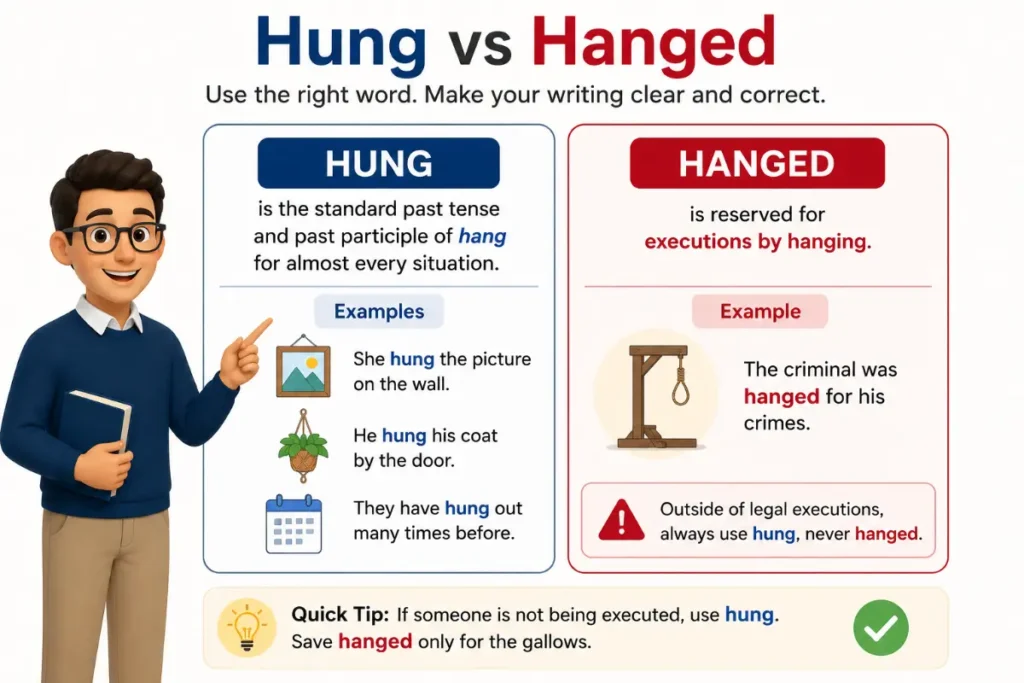
- Hung is the standard past tense and past participle of hang for almost every situation.
- Hanged is reserved for executions by hanging.
- American and British English follow the same distinction.
- Professional editors strongly recommend following the traditional rule.
Conclusion
Understanding Hanged vs Hung is easier once you remember that each word has a specific purpose. Remember this simple rule. Use hung for almost every everyday meaning of hang. Reserve hanged exclusively for execution by hanging.
Following this distinction makes your writing more accurate, professional, and consistent with modern English grammar. Whenever you’re unsure, ask yourself one simple question: Does the sentence describe an execution? If the answer is yes, choose hanged. If the answer is no, hung is the correct choice almost every time.
Frequently Asked Questions
What is the main difference between Hanged vs Hung?
Use hanged only for execution by hanging. Use hung for every other meaning of the verb hang.
Can I use “hung” for a criminal who was executed?
No. Use hanged because standard English refers to a person executed by hanging as hanged, not hung.
Is “hanged” an old-fashioned word?
No. Although it is less common in everyday conversation, hanged remains the correct and current form for executions.
Why are pictures hung instead of hanged?
Choose hung when talking about pictures because the sentence describes display, not execution.
Is “the man hung from the rope” correct?
Yes. Choose hung when a man is simply suspended from a rope rather than executed.
Which form should students use in essays?
Students should follow the traditional grammar rule by using hanged only for executions and hung in every other context.
Do dictionaries recognize both words?
Yes. Modern dictionaries list both forms and explain that hanged has a specialized meaning related to execution.
Is this rule the same in American and British English?
Yes. Both varieties of English reserve hanged for executions and use hung for all ordinary meanings.
How can I remember the difference?
Associate the E in Hanged with Execution. Use hung if the sentence does not refer to an execution.
Which word is more common?
English speakers use hung far more often because they apply it to everyday situations involving objects, decorations, clothing, artwork, and physical suspension.

Confusing Words, Spelling & Word Choice
Claire Whitmore is a U.S.-based English editor who writes about commonly confused words, spelling differences, and word choice. Her work helps readers understand subtle distinctions between similar-looking words through simple definitions, practical examples, and modern usage guidance in both American and British English.