
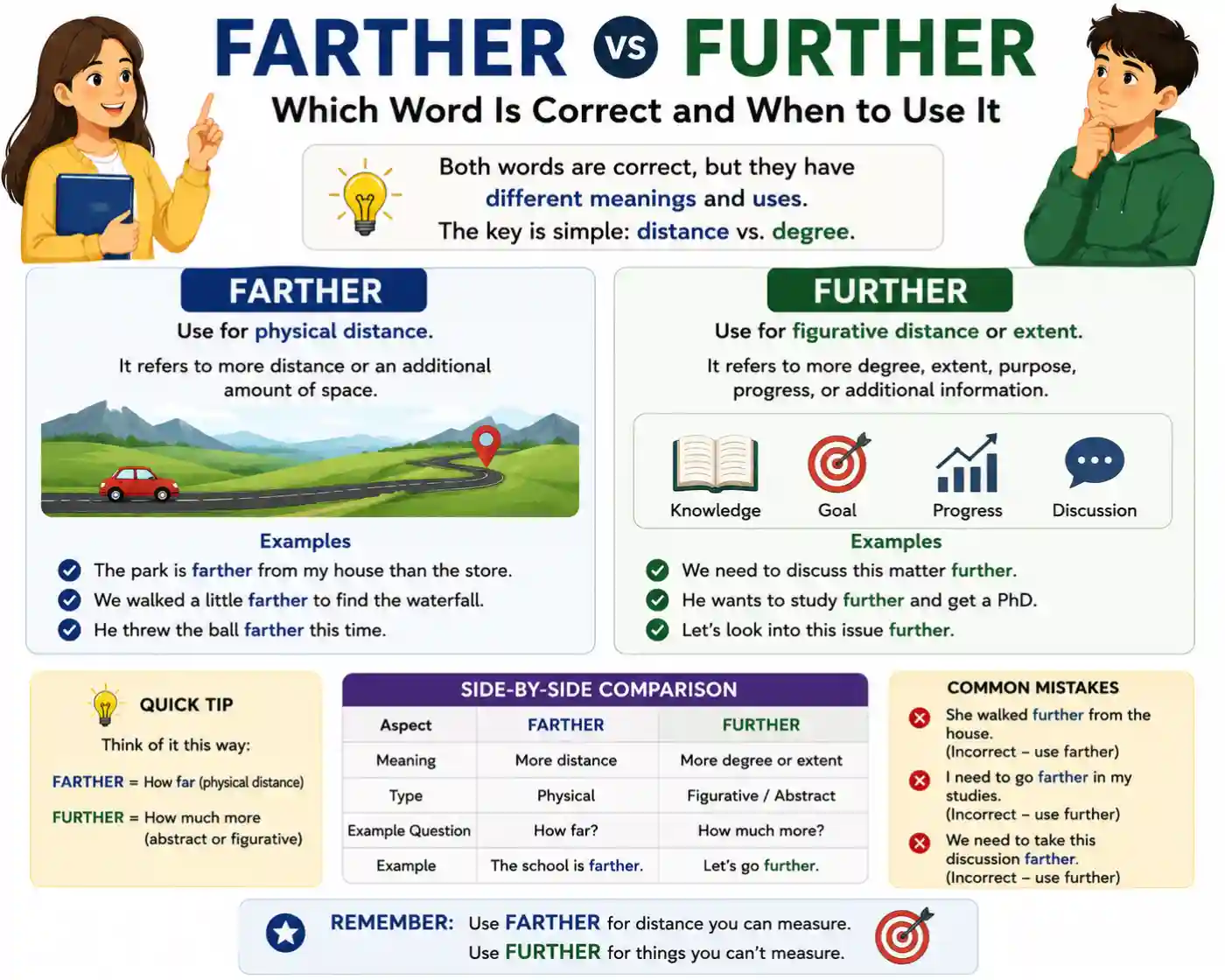
Farther vs Further is one of the most common grammar questions in English because these two words look alike, sound almost identical, and have closely related meanings. If you’ve ever stopped while writing to decide which one is correct, you’re certainly not the only one. Many students, professionals, and native English speakers mix them up.
The good news is that choosing the right word is easier than it seems. In most situations, farther refers to measurable physical distance, while further refers to abstract ideas, additional information, progress, time, or continued actions. Learning this simple distinction can make your writing more accurate and easier to understand.
Although modern dictionaries now accept further in many situations involving physical distance, traditional grammar still recommends using farther for measurable distances and further for figurative meanings. Following this guideline adds clarity and precision, especially in academic, professional, and formal writing.
In this guide, you’ll learn the meanings of both words, the key grammar rules, the differences between their usage, real world examples, common mistakes, memory tricks, professional writing tips, and simple techniques to help you choose the correct word with confidence every time.
Short Answer
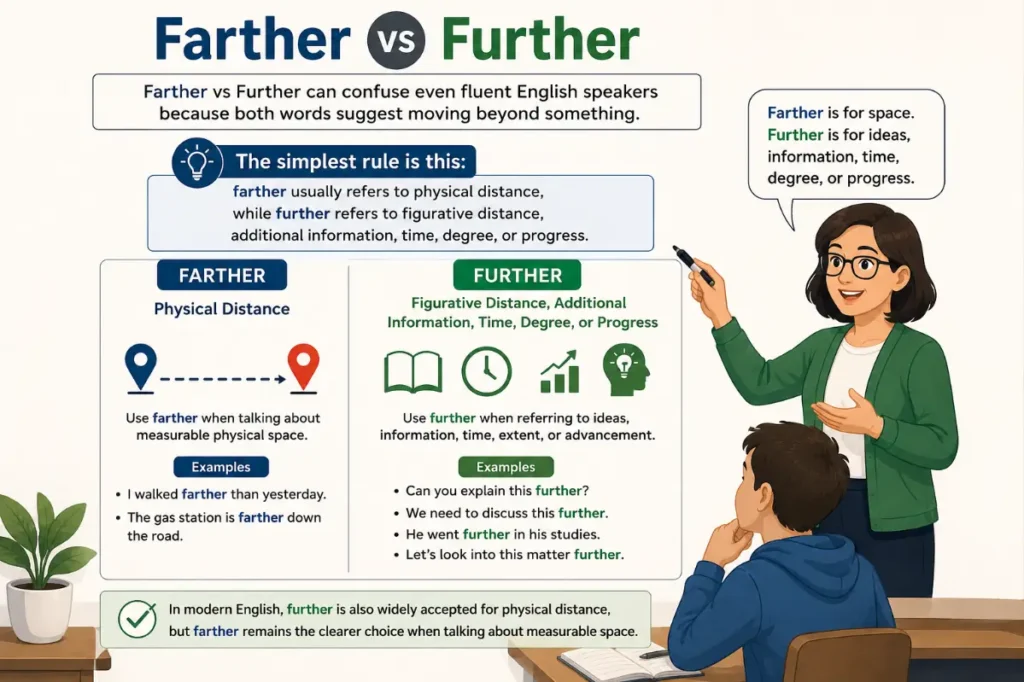
Farther vs Further can confuse even fluent English speakers because both words suggest moving beyond something. The simplest rule is this: farther usually refers to physical distance, while further refers to figurative distance, additional information, time, degree, or progress. In modern English, further is also widely accepted for physical distance, but farther remains the clearer choice when talking about measurable space.
Table of Contents
- What Do Farther and Further Mean
- Farther vs Further Comparison Table
- The Main Difference Between Farther and Further
- When to Use Farther
- When to Use Further
- Why People Confuse These Words
- Examples in Everyday English
- Examples in Professional Writing
- Common Mistakes
- Memory Tricks
- Writing Tips
What Do Farther and Further Mean
Although these words are closely related, they usually describe different kinds of distance.
What Does Farther Mean
Farther describes physical distance.
It answers questions like:
- How far is something?
- Which place is more distant?
- Can someone travel a greater distance?
Examples include roads, cities, buildings, parks, mountains, rivers, and any measurable location.
Example:
- The gas station is farther down the highway.
Explanation:
The highway represents measurable physical space, so farther is the traditional and preferred choice.
What Does Further Mean
Further usually refers to something nonphysical.
It often means:
- More
- Additional
- Extra
- Greater degree
- Later stage
- Continued progress
Examples include knowledge, education, discussion, research, investigation, planning, relationships, careers, and personal growth.
Example:
- We need further evidence before making a decision.
Explanation:
Evidence cannot be measured in miles, so further is correct.
Farther vs Further Comparison Table
| Feature | Farther | Further |
|---|---|---|
| Physical distance | Yes | Sometimes accepted |
| Figurative distance | No | Yes |
| Additional information | No | Yes |
| Progress | No | Yes |
| Time | No | Yes |
| Degree | No | Yes |
| Formal writing | Preferred for measurable distance | Preferred for abstract meanings |
| Everyday English | Common | Very common |
The Main Difference Between Farther and Further
The easiest way to remember the rule is to ask yourself one simple question.
Can I measure it in feet, meters, miles, or kilometers?
If the answer is yes, choose farther.
If the answer is no, choose further.
Examples:
- We walked farther than yesterday.
- She wants to further her education.
- The restaurant is farther from my house.
- We need further discussion before voting.
- Their cabin is farther into the forest.
- Further improvements are expected next year.
This single question solves most grammar problems involving these words.
Why People Confuse Farther and Further
Several reasons make these words difficult.
- They come from the same historical root.
- They sound almost identical.
- Their meanings overlap in modern English.
- Many native speakers use them interchangeably.
- Some dictionaries now accept further for physical distance.
Because language changes over time, strict grammar rules have become more flexible. Even so, professional editors still recommend using farther for measurable distance because it removes ambiguity.
When to Use Farther
Choose farther when discussing actual distance between physical places or objects.
Use it for:
- Walking distances
- Driving distances
- Running races
- Geographic locations
- Physical movement
- Travel routes
Examples
- We walked farther than we planned.
Explanation:
The walking distance can be measured.
- Their new house is farther from downtown.
Explanation:
The location has measurable distance.
- She threw the ball farther than anyone else.
Explanation:
The ball traveled through physical space.
- The airport is farther away than I expected.
Explanation:
The airport has a measurable location.
- The hikers climbed farther into the mountains.
Explanation:
The movement involves actual geography.
- My office is farther from the station than yours.
Explanation:
The distance between two locations can be measured.
- The dog ran farther than yesterday.
Explanation:
Running distance is measurable.
- The second island is farther offshore.
Explanation:
The location is physical.
Common Expressions Using Farther
Some everyday expressions naturally use farther.
Examples include:
- farther away
- farther down the road
- farther north
- farther south
- farther east
- farther west
- farther inland
- farther offshore
Example:
- The hotel is farther north than the museum.
Because directions describe physical space, farther fits perfectly.
When to Use Further
Use further when discussing ideas, actions, progress, or anything abstract.
Common situations include:
- Education
- Research
- Business
- Legal writing
- Medicine
- Technology
- Planning
- Communication
Examples
- We need further investigation.
Explanation:
An investigation is not physical distance.
- She wants further training.
Explanation:
Training represents additional learning.
- Further discussion is necessary.
Explanation:
Discussion involves ideas, not miles.
- Please contact us for further information.
Explanation:
Information cannot be measured physically.
- Scientists conducted further research.
Explanation:
Research represents additional work.
- The company announced further changes.
Explanation:
Changes are abstract.
- Further improvements are expected.
Explanation:
Improvements describe progress.
- We received further instructions this morning.
Explanation:
Instructions represent additional guidance.
Common Expressions Using Further
Many fixed expressions always use further.
Examples include:
- further information
- further research
- further education
- further action
- further notice
- further discussion
- further questions
- further development
- further assistance
- until further notice
Example:
- The office will remain closed until further notice.
Using farther here would sound incorrect.
Can Further Describe Physical Distance
Yes. Modern dictionaries and style guides generally accept further for physical distance.
Example:
- The cabin is further up the hill.
This sentence is grammatically acceptable.
However, many editors still prefer:
- The cabin is farther up the hill.
The second version immediately signals physical distance and follows the traditional distinction.
Which Choice Is Better
For everyday conversation, either word is usually understood.
For school assignments, business writing, journalism, academic papers, and professional communication, following the traditional distinction creates greater clarity.
Use this guideline.
- Physical distance = farther.
- Abstract ideas = further.
Real Life Examples
At School
Correct:
- Please read further before answering the question.
Explanation:
Reading continues beyond the current point.
Incorrect:
- Please read farther before answering.
The sentence is discussing progress through text, not physical movement.
During a Road Trip
Correct:
- We drove farther than expected.
Explanation:
Driving covers measurable distance.
Incorrect:
- We drove further than expected.
Although accepted by many dictionaries, farther is more precise.
At Work
Correct:
- We need further approval from management.
Explanation:
Approval is an abstract process.
During Research
Correct:
- The scientists completed further testing.
Explanation:
Testing represents additional work.
During Exercise
Correct:
- She ran farther than anyone else.
Explanation:
Running distance is measurable.
During a Meeting
Correct:
- Let’s discuss this further tomorrow.
Explanation:
The discussion continues rather than travels through space.
Farther and Further as Adverbs
Both words frequently function as adverbs.
Examples of farther as an adverb
- He walked farther.
- They traveled farther.
- The birds flew farther.
In each sentence, the adverb describes movement through physical space.
Examples of further as an adverb
- Please explain further.
- We investigated further.
- Think further before deciding.
Each sentence refers to additional thought, explanation, or progress rather than measurable distance.
Farther and Further as Adjectives
Both words can also describe nouns.
Examples of farther
- The farther shoreline looked beautiful.
- The farther mountain was covered with snow.
- The farther exit was closed.
Examples of further
- Further questions are welcome.
- Further evidence was presented.
- Further discussion will continue tomorrow.
- Further improvements are expected this year.
Notice that further commonly modifies abstract nouns, while farther modifies physical places and objects.
Using Further as a Verb
One unique feature of further is that it also functions as a verb. It means to advance, promote, or help something progress.
Examples
- She worked to further scientific research.
- The scholarship helped further his education.
- Volunteers furthered the organization’s mission.
- New technology will further innovation.
You cannot replace further with farther in these sentences because farther is never used as a verb.
Common Mistakes
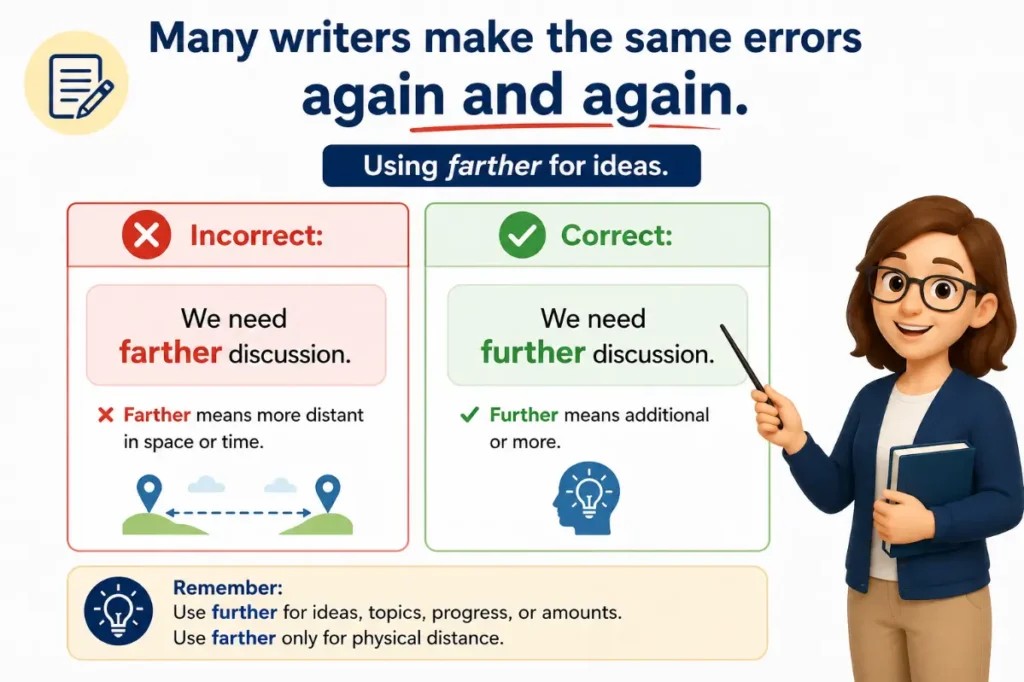
Many writers make the same errors again and again.
- Using farther for ideas.
Incorrect:
- We need farther discussion.
Correct:
- We need further discussion.
Reason:
Discussion is abstract.
- Using further as a verb incorrectly replaced with farther.
Incorrect:
- The grant will farther medical research.
Correct:
- The grant will further medical research.
Reason:
Only further functions as a verb.
- Assuming the words are always interchangeable.
Although many people use them interchangeably in conversation, choosing the more precise word makes your writing stronger.
Memory Tricks
Remember these simple techniques whenever you hesitate.
Trick One
Think of far inside farther.
It reminds you of far away places you can physically travel to.
Trick Two
Think of further as meaning more or additional.
If you can replace it with “more,” further is usually correct.
Example:
- We need further explanation.
Can you say:
- We need more explanation.
Yes.
Therefore, further is correct.
Trick Three
Ask yourself one question.
Can I measure this with a ruler, tape measure, miles, or kilometers?
- Yes → farther.
- No → further.
Professional Writing Tips
Professional editors often rely on consistency rather than flexibility.
Keep these habits in mind.
- Use farther for measurable distances.
- Use further for ideas, progress, discussions, and additional information.
- Remember that further can be a verb.
- Prefer the traditional distinction in formal documents.
- Stay consistent throughout your writing.
- When in doubt, ask if the distance is physical or figurative.
Following these practices helps your writing sound polished, accurate, and easy to understand.
Pronunciation
The pronunciation of these words is almost identical, which is another reason many people confuse them.
| Word | IPA | Simple Pronunciation |
|---|---|---|
| Farther | /ˈfɑrðər/ | FAR ther |
| Further | /ˈfɝːðər/ | FUR ther |
In many American accents, the difference is very subtle. Native speakers often rely on context rather than pronunciation to understand which word is intended.
Word Origin
Knowing where these words came from helps explain why they overlap.
Farther
Farther developed from the word far and has long been associated with measurable distance.
Over time, English speakers began using it almost exclusively for physical space.
Further
Further comes from an older Germanic root meaning to advance or to promote. That broader meaning explains why it works with ideas, progress, education, research, and development.
Today, further has more meanings than farther, making it the more versatile word.
Farther vs Further in American and British English
The traditional distinction exists in both American and British English, but actual usage varies.
American English
Many American style guides recommend this rule.
- Use farther for physical distance.
- Use further for figurative distance and additional ideas.
This approach is common in newspapers, schools, universities, and business writing.
British English
British writers also recognize the distinction, but further appears more frequently for both physical and figurative meanings.
For example:
- The village is further down the road.
Many British readers would consider this completely natural.
Even so, using farther for measurable distance is never considered wrong.
Farther vs Further in Formal Writing
If you’re writing for school, work, publishing, or professional communication, choosing the more precise word improves clarity.
Use farther in:
- Academic papers discussing geographic locations.
- Travel articles.
- Engineering reports involving measurements.
- Sports reporting.
- Navigation instructions.
Use further in:
- Business emails.
- Research papers.
- Legal documents.
- Medical writing.
- Technical documentation.
- Policy manuals.
- Marketing reports.
Example:
Correct:
- Further analysis is required before approval.
Correct:
- The emergency shelter is five miles farther north.
Each sentence clearly matches the traditional grammar rule.
Farther vs Further in Everyday Conversation
In casual conversation, many native speakers use further for nearly everything.
Examples:
- We walked further than expected.
- The store is further away.
- Drive further down the road.
Most listeners will understand these sentences without confusion.
However, careful writers still prefer farther for physical distance because it removes any possibility of misunderstanding.
Examples in Everyday Life
Traveling
- The next town is farther than we thought.
Explanation:
The distance can be measured on a map.
Education
- She plans to pursue further studies after graduation.
Explanation:
Education represents continued learning.
Business
- The manager requested further details.
Explanation:
Details are additional information.
Sports
- He kicked the ball farther than anyone else.
Explanation:
The ball traveled through physical space.
Healthcare
- Further testing confirmed the diagnosis.
Explanation:
Testing refers to additional medical evaluation.
Family
- Our grandparents live farther from the city now.
Explanation:
Their home has a measurable location.
Technology
- Engineers are conducting further experiments.
Explanation:
Experiments represent continued research.
Reading
- Please read further before making your decision.
Explanation:
The sentence refers to continuing through the text.
Examples in Literature and Journalism
Professional writers generally follow the traditional distinction because it creates precision.
Examples:
- The expedition traveled farther into the wilderness.
- Further negotiations are scheduled next week.
- Scientists need further evidence.
- The rescue team searched farther along the river.
- Further improvements are expected next year.
- The hikers moved farther uphill before sunset.
Notice that every sentence involving measurable distance uses farther, while every sentence involving ideas or progress uses further.
Common Phrases That Use Further
Many established English expressions always use further.
- Further information.
- Further action.
- Further investigation.
- Further education.
- Further notice.
- Further review.
- Further assistance.
- Further explanation.
- Further evidence.
- Further discussion.
- Further consideration.
- Further research.
- Further analysis.
- Further questions.
These expressions are so common that replacing further with farther would sound unnatural.
Common Phrases That Use Farther
Although fewer fixed expressions exist, these are common.
- Farther away.
- Farther north.
- Farther south.
- Farther east.
- Farther west.
- Farther inland.
- Farther offshore.
- Farther down the road.
- Farther along the trail.
- Farther from home.
Each expression refers to measurable physical distance.
Quick Test
Try choosing the correct word before checking the answer.
1. We need ______ information.
Answer:
Further
Reason:
Information is abstract.
2. The beach is ______ than the park.
Answer:
Farther
Reason:
The locations can be measured.
3. Scientists carried out ______ experiments.
Answer:
Further
Reason:
Experiments continue the research.
4. We hiked ______ than last weekend.
Answer:
Farther
Reason:
Hiking covers measurable distance.
5. Please explain ______.
Answer:
Further
Reason:
The explanation continues.
6. Their cabin is ______ into the forest.
Answer:
Farther
Reason:
The cabin’s location is physical.
7. We need ______ approval.
Answer:
Further
Reason:
Approval is not physical distance.
8. She threw the javelin ______ than the other athletes.
Answer:
Farther
Reason:
The throw traveled through measurable space.
Related Grammar Notes
Learning similar word pairs helps strengthen your understanding of English usage.
Some commonly confused pairs include:
- Affect vs Effect.
- Advice vs Advise.
- Lay vs Lie.
- Then vs Than.
- Less vs Fewer.
- Who vs Whom.
- Its vs It’s.
- Among vs Between.
- Toward vs Towards.
- Beside vs Besides.
These pairs often confuse writers because the words are similar in spelling or pronunciation but have different meanings or grammatical roles.
People Also Ask
Is farther or further more correct?
Both are correct. Farther is traditionally used for physical distance, while further is used for abstract ideas, additional information, progress, and continued actions.
Can I always use further?
In modern English, further is accepted for many situations, including physical distance. However, using farther for measurable distance creates clearer and more precise writing.
Why do dictionaries allow both?
Language changes over time. Because speakers increasingly used further in place of farther, dictionaries began recognizing that broader usage while still noting the traditional distinction.
Is farther becoming less common?
Not exactly. It remains widely used in education, journalism, editing, and professional writing whenever physical distance is involved.
Which word should students use?
Students should follow the traditional rule because it demonstrates strong grammar and improves clarity.
Key Takeaways
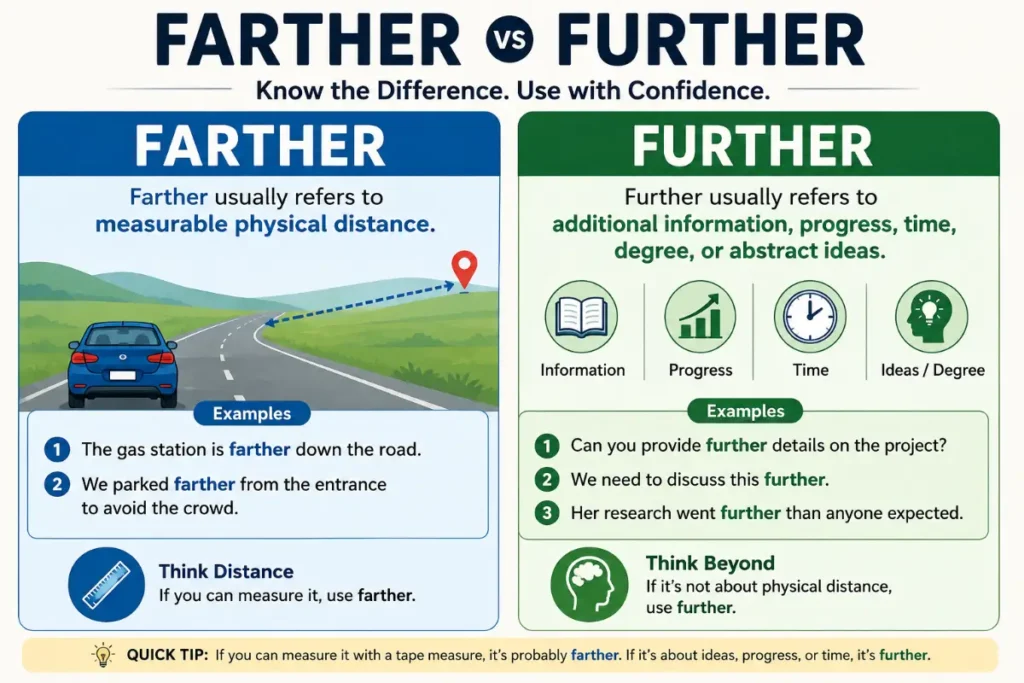
- Farther usually refers to measurable physical distance.
- Further usually refers to additional information, progress, time, degree, or abstract ideas.
- Further can also function as a verb meaning to promote or advance.
- Modern English accepts further for physical distance, but farther remains the clearer choice.
- Following the traditional distinction makes academic and professional writing more precise.
- Asking “Can I measure it?” is the easiest way to choose the correct word.
- Many fixed expressions, such as further information and until further notice, always use further.
Conclusion
Understanding Farther vs Further becomes much easier once you focus on the type of distance being described. If you’re talking about measurable physical space, farther is the traditional and most precise choice. If you’re referring to additional information, progress, time, degree, or abstract ideas, further is the correct word.
Modern English allows some overlap, especially with further describing physical distance. Even so, following the traditional distinction helps your writing stay clear, polished, and professional. When you’re unsure, ask yourself one simple question: Can I measure it in miles or feet? If the answer is yes, use farther. If the answer is no, use further. That small habit will help you choose the right word with confidence every time.
Frequently Asked Questions
What is the easiest way to remember Farther vs Further?
Think of farther as relating to far places you can measure. Use further for ideas, progress, additional information, or continued actions.
Can farther and further be used interchangeably?
Sometimes. Many modern dictionaries accept further for physical distance, but farther remains the preferred choice when the distance is measurable.
Which word is better for formal writing?
Use farther for physical distance and further for abstract meanings. This distinction is widely recommended in academic and professional writing.
Is further more common than farther?
Yes. Further appears more often because it has several meanings and can function as an adjective, adverb, and verb.
Can farther be used as a verb?
No. Only further can be used as a verb, meaning to promote, advance, or help something develop.
Why do many people mix up these words?
They have similar spellings, nearly identical pronunciations, related histories, and overlapping meanings in modern English.
Do American and British English follow the same rule?
Both recognize the traditional distinction. However, British English more commonly uses further for physical distance than American English does.
Is it wrong to say “further down the road”?
No. Many native speakers use this phrase naturally. Still, farther down the road is more precise if you are referring to actual physical distance.
Which word should I use in business emails?
Use further because business communication usually refers to additional information, discussion, assistance, approval, or action rather than measurable distance.
Which word appears more often in dictionaries?
Both are standard English words, but further has more definitions and broader usage, making it the more versatile term.

Confusing Words, Spelling & Word Choice
Claire Whitmore is a U.S.-based English editor who writes about commonly confused words, spelling differences, and word choice. Her work helps readers understand subtle distinctions between similar-looking words through simple definitions, practical examples, and modern usage guidance in both American and British English.