

Affect vs Effect is one of the most common grammar questions in English. Even experienced writers, students, and professionals sometimes stop for a moment before choosing the right word. Since the two words look and sound similar, they are easy to confuse.
The good news is that the difference is much simpler than many people think. In most situations, affect is an action, while effect is the result of that action. Learning this basic rule will help you write with more confidence in emails, essays, business documents, academic papers, and everyday conversations.
This guide explains everything you need to know. You will learn the meanings, grammar rules, pronunciation, differences, exceptions, memory tricks, real life examples, common mistakes, and professional writing tips. By the end, you will know exactly when to use each word without second guessing yourself.
Short Answer
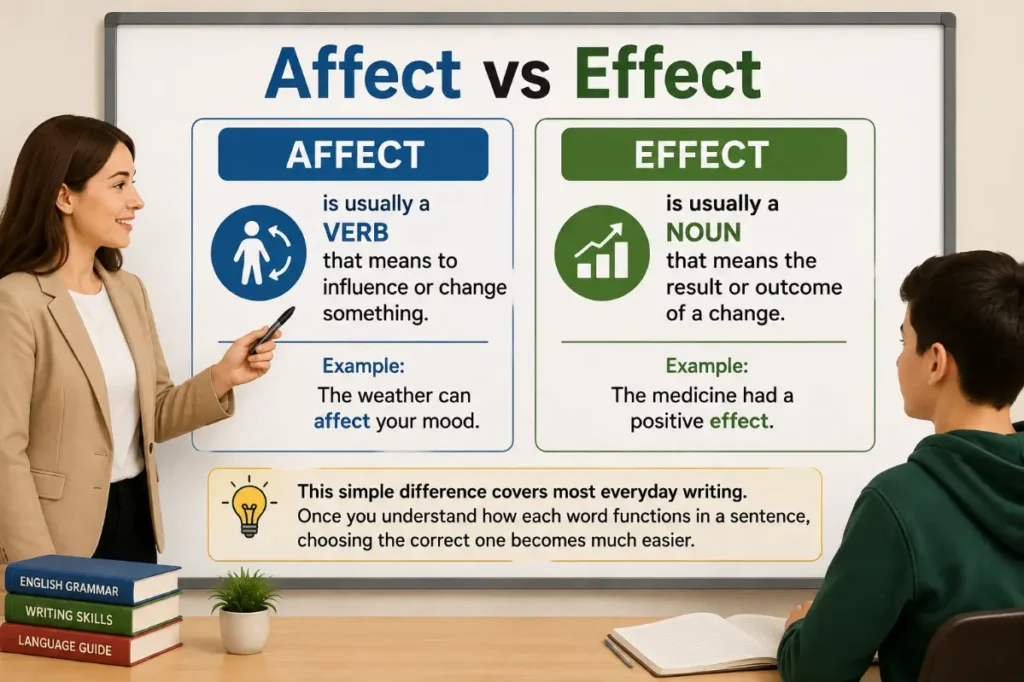
Affect is usually a verb that means to influence or change something. Effect is usually a noun that means the result or outcome of a change. This simple difference covers most everyday writing. Once you understand how each word functions in a sentence, choosing the correct one becomes much easier.
Table of Contents
- What Does Affect Mean
- What Does Effect Mean
- Affect vs Effect Comparison Table
- The Main Difference Between Affect and Effect
- When to Use Affect
- When to Use Effect
- Affect vs Effect in Different Types of Writing
- Common Mistakes and How to Avoid Them
- Easy Memory Tricks
- Special Grammar Exceptions
- Professional Writing Tips
- Frequently Asked Questions
- Key Takeaways
- Conclusion
What Does Affect Mean
Affect is most commonly used as a verb. It means to influence, change, alter, or have an impact on someone or something. Think of affect as an action. Something happens that changes another thing in some way.
Definition
Affect (verb): To influence or produce a change in something.
Pronunciation
Affect
Pronounced as:
uh FEKT
The stress falls on the second syllable.
Simple Meaning
If one thing changes another thing, it affects it.
Examples
The weather affected our vacation plans.
Explanation: Bad weather caused the plans to change.
Stress can affect your sleep.
Explanation: Stress influences how well you sleep.
Regular exercise affects your overall health.
Explanation: Exercise has an influence on your health.
The new law affected thousands of businesses.
Explanation: The law changed how those businesses operate.
Your attitude affects your performance at work.
Explanation: Your attitude influences how well you perform.
Notice that every sentence describes an action or influence instead of a final result.
What Does Effect Mean
Effect is most commonly used as a noun. It refers to the result, consequence, or outcome of an action. If affect is the action, effect is what happens because of that action.
Definition
Effect (noun): A result produced by a cause.
Pronunciation
Effect
Pronounced as:
ih FEKT
Like affect, the stress falls on the second syllable.
Simple Meaning
An effect is the result you can see after something happens.
Examples
The medicine had an immediate effect.
Explanation: The medicine produced a noticeable result.
One effect of exercise is better heart health.
Explanation: Better heart health is the result of exercising.
The new policy had little effect on sales.
Explanation: Sales did not change much as a result of the policy.
The heavy rain had a positive effect on local farms.
Explanation: Farms benefited because of the rainfall.
The advertisement had a strong effect on customer behavior.
Explanation: Customers changed their buying habits because of the advertisement.
Every example focuses on a result instead of an action.
Affect vs Effect Comparison Table
| Feature | Affect | Effect |
|---|---|---|
| Part of speech | Usually a verb | Usually a noun |
| Basic meaning | To influence | The result of something |
| Answers the question | What changed it | What happened because of it |
| Focus | Action | Result |
| Common use | Everyday writing | Everyday writing |
| Example | The speech affected everyone. | The speech had a lasting effect. |
This table covers the rule that applies in most situations.
The Main Difference Between Affect and Effect
The easiest way to remember Affect vs Effect is to ask yourself a simple question. Is the sentence talking about an action that changes something? If yes, use affect. Is the sentence talking about the result of that action? If yes, use effect. Look at these pairs. The cold weather affected the crops. The cold weather changed the crops. The effect of the cold weather was severe. The severe damage was the result.
A Simple Formula to Remember
Many grammar experts teach this pattern because it works in nearly every situation.
Affect = Action
Effect = End Result
You can also think of it like this.
Someone affects something.
Something has an effect.
Examples.
The teacher affected the students’ confidence.
The students gained confidence as an effect of the teacher’s encouragement.
The drought affected food production.
Higher food prices were one effect of the drought.
Technology affects how we communicate.
Faster communication is one positive effect of technology.
This simple pattern will help you choose the correct word in most writing situations.
When to Use Affect
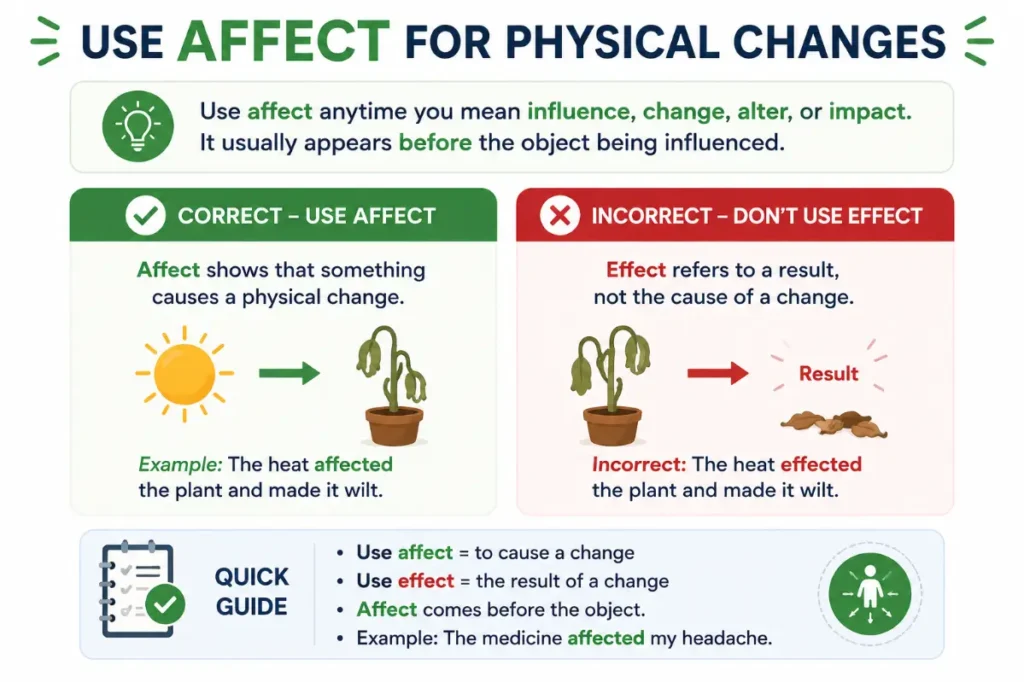
Use affect anytime you mean influence, change, alter, or impact. It usually appears before the object being influenced.
Use Affect for Physical Changes
The heat affected the paint.
Explanation: The heat changed the paint.
The storm affected power lines across the city.
Explanation: The storm caused damage to the power lines.
Use Affect for Emotions
His words affected her deeply.
Explanation: His words changed her feelings.
The movie affected everyone in the audience.
Explanation: The movie influenced their emotions.
Use Affect for Health
Smoking affects your lungs.
Explanation: Smoking changes how your lungs function.
A healthy diet affects your energy levels.
Explanation: Good nutrition influences your energy.
Use Affect for Education
Attendance affects academic performance.
Explanation: Going to class influences grades.
Reading every day affects vocabulary growth.
Explanation: Reading improves vocabulary over time.
Use Affect for Business
Interest rates affect borrowing costs.
Explanation: Rate changes influence loan prices.
Customer reviews affect purchasing decisions.
Explanation: Reviews influence what people buy.
Use Affect for Nature
Climate change affects wildlife habitats.
Explanation: Habitats change because of climate conditions.
Pollution affects air quality.
Explanation: Pollution changes the quality of the air.
Across all these examples, affect always expresses influence or change. It tells readers that one thing is acting on another.
Common Sentence Patterns With Affect
Recognizing common patterns makes choosing the correct word much easier. Subject plus affect plus object. The news affected everyone. Exercise affects mental health. High prices affect consumers. Weather affects travel. Loud music affects concentration. You can replace affect with influence in most of these sentences without changing the meaning. The news influenced everyone. Exercise influences mental health. If that replacement sounds natural, affect is almost certainly the correct choice.
Affect in Different Verb Tenses
Because affect is a verb, it changes form like other verbs.
Present Tense
The weather affects traffic every morning.
Past Tense
The accident affected several families.
Future Tense
The decision will affect our budget next year.
Present Perfect
The new software has affected productivity.
Present Continuous
The construction is affecting local businesses. Seeing affect in different tenses helps you recognize that it behaves just like other action verbs such as improve, influence, or change.
When to Use Effect
Use effect when you are talking about the result, consequence, or outcome of an action. In most sentences, effect is a noun, meaning it names something rather than describes an action.
Ask yourself this question:
Is this the result of something that already happened?
If the answer is yes, effect is usually the correct choice.
Use Effect for Results
The new policy had a positive effect on employee morale.
Explanation: Better morale was the result of the policy.
The rain had little effect on the outdoor event.
Explanation: The event did not change much because of the rain.
The medicine produced an immediate effect.
Explanation: The medicine quickly created a result.
Use Effect for Consequences
One effect of poor planning is missed deadlines.
Explanation: Missed deadlines are the consequence of poor planning.
The earthquake had devastating effects on nearby towns.
Explanation: The damage was the result of the earthquake.
The teacher’s encouragement had a lasting effect on her students.
Explanation: Greater confidence was the outcome of the encouragement.
Use Effect in Science
Scientists often discuss cause and effect.
Explanation: One event causes another event.
The greenhouse effect helps keep Earth warm.
Explanation: This is the name of a natural scientific process.
The placebo effect can influence how patients feel.
Explanation: This is the observed result of believing a treatment will work.
Use Effect in Business
The price increase had little effect on demand.
Explanation: Customer demand did not change much.
The marketing campaign had a significant effect on sales.
Explanation: Sales improved because of the campaign.
The new software had an immediate effect on productivity.
Explanation: Productivity increased as a result of the software.
Common Sentence Patterns With Effect
Certain sentence structures appear repeatedly in English. Recognizing them makes choosing effect much easier.
Have an Effect
The new law had an effect on small businesses. Exercise has a positive effect on mental health. Sleep has a direct effect on memory.
The Effect Of
The effect of pollution is easy to see.
Cause and Effect
Teachers often explain cause and effect. Researchers study cause and effect relationships. Children learn cause and effect from everyday experiences. Whenever you see these patterns, effect is almost always the correct choice.
Affect vs Effect in Everyday Situations
Many writers understand the rule but become confused in real sentences. Looking at common situations makes the difference much clearer.
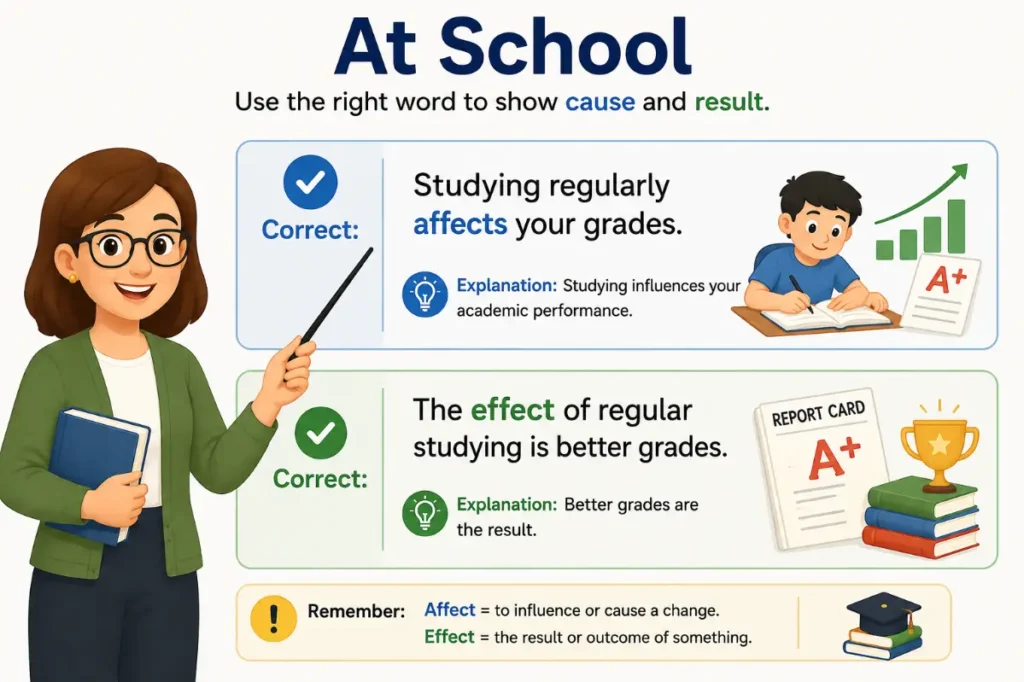
At School
Correct:
Studying regularly affects your grades.
Explanation: Studying influences your academic performance.
Correct:
The effect of regular studying is better grades.
Explanation: Better grades are the result.
At Work
Correct:
Poor communication affects teamwork.
Explanation: Communication influences how people work together.
Correct:
One effect of poor communication is lower productivity.
Explanation: Lower productivity is the outcome.
In Health
Correct:
Exercise affects your heart health.
Explanation: Exercise influences your body.
Correct:
A positive effect of exercise is improved endurance.
Explanation: Improved endurance is the result.
In Finance
Correct:
Inflation affects consumer spending.
Explanation: Inflation changes spending habits.
Correct:
One effect of inflation is higher prices.
Explanation: Higher prices are the consequence.
In Technology
Correct:
Artificial intelligence affects many industries.
Explanation: AI influences how industries operate.
Correct:
One effect of automation is increased efficiency.
Explanation: Greater efficiency is the result.
Side by Side Examples
These sentence pairs show how the meaning changes.
| Affect | Effect |
|---|---|
| The storm affected traffic. | The effect of the storm was heavy traffic delays. |
| Lack of sleep affects memory. | One effect of lack of sleep is poor memory. |
| The decision affected everyone. | The decision had a lasting effect on the company. |
| Heat affects metal. | Heat has a noticeable effect on metal. |
| Social media affects communication. | One effect of social media is faster communication. |
| High taxes affect businesses. | The effect was slower economic growth. |
| Noise affects concentration. | The effect of noise is reduced focus. |
| Exercise affects mood. | A positive effect is reduced stress. |
Notice the pattern.
Affect describes the influence.
Effect describes what happened afterward.
Common Mistakes People Make
These two words cause confusion because they share similar spelling and pronunciation. Here are the mistakes people make most often.
Mistake One
Incorrect:
The weather had a bad affect on travel.
Correct:
The weather had a bad effect on travel.
Why?
The sentence talks about a result.
Mistake Two
Incorrect:
The teacher effected the students positively.
Correct:
The teacher affected the students positively.
Why?
The teacher influenced the students.
Mistake Three
Incorrect:
This medicine will effect your sleep.
Correct:
This medicine will affect your sleep.
Why?
The medicine changes your sleep.
Mistake Four
Incorrect:
The affect was immediate.
Correct:
The effect was immediate.
Why?
The sentence names a result.
Mistake Five
Incorrect:
Stress has many affects.
Correct:
Stress has many effects.
Why?
Effects means results.
A Quick Self Check
Before choosing the word, ask yourself these questions.
- Am I talking about influencing something?
Use affect.
- Am I talking about a result?
Use effect.
- Can I replace the word with influence?
If yes, choose affect.
- Can I replace the word with result?
If yes, choose effect.
This simple habit helps eliminate most mistakes.
Easy Memory Tricks
Many students remember Affect vs Effect using simple mental shortcuts.
Trick One
A in Affect stands for Action. Affect is usually something that changes another thing.
Trick Two
E in Effect stands for End Result. Effect is what happens after the action.
Trick Three
Think about a domino chain. The first domino affects the next domino. The final effect is that every domino falls.
Trick Four
Imagine throwing a stone into a lake. Throwing the stone affects the water. The ripples are the effect.
Trick Five
Remember this sentence.
Actions affect.
Results are effects.
Many English teachers recommend this because it is short, memorable, and accurate.
Cause and Effect
One of the most common phrases in English is cause and effect. A cause is the reason something happens. An effect is the result.
For example:
Cause:
Heavy snowfall.
Effect:
Schools closed for two days.
Cause:
Regular exercise.
Effect:
Better physical fitness.
Cause:
Poor customer service.
Effect:
Negative online reviews.
Understanding this relationship makes the difference between affect and effect much easier.
Affect vs Effect in Academic Writing
Teachers, researchers, and students use these words frequently. Academic writing often explains relationships between ideas.
Examples:
Climate change affects ecosystems around the world.
The long term effects of climate change include rising sea levels.
Education affects earning potential.
One effect of higher education is increased career opportunities.
Researchers carefully choose these words because they describe different parts of the same process.
Affect vs Effect in Business Writing
Professional documents often discuss performance, productivity, finance, and customer behavior.
Examples:
The policy affected employee satisfaction.
Its effect was higher retention.
Economic conditions affect investment decisions.
The overall effect was slower market growth.
Using the correct word improves credibility and makes reports easier to understand.
Affect vs Effect in News Writing
Journalists regularly report causes and results.
Examples:
The storm affected thousands of homes.
The effect was widespread flooding.
The announcement affected stock prices.
The immediate effect was increased investor confidence.
Notice how both words often appear in the same news story because reporters describe both the influence and its outcome.
Special Grammar Exceptions
The rule that affect is a verb and effect is a noun works in the vast majority of sentences. However, English has a few exceptions. Knowing them will help you understand formal writing, academic texts, and professional documents.
Effect as a Verb
Although uncommon, effect can be used as a verb. In this case, it means to bring about, accomplish, or cause something to happen. This usage appears mainly in legal, governmental, business, and formal writing.
Examples
The company hopes to effect major organizational changes.
Explanation: The company wants to bring about those changes.
The agreement effected significant reforms.
Explanation: The agreement caused the reforms to happen.
The new policy will effect lasting improvements.
Explanation: The policy will produce those improvements.
In everyday conversation, people usually replace effect with words like create, bring about, cause, or produce.
Affect as a Noun
The noun affect is much less common. It is primarily used in psychology and psychiatry. Here, affect refers to a person’s observable emotional expression or emotional state.
Examples
The patient displayed a flat affect.
Explanation: The patient showed very little outward emotion.
The doctor observed a cheerful affect during the interview.
Explanation: The patient’s visible emotional expression appeared cheerful.
Unless you work in medicine or psychology, you are unlikely to use this meaning.
Formal and Informal Usage
The basic rule remains the same in both formal and informal English.
Informal English
The weather affected our trip. The effect was disappointing.
Business English
Economic conditions affect hiring decisions. The overall effect was reduced spending.
Academic English
Social media affects communication patterns. Researchers measured the long term effects of online learning.
Legal English
The new regulation will effect substantial reforms. This formal verb use is correct but uncommon outside legal and governmental writing.
American and British English
There is no difference between American English and British English when using affect and effect.
Both varieties follow the same grammar rules.
American English
The decision affected sales.
The effect was immediate.
British English
The decision affected sales.
The effect was immediate.
The spelling, pronunciation, and meanings remain the same.
Pronunciation Guide
Although the two words are pronounced similarly, their first vowel sounds differ slightly.
| Word | Pronunciation | Simple Guide |
|---|---|---|
| Affect | uh FEKT | Begins with a soft “uh” sound |
| Effect | ih FEKT | Begins with a short “ih” sound |
In fast speech, the difference can be subtle. That is one reason many people confuse the words in writing.
Word Origin
Learning where these words came from helps explain why they are closely related. Both words trace back to the Latin verb facere, meaning to make or to do. Over time, English developed two closely connected words. Affect came to describe acting upon something or influencing it. Effect came to describe what is produced after that influence. Even today, their historical connection explains why one word represents the action and the other represents the result.
Professional Writing Tips
Strong writers rarely guess which word to use. Instead, they check the role the word plays in the sentence.
Tip One
Identify the part of speech. If you need a verb, choose affect. If you need a noun, choose effect.
Tip Two
Replace the word mentally. If influence fits naturally, use affect. If result or outcome fits naturally, use effect.
Example:
The new schedule affected productivity.
You can replace affected with influenced.
The new schedule had a positive effect.
You can replace effect with result.
Tip Three
Read the sentence aloud. Many mistakes become obvious when you hear the sentence rather than simply reading it silently.
Tip Four
Look for common phrases.
Certain expressions almost always use effect.
Examples include:
cause and effect
side effects
special effects
take effect
Common Expressions With Affect
These combinations appear frequently in everyday English. Affect performance Affect behavior Each phrase describes something being influenced.
Common Expressions With Effect
Many fixed expressions use effect because they describe results.
Side effect
Special effect
Sound effect
Greenhouse effect
Ripple effect
Domino effect
Cause and effect
Real Life Examples
Here are examples from everyday situations.
Family Life
Lack of sleep affects parents’ patience. One effect of better sleep is improved mood.
School
Homework affects exam preparation. A positive effect is greater confidence during tests.
Workplace
Leadership affects employee motivation. One effect of strong leadership is higher productivity.
Health
Stress affects blood pressure. One effect of regular exercise is improved heart health.
Technology
Online reviews affect buying decisions. One effect of positive reviews is increased sales.
Environment
Pollution affects rivers and lakes. A serious effect is declining water quality.
Sports
Practice affects athletic performance. One effect of consistent practice is better accuracy.
Travel
Weather affects flight schedules. The effect was several delayed departures. These examples reinforce the same pattern. Affect describes influence. Effect describes the outcome.
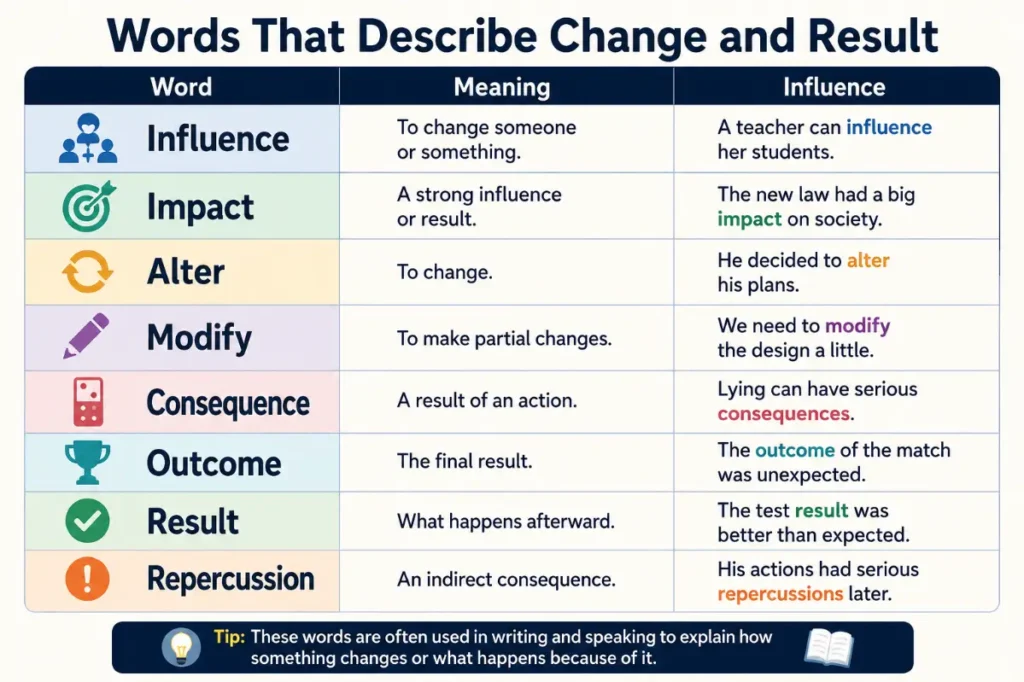
Related Words
Understanding similar words strengthens your vocabulary.
| Word | Meaning |
|---|---|
| Influence | To change someone or something |
| Impact | A strong influence or result |
| Alter | To change |
| Modify | To make partial changes |
| Consequence | A result of an action |
| Outcome | The final result |
| Result | What happens afterward |
| Repercussion | An indirect consequence |
These words often appear in articles discussing Affect vs Effect.
Key Takeaways
- Affect is usually a verb that means to influence or change.
- Effect is usually a noun that means the result or outcome.
- Think of Affect = Action.
- Think of Effect = End Result.
- If influence fits, choose affect.
- If result fits, choose effect.
- The exceptions are real but uncommon.
- The same rules apply in both American and British English.
- Learning common phrases like side effect and cause and effect makes correct usage much easier.
- With regular practice, choosing between the two becomes automatic.
Conclusion
Understanding Affect vs Effect becomes much easier once you focus on the role each word plays in a sentence. In everyday English, affect usually means to influence, making it a verb, while effect usually means the result, making it a noun. This simple distinction applies to the vast majority of situations you will encounter.
When you are unsure, pause and ask yourself a quick question. Are you describing an action that changes something, or are you describing the outcome of that change? If it is the action, choose affect. If it is the result, choose effect. You can also test your sentence by replacing affect with influence or effect with result. If the sentence still makes sense, you have likely chosen the correct word.
Although there are rare exceptions, they appear mainly in specialized fields such as law, business, psychology, and medicine. For everyday writing, mastering the basic rule is enough to improve your grammar and make your communication clearer.
Frequently Asked Questions
What is the main difference between Affect vs Effect?
The main difference is that affect is usually a verb meaning to influence, while effect is usually a noun meaning the result of that influence.
Is affect always a verb?
No. Affect can be a noun in psychology, where it refers to a person’s visible emotional expression. Outside that field, it is almost always used as a verb.
Can effect be used as a verb?
Yes. In formal English, effect can mean to bring about or to cause something to happen. This usage is common in legal and business writing but uncommon in everyday conversation.
How can I remember Affect vs Effect?
Remember Affect = Action and Effect = End Result. This simple memory trick works for most situations.
Which word should I use in the sentence “The weather ___ my plans”?
Use affected because the weather influenced your plans.
Correct sentence:
The weather affected my plans.
Which word should I use after “have an”?
Use effect.
Examples:
The change had an effect.
The medicine had an immediate effect.
Is “side affect” correct?
No. The correct phrase is side effect because it refers to a result.
Do Americans and British people use these words differently?
No. Both American and British English follow the same grammar rules for affect and effect.
Why do so many people confuse Affect vs Effect?
The words have similar spelling, similar pronunciation, and closely related meanings. The confusion disappears once you remember that affect usually describes the action and effect usually describes the result.
Can both words appear in the same sentence?
Yes. They often do.
Example:
The new policy affected employee morale, and its effect was higher productivity.

English Grammar & Usage
Nathan Holloway is an American grammar writer and language researcher who specializes in English grammar, sentence structure, verb usage, and common writing mistakes. He enjoys breaking down confusing grammar rules into practical explanations with clear examples, making English easier for students, professionals, and everyday writers.