
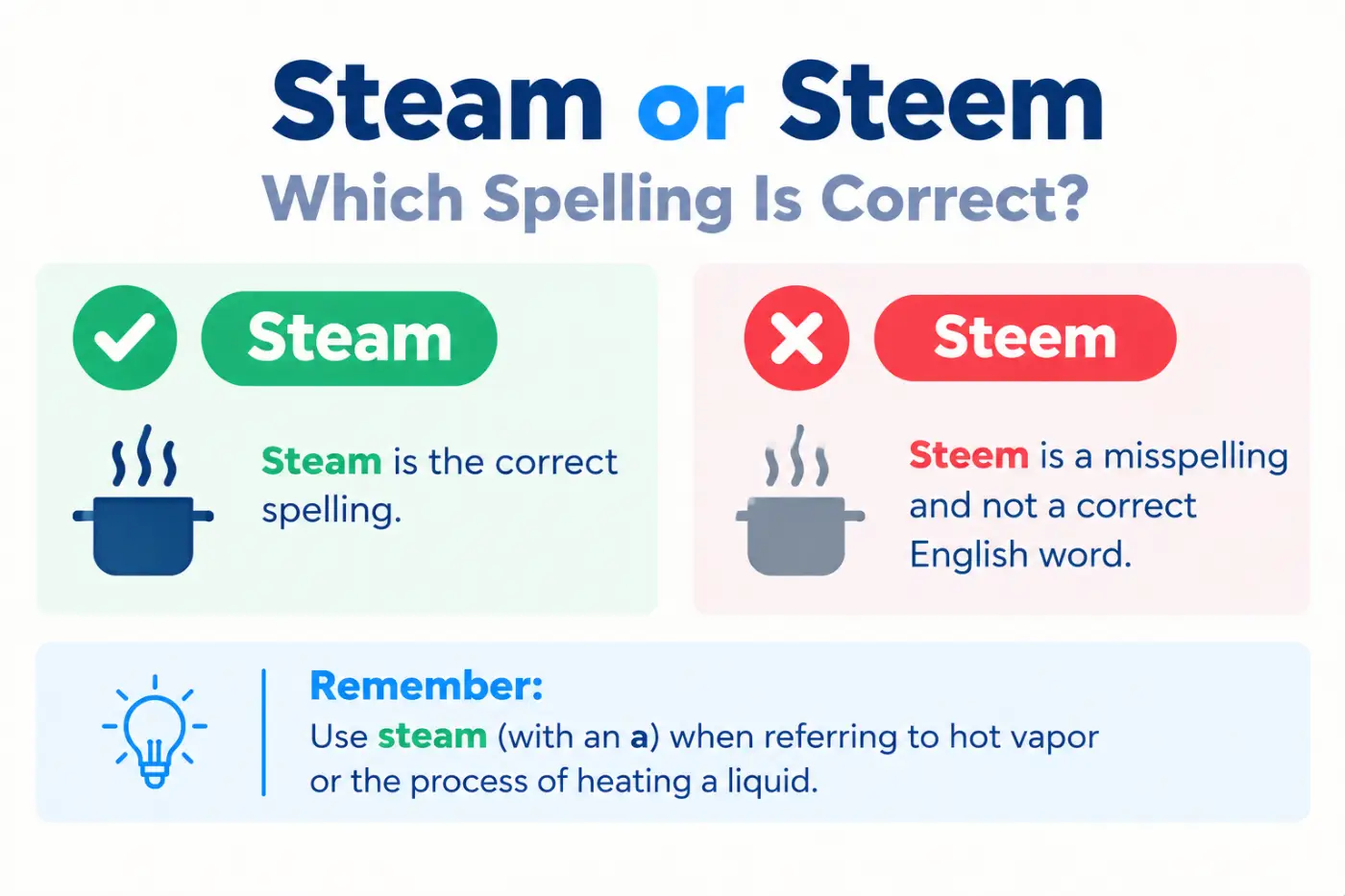
Steam or steem is a spelling question that often confuses English learners and writers because both forms sound alike in ordinary pronunciation. However, only one is the standard spelling of the familiar English word for the vapor associated with boiling water. That word is steam.
The word steam has several uses beyond its literal meaning. People talk about steam rising from a hot cup of coffee, steam powering an engine, and someone letting off steam after a frustrating day. These expressions appear in everyday conversations, books, news reports, and professional writing.
Understanding the difference helps you avoid spelling errors and choose the right word in context. Once you learn what steam means, how to use it, and why steem is generally incorrect in ordinary writing, you’ll find the distinction easy to remember.
Short Answer
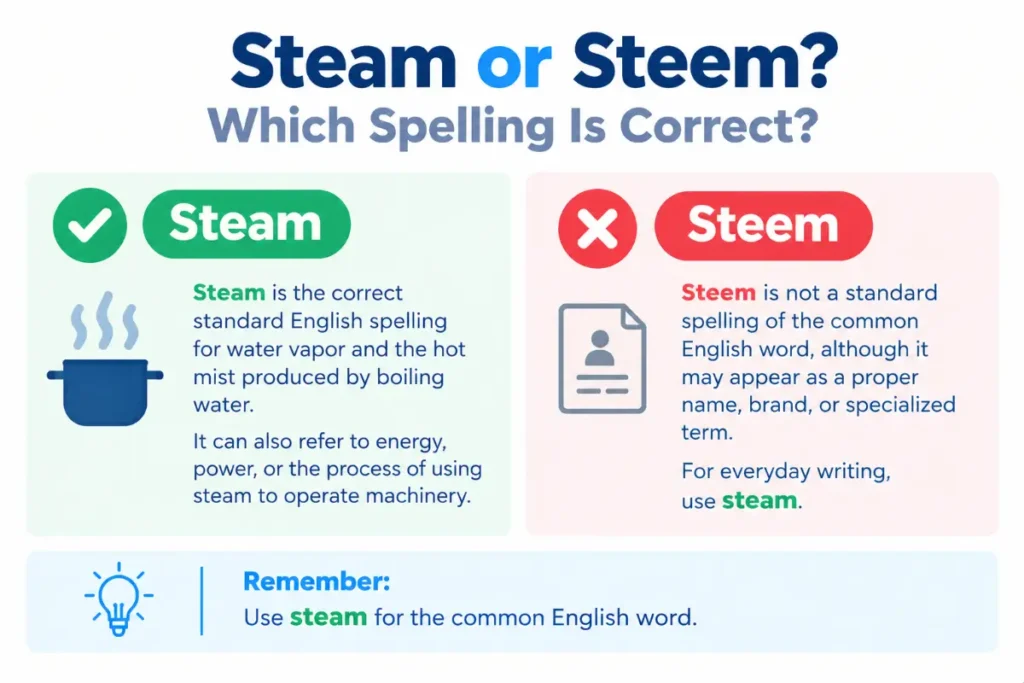
Steam is the correct standard English spelling for water vapor and the hot mist produced by boiling water. It can also refer to energy, power, or the process of using steam to operate machinery. Steem is not a standard spelling of the common English word, although it may appear as a proper name, brand, or specialized term. For everyday writing, use steam.
Table of Contents
- What Is the Correct Spelling.
- What Does Steam Mean.
- What Does Steem Mean.
- The Difference Between Steam and Steem.
- How to Use Steam in a Sentence.
- Real Life Examples of Steam.
- Common Spelling Mistakes.
- Why People Confuse These Words.
- Easy Ways to Remember the Correct Spelling.
- Pronunciation and Word Origin.
- American and British English Usage.
- Related Words and Expressions.
- Frequently Asked Questions.
- Key Takeaways.
- Conclusion.
What Is the Correct Spelling
Steam is the correct spelling of the common English word. It refers to water vapor, the vapor produced when water is heated, or energy associated with steam powered machinery.
For example, you might write, The steam from the kettle fogged up the kitchen window. In this sentence, steam describes the hot vapor coming from the kettle.
Steem is generally a misspelling when someone intends to use the ordinary word steam. However, the spelling may appear in proper names, business names, usernames, or specialized contexts. Its presence in a name does not make it a standard alternative spelling of the common noun.
Here is the simplest rule to follow.
- Use steam when writing about water vapor, steam engines, cooking, or familiar expressions involving energy and momentum.
- Avoid steem when you intend to use the ordinary English word.
- Preserve Steem or steem when it is the verified spelling of a particular name, product, or specialized term.
This distinction is useful for school assignments, workplace communication, online articles, emails, and everyday writing.
What Does Steam Mean
Steam is a noun and a verb. Its meaning depends on how you use it in a sentence.
Steam as a Noun
As a noun, steam commonly refers to water in its gaseous form or to the visible vapor associated with hot water.
For example, The steam rising from the soup made the kitchen smell wonderful.
Here, steam refers to the hot vapor rising from the soup. The sentence uses the word in its literal sense.
Steam can also refer to energy, force, or the power needed to keep something moving. This meaning often appears in expressions about progress, motivation, and productivity.
For example, The project gained steam after the team hired an experienced manager.
In this sentence, gained steam means that the project began progressing more quickly and attracting more attention. The word describes growing momentum rather than actual water vapor.
Steam as a Verb
As a verb, steam can describe the process of producing or releasing steam. It can also refer to cooking food with steam or treating something with steam.
For example, We steam the vegetables to keep them tender.
Here, steam means to cook the vegetables using hot water vapor. It describes an action rather than a physical substance.
The verb also appears in sentences about cleaning, pressing clothes, and removing wrinkles.
For example, I need to steam my shirt before the interview.
In this sentence, steam means to use a steam producing appliance to remove wrinkles from the shirt.
Steam as an Expression of Anger
Steam can also describe strong frustration or anger. This meaning appears in the expression steam coming out of someone’s ears.
For example, My brother was so angry about the broken computer that he looked like he had steam coming out of his ears.
The sentence uses an exaggerated image to show how angry the brother felt. No actual steam needs to be present.
Another common expression is let off steam. It means to release tension or frustration through an activity or conversation.
For example, She went for a long walk to let off steam after a difficult day.
Here, letting off steam means reducing stress and frustration. The phrase is figurative rather than literal.
What Does Steem Mean
Steem is not the standard spelling of the everyday English word for water vapor. If you write about a boiling kettle, a steam engine, or steaming vegetables, you should use steam.
Still, the spelling steem can occur in specific contexts. A company, online platform, product, username, or other proper name may use those letters intentionally. In such cases, the correct spelling depends on the name itself.
This distinction matters because not every unfamiliar spelling is automatically a typo. Proper names can follow their own spelling conventions, even when they differ from standard English words.
Consider these examples.
1. Incorrect for the ordinary meaning. The steem from the kettle filled the room.
The sentence should use steam because it refers to vapor from hot water.
2. Correct for the ordinary meaning. The steam from the kettle filled the room.
The word correctly describes the vapor rising from the kettle.
3. Potentially correct as a name. The company uses Steem as its official brand name.
In this sentence, Steem is a proper name. Its spelling should follow the organization’s official usage.
When editing a sentence, consider its meaning before correcting the spelling. If the writer means hot water vapor, the correct choice is steam. If the writer refers to an actual name spelled Steem, preserve that spelling.
The Difference Between Steam and Steem
The main difference is standard spelling. Steam is the accepted everyday English word, while steem is not a standard alternative for the same meaning.
| Feature | Steam | Steem |
|---|---|---|
| Standard English word | Yes | No |
| Refers to water vapor | Yes | Not as a standard word |
| Used as a verb | Yes | Not in standard everyday usage |
| Common in idioms | Yes | No |
| Can appear as a name | Yes | Yes |
| Suitable for ordinary writing about vapor | Yes | No |
The difference becomes clearer when you examine how each spelling works in context.
For example, The steam from the shower set off the bathroom’s humidity sensor. The word steam correctly describes the vapor in the bathroom.
By contrast, The steem from the shower set off the bathroom’s humidity sensor contains a spelling error if the writer means water vapor. The intended meaning remains understandable, but the spelling is incorrect.
The two forms may sound alike, so pronunciation alone won’t help you choose between them. You need to remember the standard spelling and consider the meaning of the sentence.
How to Use Steam in a Sentence
The word steam works in many everyday situations. Learning its different uses will help you recognize the correct spelling naturally.
Steam in Everyday Life
People often use steam to describe vapor produced by hot water or hot food.
Example: Steam rose from the fresh coffee as I carried the mug to the table.
Explanation: Steam describes the visible vapor rising from the hot coffee.
Example: The bathroom mirror became cloudy because of the steam from the shower.
Explanation: The sentence connects steam with moisture and warm water vapor in the bathroom.
Example: Please be careful when opening the pot because the steam is very hot.
Explanation: Steam refers to hot vapor that can burn skin, so the sentence gives a practical safety warning.
Steam in Cooking
Steam is a common word in recipes and cooking instructions. It describes a method of cooking food with hot vapor rather than immersing it in water or frying it in oil.
Example: We steam broccoli for five minutes before serving it.
Explanation: Steam is a verb because it describes the cooking method.
Example: The recipe says to steam the dumplings until they’re fully cooked.
Explanation: The verb explains how the dumplings should be prepared.
Example: Steam the fish gently to keep it moist and tender.
Explanation: The sentence gives a cooking instruction and uses steam as an action word.
Steam in Technology and Industry
It has played a major role in transportation, manufacturing, and power generation. Steam engines use the energy associated with heated water vapor to produce mechanical movement.
Example: The old steam locomotive moved slowly across the countryside.
Explanation: Steam describes the type of locomotive and indicates that it uses steam power.
Example: The factory uses steam to help operate some of its equipment.
Explanation: Steam refers to a source of thermal energy used in industrial processes.
Example: Engineers inspected the steam pipes before starting the machinery.
Explanation: The word identifies pipes that carry steam through the industrial system.
Steam in Business and Daily Conversation
Steam also appears in figurative expressions. These expressions describe momentum, progress, frustration, or a loss of energy.
Example: The new restaurant is gaining steam in the local community.
Explanation: Gaining steam means becoming more popular or successful.
Example: Our sales campaign lost steam after the first week.
Explanation: Lost steam means the campaign lost momentum or became less effective.
Example: He took a short break to let off steam after a stressful meeting.
Explanation: Let off steam means to release frustration or tension.
These examples show why understanding the meaning of steam is more useful than memorizing its spelling alone. Once you recognize the word in different contexts, you’ll be less likely to replace it with an incorrect form.
Real Life Examples of Steam
The following examples demonstrate how the word works in common situations. Each sentence includes a short explanation to help you understand its meaning and grammatical role.
Examples From Home
1. Steam covered the kitchen window while the pasta boiled.
Steam is a noun describing the vapor produced during cooking.
2. I used a handheld steamer to remove wrinkles from my jacket.
The related noun steamer names a device that produces steam for a particular purpose.
3. The kettle began to steam after the water reached a boil.
Steam functions as a verb because it describes what the kettle began to do.
4. Hot steam escaped when Dad lifted the pressure cooker’s lid.
Steam is a noun identifying the hot vapor escaping from the cooker.
Examples From School
1. The science teacher explained how steam forms when water receives enough heat.
Steam refers to water in its gaseous state.
2. We learned how steam engines helped transform transportation.
Steam describes the technology used to power the engines.
3. The student wrote the word steam correctly on the spelling test.
Steam is the correct spelling being discussed.
4. Our experiment showed how heated water could produce steam.
Steam names the substance produced during the experiment.
Examples From Work
1. The marketing campaign gained steam after several positive reviews appeared online.
Gained steam is an expression meaning the campaign gained momentum.
2. The maintenance team checked the steam system before the factory opened.
Steam identifies the type of system being inspected.
3. The proposal lost steam when the project budget was reduced.
Lost steam means the proposal lost support or momentum.
4. We need to steam the uniforms before the presentation.
Steam is a verb describing the process of removing wrinkles.
Examples From Creative Writing
1. Steam curled above the cup like a thin ribbon in the morning light.
Steam is a noun, and the comparison creates a visual image of the vapor.
2. The old engine hissed and released clouds of steam.
Steam describes the vapor released by the engine.
3. Anger rose inside him until he felt ready to burst with steam.
Steam is used figuratively to suggest intense frustration.
4. The story gained steam as the mystery became more complicated.
Gained steam means the story became more engaging or exciting.
In all these examples, steam is the standard spelling for the ordinary word. The context changes its meaning, but the spelling stays the same.
Common Spelling Mistakes
Spelling mistakes often happen when writers rely on sound instead of remembering the conventional written form. Since steam and steem can sound alike, it helps to learn the situations that lead to errors.
Using Steem for Water Vapor
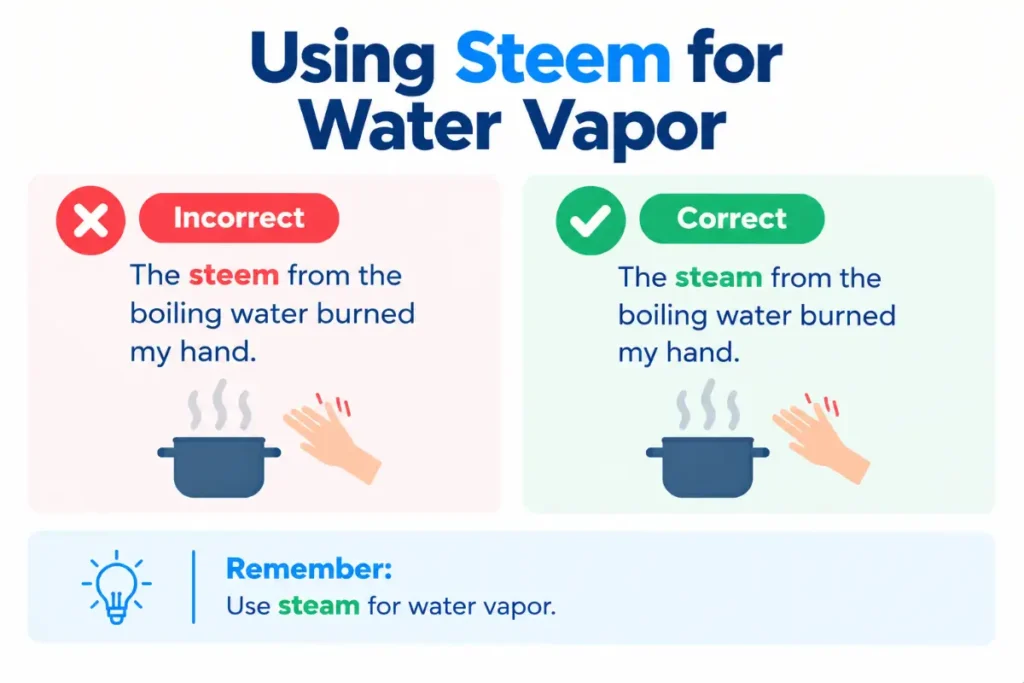
Incorrect: The steem from the boiling water burned my hand.
Correct: The steam from the boiling water burned my hand.
Explanation: Steam is the standard spelling for the hot vapor. Steem is incorrect in this sentence because the writer is using the ordinary English word.
Using Steem in a Science Assignment
Incorrect: Water produces steem when it is heated.
Correct: Water produces steam when it is heated.
Explanation: The correct spelling is steam. In a science assignment, accurate spelling helps make the explanation clear and professional.
Using Steem in a Cooking Recipe
Incorrect: Steem the carrots until they’re soft.
Correct: Steam the carrots until they’re soft.
Explanation: Steam is the verb that describes cooking food with hot vapor. The alternative spelling is not standard in this context.
Using Steem in a Figurative Expression
Incorrect: The project is finally picking up steem.
Correct: The project is finally picking up steam.
Explanation: Picking up steam means gaining speed, energy, or momentum. The expression always uses the standard spelling steam.
Correcting a Proper Name by Mistake
Incorrect correction: The editor changed the official name Steem to Steam without checking the source.
Better approach: Verify the intended name before making the change.
Explanation: Standard spelling rules apply to ordinary vocabulary, but proper names may have unique spellings. Editors should preserve a verified name even if it resembles a misspelled common word.
The safest approach is to identify the intended meaning first. Correct the spelling when the writer means water vapor or the familiar figurative expression, but don’t automatically change a verified proper name.
Why People Confuse These Words
Several factors explain why writers may confuse steam and steem. Understanding these factors can make spelling errors easier to avoid.
They Can Sound the Same
In standard English pronunciation, steam is commonly pronounced with a long vowel sound, as in the word team. The spelling steem can suggest the same sound to a reader, even though it is not the standard spelling of the ordinary word.
When two spellings appear to represent the same sound, writers may rely on their ears rather than their knowledge of conventional spelling. That approach can lead to mistakes.
English Spelling Is Not Always Predictable
English contains many words with similar sounds but different spellings. For example, see and sea sound alike but have different meanings and spellings. Similarly, right and write share a pronunciation but function differently.
These words demonstrate that sound alone doesn’t determine spelling. Writers must also learn standard written forms and understand the context in which each word appears.
Typing Errors Can Become Habits
A person who types quickly may accidentally enter steem instead of steam. If spellcheck doesn’t recognize the intended meaning or the incorrect form appears in a specialized name or custom dictionary, the error may go unnoticed.
Repeated exposure can also make an incorrect spelling look familiar. Familiarity, however, doesn’t make it standard English.
Online Names Can Create Confusion
The internet contains usernames, brands, product names, and platform names that don’t follow ordinary spelling patterns. Seeing a particular name repeatedly may cause readers to assume that its spelling is also a standard English variant.
Keep the distinction clear. A spelling may be valid as a name without being correct for the ordinary word.
Easy Ways to Remember the Correct Spelling
Memory techniques can help you recall the right spelling without checking a dictionary every time.
Remember Steam and Team
The words steam and team share the same final four letters. If you already know how to spell team, you can use it to remember steam.
Think of a team working together to power a steam engine. The image connects the spelling with a familiar word and gives you a simple reminder.
Connect Steam With Water
Picture a kettle releasing steam as water boils. Every time you see the vapor rising, remember that the word ends with eam.
This visual association works well because it links the spelling to a common experience. You don’t need a complicated rule to remember it.
Learn the Word in a Phrase
Memorizing a word inside a familiar expression can be more effective than memorizing it in isolation.
Practice these phrases.
- Steam from a kettle.
- Steam the vegetables.
- Gain steam.
- Lose steam.
- Let off steam.
Each phrase reinforces the standard spelling in a different context. After using these expressions repeatedly, the correct form should become easier to recall.
Use a Simple Sentence Test
When you’re unsure about the spelling, replace the word mentally with vapor or momentum.
If the sentence still makes sense with vapor, the correct spelling is steam. If the sentence describes progress or energy, the expression may also require steam.
For example, The business is gaining vapor doesn’t convey the intended meaning. The natural expression is The business is gaining steam.
This technique helps you connect the spelling with meaning rather than relying entirely on memory.
Pronunciation and Word Origin
How to Pronounce Steam
In American English, steam is pronounced /stiːm/. The first sound is the consonant cluster represented by st. The vowel is the long ee sound, followed by the m sound.
The word rhymes with team, dream, cream, and beam. These familiar rhyming words can help English learners remember both the pronunciation and the spelling.
Although steem may suggest the same pronunciation, that similarity doesn’t make it an accepted alternative spelling for the common word. Standard written English uses steam.
Where the Word Steam Comes From
The word steam has roots in Old English. Historical forms of the word were associated with vapor, exhalation, and similar phenomena.
Over time, the word developed a wider range of meanings. It became closely associated with the use of heated water vapor in machinery and transportation, especially during the development of steam powered technology.
Today, steam appears in scientific explanations, cooking instructions, industrial settings, and everyday expressions. Its figurative uses have also become common, especially in phrases such as gaining steam and letting off steam.
The word’s long history helps explain why it has so many familiar uses. However, its standard modern spelling remains steam.
American and British English Usage
Steam is the standard spelling in both American English and British English. There is no general US versus UK spelling difference between steam and steem.
American writers use steam when discussing hot vapor, cooking, machinery, or figurative momentum. British writers use the same spelling for the same meanings.
For example, an American might write, The steam from the kettle filled the kitchen. A British writer could use exactly the same sentence without changing the spelling of steam.
Regional differences may affect vocabulary, pronunciation, or the names of certain appliances. They don’t change the standard spelling of this word.
If you’re writing for an international audience, steam is the safe and correct choice when you mean water vapor or the related figurative expression.
Related Words and Expressions
Learning related words can expand your vocabulary and help you use steam more accurately.
Steamy
Steamy is an adjective meaning full of steam or characterized by steam. It can also describe a hot and humid atmosphere.
Example: The bathroom felt steamy after the long shower.
Explanation: Steamy describes the humid conditions caused by hot water vapor.
The word can also have a figurative meaning related to romantic or sexual tension. The intended meaning depends on the context.
Steamer
A steamer is a device, vessel, or machine associated with steam. The exact meaning depends on the subject.
Example: She used a garment steamer to remove wrinkles from her dress.
Explanation: A garment steamer is a device that uses steam to smooth clothing.
The word can also refer to certain types of ships or cooking equipment.
Steam Engine
A steam engine is a machine that converts energy from heated water vapor into mechanical work.
Example: The museum displayed an antique steam engine from the nineteenth century.
Explanation: Steam engine names the type of machinery on display.
Steam Powered
Steam powered describes a machine or vehicle that operates using steam as an energy source.
Example: The railway museum restored a steam powered locomotive.
Explanation: Steam powered explains how the locomotive operates.
Gain Steam
Gain steam is an expression meaning to gain momentum, popularity, or strength.
Example: The charity campaign gained steam after local businesses joined the effort.
Explanation: The campaign attracted greater support and became more active.
Lose Steam
Lose steam means to lose energy, momentum, or enthusiasm.
Example: The team lost steam near the end of the season.
Explanation: The team became less effective or less energetic.
Let Off Steam
Let off steam means to release stress, anger, or frustration.
Example: He played basketball after work to let off steam.
Explanation: Playing basketball helped him relax and release tension.
Full Steam Ahead
Full steam ahead means to proceed with energy, confidence, and determination.
Example: The company decided to move forward with the expansion at full steam ahead.
Explanation: The expression communicates a strong commitment to progress.
These related words and phrases show how steam works across different parts of English. Learning them together makes the word easier to remember and use naturally.
Key Takeaways
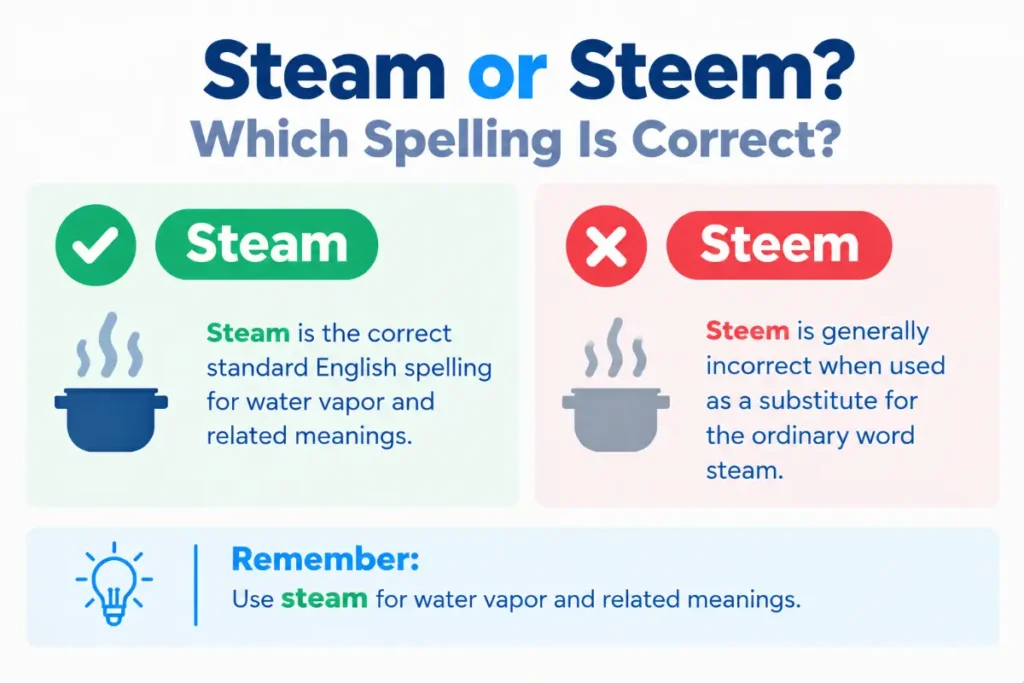
- Steam is the correct standard English spelling for water vapor and related meanings.
- Steem is generally incorrect when used as a substitute for the ordinary word steam.
- A name, brand, or specialized term may legitimately use the spelling Steem.
- Steam functions as both a noun and a verb.
- Common expressions include gain steam, lose steam, let off steam, and full steam ahead.
- Steam is spelled the same way in American and British English.
- The words team, cream, and dream can help you remember the spelling.
- Context matters when deciding if an unfamiliar spelling is a typo or part of a proper name.
Conclusion
Steam or steem is a simple spelling question once you know the standard rule. Steam is the correct word for water vapor, steam powered machinery, cooking with hot vapor, and familiar expressions about progress or frustration. Steem isn’t a standard alternative spelling for these meanings, although it may appear in proper names or specialized contexts.
The easiest way to remember the difference is to connect steam with words such as team and cream. You can also practice common phrases like gaining steam and letting off steam. These familiar expressions reinforce the correct spelling while helping you build a more natural English vocabulary.
When writing a school assignment, email, article, recipe, or professional document, choose steam whenever you mean the ordinary English word. Check the source before changing an unfamiliar proper name. This simple habit will help you write accurately and avoid a common spelling mistake.
Frequently Asked Questions
1. Is steam or steem the correct spelling?
Steam is the correct standard spelling for water vapor, steam powered machinery, cooking with steam, and common expressions about momentum. Steem is not a standard alternative spelling of the ordinary English word.
2. Is steem ever a real word?
Steem may appear as a proper name, brand, username, or specialized term. However, it isn’t the standard spelling of the common word steam. Always check the context before deciding that a particular use is incorrect.
3. What does steam mean in simple English?
Steam is the vapor associated with heated water. The word can also describe energy or momentum, as in the expression gaining steam. It can function as both a noun and a verb.
4. How do you use steam in a sentence?
You can write, The steam from the kettle fogged the window. Here, steam is a noun that describes the vapor. You can also write, We steam the vegetables for dinner, where steam functions as a verb.
5. Do steam and steem sound the same?
They may be pronounced the same when someone reads steem as an attempted spelling of steam. The standard pronunciation of steam is /stiːm/. However, identical or similar pronunciation doesn’t make the spellings interchangeable.
6. Is steam spelled the same way in American and British English?
Yes. Steam is the standard spelling in both American and British English. Neither variety normally uses steem as an alternative spelling for water vapor.
7. What does gaining steam mean?
Gaining steam means building momentum, becoming more popular, or making faster progress. For example, The new business is gaining steam means that the business is growing or attracting increasing interest.
8. What is the difference between steam and steamy?
Steam is a noun or verb that refers to vapor or the process of producing or using it. Steamy is an adjective that describes something full of steam or a humid atmosphere. For example, a steamy bathroom contains a lot of warm moisture.
9. Why do people spell steam as steem?
People may confuse the spellings because they can sound alike. Typing mistakes, unfamiliarity with standard spelling, and exposure to unusual brand names can also contribute to the error. Remembering steam alongside team or cream can help prevent mistakes.
10. How can I remember the correct spelling of steam?
Remember the phrase steam from a kettle or connect steam with the rhyming word team. Both techniques reinforce the standard spelling. You can also practice familiar expressions such as gain steam and let off steam.

English Grammar & Usage
Nathan Holloway is an American grammar writer and language researcher who specializes in English grammar, sentence structure, verb usage, and common writing mistakes. He enjoys breaking down confusing grammar rules into practical explanations with clear examples, making English easier for students, professionals, and everyday writers.