
Skull or scull can be confusing because both words sound the same in standard English pronunciation. However, they refer to different things. One belongs to human and animal anatomy, while the other belongs mainly to the world of rowing and boating. Choosing the right spelling depends on the meaning you want to express.
The easiest way to remember the difference is to connect skull with the bones in your head and scull with an oar or a rowing boat. If you’re writing about a head injury, a skeleton, or a medical examination, use skull. If you’re describing a rowing race or a narrow boat used for exercise, scull may be the correct choice.
Both spellings are legitimate English words, so a spell checker may accept either one. The challenge is choosing the word that fits your sentence. This guide explains their meanings, pronunciation, grammar, origins, practical uses, and common mistakes so you can write with confidence.
Short Answer
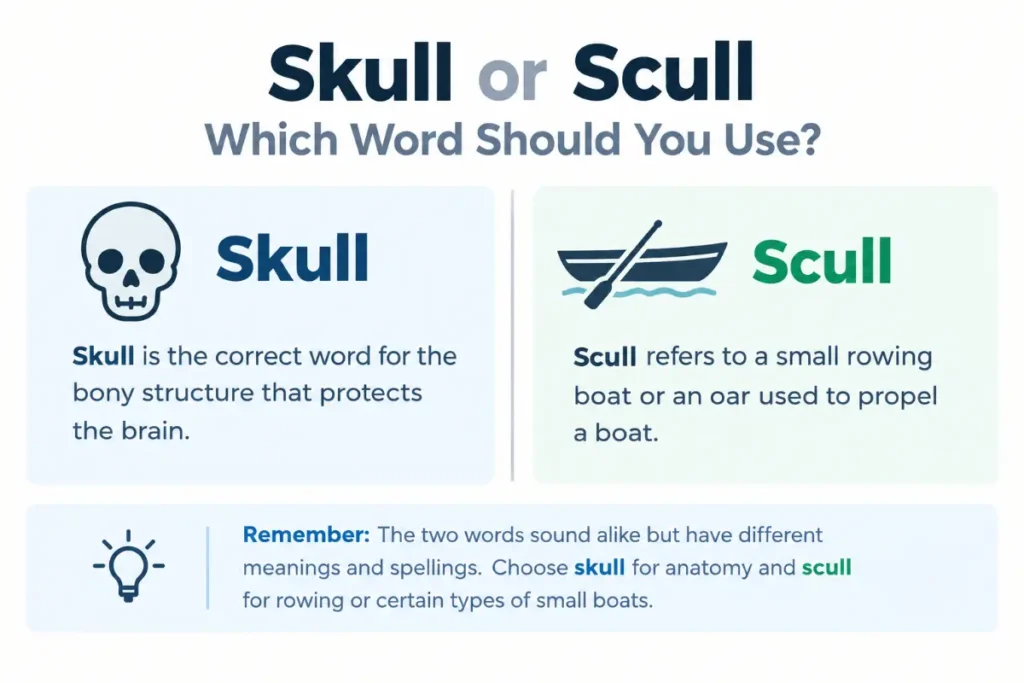
Skull is the correct word for the bony structure that protects the brain. Scull refers to a small rowing boat or an oar used to propel a boat. The two words sound alike but have different meanings and spellings. Choose skull when discussing anatomy and scull when talking about rowing or certain types of small boats.
Table of Contents
- What Skull Means.
- What Scull Means.
- The Difference Between Skull and Scull.
- How to Use Skull Correctly.
- How to Use Scull Correctly.
- Pronunciation and Word Origins.
- Examples in Everyday English.
- Common Spelling Mistakes.
- Memory Tips.
- Related Grammar and Usage Notes.
- Frequently Asked Questions.
- Key Takeaways.
- Conclusion.
What Skull Means
A skull is the bony structure of the head that protects the brain and supports the structures of the face. It forms an essential part of the human skeleton and also appears in many other vertebrate animals.
In everyday English, people often use the word when discussing anatomy, medicine, injuries, fossils, skeletons, and symbols associated with danger or death.
The meaning of skull in anatomy
The human skull protects the brain from many forms of physical impact and provides structure for the face. It also contains openings for important nerves and blood vessels.
Anatomists commonly divide the skull into two main parts.
- The cranium. This part encloses and protects the brain.
- The facial skeleton. This part forms the structure of the face and supports features such as the nose and mouth.
These parts work together to create the bony framework of the head. Although people sometimes use skull and cranium as interchangeable terms in casual conversation, they aren’t always anatomically identical. The cranium specifically refers to the part that encloses the brain.
Examples of skull in anatomy
1. The doctor examined the patient’s skull after the accident.
This sentence refers to the bones of the patient’s head.
2. The human skull protects the brain.
This example explains one of the skull’s main biological functions.
3. Scientists discovered a fossilized skull during the excavation.
Here, skull refers to the preserved head bones of an ancient organism.
4. The museum displayed a dinosaur skull.
The sentence describes the head bones of an extinct animal.
5. The X ray showed a fracture in the skull.
This example uses the word in a medical context to describe a break in a bone.
Other common uses of skull
The word also appears outside medical and scientific writing.
A skull symbol. A skull and crossbones often represent poison, danger, or death. The symbol appears on certain warning labels and in popular culture.
A skull design. Artists and designers use skull images in clothing, jewelry, tattoos, and decorative artwork.
A skull in archaeology. Researchers study skulls to learn about ancient populations, human evolution, and the physical characteristics of past communities.
In each case, skull keeps its connection to the bony structure of the head, even when the word appears in a symbolic or artistic context.
What Scull Means
Scull has several related meanings connected to rowing and boats. It can refer to a small rowing boat, an oar used to move a boat, or the action of propelling a boat with a sculling motion.
Unlike the anatomical word, this spelling belongs to the vocabulary of water sports and boating. It also appears in rowing competitions, where athletes use specialized equipment to move their boats across the water.
The meaning of scull as an oar
A scull can be an oar used to propel a boat. In a common form of sculling, a rower uses two oars, one in each hand, to move the boat forward.
Sculling differs from sweep rowing. In sweep rowing, each rower generally handles one oar with both hands. In sculling, each rower handles two oars.
This distinction matters in competitive rowing because the two techniques require different equipment and coordination.
The meaning of scull as a boat
A scull can also refer to a narrow, lightweight rowing boat designed for speed and efficient movement through water. In rowing, the term often appears in names such as single scull, double scull, and quadruple scull.
These names identify boats according to the number of rowers.
- Single scull. One rower uses two oars to propel the boat.
- Double scull. Two rowers each use two oars.
- Quadruple scull. Four rowers each use two oars.
These boats are designed for rowing and racing. Their narrow shape helps reduce resistance as they move through the water.
The meaning of scull as an action
Scull can also function as a verb. It describes moving a boat through water with sculling movements.
For example, a rower might scull across a lake during a morning workout. The verb describes the action rather than the equipment alone.
Consider these examples.
1. The athlete learned to scull during her first rowing lesson.
Here, scull is a verb describing a rowing technique.
2. He bought a scull for training on the river.
In this sentence, scull refers to a rowing boat.
3. The rower adjusted his scull before the race.
This sentence refers to rowing equipment, although the exact item depends on the context.
4. The team practiced in a double scull before the competition.
The phrase identifies a boat designed for two scullers.
5. She used her oars to scull toward the dock.
In this example, scull describes the action of propelling the boat.
The surrounding words usually make the intended meaning clear. References to rowers, oars, boats, races, rivers, and training often signal the spelling scull.
The Difference Between Skull and Scull
The main difference is meaning. Skull refers to the bones of the head, while scull belongs to rowing and boating.
The words are homophones in standard English. That means they share the same pronunciation but have different spellings and meanings.
| Feature | Skull | Scull |
|---|---|---|
| Main meaning | The bony structure of the head | A rowing boat, an oar, or a rowing action |
| Part of speech | Noun | Noun and verb |
| Common subject | Anatomy and medicine | Rowing and boating |
| Example | The skull protects the brain. | They raced in a double scull. |
| Related words | Cranium, skeleton, bone | Rowing, oar, sculler |
| Typical context | Medical reports and anatomy lessons | Rowing clubs and water sports |
Which spelling should you choose
Use the meaning of the sentence to guide your decision.
- If you’re describing the bones of a person’s head, write skull.
- If you’re describing a rowing boat, write scull.
- If you’re describing an oar used for sculling, write scull.
- If you’re describing the act of moving a boat with sculling movements, write scull.
- If you’re describing a skull shaped symbol or a fossilized head, write skull.
For example, the sentence The skull was found near the river uses skull because it refers to bones. The sentence The scull was found near the river uses scull if the object is a rowing boat or related equipment.
The location doesn’t determine the spelling. The intended meaning does.
Why the difference matters
A single letter can change the meaning of an entire sentence. Since both spellings are valid English words, automatic spell checkers may not flag an incorrect choice.
Imagine writing a report about a rowing competition and saying that an athlete injured his scull. A reader might understand that you meant his head, but the spelling would point toward rowing equipment instead.
Likewise, writing that a team competed in a single skull would confuse readers because the established rowing term is single scull.
Accurate word choice helps readers understand your message without having to guess what you intended.
How to Use Skull Correctly
Use skull when the sentence concerns the bony structure of the head. The word works in everyday conversation, academic writing, medical contexts, and descriptions of art or symbols.
Use skull in medical writing
Medical writing often uses skull to describe injuries, fractures, scans, and anatomical structures.
Examples include the following.
1. The patient suffered a skull fracture in the accident.
The word refers to a break in one or more bones of the head.
2. The radiologist examined the skull scan.
This sentence describes a medical examination of the head’s bony structure.
3. The surgeon explained how the skull protects the brain.
The word appears in an explanation of human anatomy.
4. The child wore a helmet to protect his skull during the cycling lesson.
This sentence uses skull to identify the part of the body that needs protection.
In formal medical writing, precise terminology matters. A skull fracture, for instance, isn’t the same thing as an injury to the brain. The two can occur together, but they describe different structures.
Use skull in science and education
Teachers, students, researchers, and museum staff commonly use the word when discussing anatomy and fossils.
Examples include the following.
1. The biology class studied the human skull.
This sentence describes an anatomy lesson.
2. The researchers compared the skulls of two ancient mammals.
The plural form skulls refers to the head bones of multiple animals.
3. The fossilized skull provided clues about the animal’s diet.
The sentence explains how researchers can use fossil evidence to study extinct species.
4. The diagram labels each major part of the skull.
Here, skull refers to the anatomical structure shown in an educational illustration.
Use skull in art and everyday expressions
The word also appears in creative writing, fashion, and familiar expressions.
Examples include the following.
1. She wore a shirt with a large skull printed on the front.
The word refers to an image of a head skeleton.
2. The pirate flag displayed a skull and crossbones.
The phrase names a recognizable symbol often associated with danger or piracy.
3. The artist drew a detailed skull in charcoal.
This sentence describes an artwork based on the bones of the head.
4. The archaeologist carefully cleaned the ancient skull.
The word refers to physical remains being studied.
These examples show that skull doesn’t have to appear in a medical sentence. Its central meaning remains the same across different subjects.
Singular and plural forms
The singular form is skull. The standard plural form is skulls.
| Singular | Plural | Example |
|---|---|---|
| Skull | Skulls | The museum displayed several skulls. |
| A skull | Two skulls | Researchers examined two skulls. |
| The skull | The skulls | The skulls belonged to different animals. |
The plural follows the usual English rule of adding s to a regular noun. You don’t need an apostrophe to make skull plural.
Incorrect: The museum displayed three skull’s.
Correct: The museum displayed three skulls.
The apostrophe would suggest possession or a contraction, neither of which is needed in this sentence.
How to Use Scull Correctly
Use scull when discussing rowing boats, rowing equipment, or the action of moving a boat through water with sculling movements.
The word is more specialized than skull. You will encounter it most often in rowing clubs, sporting reports, equipment descriptions, and conversations about boating.
Use scull in rowing competitions
Competitive rowing uses several boat categories. The term scull appears in names that identify events involving rowers who use two oars each.
Examples include the following.
1. She won the women’s single scull event.
The sentence describes a rowing competition involving one athlete.
2. The double scull team trained every morning.
Here, double scull identifies a boat and event involving two rowers.
3. Four athletes competed in the quadruple scull.
The phrase refers to a boat designed for four scullers.
4. He hopes to qualify for the national sculling championship.
The word sculling refers to the rowing technique used in the competition.
5. The coach inspected the sculls before practice.
The plural noun refers to rowing equipment or boats, depending on the surrounding context.
In competitive rowing, names such as single scull and double scull are established terms. Replacing scull with skull changes the spelling and makes the terminology incorrect.
Use scull when describing rowing equipment
The word can refer to an oar used in sculling. The context should make clear that you’re discussing a piece of equipment rather than a boat.
Examples include the following.
1. The rower repaired a damaged scull before training.
The sentence refers to rowing equipment.
2. She carried two sculls down to the water.
The meaning is equipment used for rowing.
3. The club ordered new sculls for its athletes.
Here, sculls refers to rowing equipment purchased for training.
Because scull can refer to different things in boating, readers rely on context to identify the exact object.
Use scull as a verb
When scull functions as a verb, it describes a rowing action. Its grammatical form changes according to the sentence.
| Verb form | Example |
|---|---|
| Scull | I scull on the lake every weekend. |
| Sculls | She sculls before work. |
| Sculled | They sculled toward the shore yesterday. |
| Sculling | He enjoys sculling on calm water. |
The word follows the regular spelling pattern for many English verbs.
Examples in context include the following.
1. I scull for an hour each morning.
Scull is the main verb and describes a regular activity.
2. My sister sculls for her university team.
Sculls agrees with the singular subject my sister.
3. We sculled across the lake before sunset.
Sculled describes a completed action in the past.
4. They are sculling along the river.
Sculling appears in the present progressive construction to describe an ongoing activity.
These forms help you use scull correctly in different tenses.
Understand the difference between sculling and sweep rowing
Sculling and sweep rowing are two common rowing methods, but they use different equipment and hand movements.
In sculling, each rower generally uses two oars. In sweep rowing, each rower generally uses one oar and holds it with both hands.
This distinction affects boat design, technique, and how athletes coordinate their movements.
For example, a single sculler controls two oars while rowing alone. In a sweep rowing crew, athletes coordinate their efforts while each handles one oar.
Knowing this distinction helps you understand sports coverage and use rowing vocabulary accurately.
Pronunciation and Word Origins
How to pronounce skull and scull
Both words have the same pronunciation in standard American English. They rhyme with dull, full, and pull.
Their shared pronunciation makes them homophones. You can’t hear the spelling difference in ordinary speech, so you must rely on context when writing.
The vowel sound in both words is the same short sound heard in the word cup. Neither word has a long vowel sound.
Where the words come from
The two words have different histories that reflect their separate meanings.
Skull comes from older English forms associated with the head and its bony structure. Its history connects it to the Germanic languages, which contain related words for the head or skull.
Scull has historical connections to words for an oar and to the practice of moving a boat through water. The word developed within the vocabulary of rowing and boating.
Their similar sounds don’t mean they share the same meaning or origin. English contains many words that sound alike but developed along different historical paths.
Are skull and scull homophones
Yes. In standard English pronunciation, they are homophones because they sound alike but have different meanings and spellings.
Other familiar examples of homophones include the following.
- Sea and see. Sea refers to a large body of salt water, while see describes the act of using your eyes or meeting someone.
- Right and write. Right can describe correctness or direction, while write means to form words.
- Brake and break. A brake slows a vehicle, while break means to separate something into pieces or interrupt something.
- Their and there. Their indicates possession, while there refers to a place or introduces a statement.
- Skull and scull. Skull refers to head bones, while scull relates to rowing.
Homophones can create spelling mistakes because pronunciation alone doesn’t tell you which word belongs in a sentence.
Examples in Everyday English
Seeing both words in realistic sentences makes their difference easier to remember.
Examples using skull
1. The doctor ordered an X ray to check for a skull fracture.
The sentence describes a medical examination after a possible head injury.
2. The museum has a replica of a human skull.
Here, skull refers to an object used for education or display.
3. The dinosaur skull was millions of years old.
This sentence describes fossilized remains from an ancient animal.
4. A skull and crossbones appeared on the warning label.
The phrase identifies a symbol commonly associated with poison or danger.
5. The artist painted a silver skull on the black jacket.
The word describes an artistic image rather than an actual set of bones.
6. The anatomy textbook explains the structure of the skull.
The sentence uses the word in an educational context.
7. Researchers found several skulls at the archaeological site.
The plural noun refers to the remains of multiple heads.
8. The helmet helped protect his skull during the cycling accident.
This example connects the word with physical protection.
Examples using scull
1. The athlete practiced in a single scull every morning.
The sentence identifies a rowing boat used by one athlete.
2. Our rowing club bought a new double scull.
Here, double scull names a boat designed for two rowers.
3. She learned to scull during the summer holidays.
The word functions as a verb describing a rowing activity.
4. The team entered the quadruple scull competition.
This sentence refers to a rowing event involving four scullers.
5. He carried his sculls to the boathouse.
The word refers to rowing equipment.
6. The coach watched the athletes sculling across the lake.
Sculling describes the action taking place on the water.
7. They repaired the scull before the next race.
The exact object depends on the surrounding context, but the sentence belongs to the world of rowing.
8. She hopes to become a skilled sculler.
Sculler is a noun for a person who practices sculling.
Examples that show the difference
Compare these sentences to see how one letter changes the meaning.
| Sentence | Meaning |
|---|---|
| The skull was carefully examined. | Someone examined the bones of a head. |
| The scull was carefully examined. | Someone examined a rowing boat or piece of rowing equipment. |
| The museum displayed a human skull. | The museum displayed anatomical remains or a replica. |
| The club purchased a racing scull. | The club purchased a rowing boat. |
| The skull had a small fracture. | A bone in the head was broken. |
| The scull had a small crack. | A rowing boat or piece of equipment was damaged. |
The grammar of these sentences is similar, but the meaning changes with the noun. This is why context matters more than sound when choosing the spelling.
Common Mistakes
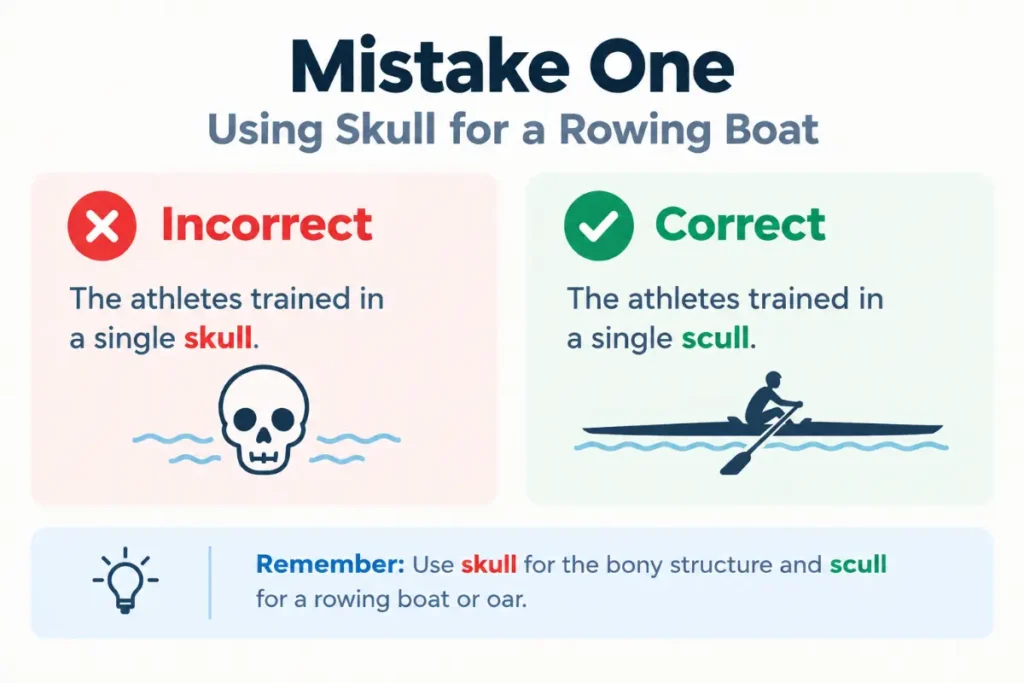
Mistake One Using Skull for a Rowing Boat
Incorrect: The athletes trained in a single skull.
Correct: The athletes trained in a single scull.
A single scull is a rowing boat designed for one rower. The spelling skull refers to the bones of the head, so it doesn’t fit this sports context.
Mistake Two Using Scull for the Bones of the Head
Incorrect: The doctor examined the patient’s scull.
Correct: The doctor examined the patient’s skull.
The sentence describes a medical examination. Skull is the appropriate word because the doctor is examining the bony structure of the head.
Mistake Three Assuming One Word Is Incorrect
Incorrect assumption: Scull is a misspelling of skull.
Correct understanding: Both are valid English words with different meanings.
Scull is the standard spelling in rowing terminology. It isn’t an alternative spelling for the anatomical word.
Mistake Four Trusting Spell Check Without Checking Meaning
A spell checker may accept both words because both are correctly spelled English words.
For example, a document might contain the sentence The surgeon examined the scull. A basic spell checker may not flag it, even though skull is the intended word.
Always review the meaning of a sentence after running a spelling check. Correct spelling alone doesn’t guarantee correct word choice.
Mistake Five Confusing Scull With Skull in Sports Writing
Incorrect: The team won the double skull event.
Correct: The team won the double scull event.
Double scull is the established term for a rowing boat and event involving two scullers. Sports writers should use the accepted rowing terminology.
Memory Tips
A simple memory trick can help you choose the right spelling without looking it up.
Connect skull with the head
Remember the k in skull by connecting the word with the hard bones in your head. The word appears in anatomy lessons, medical reports, and descriptions of skeletons.
You can also remember this sentence.
The skull protects the brain.
The connection between skull and brain makes the spelling easier to recall.
Connect scull with the water
Remember the c in scull by connecting it with a canoe, crew, or competition on the water. These words can remind you of rowing and boating.
You can remember this sentence.
The crew practiced in a scull.
The water related context points you toward the correct spelling.
Ask one simple question
When you’re unsure which word to use, ask yourself what the sentence describes.
- Is it about a head or its bones? Use skull.
- Is it about rowing equipment or a rowing boat? Use scull.
- Is it about moving a boat with oars? Use scull.
This quick check works in school assignments, emails, reports, and everyday writing.
Related Grammar and Usage Notes
What part of speech is skull
Skull is primarily a countable noun. It names a physical object, so you can use it with articles and plural forms.
Examples include the following.
- A skull was displayed in the museum.
- The skull belongs to a small mammal.
- Several skulls were found during the excavation.
You can also use skull as a modifier in compound expressions such as skull fracture and skull shape.
What part of speech is scull
Scull can function as both a noun and a verb.
As a noun, it can refer to a rowing boat or an oar used in sculling. As a verb, it describes propelling a boat through water with sculling movements.
Examples include the following.
1. The scull was ready for the race.
Scull is a noun referring to rowing equipment or a boat.
2. They scull on the lake every weekend.
Scull is a verb describing their activity.
3. The sculler adjusted her technique.
Sculler is a noun that refers to a person who sculls.
What is the plural of scull
The regular plural form is sculls.
For example, The club purchased three sculls for its training program.
The plural form follows the usual English pattern of adding s to a regular noun. When scull functions as a verb, its third person singular form is sculls, its past tense is sculled, and its present participle is sculling.
Does American English use scull
Yes. Scull is a standard English word in American rowing and boating vocabulary. It appears in descriptions of boats, oars, techniques, and competitions.
Skull is also standard American English when referring to the bones of the head.
The distinction isn’t a difference between American and British spelling. Both forms are used in English, but they have different meanings.
Is scull an uncommon word
Scull is less common in general conversation because it belongs mainly to rowing and boating. People who don’t follow those activities may encounter it less often than skull.
However, scull is a familiar and important term in rowing. Its frequency depends on the subject being discussed.
Key Takeaways
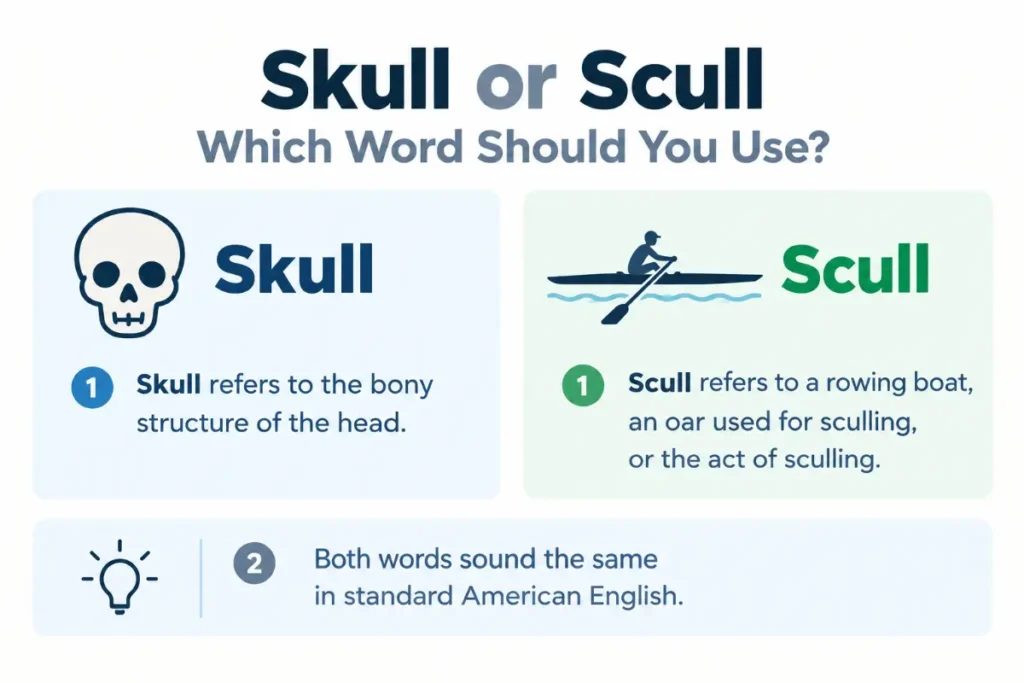
- Skull refers to the bony structure of the head.
- Scull refers to a rowing boat, an oar used for sculling, or the act of sculling.
- Both words sound the same in standard American English.
- Skull is a noun, while scull can function as both a noun and a verb.
- Single scull, double scull, and quadruple scull are established rowing terms.
- Both spellings are correct, but they aren’t interchangeable.
- A spell checker may accept the wrong word if it doesn’t fit the intended meaning.
- The simplest memory trick is to connect skull with the head and scull with the water.
Conclusion
Skull or scull comes down to meaning rather than pronunciation. Use skull when discussing the bones of the head, anatomy, fossils, or symbols. Use scull when talking about rowing boats, oars, and the action of propelling a boat through water.
The easiest way to remember the difference is to connect skull with the head and scull with rowing. Since both words sound alike, you can’t rely on pronunciation alone to choose the correct spelling. Instead, look at the subject of your sentence and decide what you’re describing.
Once you understand this distinction, you’ll be able to use both words confidently in everyday writing, school assignments, scientific explanations, and sports reports.
Frequently Asked Questions
Is skull or scull the correct spelling?
Both spellings are correct. Skull refers to the bony structure of the head, while scull refers to rowing equipment, a rowing boat, or the action of moving a boat through water. Choose the spelling that matches your intended meaning.
Are skull and scull pronounced the same?
Yes. Both words have the same pronunciation in standard American English. They are homophones, meaning they sound alike but have different spellings and meanings.
What does scull mean in rowing?
In rowing, scull can refer to a small rowing boat, an oar used for sculling, or the action of propelling a boat with sculling movements. The term also appears in names such as single scull and double scull.
What does skull mean in anatomy?
Skull refers to the bony structure of the head. It includes the cranium, which encloses the brain, and the facial skeleton, which supports the structure of the face.
Is scull a real English word?
Yes. Scull is a standard English word used in rowing and boating. It’s not a misspelling of skull, and it has its own established meanings and grammatical forms.
What is the difference between a single scull and a double scull?
A single scull is a rowing boat used by one rower, who handles two oars. A double scull is designed for two rowers, each using two oars.
What is the plural of skull?
The plural of skull is skulls. For example, The museum displayed several skulls from different animal species. The word follows the regular English rule for forming plurals.
Can scull be used as a verb?
Yes. Scull can describe the action of propelling a boat through water using sculling movements. For example, She learned to scull during her first rowing lesson.
Why does spell check accept both words?
Both words are correctly spelled English words. A standard spell checker may recognize each one without understanding the intended meaning of your sentence. You still need to check the context to choose the right word.
Is the difference between skull and scull related to American and British English?
No. The distinction isn’t based on regional spelling preferences. Both words are standard in American and British English, but skull refers to head bones and scull belongs to rowing and boating.

Confusing Words, Spelling & Word Choice
Claire Whitmore is a U.S.-based English editor who writes about commonly confused words, spelling differences, and word choice. Her work helps readers understand subtle distinctions between similar-looking words through simple definitions, practical examples, and modern usage guidance in both American and British English.