
The choice between catalogue or catalog often confuses writers because both spellings are correct, yet their use depends on regional English conventions. In the United States, people generally write catalog, while British writers usually prefer catalogue. The two forms have the same meaning and pronunciation, so the difference comes down to spelling rather than grammar.
This distinction matters when you’re writing product descriptions, business documents, academic assignments, website content, or marketing materials. Using the preferred spelling for your audience makes your writing look polished and consistent. For example, an American retailer will usually advertise a product catalog, while a British retailer is more likely to publish a product catalogue.
The good news is that you don’t need to memorize two different definitions or learn separate grammar rules. Once you understand the regional preference, choosing the right form becomes easy. This guide explains the meaning, pronunciation, history, usage rules, common mistakes, and practical examples so you can confidently use the word in everyday and professional writing.
Short Answer
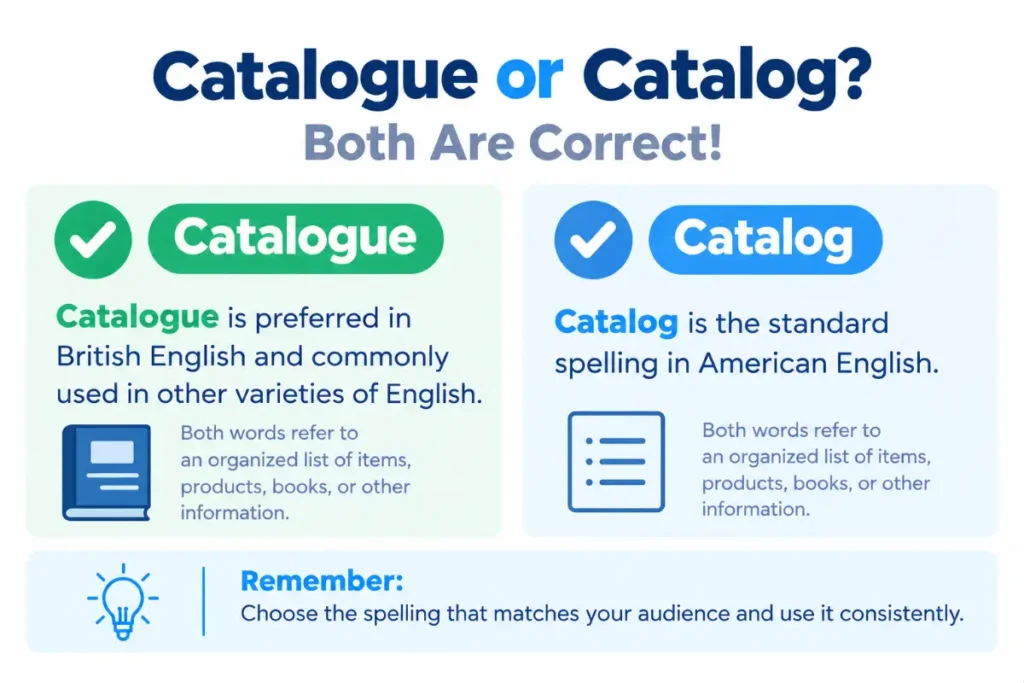
Catalogue or catalog are both correct spellings of the same word. Catalog is the standard spelling in American English, while catalogue is preferred in British English and commonly used in other varieties of English. Both words refer to an organized list of items, products, books, or other information. Choose the spelling that matches your audience and use it consistently.
Table of Contents
- What Catalogue and Catalog Mean.
- The Difference Between Catalogue and Catalog.
- Which Spelling Is Correct in American English.
- Which Spelling Is Correct in British English.
- Pronunciation and Word Origin.
- How to Use the Word Correctly.
- Catalogue and Catalog as a Verb.
- Real Life Examples.
- Common Spelling Mistakes.
- Memory Tips.
- Related Words and Expressions.
- Professional Writing Tips.
- Frequently Asked Questions.
- Key Takeaways.
- Conclusion.
What Catalogue and Catalog Mean
Both spellings refer to an organized collection of information about items, products, services, books, or other resources. A catalog or catalogue helps readers find what they need without searching through unrelated information.
For example, a clothing company might publish a catalog showing its available shirts, pants, shoes, and accessories. A library might maintain a catalog that helps visitors find books by title, author, or subject.
The word can describe a printed publication, a digital collection, or a structured record of information. Its precise meaning depends on the context.
The Meaning of Catalog as a Noun
In American English, catalog is the usual spelling of the noun. It commonly refers to a list or collection arranged so people can locate specific items.
Consider these examples.
1. The college published a course catalog for incoming students.
This means the college created a document listing its available courses and related information.
2. I ordered a new sofa from the furniture catalog.
This means the speaker used a publication showing the furniture available for purchase.
3. The librarian searched the online catalog for a book about American history.
This means the librarian used an organized database to locate a particular book.
In each sentence, the noun identifies a collection of information that helps someone find or choose something.
The Meaning of Catalogue as a Noun
In British English, catalogue is the more common spelling. It carries the same meaning as the American form and appears in many of the same contexts.
For example.
1. The museum published a catalogue of its latest exhibition.
This means the museum produced a publication describing the artworks or objects displayed in the exhibition.
2. Please check the course catalogue before choosing your classes.
This means the student should review the list of available courses before making a decision.
3. The company sent its new product catalogue to customers.
This means the company distributed a document showing its products.
The additional letters don’t change the meaning. The choice reflects regional spelling conventions.
What Does Catalog Mean in Everyday Language
In everyday use, a catalog is often a list of choices. It may help someone shop, study, research, or organize information.
The term also appears in libraries, universities, museums, online stores, music platforms, and business databases. A company’s catalog might include its entire product range, while a streaming service might organize a musician’s recorded work into a catalog.
The central idea remains the same. A catalog brings related information together in an organized form.
The Difference Between Catalogue and Catalog
The main difference between the two spellings is regional preference. They have the same basic meaning, grammatical function, and pronunciation.
| Feature | Catalog | Catalogue |
|---|---|---|
| Preferred region | United States | United Kingdom |
| Meaning | An organized list or collection | An organized list or collection |
| Pronunciation | Same | Same |
| Part of speech | Noun and verb | Noun and verb |
| American business writing | Standard choice | Less common |
| British business writing | Less common | Standard choice |
| General meaning | Identical | Identical |
The easiest rule is to use catalog for American readers and catalogue for British readers. Other English speaking regions may follow British conventions, American conventions, or a mixture depending on the country, organization, and style guide.
Is One Spelling More Correct Than the Other
Neither spelling is universally more correct. Both are accepted English forms.
However, a spelling can be more appropriate for a particular audience. If you’re writing for a US company, an American school, or a US based website, catalog is generally the better choice. If you’re preparing a document for a British publisher or UK audience, catalogue is usually preferable.
This distinction is similar to other regional spelling pairs, such as color and colour or center and centre. The words have the same meaning, but the preferred spelling changes by region.
Does the Extra Ending Change the Meaning
No. The ending ue in catalogue does not create a separate meaning.
You can replace one spelling with the other without changing the central message of a sentence. For example, The store printed a catalog and The store printed a catalogue describe the same action. The difference lies in the spelling convention rather than the information being communicated.
Which Spelling Is Correct in American English
Catalog is the preferred spelling in American English. American dictionaries and standard US writing conventions generally use this form for both the noun and the verb.
You’ll commonly see catalog in American retail stores, university publications, libraries, software documentation, and business communications. The shorter spelling is also the usual choice for American websites and online shopping platforms.
Here are some examples of standard American usage.
1. The bookstore released its fall catalog yesterday.
The bookstore published a list of the books or products available during the fall season.
2. Students can download the university catalog from the school website.
The university provides a document containing information about courses, programs, policies, and academic requirements.
3. The company plans to catalog every item in its warehouse.
The company intends to create an organized record of all the items it stores.
4. Our online catalog includes hundreds of educational resources.
The website provides an organized collection of learning materials.
In all four sentences, the shorter spelling fits standard American English.
Why Americans Prefer Catalog
American English often favors shorter spellings in words that have longer forms in British English. Examples include color instead of colour and favorite instead of favourite.
The same general pattern appears in catalog and catalogue. However, this is a regional spelling convention, not a rule that requires every American word to be shorter.
American writers should also follow the spelling preferences of their employer, publisher, or organization when a specific style guide applies. A company might retain the British spelling in an official name or product title, even when its other materials use American English.
Should American Students Write Catalog or Catalogue
American students should normally write catalog in essays, research assignments, reports, and other schoolwork.
For example, a student writing about a college might say, The course catalog explains the requirements for graduation. This sentence follows standard American spelling.
If an assignment asks students to follow a British English style guide, the expected spelling may differ. In ordinary US academic writing, however, catalog is the safest choice.
Which Spelling Is Correct in British English
Catalogue is the preferred spelling in British English. It is widely used in the United Kingdom in education, retail, publishing, libraries, and other professional settings.
British writers generally use the longer form for both the noun and the verb. This preference also appears in many publications that follow traditional British spelling conventions.
Consider these examples.
1. The department published its new course catalogue.
The department released a document listing available courses and related academic information.
2. The retailer mailed a Christmas catalogue to its customers.
The retailer sent customers a publication showing products available for purchase during the Christmas season.
3. The archive maintains a catalogue of historical photographs.
The archive keeps an organized record of its photographs so researchers can find them.
4. The museum will catalogue its new collection next month.
The museum will record and organize information about the newly acquired objects.
These examples show how the British spelling works in both noun and verb forms.
Why British English Uses Catalogue
The longer spelling reflects the spelling conventions established in British English. It has remained common in British publishing, education, and commerce.
Writers in the United Kingdom often use other spellings that differ from American English, including centre, theatre, and travelling. These differences developed through the history of English and the development of regional spelling standards.
The spelling catalogue is not more formal or more sophisticated than catalog. It is simply the established preference in British English.
Should British Writers Ever Use Catalog
Yes. British writers may encounter catalog in American publications, international software, company documents, and technical contexts. They can reproduce that spelling when quoting a title, retaining a brand name, or following a source’s official terminology.
For ordinary British prose, though, catalogue is generally the better option. Consistency matters more than changing every spelling to match one country’s conventions in all circumstances.
Pronunciation and Word Origin
Understanding pronunciation and history can make the spelling easier to remember. Fortunately, this word is relatively straightforward because the two forms share the same pronunciation.
How to Pronounce Catalog and Catalogue
Both spellings are pronounced the same way in standard English. The final ue in the British spelling doesn’t create an extra syllable.
The word has three syllables, with the main stress on the first syllable. Regional accents can affect the exact vowel sounds, but the two spellings don’t have separate standard pronunciations.
For example, an American speaker and a British speaker may pronounce the word with slightly different accents. Both are saying the same word, even when one writes catalog and the other writes catalogue.
Where the Word Comes From
The word catalog comes through Latin from Greek roots associated with listing or enumerating items. The Greek word katalogos referred to an enumeration or list.
Over time, the term became associated with organized records and publications. Its meaning expanded to cover lists of books, goods, artworks, academic courses, and other collections.
The spelling catalogue became established in British English, while catalog became the standard American form. Both spellings preserve the same underlying word and meaning.
Does the Word Have Other Meanings
Yes. Beyond a printed list of products, a catalog can refer to an organized collection of information or items. The term is common in several fields.
1. In education, a course catalog describes programs, classes, requirements, and academic policies.
2. In libraries, a library catalog helps users locate books, journals, and other resources.
3. In business, a product catalog presents goods or services that a company offers.
4. In music, an artist’s catalog refers to the body of recorded work associated with that artist.
5. In computing, a data catalog organizes information about available datasets, their contents, and their sources.
The context tells readers what kind of collection the writer means. The regional spelling doesn’t change any of these definitions.
How to Use the Word Correctly
The word works as both a noun and a verb. Recognizing the difference helps you use it accurately in sentences.
Using Catalog as a Noun
A noun names a person, place, thing, or idea. When used as a noun, catalog refers to an organized list, record, or collection.
Here are several common uses.
1. The store printed a new catalog for its customers.
The word refers to a publication that displays products.
2. I found the article through the library catalog.
The word refers to an organized system for locating library materials.
3. The professor reviewed the course catalog before advising students.
The word refers to a document containing information about courses and academic requirements.
4. The artist’s catalog contains work from several decades.
The word refers to a collection of the artist’s work.
In British English, writers can use catalogue in each example without changing the sentence’s meaning.
Using Catalog as a Verb
As a verb, catalog means to make a systematic record of items or information. It can also mean to arrange information so people can find it easily.
For example.
1. The librarian will catalog the new books.
The librarian will record and organize information about the books.
2. Researchers catalog historical documents to preserve accurate records.
Researchers organize information about the documents so others can identify and study them.
3. The company cataloged all its products before launching the website.
The company created organized records of its products before making the website available.
In British English, the usual verb spelling is catalogue. The past tense becomes catalogued, and the present participle becomes cataloguing.
Understanding the Different Verb Forms
The spelling changes slightly depending on the tense and the regional convention.
| Verb form | American English | British English |
|---|---|---|
| Base form | Catalog | Catalogue |
| Third person singular | Catalogs | Catalogues |
| Present participle | Cataloging | Cataloguing |
| Simple past | Cataloged | Catalogued |
| Past participle | Cataloged | Catalogued |
These forms show why choosing a regional spelling convention matters. If you begin with catalog in American English, use catalogs, cataloging, and cataloged. If you begin with catalogue in British English, use catalogues, cataloguing, and catalogued.
Can Catalog Be Used as an Adjective
The word itself is primarily used as a noun or verb. However, it can modify another noun when it appears before that noun.
For example, catalog search describes a search of a catalog, and catalog management refers to the process of maintaining catalog information.
In these expressions, catalog functions as a noun modifier. It helps specify the type of search or management being discussed.
British writers may use catalogue search or catalogue management when following British spelling conventions. In technical fields, a specific organization’s terminology may take priority.
Real Life Examples
Real examples make regional spelling rules easier to apply. The following sentences show how the word appears in shopping, education, libraries, technology, and everyday communication.
Examples From Shopping and Retail
Retailers use catalogs to present products and help customers compare their options. A catalog may be printed, available as a PDF, or built into an online store.
1. The furniture store sent me a catalog of its latest designs.
The catalog contains pictures and details of furniture available for purchase.
2. You can browse our product catalog before placing an order.
The business invites customers to review its available products before buying.
3. The company cataloged every item in its inventory.
The company created organized records of the products it owns.
For an American audience, catalog is the standard choice in all three examples. A British retailer would generally use catalogue, catalogued, and related forms.
Examples From Education
Schools and colleges often publish catalogs to explain their courses, programs, fees, and academic requirements.
1. The college catalog lists the classes required for graduation.
The document explains which classes students must complete to earn their degrees.
2. Check the catalog before registering for a course.
Students should review the available information before signing up for a class.
3. The university cataloged its research publications.
The university organized its research records so people could locate them.
The first two examples use the word as a noun. The third uses it as a verb.
Examples From Libraries and Research
Libraries use catalogs to organize their collections and make information easier to find. Researchers also create catalogs of documents, artifacts, photographs, and other materials.
1. The online catalog helped me locate a rare book.
The library’s search system helped the speaker find a specific book.
2. The historian prepared a catalog of photographs from the nineteenth century.
The historian created an organized record of historical photographs.
3. The research team cataloged every document collected during the study.
The team recorded and organized the documents for later reference.
These examples demonstrate that a catalog doesn’t have to be a printed publication. It can also be a digital database or a structured research record.
Examples From Technology
The word also appears in software, data management, and digital services. In these settings, it often refers to an organized collection of information that users can search or manage.
1. The software includes a catalog of available features.
The software provides an organized list of its features.
2. The company created a data catalog for its research team.
The company organized information about its datasets so researchers could find and understand them.
3. The platform catalogs digital resources from several departments.
The platform records and organizes digital resources from different parts of the organization.
American software documentation generally favors catalog and its related forms. However, organizations that follow British English may prefer the longer spelling.
Common Mistakes
Most errors involving these two spellings come from mixing regional conventions or assuming that one form is incorrect. A few simple rules can help you avoid these problems.
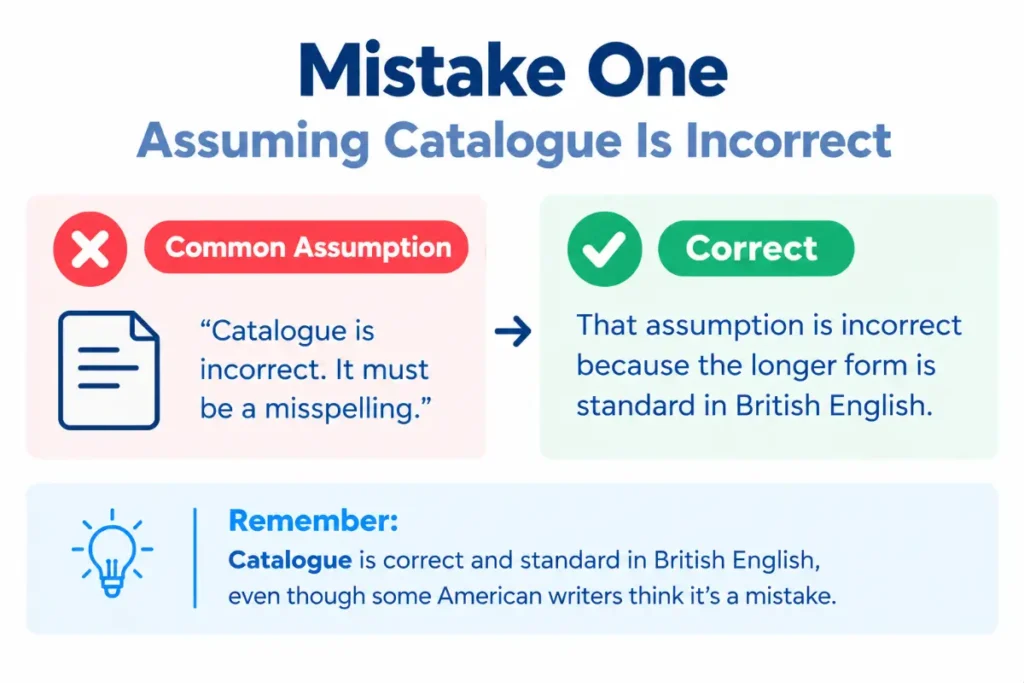
Mistake One Assuming Catalogue Is Incorrect
Some American writers see the extra letters and assume that catalogue is a misspelling. That assumption is incorrect because the longer form is standard in British English.
For example, The museum published a catalogue of its paintings is correct British English. An American publication would usually use catalog in the same sentence.
The best approach is to identify your audience before deciding which spelling to use.
Mistake Two Assuming Catalog Is Incorrect
British writers sometimes encounter the shorter spelling and think it is incomplete. However, catalog is the standard American spelling and is widely understood internationally.
For example, an American company can correctly write, Our catalog includes more than five hundred products. The sentence follows American spelling conventions.
Don’t add the final letters simply because the word looks more familiar in British English.
Mistake Three Mixing Regional Spellings
Using different regional forms in the same document can make your writing look inconsistent.
For example, an American report might use catalog in one section and catalogue in another without a clear reason. Readers will still understand the text, but the inconsistent spelling may suggest that the document hasn’t been carefully edited.
Choose one convention and apply it throughout the document. If your organization has an established style guide, follow that guide.
Mistake Four Confusing Spelling With Meaning
The two forms don’t represent different types of lists. A catalog isn’t a digital list while a catalogue is a printed one.
Both spellings can refer to printed publications, online databases, product collections, and organized records. The format depends on the context rather than the ending.
Mistake Five Using the Wrong Verb Form
Regional spelling differences continue when the word functions as a verb.
American English uses cataloging and cataloged. British English usually uses cataloguing and catalogued.
For example, an American editor might write, We are cataloging the new records. A British editor would usually write, We are cataloguing the new records.
Both sentences are correct within their respective spelling conventions.
Memory Tips
Remembering the regional difference takes only a little practice. These simple techniques can help you make the right choice without stopping to think about it every time.
Connect Catalog With the United States
Remember that catalog is the standard American form. It has no final ue.
If you’re writing for American customers, teachers, colleagues, or readers, this is usually the spelling you need.
Connect Catalogue With British English
The longer spelling, catalogue, is the usual British form. Think of it as part of the same spelling pattern found in words such as dialogue and analogue, which also have shorter forms in American English.
This connection isn’t a rule for every English word. It’s simply a helpful reminder for this particular spelling choice.
Focus on Your Audience
The most useful memory trick is to ask yourself who will read your writing.
1. If your audience is primarily American, choose catalog.
2. If your audience is primarily British, choose catalogue.
3. If you’re writing for an international audience, follow the style guide used by your organization or publication.
4. If you’re reproducing an official title or company name, preserve its established spelling.
This approach works better than trying to memorize every possible exception.
Related Grammar and Usage Notes
Understanding related words helps you use the term more precisely, especially in business, education, and professional writing.
Catalog and Catalogue Compared With Directory
A directory is an organized list of people, organizations, locations, or services. It often helps users find contact details or identify where something is located.
For example, a business directory might list local companies with their phone numbers and addresses. A product catalog, by contrast, usually presents goods or services available from a seller.
The terms sometimes overlap, but they aren’t always interchangeable. A directory emphasizes finding people or organizations, while a catalog often emphasizes a collection of items or information.
Catalog and Catalogue Compared With Inventory
An inventory is a record of the goods, materials, or items a person or organization has available or owns. Businesses use inventories to track quantities, stock levels, and assets.
A product catalog generally describes what a company offers for sale. An inventory records what the company has in stock or holds at a particular time.
For example, a store might advertise one hundred products in its catalog but have only sixty of those products available in its current inventory. The catalog and inventory serve different purposes.
Catalog and Catalogue Compared With Archive
An archive is a collection of historical records or materials preserved for future use. Archives often contain documents, photographs, letters, recordings, and other resources.
A catalog helps people identify and locate items within an archive. The archive is the collection, while the catalog is an organized record that describes its contents.
For example, a museum might preserve thousands of historical photographs and maintain a catalog so researchers can find individual images.
Catalog and Catalogue Compared With List
A list is a broad term for items written or presented one after another. It doesn’t necessarily require a formal structure or detailed descriptions.
A catalog is usually more organized and may include additional information such as product descriptions, prices, identification numbers, authors, or categories.
A shopping list might contain five items you need to buy. A product catalog might contain hundreds of products with detailed specifications and pictures.
How the Spelling Works in Compound Terms
The word appears in many established expressions, including product catalog, library catalog, course catalog, and catalog management.
In American English, these expressions generally use catalog. British English often uses catalogue instead.
Most of these expressions are written as two words. You don’t need to insert a hyphen simply because the first word modifies the second.
For instance, product catalog is a standard expression in American English. In a sentence such as The company updated its product catalog, the two words work together without a hyphen.
Choosing the Right Form for Professional Writing
Professional writing benefits from consistency. Before drafting a report, website, product description, or academic paper, decide which regional spelling convention your readers expect.
American companies usually prefer American English in customer facing content intended for the US market. British publishers and organizations generally follow British spelling conventions in their publications.
When working with an international team, check the organization’s editorial guidelines rather than relying on personal preference. The same rule applies to related forms of the word, including cataloging, cataloged, cataloguing, and catalogued.
Key Takeaways
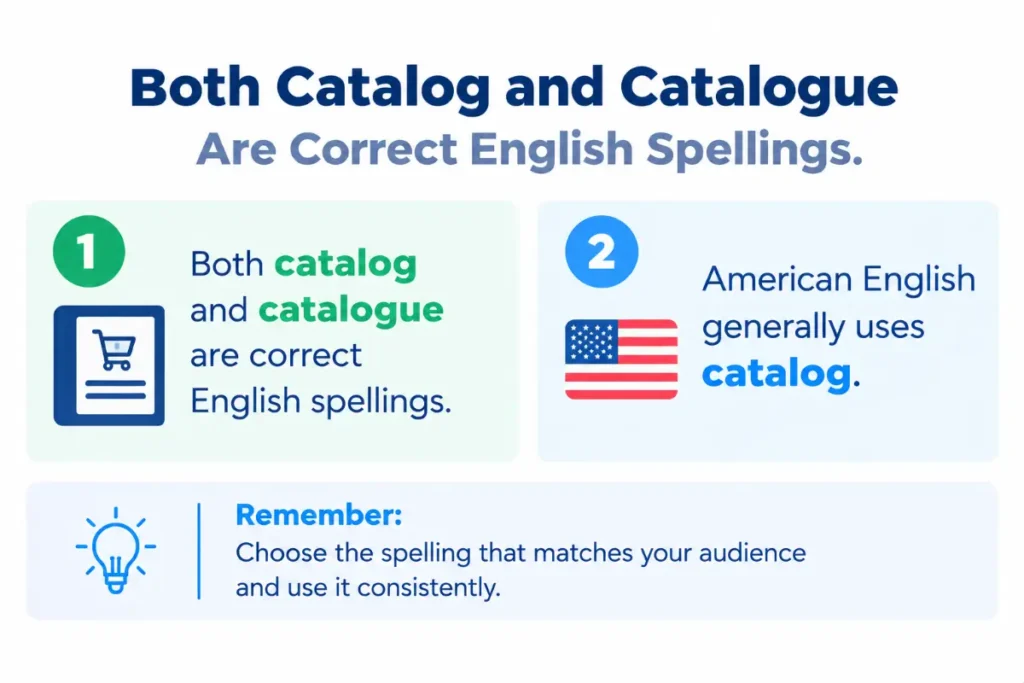
1. Both catalog and catalogue are correct English spellings.
2. American English generally uses catalog.
3. British English generally uses catalogue.
4. Both spellings have the same meaning and pronunciation.
5. Both forms can function as nouns and verbs.
6. American verb forms include cataloging and cataloged.
7. British verb forms include cataloguing and catalogued.
8. Consistency matters in professional, academic, and business writing.
9. Always consider your audience and follow your organization’s preferred style guide.
Conclusion
The choice between catalogue or catalog comes down to regional spelling conventions. Both words describe an organized list or collection of information, and neither is universally more correct than the other. For American readers, catalog is the standard choice, while catalogue is generally preferred in British English.
Once you understand this difference, you can use the word confidently in product descriptions, academic assignments, business documents, library records, and website content. You don’t need to learn separate meanings or grammar rules because the two spellings serve the same purpose. Simply choose the form that fits your audience and apply it consistently.
For everyday American writing, remember one straightforward rule. Use catalog for the noun and verb, along with forms such as catalogs, cataloging, and cataloged. If you’re writing for a British audience, use catalogue, catalogues, cataloguing, and catalogued instead. This small spelling choice helps keep your writing clear, accurate, and professional.
Frequently Asked Questions
Is Catalogue or Catalog Correct?
Both spellings are correct. Catalog is the standard American spelling, while catalogue is preferred in British English. Both refer to an organized list or collection of information.
Is Catalog American or British English?
Catalog is the standard American English spelling. American businesses, universities, libraries, and publishers commonly use it in their writing.
Is Catalogue British or American English?
Catalogue is the preferred British English spelling. It is commonly used in the United Kingdom in retail, education, publishing, and other professional settings.
Do Catalog and Catalogue Mean the Same Thing?
Yes. Both words have the same meaning and can function as nouns or verbs. The difference is regional spelling rather than meaning or grammar.
How Do You Spell Catalog in the United States?
In the United States, the standard spelling is catalog. American writers also use catalogs for the plural noun and cataloging and cataloged for common verb forms.
How Do You Spell Catalogue in the United Kingdom?
In the United Kingdom, the preferred spelling is catalogue. The related verb forms include catalogues, cataloguing, and catalogued.
Is Catalogue a Misspelling in American English?
No. Catalogue is a recognized English spelling, although American English generally prefers catalog. The longer form can still appear in American writing when a particular title, name, or style requires it.
Is Catalog a Misspelling in British English?
No. Catalog is the standard American spelling and is understood in Britain. However, British writers generally choose catalogue in ordinary prose to follow local spelling conventions.
How Do You Pronounce Catalog and Catalogue?
Both spellings have the same standard pronunciation and contain three syllables. The main stress falls on the first syllable. Regional accents may affect the exact sounds, but the spelling difference doesn’t change the pronunciation.
Should I Use Catalog or Catalogue on My Website?
Choose the spelling that matches your primary audience. Use catalog for a website aimed mainly at American readers and catalogue for one aimed mainly at British readers. Keep the spelling consistent across product pages, menus, headings, and related content.
What Is the Difference Between Cataloging and Cataloguing?
Cataloging is the standard American spelling, while cataloguing is the preferred British spelling. Both describe the process of creating and maintaining organized records of items or information.
Can Catalogue Be Used as a Verb?
Yes. In British English, catalogue can mean to create an organized record of items. For example, The librarian will catalogue the new books means the librarian will record and organize information about them. American English generally uses catalog for the same action.

Confusing Words, Spelling & Word Choice
Claire Whitmore is a U.S.-based English editor who writes about commonly confused words, spelling differences, and word choice. Her work helps readers understand subtle distinctions between similar-looking words through simple definitions, practical examples, and modern usage guidance in both American and British English.