
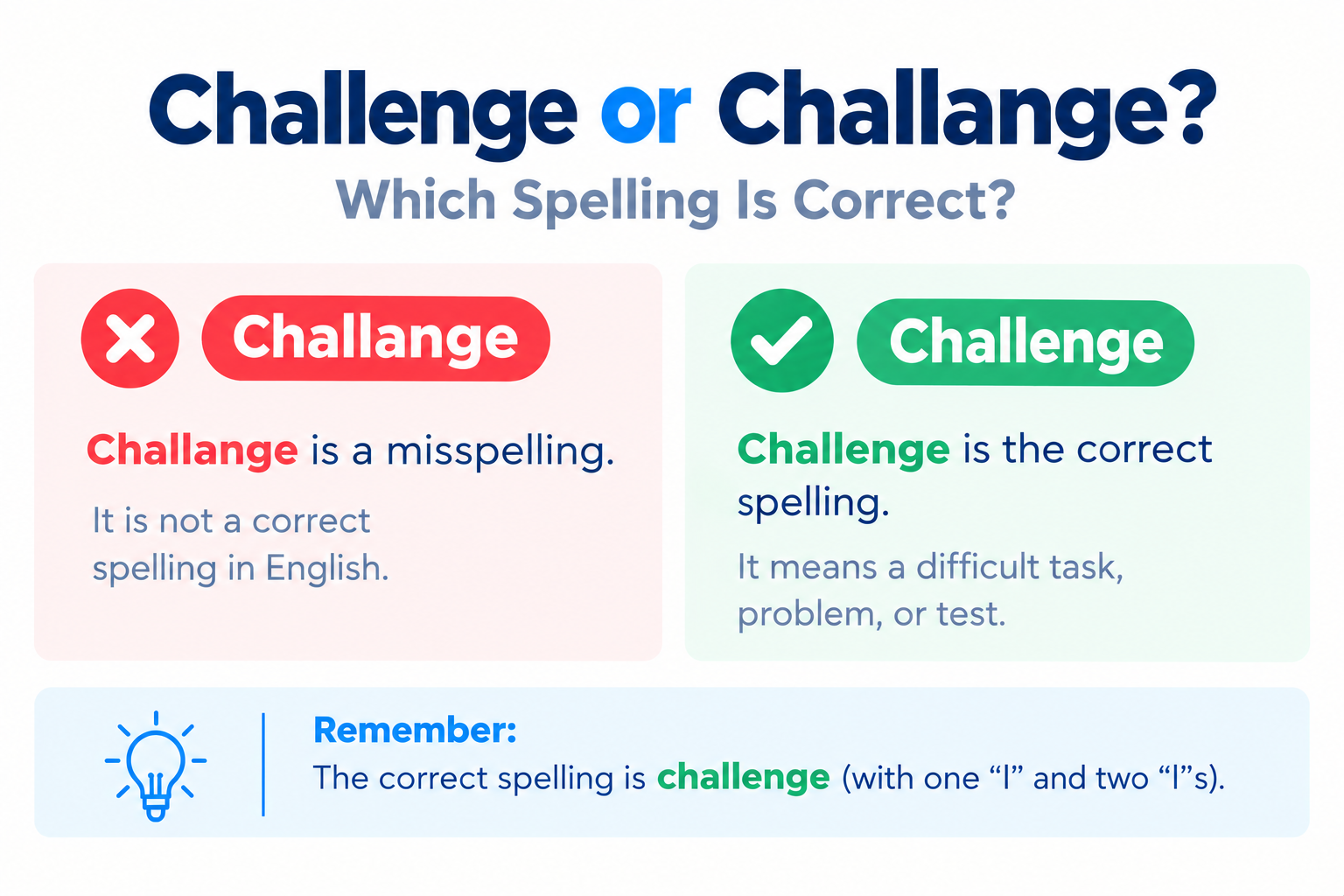
Challenge or challange is a common spelling question because both versions may look plausible at first glance. However, only challenge is the standard spelling in English. The incorrect form often appears when people rely on how they think the word should look instead of remembering its established spelling.
The word challenge has several useful meanings. It can describe a difficult task you need to complete, a problem that tests your abilities, or an action that questions a decision or invites someone to compete. For example, learning a new language can be a challenge, and you can challenge a friend to a game.
Getting this spelling right matters in school assignments, professional emails, essays, website content, and everyday messages. Once you understand the correct spelling, recognize how the word works in a sentence, and learn a simple memory trick, you’ll be less likely to make the same mistake again.
Short Answer
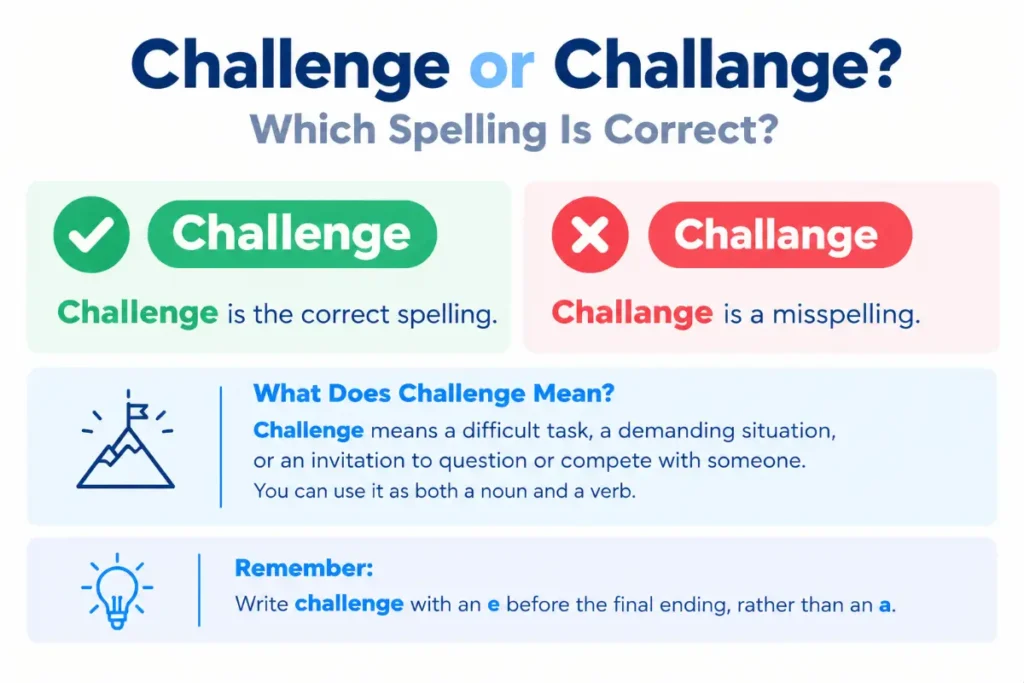
Challenge is the correct spelling. Challange is a misspelling. The word challenge means a difficult task, a demanding situation, or an invitation to question or compete with someone. You can use it as both a noun and a verb. Remember to write challenge with an e before the final ending rather than an a.
Table of Contents
- Which Spelling Is Correct.
- What Challenge Means.
- Why Challange Is Incorrect.
- How to Use Challenge in a Sentence.
- Challenge as a Noun and a Verb.
- Challenge Compared With Similar Words.
- Common Spelling Mistakes.
- Easy Ways to Remember the Spelling.
- American and British English Usage.
- Related Grammar and Word Forms.
- Frequently Asked Questions.
- Key Takeaways.
- Conclusion.
Which Spelling Is Correct
The correct spelling is challenge. The spelling challange is incorrect in standard English and should be corrected in formal and informal writing.
| Spelling | Status | Explanation |
|---|---|---|
| Challenge | Correct | The standard English spelling. |
| Challange | Incorrect | A common misspelling caused by using the wrong vowel. |
The difference comes down to one letter. Challenge contains an e in the final part of the word, while challange uses an a in that position.
For example, write, “Finishing the project on time was a challenge.” Do not write, “Finishing the project on time was a challange.” The first sentence uses the accepted spelling and correctly describes a difficult task.
The same rule applies when you use the word as a verb. You might challenge an opinion, challenge a decision, or challenge yourself to improve a skill. In every case, the base spelling remains challenge.
What Challenge Means
Challenge has several meanings, but they share a central idea. A challenge tests someone’s ability, effort, belief, or willingness to act.
Challenge as a Difficult Task
A challenge can be a task that requires effort, patience, skill, or determination. It may be difficult without being impossible.
Example: “Learning to drive was a challenge for Maria.”
This sentence means that Maria found learning to drive difficult or demanding. It doesn’t necessarily mean she failed. Instead, the experience required her to develop new skills and overcome obstacles.
Other examples include completing a demanding school assignment, training for a marathon, learning computer programming, or managing a complicated project at work. Each can be called a challenge because it requires effort to achieve a goal.
Challenge as a Difficult Situation
The word can also describe a problem or circumstance that makes something harder to accomplish.
Example: “The company faced a challenge when its main supplier closed.”
Here, challenge refers to a difficult situation that affected the company. The sentence suggests that the company needed to find a solution, such as choosing a new supplier or changing its plans.
Challenges can involve money, time, health, relationships, education, or work. The word doesn’t automatically mean a disaster. It often describes a problem that people can address through planning and effort.
Challenge as an Invitation to Compete
A challenge can be an invitation to prove your ability against another person or to complete a specific task.
Example: “Jordan challenged his brother to a chess match.”
This sentence means Jordan invited his brother to compete in chess. The verb challenged describes the action of issuing that invitation.
People also use the noun in phrases such as a fitness challenge, a reading challenge, or a cooking challenge. These expressions usually refer to activities with a goal, a set of rules, or a defined period.
Challenge as an Act of Questioning
Challenge can also mean questioning an idea, decision, claim, or person’s authority. In this sense, the word often appears in discussions, legal matters, academic work, and professional settings.
Example: “The lawyer challenged the accuracy of the evidence.”
This means the lawyer questioned the evidence and argued that its accuracy might be doubtful. The sentence does not tell us if the lawyer succeeded. It simply describes the act of questioning a claim.
Similarly, a student might challenge an answer by presenting different evidence, or an employee might challenge a policy by explaining why it seems unfair or ineffective.
Why Challange Is Incorrect
The spelling challange is incorrect because standard English recognizes challenge as the accepted form. Although the incorrect version may seem reasonable to some writers, it doesn’t follow the established spelling of this word.
The Role of the Vowels
The main difference is the vowel in the final part of the word. Challenge uses e, while challange uses a. That small change creates a spelling error.
English spelling can be confusing because the same sound may have different spellings in different words. However, spelling isn’t always predictable from pronunciation alone. The best approach is to learn the accepted spelling of common words and check unfamiliar forms when needed.
For example, write, “The final exam presented a challenge for the students.” The spelling challenge is correct even if you initially feel tempted to write challange.
Why People Make This Mistake
There are several reasons writers may use the wrong form.
1. Uncertainty about vowel placement. English contains many words with similar letter patterns, so writers sometimes choose the wrong vowel when spelling from memory.
2. Typing too quickly. When you type a message or document quickly, you may enter a familiar looking but incorrect spelling without noticing it.
3. Limited exposure to the written word. Someone who has heard the word more often than they’ve read it may struggle to recall its exact spelling.
4. Repeated typing errors. If you make the same mistake regularly, the incorrect version can start to look familiar. Familiarity doesn’t make a spelling correct.
5. Weak proofreading habits. Writers often focus on the meaning of a sentence and overlook small spelling errors. A quick final review can catch many of these mistakes.
The solution is straightforward. Learn the standard spelling, practice using it in meaningful sentences, and check your writing before submitting or publishing it.
How to Use Challenge in a Sentence
Challenge works in several situations, from casual conversations to academic writing and professional communication. The exact meaning depends on the context.
Examples From Everyday Life
1. “Getting out of bed early is a challenge for me.”
This sentence describes a personal difficulty. The speaker finds it hard to wake up early or get started in the morning.
2. “My friend gave me a challenge to run five miles.”
Here, challenge refers to a task proposed by a friend. The speaker is being encouraged to complete a specific physical activity.
3. “Learning to cook healthy meals can be a challenge.”
This example describes an activity that may require practice, planning, and new skills.
4. “She accepted the challenge with a smile.”
This sentence means she agreed to attempt something demanding. Her smile suggests that she felt positive or confident about it.
5. “The puzzle was challenging but enjoyable.”
Challenging is the adjective form of the verb challenge. It describes something that requires thought or effort.
Examples in School and Education
1. “The science project was a challenge for the entire class.”
The project required students to work through difficulties or complete demanding tasks.
2. “The teacher challenged the students to explain their answers.”
In this sentence, challenged means the teacher encouraged the students to think carefully and demonstrate their understanding.
3. “He challenged the conclusion because the evidence was incomplete.”
Here, challenged means questioned or disputed. The student believed the conclusion needed stronger support.
4. “Reading every day helped her overcome the challenge of difficult vocabulary.”
This sentence shows how regular practice helped the student deal with a specific learning difficulty.
Examples in the Workplace
1. “Meeting the deadline was our biggest challenge.”
The sentence identifies the most difficult part of a work assignment.
2. “The manager challenged the team to improve customer service.”
Here, challenged means encouraged the team to meet a demanding goal.
3. “The employee challenged the decision during the meeting.”
This means the employee questioned the decision, perhaps by raising concerns or presenting a different point of view.
4. “Adapting to the new software was challenging at first.”
Challenging describes the adjustment as difficult during the initial period.
Examples in Formal Writing
1. “The study examines the challenges faced by small businesses.”
Challenges refers to several difficulties that affect small businesses.
2. “The researchers challenged the earlier interpretation of the results.”
Challenged means they questioned a previous explanation and offered reasons to reconsider it.
3. “The proposed policy presents a significant challenge for local authorities.”
This sentence explains that the policy creates a serious problem or demanding responsibility for local officials.
4. “The report identifies practical ways to address this challenge.”
The word challenge refers to a problem already mentioned in the report.
These examples show that challenge is useful in everyday speech, education, business, and formal writing. Its spelling doesn’t change according to the setting.
Challenge as a Noun and a Verb
One reason challenge is such a useful word is that it works as both a noun and a verb. Understanding this difference will help you use it correctly.
Challenge as a Noun
A noun names a person, place, thing, idea, or situation. When challenge functions as a noun, it usually identifies a difficult task, a problem, a competition, or an act of questioning.
Examples include the following.
1. “The interview was a challenge.”
Challenge names the difficult experience of completing the interview.
2. “She enjoys a good challenge.”
Challenge refers to an activity that tests her skills or abilities.
3. “The team accepted the challenge.”
The word identifies a task or competition that the team agreed to undertake.
4. “The court heard a legal challenge to the decision.”
Here, challenge refers to a formal attempt to contest a decision.
Challenge as a Verb
A verb describes an action or state. As a verb, challenge means to question, invite someone to compete, or encourage someone to make an effort.
Examples include the following.
1. “I challenge you to finish this puzzle.”
The speaker invites another person to complete a task.
2. “The journalist challenged the politician’s claim.”
The journalist questioned the claim and sought to test its accuracy.
3. “The coach challenged the players to work harder.”
The coach encouraged the players to improve their effort.
4. “She challenged herself to read more books.”
She set a personal goal that would test her commitment or abilities.
How to Tell the Difference
Look at how the word functions in the sentence. If it names a task or difficulty, it is a noun. If it describes the action of questioning, inviting, or pushing someone to improve, it is a verb.
Compare these sentences.
| Sentence | Part of Speech | Explanation |
|---|---|---|
| The challenge was difficult. | Noun | Challenge names a task. |
| I challenge your decision. | Verb | Challenge describes an action. |
| He accepted the challenge. | Noun | Challenge names an opportunity or task. |
| They challenged the result. | Verb | Challenged describes questioning the result. |
This distinction becomes especially useful when you edit longer sentences. Recognizing the word’s grammatical role helps you choose the correct form without changing its spelling.
Challenge Compared With Similar Words
Challenge has several related words, but they don’t all mean the same thing. Choosing the right one can make your writing more precise.
Challenge and Difficulty
A difficulty is a problem or obstacle that makes something harder to do. A challenge is often a demanding task or situation that requires effort to overcome.
For example, “The lack of funding created a difficulty for the school” emphasizes a particular obstacle. “Expanding the school was a challenge” describes the demanding task as a whole.
The two words can overlap, but challenge often carries a sense of effort, testing, or opportunity.
Challenge and Problem
A problem is something that needs attention or a solution. A challenge is something that tests your ability to respond.
For example, “The computer has a problem” suggests that something isn’t working properly. “Learning to repair the computer is a challenge” emphasizes the effort required to learn the skill.
A problem can become a challenge when solving it requires time, knowledge, or determination.
Challenge and Obstacle
An obstacle is something that blocks or slows progress. A challenge is a demanding situation that calls for action or effort.
For example, “Heavy traffic was an obstacle to reaching the airport on time” identifies something that got in the way. “Catching the early flight was a challenge” describes the overall difficulty of completing the task.
Challenge and Competition
A competition is an event or activity in which people compete to achieve a result. A challenge can involve competition, but it can also be a personal goal or a difficult problem.
For example, a spelling competition involves contestants trying to perform well against one another. A personal spelling challenge might involve learning twenty new words without competing against anyone.
Challenge and Test
A test measures knowledge, ability, or performance. A challenge can test those things, but it doesn’t always involve a formal assessment.
For example, “The exam tested her knowledge of grammar” describes a formal assessment. “Writing a clear article about grammar was a challenge” describes a demanding writing task.
| Word | Main Meaning | Example |
|---|---|---|
| Challenge | A demanding task or act of questioning | Learning French was a challenge. |
| Difficulty | A problem that makes something harder | We had difficulty finding the address. |
| Problem | Something that needs a solution | The printer has a problem. |
| Obstacle | Something that blocks progress | The cost was an obstacle. |
| Competition | An activity involving competing participants | She entered a writing competition. |
| Test | An assessment of knowledge or ability | The test measured his grammar skills. |
Choose the word that expresses your intended meaning. Doing so makes your writing clearer and prevents vague or repetitive sentences.
Common Spelling Mistakes
Challenge is easy to spell once you recognize the correct form, but several related errors can appear when writers add endings or type quickly.
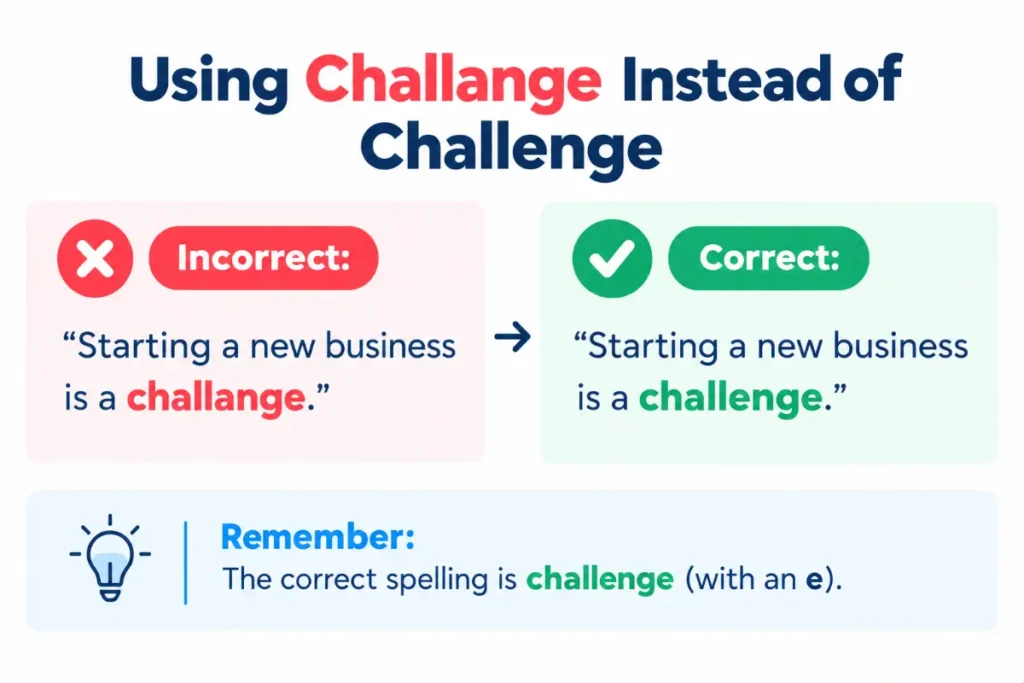
Using Challange Instead of Challenge
Incorrect: “Starting a new business is a challange.”
Correct: “Starting a new business is a challenge.”
The incorrect sentence uses a instead of e in the final part of the word. The corrected sentence follows standard English spelling.
Misspelling the Plural Form
Incorrect: “Students face many challanges during college.”
Correct: “Students face many challenges during college.”
The plural form of challenge is challenges. To form the plural, add s to the complete word. Don’t replace the e with a.
Misspelling the Past Tense
Incorrect: “The teacher challanged the students to think critically.”
Correct: “The teacher challenged the students to think critically.”
The past tense is challenged. Keep the original spelling and add d after the final e.
Misspelling the Present Participle
Incorrect: “She is challanging herself to improve.”
Correct: “She is challenging herself to improve.”
The present participle is challenging. Remove the final e before adding ing.
Confusing Challenge With Challenging
Challenge and challenging are both correct words, but they have different grammatical uses.
1. “The assignment is a challenge.”
Challenge is a noun that identifies the demanding task.
2. “The assignment is challenging.”
Challenging is an adjective describing the assignment as difficult.
3. “The assignment challenges the students.”
Challenges is a verb describing what the assignment does to the students.
Understanding these forms helps you avoid spelling mistakes and grammatical errors at the same time.
Easy Ways to Remember the Spelling
The best memory tricks are simple enough to use when you’re writing quickly. You don’t need to memorize a complicated spelling rule to remember challenge.
Remember the Final E
The easiest trick is to focus on the correct ending. Challenge contains e before its final consonant and final e. Challange replaces the important e with a.
When you write the word, pause briefly and check that you’ve written challenge.
Learn the Word as a Complete Unit
Instead of trying to remember each letter separately, practice the whole word as one unit.
Write a sentence such as, “Every challenge helps me learn something new.” Read it aloud, write it from memory, and check the spelling. Repeating a complete sentence helps you connect the word with its meaning and use.
Connect the Word With a Familiar Goal
Think of a challenge as something that tests your ability. For example, finishing a difficult assignment, learning a new skill, or completing a workout can all be challenges.
When you connect the spelling with a familiar idea, the correct form becomes easier to recall.
Practice the Word Family
Learning related forms reinforces the base spelling.
- Challenge.
- Challenges.
- Challenged.
- Challenging.
- Challenging someone.
- A challenging task.
Notice that the spelling changes slightly when you add certain endings, but the word always comes from the correctly spelled base form challenge.
Use a Quick Self Test
Try completing these sentences without looking at the answers.
- Learning to swim was a difficult ______.
- The teacher ______ the class to explain its reasoning.
- The students faced several new ______.
- She is ______ herself to become a better writer.
Answers.
- Challenge.
- Challenged.
- Challenges.
- Challenging.
This short exercise tests your understanding of the noun, verb, plural, and present participle forms.
American and British English Usage
Some English words have different spellings in American and British English. Examples include color and colour, center and centre, and organize and organise in varieties that use those conventions.
Challenge isn’t one of those words. Challenge is the standard spelling in both American and British English. Challange isn’t an accepted regional alternative in standard English.
This means you don’t need to change the spelling based on your audience. A student writing an essay in the United States should use challenge. A writer preparing a report for a British audience should use the same spelling.
The distinction matters because writers sometimes assume that an unfamiliar spelling must be an acceptable regional variation. That’s not always the case. When a word looks unusual, check its standard form rather than assuming that it belongs to another variety of English.
Related Grammar and Usage Notes
Correct spelling is only one part of effective writing. You also need to understand how challenge changes when it appears in different sentence structures.
The Plural Form Challenges
Use challenges when you refer to more than one challenge.
Example: “The new manager faced several challenges during the first month.”
Challenges is the plural noun because the manager faced multiple difficulties.
When challenge functions as a verb, challenges can also describe an action performed by one person or thing in the present tense.
Example: “The new policy challenges traditional ideas.”
Here, challenges is a verb. It means the policy questions or tests traditional ideas.
The Past Tense Challenged
Add d to challenge to form challenged.
Example: “The team challenged the referee’s decision.”
The sentence describes an action that took place in the past. The team questioned the referee’s decision.
The same form can also work as a past participle.
Example: “The decision was challenged by several members.”
Here, challenged appears in a passive construction. Several members questioned the decision, but the sentence places the decision at the center of attention.
The Present Participle Challenging
Remove the final e before adding ing.
Example: “The students are challenging the results.”
Challenging describes an action in progress. The students are currently questioning the results.
The same spelling can function as an adjective.
Example: “The students completed a challenging assignment.”
In this sentence, challenging describes the assignment as demanding or difficult.
The Adjective Challenging
Challenging is useful when you want to describe a task that requires effort or skill.
Example: “The course is challenging but rewarding.”
The adjective challenging describes the course as demanding. Rewarding adds the idea that the effort brings benefits.
This combination is common in educational and professional writing because it expresses difficulty without suggesting that the experience is entirely negative.
The Related Noun Challenge
Challenge can appear after articles and descriptive words.
Examples include the following.
- A challenge.
- The challenge.
- A serious challenge.
- An unexpected challenge.
- Several challenges.
Example: “The unexpected challenge delayed the project.”
The article the identifies a specific challenge, while unexpected describes it as something the team didn’t anticipate.
Common Expressions With Challenge
Some expressions appear frequently in everyday English.
1. Face a challenge. This means to encounter a difficult task or situation. Example: “The family faced a challenge when they moved to a new city.”
2. Accept a challenge. This means to agree to attempt a demanding task. Example: “He accepted the challenge of learning to play the piano.”
3. Rise to the challenge. This means to respond successfully to a difficult situation. Example: “The team rose to the challenge and completed the project on time.”
4. Take on a challenge. This means to agree to handle a demanding task. Example: “She took on the challenge of organizing the event.”
5. Challenge an assumption. This means to question an idea that people accept as true. Example: “The new research challenges the assumption that the method always works.”
6. A challenge to authority. This refers to an action that questions or opposes someone’s authority. Example: “The public criticism became a challenge to the leader’s authority.”
7. Meet a challenge. This means to deal with a demanding situation successfully or adequately. Example: “The school met the challenge by providing extra tutoring.”
8. Overcome a challenge. This means to succeed in dealing with a difficulty. Example: “She overcame the challenge by practicing every day.”
These expressions make your writing more natural and help you describe different responses to demanding situations.
Professional Writing Tips
Spelling errors can affect how readers perceive your work, especially in applications, reports, academic papers, and business communication. A single typo doesn’t automatically make writing poor, but repeated errors can distract readers from your message.
Proofread Before You Submit
Read your work once for meaning and again for spelling. During the spelling review, pay attention to words you often mistype, including challenge and its related forms.
For example, if you’re writing a job application, check the sentence “I enjoy taking on new challenges.” The correct plural spelling helps your application look polished and professional.
Use Spell Check Carefully
A spell checker can identify many misspellings, including challange. However, it may not catch every error, especially when a typo resembles another recognized word.
Don’t rely entirely on automated corrections. Read the complete sentence to make sure the spelling and meaning fit the context.
Build a Personal List of Difficult Words
If you repeatedly misspell certain words, keep a short practice list. Include the correct spelling, a definition, and one example sentence for each word.
For instance, record challenge with the definition of a demanding task and the example “Completing the course was a challenge.” Reviewing this entry occasionally can help reinforce the correct form.
Choose Precision Over Complicated Vocabulary
You don’t need an elaborate word to express a clear idea. Challenge works well in many situations because it communicates difficulty, competition, or questioning without unnecessary complexity.
For example, “The project presented a challenge” is clear and professional. Choose more specific words only when they express your meaning more accurately.
Key Takeaways
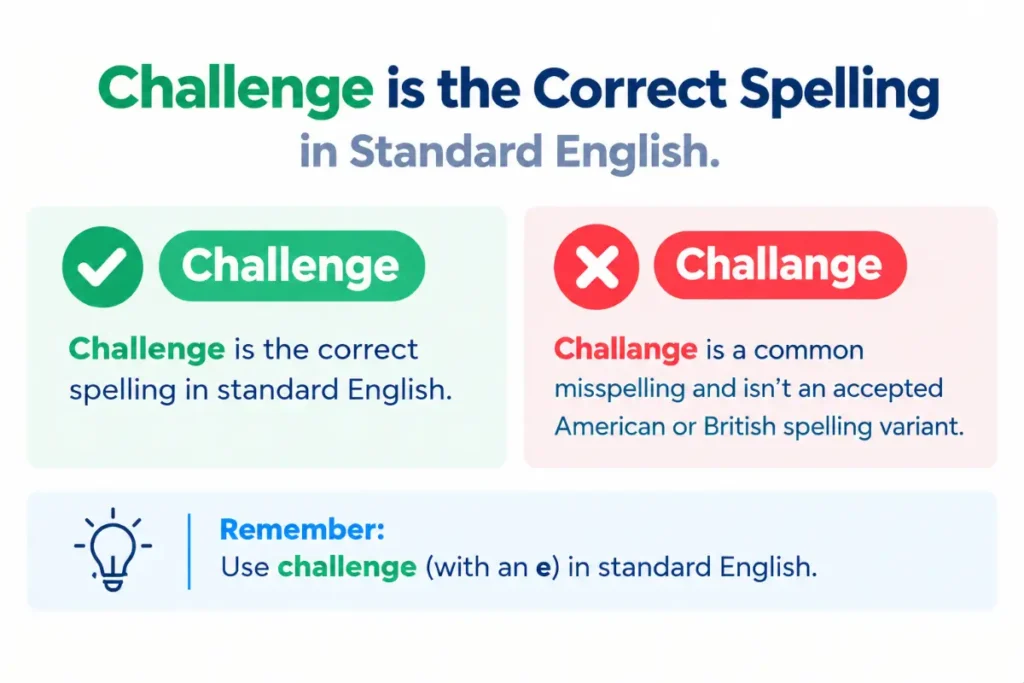
- Challenge is the correct spelling in standard English.
- Challange is a common misspelling and isn’t an accepted American or British spelling variant.
- Challenge can function as both a noun and a verb.
- The plural form is challenges.
- The past tense is challenged.
- The present participle is challenging.
- The word can describe a difficult task, a competition, or an act of questioning.
- A simple memory trick is to remember the e in the final part of challenge.
- Proofreading and regular practice can help prevent repeated spelling mistakes.
- Spell check is useful, but reading the sentence carefully remains important.
Conclusion
Challenge or challange is a spelling question with a straightforward answer. Challenge is the correct spelling, and challange is incorrect. The standard form remains the same in American and British English, so you can use challenge confidently in academic writing, workplace documents, emails, and everyday conversations.
The word describes much more than a difficult task. You can face a challenge, accept a challenge, challenge an opinion, or challenge yourself to develop a new skill. Learning its different meanings and grammatical forms helps you communicate more clearly and choose the right expression for each situation.
Remember the correct spelling by focusing on the e in challenge. Practice using the word in complete sentences, review related forms such as challenges and challenged, and proofread your work before sharing it. A small spelling habit can make your writing clearer and help you express your ideas with confidence.
Frequently Asked Questions
Is Challenge or Challange Correct?
Challenge is correct. Challange is a misspelling and should be corrected in standard English writing.
Why Do People Spell Challenge Incorrectly?
People often confuse the vowels or type too quickly. Limited exposure to the written word and weak proofreading habits can also contribute to the mistake.
What Does Challenge Mean?
Challenge can mean a difficult task, a demanding situation, an invitation to compete, or an act of questioning a decision or claim. Its exact meaning depends on the sentence.
Is Challenge an American or British Spelling?
Challenge is the standard spelling in both American and British English. There is no difference between the two varieties for this word.
What Is the Plural of Challenge?
The plural is challenges. For example, “The students faced several challenges during the semester.”
What Is the Past Tense of Challenge?
The past tense is challenged. For example, “The employee challenged the decision during the meeting.”
What Is the Difference Between Challenge and Challenging?
Challenge can function as a noun or a verb, while challenging often functions as an adjective or a verb form. For example, “The task is a challenge” uses a noun, while “The task is challenging” uses an adjective.
Is Challange Ever Correct?
Challange is not the standard spelling of the English word. Use challenge in schoolwork, professional documents, emails, and everyday writing.
How Do You Remember the Correct Spelling of Challenge?
Remember the e in the final part of challenge. Practice the word in a sentence such as “Every challenge offers a chance to learn.”
Can Challenge Be Used as a Verb?
Yes. Challenge can mean to question something, invite someone to compete, or encourage someone to make a greater effort. For example, “The coach challenged the team to improve.”
What Are Some Synonyms for Challenge?
Depending on the context, synonyms include difficulty, obstacle, test, trial, problem, and contest. These words aren’t always interchangeable, so choose the one that best matches your intended meaning.

Confusing Words, Spelling & Word Choice
Claire Whitmore is a U.S.-based English editor who writes about commonly confused words, spelling differences, and word choice. Her work helps readers understand subtle distinctions between similar-looking words through simple definitions, practical examples, and modern usage guidance in both American and British English.