
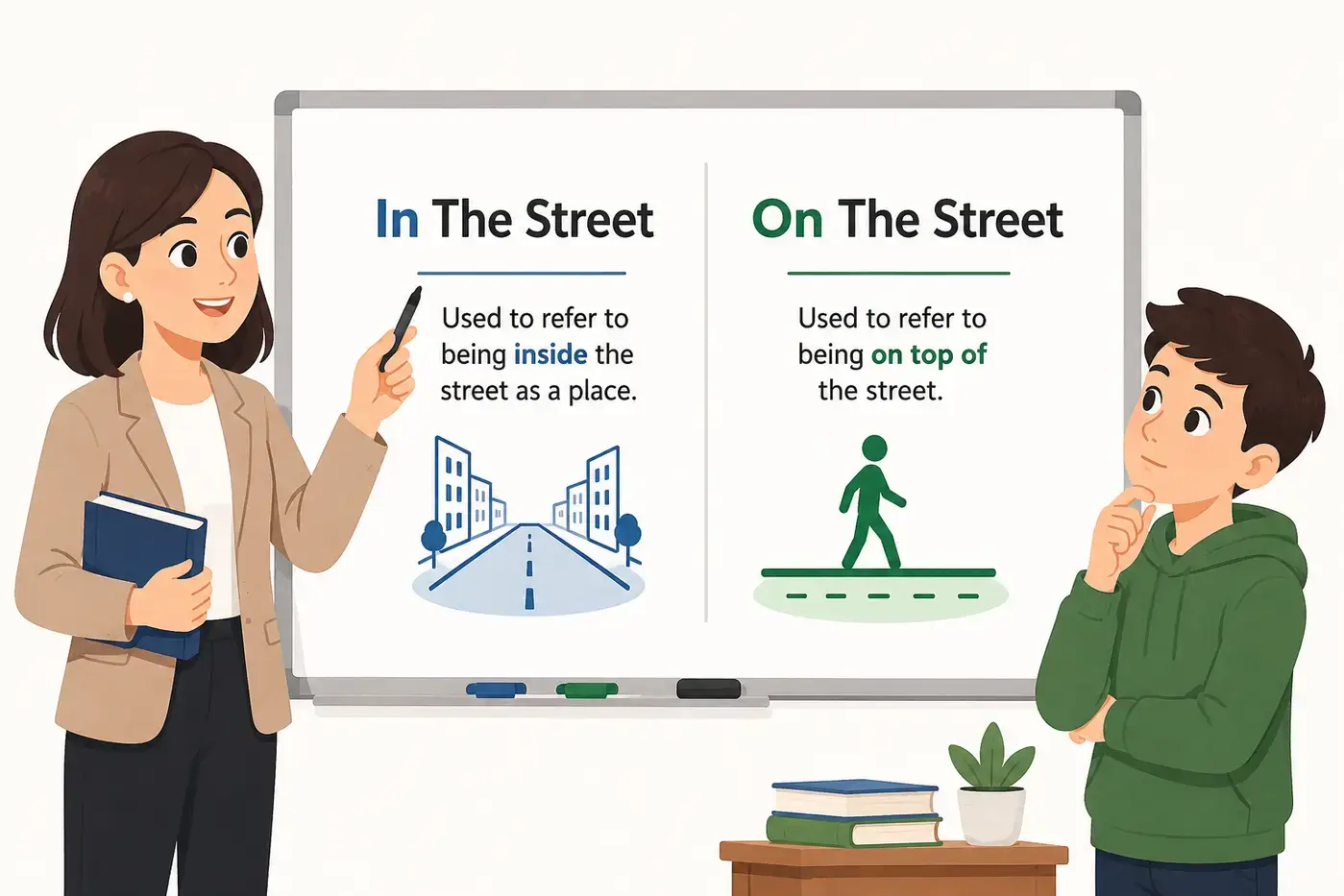
In the Street vs On the Street is a common source of confusion because both phrases seem to describe the same place. Many English learners assume they are interchangeable. Native speakers know there is a subtle difference, and that difference can change the meaning of a sentence.
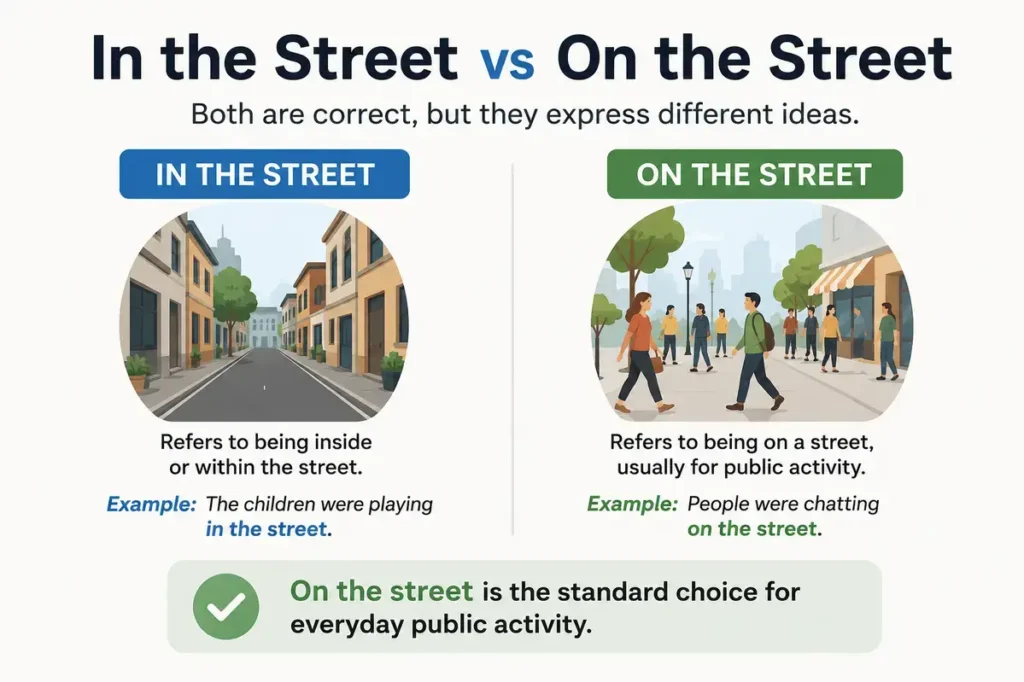
If you hear someone say a child is in the street, you probably imagine the child standing in the road where cars drive. If someone says people are on the street, you picture them outside, walking, talking, shopping, or simply spending time outdoors. The location sounds similar, but the mental image is very different.
This difference comes from English usage rather than strict grammar. Both expressions are grammatically correct. The challenge is knowing which one sounds natural in a particular situation. This guide explains the meanings, grammar, real life usage, American and British preferences, common mistakes, professional writing advice, and simple memory tricks. By the end, you’ll know exactly when to use each phrase with confidence.
Short Answer
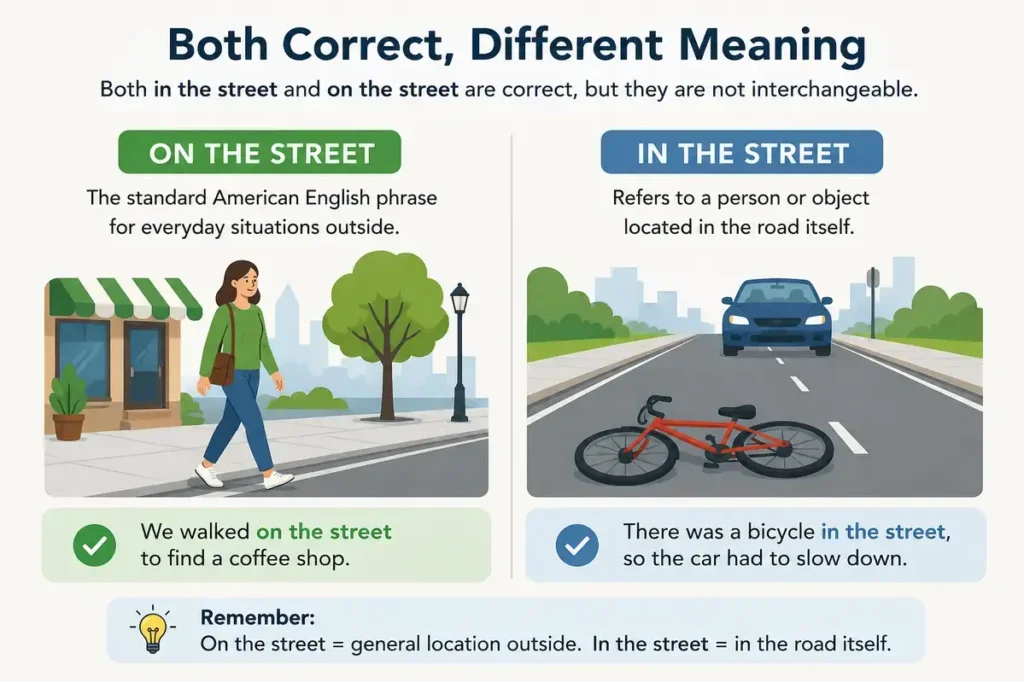
Both in the street and on the street are correct, but they are not interchangeable. On the street is the standard American English phrase for everyday situations outside, while in the street normally refers to a person or object located in the road itself. The right choice depends on the meaning you want to express.
Table Of Contents
- What Does In The Street Vs On The Street Mean.
- The Quick Difference.
- Why English Uses Different Prepositions.
- When To Use On The Street.
- When To Use In The Street.
- Comparison Table.
- Real World Examples.
- Common Grammar Mistakes.
- Professional Writing Tips.
- Memory Tricks.
- Related Grammar Notes.
- Frequently Asked Questions.
- Key Takeaways.
- Conclusion.
What Does In The Street Vs On The Street Mean
Both expressions refer to a street, but they focus on different ideas.
On the street usually describes someone or something located outside in a public area. It is the standard choice in everyday American English.
In the street emphasizes being physically inside the roadway. It often suggests a person or object occupies the space where vehicles travel.
That small change in the preposition creates a different picture in the reader’s mind.
Consider these examples.
She was talking to her neighbor on the street.
This sounds completely natural. It simply means the conversation happened outside.
She was standing in the street.
This creates a stronger image. It tells us she was actually standing in the road.
The Quick Difference
| Expression | Common Meaning | American English |
|---|---|---|
| On the street | Outside in a public place | Very common. |
| In the street | Physically in the roadway | Less common except for this meaning. |
| Key Difference | Explanation |
|---|---|
| On the street | Focuses on a general location or public outdoor setting. |
| In the street | Focuses on an exact physical position inside the roadway. |
Why English Uses Different Prepositions
English prepositions often describe the way people think about space instead of following strict logic.
Think about these examples.
You sit in a car.
You sit on a bus.
English developed these patterns over hundreds of years. Native speakers learn them naturally through repeated exposure instead of memorizing rules.
The same principle explains In the Street vs On the Street.
When English speakers imagine daily life happening outside among buildings and sidewalks, they normally choose on the street.
When To Use On The Street
This is the expression you’ll hear most often in American English.
Use on the street when talking about normal outdoor activity.
People Outside
1.We met on the street after work.
The sentence simply tells us where the meeting happened.
2.Children were playing on the street.
The focus is on outdoor activity instead of the exact position.
3.Tourists filled the street during the festival.
Many writers would still use on the street because the emphasis is the public area rather than the traffic lane.
Everyday Conversations
1. saw him on the street yesterday.
2.She recognized her old teacher on the street.
3.Musicians performed on the street all afternoon.
4.Each example sounds natural because the speaker is describing public life.
Business And Journalism
You’ll often see on the street in newspapers and business writing.
1.Reporters interviewed shoppers on the street.
2.The company asked people on the street for their opinions.
3.Police increased patrols on the street.
Editors usually prefer this expression because it sounds natural and familiar.
Idiomatic Meaning
One reason on the street appears so often is that English includes several common idioms using this phrase.
Word On The Street
Word on the street is that the restaurant will reopen next month. This expression means people are talking about something informally.
Back On The Street
After losing his apartment he was back on the street. Here the phrase means someone has become homeless.
On The Streets
Many charities help people living on the streets. This expression refers to homelessness rather than a physical location.
Street Knowledge
Police officers often rely on information gathered on the street. The phrase suggests information collected directly from ordinary people instead of official reports.
These meanings cannot normally be replaced with in the street.
When To Use In The Street
Although less common, in the street has an important role. It usually highlights physical position.
Someone Is In The Road
A dog was standing in the street.
The dog occupies the roadway.
A bicycle lay in the street after the accident.
The bicycle is physically located in the road.
There was broken glass in the street.
The glass is on the driving surface.
Notice that every example emphasizes exact placement.
Safety Warnings
Parents often use in the street because they want children to think about danger.
Do not play in the street.
Look both ways before stepping in the street.
Never leave toys in the street.
Each sentence directs attention to the roadway where vehicles travel.
Emergency Situations
Firefighters found debris in the street.
Water covered the street after the storm.
A fallen tree blocked traffic in the street.
Again the emphasis is the road itself.
Visual Description
Writers also choose in the street to create vivid scenes.
Rainwater shimmered in the street beneath the city lights.
Leaves scattered in the street after the windstorm.
The phrase helps readers picture objects lying directly on the pavement.
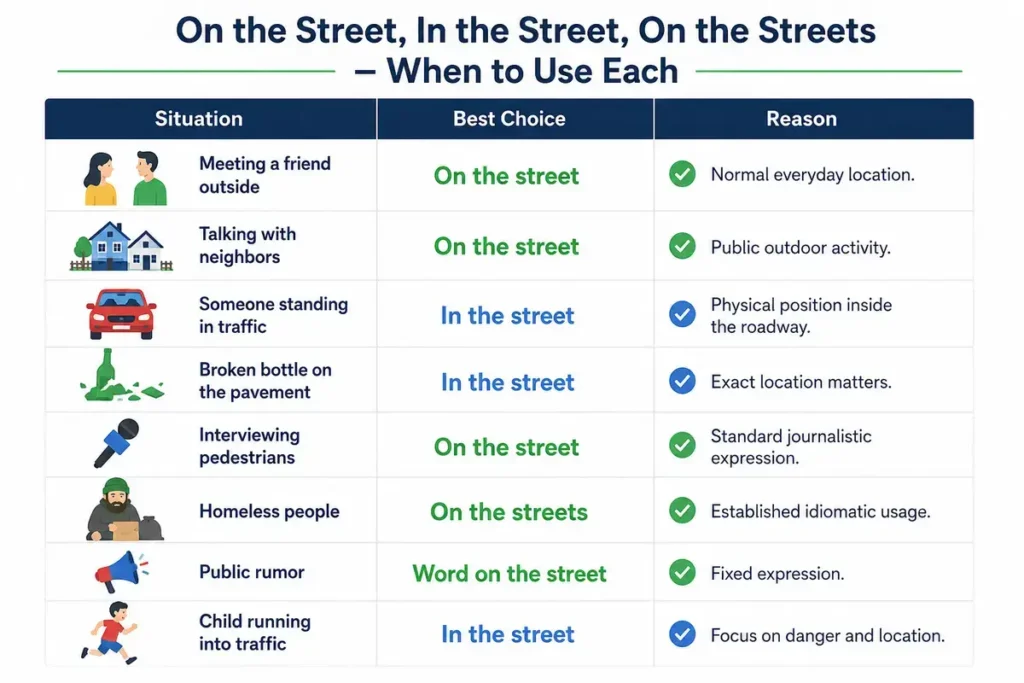
Comparison Table
| Situation | Best Choice | Reason |
|---|---|---|
| Meeting a friend outside | On the street | Normal everyday location. |
| Talking with neighbors | On the street | Public outdoor activity. |
| Someone standing in traffic | In the street | Physical position inside the roadway. |
| Broken bottle on the pavement | In the street | Exact location matters. |
| Interviewing pedestrians | On the street | Standard journalistic expression. |
| Homeless people | On the streets | Established idiomatic usage. |
| Public rumor | Word on the street | Fixed expression. |
| Child running into traffic | In the street | Focus on danger and location. |
Real Life Examples
Looking at real situations makes the difference much easier to remember.
Example One
She was waiting for her friend on the street. This tells us she was outside. The sentence does not say she was standing in the traffic lane. She could have been on the sidewalk or near the curb.
Example Two
She was standing in the street. This creates a different picture. She is physically in the road where vehicles drive.
Example Three
We spent the afternoon walking on the street. This sounds natural because the sentence describes being outdoors in a public place.
Example Four
The ball rolled into the street. Here the ball moved onto the roadway. Using in the street highlights its exact location.
Example Five
The police found debris in the street after the crash. The debris is lying on the road. The focus is its physical position.
Example Six
A reporter interviewed people on the street. This is a common expression in journalism. It simply means the interviews happened in public.
Common Mistakes
Many learners repeat the same errors because they translate directly from their first language instead of following natural English usage.
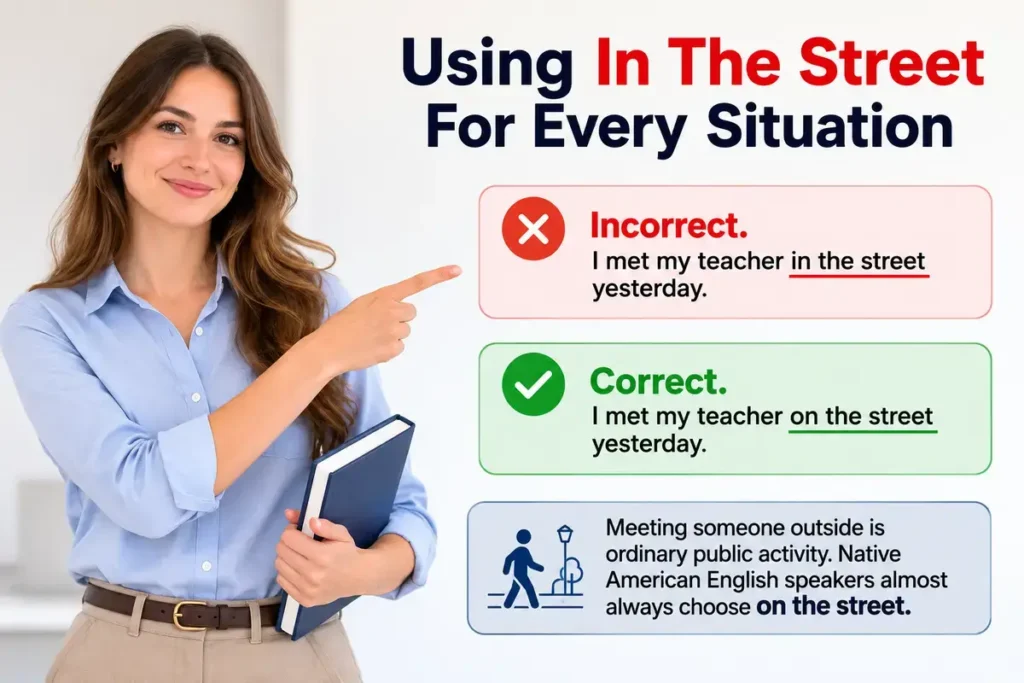
Using In The Street For Every Situation
Incorrect.
I met my teacher in the street yesterday.
Correct.
I met my teacher on the street yesterday.
Meeting someone outside is ordinary public activity. Native American English speakers almost always choose on the street.
Using On The Street For Road Hazards
Less natural.
There was a large rock on the street blocking traffic.
More natural.
There was a large rock in the street blocking traffic.
The second sentence emphasizes that the rock is occupying the roadway.
Replacing Fixed Expressions
Incorrect.
Word in the street says prices will rise.
Correct.
Word on the street says prices will rise.
This is a fixed English expression. It does not change.
Confusing Sidewalk With Road
Many learners think street always means the entire outdoor area. Native speakers often picture the road itself. That is why in the street usually sounds more specific.
Why Native Speakers Choose Different Expressions
Native speakers rarely stop to think about this grammar rule. They learn these expressions through years of reading listening and conversation. Instead of memorizing definitions they connect each phrase with a mental picture.
When they imagine everyday life outside they naturally say on the street.
When they imagine someone standing where cars drive they naturally say in the street.
That instinct develops through repeated exposure.
American English Vs British English
American English strongly prefers on the street for general location.
Examples include.
I saw her on the street.
He stopped me on the street.
There were musicians on the street.
British English also uses on the street in many situations. At the same time British speakers sometimes use in the street a little more often than Americans when describing people outdoors.
For example.
The children were playing in the street.
This sentence sounds perfectly natural in British English because many neighborhoods have quiet residential roads where children play safely.
In American English many writers still accept this sentence. Others may prefer on the street unless they want to emphasize that the children are actually in the roadway.
This difference is small. Both varieties understand each expression easily.
Formal And Informal Usage
Both expressions work in formal and informal writing.
The choice depends on meaning rather than formality.
Academic writing.
Researchers observed pedestrian activity on the street.
News writing.
Police discovered damaged vehicles in the street.
Business writing.
The company conducted interviews on the street.
Creative writing.
The old bicycle lay abandoned in the street.
Professional editors rarely change these expressions unless the chosen preposition creates the wrong image.
Pronunciation
Both phrases are easy to pronounce.
On the street.
The stress falls naturally on street.
In the street.
Again the strongest stress usually falls on street.
In connected speech native speakers often reduce the until it sounds very short.
Word Origin
The word street comes from the Latin word strata which referred to a paved road.
As English developed different prepositions became attached to familiar locations.
That history explains why English speakers say.
On the street.
Yet they also say.
In the house.
These patterns developed naturally over centuries instead of following one universal grammar rule.
Professional Writing Tips
Professional editors think about the picture a sentence creates.
Imagine you are editing these examples.
The children were laughing on the street.
This sounds like normal outdoor activity.
The children were laughing in the street.
Now readers picture children standing in the roadway.
Neither sentence is automatically wrong.
The better choice depends on the scene you want readers to imagine.
This is why experienced writers pay close attention to prepositions. Small words often create the biggest differences.
Memory Tricks
Simple memory devices make these expressions much easier to remember.
Picture The Road
If something occupies the driving lane think in the street.
If someone is simply outside think on the street.
Think About Danger
Parents warn children not to play in the street because cars drive there.
That image helps fix the phrase in your memory.
Remember Common Idioms
Every time you hear these expressions notice the preposition.
Word on the street.
Back on the street.
Life on the streets.
All of these use on.
The more often you notice them the more natural they become.
Related Grammar Notes
This topic connects with several other English preposition patterns.
On The Road Vs In The Road
A traveler is on the road.
A fallen tree is in the road.
The same idea applies to streets.
At School Vs In School
At school refers to location.
In school often refers to being enrolled as a student.
Again English changes meaning through tiny prepositions.
At The Beach Vs On The Beach
Someone relaxing by the ocean is usually on the beach.
Someone standing inside a beach house is in the beach house.
Prepositions always depend on the relationship between the object and the place.
Key Takeaways
- In the Street vs On the Street are both correct but they express different ideas.
- On the street is the standard choice for everyday public activity.
- In the street usually emphasizes the roadway itself.
- American English strongly prefers on the street for general location.
- Many common English idioms use on the street.
- Picture the scene before choosing the preposition.
- The best choice depends on the meaning you want readers to understand.
Conclusion
In the Street vs On the Street is not a question of right or wrong. Both expressions belong in English, but they serve different purposes.
For everyday conversations, public activity, journalism, and most general situations, on the street is the natural choice in American English. It sounds familiar because native speakers use it every day. Use in the street when the exact position matters. It tells readers that someone or something is physically in the roadway, often where traffic travels. That small change in the preposition creates a much clearer mental picture.
One of the easiest ways to choose the correct phrase is to imagine the scene. If the focus is simply being outside, on the street will almost always sound natural. If the focus is the road itself, in the street is usually the better option. Once you connect each expression with its image instead of trying to memorize a grammar rule, the choice becomes almost automatic. That’s the same approach experienced editors, professional writers, and native speakers rely on every day.
Frequently Asked Questions
Is In the Street vs On the Street both correct?
Yes. Both expressions are correct. The difference is meaning. On the street usually refers to being outside in a public place. In the street usually means being physically in the roadway.
Which expression is more common in American English?
On the street is much more common. Americans use it for everyday conversations, news reports, business writing, and casual speech.
When should I use In the Street?
Use in the street when you want to show that a person, animal, or object is actually in the road where vehicles travel.
Correct example.
The child ran into the street.
This sentence creates a clear picture of the child’s location.
When should I use On the Street?
Use on the street for normal outdoor activities or when referring to people in public.
Examples.
I met my neighbor on the street.
A musician was performing on the street.
Both sound natural because the focus is the public setting.
Is In the Street more common in British English?
Yes. British English uses in the street a little more often than American English, especially when talking about residential streets where children play. Even so, on the street remains common in British English as well.
Why does Word on the Street use On instead of In?
Word on the street is a fixed idiom. It means unofficial information or popular opinion. Native speakers do not replace on with in in this expression.
Can I say People live in the street?
That sentence is unusual in American English.
If you mean people are homeless, say.
People live on the streets.
If you mean they live along a particular street, say.
They live on Maple Street.
Is On the Street always about sidewalks?
No. On the street refers broadly to being outdoors in a public place. It does not always mean someone is standing on the sidewalk.
Why do learners confuse these phrases?
Many languages use one preposition for roads, streets, and public places. English divides these ideas into different expressions based on the mental picture the speaker wants to create.
How can I remember the difference?
Picture the scene.
If someone is outside in everyday life, choose on the street.
If someone or something is occupying the roadway, choose in the street.
That simple image works in most situations.

English Grammar & Usage
Nathan Holloway is an American grammar writer and language researcher who specializes in English grammar, sentence structure, verb usage, and common writing mistakes. He enjoys breaking down confusing grammar rules into practical explanations with clear examples, making English easier for students, professionals, and everyday writers.