
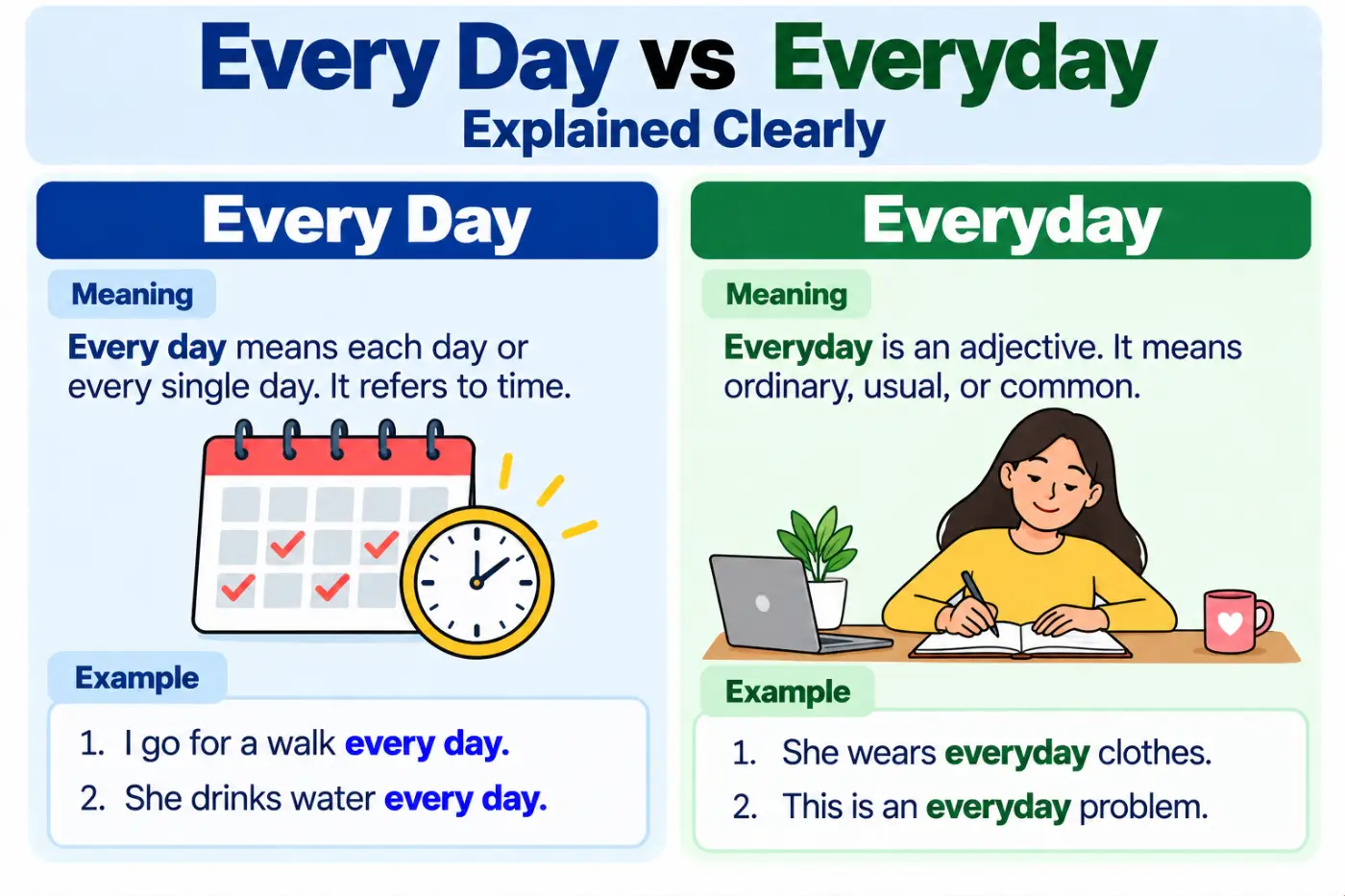
Every day vs everyday causes confusion because the two forms look almost identical and sound the same in normal speech. The difference is grammatical rather than pronunciation based. Every day refers to something that happens each day while everyday describes something ordinary or common.
The easiest way to tell them apart is to look at the job the words perform in the sentence. When the expression tells you how often an action happens use two words. When it describes a noun use the single word form.
This small spelling difference can change the meaning and grammar of a sentence. Once you understand the basic rule you can spot the correct form quickly in emails school assignments articles conversations and professional writing.
Short Answer
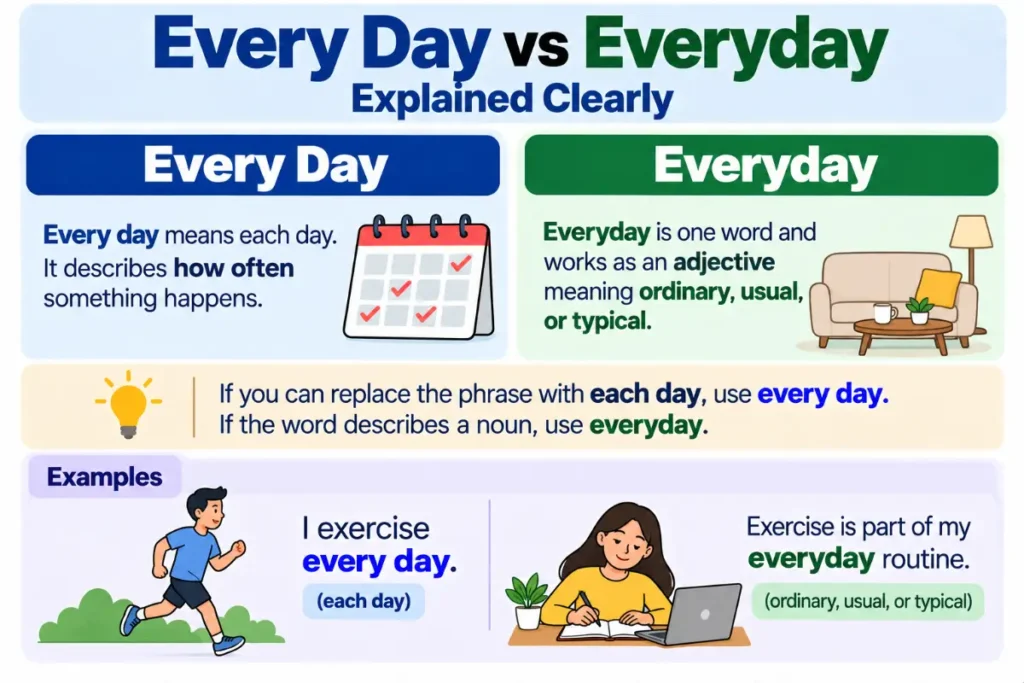
Every day means each day. It describes how often something happens. Everyday is one word and works as an adjective meaning ordinary usual or typical. If you can replace the phrase with each day use every day. If the word describes a noun use everyday. For example I exercise every day. Exercise is part of my everyday routine.
Table Of Contents
- The basic difference.
- What every day means.
- What everyday means.
- How the grammar works.
- Every day vs everyday examples.
- A simple comparison.
- How to choose the correct form.
- Common mistakes.
- Everyday as an adjective.
- Every day as an adverbial phrase.
- Pronunciation and sound.
- American English and British English.
- Professional writing tips.
- Memory tricks.
- Related expressions.
- Real life examples.
- Frequently asked questions.
- Key takeaways.
- Conclusion.
The Basic Difference
The main difference is simple.
Every day means each day. It usually tells us when or how often an action happens.
Everyday means ordinary usual or common. It normally comes directly before a noun and describes that noun.
Consider these two sentences.
I walk to work every day.
I wear my everyday shoes to work.
In the first sentence every day tells us how often I walk to work. It functions as an adverbial phrase.
In the second sentence everyday describes shoes. It tells us what kind of shoes they are.
That is the central rule. Learn that distinction and most usage questions become easy.
What Every Day Means
Every day means each day or on each day.
It refers to frequency. You use it when something happens regularly on a daily basis.
Examples include:
I drink coffee every day.
She reads every day.
We practice English every day.
They call their parents every day.
He checks his email every day.
In each sentence the expression answers a question about frequency.
How often do I drink coffee?
Every day.
How often does she read?
Every day.
How often do they call their parents?
Every day.
The two words stay separate because the expression has a meaning similar to each day.
You can often test the sentence by replacing every day with each day.
I exercise every day.
I exercise each day.
The second version sounds slightly more formal or deliberate but the basic meaning remains clear.
This substitution test is one of the most useful ways to check your writing.
What Everyday Means
Everyday is an adjective. It means ordinary usual regular or typical.
It describes a noun.
Examples include:
These are my everyday clothes.
Cooking is an everyday activity for many families.
She uses an everyday vocabulary in her writing.
The store sells everyday household products.
Stress is an everyday part of modern work for many people.
In these sentences everyday describes clothes activity vocabulary products and part.
You cannot normally replace everyday with each day and keep the same grammatical structure.
These are my each day clothes.
That sentence doesn’t work because each day does not function as an adjective before clothes.
The correct sentence is:
These are my everyday clothes.
The meaning is that the clothes are ordinary clothes used as part of normal life.
How The Grammar Works
The difference becomes clearer when you look at grammar.
Every day is a phrase made from an adjective and a noun.
Every modifies day. The complete phrase means each day.
Everyday is a single adjective.
It usually modifies a noun that follows it.
Compare the structures.
I study every day.
I study is the main clause and every day tells us how often the action happens.
Everyday describes English and tells us what type of English is being discussed.
This grammatical difference matters because English often uses word combinations that look similar but perform different jobs.
Another useful comparison is always and usual.
Always describes frequency.
Usual describes something that is normal or expected.
The same broad idea appears with every day and everyday.
Every Day Vs Everyday Examples
The best way to learn this distinction is to see the two forms in natural sentences.
I call my grandmother every day.
This means I call her each day. The expression tells us how often I call.
My call with my grandmother is part of my everyday routine.
Here everyday describes routine. It means the routine belongs to normal daily life.
She practices the piano every day.
The expression tells us that her practice happens each day.
The piano is part of her everyday life.
Everyday describes life and means normal or ordinary life.
We use this app every day.
This tells us how often we use the app.
The app is useful for everyday tasks.
This tells us that the tasks are ordinary activities people commonly need to handle.
He wears a suit every day.
The phrase tells us how often he wears a suit.
He bought an everyday suit for work.
The adjective describes the suit as ordinary or suitable for regular use.
They cook dinner every day.
The phrase tells us the frequency of cooking.
Cooking is an everyday activity in their home.
The adjective describes the activity as normal and routine.
A Simple Comparison
| Form | Meaning | Grammar role | Example |
|---|---|---|---|
| Every day | Each day | Adverbial phrase | I walk every day. |
| Everyday | Ordinary or usual | Adjective | These are my everyday shoes. |
The quickest rule is this.
Use every day for frequency.
Use everyday for description.
If the phrase answers how often use every day.
If it describes a noun use everyday.
That rule handles most everyday writing situations.
How To Choose The Correct Form
When you aren’t sure which form to use pause for a moment and look at the sentence.
First ask whether the expression means each day.
If it does use every day.
For example:
She studies every day.
You can rewrite it as:
She studies each day.
The meaning stays almost the same.
Next ask if the word describes a noun.
If it does use everyday.
For example:
She has an everyday study routine.
Here everyday describes routine. It means the routine is normal or regular.
Another useful test is to look at the word that comes before the expression.
If you have a verb followed by the expression the two word form will often be correct.
I work every day.
He runs every day.
We practice every day.
They travel every day.
If the expression comes before a noun and describes that noun the single word form will often be correct.
Everyday clothes.
Everyday language.
This isn’t an absolute rule for every possible sentence because English grammar has many structures. Still it works extremely well for ordinary usage.
Common Mistakes
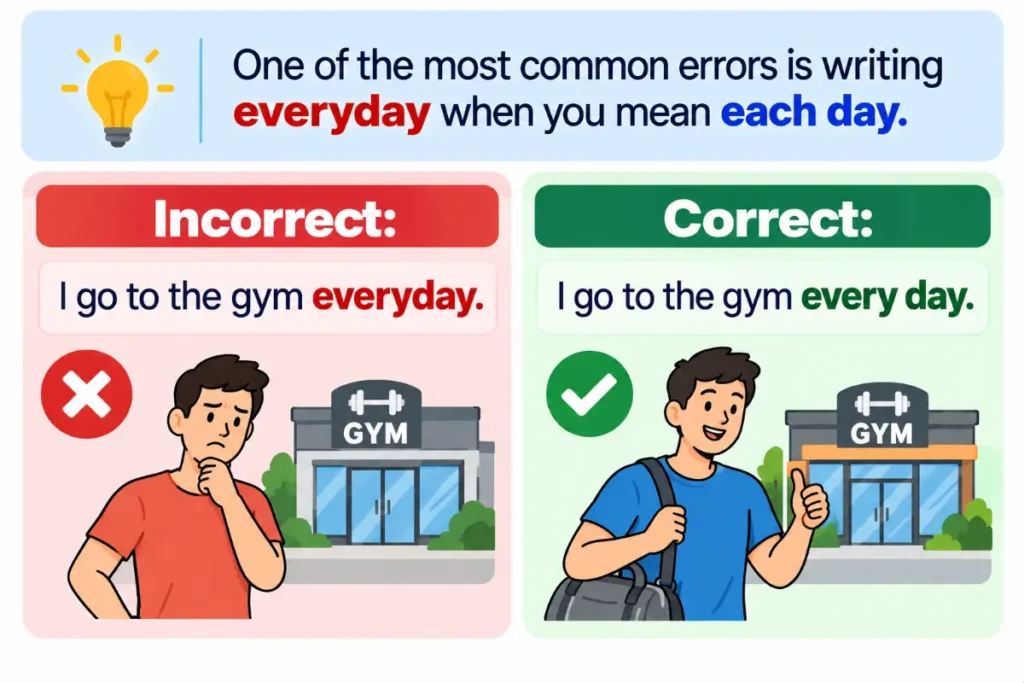
One of the most common errors is writing everyday when you mean each day.
Incorrect:
I go to the gym everyday.
Correct:
I go to the gym every day.
The expression tells us how often the person goes to the gym. It doesn’t describe the gym.
Another common mistake is separating everyday when it acts as an adjective.
Incorrect:
I need some every day clothes.
Correct:
I need some everyday clothes.
Here the word describes clothes. It means clothes for normal or regular use.
Another mistake is assuming that everyday always means something happens daily.
That isn’t quite right.
Everyday means ordinary or typical. Something can be everyday without happening every single day.
For example:
Traffic is an everyday problem for many commuters.
The sentence doesn’t necessarily mean every commuter faces traffic every single day. It describes traffic as a common and ordinary part of life.
The same idea applies to everyday language.
Everyday language means ordinary language used in normal communication. It doesn’t mean language that must be used every day.
Everyday As An Adjective
Everyday is an adjective. This means it modifies or describes a noun.
Common combinations include:
Everyday life.
Everyday language.
Notice how the adjective usually appears immediately before the noun.
She prefers comfortable everyday clothes.
He uses simple everyday language.
The article focuses on everyday problems.
These are useful everyday tools.
Everyday can also appear after certain linking structures when it functions as a description.
For example:
Her problems are everyday concerns.
The expression still describes the concerns as ordinary or common.
Every Day As An Adverbial Phrase
Every day usually works as an adverbial phrase that modifies a verb or an entire action.
It tells us how often something happens.
Examples include:
I exercise every day.
She cooks every day.
We talk every day.
He studies every day.
They walk every day.
The phrase can appear in different positions depending on the sentence.
Every day I walk for thirty minutes.
I walk every day for thirty minutes.
I walk for thirty minutes every day.
All three sentences communicate the same basic frequency.
The placement can affect rhythm and emphasis but doesn’t change the central meaning.
Pronunciation And Sound
Every day and everyday are normally pronounced the same in standard American English when they appear naturally in speech.
That creates part of the confusion.
Because the forms sound alike speakers cannot rely on pronunciation to choose the spelling. You need to look at grammar and meaning.
If you are writing the sentence and hear the expression in your head ask what role it plays.
If it means ordinary or usual and modifies a noun write one word.
The spelling carries the grammatical difference even though the pronunciation does not provide a useful clue.
American English And British English
The distinction between every day and everyday applies in both American and British English.
Both varieties use every day to mean each day.
Both also use everyday as an adjective meaning ordinary or usual.
For example:
I work every day.
This is my everyday bag.
The basic rule does not change because of the variety of English being used.
Other spelling differences can vary between American and British English but this particular distinction is shared.
That makes the rule useful for international English writing as well as American English.
Formal And Informal Usage
Both forms are standard and appropriate in formal and informal writing.
Every day can appear in professional reports academic writing personal messages and ordinary conversation.
For example:
The team meets every day to review progress.
Everyday can also appear in formal writing when it describes something ordinary or routine.
For example:
The study examines how people make everyday financial decisions.
The key issue isn’t formality. The issue is grammar.
Using the wrong form can make polished writing look careless even when the meaning is easy to understand.
A professional writer should therefore check the function of the expression instead of relying only on how it sounds.
Professional Writing Tips
Clear writing depends on small details. This distinction is a good example.
If you’re editing an article report email or website copy look for every day and everyday separately.
When you find every day ask if it means each day.
When you find everyday ask what noun it describes.
This quick check can catch many errors.
Consider this sentence:
Our team checks the data everyday.
The intended meaning is that the team checks the data each day.
The correct version is:
Our team checks the data every day.
Now consider:
Our team follows an everyday data review process.
Here everyday describes process. It means the process is part of normal routine work.
Professional writers should also avoid forcing everyday into a sentence simply because it looks shorter.
Shorter isn’t always better.
The correct grammatical form is better.
Memory Tips
A simple memory trick can help you remember the difference.
Think of every day as a calendar phrase.
You can point to Monday Tuesday Wednesday and the other days on a calendar. Each one is a day.
So when you mean each day use every day.
Think of everyday as a description.
It describes things that are ordinary familiar or routine.
Everyday clothes are normal clothes.
Everyday language is ordinary language.
Another useful trick is the each day test.
Replace the expression with each day.
If the sentence still makes sense use every day.
For example:
I read every day.
I read each day.
The meaning works.
Now try:
I wear every day shoes.
I wear each day shoes.
The second version doesn’t work.
The correct form is:
I wear everyday shoes.
You can also remember this simple formula.
Frequency equals every day.
Description equals everyday.
Once that pattern becomes familiar you won’t need to stop and think about it very often.
Related Grammar And Usage Notes
Every is a determiner that can refer to each member of a group considered individually.
In every day the word every modifies the noun day.
The phrase therefore refers to each day.
Everyday developed as a compound adjective and now functions as a single word with a related but different meaning.
This difference reflects a broader pattern in English. Two words can develop into a compound word that takes on its own grammatical function and meaning.
You can see a similar distinction in other expressions.
A lot means a large amount.
Alot is a common misspelling.
Some compound words and phrases also change meaning when written together or separately.
The important point is that spelling and grammar work together.
Don’t assume that two words should be combined simply because they sound like one word.
Every Day In Different Sentence Positions
It can appear at the beginning middle or end of a sentence.
Every day I take a short walk.
I every day take a short walk.
The second version is grammatically possible in limited contexts but sounds unnatural in ordinary American English.
I take a short walk every day.
This is the most natural position in many everyday sentences.
Every day can also appear at the beginning for emphasis.
Every day she learns something new.
The expression still means each day.
The meaning doesn’t depend on its position.
Everyday In Different Contexts
It is especially common when describing normal life.
Everyday life refers to ordinary daily experiences.
Everyday language refers to ordinary speech rather than highly technical or formal language.
The word often carries a sense of familiarity.
An everyday item doesn’t need to be used literally every single day. It simply belongs to normal routine life or common experience.
That distinction is important because learners sometimes interpret the word too literally.
Real Life Examples
Here are several examples that show how the meaning changes.
I check the weather every day.
The expression tells us frequency. The person checks the weather each day.
Checking the weather is an everyday habit.
The adjective describes the habit as normal or routine.
She drinks water every day.
The phrase tells us how often she drinks water.
Water is an everyday necessity.
The adjective describes water as something ordinary and commonly needed.
He wears his everyday shoes when he goes to the store.
Everyday describes the shoes. They are regular shoes for normal use.
He cleans those shoes every day.
Every day tells us how often he cleans them.
We use English every day.
The expression describes frequency.
We use everyday English in casual conversation.
Everyday describes the type of English.
They face everyday challenges.
Everyday means ordinary or common.
They solve problems every day.
Every day means each day.
She keeps an everyday journal.
Everyday describes the kind of journal.
She writes in it every day.
Every day describes the frequency of writing.
These paired examples show why the distinction matters. The words look almost identical but their grammatical jobs are different.
When Everyday Does Not Mean Daily
This point deserves special attention.
Everyday does not literally mean daily.
It means ordinary usual or typical.
Suppose someone says:
That is an everyday problem.
The speaker is saying that the problem is common or ordinary.
The sentence doesn’t necessarily say the problem occurs every day.
Now compare:
That problem happens every day.
This sentence makes a direct claim about frequency.
The problem occurs each day.
This difference can matter in professional and academic writing because precise language prevents misunderstandings.
If you want to describe frequency use every day.
If you want to describe something as ordinary use everyday.
Everyday Language And Every Day Language
The phrase everyday language is standard when you mean ordinary language used in normal communication.
For example:
The teacher explained the difficult concept in everyday language.
Here everyday describes language.
The phrase every day language would normally be incorrect if you mean ordinary language.
However the words every day can appear separately when they have a different grammatical function.
For example:
We use clear language every day.
Here every day tells us how often we use clear language.
This is a useful contrast because both expressions can appear near the noun language while serving completely different purposes.
Everyday Use And Use Every Day
These two structures are especially easy to confuse.
Everyday use means regular or ordinary use.
This product is designed for everyday use.
Everyday describes use.
Use every day means use something each day.
You should use this product every day.
Every day describes the frequency of use.
The first sentence describes the type of use.
The second sentence describes how often someone should use the product.
This distinction appears in instructions product descriptions advertisements and health and fitness writing.
Key Takeaways
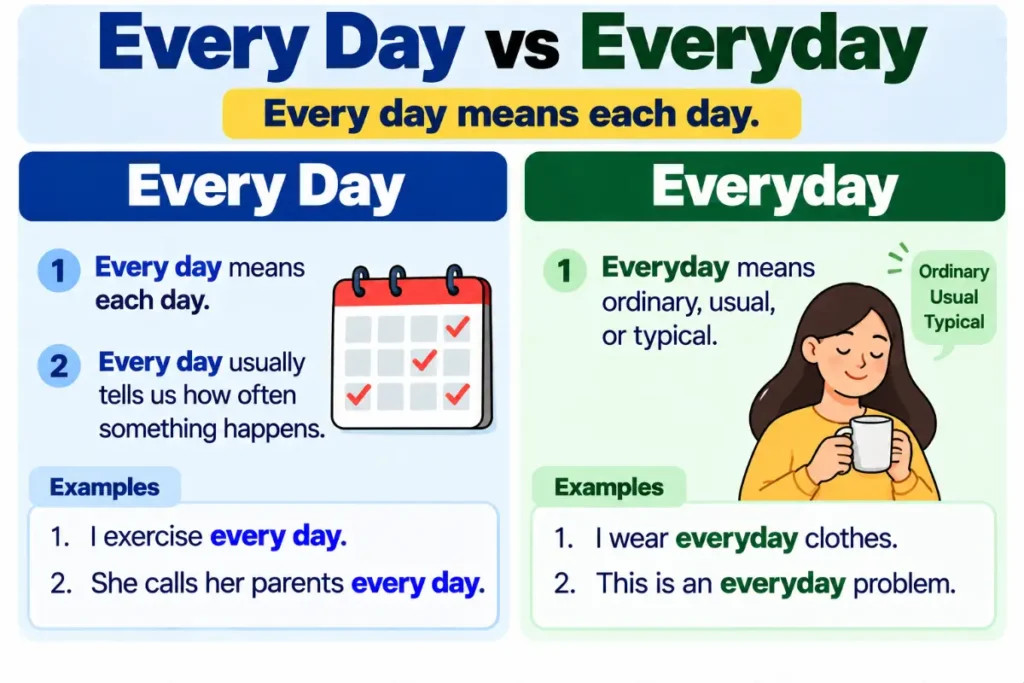
- Every day means each day.
- Everyday means ordinary usual or typical.
- Every day usually tells us how often something happens.
- Everyday usually describes a noun.
- Use the each day test when you’re unsure.
- I study every day means I study each day.
- Everyday English means ordinary English.
- Everyday does not necessarily mean something happens daily.
- The distinction applies in both American and British English.
- Both forms are standard English but they aren’t interchangeable.
Conclusion
Every day vs everyday becomes much easier once you focus on grammar instead of sound. Every day means each day and usually tells us how often an action happens. Everyday is an adjective that describes something as ordinary usual typical or suitable for regular use.
The fastest test is simple. Replace the expression with each day. If the sentence still works use every day. If you need an adjective to describe a noun use everyday. This small check can prevent one of the most common spelling and usage mistakes in everyday English.
With regular practice the distinction will become second nature. Write I read every day when you’re talking about frequency. Write everyday reading when you’re describing ordinary reading. The words are close in appearance but their jobs are different and that one grammatical difference tells you which form to choose.
Common Questions About Every Day And Everyday
Is every day always two words?
When you mean each day or on each day use two words.
For example:
I exercise every day.
The phrase describes frequency.
Is everyday always one word?
When everyday functions as an adjective meaning ordinary usual or typical it is written as one word.
For example:
These are my everyday shoes.
The word describes shoes.
Can everyday mean every day?
No. Everyday and every day have different grammatical functions.
Everyday means ordinary usual or typical.
Every day means each day.
They may sound the same but they aren’t interchangeable.
Is I work everyday correct?
If you mean that you work each day the standard form is:
I work every day.
Every day describes how often you work.
Is everyday a real word?
Yes. Everyday is a standard English adjective.
It commonly means ordinary usual typical or suitable for regular use.
Examples include everyday clothes everyday language and everyday activities.
Can every day come before a noun?
Every day can appear before a noun in some grammatical structures but that doesn’t make it the same as everyday.
For example:
Every day brings a new challenge.
Here every modifies day and the phrase is the subject of the sentence.
The expression means each day.
Is everyday formal English?
Yes. Everyday is a standard word used in both formal and informal English.
Its level of formality depends on the context and the noun it describes.
What is the easiest way to remember the difference?
Remember this rule.
Every day means each day.
Everyday means ordinary or usual.
The each day substitution test is especially useful.
Which is correct every day life or everyday life?
Everyday life is correct when you mean ordinary life.
For example:
Technology affects everyday life.
Everyday describes life.
Which is correct every day activities or everyday activities?
Everyday activities is correct when you mean ordinary or routine activities.
For example:
Exercise and cooking are everyday activities for many people.
The adjective describes activities.
Can everyday describe people?
Yes. Everyday can describe a person in certain contexts when the meaning is ordinary or typical.
For example:
She is an everyday person with ordinary concerns.
However the word can sound less natural than alternatives such as ordinary or typical depending on the sentence.
Why do every day and everyday sound the same?
The two forms developed closely enough that normal pronunciation doesn’t provide a clear distinction in modern English.
Writers therefore need to use grammar and meaning to choose the spelling.

Confusing Words, Spelling & Word Choice
Claire Whitmore is a U.S.-based English editor who writes about commonly confused words, spelling differences, and word choice. Her work helps readers understand subtle distinctions between similar-looking words through simple definitions, practical examples, and modern usage guidance in both American and British English.