
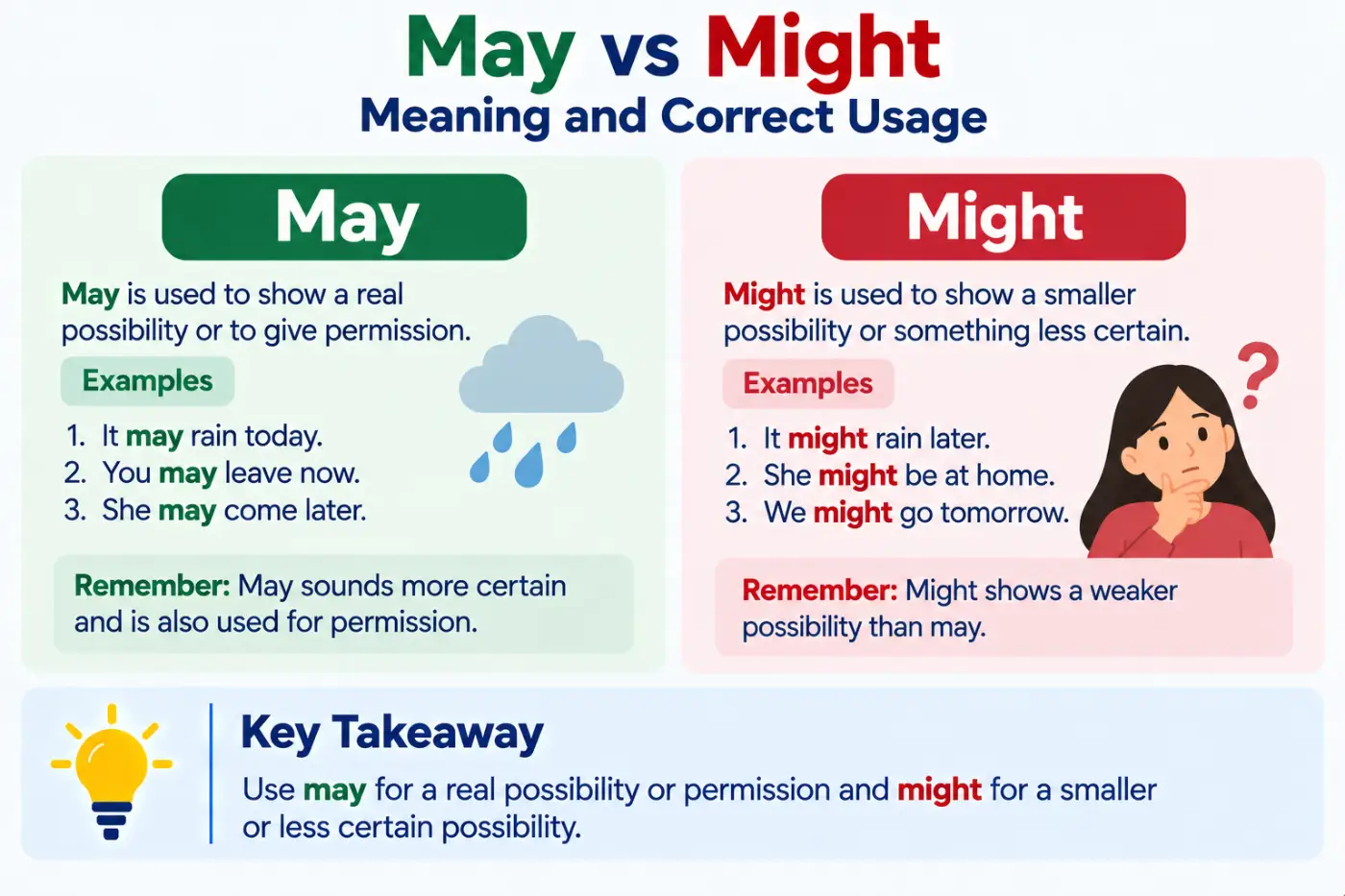
May vs might can be confusing because both modal verbs often appear in sentences about possibility. In many everyday situations, you can use either one without creating a serious grammatical error. The difference usually comes from certainty, context, time, and the speaker’s intended tone.
May has several jobs in English. It can describe possibility, give or ask for permission, and appear in formal expressions. Might also expresses possibility, but speakers often choose it when they want to sound more tentative. It can also refer to a possibility viewed from a past point in time.
The good news is that you don’t need to memorize dozens of complicated rules. Once you understand the main patterns, the choice becomes much easier. This guide explains the difference between these modal verbs with clear examples, grammar rules, pronunciation help, formal and informal usage, common mistakes, regional notes, and practical memory tips.
Short Answer
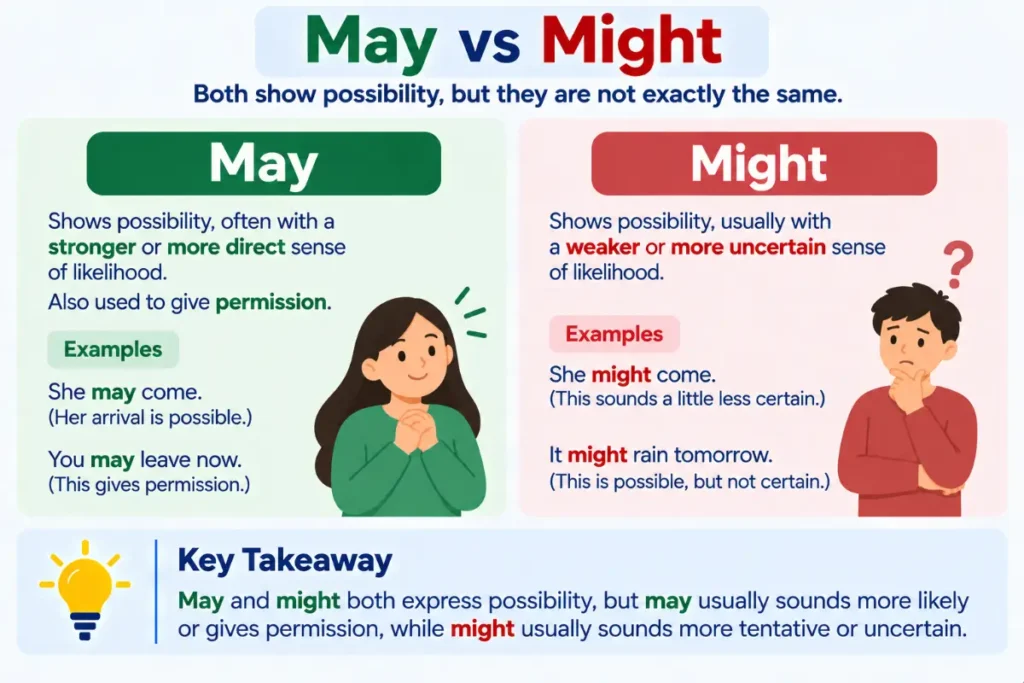
May and might both express possibility, but may often presents a possibility with a stronger or more direct sense of likelihood. Might can make a possibility sound more tentative or uncertain. May also commonly expresses permission. For example, She may come means her arrival is possible, while She might come usually sounds a little less certain.
Table Of Contents
- What may means.
- What might means.
- The main difference.
- Possibility and probability.
- Permission and polite language.
- Talking about the past.
- Reported speech.
- Conditional sentences.
- Questions and negative forms.
- May have and might have.
- Real life examples.
- Common mistakes.
- Pronunciation.
- Formal and informal usage.
- American and British English.
- Related modal verbs.
- Memory tips.
- Professional writing advice.
- Frequently asked questions.
- Key takeaways.
- Conclusion.
What May Means
May is a modal auxiliary verb. One of its most common uses is to express possibility.
For example:
It may rain tonight.
The sentence tells us that rain is possible. The speaker does not present it as a certain event.
You can also use may when talking about a future possibility.
She may visit us next week.
The speaker thinks the visit is possible, but the sentence does not guarantee that it will happen.
May also expresses permission.
You may leave early today.
Here, may does not describe possibility. It gives permission.
That distinction matters because the same word can serve different grammatical purposes.
Consider these two sentences:
You may be right.
You may leave now.
In the first sentence, may expresses possibility. The speaker thinks being right is possible.
In the second sentence, may expresses permission. The speaker allows the listener to leave.
May can also appear in polite or formal wishes.
May your plans succeed.
These uses are less common in casual conversation but remain grammatically standard.
What Might Means
Might is also a modal auxiliary verb. Its most familiar use is to express possibility.
For example:
It might rain tonight.
This tells us that rain is possible. Compared with may, might often sounds more tentative.
She might come to the party.
The speaker is not confident that she will come. The possibility exists, but the outcome remains uncertain.
Might can also describe a possibility viewed from the past.
He said he might visit us.
At the time he spoke, visiting was a possible future event. The sentence reports that earlier possibility from a later point in time.
Might also appears in hypothetical situations.
If we leave early, we might avoid traffic.
Here, might describes a possible result of the condition.
Might can sometimes sound more cautious or less direct than may. This makes it useful when the speaker does not want to make a strong claim.
The Main Difference
The easiest way to understand the difference is to think about how strongly the speaker presents a possibility.
May often sounds more direct.
Might often sounds more tentative.
Compare:
She may come tonight.
She might come tonight.
Both sentences say that her arrival is possible. The first can sound a little more confident. The second can suggest greater uncertainty.
However, this distinction is not an exact mathematical scale. English speakers do not use may and might as precise probability percentages. Context and speaker intention matter.
That means you should not assume that may always means a high probability and might always means a low probability.
For example:
We may never know the full story.
We might never know the full story.
Both sentences express uncertainty. The choice depends partly on tone and context.
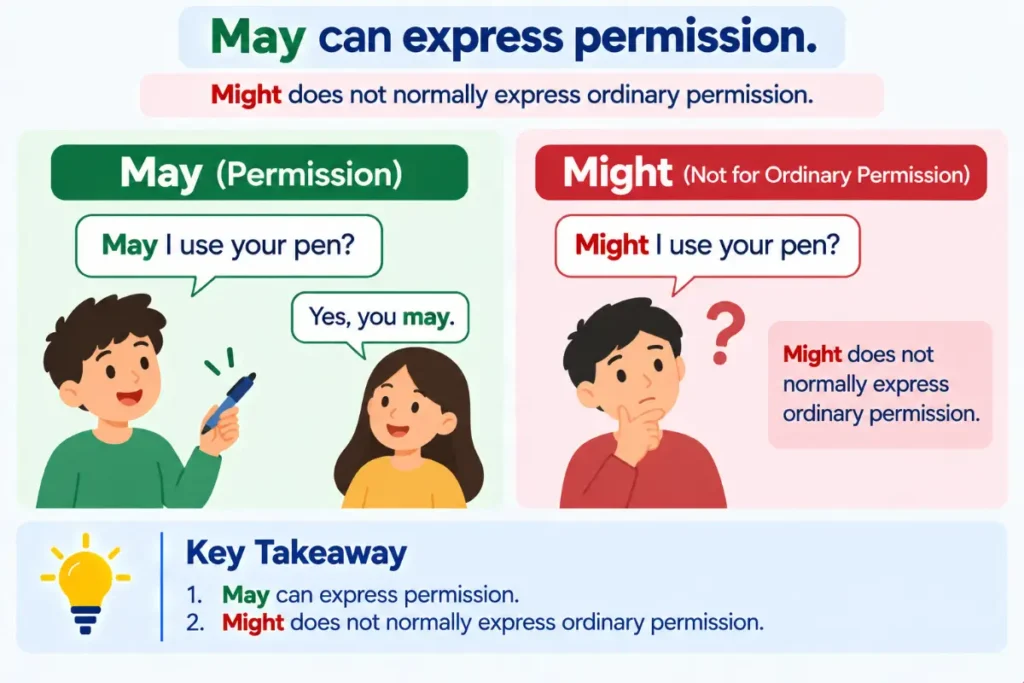
May has another major use that might does not normally share in modern standard English. May can express permission.
You may enter now.
Might does not normally replace may in this meaning.
You might enter now.
This usually changes the meaning from permission to possibility or sounds unusual depending on context.
May vs Might For Possibility
When both verbs express possibility, either one can often work.
Consider:
John may be at home.
John might be at home.
Both sentences suggest that John could be at home.
The difference is subtle. May can sound somewhat more direct or neutral. Might often creates a stronger sense of uncertainty.
Another example:
The package may arrive tomorrow.
The package might arrive tomorrow.
The first sounds like a reasonable possibility. The second sounds a little more cautious.
This distinction becomes useful when you want your writing to reflect your level of confidence.
If you have some reason to expect the event, may can work naturally.
If you are simply considering an uncertain possibility, might may feel more appropriate.
Still, context matters more than a rigid rule. Native speakers frequently use these modal verbs with overlapping meanings.
Probability And Degree Of Certainty
Many learners want to know exactly how much more likely may is than might. English does not provide a fixed percentage for either modal.
You cannot reliably say that may means a sixty percent chance while might means a thirty percent chance.
Instead, think of the verbs as flexible markers of possibility.
May can sound relatively neutral.
She may be busy.
Might can sound more tentative.
She might be busy.
The difference becomes especially noticeable when someone wants to avoid sounding too certain.
For example:
This explanation may be correct.
This explanation might be correct.
The second sentence sounds more cautious. The writer is leaving more room for another explanation.
This is especially useful in academic and professional writing. If the evidence does not support a firm statement, a cautious modal can help avoid overclaiming.
Permission With May
May has a traditional and widely recognized role in expressing permission.
You may use my computer.
Students may leave after the exam.
May I come in?
May I ask a question?
These forms are standard.
May I ask a question? is especially common in polite or formal speech.
In casual American English, can is also widely used for permission.
Can I use your phone?
Can I sit here?
That does not mean may is incorrect. May simply tends to sound more formal or polite in permission questions.
Might does not normally express ordinary permission.
Might I ask a question? is possible, but it has a different tone. It sounds highly tentative or formal and can sometimes sound old fashioned.
Might For Tentative Suggestions
Might can soften suggestions.
You might want to check the address again.
This does not literally mean that checking the address is a weak possibility. Instead, might makes the suggestion less forceful.
Compare:
You should check the address again.
You might want to check the address again.
The first is more direct. The second is softer.
This pattern is common in professional communication because it allows the writer to offer advice without sounding commanding.
For example:
You might want to review the figures before sending the report.
The writer is recommending an action while leaving the final decision to the reader.
Talking About The Past
Might has an important role when a possibility is viewed from a past point in time.
For example:
He said he might call later.
The person said this earlier. At that earlier time, calling later was a possible future event.
May can also appear in past related constructions, but the structure matters.
He said he might call.
This is natural reported speech.
He said he may call.
This can also be possible when the writer wants to preserve the original modal or when the possibility remains current. Context determines the most natural choice.
Consider:
In January she said she might move to Texas.
This reports an earlier possibility.
Now imagine the situation is still open:
She may move to Texas later this year.
The second sentence describes a current possibility about the future.
Reported Speech
Reported speech is one area where might often appears as the backshifted form of may.
Direct speech:
I may visit tomorrow.
Reported speech:
She said she might visit the next day.
The original speaker used may. When the statement is reported from a later viewpoint, might commonly appears.
Another example:
Direct:
I may be late.
Reported:
He said he might be late.
This pattern is useful, but it is not an absolute requirement in every context. English speakers can preserve the original modal when the situation remains current or when the writer wants to maintain the original meaning and viewpoint.
For learners, the basic pattern is still valuable:
may in direct speech can become might in reported speech.
Conditional Sentences
Might frequently appears in conditional sentences.
If we leave now, we might catch the earlier train.
The sentence describes a possible result of a condition.
Another example:
If you ask her, she might help.
The speaker cannot guarantee the result. The conditional structure presents help as one possible outcome.
May can also occur in conditional sentences.
If you hurry, you may catch the bus.
Both forms can work. Again, the choice can reflect the speaker’s sense of certainty or tone.
Might often sounds more tentative.
May can sound somewhat more confident or neutral.
May Have And Might Have
The forms may have and might have describe possibilities related to the past.
For example:
She may have forgotten the appointment.
This means it is possible that she forgot it.
She might have forgotten the appointment.
This also means it is possible that she forgot it. The second sentence can sound more tentative.
These structures are useful when you do not know what happened but have a possible explanation.
Another example:
He may have left early.
He might have left early.
Both sentences present leaving early as a possible explanation.
Do not confuse these forms with must have.
She must have forgotten.
This normally expresses a strong logical conclusion rather than a simple possibility.
That distinction is important in careful writing.
Negative Forms
The negative forms are may not and might not.
May not can express the possibility that something will not happen.
She may not come tonight.
This means her absence is possible.
Might not also expresses a possible negative outcome.
She might not come tonight.
The second often sounds more tentative.
May not can also mean lack of permission.
You may not enter this room.
Here, the meaning is not possible absence. It means you are not permitted to enter.
Context tells you which meaning is intended.
Consider:
You may not understand the instructions.
This usually means it is possible that you do not understand them.
You may not enter the room.
This means permission is denied.
The same words can therefore carry very different meanings depending on the verb and context.
Questions With May And Might
May commonly appears in polite questions.
May I use your phone?
These questions request permission.
Might can appear in questions that ask about possibility.
Might they arrive later?
These forms are grammatical but can sound more formal or less common in ordinary American conversation.
For everyday questions, speakers often use could, might, or other constructions depending on the intended meaning.
Could she be at home?
Might she be at home?
Both can ask about possibility, although the first may sound more natural in casual conversation.
May And Might In Formal Writing
Both verbs are useful in formal writing.
May is often used when describing a possibility carefully.
The change may affect future results.
This avoids claiming certainty.
Might can express even greater caution.
The change might affect future results.
This can be useful when evidence is limited or the writer wants to avoid overstating a conclusion.
You will often see these verbs in academic, scientific, legal, business, and analytical writing.
For example:
The findings may indicate a change in consumer behavior.
The findings might indicate a change in consumer behavior.
The second version sounds slightly more cautious. Neither sentence automatically proves the claim. The surrounding evidence still matters.
A good writer chooses a modal based on the evidence and intended level of certainty rather than simply trying to sound formal.

Real Life Examples
Everyday Conversation
I may go to the store later.
The speaker considers going possible.
I might stay home tonight.
The speaker presents staying home as a less certain possibility.
Work
The manager may approve the request tomorrow.
The approval is presented as a reasonable possibility.
The client might ask for another revision.
The writer is preparing for an uncertain possibility.
School
The teacher may give us a quiz tomorrow.
The quiz is possible.
We might have a quiz tomorrow.
This sounds a little more tentative.
Travel
The flight may be delayed because of the weather.
The speaker considers a delay possible.
We might miss the connection if the first flight is late.
The second flight is presented as a possible consequence.
Personal Situations
She may call you tonight.
Her call is possible.
She might call after work.
The speaker sounds less certain about the call.
Common Mistakes
Using Might For Permission
Incorrect in ordinary permission use:
Might I use your laptop?
This is grammatically possible in a highly formal or old fashioned style, but it does not function like the everyday permission form may I.
More natural:
May I use your laptop?
Or in casual American English:
Can I use your laptop?
Treating May And Might As Exact Probability Markers
It is a mistake to assume that one always represents a specific probability.
English does not work that mechanically. Both verbs can express uncertain possibilities, and context influences the strength of the statement.
Thinking Might Always Means Past Time
Might can refer to present or future possibilities.
She might come tomorrow.
There is nothing past tense about this sentence.
Might can also appear in past related structures.
She said she might come tomorrow.
The meaning comes from context.
Using May When The Speaker Wants Strong Caution
May can sound more direct than might in some contexts.
The project may fail.
The project might fail.
Both are possible, but the second often sounds more cautious.
Confusing May Not With Permission
You may not enter.
This means permission is denied.
The sentence does not mean that entering is merely unlikely.
Context and situation determine the meaning.
Pronunciation Guide
May is pronounced /meɪ/.
Might is pronounced /maɪt/.
The vowel sounds are different.
May contains the long vowel sound found in words such as day and say.
Might contains the diphthong found in words such as time and right.
The final t in might should be pronounced clearly in careful speech, although connected speech can soften sounds in natural conversation.
The two words are short, but their vowel sounds make them easy to distinguish.
Practice them in contrasting sentences:
She may come.
She might come.
Listening for the vowel can help you recognize the difference quickly.
Formal And Informal Usage
May is common in both formal and informal English, but its role changes with context.
In casual conversation, can is often preferred for permission.
Can I borrow your pen?
In more formal situations, may sounds more traditional.
May I borrow your pen?
For possibility, both may and might are normal in everyday speech.
It may rain.
It might rain.
In formal writing, might can sometimes be useful because it allows the writer to express uncertainty carefully.
The results might suggest a connection.
The word might does not automatically make writing more professional. Good writing comes from choosing the modal that accurately reflects the evidence.
American And British English
American and British English share the main grammar rules for may and might.
Both varieties use may for possibility and permission.
Both use might for possibility and tentative statements.
There are some differences in conversational preference. American English commonly uses can for permission in ordinary speech, while may remains standard and widely understood.
British English also uses can for permission, although may is common in formal contexts.
Neither variety has a major rule that changes the basic distinction between these two modal verbs.
The same practical rule works across major English varieties: use may for possibility or permission, and use might when expressing possibility with a more tentative tone or when reporting certain past viewpoints.
May And Might Compared With Can And Could
May and might belong to a larger group of modal verbs that includes can, could, will, would, shall, and should.
Can commonly expresses ability or general possibility.
I can swim.
It can get cold here in winter.
Could can express past ability, possibility, or polite requests.
Could you help me?
It could rain later.
May often expresses possibility or permission.
It may rain later.
May I come in?
Might expresses possibility and often sounds more tentative.
It might rain later.
These modal verbs overlap in some situations, but they are not interchangeable in every sentence.
May And Might Compared With Will
Will generally expresses a future event or prediction more directly.
It will rain tomorrow.
This sounds like a prediction rather than a possibility.
May:
It may rain tomorrow.
This leaves room for uncertainty.
Might:
It might rain tomorrow.
This usually sounds even more tentative.
The choice therefore affects how strongly the speaker presents the future event.
May And Might Compared With Must
Must often expresses strong necessity or a strong logical conclusion.
She must be home.
This can mean the speaker has strong evidence that she is home.
May:
She may be home.
This presents home as one possibility.
Might:
She might be home.
This also presents home as a possibility and can sound more tentative.
These differences matter because modal verbs communicate the speaker’s attitude toward the information.
Memory Tips
Think Of May As Permission
Remember:
May I?
This is a classic permission pattern.
May I come in?
May I borrow your pen?
Think Of Might As More Tentative
Might often sounds like the speaker is leaving more room for uncertainty.
She might come.
It might rain.
We might be late.
Remember That Might Can Talk About The Future
Do not assume that might is always past tense.
We might go tomorrow.
The event is future.
Use Context
Do not choose a modal based only on a rigid rule. Ask what you actually want to communicate.
Are you giving permission?
Are you describing a possibility?
The answer usually points toward the right form.
Related Grammar And Usage Notes
Modal verbs have several important grammar characteristics.
They normally appear before the base form of another verb.
She may come.
She might come.
Not:
She may comes.
Not:
She might comes.
After may or might, use the base verb.
You may leave.
You might be right.
The same rule applies when the following verb is be.
He may be tired.
He might be tired.
Do not add to after the modal.
Incorrect:
She may to leave.
Correct:
She may leave.
This is one of the easiest grammar rules to remember.
Modal verbs also do not take the usual third person s ending.
Incorrect:
He mights come.
Correct:
He might come.
Incorrect:
She mays call.
Correct:
She may call.
These forms remain unchanged regardless of the subject.
Expert Editor Insight
An experienced editor does not treat may and might as interchangeable tokens or rigid probability markers. The real question is what the writer wants the reader to understand about possibility, permission, evidence, time, and confidence. In careful writing, might can create useful distance from a claim, while may can present a possibility more directly. The strongest editing habit is to read the sentence in context and ask if the modal accurately represents the evidence rather than choosing a word simply because it sounds formal.
Key Takeaways
- May and might are modal auxiliary verbs.
- Both can express possibility.
- May often sounds more direct or neutral when expressing possibility.
- Might often sounds more tentative.
- May can express permission.
- Might does not normally express ordinary permission.
- May I ask a question? is a standard polite request.
- Might can appear in reported speech.
- Might can describe present and future possibilities.
- May have and might have can describe possible past events.
- Both may and might can appear in conditional sentences.
- Modal verbs take the base form of the following verb.
- Do not write she may comes or he might goes.
- May not can express either possible absence or denied permission depending on context.
- Do not treat may and might as exact percentage markers.
- Choose the modal that best reflects your intended level of certainty.
Conclusion
May vs might becomes much easier once you stop treating the two words as fixed probability labels. Both can express possibility, but might often sounds more tentative, while may can sound more direct or neutral. May also has a separate and important use for permission, especially in polite or formal questions.
The practical rule is simple. Use may for possibility or permission when the context calls for it. Use might when you want to express possibility more cautiously, describe a possibility from a past viewpoint, or soften a suggestion. Both forms can describe present and future possibilities.
For a quick editing check, ask yourself what you mean before choosing the modal. If you are giving permission, may is often the natural choice. If you are presenting an uncertain possibility, might may give the sentence the careful tone you want.
Frequently Asked Questions
What is the difference between may and might?
May and might both express possibility, but might often sounds more tentative. May also has a common permission use, as in May I leave early? Might can refer to a possibility in the present or future and can also appear in reported speech about an earlier possibility. The difference is mainly about meaning, context, viewpoint, and tone rather than a fixed probability.
Is might the past tense of may?
Might can function as a past related form of may in some contexts, especially in reported speech. For example, I may go can become She said she might go. However, might is not limited to past time. You can use it for present or future possibilities too, as in We might go tomorrow.
Is may more likely than might?
May can sound somewhat more confident or direct than might, but English speakers do not use these verbs as exact probability measurements. Both can describe possible events. Context and speaker intention matter. If you want to sound more tentative, might is often a natural choice. If you want a neutral possibility, may can work well.
Can may and might be used for future events?
Yes. Both can describe future possibilities. For example, I may visit tomorrow and I might visit tomorrow are both grammatical. The second usually sounds more tentative. Neither sentence guarantees that the visit will happen. The choice depends on how confidently the speaker wants to present the possibility.
Can may be used to ask for permission?
Yes. May is a standard way to ask for permission, especially in polite or formal English. May I come in? and May I use your phone? are both correct. In casual American English, Can I come in? and Can I use your phone? are also very common.
Can might be used for permission?
Might I ask a question? is grammatically possible, but it has a much more formal and tentative tone than May I ask a question? In ordinary modern conversation, might is not the usual choice for simple permission. Use may or can depending on the level of formality.
Which sounds more formal may or might?
Neither modal is automatically formal in every situation. May can sound formal when it expresses permission, while might often sounds cautious or tentative when it expresses possibility. Both appear in formal writing. The surrounding sentence and context determine the overall tone.
Can I say might have for a past possibility?
Yes. Might have is commonly used to describe a possible past event. For example, She might have missed the bus means it is possible that she missed it. May have can express a similar idea. Might have often sounds somewhat more tentative, while the exact distinction depends on context.
Is may not the same as might not?
Both can express the possibility that something will not happen. She may not come and She might not come both describe possible absence. Might not can sound more tentative. May not can also express denied permission, as in You may not enter. Context determines the intended meaning.
Should I use may or might in academic writing?
Both can work in academic writing. Choose based on the strength of your claim. May can present a reasonable possibility, while might can create a more cautious tone. For example, The results may indicate a change is relatively direct. The results might indicate a change sounds more tentative. The evidence should determine the wording.
Can may and might be followed by to?
No. Modal verbs such as may and might are followed by the base form of the verb without to. Say She may leave and She might leave. Do not say She may to leave or She might to leave. This is a basic modal verb rule that applies consistently in standard English.

English Grammar & Usage
Nathan Holloway is an American grammar writer and language researcher who specializes in English grammar, sentence structure, verb usage, and common writing mistakes. He enjoys breaking down confusing grammar rules into practical explanations with clear examples, making English easier for students, professionals, and everyday writers.