

Lier or liar can confuse even careful English learners because both words are pronounced the same in standard English. The spelling looks almost identical too, but the meanings are very different. If you mean a person who tells lies, the word you want is liar.
The confusion becomes easier to understand once you look at the words behind each form. Liar comes from lie in the sense of telling something untrue. Lier is formed from lie in the sense of being in a horizontal or resting position. The two meanings come from different senses of the same English verb, so the spelling difference carries real meaning.
For everyday writing, liar is the form you’ll use far more often. Lier does exist in English, but it is rare and usually appears in specialized or literal contexts. This guide explains the difference in plain English, shows how each word works in a sentence, covers pronunciation and word history, and gives you practical ways to choose the right form without second guessing yourself.
Table of Contents
- Quick Answer
- The Core Difference
- Meaning of Liar
- Meaning of Lier
- Comparison Table
- Why the Words Cause Confusion
- Which Form Should You Use
- Grammar and Word Formation
- Pronunciation
- Sentence Examples
- Common Mistakes
- Memory Tips
- Related Words and Expressions
- Regional Usage
- Formal and Informal Writing
- Real Life Usage
- Etymology and Word Origin
- Expert Editor Insight
- FAQs
- Key Takeaways
- Conclusion
The Core Difference
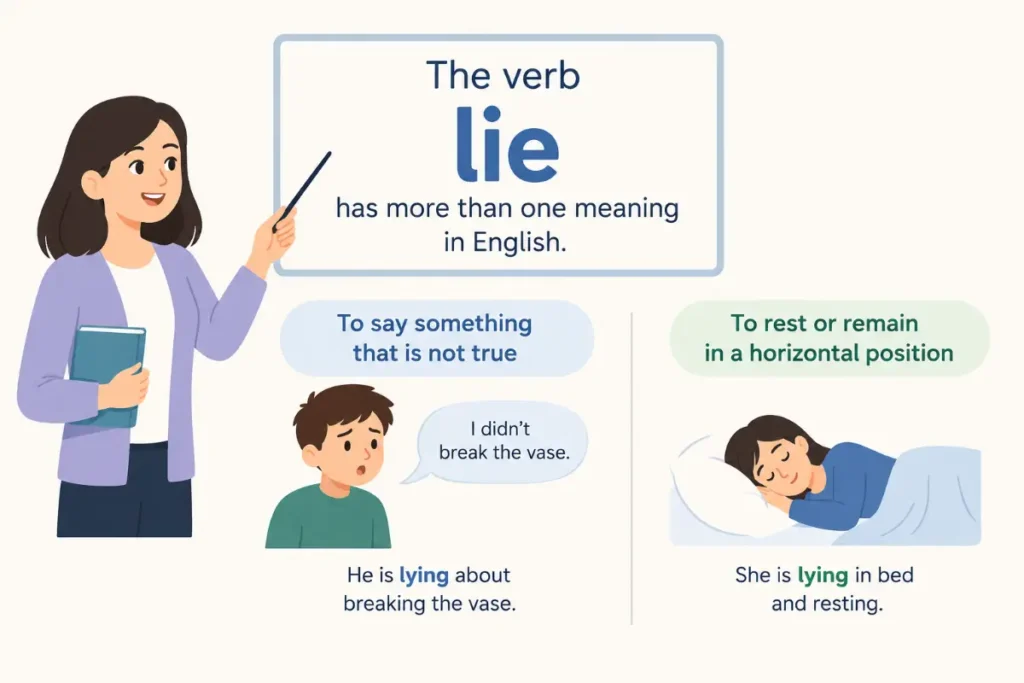
The easiest way to remember the distinction is to focus on the meaning of lie. The verb lie has more than one meaning in English. One meaning is to say something that is not true. Another meaning is to rest or remain in a horizontal position.
When you add the person ending er, those meanings produce different words. A liar is a person who tells lies. A lier can refer to a person or thing that lies or rests in a particular position. This word is much less common in modern everyday English.
That difference is small in spelling but large in meaning. Consider these examples.
He is a liar.
The first sentence says the person tells lies.
The animal was a quiet lier beneath the tree.
The second example uses lier in the rare sense connected with lying down. Although grammatically possible, that sentence sounds unusual to most modern readers. A writer would usually choose a more natural phrase such as The animal was lying beneath the tree. This is why context matters so much. The two forms should not be treated as simple spelling variants.
Meaning of Liar
A liar is a person who tells lies. The noun comes from the verb lie when lie means to make a false statement or deliberately say something untrue.
For example:
He is a liar.
She called him a liar.
The word normally describes a person rather than an action. It can carry a strong negative judgment because calling someone a liar directly accuses that person of dishonesty.
Still, context matters. People sometimes use liar casually or humorously.
For example:
You’re such a liar. You knew about the surprise the whole time.
In that situation the speaker may be teasing rather than making a serious accusation.
The plural form is liars.
For example:
The investigation exposed several liars.
The adjective related to the idea is dishonest rather than liary. English does not normally form an adjective by simply adding a common suffix to liar.
Meaning of Lier
Lier is a real English word, but it is uncommon.
It can describe someone or something that lies down or remains in a lying position. This meaning comes from the other sense of lie.
For example:
The lier remained still for several minutes.
That sentence is grammatically understandable, but most native speakers would probably avoid the noun and simply say:
The person remained lying down for several minutes.
This difference between grammatical possibility and natural usage is useful when learning English. A word can exist in dictionaries and still be rare enough that native speakers normally choose another expression.
Lier may also appear in technical, historical, or specialized contexts. Its rarity means that using it in ordinary conversation can sound unusual or overly technical.
So if your intended meaning is someone who tells lies, lier is not the word you need.
Comparison Table
| Form | Meaning | Part of Speech | Derived From | Frequency | Typical Context | Example |
|---|---|---|---|---|---|---|
| Liar | A person who tells lies | Noun | Lie meaning to tell something untrue | Very common | Everyday speech, writing, criticism, storytelling | He is a liar. |
| Lier | A person or thing that lies or rests | Noun | Lie meaning to recline or rest | Rare | Specialized, literal, or unusual contexts | The lier remained in position. |
The table shows why treating these words as simple spelling alternatives can cause trouble. Their meanings come from different senses of lie.
Why the Words Cause Confusion
The biggest reason is pronunciation.
In standard American English, liar and lier are normally pronounced alike. This makes them homophones. When you hear the word in conversation, you cannot depend on sound alone to determine the spelling.
You need to use meaning and context.
There is another source of confusion. English spelling often uses different endings to form nouns from verbs. Learners may see lie plus er and expect lier automatically. That form is possible for one meaning, but the word for a person who tells lies has a different established spelling.
The spelling liar reflects the pronunciation and historical development of that particular noun.
There is also a common visual trap. The letters i and a appear next to each other in liar, while lier looks like a simple spelling of lie plus er. Because lier seems structurally straightforward, learners may choose it even when they mean someone who tells lies.
The safest approach is to start with the meaning rather than the letters.
Ask yourself what the person is doing.
If the person tells untruths, use liar.
If you are referring to someone or something that lies down or rests, lier can technically apply, but a different phrase will often sound more natural.
Which Form Should You Use
For almost all ordinary situations involving dishonesty, use liar.
If you want to describe a person who regularly says things that are false, liar is the natural English noun.
For example:
My brother said he never ate the cake, but he was a liar.
The company was accused of misleading customers.
She knew he was lying.
Only the first sentence needs the noun liar. In the other sentences, English uses different grammatical forms.
Lier is not an incorrect spelling of liar. That distinction matters. Calling lier simply wrong would be misleading because it has a legitimate dictionary use connected with the other meaning of lie.
However, legitimate does not mean common. In modern everyday English, lier is rare. Native speakers usually avoid it because English already has more natural ways to express the same idea.
This gives you a useful rule.
Use liar for dishonesty.
Use lier only when the specific meaning of lying down or resting truly calls for it and the context supports that unusual noun.
Grammar and Word Formation
Liar is a common countable noun.
You can use it with articles and determiners.
He is a liar.
She called him a liar.
They are liars.
That person is a liar.
Because liar is countable, you can talk about one liar or several liars.
Lier also functions as a noun, but it is much less common.
The important grammar issue is the verb lie itself. English has two unrelated meanings that learners often need to keep separate.
The first means to say something false.
For example:
He lies to his parents.
She lied about the money.
They have lied before.
The second means to rest in a horizontal position.
For example:
I lie on the couch after work.
She lay on the bed.
The dog is lying on the floor.
These two verbs create different noun forms and different past tense patterns. That is one reason the vocabulary around lie can feel tricky.
Lie Meaning Tell an Untruth
The forms include lie, lied, lying, and liar.
For example:
He lies when he is nervous.
He lied yesterday.
He is lying now.
He is a liar.
Notice that the noun liar identifies the person.
Lie Meaning Rest
The forms include lie, lay, lain, and lying.
For example:
I lie down every afternoon.
Yesterday I lay down for an hour.
I have lain here for twenty minutes.
She is lying on the sofa.
A noun such as lier can technically be formed from this sense, but it is not common in ordinary modern English.
This distinction is worth learning because many English mistakes involving liar begin with confusion between the two meanings of lie.
Pronunciation
Liar and lier are generally homophones in American English. Both are commonly pronounced with two syllables.
The standard pronunciation of liar is commonly represented as /ˈlaɪər/.
The stress falls on the first syllable.
The word begins with the same sound as lie and then moves into a relaxed second syllable. In natural speech, the two vowel sounds can flow together.
The pronunciation of lier can also be represented as /ˈlaɪər/ when it is used as the noun formed from lie meaning to rest.
Because the two words sound alike, pronunciation cannot solve the spelling question by itself. Meaning has to do the work.
This is a classic example of a homophone problem. English contains many words that share pronunciation while differing in spelling and meaning. You can hear the sound, but you need context to choose the written form.
Sentence Examples
Here are natural examples using liar.
- He admitted that he had lied about where he was.
- She called the politician a liar during the argument.
- Nobody trusted him because he had a reputation as a liar.
- I thought he was joking, but he was actually telling a lie.
- The child insisted he was innocent, but his story kept changing.
- Calling someone a liar is a serious accusation.
- She realized that the salesman had not been honest with her.
- The character in the novel is a clever liar who fools everyone.
- He may have made a mistake, but that does not automatically make him a liar.
- The witness was accused of being a liar after giving conflicting statements.
These examples show that liar is normally connected with dishonesty or false statements.
Now consider the rare word lier.
- The lier remained motionless on the ground.
- The old description refers to the animal as a quiet lier.
These sentences are grammatically possible but stylistically unusual. A modern writer would often choose lying person, person lying down, resting animal, or another clearer expression.
That is an important lesson. A word can be technically valid while still being a poor choice for ordinary communication.
Common Mistakes
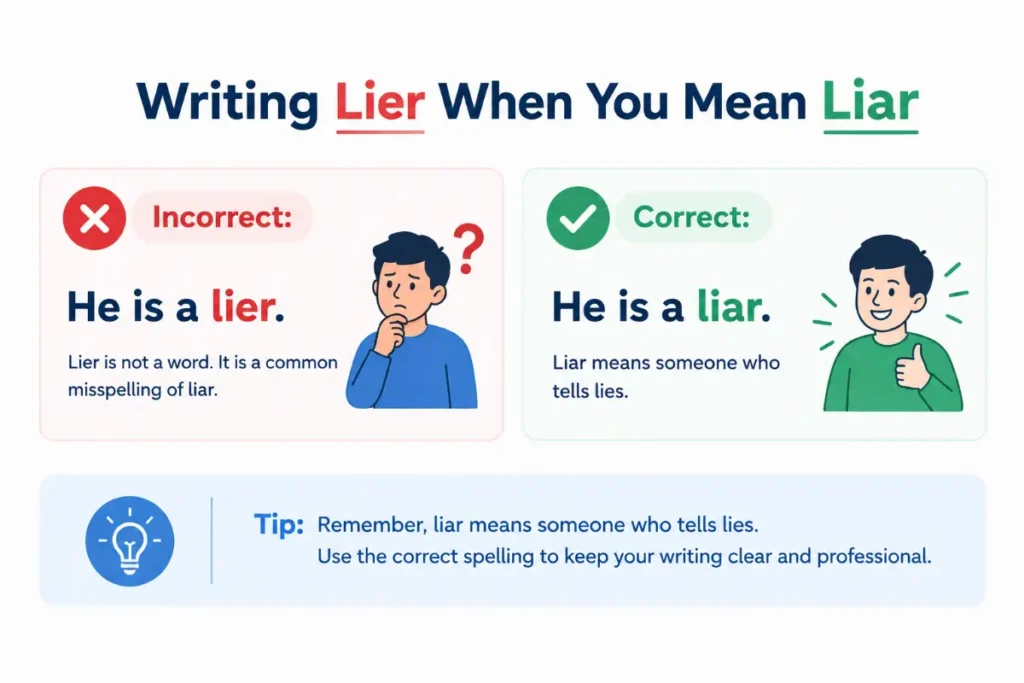
Writing Lier When You Mean Liar
Incorrect:
He is a liar.
The error usually happens because the writer connects the word directly to lie plus er. The established noun for someone who tells lies is liar.
Writing Liar When You Mean Someone Lying Down
This mistake is less common because people rarely use lier in ordinary speech.
If you are describing a person who is physically lying down, it is usually better to write:
The person is lying on the floor.
You generally do not need the noun lier.
Confusing Lie and Lay
This is one of the most common grammar problems related to the same word family.
Lie means to rest in a horizontal position.
Lay means to put something somewhere.
For example:
I lie on the sofa.
I lay the book on the table.
The past tense of lie in the resting sense is lay.
Yesterday I lay on the sofa.
The past tense of lie in the dishonesty sense is lied.
He lied yesterday.
Keeping these patterns separate helps prevent later confusion.
Assuming Every Word Ending in Er Is Formed the Same Way
English noun formation is not perfectly mechanical. A learner may think that lie plus er must always produce lier for every meaning.
But vocabulary develops through historical usage. The established noun for someone who tells lies is liar.
Using Rare Words Just Because They Are Technically Correct
Good writing is not only about grammatical possibility. It is also about clarity.
Lier may be legitimate, but most readers will find lying person or someone lying down easier to understand. Professional editors usually prefer the expression that communicates the intended idea with the least friction.
Memory Tips
The easiest memory trick connects liar with lie meaning to say something false.
Think:
Lie about the truth → liar.
If someone tells lies, that person is a liar.
Another useful trick is to connect liar with other words about dishonesty.
Liar.
Lie.
Lying.
Lied.
These words belong to the same meaning family.
For the physical meaning of lie, remember the action rather than the rare noun.
Lie down.
Lie on the bed.
Lie on the floor.
Lying down.
This approach removes the need to use lier at all in most everyday sentences.
You can also remember the phrase:
A liar tells lies.
That short sentence is easy to recall and gives you the spelling immediately.
Related Words and Expressions
Lie
Lie can mean to say something false or to rest in a horizontal position. Context tells you which meaning applies.
Liar
Liar means a person who tells lies. It is the standard noun for this meaning.
Lying
Lying can refer to telling an untruth or resting in a horizontal position. The surrounding sentence determines the meaning.
Lied
Lied is the past tense and past participle of lie when lie means to tell an untruth.
He lied to me.
Lie Down
Lie down means to move into or remain in a resting horizontal position.
Please lie down and rest.
Dishonest
Dishonest is an adjective describing a person or action that lacks honesty.
He was dishonest about the money.
Deceiver
A deceiver is someone who deliberately causes another person to believe something untrue or misleading. The word is broader than liar because deception does not always require a direct spoken lie.
Untruth
An untruth is something that is not true. It can be intentional or can sometimes be used more gently than the word lie.
These related words help you choose a precise expression instead of relying on liar every time you discuss dishonesty.
Regional Usage
American English
American English uses liar as the normal word for a person who tells lies. Lier is rare and does not represent an American spelling variant of liar.
In everyday American conversation, speakers are far more likely to say someone is lying, someone told a lie, or someone is a liar than to use lier for a person who is lying down.
British English
British English also uses liar as the standard noun for someone who tells lies. The distinction between liar and the rare lier is essentially the same.
There is no standard British spelling that changes liar to lier when discussing dishonesty.
Australian English
Australian English follows the same basic distinction. Liar is the ordinary word for a person who tells lies. Lier is not a common alternative spelling.
Canadian English
Canadian English also uses liar for dishonesty. The spelling difference is not a major regional issue. Canadian writers generally use the same standard forms found in American and British English.
The important point across these major varieties is that pronunciation does not create a useful regional spelling distinction. Context and meaning determine the correct written form.
Formal and Informal Writing
Liar can appear in both informal and formal writing, but its tone depends heavily on context.
Calling someone a liar is direct and often confrontational. In a formal report, writers may choose a more precise description such as the person provided false information, the statement was inaccurate, or the witness gave conflicting accounts.
That does not make liar an informal word. It simply means the word carries a strong accusation.
For example:
The witness was a liar.
This is direct and personal.
The witness provided information that was later shown to be false.
This is more neutral and evidence focused.
Good writing considers both accuracy and tone. If you are writing an academic paper, legal document, workplace report, or professional complaint, describe the evidence clearly rather than using a loaded label when the facts can be stated more precisely.
In casual conversation, however, liar is completely natural.
Real Life Usage
Daily Conversation
Liar appears naturally when people discuss honesty.
You told me you were at home. You’re a liar.
That playful accusation may be part of a joke between friends.
Another example is:
I knew he was lying, but I didn’t call him a liar.
Here the speaker separates the person’s action from a broader judgment about the person.
Workplace Communication
Professional communication usually favors specific facts over personal labels.
Instead of:
He is a liar.
A manager might write:
He provided information that did not match the records.
This approach is clearer and more professional because it identifies the actual issue.
Academic Writing
Academic writing rarely needs the noun liar unless the subject itself concerns deception or the word is being analyzed.
For example:
The novel presents its main character as an unreliable liar.
That sentence is appropriate because the word is part of literary analysis.
News Writing
News reports tend to focus on documented claims rather than simply labeling someone.
A report might say:
The official denied making the statement, while records showed that the statement had been made.
This gives readers evidence instead of relying on a personal label.
Literature and Storytelling
Liar is common in stories because characters often accuse each other of dishonesty.
For example:
You promised you would never return, she said. You’re a liar.
In fiction, the word can reveal conflict, emotion, anger, distrust, or betrayal.
Etymology and Word Origin
The words connected with lie have deep Germanic roots and have developed around more than one meaning.
The verb lie meaning to rest or recline has roots in Old English and is related to similar words in other Germanic languages. The verb lie meaning to tell an untruth also has a long history in English, although its development is distinct from the physical sense of lying down.
Liar developed from the dishonesty sense of lie and became the established noun for a person who tells lies. The spelling does not simply represent a modern spelling preference. It reflects the historical development and established usage of the noun.
Lier can be formed from the physical sense of lie, but it has never reached the same level of everyday use. English speakers generally prefer the verb phrase lying down instead.
This is a good example of how English vocabulary develops. A word can be grammatically possible and historically understandable without becoming common in modern speech.
Why Liar Is More Natural Than Lier
The difference between dictionary existence and everyday usefulness matters here.
Lier can be understood because English allows nouns to be formed from verbs with the ending er. But language is shaped by actual usage. Speakers choose forms that become familiar and efficient over time.
Liar became firmly established as the noun for a person who tells lies.
Lier remained uncommon.
That is why a dictionary based on standard usage can recognize both forms while ordinary speakers still use one almost exclusively.
This also explains why spellcheck software may behave differently depending on context. A tool may recognize lier as a word but still recommend another expression if the surrounding sentence suggests a different meaning. Automated spelling checks can identify forms, but they cannot always determine the writer’s intended sense without enough context.
Human judgment still matters.
When Lier May Be Appropriate
There are situations where lier can make sense.
Suppose you are discussing word formation or studying the verb lie in its physical sense. You might need to mention lier as a possible noun.
You could write:
The rare noun lier refers to one who lies or rests in a particular position.
That is a useful linguistic discussion.
You might also encounter the word in older or specialized writing. In such cases, the surrounding text should make the intended meaning clear.
For ordinary communication, though, there is rarely a reason to choose lier. If you mean someone who is lying down, use the verb form.
For example:
The child is lying on the couch.
This sounds much more natural than:
The child is a lier on the couch.
The second sentence may be grammatically interpretable, but it is not the normal way a native speaker would express the idea.
How Context Changes the Meaning
Context is the key to understanding these words.
Consider the sentence:
He is lying.
Without context, the sentence has two possible meanings.
He is saying something false.
Or:
He is resting in a horizontal position.
Now consider:
He is a liar.
The noun strongly points to dishonesty.
The physical meaning cannot be intended because liar has become established with the dishonesty sense.
This is why English learners should avoid translating words mechanically from spelling alone. A single English verb can have several meanings, and those meanings can create different related words.
The surrounding words usually provide the clue.
If you see words such as truth, honesty, deception, false statement, or dishonest, the intended vocabulary is likely connected with liar.
If you see words such as bed, floor, couch, rest, horizontal, or sleep, the physical sense of lie is likely intended.
Expert Editor Insight
A professional editor would usually correct lier to liar when the sentence refers to someone who tells lies, but would not automatically mark lier as an invalid English word. The real question is meaning. If the writer means dishonesty, liar is the established everyday noun. If the writer means someone or something that lies down, lier is technically possible but often less natural than a direct phrase such as someone lying down. Good editing therefore checks meaning, context, grammar, and audience instead of treating every unusual word as a simple spelling error.
Key Takeaways
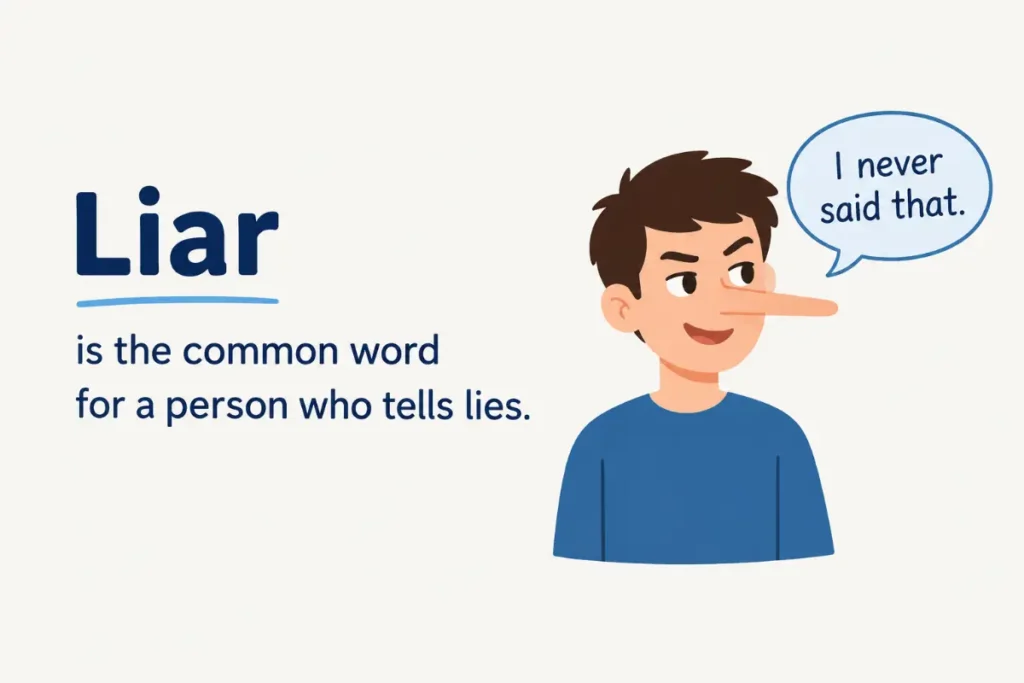
- Liar is the common word for a person who tells lies.
- Lier is a legitimate but rare noun connected with lying down or resting.
- The two forms are generally pronounced the same.
- They are not interchangeable because they come from different meanings of lie.
- If you mean dishonesty, use liar.
- If you mean physical resting, use lying down in most ordinary sentences.
- Lie meaning tell an untruth uses forms such as lied and lying.
- Lie meaning rest has a different past tense pattern, including lay and lain.
- Calling someone a liar can sound like a strong accusation, so consider tone in formal writing.
- The easiest memory trick is A liar tells lies.
Conclusion
Lier or liar becomes much easier once you connect each spelling with its meaning. Liar is the common English noun for a person who tells lies. Lier is a rare but legitimate noun associated with the physical sense of lying or resting. Since both forms are generally pronounced alike, the sound alone cannot tell you which spelling to choose.
For everyday English, liar is the form you need when discussing dishonesty. If you mean physical position, native speakers usually use a phrase such as lying down rather than the uncommon noun lier. The best memory trick is simple: a liar tells lies . Keep that connection in mind and you’ll quickly know which spelling belongs in your sentence.
FAQs
Is lier a real word?
Yes. Lier is a legitimate but uncommon English noun connected with the verb lie in the sense of resting or being in a lying position. It is not the standard spelling for a person who tells lies. For that meaning, use liar. In ordinary writing, native speakers usually prefer a phrase such as someone lying down rather than the rare noun lier.
What does liar mean?
Liar means a person who tells lies or makes false statements. It is a common noun related to the verb lie when lie means to say something untrue. The word can sound serious because calling someone a liar directly questions that person’s honesty. In casual speech, people may also use it playfully among friends.
What is the difference between lier or liar?
The difference is mainly meaning and usage. Liar is the common noun for someone who tells lies. Lier is a rare noun connected with lying down or resting. They are generally pronounced alike, so you cannot depend on sound alone. If you are talking about dishonesty, the correct choice is liar.
Are lier and liar homophones?
Yes. In standard American English, lier and liar are generally pronounced alike. Their different spellings reflect different meanings and word histories. Because they sound the same, context becomes especially important. If the sentence concerns dishonesty, use liar. If it concerns physical lying or resting, lier may technically fit, although a more natural phrase is often available.
Why do people spell liar as lier?
People often choose lier because it looks like the direct combination of lie and the noun ending er. The spelling feels logical at first glance. However, the established English noun for someone who tells lies is liar. The fact that lier can exist with another meaning adds to the confusion because both forms are linguistically possible but serve different purposes.
Can lier mean someone who tells lies?
In standard modern English, lier is not the normal noun for someone who tells lies. Liar is the established word for that meaning. Lier is associated with the other sense of lie, meaning to rest or remain in a horizontal position. If you are discussing dishonesty, use liar to make your meaning clear.
How do you remember the correct spelling?
Use the simple sentence A liar tells lies. The related words liar and lies share the same meaning family. If you are talking about dishonesty, choose liar. For physical position, focus on the verb phrase lying down instead of trying to use the rare noun lier. This memory method works because it connects spelling directly with meaning.
Is liar appropriate in formal writing?
Liar is grammatically correct in formal writing, but its tone can be strong. In professional, academic, or evidence based writing, it may be better to describe the specific false statement or misleading action instead of labeling a person. For example, saying the person provided false information can sound more neutral and precise than directly calling the person a liar.

Confusing Words, Spelling & Word Choice
Claire Whitmore is a U.S.-based English editor who writes about commonly confused words, spelling differences, and word choice. Her work helps readers understand subtle distinctions between similar-looking words through simple definitions, practical examples, and modern usage guidance in both American and British English.