
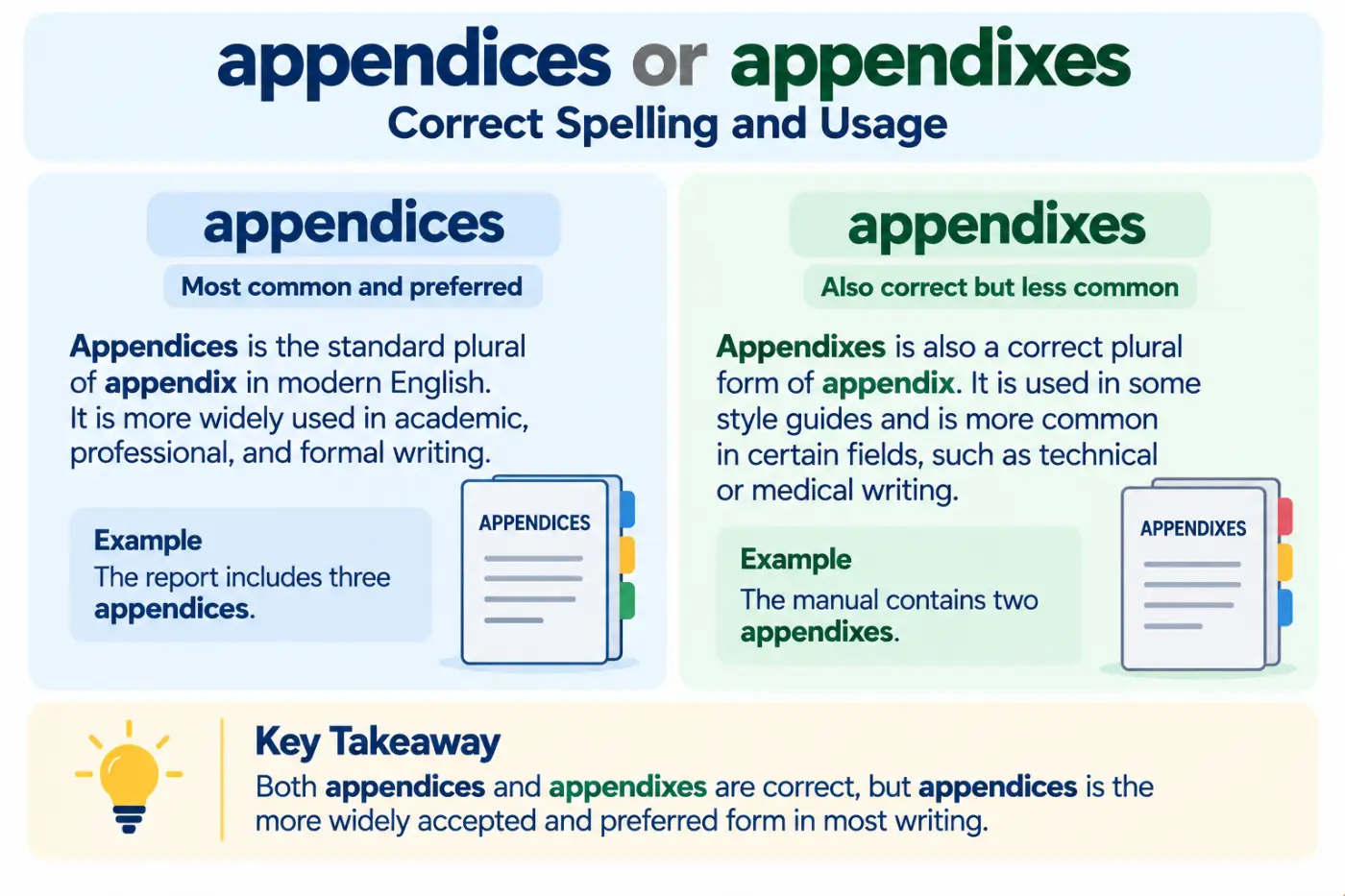
The choice between appendices or appendixes can feel surprisingly tricky because English gives us two accepted plural forms for the same noun. If you have ever written a research paper, report, book, legal document, or long business document, you may have stopped and wondered which version belongs at the end. The good news is that you do not have to treat one form as a spelling error.
The word appendix comes from Latin and entered English with its original Latin plural appendices. Over time, English also developed the regular plural appendixes. Both forms are now recognized in standard English. The difference is mainly connected with tradition, field, and style rather than a strict rule that makes one form right and the other wrong.
In this guide, you’ll learn how the two plurals work, why both exist, how native speakers use them, how pronunciation differs, which form tends to suit academic writing, and how to choose the right one for your document. You’ll also see practical examples, common mistakes, memory tips, and related words that can make the whole topic easier to handle.
Short Answer
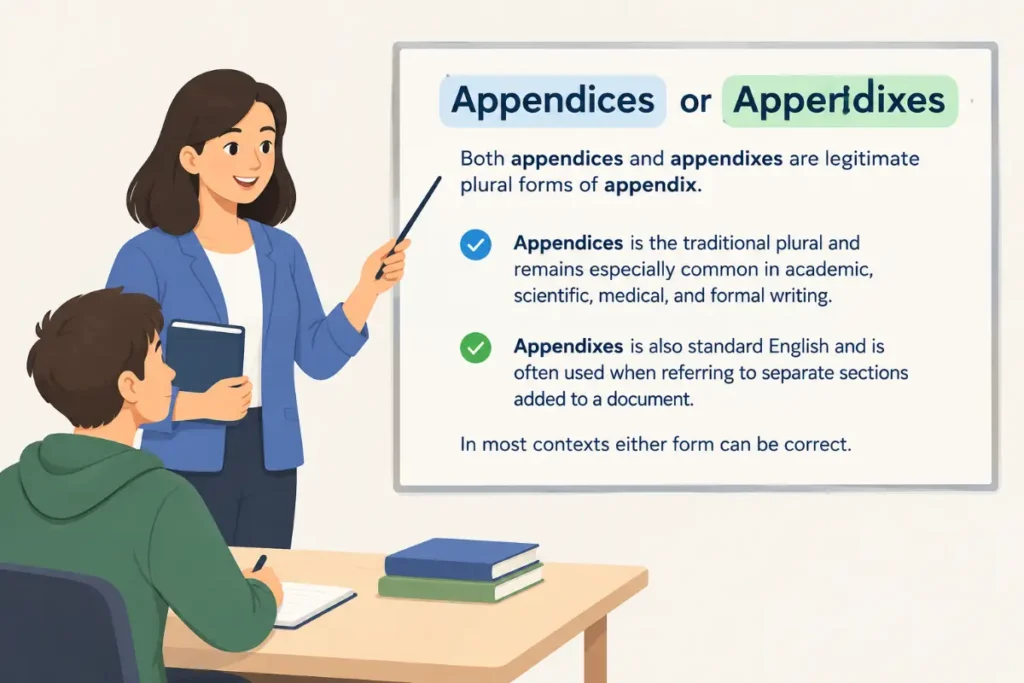
Both appendices and appendixes are legitimate plural forms of appendix. Appendices is the traditional plural and remains especially common in academic, scientific, medical, and formal writing. Appendixes is also standard English and is often used when referring to separate sections added to a document. In most contexts either form can be correct.
Table of Contents
- Quick Answer.
- Why Two Plural Forms Exist.
- Meaning of Appendix.
- appendices or appendixes in Standard English.
- Comparison of the Two Forms.
- Spelling and Plural Formation.
- Which Form Should You Use.
- Grammar Rules.
- Pronunciation.
- Sentence Examples.
- Common Mistakes.
- Academic and Professional Writing.
- Regional Usage.
- Etymology and Word Origin.
- Related Words and Expressions.
- Memory Tips.
- Expert Editor Insight.
- FAQs.
- Key Takeaways.
- Conclusion.
Quick Answer
Both forms are correct. Appendices is the traditional plural that comes directly from Latin and is widely used in formal and academic contexts. Appendixes is the regular English plural formed by adding es and is also accepted.
The choice usually depends on the writer’s field, house style, and personal preference. If you are writing an academic paper, appendices will often feel more familiar. If your organization uses appendixes, there is no grammatical need to change it simply because another writer prefers the traditional form.
Why Two Plural Forms Exist
English contains thousands of words borrowed from other languages. Some keep older plural patterns while also developing regular English plurals. Appendix is a good example.
When English borrowed the word from Latin, it retained the Latin plural pattern. That gave English appendices. As the word became part of everyday English vocabulary, speakers and writers also applied the familiar English plural pattern by adding es. That produced appendixes.
This process is not unusual. English contains many words with competing plural forms because the language has absorbed vocabulary from Latin, Greek, French, Italian, and many other languages.
Consider these examples.
- Index can become indexes or indices.
- Formula can become formulas or formulae.
- Antenna can become antennas or antennae.
- Appendix can become appendixes or appendices.
These pairs do not always have identical patterns of use. A particular field may strongly prefer one form. That is why context matters.
The important point is that the existence of two forms does not automatically mean one is wrong. In this case, both have established use in standard English.
Meaning of Appendix
Before choosing the plural, it helps to understand the singular noun.
An appendix is an additional section placed after the main part of a document or book. It usually contains supporting material that is useful but not essential to the main discussion.
For example, a research paper might explain its main findings in the body and place a long questionnaire in an appendix. A business report might put detailed financial tables in an appendix so the main report stays easier to read.
The word also has a biological meaning. In anatomy, an appendix can refer to a structure attached to another body part. The human appendix is a small pouch connected to the large intestine.
These meanings share a broad historical idea of something attached or added to a larger structure.
When referring to several additional sections in a document, writers may use either plural form.
The report contains three appendices.
The report contains three appendixes.
Both sentences are grammatically acceptable.
appendices or appendixes in Standard English
Both forms have a place in standard English. The traditional form appendices comes from the original Latin plural. The regular English form appendixes follows a familiar English plural pattern.
In formal writing, appendices is often the safer stylistic choice because readers are accustomed to seeing it in academic and technical documents. You’ll frequently encounter it in research papers, dissertations, books, scholarly reports, and other structured documents.
Appendixes is not an error. It can sound more natural in general English because it follows the same plural pattern as many ordinary nouns.
The best choice depends on the context.
If you are following a publication manual, university style guide, employer style guide, or publisher preference, follow that system consistently. Consistency matters more than switching between forms without a reason.
For example, if a report has three sections, you could label them:
Appendix A.
Appendix B.
Appendix C.
When discussing all three collectively, you could write:
The appendices provide supporting data.
Or:
The appendixes provide supporting data.
The key is to choose one form and keep it consistent throughout the document.
Comparison of the Two Forms
| Feature | Appendices | Appendixes |
|---|---|---|
| Singular | Appendix | Appendix |
| Plural status | Standard plural | Standard plural |
| Formation | Traditional Latin plural | Regular English plural |
| Meaning | More than one appendix | More than one appendix |
| Common setting | Academic, scientific, technical, formal writing | General, professional, and practical writing |
| Pronunciation | Commonly pronounced with a long e sound in the ending | Commonly pronounced with an iz sound in the ending |
| Formality | Often perceived as traditional and formal | Neutral and standard |
| Regional status | Used across major English varieties | Used across major English varieties |
| Grammatical status | Correct | Correct |
The table shows the central point clearly. Neither plural should be treated as a simple misspelling of the other.
Spelling and Plural Formation
The difference comes from two different approaches to forming plurals.
Appendices follows the historical Latin pattern. In Latin, the plural form developed from appendix through a change in the ending. English retained that form after adopting the word.
Appendixes follows the regular English approach. English speakers often form the plural of a noun ending in x by adding es.
For example:
Box becomes boxes.
Fox becomes foxes.
Tax becomes taxes.
Appendix can therefore become appendixes through the regular English pattern.
The traditional form developed differently:
Appendix becomes appendices.
This creates an interesting spelling difference because the two forms also have different pronunciation patterns.
The spelling appendices should not be confused with a word such as appendicitis. The words are related historically but serve different grammatical and semantic functions.
Which Form Should You Use
If you need one practical choice for academic or highly formal writing, appendices is often the more familiar option. It fits naturally in research papers, dissertations, scholarly books, scientific reports, and technical documents.
That does not make appendixes incorrect.
For everyday professional writing, either form can work. If your workplace already uses appendixes in its templates, there is no need to change it. If your professor, publisher, journal, or organization specifies a preferred style, follow that instruction.
Consistency is the bigger editorial principle.
Imagine a report that uses appendices on one page and appendixes on another page. Even though both forms are legitimate, the inconsistency may look careless. Pick one form and use it throughout the document.
An editor would also check the headings.
Appendix A.
Appendix B.
Appendix C.
Those labels remain singular because each label identifies one section. The plural belongs when you refer to two or more sections together.
Grammar Rules
Appendix is a countable noun. You can refer to one appendix or several appendices or appendixes.
The singular form is:
The report includes one appendix.
The plural forms are:
The report includes three appendices.
The report includes three appendixes.
Both plural constructions are correct.
You can use a number before the plural.
The book contains four appendices.
The book contains four appendixes.
You can also use a possessive form.
The appendices contain the survey results.
The appendixes contain the survey results.
When the word appears as part of a title or heading, capitalization depends on the document style.
For example:
Appendix A.
Appendix B.
Appendices.
There is no need to capitalize the word in ordinary prose unless it begins a sentence or appears in a proper title.
Pronunciation
The two forms have different common pronunciation patterns.
Appendix is commonly pronounced /əˈpɛndɪks/.
Appendices is commonly pronounced /əˈpɛndɪsiːz/.
Appendixes is commonly pronounced /əˈpɛndɪksɪz/.
The difference is easiest to hear at the end.
Appendices ends with a sound similar to seez.
Appendixes ends with a sound similar to siz.
The pronunciation of appendices reflects its historical plural form. The pronunciation of appendixes follows the regular English plural ending associated with words ending in a sibilant sound.
The stress stays on the second syllable of appendix and the related plural forms.
A useful learning method is to practice the singular first and then add each plural ending naturally.
Appendix.
Appendices.
Appendixes.
You do not need to force the pronunciation. In ordinary speech, native speakers usually say the forms smoothly without separating every syllable.
Sentence Examples
Here are examples using appendices in different contexts.
- The research paper includes three appendices with additional data.
This sentence refers to several supporting sections at the end of a research paper.
- Please review the appendices before submitting the report.
The plural refers to more than one additional section.
- The survey questions appear in Appendix A.
Appendix remains singular because only one section is being identified.
- The appendices contain the full set of interview questions.
The sentence describes several supporting sections.
- The professor asked students to label their appendices clearly.
The academic context makes the traditional plural especially natural.
- The book includes two appendices with historical documents.
The word identifies additional material placed after the main text.
- Detailed calculations are provided in the appendices.
The sentence refers to several supporting sections containing calculations.
- The report’s appendices provide background information.
The plural form works naturally in professional writing.
- Each appendix begins on a new page.
This sentence uses the singular because each individual section is being discussed.
- The final chapter refers readers to the appendices.
The sentence directs readers to several supporting sections.
Now consider examples using appendixes.
- The manual contains several appendixes with technical information.
- The report includes two appendixes for additional reference material.
- The author added three appendixes to the revised edition.
- The appendixes contain detailed charts and tables.
- The editor asked the writer to shorten the appendixes.
These sentences are also grammatically correct.
Common Mistakes
- Treating appendices as the only correct plural.
This is one of the most common misunderstandings. Appendices is traditional and widely used, but appendixes is also a standard plural.
- Treating appendixes as a spelling error.
The regular English plural is legitimate. It may be less common in some formal settings, but less common does not mean incorrect.
- Using appendix for more than one section.
If a report contains several supporting sections, the plural should be used.
Incorrect: The report contains three appendix.
Correct: The report contains three appendices.
You could also write three appendixes.
- Changing the plural inside one document.
Using both forms in the same document without a clear reason can make the writing look inconsistent.
Choose one form and stick with it.
- Confusing appendix with attachment.
An appendix is normally part of a larger document and appears as additional material connected to the main text. An attachment is usually a separate item sent with a document or message.
For example, an email may contain a PDF attachment. A report may contain an appendix.
Academic and Professional Writing
Academic writing often favors appendices because the form has a long tradition in scholarly publishing.
A thesis may include appendices containing interview transcripts, survey instruments, detailed calculations, tables, questionnaires, or supplementary results. A research report may use appendices to keep supporting evidence available without interrupting the main argument.
For example:
The full questionnaire is provided in Appendix B.
The survey results are summarized in the main discussion and presented in greater detail in the appendices.
Professional documents use the word in similar ways. Business reports, technical manuals, policy documents, legal materials, and project reports may include additional sections at the end.
There is a useful principle here. Supporting information belongs in an appendix when readers may need it for reference but the main argument can stand without it.
A good appendix should serve a purpose. Adding pages simply to make a document look more detailed does not improve the document.
Regional Usage
American English
American English recognizes both plural forms. Appendices is particularly familiar in academic and technical writing, while appendixes also appears in general and professional use.
American style guides and publishers may have their own preferences. For that reason, writers should follow the specific style required for their document instead of assuming that one plural is universally mandatory.
British English
British English also uses both forms. Appendices has a strong traditional presence in academic and formal writing.
The difference is therefore not a simple American versus British spelling issue. Both varieties recognize the two plural forms.
Australian English
Australian English uses both forms as well. The choice can depend on the publication, institution, field, or individual writer.
Academic contexts may favor the traditional form, while general writing can comfortably use the regular English plural.
Canadian English
Canadian English also recognizes both forms. As with American and British English, context and editorial style can influence the preferred choice.
There is no major regional rule that makes appendixes incorrect or appendices mandatory.
Etymology and Word Origin
Appendix comes from Latin appendix, a noun related to the idea of something attached or added. The Latin word is connected with appendere, meaning to hang or attach something to something else.
That original idea fits the modern document meaning quite well. An appendix is something attached to the main body of a work.
English adopted the word through Latin and later developed the traditional plural appendices. Because English often regularizes borrowed words, appendixes also became established as an English plural.
The biological sense developed from the same general idea of an attached structure. The appendix in anatomy is a structure attached to the intestine.
This is a useful example of how a word can carry a physical meaning into a broader figurative or organizational meaning. An appendix in a book is not physically hanging from the main text, but it is attached to the main work as additional material.
Formal and Informal Usage
Neither plural is inherently informal.
Appendices may sound more traditional because readers encounter it frequently in scholarly writing. Appendixes may feel more regular because it follows an ordinary English plural pattern.
In a casual conversation, you might simply say:
The extra information is at the back.
In a formal report, you might write:
The supporting data are provided in the appendices.
The choice should match your audience and document style.
Do not assume that a Latin plural automatically makes your writing better. Good formal writing depends on clarity, consistency, accuracy, and appropriate word choice.
Related Words and Expressions
- Appendix. The singular form referring to one additional section or one attached structure.
- Appendices. The traditional plural form.
- Appendixes. The regular English plural form.
- Attachment. A separate file or item provided with a message or document.
- Supplement. Additional material that supports or expands the main work.
- Annex. An additional section or document attached to a larger work. This term is especially common in legal, governmental, and international contexts.
- Addendum. Additional material added to a document, often after the original document was completed.
- Exhibit. A document, object, or piece of evidence presented as part of a legal, formal, or organized record.
These words overlap in meaning but should not be treated as perfect substitutes. For example, an appendix is normally part of the document itself, while an attachment is commonly sent separately.
Appendix Versus Annex
Appendix and annex can sometimes refer to similar material, especially in formal documents.
An appendix usually contains supporting information that expands on the main text. An annex can also provide additional information but is often used for material that has a more independent or official function.
The distinction depends heavily on the organization and document type.
For ordinary academic writing, appendix is usually the familiar term.
For international, governmental, military, or legal documents, annex may appear more often.
Do not change one into the other simply for variety. Use the term that fits the document’s established terminology.
Appendix Versus Addendum
An appendix is normally planned as an additional section of a document.
An addendum is something added after the main document has already been prepared. It can contain new information, corrections, or material that became necessary later.
For example, a research paper can include an appendix containing the original questionnaire. A report might receive an addendum after publication because new information becomes available.
The difference is mainly about function and timing.
Memory Tips
If you keep forgetting the two plural forms, use these simple reminders.
- Think tradition. Appendices keeps the older Latin style.
- Think regular English. Appendixes follows the familiar English plural pattern.
- Think one versus many. One appendix becomes two or more appendices or appendixes.
- Think consistency. Once you choose one plural for a document, keep using that form.
- Think academic writing. If you are writing a thesis, research paper, or scholarly report and no style guide says otherwise, appendices will usually fit naturally.
- Think labels. Use Appendix A, Appendix B, and Appendix C for individual sections. Use a plural when referring to them collectively.
How Native Speakers Choose Between the Forms
Native speakers generally understand both forms without difficulty. The choice often happens almost automatically based on field, habit, and the type of document being written.
A researcher may naturally write appendices because that form is common in academic work. Another writer may choose appendixes because it follows the regular English plural pattern they use with other nouns.
This is one of those cases where language is more flexible than a simple right or wrong rule suggests.
The best approach is not to spend too much time worrying about the choice. Check your required style, consider your audience, choose one form, and use it consistently.
Professional Editing Tips
When editing a document containing several supporting sections, check three things.
First, make sure the singular and plural forms match the number of sections being discussed.
Second, check consistency. If you choose appendices, do not switch to appendixes halfway through the document unless there is a specific reason.
Third, check the labels and cross references. If the text says See Appendix C, the heading should actually identify that section as Appendix C.
Cross references matter because readers often use them to move through long documents. A small mismatch can make an otherwise polished report frustrating to use.
An experienced editor also checks the content itself. Every appendix should support the main document. If a section does not help readers verify, understand, or explore the main material, it may belong somewhere else.
Expert Editor Insight
From an editorial perspective, the most useful point is that both plural forms are legitimate. The traditional form is deeply established in formal and academic English, while the regular English form is also standard. Professional editors therefore focus less on declaring one universally correct and more on matching the document’s style, audience, field, and existing terminology. The best practical rule is simple: follow the required style guide when one exists, otherwise choose the form that fits your context and use it consistently.
Key Takeaways
- Both appendices and appendixes are correct plural forms of appendix.
- Appendices is the traditional plural that comes from Latin.
- Appendixes is the regular English plural.
- Academic and scholarly writing often uses appendices.
- Appendixes is also standard and should not be treated as a spelling mistake.
- The two forms generally have the same meaning.
- Regional English varieties recognize both forms.
- Style guides and institutional preferences can determine which form you should use.
- Consistency matters more than switching between forms.
- Use Appendix A, Appendix B, and Appendix C when referring to individual sections.
Conclusion
appendices or appendixes does not have a single wrong answer because both forms are standard English plurals of appendix. Appendices is the traditional Latin based form and is especially familiar in academic, scientific, technical, and formal writing. Appendixes follows the regular English plural pattern and is also grammatically correct.
The two forms generally carry the same meaning. The main difference is style, tradition, and context rather than meaning. If you are preparing a thesis, research paper, or formal report, appendices will often sound natural. In other settings, appendixes may work just as well.
The best editing tip is to choose one form and stay consistent. If a style guide gives you a preference, follow it. Otherwise, pick the form that fits your audience and document and use it confidently.
FAQs
Are appendices and appendixes both correct?
Yes. Both are accepted plural forms of appendix. Appendices is the traditional plural derived from Latin and is especially common in academic, scientific, and formal writing. Appendixes is the regular English plural and is also standard. The choice usually depends on context, field, style preference, and consistency rather than a strict grammatical difference.
What is the plural of appendix?
The plural can be appendices or appendixes. Both forms are correct. Appendices follows the traditional Latin plural pattern, while appendixes follows the regular English approach to plural formation. In academic and scholarly writing, appendices is often the more familiar choice. In general English, appendixes can also be used naturally.
appendices or appendixes which should I use?
Both forms work, so the best choice depends on your context. If you are writing a thesis, dissertation, academic paper, scientific report, or formal publication, appendices may fit the established style more naturally. If your organization already uses appendixes, keep that form. Most importantly, remain consistent throughout the document.
Is appendixes grammatically correct?
Yes. Appendixes is a grammatically correct plural form of appendix. It follows a regular English plural pattern by adding es. Some readers may see appendices more often, especially in academic contexts, but frequency does not make appendixes incorrect. You can use it in professional and general writing when it fits your style.
Is appendices more formal than appendixes?
Appendices can feel more formal or traditional because of its strong presence in academic and scholarly writing. However, appendixes is not an informal or incorrect form. Both are standard. The difference is largely one of convention and style. A formal document can use appendixes if that is the preferred form of its publisher or organization.
How do you pronounce appendices?
Appendices is commonly pronounced with the stress on the second syllable and an ending that sounds similar to seez. Its pronunciation differs from appendixes, which has a regular English plural ending. The easiest way to learn the form is to practice the singular appendix first and then add the plural pronunciation naturally.
What is the difference between an appendix and an annex?
An appendix usually provides supporting information attached to the main body of a document. An annex can serve a similar purpose but is especially common in legal, governmental, international, and official documents. The exact distinction depends on the field and document style. In ordinary academic writing, appendix is usually the more familiar term.
Can I use both plural forms in one document?
You technically can because both forms are correct, but switching between them without a clear reason is poor editorial practice. Readers may wonder if the change has a special meaning. Choose one form for your document and use it consistently. If a publisher or institution provides a style guide, follow its preferred form.

Confusing Words, Spelling & Word Choice
Claire Whitmore is a U.S.-based English editor who writes about commonly confused words, spelling differences, and word choice. Her work helps readers understand subtle distinctions between similar-looking words through simple definitions, practical examples, and modern usage guidance in both American and British English.