
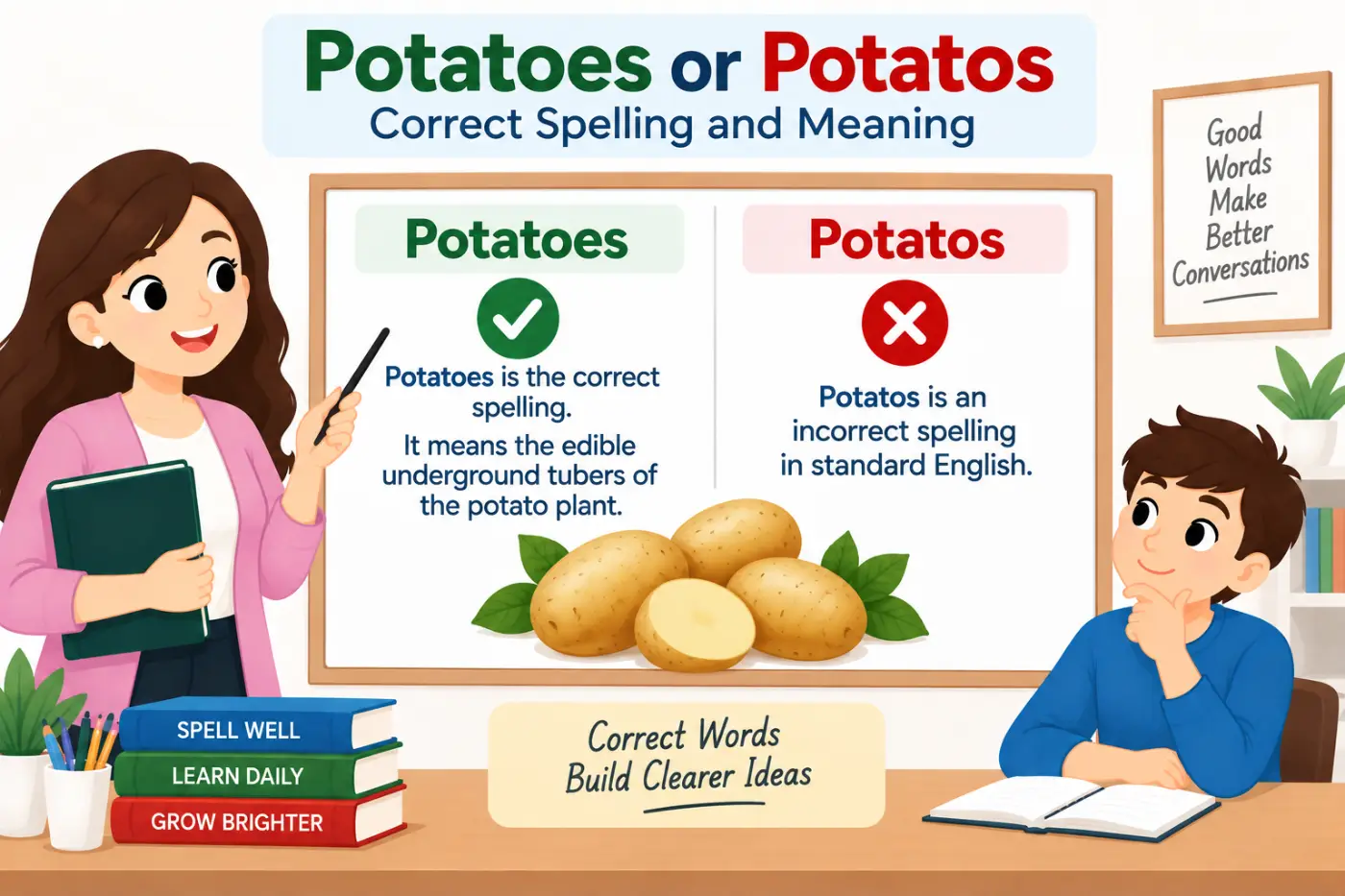
Potatoes or potatos is an easy spelling question to get wrong because the plural ending can feel unpredictable. The correct form is potatoes. If you are writing about more than one potato, add es rather than simply adding s.
The confusion comes from a real pattern in English. Many nouns ending in o form their plurals with s, while several common words take es. Potato belongs to the second group. That means the plural spelling cannot be worked out by sound alone. You need to know the established form used in standard English.
This distinction matters in everyday writing because potato is such a common word. You may need it in a grocery list, recipe, school assignment, restaurant menu, article, email, or casual message. In this guide you’ll learn the plural rule, pronunciation, word origin, common mistakes, examples, regional usage, and a few simple memory tricks that make the spelling much easier to remember.
Short Answer
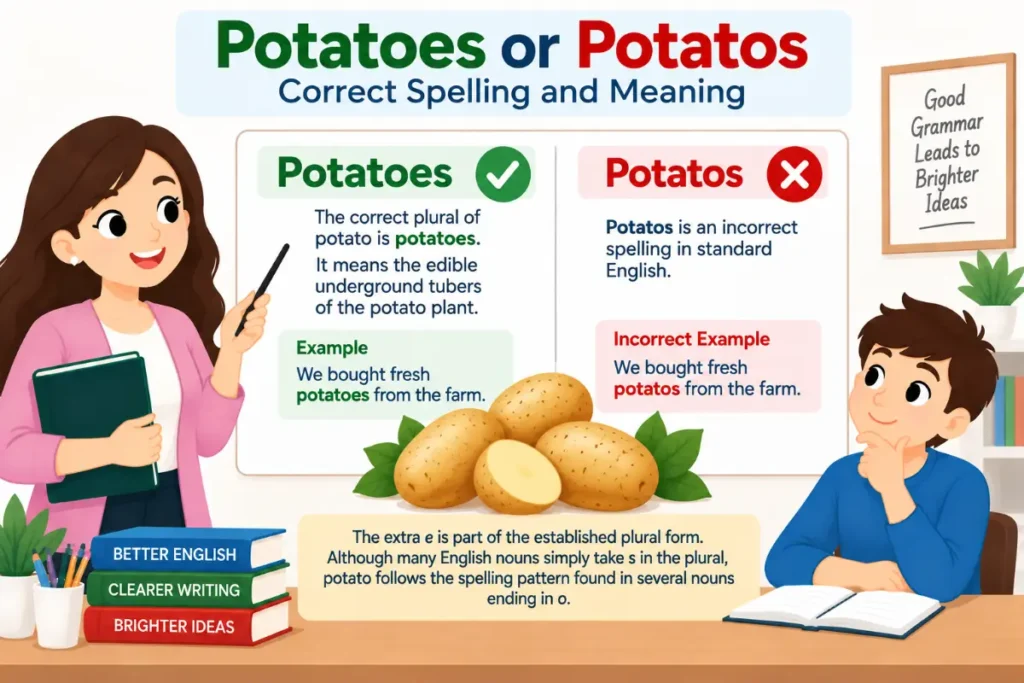
The correct plural of potato is potatoes. Potatos is an incorrect spelling in standard English. The extra e is part of the established plural form. Although many English nouns simply take s in the plural, potato follows the spelling pattern found in several nouns ending in o.
Table of Contents
- Quick answer and spelling rule.
- Meaning of potato and its plural.
- Why the plural uses es.
- Comparison with other nouns ending in o.
- Sentence examples.
- Common spelling mistakes.
- Pronunciation guide.
- Word origin and history.
- American and British usage.
- Grammar and plural rules.
- Real life usage.
- Related words and confusing forms.
- Memory tips.
- Expert editor insight.
- FAQs.
- Key takeaways.
- Conclusion.
The Correct Plural Form
The standard plural is potatoes.
The singular form refers to one potato.
I bought one potato.
The plural form refers to two or more.
I bought five potatoes.
The change looks small, but that final e matters. Writing potatos removes a letter from the standard plural and creates a spelling error.
A useful way to remember the form is to think of the singular word first.
Potato + es = potatoes.
You don’t need to change the pronunciation dramatically. The main difference appears in the written form.
The plural ending also follows a broader spelling pattern. Some nouns ending in o take es when they become plural. Potato is one of the familiar examples that learners often encounter.
Why The Plural Uses Es
English plural spelling isn’t governed by one rule that works perfectly for every noun. The most common plural ending is s, but some nouns take es for historical and spelling pattern reasons.
Words ending in certain sounds can take es because the ending makes the plural easier to pronounce and distinguish.
Potato follows the established plural pattern:
Potato → potatoes.
The same pattern appears in words such as tomato.
Tomato → tomatoes.
Another familiar example is hero.
Hero → heroes.
Echo also commonly becomes echoes.
These examples can help you see that potato isn’t an isolated oddity. It belongs to a group of nouns whose standard plurals use es.
Still, you shouldn’t assume that every noun ending in o takes es. That would create another spelling problem.
For example:
Photo → photos.
Piano → pianos.
Video → videos.
Radio → radios.
So the best approach is to learn common plural forms as established vocabulary rather than trying to force every word into one rule.
Comparison With Other Nouns Ending In O
| Singular | Standard Plural | Plural Ending | Example |
|---|---|---|---|
| Potato | Potatoes | es | We bought fresh potatoes. |
| Tomato | Tomatoes | es | The tomatoes are ripe. |
| Hero | Heroes | es | The heroes saved the town. |
| Echo | Echoes | es | The echoes filled the cave. |
| Photo | Photos | s | I printed several photos. |
| Piano | Pianos | s | The store sells pianos. |
| Radio | Radios | s | The radios stopped working. |
| Video | Videos | s | She watched several videos. |
| Volcano | Volcanoes or volcanos | Both forms occur | The volcanoes were active. |
| Memo | Memos | s | The manager sent two memos. |
The table shows why learners sometimes hesitate. English has more than one plural pattern for nouns ending in o.
There’s no need to memorize every noun in one sitting. Start with the common words you actually use.
Potato and tomato are especially useful to remember together.
Potato → potatoes.
Tomato → tomatoes.
That pair gives you a strong spelling pattern.
Meaning Of Potato
A potato is a starchy underground tuber produced by the potato plant. It is widely used as food and can be prepared in many ways.
The word can refer to the food itself or the plant structure that people harvest and eat.
For example:
I baked a potato for dinner.
The farmer grows potatoes on this land.
The singular form is used for one item. The plural form describes more than one.
One potato.
Two potatoes.
Several potatoes.
A bag of potatoes.
A plate of potatoes.
The word is common in everyday American English. You’ll find it in recipes, grocery stores, restaurants, agriculture, nutrition discussions, and ordinary conversation.
Sentence Examples
Here are natural examples that show how the correct plural works.
- We bought a bag of potatoes at the grocery store.
- The potatoes are already boiling on the stove.
- She roasted the potatoes with garlic and herbs.
- These potatoes taste better when they are baked.
- The farmer grows potatoes and other vegetables.
- I need three potatoes for this recipe.
- The restaurant serves mashed potatoes with the chicken.
- We planted potatoes in the garden last spring.
- He cut the potatoes into small pieces before cooking them.
- The children helped wash the potatoes before dinner.
Each sentence uses the plural because the meaning involves more than one potato.
Now look at the singular form.
I ate one potato with my lunch.
The difference is simple. One item takes the singular form. More than one takes the plural form.
Common Spelling Mistakes
Writing Potatos
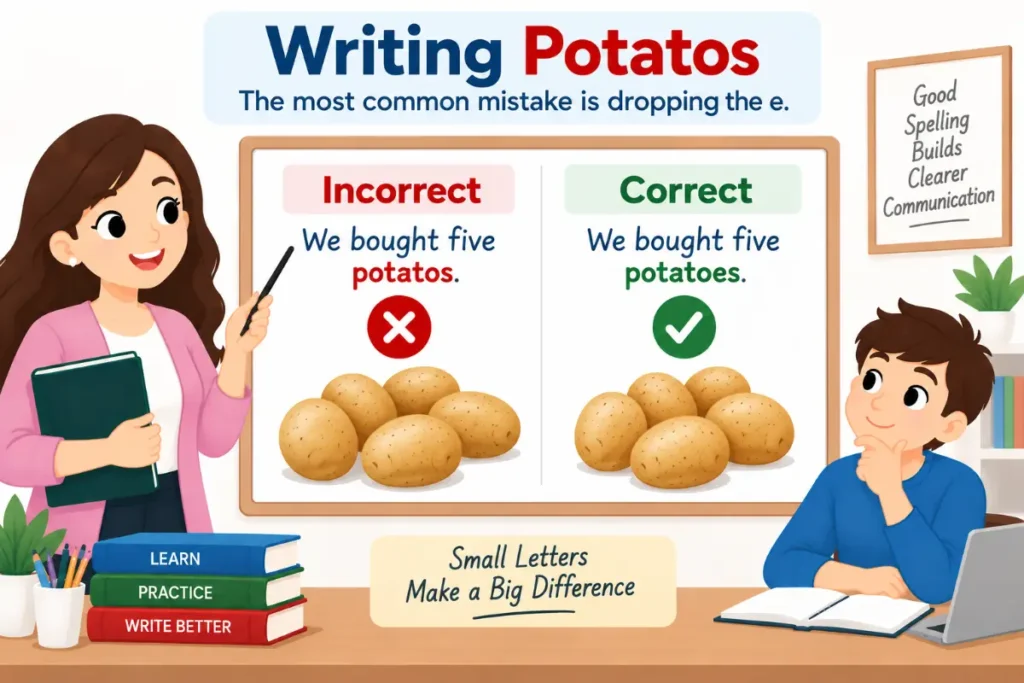
The most common mistake is dropping the e.
Incorrect: We bought five potatos.
Correct: We bought five potatoes.
This happens because adding s is the most familiar plural pattern in English. A writer may automatically attach s to the singular form without checking the established spelling.
Adding Too Many Letters
Another possible error is writing potatoees.
The standard spelling contains one e before the final s.
Potatoes.
Not potatoees.
Confusing Singular And Plural
Some writers use the plural when referring to one item.
Incorrect: I baked one potatoes.
Correct: I baked one potato.
The noun must agree with the quantity.
Using The Wrong Verb
Plural nouns normally take plural verb forms.
The potatoes are ready.
Not:
The potatoes is ready.
The singular form takes the singular verb.
The potato is ready.
Treating Every O Word The Same
A common learning mistake is assuming that every noun ending in o must take es.
That doesn’t work.
Photo becomes photos.
Piano becomes pianos.
Radio becomes radios.
Potato follows the es pattern because that is its established standard plural.
Pronunciation Guide
The singular word is commonly pronounced /pəˈteɪtoʊ/ in American English.
The plural is commonly pronounced /pəˈteɪtoʊz/.
A simple pronunciation guide is:
Potato: puh TAY toe.
Potatoes: puh TAY toez.
The plural ending is pronounced with a z sound because it follows a voiced vowel sound.
The main stress remains on the middle syllable.
Potato.
Potatoes.
The extra e in the spelling does not create a completely separate vowel sound. This is one reason people may forget it when writing. They hear the plural ending but don’t necessarily think about the exact letters needed to represent it.
A useful learning trick is to say the singular and plural together several times.
Potato.
Potatoes.
Tomato.
Tomatoes.
That creates a sound and spelling connection that can make the pattern easier to remember.
Word Origin And History
Potato entered English through Spanish patata. The Spanish term came from the indigenous Caribbean and South American naming history associated with the plant and its edible tuber.
The potato itself originated in the Andes region of South America and later became an important crop in many parts of the world.
The English spelling developed through contact with Spanish and other European languages. As the word became established in English, its plural followed English spelling conventions.
The plural form is therefore not created by simply copying the pronunciation. It reflects the way English handles this particular noun.
Understanding the history also helps explain why the word looks the way it does today. English contains thousands of words shaped by contact with other languages. Their spelling and plural behavior often reflect that long history.
American English Usage
American English uses potatoes as the standard plural.
You’ll see it everywhere from recipes and grocery lists to restaurant menus and school writing.
Examples include:
Mashed potatoes are a popular side dish.
The store sells several types of potatoes.
Farmers grow potatoes in many regions.
There is no American spelling that changes the plural to potatos.
For US readers and writers the standard choice is potatoes.
British English Usage
British English also uses potatoes as the standard plural.
The spelling is the same as in American English.
A British writer might say:
We need some potatoes for dinner.
The potatoes are growing well this year.
There is no meaningful British spelling difference in this word.
This is a useful example of a word whose standard plural remains stable across major varieties of English.
Australian English Usage
Australian English uses potatoes as the standard plural too.
The word appears naturally in cooking, agriculture, shopping, education, and everyday speech.
There is no established Australian variant that changes the plural to potatos.
Canadian English Usage
Canadian English follows the same standard spelling.
Potatoes is the normal plural form in Canadian writing.
The spelling remains consistent with American and British English, so writers don’t need to adjust it based on region.
Grammar And Plural Rules
Potato is a countable noun.
That means you can talk about one potato, two potatoes, several potatoes, or many potatoes.
The singular form works with one.
I bought one potato.
The plural form works with numbers greater than one.
I bought two potatoes.
It also works with plural quantity words.
We need several potatoes.
She cooked many potatoes.
The plural noun can appear as the subject of a sentence.
The potatoes are ready.
It can also appear as the object.
We washed the potatoes.
The spelling stays the same regardless of its position in the sentence.
Using Articles
The singular countable noun normally needs a determiner.
I bought a potato.
I bought one potato.
The plural can appear without an article when speaking generally.
Potatoes are easy to grow.
It can also take a determiner when referring to specific items.
The potatoes on the table are cold.
Using Quantifiers
Common quantity words work naturally with the plural.
Some potatoes.
Many potatoes.
Several potatoes.
A few potatoes.
Enough potatoes.
Too many potatoes.
These patterns are useful because they make the plural meaning clear.
Possessive Forms
The plural possessive can also be formed when needed.
The potatoes’ skins were washed carefully.
The apostrophe comes after the s because potatoes is already plural.
The singular possessive would look different.
The potato’s skin was removed.
These forms are grammatically separate from the spelling of the plural itself.
Real Life Usage Examples
Daily Conversation
I need to buy some potatoes before dinner.
Can you peel the potatoes while I prepare the sauce?
The word sounds completely ordinary in casual conversation. Most speakers don’t think about its unusual plural spelling until they have to write it.
Workplace Communication
Please order twenty potatoes for the event.
The kitchen team confirmed that the potatoes have arrived.
In a workplace setting involving food service or agriculture the plural can appear naturally in inventory lists and written instructions.
Academic Writing
Potatoes are an important crop in many agricultural systems.
The researchers examined how different soil conditions affected potato growth.
Academic writing often uses the plural when discussing the crop as a category.
News Writing
Local farmers harvested thousands of potatoes this season.
Higher food costs have affected the price of potatoes in some markets.
News writing generally uses the standard plural without any special regional variation.
Recipes And Cooking
Add the potatoes to the boiling water.
Roast the potatoes until they are golden brown.
Cooking instructions frequently use the plural because recipes often require several pieces.
Why Potatoes Is Easy To Misspell
The spelling looks more complicated than the pronunciation.
When people hear the word they recognize the familiar potato sound followed by a plural ending. They don’t necessarily hear an obvious extra e.
English also trains learners to expect a simple s plural in many cases.
Cat becomes cats.
Book becomes books.
Apple becomes apples.
Potato looks as if it should behave the same way.
That expectation leads naturally to the incorrect form.
There’s another issue too. Some nouns ending in o really do take s.
Photo becomes photos.
Video becomes videos.
Piano becomes pianos.
So learners can’t depend on one universal rule.
The safest approach is to learn common words together with their plural forms.
Memory Tips
Remember Potato And Tomato Together
This is probably the easiest trick.
Potato becomes potatoes.
Tomato becomes tomatoes.
Both use the same es ending.
If you can remember one you can often remember the other.
Think Of The Sound Of Es
Say the plural slowly.
Potatoes.
You can hear the final plural sound. Then picture the spelling with es.
Potatoes.
Remember The Full Word
Instead of thinking:
Potato plus s.
Think:
Potatoes.
This avoids automatically applying the most common plural rule.
Build A Small Word Family
Keep these together in your memory:
Potato.
Potatoes.
Tomato.
Tomatoes.
Hero.
Heroes.
Echo.
Echoes.
You don’t need to treat these as one perfect grammar rule. They simply provide useful examples of nouns that take es.
Related Grammar And Usage Notes
Potato Is Countable
You can count potatoes.
One potato.
Two potatoes.
Ten potatoes.
That makes it a countable noun.
Potato Can Be Used As A Modifier
The word can also describe another noun.
Potato salad.
Potato soup.
In these combinations potato often stays singular because it functions as a noun modifier rather than the main noun being counted.
For example:
I made potato soup.
Here potato describes the type of soup.
But:
I bought potatoes.
Here potatoes is the main noun and refers to multiple individual items.
Potato And Potatoes Do Not Always Mean The Same Thing
Potatoes usually refers to individual tubers or the crop considered as multiple units.
Potato can describe the food generally when used as a modifier.
Potato salad.
The exact meaning comes from sentence structure and context.
Related And Confused Words
Tomato
Tomato is closely related in spelling behavior because its plural is tomatoes.
Potato
The singular form refers to one item.
Potatoes
The plural refers to more than one.
Potatos
This is the common incorrect spelling discussed in this article.
Sweet Potato
Sweet potato is a related food term. Its plural is sweet potatoes.
Potato Salad
This phrase normally uses potato as a noun modifier.
Potato Plant
This describes the plant that produces potatoes.
Potato Skin
This refers to the outer skin of a potato.
These related expressions show how the noun behaves in different grammatical roles.
Formal And Informal Usage
The standard plural is appropriate in every normal level of English.
You can use it in casual messages.
I bought some potatoes.
You can use it in professional writing.
The restaurant ordered additional potatoes.
You can use it in academic writing.
The study examined potato production.
You can use it in formal documents.
The supplier will deliver the potatoes tomorrow.
There is no reason to reserve the standard spelling for formal contexts. It is simply the correct plural form.
The incorrect spelling should be avoided in both casual and formal writing. A quick text message may contain spelling errors without serious consequences, but polished writing should use the established form.
Is The Plural Rule Always Es
No. This is one of the most important points.
English nouns ending in o have different plural patterns.
Potato becomes potatoes.
Tomato becomes tomatoes.
But photo becomes photos.
Piano becomes pianos.
Video becomes videos.
Radio becomes radios.
There are also words where both forms occur.
Volcano can appear as volcanoes or volcanos.
The plural patterns developed through different word histories and established usage. That’s why it’s better to learn common words individually rather than memorizing an absolute rule that says every o ending noun takes es.
For everyday writing you only need to remember the form that belongs to the word you are using.
For potato the standard form is potatoes.
When Spellcheck Can Help
A modern spelling checker will usually identify potatos as an error when the surrounding context clearly indicates that the writer intends the plural of potato.
Still, spellcheck should be treated as a safety net rather than your only method of proofreading.
A spelling tool can catch many errors but it may not understand every context. It also cannot replace knowing why a word is spelled a certain way.
For important writing, read the sentence yourself.
Ask:
- Am I talking about one potato or more than one?
- If I mean more than one, did I use the standard plural?
- Does the noun agree with the verb?
- Does the surrounding sentence make the intended meaning clear?
These quick checks catch both spelling and grammar problems.
Expert Editor Insight
An experienced editor would treat potatos as a straightforward spelling error rather than a legitimate regional variant. The standard plural is potatoes, and the same spelling appears across American British Canadian and Australian English. The reason writers make the mistake is understandable because many nouns simply take s and several o ending nouns also use s. My practical editing tip is to pair potato with tomato in your memory. If you remember tomatoes, potatoes becomes much easier to spell correctly.
Key Takeaways
- The standard plural of potato is potatoes.
- Potatos is an incorrect spelling in standard English.
- The plural uses es rather than simple s.
- Potato is a countable noun.
- The singular refers to one item.
- The plural refers to two or more items.
- Potato and tomato follow the same useful plural pattern.
- Not every noun ending in o takes es. Photo, piano, video, and radio normally take s.
- The spelling is the same across major varieties of English.
- The easiest memory trick is to remember potato and tomato together.
Conclusion
Potatoes or potatos has a simple answer. Potatoes is the correct plural spelling, while potatos is a common spelling mistake. The extra e matters because this noun follows the established es plural pattern.
The word is used constantly in everyday conversation, cooking, shopping, agriculture, school writing, professional communication, and formal writing. The same standard spelling works in American, British, Canadian, and Australian English, so there is no regional version you need to learn.
For an easy memory trick, pair potato with tomato. Both change to potatoes and tomatoes in the plural. When you remember that shared pattern, the spelling becomes much easier to get right.
FAQs
Is potatos a correct spelling?
No. The standard plural spelling is potatoes. Potatos is a common spelling mistake caused by adding s directly to the singular form. English has several different plural patterns for nouns ending in o, so the simple s rule does not work for every word. In standard school, professional, academic, and published writing, use potatoes.
What is the plural of potato?
The plural of potato is potatoes. You use potato when referring to one item and potatoes when referring to two or more. For example, I bought one potato uses the singular, while I bought three potatoes uses the plural. The plural ending is es rather than just s, so the final e should not be left out.
Why does potato become potatoes?
Potato uses the es plural pattern that occurs with several established English nouns ending in o. Tomato and hero follow similar patterns. English does not have one universal rule for every noun ending in o, though. Some words such as photo and piano take s. The best approach is to learn the standard plural form of common words.
How do you pronounce potatoes?
The plural is commonly pronounced /pəˈteɪtoʊz/ in American English. An easy guide is puh TAY toez. The main stress stays on the middle syllable. The final plural sound is similar to the z sound in words such as dogs. The written e in the plural does not represent a separate strong vowel sound.
Is potato singular or plural?
Potato is singular. It refers to one item when used as a countable noun. The plural form is potatoes. You can say one potato, a potato, or the potato for singular use. For more than one you can say two potatoes, several potatoes, or many potatoes. The verb should also agree with the number of the noun.
Are potatoes and potatos pronounced differently?
They are not normally distinguished by a major difference in pronunciation because potatos is an incorrect spelling rather than a standard alternative word. The intended plural is pronounced with the regular plural ending. The important distinction appears in writing. If you mean more than one potato, write potatoes with es.
Is potato pluralized with s or es?
The standard plural uses es. Potato becomes potatoes. However, you should not assume that every English noun ending in o follows the same pattern. Photo becomes photos and piano becomes pianos. This is why common vocabulary should be learned with its established plural form instead of relying on one rule for every o ending noun.
What is an easy way to remember the spelling?
A simple memory trick is to pair potato with tomato. Potato becomes potatoes and tomato becomes tomatoes. Both use the es ending. You can also remember the phrase potatoes for dinner because it gives you the complete plural form in a natural sentence. Repeating the word in context is often easier than memorizing isolated letters.

Confusing Words, Spelling & Word Choice
Claire Whitmore is a U.S.-based English editor who writes about commonly confused words, spelling differences, and word choice. Her work helps readers understand subtle distinctions between similar-looking words through simple definitions, practical examples, and modern usage guidance in both American and British English.