
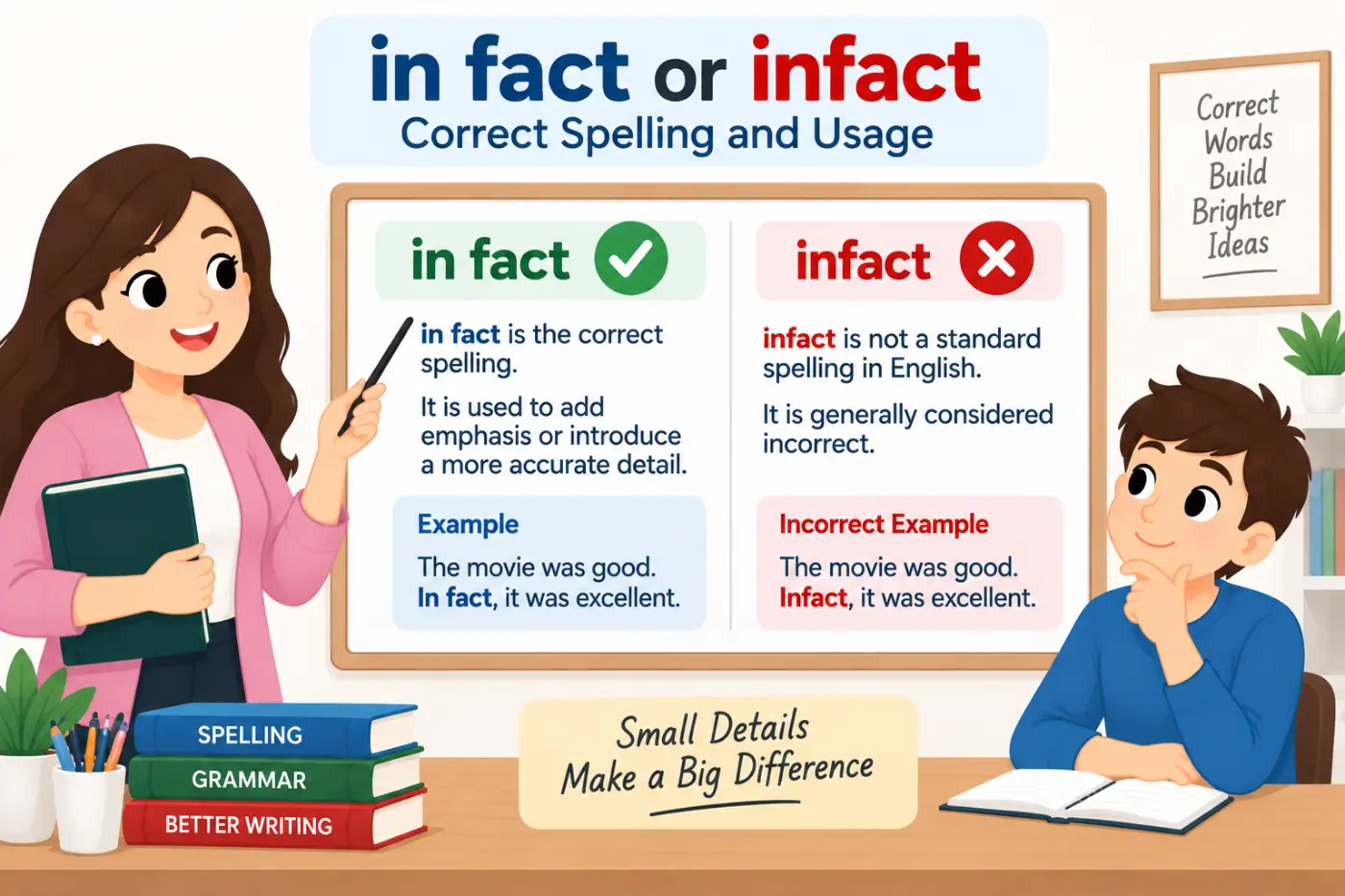
In fact or infact is a common spelling question because the phrase sounds like one smooth unit when people say it aloud. The correct form is in fact and it contains two separate words. Infact is not the standard spelling of the expression.
The confusion usually comes from pronunciation and fast typing. In natural speech the words often run together so closely that they can sound almost like a single word. English also contains many expressions that began as separate words and later became established as single words. That makes it tempting to write this phrase as one word even though standard usage keeps it open.
The phrase itself is useful far beyond spelling exercises. It can emphasize that something is true introduce a surprising fact correct an earlier impression or strengthen an argument. You’ll find it in everyday conversation emails essays journalism academic writing and formal prose. This guide explains the spelling meaning grammar pronunciation punctuation and natural usage so you can use the expression confidently.
Short Answer
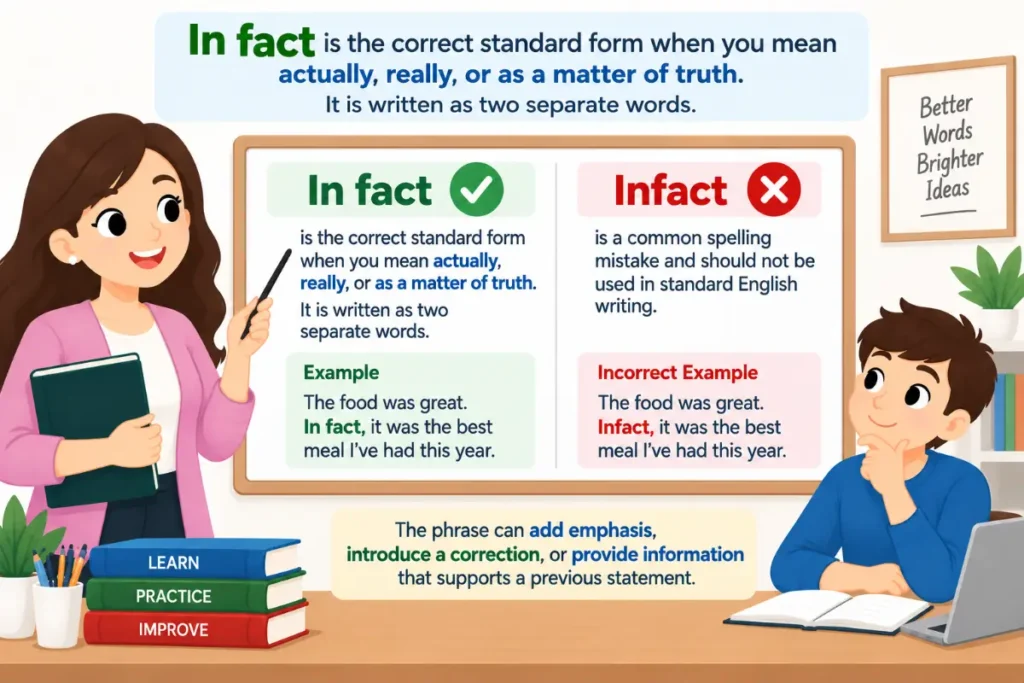
In fact is the correct standard form when you mean actually really or as a matter of truth. It is written as two separate words. Infact is a common spelling mistake and should not be used in standard English writing. The phrase can add emphasis introduce a correction or provide information that supports a previous statement.
Table of Contents
- Quick Answer
- Meaning and Definition
- Why The Words Stay Separate
- Key Differences
- Which Form Is Correct
- Sentence Examples
- Common Mistakes
- Pronunciation Guide
- Word Origin
- Regional Usage
- Grammar Rules
- Real Life Usage
- Related Expressions
- Memory Tips
- Expert Editor Insight
- FAQs
- Key Takeaways
- Conclusion
Meaning and Definition
Meaning of In Fact
In fact is a fixed English phrase that normally means actually, really, or as a matter of fact.
It often gives extra force to a statement. For example:
I thought the store was closed. In fact, it was open until midnight.
The second sentence corrects the impression created by the first sentence. The phrase tells the reader that the information that follows is the actual situation.
It can also introduce information that strengthens an earlier statement.
The restaurant is popular. In fact, people often wait an hour for a table.
Here the phrase adds evidence to the previous claim.
Another common use is emphasis.
She is not just good at math. In fact, she won a national competition.
The expression works well because it signals that the following information deserves attention.
Meaning of Infact
Infact is generally a misspelling of in fact. It does not function as the standard written form of the expression.
You may see it in social media posts comments text messages informal notes or quickly typed drafts. People often understand what the writer intended because the surrounding sentence provides enough context.
That does not make the spelling correct.
This is an important distinction in language. A reader can understand a spelling mistake without that mistake becoming a standard word. English readers regularly recover meaning from context even when a word has been typed incorrectly.
If you are writing an essay email article report application or other polished material write in fact as two words.
Why The Words Stay Separate
The easiest way to understand the spelling is to look at the grammar.
In is a preposition.
Fact is a noun.
Together they form the phrase in fact.
The phrase has developed as a grammatical expression rather than as a single lexical word. The space between the two words reflects that structure.
Compare it with established compounds such as inside or indeed. Those are single words with their own histories and meanings. You cannot assume that every frequently used phrase eventually becomes one word.
English has many expressions that remain open combinations even after centuries of use.
For example:
In fact.
At first.
At last.
Of course.
At once.
For example.
These phrases are written as separate words because their grammatical structure remains visible.
The spoken form can still sound compact. That is normal. English speech often reduces unstressed words and connects sounds across word boundaries.
This creates a useful lesson for spelling. Pronunciation does not always tell you where one English word ends and another begins.
Key Differences
- Spelling. In fact contains a space. Infact removes that space and is normally considered incorrect.
- Meaning. In fact can mean actually really or as a matter of truth. Infact does not have a separate standard meaning.
- Grammar. In fact functions as a phrase that can modify or comment on a whole statement.
- Word structure. In fact consists of two words rather than one.
- Pronunciation. The phrase is often spoken smoothly which can make it sound like one word.
- Formality. In fact is acceptable in casual conversation as well as formal writing.
- Context. The expression works in conversation emails essays reports journalism academic writing and professional communication.
- Standard usage. In fact is the established written form. Infact should normally be corrected during proofreading.
The distinction is therefore straightforward. The issue isn’t a difference in meaning between two accepted forms. It is mainly a question of standard spelling and word boundaries.
Which Form Is Correct
The correct form is in fact.
Standard English dictionaries and established usage treat in fact as a two word expression. The phrase is commonly used as an adverbial expression that adds emphasis or presents information as true.
The incorrect form develops naturally from connected speech. When people say the phrase quickly the boundary between the two words can become less noticeable.
That can lead to a spelling error such as:
Infact I forgot about the meeting.
The corrected version is:
In fact, I forgot about the meeting.
The spelling also becomes easier to remember when you focus on meaning. Ask yourself what the phrase is doing. If you could replace it with actually or as a matter of fact then you almost certainly need the two word form.
Another useful test is to look at the next word. Fact is a normal noun and can appear with determiners in other constructions.
The fact.
A fact.
This fact.
The phrase in fact preserves that separate noun.
Sentence Examples
The following examples show several natural uses.
Everyday Conversation
- I thought he lived in Chicago. In fact, he lives in Dallas.
This use corrects an earlier assumption.
- I’m not tired. In fact, I could stay up for another hour.
Here the phrase adds emphasis to the speaker’s actual condition.
Text Messages
- I thought the meeting was tomorrow. In fact, it’s today.
The expression introduces a correction.
- You were right. In fact, you were right about everything.
This use strengthens the previous statement.
Work Communication
- The project is almost complete. In fact, we only have two tasks left.
The phrase introduces supporting information.
- I expected the report to take longer. In fact, we finished it ahead of schedule.
The expression highlights a result that differs from the expectation.
Academic Writing
- The findings support the original hypothesis. In fact, the results were stronger than the researchers expected.
Here the phrase emphasizes evidence.
- Many people assume the process is expensive. In fact, the available data suggest otherwise.
This use introduces a correction to a common assumption.
Formal Writing
- The proposal appears practical. In fact, it addresses several problems that earlier plans overlooked.
The phrase strengthens the argument.
- The evidence is limited. In fact, further research is needed before a firm conclusion can be reached.
Here it adds precision to the preceding statement.
Common Mistakes
Writing Infact As One Word
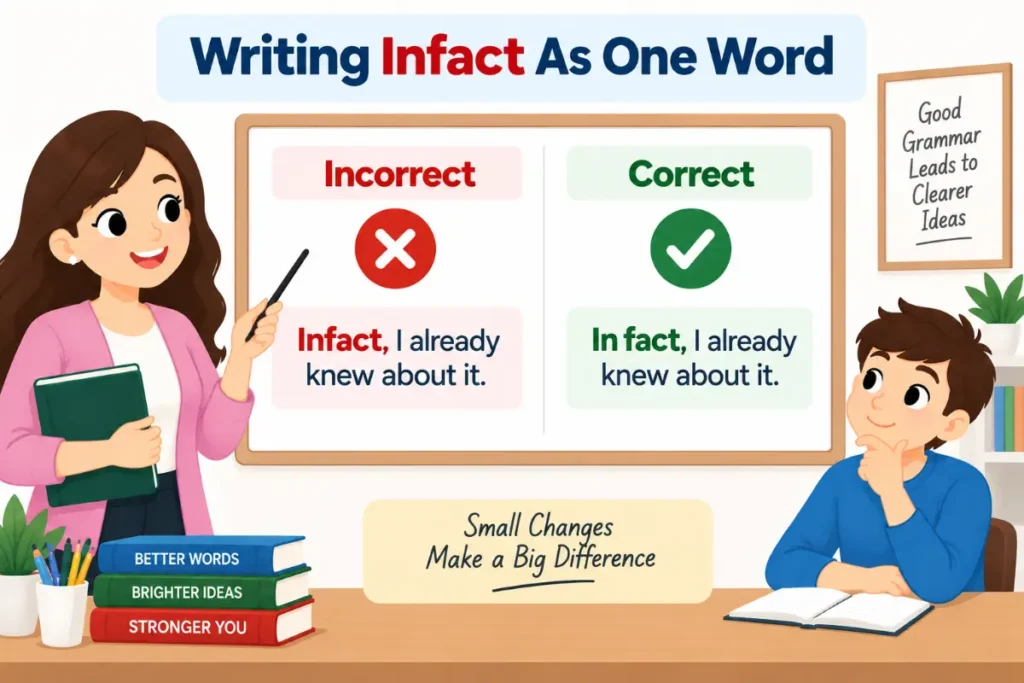
Incorrect: Infact, I already knew about it.
Correct: In fact, I already knew about it.
The error happens because the phrase often sounds connected during normal speech.
Adding Unnecessary Capitalization
Incorrect: In Fact, the results were different.
Correct: In fact, the results were different.
The phrase normally follows ordinary sentence capitalization. Only the first word is capitalized when the phrase begins a sentence.
Using It Without A Clear Purpose
In fact is useful but it shouldn’t appear simply because a sentence feels formal.
Compare:
The plan worked.
The plan worked. In fact, it worked extremely well.
The second version has a purpose. The phrase adds emphasis and introduces additional information.
If removing the phrase doesn’t change the point or emphasis of the sentence then you may not need it.
Confusing In Fact With In Fact That
The expression can be followed by a complete clause but it doesn’t normally need that as a fixed grammatical partner.
Natural:
In fact, she already knew.
Natural:
In fact, the results were better than expected.
The phrase introduces the statement rather than acting as a conjunction.
Treating It Like A Single Word
Writing infact is similar to other spacing errors where two familiar words become one during typing.
The correction is simple. Remember that fact remains an independent noun.
Pronunciation Guide
The common pronunciation of in fact can be represented approximately as:
/ɪn fækt/
A simple pronunciation guide is:
in fakt
The main stress usually falls on fact because it carries the stronger meaning in the phrase.
In natural American speech the phrase can sound closely connected. The final consonant of in flows directly into the beginning of fact.
That connected pronunciation explains much of the spelling confusion.
You don’t normally pause between the two words when speaking.
Compare the careful version:
In. Fact.
With natural speech:
In fact.
The second version is much more typical.
This is a good example of why spoken English and written English need separate attention. Speech prioritizes rhythm and flow. Writing has to preserve word boundaries.
If you’re learning English as a second language you may find it useful to practice the phrase in complete sentences rather than pronouncing each word in isolation.
Word Origin
The phrase combines the preposition in with the noun fact.
Fact ultimately comes from Latin factum, meaning something done or an act. It entered English through French influence and developed into the modern sense of a thing known or accepted as true.
The modern expression in fact grew from the basic idea of something existing in actual reality.
Over time it became a common discourse expression used to emphasize truth or introduce information that corrects or strengthens what came before.
The history of the phrase helps explain its meaning but doesn’t change the modern spelling. Contemporary standard English keeps the words separate.
This is a good example of how English preserves many older grammatical combinations instead of turning every frequent phrase into a compound word.
Regional Usage
American English
In fact is completely standard in American English. It appears frequently in conversation professional writing journalism academic work and everyday communication.
American speakers commonly use it to emphasize a point or correct an assumption.
I thought she was from Boston. In fact, she’s from Seattle.
The spelling remains two words.
British English
British English also uses in fact as the standard form. There is no major British spelling difference for this expression.
The phrase appears in both formal and informal writing and carries the same general meanings found in American English.
Australian English
Australian English follows the same standard spelling. In fact remains a two word expression.
It is used naturally in conversation professional writing education journalism and general prose.
Canadian English
Canadian English also uses the standard two word form. There is no meaningful regional spelling variation that makes infact acceptable as a standard alternative.
Across these major English varieties the spelling stays consistent.
Grammar Rules
In fact is commonly described as an adverbial phrase or adverbial expression.
It can comment on an entire statement rather than modifying only one individual word.
For example:
In fact, the opposite is true.
The phrase frames the whole statement that follows.
It can also appear after a clause.
The answer was difficult. In fact, nobody solved it.
In this position it introduces additional information.
The phrase can also appear within a sentence.
She did, in fact, finish the assignment.
Here the expression adds emphasis to the statement.
In Fact At The Beginning
When in fact begins a sentence it is often followed by a comma.
In fact, I had already seen the movie.
The comma helps separate the introductory expression from the main clause.
In Fact In The Middle
The phrase can be inserted into a sentence with commas when it acts as an aside.
She was, in fact, the first person to arrive.
The commas show that the phrase is parenthetical.
In Fact At The End
The phrase can sometimes appear at the end.
He knew the answer in fact.
This is possible but can sound less natural or more literary depending on the sentence. In ordinary American English writers often place the expression earlier.
A more natural version might be:
He knew the answer. In fact, he had known it all along.
Punctuation
The punctuation depends on where the phrase appears.
At the beginning:
In fact, the results were surprising.
In the middle:
The results were, in fact, surprising.
As a separate sentence:
The results were surprising. In fact, they changed the entire discussion.
The key point is that punctuation supports the grammatical role of the phrase. The space between in and fact is always maintained in standard writing.
How In Fact Changes Meaning And Tone
The phrase does more than tell readers that something is true. Its position and context can change the tone.
Correction
I thought the store closed at five. In fact, it closes at seven.
The phrase tells the reader that the second statement corrects the first.
Emphasis
She’s very experienced. In fact, she has worked in the field for twenty years.
The expression makes the supporting detail feel more significant.
Contrast
The task looked simple. In fact, it was surprisingly difficult.
The phrase highlights a difference between expectation and reality.
Confirmation
You were right. In fact, the evidence supports your argument.
Here it strengthens agreement.
Stronger Argument
The policy has created problems. In fact, several departments have reported the same issue.
The phrase helps move from a general claim to supporting evidence.
This flexibility makes the expression valuable in persuasive writing. Still, strong writing uses it with purpose rather than scattering it throughout every paragraph.
Real Life Usage Examples
Daily Conversation
In everyday speech the phrase often appears when someone corrects themselves or adds an unexpected detail.
I thought Mark was still at work. In fact, he left an hour ago.
That movie was better than I expected. In fact, I’d watch it again.
The expression feels natural because conversation often involves adjusting information as people talk.
Email And Workplace Communication
In workplace writing the phrase can clarify facts or emphasize a result.
The first phase is complete. In fact, the team finished two days early.
We expected a small increase in demand. In fact, orders have nearly doubled.
It works well in professional communication because it is clear without sounding overly technical.
Academic Writing
Academic writers use the expression to introduce evidence or correct an assumption.
The results appear consistent with earlier research. In fact, the findings provide additional support for that conclusion.
The sample was smaller than originally planned. In fact, this limitation should be considered when interpreting the results.
In academic prose it should support a logical relationship rather than serve as decoration.
News Writing
Journalists can use the phrase when clarifying a developing story.
The storm weakened overnight. In fact, officials reported that conditions had improved significantly by morning.
The company expected modest growth. In fact, sales exceeded the original forecast.
The expression can help signal that the next detail provides a more accurate picture.
Literature And Storytelling
Storytellers can use in fact to reveal information or shift the reader’s understanding.
He appeared calm. In fact, he had been worried for hours.
She thought the old house was empty. In fact, someone was living there.
This use can create a small turn in the story. The reader is led toward one assumption and then given a more accurate reality.
Related Expressions
As A Matter Of Fact
This is a close alternative to in fact.
I thought she was new. As a matter of fact, she has worked here for ten years.
It can sound slightly more deliberate or emphatic.
Actually
Actually often serves the same purpose when correcting an assumption.
I thought he was from Texas. Actually, he’s from Arizona.
It is extremely common in conversation.
Really
Really can express emphasis but has a wider range of meanings.
That was really difficult.
It doesn’t always perform the same discourse function as in fact.
Indeed
Indeed can express agreement or emphasis and often has a more formal tone.
The results were indeed significant.
It isn’t always a direct replacement.
Truly
Truly emphasizes sincerity or truth.
She truly believed him.
The focus is slightly different from in fact.
In Reality
In reality highlights a contrast between appearance and actual circumstances.
The plan seemed simple. In reality, it required months of work.
As It Turns Out
This phrase introduces information that became clear later.
As it turns out, the documents were filed incorrectly.
It often suggests discovery.
Actually Speaking
This expression can introduce correction or clarification but sounds more marked than everyday actually.
These related expressions are useful because they give writers choices. Still, they shouldn’t be treated as exact substitutes in every sentence. Meaning and tone matter.
Memory Tips
Remember The Meaning
If you can replace the phrase with actually or as a matter of fact then write the two words separately.
For example:
In fact, I already knew.
Actually, I already knew.
The meaning stays close.
Remember The Noun
Fact is a separate noun.
A fact.
The fact.
This fact.
Because fact remains an independent word in the phrase, keep the space.
Remember The Sound
The phrase may sound like one unit when spoken but spoken rhythm doesn’t determine written word boundaries.
Think of the written form rather than trying to spell what you hear.
Use A Visual Association
Imagine the phrase as two building blocks.
IN + FACT
They work together but they don’t merge.
This simple visual cue can help prevent the most common typing error.
Proofread For Spacing
During proofreading search mentally for common closed up phrases. If you see infact check it immediately.
The same habit can help with other expressions such as a lot and at least.
Formal And Informal Usage
In fact works comfortably across different levels of English.
In casual speech it can sound completely natural.
In fact, I was just about to call you.
In workplace writing it can strengthen a point.
In fact, the figures show a larger increase than expected.
In academic writing it can introduce evidence or qualification.
In fact, the findings suggest that the original assumption needs revision.
In formal writing the phrase should still be used carefully. It can become repetitive if every paragraph contains it.
Good editors ask what relationship the phrase creates. Does it correct something? Add evidence? Emphasize a point? Contrast expectation with reality?
If the answer is no then removing it may produce cleaner prose.
Why Infact Is So Common
The spelling mistake has a straightforward explanation.
First, speech connects the words. Native speakers rarely pronounce a clear pause between in and fact.
Second, fast typing encourages writers to represent familiar phrases as single units.
Third, English contains many compounds that really are written as one word. Readers may unconsciously assume that a frequently used expression follows the same pattern.
Fourth, digital communication often receives less proofreading. A quick message may contain several spacing or spelling mistakes that would never appear in edited prose.
The mistake is therefore easy to understand. But it remains a mistake in standard writing.
This is also a useful example of the difference between word recognition and word segmentation. A reader can recognize the intended phrase even when the writer has incorrectly joined its parts.
That is why infact may look familiar without being correct.
Expert Editor Insight
An experienced editor will almost always change infact to in fact in standard prose. The error usually comes from connected speech or fast typing rather than a misunderstanding of the phrase itself. Professional editors also watch how often the expression appears because repeated use can make writing feel padded or overly emphatic. The best approach is simple: keep the words separate and use the phrase only when it adds correction emphasis evidence or contrast. If removing it leaves the sentence stronger and just as clear then you probably don’t need it.
Key Takeaways
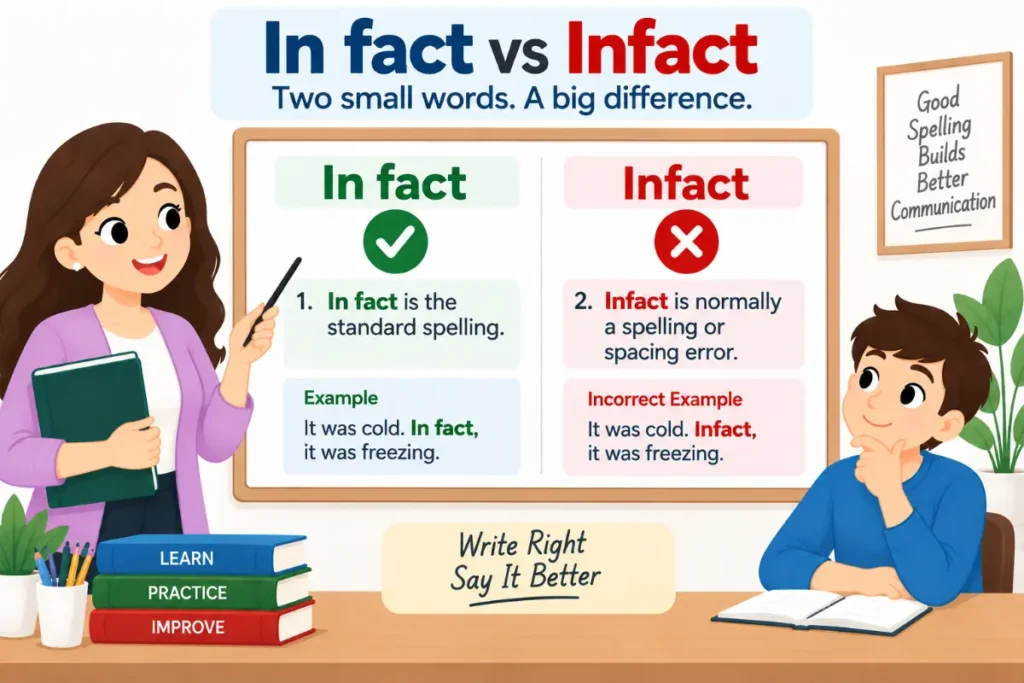
- In fact is the standard spelling.
- Infact is normally a spelling or spacing error.
- The expression contains two separate words.
- It commonly means actually really or as a matter of fact.
- It can correct an assumption add evidence or emphasize a point.
- It works in casual conversation and formal writing.
- It can begin a sentence and is commonly followed by a comma in that position.
- The phrase is pronounced smoothly enough to make the two word spelling easy to forget.
- A useful memory trick is to remember that fact remains an independent noun.
- Use the expression when it adds a clear purpose to your sentence.
Conclusion
In fact or infact has a simple answer. The correct standard form is in fact written as two separate words. Infact is normally a spelling mistake caused by connected pronunciation fast typing or confusion about English word boundaries.
The phrase means actually really or as a matter of fact and can serve several useful purposes. It can correct an assumption add supporting information emphasize a point or show a contrast between appearance and reality. You can use it naturally in conversation emails academic writing journalism and formal prose.
For an easy memory trick remember that fact is still a separate noun inside the expression. Think of the phrase as in plus fact and keep the space. That small habit will help you avoid one of the most common spacing mistakes in everyday English.
FAQs
Is infact one word?
No. In standard English the expression is written as two words: in fact. The closed form infact is generally a spelling mistake. The confusion happens because the phrase is often pronounced smoothly without a noticeable pause. In formal writing academic work professional emails and published content you should keep the space between in and fact.
What does in fact mean?
In fact commonly means actually really or as a matter of fact. It can introduce information that confirms a previous statement or corrects an earlier assumption. For example a speaker might say that something seemed difficult and then use the phrase to introduce evidence showing what actually happened. Its exact tone depends on the surrounding sentence.
Which is correct in fact or infact?
In fact is the correct standard form. Infact is normally treated as a spelling or spacing error rather than a separate English word. The phrase contains the preposition in and the noun fact. Keeping them separate reflects the established written form. If you are unsure remember that fact can stand alone as a noun and remains separate inside this expression.
Can in fact start a sentence?
Yes. In fact can begin a sentence naturally and often does so when the writer wants to emphasize a fact or correct an earlier statement. A comma commonly follows the phrase when it introduces the main clause. For example: In fact, the results were better than expected. This construction works in both formal and informal writing.
Is in fact formal or informal?
In fact works in both informal and formal English. People use it in everyday conversation and text messages as well as academic essays reports professional emails journalism and formal prose. The expression itself is neutral. Its effect depends on context. In formal writing it is best used to introduce meaningful evidence clarification or emphasis rather than simply making a sentence sound stronger.
What is a synonym for in fact?
Common alternatives include actually as a matter of fact indeed in reality and really. These expressions overlap but they are not identical in every context. Actually is especially common in conversation. Indeed can sound more formal. In reality highlights a contrast between appearance and truth. Choose the expression that matches the exact relationship you want to create.
Why do people write infact?
People often write infact because the two words sound closely connected in normal speech. Fast typing also makes it easy to remove spaces between familiar expressions. Another reason is analogy with genuine compound words that are written as one word. Despite these influences standard English keeps in and fact separate. Proofreading for closed up phrases can help catch the error.
Is in fact followed by a comma?
A comma is commonly used after in fact when the phrase begins a sentence. For example: In fact, she had already finished the work. When the expression appears parenthetically in the middle of a sentence it can be set off with commas. However punctuation depends on sentence structure. The spelling itself remains unchanged and always keeps the space.

Confusing Words, Spelling & Word Choice
Claire Whitmore is a U.S.-based English editor who writes about commonly confused words, spelling differences, and word choice. Her work helps readers understand subtle distinctions between similar-looking words through simple definitions, practical examples, and modern usage guidance in both American and British English.