
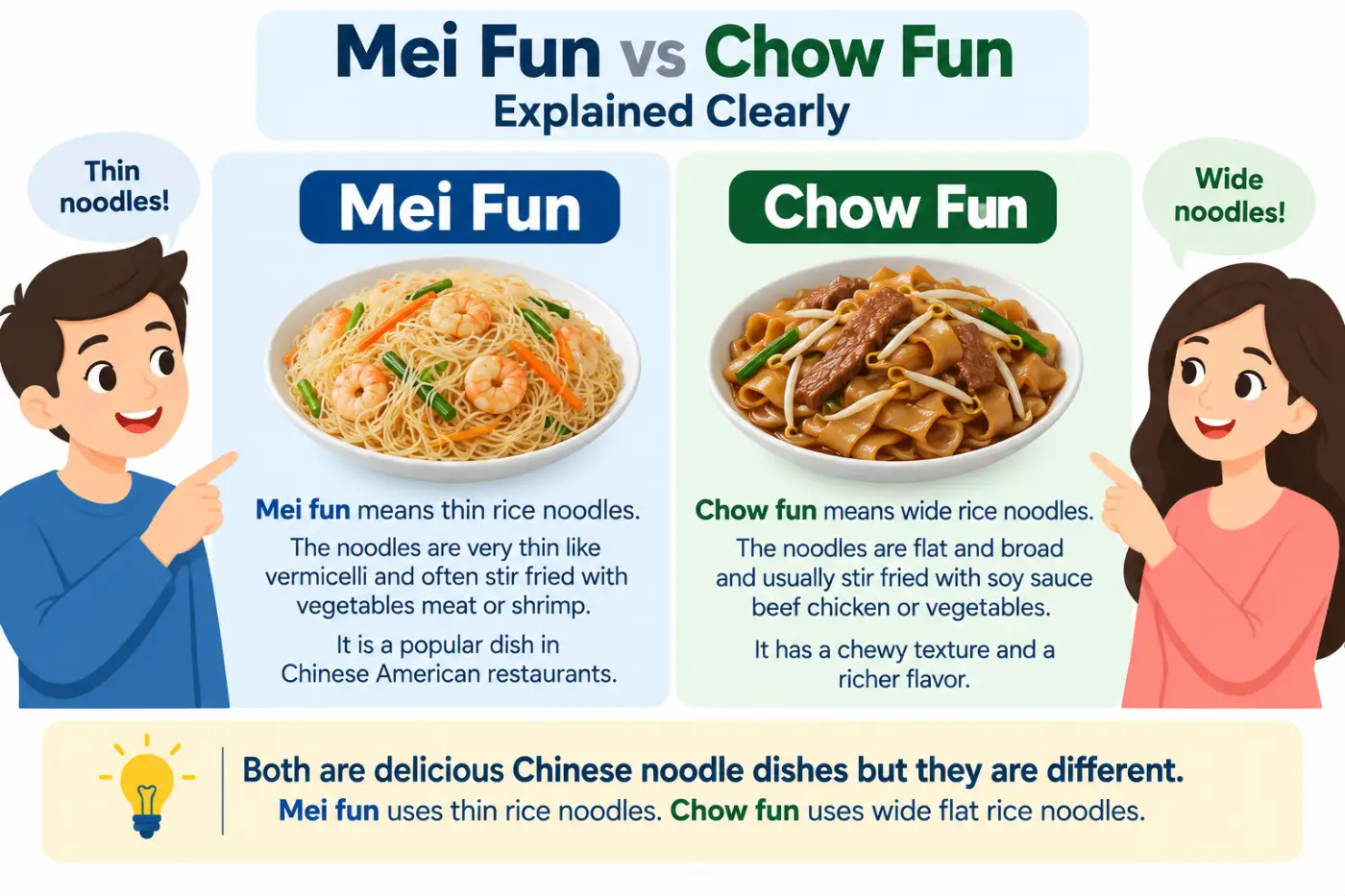
Mei Fun vs Chow Fun is a common food comparison because both dishes feature rice noodles and appear on many Chinese restaurant menus. The main difference is the type of noodle used. Mei fun features thin rice vermicelli, while chow fun uses wide, flat rice noodles. Although both dishes can include similar ingredients and seasonings, their noodles give them distinct textures and eating experiences.
The difference becomes clear when you take a bite. Mei fun has thin, delicate strands that absorb seasonings well and create a lighter texture. Chow fun, on the other hand, has broad, soft, and chewy noodles that make the dish feel more substantial. Cooks can stir fry either dish with vegetables, eggs, chicken, pork, shrimp, or other seafood, but the noodle shape changes the final result.
The names can also create confusion because Chinese restaurant menus use several spellings and related terms. You might see mei fun, rice vermicelli, chow fun, ho fun, or hor fun. Some menu items even combine these terms, making it harder to identify the dish. Understanding the noodle types, textures, ingredients, and cooking styles will help you choose the right dish for your taste.
This guide explains the noodle types meanings textures cooking methods flavors regional connections common dishes and practical differences so you can order with confidence.
Short Answer
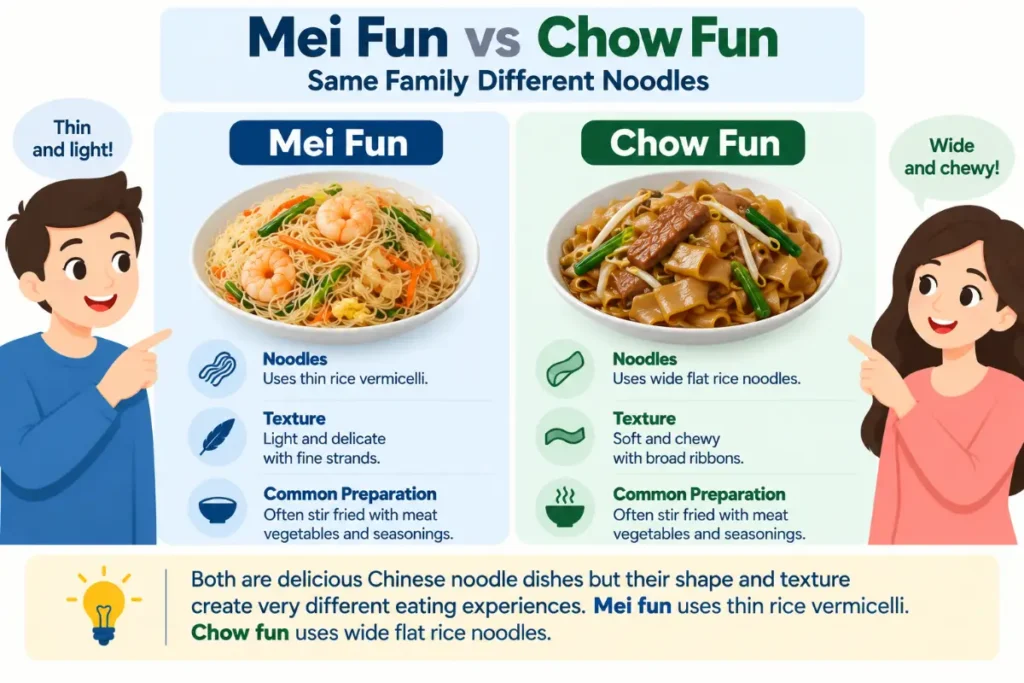
Mei fun uses thin rice vermicelli while chow fun uses wide flat rice noodles. Mei fun is light and delicate with fine strands. Chow fun is soft and chewy with broad ribbons. Both can be stir fried with meat vegetables and seasonings but their shape and texture create very different eating experiences.
Table Of Contents
- What Mei Fun Means
- What Chow Fun Means
- The Main Difference Between Them
- Mei Fun Vs Chow Fun At A Glance
- How The Noodles Look And Feel
- How They Are Cooked
- How The Flavors Differ
- Popular Dishes Made With Each Noodle
- What Chow Means In Chinese Food Names
- How Restaurant Menus Use The Terms
- Regional Usage And Food Culture
- Mei Fun Vs Chow Fun In Real Life
- Common Mistakes And Confusions
- How To Choose Between Them
- Memory Tips
- Related Noodles You Should Know
- Expert Editor And Food Language Insight
- FAQs
- Key Takeaways
- Conclusion
What Mei Fun Means
Mei fun generally refers to thin rice noodles that are also called rice vermicelli. The noodles are narrow round strands rather than wide flat sheets. They are usually made primarily from rice and water and may contain additional starch depending on the product.
The word can refer to the noodle itself or to a prepared dish made with those noodles. That distinction matters because restaurant menus sometimes use the noodle name as the name of the complete meal.
The noodles are usually light in appearance and can become tender quickly after soaking or cooking. Their fine shape lets them mix easily with vegetables meat seafood eggs and sauces.
Mei fun dishes are especially common in Chinese American restaurant menus and across several Asian food traditions. Preparation styles vary considerably. A stir fried version may include vegetables protein and savory seasonings. Other versions can appear in soups or other preparations.
One famous menu item is Singapore mei fun. Despite its name the dish is strongly associated with Cantonese restaurant cooking outside Singapore and often uses curry powder along with thin rice vermicelli. The name therefore doesn’t mean that every dish carrying mei fun follows one fixed recipe.
The key point is simple. When you see mei fun on a menu you should expect thin rice noodles.
What Chow Fun Means
Chow fun is associated with wide flat rice noodles. These noodles are much broader than rice vermicelli and have a smooth ribbon like appearance.
The noodles are closely connected with Cantonese cooking and dishes based on hor fun or ho fun. The exact English spelling can vary because Chinese food names are often represented through different systems of romanization.
One of the best known examples is beef chow fun. The dish commonly combines wide rice noodles with sliced beef bean sprouts scallions and savory seasonings. High heat cooking can create a distinctive toasted aroma and flavor often described through the Cantonese cooking concept of wok hei.
Chow fun noodles have a soft slippery texture with more chew and body than thin rice vermicelli. Their broad surface also gives sauces and cooking juices plenty of room to cling to the noodles.
Fresh chow fun noodles are especially useful for stir frying because they have a soft texture and can move quickly through a hot wok. Dried forms also exist and require different preparation.
So when you see chow fun on a menu think broad flat rice noodles rather than thin vermicelli.
The Main Difference Between Them
The biggest difference isn’t the sauce or the meat. It is the noodle.
Mei fun uses thin rice vermicelli. Chow fun uses wide flat rice noodles. That basic difference affects texture cooking time appearance and the kinds of dishes each noodle works well in.
Here are the most useful distinctions.
- Shape. Mei fun is thin and round. Chow fun is broad and flat.
- Texture. Mei fun tends to feel light and delicate. Chow fun tends to feel soft slippery and chewy.
- Appearance. Mei fun looks like fine white strands. Chow fun looks more like wide ribbons.
- Cooking behavior. Thin vermicelli cooks quickly and can become soft if overcooked. Broad noodles need careful handling so they don’t break during high heat cooking.
- Typical dishes. Mei fun appears in stir fries soups and other rice noodle preparations. Chow fun is strongly associated with Cantonese stir fried noodle dishes and soups.
- Eating experience. Mei fun gives you many fine strands in each bite. Chow fun gives you larger pieces with a fuller mouthfeel.
- Cultural association. Mei fun is used across several Asian cuisines. Chow fun has a particularly strong connection with southern Chinese and Cantonese food traditions.
Neither noodle is automatically better. They simply offer different experiences.
Mei Fun Vs Chow Fun At A Glance
| Feature | Mei Fun | Chow Fun |
|---|---|---|
| Main noodle type | Thin rice vermicelli | Wide flat rice noodles |
| Shape | Fine round strands | Broad flat ribbons |
| Texture | Light soft and delicate | Soft slippery and chewy |
| Typical color | White to translucent | White or slightly translucent |
| Common cooking method | Stir frying soaking or soup preparation | Stir frying or soup preparation |
| Famous example | Singapore mei fun | Beef chow fun |
| Common cuisine connection | Chinese and several Southeast Asian traditions | Cantonese and southern Chinese cooking |
| Sauce behavior | Carries seasoning across fine strands | Holds sauces and wok juices on broad surfaces |
| Overall feel | Light and delicate | Hearty and substantial |
| Best quick description | Rice vermicelli | Wide flat rice noodles |
The table gives you the basic distinction at a glance. Still the details matter because both noodle types can appear in many different recipes.
How The Noodles Look And Feel
Shape is the fastest way to tell these noodles apart.
Mei fun noodles are very thin. They resemble fine strands of pasta and often look almost threadlike when dry. After cooking they become soft and flexible. Their narrow shape lets them tangle together which gives the dish a loose and airy appearance.
Chow fun noodles look completely different. They are broad flat strips that can resemble ribbons. Fresh versions are smooth and soft. When cooked correctly they have a pleasant slippery chew.
This difference becomes obvious the moment you use chopsticks.
A bite of mei fun usually brings several fine strands together. A bite of chow fun often brings one or two broad pieces that feel much more substantial.
Texture also depends on preparation. A carefully cooked mei fun dish can have a gentle springiness while a poorly cooked version can become mushy. Chow fun can become wonderfully tender while still retaining enough structure to hold together in the wok.
The noodle itself therefore plays a major role in the final dish.
How They Are Cooked
Cooking method creates another major difference.
Thin rice vermicelli often needs soaking before it enters a stir fry. The exact method depends on the noodle and recipe. Some varieties are softened in warm or hot water before being added to the wok.
Because the noodles are so thin they can cook quickly. Overworking them can cause them to break or turn too soft.
Chow fun requires a different kind of handling. Fresh wide noodles can be delicate even though they feel substantial. A cook needs enough heat to develop flavor while moving the noodles carefully to avoid tearing them apart.
High heat is especially useful for classic Cantonese stir fried noodle dishes. A skilled cook can develop browned edges and a smoky aroma while keeping the noodles intact.
This is one reason chow fun can have such a satisfying texture. The broad noodles spend time touching the hot cooking surface while still retaining their soft interior.
Mei fun generally rewards gentle handling. Chow fun often rewards high heat and careful wok movement.
How The Flavors Differ
The noodles themselves have a mild rice flavor. Most of the character comes from the ingredients and cooking method.
Mei fun tends to work well with lighter seasoning because the fine strands absorb flavor quickly. Soy sauce sesame oil garlic scallions vegetables eggs seafood and various proteins can all work well.
Some restaurant versions use curry powder. Singapore style mei fun is a familiar example. The curry seasoning can give the noodles a warm savory flavor and a yellow color.
Chow fun often works beautifully with savory sauces and wok cooked ingredients. Beef chow fun is a classic example. Beef bean sprouts scallions soy sauce and aromatics create a rich combination without needing an overly thick sauce.
Wok hei can also influence the flavor. This term is often translated as the breath of the wok. It describes the distinctive aroma and taste that can develop when food is cooked quickly over very high heat.
The result is not simply a difference in seasoning. The noodle shape changes how the seasoning interacts with each bite.
Popular Dishes Made With Each Noodle
Mei fun can appear in many preparations.
- Singapore mei fun. This stir fried dish commonly combines rice vermicelli with vegetables protein egg and curry seasoning.
- Shrimp mei fun. Shrimp provides a delicate seafood flavor that works well with thin rice noodles.
- Chicken mei fun. Chicken vegetables and savory seasoning create a simple filling combination.
- Vegetable mei fun. Mixed vegetables can provide texture and color while the noodles carry the seasoning.
- Soup preparations. Thin rice noodles can also be used in brothy dishes depending on the culinary tradition.
Chow fun has its own familiar dishes.
- Beef chow fun. This is one of the best known Cantonese preparations and commonly combines beef wide rice noodles bean sprouts and scallions.
- Chicken chow fun. Chicken can replace beef for a lighter protein option.
- Shrimp chow fun. Shrimp pairs naturally with the soft broad noodles.
- Vegetable chow fun. Vegetables can add crunch and contrast to the tender noodles.
- Wet chow fun. Some Cantonese preparations use a more substantial sauce rather than the drier style associated with dry fried beef noodles.
The exact ingredients vary by restaurant region and recipe. Food names often describe a family of related preparations rather than one rigid formula.
What Chow Means In Chinese Food Names
The word chow can cause confusion because English speakers may assume it always identifies one type of noodle.
It doesn’t.
In Cantonese food terminology the sound represented as chow can relate to stir frying or cooking. That is different from the noodle itself.
This becomes especially clear when you compare chow fun with mei fun.
Mei fun identifies the thin rice vermicelli style. Chow fun identifies a dish and noodle tradition associated with wide flat rice noodles and Cantonese cooking.
You can also encounter dishes described as chow mei fun. In that phrase chow indicates the stir fried preparation while mei fun identifies the thin rice noodles.
This is why two dishes can both contain the word chow while using completely different noodle shapes.
The wording on a menu can therefore tell you something about preparation but not every part of the noodle structure.
How Restaurant Menus Use The Terms
Restaurant menus in the United States can use food names somewhat differently from menus in China Hong Kong or other regions.
A Chinese American restaurant may use mei fun to mean a complete stir fried noodle dish. The menu may offer chicken mei fun shrimp mei fun or Singapore mei fun.
Chow fun may appear as beef chow fun chicken chow fun or another protein based dish.
You might also see ho fun or hor fun. These spellings are closely related to the Cantonese name for the broad flat rice noodle. The differences come partly from how Cantonese sounds are represented in English.
This can make ordering confusing for someone who hasn’t encountered the terms before.
A practical trick is to ignore the spelling at first and look for the noodle description. If the menu says thin rice noodles you are looking at a vermicelli style dish. If it says wide flat rice noodles you are looking at a chow fun style noodle.
The menu description often tells you more than the romanization.
Regional Usage And Food Culture
Mei fun and chow fun belong to a broader world of southern Chinese and Asian noodle traditions.
Mei fun is widely used across Chinese cooking and appears in food traditions beyond China. Thin rice vermicelli is also common in several Southeast Asian cuisines where it may appear in stir fries soups salads and other dishes.
Chow fun has a particularly strong Cantonese identity. Wide flat rice noodles are associated with southern Chinese cooking and are especially familiar in Guangdong and Hong Kong food culture.
The names also vary by region and language. Ho fun and hor fun are common English spellings for the broad rice noodle. You may also encounter Chinese names connected with Shahe noodles.
These differences don’t mean the food is unrelated. They reflect the way food traditions travel and how words change when they move between languages.
American restaurant menus often simplify these traditions for English speaking customers. That’s why one restaurant may provide a detailed regional name while another simply says rice noodles.
Mei Fun Vs Chow Fun In Real Life
Imagine you’re ordering dinner after a long day.
You want something light with thin noodles vegetables shrimp and a little savory seasoning. Mei fun is likely to fit that preference.
Now imagine you want a hearty plate of noodles with tender beef bean sprouts scallions and a smoky flavor from a hot wok. Chow fun is the more natural choice.
The difference also matters when you’re cooking at home.
Thin vermicelli doesn’t behave like wide fresh rice noodles. You can’t always substitute one for the other and expect the same result.
If a recipe depends on broad noodles holding up to high heat then thin vermicelli may break or become too soft.
Likewise a recipe designed around fine strands may feel heavy if you replace them with broad noodles.
The shape isn’t a minor detail. It changes the entire dish.
Common Mistakes And Confusions
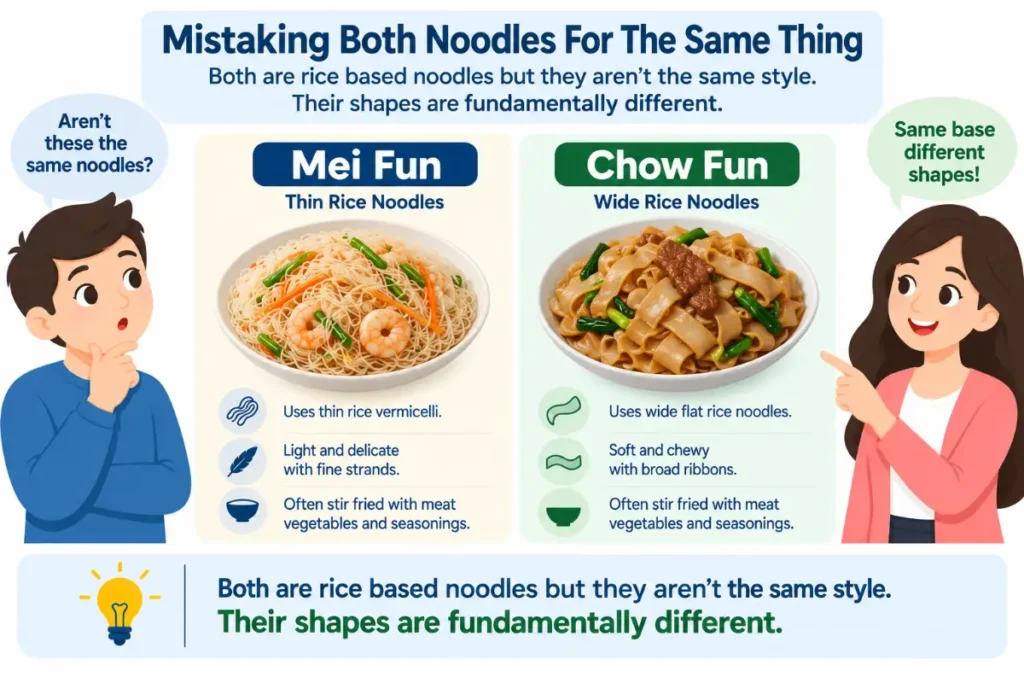
Mistaking Both Noodles For The Same Thing
Both are rice based noodles but they aren’t the same style. Their shapes are fundamentally different.
Confusing Chow Fun With Chow Mein
This is one of the biggest menu mistakes.
Chow mein generally uses wheat based noodles while chow fun uses rice noodles. The two names sound similar but refer to different noodle traditions.
Assuming Mei Fun Always Means One Dish
Mei fun can refer to the noodle itself or a prepared dish. The ingredients and seasoning can change from one recipe to another.
Assuming Singapore Mei Fun Comes From Singapore
The menu name can be misleading. Singapore style mei fun is strongly associated with Cantonese restaurant cooking and is not simply a traditional Singaporean dish.
Treating Ho Fun And Hor Fun As Completely Different Noodles
These names can refer to the same broad flat rice noodle tradition. Different romanization systems and restaurant conventions produce different spellings.
Expecting Identical Texture
Rice noodles aren’t all alike. Fine vermicelli and broad flat noodles behave differently because their shapes and thicknesses differ.
How To Choose Between Them
Choosing between these noodles is mostly a matter of texture appetite and flavor preference.
Choose mei fun if you prefer:
- Thin noodles.
- A lighter mouthfeel.
- Fine strands that mix easily with vegetables.
- Quick stir fried preparations.
- Curry seasoned restaurant style noodles.
- Delicate rice noodle texture.
Choose chow fun if you prefer:
- Wide flat noodles.
- A softer and chewier bite.
- Hearty stir fried dishes.
- Strong wok cooked flavors.
- Beef and bean sprout combinations.
- Broad noodles that carry savory sauces.
Neither choice is inherently better. Your preference depends on what kind of noodle experience you want.
How To Order At A Restaurant
If you’re unsure what to order don’t worry about remembering every Chinese food term.
Start with the noodle description.
Ask whether the dish uses thin rice vermicelli or wide flat rice noodles. Most restaurants can answer immediately.
If you want a light noodle dish ask about mei fun.
If you want broad chewy rice noodles ask about chow fun or ho fun.
If you want beef with a classic Cantonese style preparation beef chow fun is a natural option.
If you want something more strongly seasoned ask about Singapore style mei fun.
You can also ask about the sauce. Some dishes are dry fried while others contain more sauce.
A simple question can prevent an unpleasant surprise. You don’t have to become an expert in Chinese food terminology before ordering dinner.
Memory Tips
The easiest memory trick is to connect mei fun with fine noodles.
Think of mei fun as fine rice noodles.
The strands are thin and delicate.
For chow fun think of wide noodles and wok cooking.
The noodles are broad flat and substantial.
Another useful visual trick is to imagine two types of ribbon.
Mei fun is like a bundle of very fine threads.
Chow fun is like a handful of broad ribbons.
Once you picture the shapes the difference becomes much easier to remember.
You can also remember that the famous beef preparation usually points toward chow fun while Singapore style rice vermicelli commonly points toward mei fun.
These aren’t absolute rules for every menu but they are useful shortcuts when you’re ordering.
Related Noodles You Should Know
Understanding a few related noodle names makes Chinese restaurant menus much easier to read.
Chow Mein
Chow mein generally uses wheat noodles. Depending on the regional style those noodles may be soft or crisp.
Lo Mein
Lo mein commonly uses wheat based noodles that are cooked and then mixed or tossed with sauce and other ingredients.
Ho Fun
Ho fun is a common spelling connected with wide flat rice noodles. It is closely associated with the noodle used in many chow fun dishes.
Hor Fun
Hor fun is another common spelling for the same broad rice noodle tradition. You may encounter it on Cantonese restaurant menus.
Rice Vermicelli
Rice vermicelli describes thin rice noodles. Mei fun is one common Chinese term associated with this noodle type.
Rice Noodle Rolls
Rice noodle rolls are a different preparation made from rice based sheets. They shouldn’t be confused with thin rice vermicelli or wide stir fried noodles.
Glass Noodles
Glass noodles are usually made from starch such as mung bean starch. They become translucent when cooked and have a different texture from rice noodles.
Udon
Udon is a Japanese wheat noodle. It is thick and chewy and has a very different structure from both mei fun and chow fun.
Knowing these differences helps you avoid grouping every Asian noodle under the same label.
Related Grammar And Usage Notes
Although these are food terms rather than ordinary English vocabulary, spelling still matters when you’re writing about them.
The terms mei fun and chow fun are romanized expressions. That means English writers are representing sounds from another language using the Latin alphabet.
As a result you may encounter different spellings.
Mei fun can also appear as mai fun or mai fun noodles on some menus.
Chow fun can appear as chow fun noodles while ho fun and hor fun are also used for related Cantonese terminology.
These variations don’t always represent different foods. Sometimes they reflect different romanization systems restaurant traditions or attempts to make pronunciation easier for English speakers.
For professional writing consistency matters. If you’re writing a restaurant menu recipe food article or review choose one spelling and use it consistently unless you are specifically discussing alternate forms.
For readers the noodle description remains more useful than the spelling alone.
Real Life Usage Examples
Daily Conversation
- I usually order mei fun when I want something light.
This sentence highlights the thin rice noodle style and the lighter eating experience.
- The chow fun was my favorite because the noodles were so chewy.
Here chow fun identifies a dish known for broad tender noodles.
Restaurant Conversation
- Does the shrimp mei fun come with thin rice noodles?
This question confirms the noodle style before ordering.
- Can I get the beef chow fun with extra bean sprouts?
This uses a familiar Cantonese style dish and adds a personal preference.
Food Writing
- The mei fun absorbed the savory seasoning without becoming heavy.
The sentence focuses on the fine noodles and how they interact with seasoning.
- The chow fun developed a smoky aroma as it hit the hot wok.
This describes the effect of high heat cooking.
Academic Or Cultural Writing
- Cantonese cuisine includes several important rice noodle preparations with different shapes and cooking methods.
This broader statement places chow fun within a regional food tradition.
- Rice vermicelli appears across multiple Asian culinary traditions under different local names.
This explains why noodle terminology can vary across regions.
Online Food Reviews
- The mei fun was light and nicely seasoned but the noodles needed more texture.
This gives a useful review of preparation quality.
- The chow fun had soft noodles and a strong wok cooked flavor.
This focuses on the characteristics diners often notice first.
Expert Editor And Food Language Insight
When editing food content I look at two things first: the ingredient being named and the culinary context around it. With these terms the biggest mistake is treating mei fun and chow fun as alternative names for one noodle. They aren’t. A careful writer should identify mei fun with thin rice vermicelli and chow fun with broad flat rice noodles while recognizing that restaurant menus can use related Cantonese spellings such as ho fun and hor fun. Spellcheckers may not catch every terminology issue because a correctly spelled food term can still be used in the wrong context.
Key Takeaways
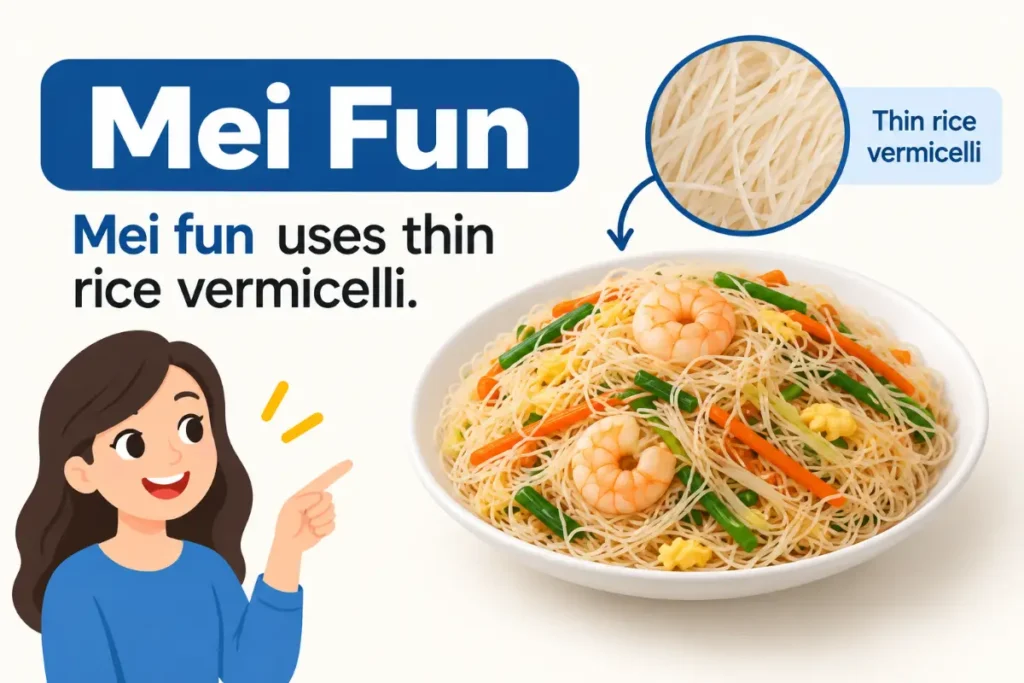
- Mei fun uses thin rice vermicelli.
- Chow fun uses wide flat rice noodles.
- Mei fun usually has a lighter and more delicate texture.
- Chow fun usually has a softer chewier and more substantial bite.
- Beef chow fun is a classic Cantonese preparation.
- Singapore style mei fun commonly uses curry seasoning.
- Ho fun and hor fun are related names for broad flat rice noodles.
- Chow mein is different because it generally uses wheat noodles.
- Noodle shape affects cooking behavior texture and flavor.
- Restaurant menus can use different romanizations for related Chinese food terms.
- Choose mei fun for fine rice noodles and chow fun for broad flat noodles.
- The best way to understand the menu is to look at the noodle description rather than relying only on the name.
Conclusion
Mei fun vs chow fun is easier to understand when you look at the shape of the noodles. Mei fun uses thin rice vermicelli with a light, delicate texture, while chow fun features wide, flat rice noodles with a soft, chewy bite. Both dishes can include meat, vegetables, eggs, seafood, and savory sauces, but the different noodle shapes give each dish its own character.
The names can be confusing because Chinese food has several English spellings and regional terms. Ho fun and hor fun are common names for the broad rice noodles used in chow fun, while mei fun refers to thin rice vermicelli. Chow mein is a different noodle dish, so it’s important not to confuse it with either option.
Here’s an easy way to remember the difference. Mei fun has thin strands, while chow fun has wide ribbons. Keep that simple visual in mind, and you’ll find it much easier to read a Chinese restaurant menu and choose the noodle dish that suits your taste.
FAQs
Is Mei Fun the Same as Chow Fun?
No. Mei fun uses thin rice vermicelli, while chow fun features wide, flat rice noodles. Although both dishes can include similar vegetables, sauces, and proteins, their textures are quite different. Mei fun offers a lighter, delicate bite, while chow fun has a softer, chewier texture. Choose mei fun for thin noodles or chow fun for a heartier meal.
Which Is Healthier Mei Fun or Chow Fun?
Neither dish is automatically healthier. The nutritional value depends on portion size, cooking oil, sauces, vegetables, and protein choices. Mei fun may seem lighter because of its thin noodles, but that doesn’t guarantee fewer calories. Chow fun can also fit into a balanced meal when prepared with plenty of vegetables, lean protein, and moderate amounts of oil.
Is Mei Fun Gluten Free?
Plain rice vermicelli made from rice and water is naturally gluten free. However, restaurant versions may contain sauces, seasonings, or other ingredients that contain gluten. Cross contact during preparation can also be a concern. If you need to avoid gluten, ask the restaurant about its noodles, sauces, ingredients, and cooking practices before ordering.
What Is the Difference Between Mei Fun and Chow Fun?
The main difference is the shape and texture of the noodles. Mei fun uses thin rice vermicelli that creates a light, delicate texture. Chow fun uses wide, flat rice noodles that feel soft and chewy. Both dishes can include chicken, shrimp, pork, eggs, and vegetables, but the noodle shape gives each dish its distinctive character.
Is Chow Fun the Same as Ho Fun?
Chow fun and ho fun are closely related terms. Ho fun or hor fun commonly refers to the wide, flat rice noodles used in Cantonese cooking, while chow fun often refers to a prepared dish made with those noodles. Spellings vary because Chinese words are represented in English in different ways.
Why Is Singapore Mei Fun Called Singapore Noodles?
Singapore mei fun, often called Singapore noodles on restaurant menus, is a stir fried rice vermicelli dish commonly associated with Cantonese style Chinese restaurant cooking. It often features curry seasoning, vegetables, eggs, and meat or seafood. Despite its name, the dish’s popularity on Western Chinese restaurant menus doesn’t establish that it originated in Singapore.
Can You Substitute Chow Fun for Mei Fun?
Yes, you can substitute chow fun for mei fun in some recipes, but the texture will change. Wide, flat chow fun noodles create a chewier, more substantial bite, while thin mei fun noodles produce a lighter result. Cooking times may also differ, so adjust the preparation method to prevent the noodles from becoming too soft or breaking apart.
What Does Chow Mean in Chow Fun?
In Chinese restaurant terminology, chow is associated with stir frying or a stir fried preparation. Chow fun commonly describes a dish made with wide, flat rice noodles. However, the word chow doesn’t identify one specific noodle shape. For example, chow mei fun uses thin rice vermicelli rather than the broad noodles found in traditional chow fun.
How Do You Pronounce Mei Fun?
In English, mei fun is commonly pronounced approximately as “may fun.” The original Chinese pronunciation depends on the language or dialect behind the term, so the English version may not match it exactly. When ordering at a restaurant, using the name printed on the menu is usually enough for staff to understand what you want.
How Do You Pronounce Chow Fun?
In American English, chow fun is commonly pronounced as “chow fun,” with the first word rhyming with “how.” The original Cantonese pronunciation differs from the English reading, but the familiar English form is widely understood at Chinese restaurants across the United States.
Which Should You Order for a Lighter Noodle Dish?
Mei fun is a good choice if you prefer thin noodles with a delicate texture. However, the amount of oil, sauce, and toppings can make the finished dish rich or heavy. Choose chow fun if you prefer wide, soft noodles with a chewier bite. For a lighter meal, consider asking for extra vegetables and less oil.
Is Mei Fun the Same as Rice Noodles?
Mei fun is a type of rice noodle, specifically thin rice vermicelli. Rice noodles are a broader category that includes different shapes, widths, and textures. Chow fun also uses rice noodles, but its noodles are wide and flat. Therefore, all mei fun noodles belong to the rice noodle family, but not all rice noodles are mei fun.

Confusing Words, Spelling & Word Choice
Claire Whitmore is a U.S.-based English editor who writes about commonly confused words, spelling differences, and word choice. Her work helps readers understand subtle distinctions between similar-looking words through simple definitions, practical examples, and modern usage guidance in both American and British English.