
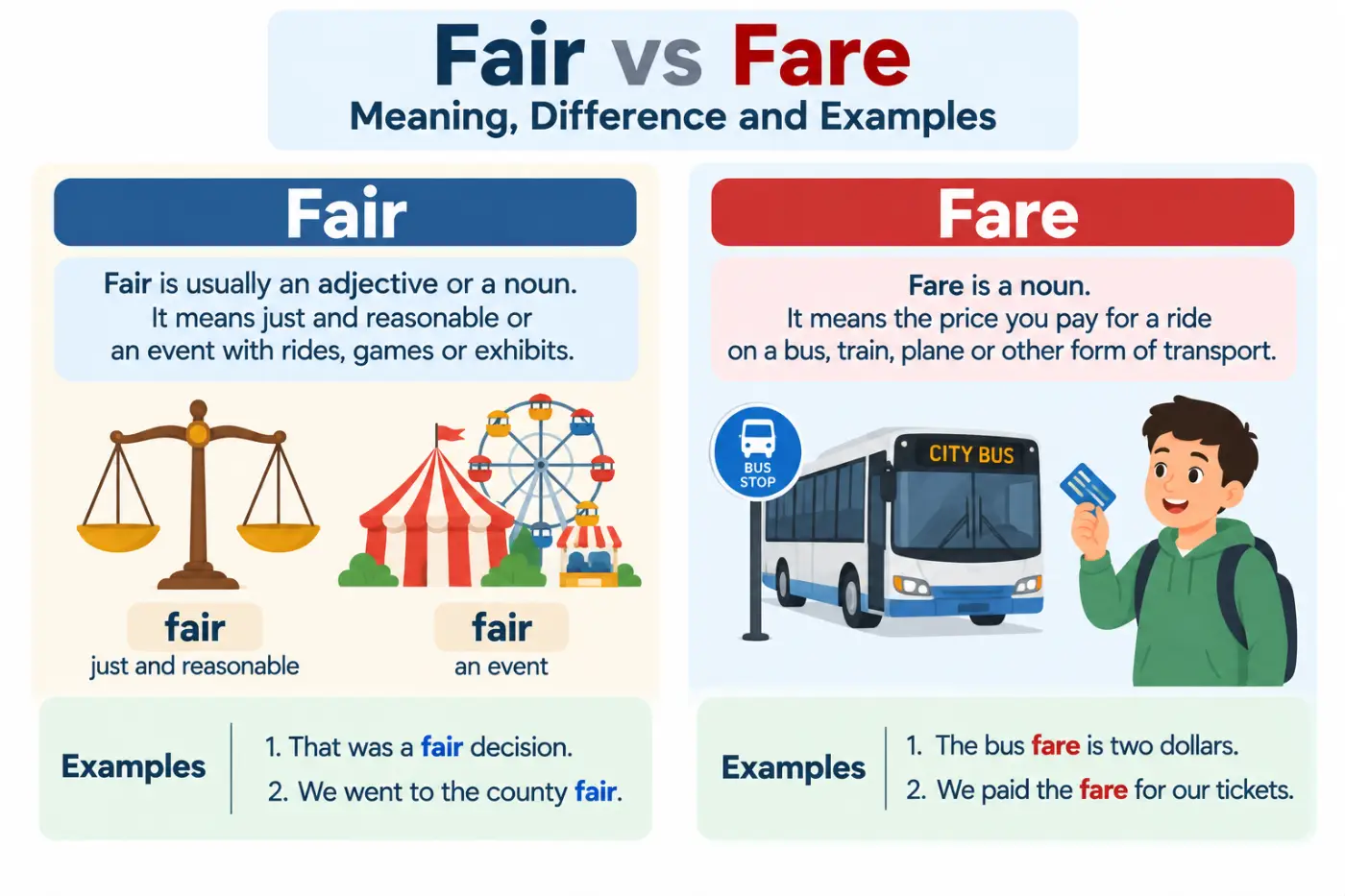
Fair vs Fare can be confusing because the two words usually sound exactly alike even though they carry very different meanings. If you write The taxi fair was expensive you have used the wrong word. The correct sentence is The taxi fare was expensive.
The confusion comes from pronunciation rather than meaning. Both words belong to the group of English homophones. Homophones share the same pronunciation but differ in spelling and meaning. That means your ear can’t always tell you which word belongs on the page. You need to look at the context and understand what the sentence is trying to say.
Once you learn the main meanings the distinction becomes much easier. Fair commonly relates to equality reasonableness appearance weather or a public event. Fare most often relates to the cost of transportation food or how someone performs in a particular situation. This guide explains those meanings with practical examples so you can choose the right word without second guessing yourself.
Short Answer
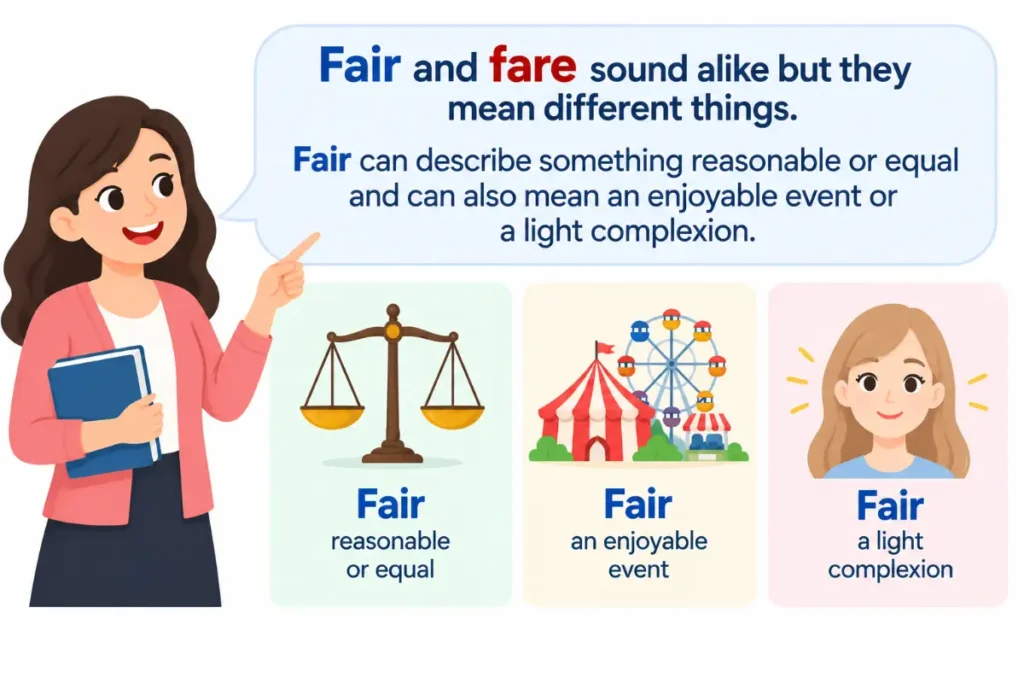
Fair and fare sound alike but they mean different things. Fair can describe something reasonable or equal and can also mean an enjoyable event or a light complexion. Fare usually refers to the price of a trip or the food available at a place. It can also function as a verb meaning to perform or get along in a situation.
Table Of Contents
- Quick answer to the difference.
- Meaning of fair.
- Meaning of fare.
- Fair vs Fare comparison.
- How to choose the right word.
- Grammar and parts of speech.
- Sentence examples.
- Common mistakes.
- Pronunciation.
- Word origins.
- American and British usage.
- Memory tips.
- Related words and expressions.
- Real life usage.
- Expert editor insight.
- FAQs.
- Key takeaways.
- Conclusion.
Meaning Of Fair
Fair has several meanings in modern English. Context determines which meaning a speaker or writer intends.
One of the most common meanings is reasonable or just. If something is fair then people generally consider it balanced and free from unfair advantage.
The teacher gave every student a fair chance.
The manager offered a fair price.
The judge made a fair decision.
In these examples fair describes treatment or conditions that people consider reasonable.
Fair can also describe something that is equal or impartial. A fair process gives people an appropriate opportunity rather than giving an unfair advantage to one person.
The selection process needs to be fair to everyone.
The word also has a physical or descriptive meaning. Fair can describe light skin hair or complexion in certain contexts. This use is familiar in descriptions such as fair hair or fair skin.
Fair can describe weather too. If someone says the weather is fair they usually mean that conditions are pleasant or reasonably clear.
We had fair weather during the trip.
Another major meaning is a public event where people gather for entertainment shopping food competitions or community activities.
The county fair opens this weekend.
That meaning appears in expressions such as state fair and trade fair.
Fair can also function as an adverb in some expressions. For example someone might say He played fair. Here fair means honestly or according to accepted rules.
This wide range of meanings can make the word seem more complicated than it really is. The key is to look at the surrounding words.
Meaning Of Fare
Fare has a narrower core meaning but it also has more than one important use.
The most familiar meaning is the price paid for transportation.
The bus fare increased this year.
I don’t have enough cash for the train fare.
In these sentences fare means the amount of money required to travel.
Fare is also commonly used for food or the type of food served in a particular setting. This use appears more often in formal descriptions or expressions about cuisine.
The restaurant serves traditional Italian fare.
The festival offered local fare from several vendors.
Here fare means food rather than transportation.
Fare can also work as a verb. As a verb it means to perform or progress in a particular situation.
How did you fare on the exam?
The company fared well during the difficult quarter.
She fared poorly in the competition.
This verbal meaning is especially useful because it doesn’t relate directly to transportation or food. It describes the result or experience of someone or something.
Fare also appears in the expression fare well. However be careful not to confuse this with fair. Farewell is a separate word that developed from the phrase fare well and is commonly used as a noun or interjection for goodbye.
Fair vs Fare Comparison
| Feature | Fair | Fare |
|---|---|---|
| Pronunciation | Usually pronounced like fare | Usually pronounced like fair |
| Main meaning | Reasonable equal or just | Transportation cost |
| Other meanings | Public event weather appearance honesty | Food or performance |
| Part of speech | Adjective noun adverb and sometimes verb in specialized uses | Noun and verb |
| Common phrase | fair price | bus fare |
| Food meaning | No | Yes |
| Transportation price | No | Yes |
| Public event | Yes | No |
| Example | That seems fair. | The fare was expensive. |
| Main memory idea | Fair relates to justice or equality | Fare relates to travel cost food or performance |
The easiest distinction is this. Fair often describes a quality or condition. Fare often names a cost type of food or someone’s performance.
That isn’t an absolute rule because both words have several uses. Still it gives you a strong starting point.
How To Choose The Right Word
When you’re unsure which spelling to use ask yourself what the sentence means.
- If you mean reasonable or just use fair.
The price seems fair.
- If you mean equal treatment use fair.
Everyone deserves a fair opportunity.
- If you mean a public event use fair.
We visited the county fair.
- If you mean the cost of transportation use fare.
The train fare is twenty dollars.
- If you mean food or cuisine use fare.
The restaurant offers traditional Southern fare.
- If you mean how someone performed use fare.
How did you fare at the interview?
This method works because meaning determines spelling. Don’t try to decide based only on sound.
Key Differences Explained
Difference In Meaning
Fair and fare have distinct meanings even though they sound alike. Fair can express justice equality reasonableness appearance weather or a public event. Fare commonly refers to a transportation price food or performance.
Difference In Grammar
Fair has several grammatical roles. It can be an adjective as in a fair decision. It can also function as an adverb in phrases such as play fair.
Fare is commonly a noun and a verb. As a noun it can mean transportation cost or food. As a verb it can mean to perform or progress.
Difference In Spelling
Fair contains the letters f a i r. Fare contains f a r e.
The difference is small visually but it changes the meaning.
Difference In Context
Fair appears frequently when people discuss justice equality prices treatment weather or events. Fare appears frequently in transportation food and expressions about performance.
Difference In Formality
Both words are standard English and work in casual and formal writing. The choice isn’t about formality. It’s about meaning.
Difference In Pronunciation
In most major English varieties fair and fare are homophones. They normally have the same pronunciation. Regional accents can produce small differences in vowel quality but the words are generally treated as sounding alike.
Fair As An Adjective
The adjective fair is extremely common.
It can describe a reasonable decision.
That was a fair decision.
It can describe equal treatment.
The students received a fair opportunity.
It can describe a reasonable price.
We found a fair deal on the car.
It can describe weather.
The forecast calls for fair weather.
It can describe appearance.
She has fair hair.
These meanings aren’t connected by one simple definition but they share an idea of suitability or acceptability in many contexts.
The meaning becomes clear from the noun that follows. A fair decision concerns justice. Fair hair concerns appearance.
Fair As A Noun
The most recognizable noun meaning refers to a public event.
The town holds a summer fair every year.
A fair may include rides food stalls games livestock exhibits crafts performances or commercial displays.
The word also appears in business and professional settings.
The company attended a trade fair.
Here the event isn’t necessarily about entertainment. It can be an organized exhibition where companies display products or services.
Fair As An Adverb
Fair can function as an adverb in certain expressions.
Play fair.
The phrase means to behave honestly and follow the accepted rules.
You need to play fair if you want people to trust you.
Fair can also appear in older or fixed expressions where it means directly or clearly. These uses are less common in everyday American English.
Fare As A Noun
The noun fare most commonly refers to a transportation charge.
The taxi fare was higher than I expected.
You can use it with many forms of transportation.
Bus fare.
Train fare.
Taxi fare.
Subway fare.
Airfare.
The word also works in broader transportation discussions.
The airline reduced its fares for the winter season.
In this context the meaning is always connected to the amount charged for travel.
Fare As Food
Fare has another established noun meaning related to food.
The café serves simple homemade fare.
The word often appears when describing the kind or style of food available rather than naming one specific dish.
Traditional fare can mean foods associated with a particular culture or region.
Local fare can refer to food produced or commonly served in a particular area.
This use is less common in everyday conversation than the transportation meaning but it remains standard English.
Fare As A Verb
Fare becomes especially interesting when it works as a verb.
To fare means to perform or progress in a particular way.
The students fared well on the test.
The new product fared better than expected.
The team fared poorly in the tournament.
The verb often appears with words such as well badly better worse poorly or successfully.
This pattern gives you a useful clue. If you can replace the word with perform or do then fare may be the correct choice.
How did you fare?
means something close to:
How did you do?
That makes this use easy to recognize once you know the pattern.
Sentence Examples
Here are natural examples that show the different uses.
- The manager made a fair decision after hearing both sides.
Fair means reasonable and impartial.
2. I thought the seller offered a fair price.
Fair means reasonable.
The examples show why pronunciation isn’t enough. You need to understand the role the word plays in the sentence.
Common Mistakes
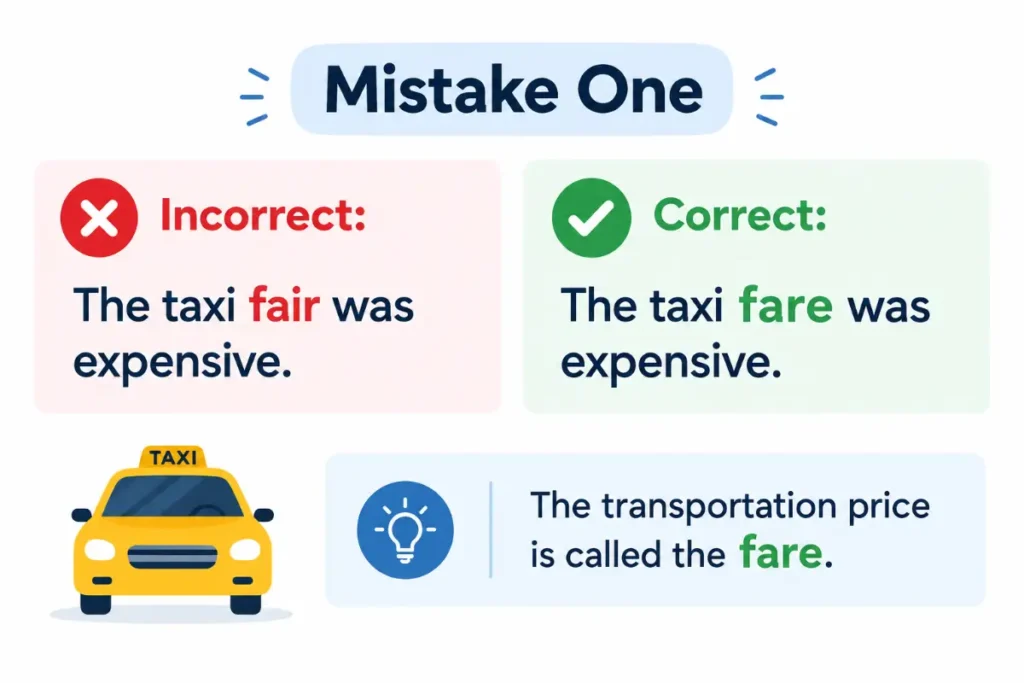
Mistake One
Incorrect: The taxi fair was expensive.
Correct: The taxi fare was expensive.
The transportation price is called the fare.
Mistake Two
Incorrect: Everyone should receive a fare chance.
Correct: Everyone should receive a fair chance.
The sentence refers to equal opportunity so fair is correct.
Mistake Three
Incorrect: How did you fair on the test?
Correct: How did you fare on the test?
Here fare is a verb meaning perform or do.
Mistake Four
Incorrect: We visited the county fare.
Correct: We visited the county fair.
The sentence refers to a public event.
Mistake Five
Incorrect: The restaurant serves traditional fair.
Correct: The restaurant serves traditional fare.
Here fare refers to food.
These errors happen because the two words sound alike. This is a classic example of phonological confusion. A writer hears the correct sound but selects the wrong spelling from memory.
Why Homophones Cause Problems
English contains many homophones. Words such as to two and too or their there and they’re create similar problems.
Fair and fare belong to the same general category.
When you hear someone say the word you can’t always identify the spelling from sound alone. The surrounding context supplies the missing information.
For example:
The fare was reasonable.
The fair was reasonable.
Both sentences are grammatically possible but they communicate different ideas.
The first discusses a price. The second discusses an event or something considered reasonable depending on context.
This is why good spelling depends partly on meaning. Memorizing isolated sounds isn’t enough.
Pronunciation Guide
Fair and fare are generally pronounced /fer/ in American English. They have one syllable and share the same basic sound.
A simple pronunciation guide is similar to the word hair.
Fair.
Fare.
Hair.
All three generally share the same vowel sound in standard American pronunciation.
The spelling difference doesn’t normally create a pronunciation difference. That’s the defining feature of a homophone.
The main pronunciation mistake isn’t saying one word incorrectly. The bigger problem is choosing the wrong written form after hearing it.
If someone says The fare was high you need the context to know that fare means a transportation price. If someone says The fair was crowded the context points to the public event.
Etymology And Word Origin
Fair and fare have different historical origins even though their modern pronunciations have converged.
Fair comes from an Old French word related to ideas of beautiful pleasant or favorable. Its history also connects with older Germanic influences. Over time English developed several related senses including ideas involving attractiveness justice and favorable conditions.
Fare has a different history. It comes from Old English faran which meant to travel or go. This connection remains visible in the verb meaning to get along or progress. The transportation meaning developed from the idea of the cost associated with traveling.
The food sense of fare has a separate historical development. It is connected with an older sense relating to food or provisions.
The shared pronunciation developed through changes in English sound patterns over many centuries. Their spelling remained different because their histories and word families remained different.
This is a useful reminder that English spelling doesn’t always follow modern pronunciation. Two words can eventually sound alike while keeping different spellings because their origins and meanings remain distinct.
American English
In American English both fair and fare are standard words.
Fair is common in phrases such as fair price fair treatment fair chance county fair and fair weather.
Fare is common in transportation phrases such as bus fare train fare taxi fare and airfare. Americans also use fare as a verb in expressions such as How did you fare?
The food meaning also appears in American English especially in writing about regional cuisine.
There is no American spelling rule that makes the two forms interchangeable. Context still determines the correct choice.
British English
British English also uses both words with the same basic distinction.
Fair commonly describes reasonable treatment attractive appearance pleasant weather and public events.
Fare commonly describes transportation costs and can also refer to food or performance.
British speakers may have accent differences that affect the exact sound of the words but fair and fare remain distinct spellings with distinct meanings.
Australian English
Australian English follows the same basic distinction. Fair is used for ideas such as justice and public events while fare commonly refers to transportation charges and food.
The words aren’t regional alternatives. The spelling depends on meaning rather than geography.
Canadian English
Canadian English also keeps fair and fare separate.
A Canadian writer would use fair for reasonable treatment or a public event and fare for transportation cost food or performance.
Regional pronunciation can vary but the written distinction remains consistent.
Formal And Informal Usage
Both words are appropriate in formal and informal writing.
Fair works naturally in professional documents.
The company should establish a fair process for resolving complaints.
Fare also works in professional contexts.
The report analyzes changes in airline fares.
In academic writing fare may appear when discussing transportation economics or cuisine.
The study examined the effect of higher transit fares on commuters.
In casual conversation both words are equally natural.
That’s not fair.
How much is the fare?
The difference isn’t formal versus informal. It is meaning.
Memory Tips
The fastest way to remember these words is to connect each spelling with a familiar idea.
Fair And Fairness
Think of fair and fairness together.
Fair treatment.
Fair opportunity.
If the idea involves justice or equality think fair.
Fare And Travel
Think of fare as the money you pay to travel.
Bus fare.
Train fare.
Taxi fare.
If you are paying for transportation think fare.
Fare And Food
Remember that fare can also mean food.
Traditional fare.
Local fare.
Regional fare.
If you’re talking about cuisine fare may be the right word.
Fare And Performance
Remember the phrase How did you fare?
If you can replace fare with do or perform the verb is probably fare.
These connections are much easier to remember than trying to memorize the spellings separately.
A Simple Decision Test
When you hear the word fair or fare in your head pause for a moment.
Ask what the sentence is talking about.
If it concerns justice equality reasonableness weather appearance or an event use fair.
If it concerns transportation cost food or performance use fare.
For example:
The price was fair.
The bus fare was high.
The fair was crowded.
The restaurant served local fare.
The team fared well.
The meaning changes but the pronunciation stays close enough to cause confusion.
Related Words And Expressions
Several expressions can help reinforce the distinction.
- Fairness. This is the noun form related to fair in the sense of justice or equal treatment.
- Fairly. This adverb can mean in a fair manner or to a moderately high degree depending on context.
- Farewell. This word is related historically to fare and means goodbye.
- Airfare. This refers to the price of traveling by air.
- Bus fare. This means the price charged for a bus trip.
- Fair price. This means a price considered reasonable.
- Fair chance. This means a reasonable or equal opportunity.
- Traditional fare. This means traditional food associated with a place or culture.
These expressions provide useful context clues. Once you recognize the common combinations you can often choose the correct spelling almost automatically.
Related Confusing Words
Fair and fare aren’t the only English homophones that cause spelling problems.
- Right and write. Right can refer to correctness or direction while write refers to producing written language.
- Buy and by. Buy means purchase while by can express location method or association.
- Here and hear. Here relates to location while hear relates to sound.
- Meet and meat. Meet means come together while meat refers to animal flesh used as food.
- Allowed and aloud. Allowed means permitted while aloud means spoken audibly.
These pairs share the same basic problem. Pronunciation doesn’t always tell you which spelling to use. Meaning does.
Real Life Usage Examples
Daily Conversation
You might hear someone say That’s not fair after a disagreement. Here fair describes something considered unjust.
You might also hear What’s the fare to downtown? In this case fare means the transportation price.
Workplace Communication
A manager may say We need a fair process for reviewing applications. Fair describes an impartial process.
A finance team might discuss changes in travel fares. Fare refers to transportation costs.
Academic Writing
A researcher might examine how fair treatment affects employee satisfaction. Fair relates to equality and justice.
A transportation study might compare rail fares across several cities. Fare refers to travel prices.
News Writing
A local newspaper might report that thousands of people attended the annual county fair.
A business report might discuss rising airfares and their effect on travel demand.
Storytelling
A character might complain that the punishment wasn’t fair.
Another character might ask how the hero fared after the difficult journey.
These examples show how naturally the words appear across different types of communication.
Professional Writing Tips
In professional writing context should always guide the spelling.
If you’re discussing prices for transportation use fare.
If you’re describing performance use fare.
One useful editing habit is to search for both words during proofreading. Since spellcheckers generally recognize fair and fare as legitimate words they may not catch a context mistake. A sentence such as The fair was expensive may be grammatically correct if you mean admission to an event. But if you’re talking about the price of a bus trip the spelling needs to be fare.
Contextual proofreading matters because automated spelling checks can recognize words without understanding your intended meaning perfectly.
Expert Editor Insight
An experienced editor treats fair and fare as a meaning problem rather than a spelling problem. Both spellings are correct English words so a basic spellchecker may not flag the wrong choice. Professional proofreading therefore looks at the surrounding sentence and asks what the writer actually means. My practical tip is to build a small mental association between fair and fairness and between fare and travel. That simple distinction catches most errors before they reach the final draft.
Key Takeaways
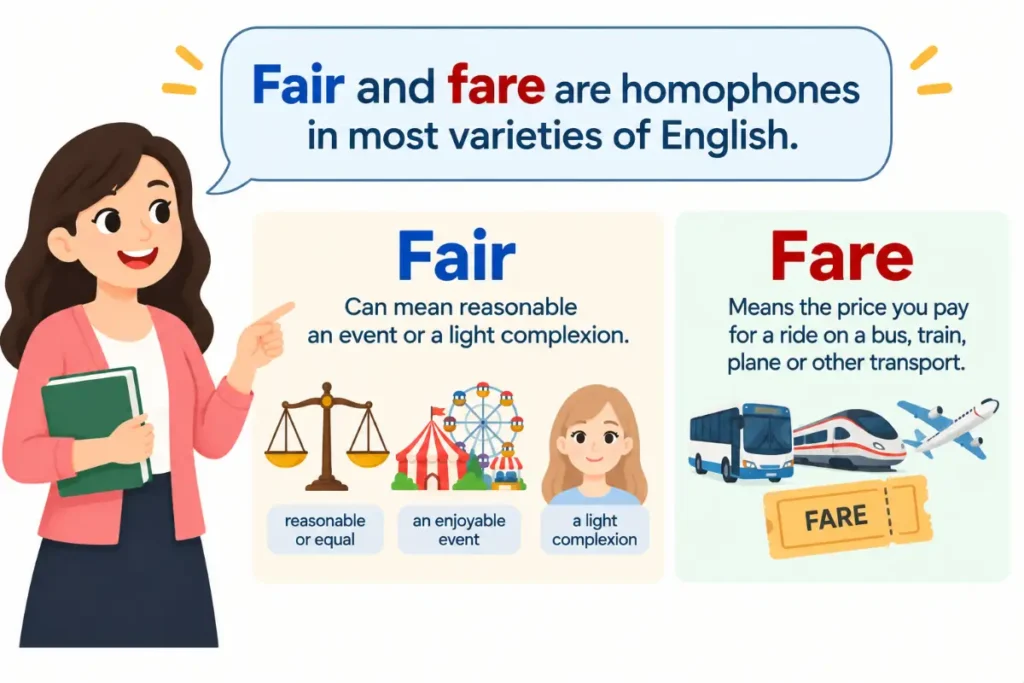
- Fair and fare are homophones in most varieties of English.
- Fair commonly means reasonable equal or just.
- Fair can also refer to a public event weather or appearance.
- Fare commonly means the price of transportation.
- Fare can also refer to food.
- Fare works as a verb meaning to perform or progress.
- Use fair price when you mean a reasonable price.
- Use bus fare train fare or taxi fare for transportation costs.
- Use How did you fare? when asking how someone performed.
- Context is more useful than pronunciation when choosing between the two spellings.
Conclusion
Fair vs Fare becomes much easier once you connect each word with its main meaning. Fair usually relates to justice equality reasonableness or a public event. Fare most often refers to the price of transportation but it can also mean food or describe how someone performs in a situation.
The biggest trap is pronunciation. Because the words generally sound alike you can’t rely on your ears to choose the spelling. Instead look at the meaning of the sentence and the words around it. If you’re talking about fairness think fair. If you’re talking about travel costs think fare.
A simple editing trick is to remember fair with fairness and fare with travel. That quick association will help you choose the right word confidently in everyday writing professional communication and academic work.
FAQs
What is the difference between fair and fare?
Fair and fare sound alike in most English accents but have different meanings. Fair can mean reasonable equal or just and can also refer to an event. Fare commonly means the price of transportation. It can also mean food or function as a verb meaning to perform or progress. Context tells you which spelling belongs in a sentence.
Is the bus fair or bus fare?
The correct expression is bus fare. Fare means the amount of money charged for transportation. For example you might say The bus fare is five dollars. Fair would be incorrect in this context because fair doesn’t mean a transportation charge. You can use fair with words such as price chance treatment or decision when describing something reasonable or just.
Is it fair price or fare price?
The usual expression is fair price. Here fair means reasonable or acceptable. For example The store offered a fair price for the used laptop. Fare refers mainly to a transportation charge or food and doesn’t normally describe a reasonable price. You can say The taxi fare was reasonable but not The taxi fair was reasonable when discussing transportation.
Is fair a homophone of fare?
Yes. Fair and fare are generally homophones in standard American English because they share the same basic pronunciation. Their spellings and meanings are different. Fair can relate to justice equality appearance weather or a public event. Fare can refer to transportation cost food or performance. The context determines which spelling you need.
How do you remember fair and fare?
A simple memory trick is to connect fair with fairness. If the sentence concerns justice equality or reasonable treatment choose fair. Connect fare with travel. A bus fare or train fare is money paid for transportation. Fare also has meanings connected with food and performance. These associations give you quick clues when the words sound identical.
How did you fare meaning?
How did you fare means How did you do or How did you perform. It asks about the result or experience of someone in a particular situation. You might ask this after an exam interview competition or difficult task. The word fare is a verb in this expression and doesn’t refer to transportation or food.
Can fare mean food?
Yes. Fare can refer to the food served or commonly eaten in a particular place or setting. Expressions such as traditional fare and local fare use the word this way. For example The restaurant serves traditional Mexican fare means the restaurant serves traditional Mexican food. This meaning is standard although it appears less often in casual conversation than the transportation meaning.
Can fair mean a public event?
Yes. Fair can function as a noun for a public event where people may find entertainment food games exhibitions products or competitions. Examples include county fair state fair and trade fair. The meaning is completely different from fair as an adjective meaning reasonable. The surrounding words usually make the intended meaning clear.
Is fair or fare used in formal writing?
Both are standard and appropriate in formal writing. The correct choice depends on meaning rather than formality. Use fair for ideas involving justice equality reasonable treatment or certain events. Use fare for transportation costs food or performance. Because both words are legitimate dictionary words a writer needs to proofread for meaning rather than relying only on spellcheck.
Why do people confuse fair and fare?
People confuse fair and fare mainly because they sound alike. English spelling often preserves different forms for words that have different histories and meanings even after their pronunciations become identical. Since both forms are legitimate English words an ordinary spellchecker may not identify the mistake. Learning common context clues is the most reliable way to avoid confusion.

Confusing Words, Spelling & Word Choice
Claire Whitmore is a U.S.-based English editor who writes about commonly confused words, spelling differences, and word choice. Her work helps readers understand subtle distinctions between similar-looking words through simple definitions, practical examples, and modern usage guidance in both American and British English.