
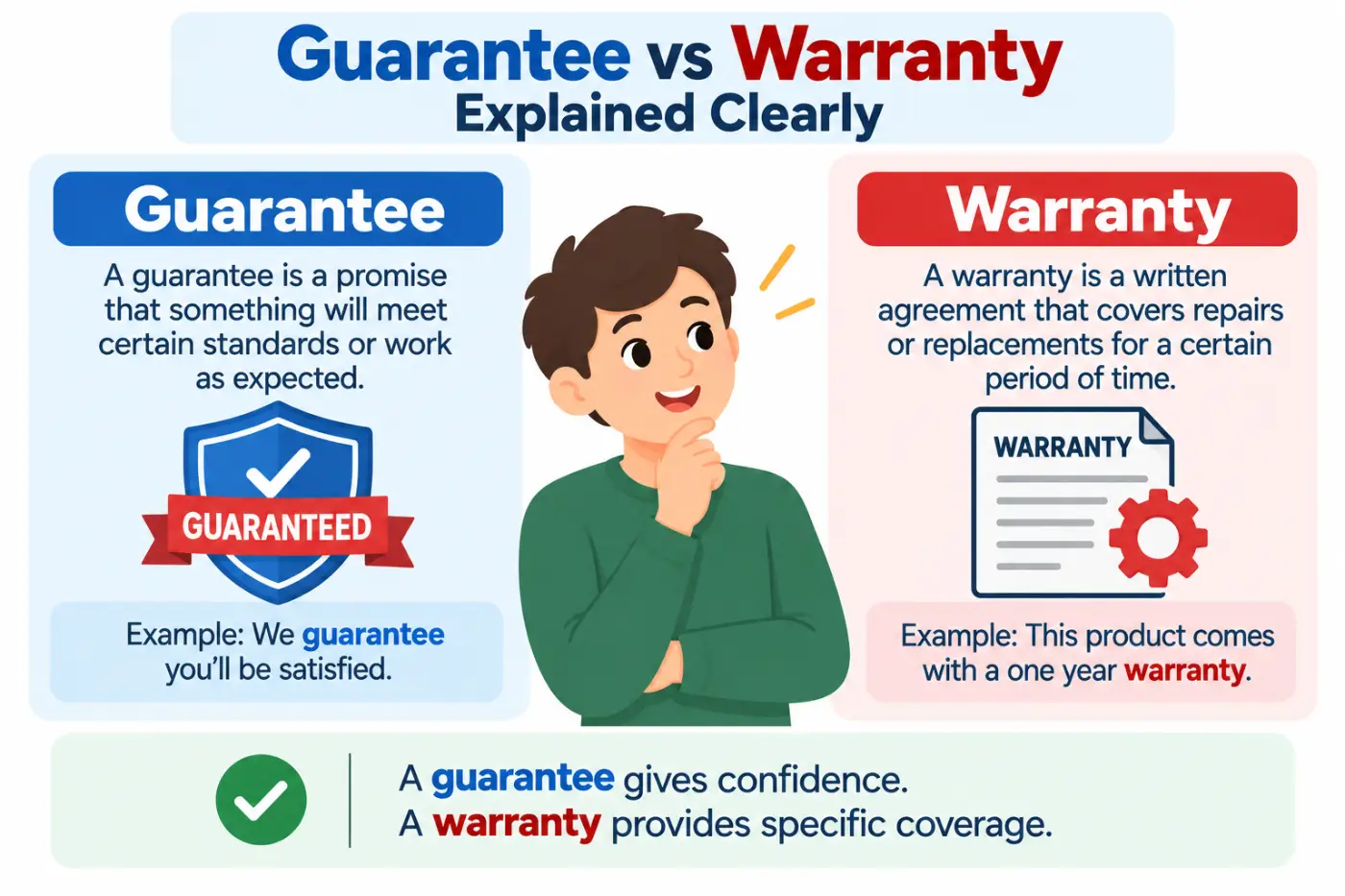
Guarantee vs Warranty can be confusing because both words involve a promise of protection or reliability. In everyday American English people sometimes use them almost interchangeably. In business and consumer contexts though the distinction can matter because a warranty often sets out specific coverage terms while a guarantee may describe a broader promise about quality performance satisfaction or an obligation.
The confusion grows because companies use both terms in advertising contracts product materials and customer service policies. A business might offer a satisfaction guarantee while a manufacturer provides a limited warranty. Both statements give customers some form of assurance but they don’t necessarily create the same rights or cover the same problems. The exact legal effect also depends on the wording and the law that applies.
This guide explains the practical difference between the two terms. You’ll learn their meanings grammatical roles common contexts examples legal considerations typical mistakes and useful memory tips. You’ll also see how the words work in American English and how to choose the clearer term when you’re writing for customers clients or colleagues.
Short Answer
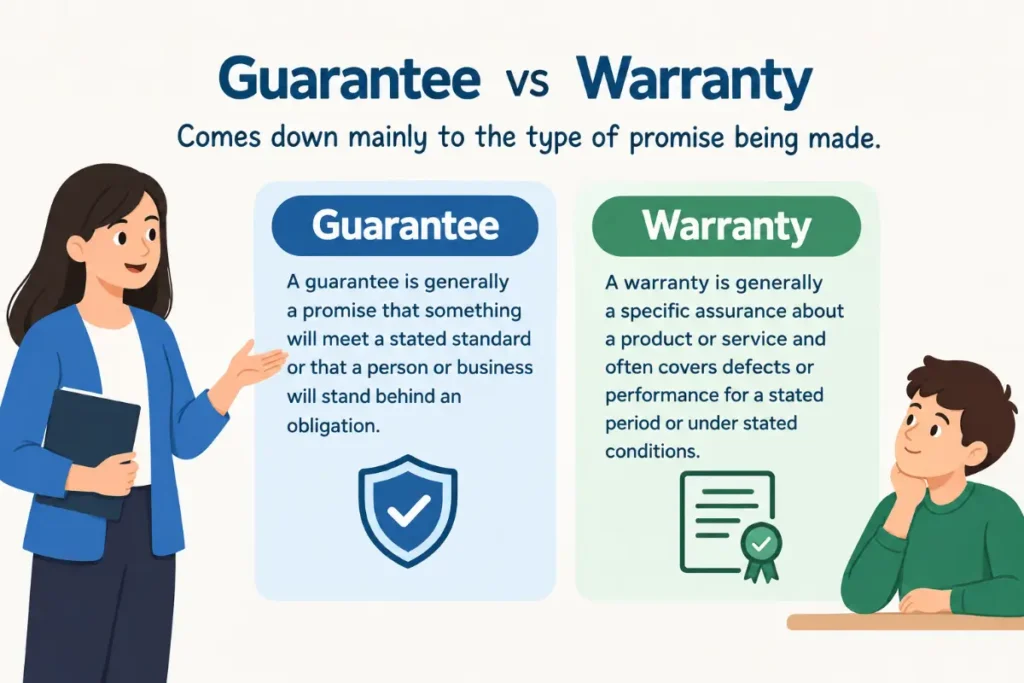
Guarantee vs Warranty comes down mainly to the type of promise being made. A guarantee is generally a promise that something will meet a stated standard or that a person or business will stand behind an obligation. A warranty is generally a specific assurance about a product or service and often covers defects or performance for a stated period or under stated conditions.
Table Of Contents
- Quick Answer
- Meaning Of Guarantee
- Meaning Of Warranty
- The Main Difference
- Guarantee vs Warranty In Everyday English
- Guarantee vs Warranty In Business
- Legal Meaning And Consumer Protection
- Comparison Table
- Examples In Real Life
- Common Mistakes
- Grammar And Usage
- Pronunciation Guide
- Word Origins
- American And British Usage
- How To Choose The Right Word
- Memory Tips
- Related Terms
- Expert Editor Insight
- FAQs
- Key Takeaways
- Conclusion
Quick Answer
A guarantee is usually a promise that something will be satisfactory reliable or completed as promised. It can also involve a promise to take responsibility if an obligation isn’t fulfilled.
A warranty usually provides defined protection concerning a product or service. It often explains what is covered how long coverage lasts and what the customer must do to make a claim.
The important point is that these words can overlap. Their exact meaning depends on context and the language used in the agreement or policy.
Meaning Of Guarantee
Guarantee is both a noun and a verb.
As a noun it refers to a promise or assurance that something will happen or meet a particular standard.
For example:
The company gives customers a money back guarantee.
The promise here concerns customer satisfaction. The company is assuring the customer that a specific remedy is available if the stated condition isn’t met.
As a verb guarantee means to promise or assure something.
The manufacturer guarantees the machine for five years.
In ordinary speech guarantee can have a broad meaning. Someone might guarantee that a restaurant is excellent or guarantee that a friend will enjoy a particular movie. These casual uses don’t necessarily create a formal legal obligation.
Guarantee can also involve responsibility for another person’s debt or obligation. In financial and commercial settings a guarantor may promise to meet an obligation if the primary party fails to do so. That use is distinct from a product satisfaction promise.
The common thread is assurance. Someone is standing behind a result obligation or claim.
Meaning Of Warranty
Warranty is primarily a noun.
A warranty is an assurance connected to a product service transaction or other subject matter. It often states that something meets specified standards or that certain defects will be addressed under defined conditions.
For example:
The laptop comes with a two year warranty.
This tells the buyer that the manufacturer provides specific protection for a defined period. The exact protection depends on the warranty terms.
A warranty might cover manufacturing defects while excluding accidental damage. It might require the customer to follow maintenance instructions. It might provide repair replacement or another remedy.
The word therefore often appears with detailed conditions.
You may see terms such as limited warranty written warranty implied warranty warranty period warranty claim and warranty coverage.
That language gives the word a more structured feel in commercial settings.
Still the everyday meaning isn’t limited to products. Warranty can appear in contracts involving services property transactions and other commercial relationships.
The Main Difference
The clearest practical distinction is this.
A guarantee usually emphasizes a promise or assurance.
A warranty usually emphasizes defined protection connected to stated terms.
That doesn’t mean every guarantee is broad and every warranty is narrow. Real agreements can use these words in different ways. The document’s actual language matters more than the label alone.
Consider two examples.
A store says it offers a 30 day satisfaction guarantee.
A manufacturer says a device includes a one year limited warranty.
The first statement focuses on the customer’s satisfaction and a promised remedy. The second focuses on specific protection for the product under defined conditions.
This distinction becomes especially useful when you’re writing business content. If you’re talking about customer confidence or satisfaction then guarantee may be the more natural word. If you’re describing repair coverage for a product then warranty will often be clearer.
Guarantee vs Warranty In Everyday English
In casual conversation the boundary between these words becomes less strict.
Someone might say:
I guarantee this restaurant has the best burgers in town.
That simply means the speaker feels very confident.
You could also hear:
This phone has a warranty.
That usually points to formal product protection.
The first use is personal and informal. The second points toward a commercial arrangement.
People also use guarantee as a general synonym for assurance.
I can guarantee you’ll enjoy the show.
Here the speaker isn’t necessarily offering a written policy. They’re expressing strong confidence.
Warranty doesn’t work the same way.
You wouldn’t normally say:
I warranty you’ll enjoy the show.
That sounds incorrect because warranty isn’t normally used as a verb in standard modern American English.
This grammatical difference provides a useful clue. Guarantee can describe both the promise and the act of making the promise. Warranty generally names the assurance itself.
Guarantee vs Warranty In Business
Businesses use these terms carefully because customers often interpret them as promises.
A satisfaction guarantee might promise a refund if a customer isn’t pleased.
A product warranty might promise repair or replacement if the product develops a covered defect.
A performance guarantee might promise that a service will meet a stated benchmark.
A warranty may describe specific product conditions such as:
- The length of coverage.
- Covered defects.
- Excluded damage.
- Required maintenance.
- Available remedies.
- Claim procedures.
- Geographic restrictions.
- Conditions that can end coverage.
Guarantees can also contain detailed terms. A money back guarantee may require the customer to request a refund within a particular period. A service guarantee may apply only to specific work.
So don’t assume that guarantee always means unlimited protection. It doesn’t.
The better approach is to read the actual promise.
Legal Meaning And Consumer Protection
The legal side deserves extra care because these words can have technical meanings depending on the jurisdiction and transaction.
In general legal and commercial writing a warranty can function as a contractual assurance concerning a fact condition product characteristic or performance standard. A guarantee can also create enforceable obligations but may take different forms.
For example a guarantee can involve one party promising to answer for another party’s obligation. That is a familiar concept in finance and lending.
Product warranties can also be affected by consumer protection laws and commercial law. In the United States the rules can vary depending on the transaction and the type of warranty. Written warranties may contain specific limitations and conditions. Some legal protections can apply even when a document uses a particular label.
This is why a professional writer shouldn’t tell customers that one word automatically determines their legal rights.
The actual contract language matters. Applicable federal and state law matters too. The facts of the transaction matter.
For high stakes contracts consumer disputes or legal notices a qualified attorney should review the language rather than relying on a general vocabulary distinction.
Comparison Table
| Feature | Guarantee | Warranty |
|---|---|---|
| Basic idea | A promise or assurance | A stated assurance about a product service or obligation |
| Common role | Noun and verb | Primarily a noun |
| Typical context | Satisfaction promises performance promises financial obligations | Product protection service agreements commercial transactions |
| Main focus | Confidence responsibility or promised result | Defined coverage standards or remedies |
| Common example | Money back guarantee | Two year product warranty |
| Conditions | May have conditions | Usually has clearly stated conditions |
| Time limit | May or may not have one | Often has a defined coverage period |
| Everyday tone | Common in casual and commercial speech | More strongly associated with formal commercial language |
| Consumer context | Often connected to satisfaction or refund promises | Often connected to repairs replacements and defects |
| Legal effect | Depends on the promise and applicable law | Depends on the wording and applicable law |
Examples In Real Life
Daily Conversation
I guarantee you’ll love this restaurant.
The speaker uses guarantee to express strong confidence. It doesn’t necessarily refer to a formal business promise.
The television still has a warranty.
Here warranty refers to formal product protection.
Customer Service
Our store offers a satisfaction guarantee.
The company is making a promise about customer satisfaction and likely offering a stated remedy.
Your replacement unit is covered under the original warranty.
This sentence refers to established product coverage.
Workplace Communication
We guarantee delivery by Friday.
This creates a strong promise about performance. In a professional setting the business should make sure it can actually meet that commitment.
The equipment warranty covers manufacturing defects.
This sentence identifies a specific area of product protection.
Academic Writing
The researchers cannot guarantee that the results will apply to every population.
Here guarantee means assure or promise. The sentence appropriately describes uncertainty.
The manufacturer provides a warranty covering defects in materials.
Here warranty identifies a formal assurance connected to a product.
Consumer Writing
The company offers a satisfaction guarantee for eligible purchases.
The appliance includes a limited warranty covering specified mechanical failures.
These examples show why the terms are useful in different contexts. One focuses on a promise to the customer. The other focuses on defined product protection.
Common Mistakes
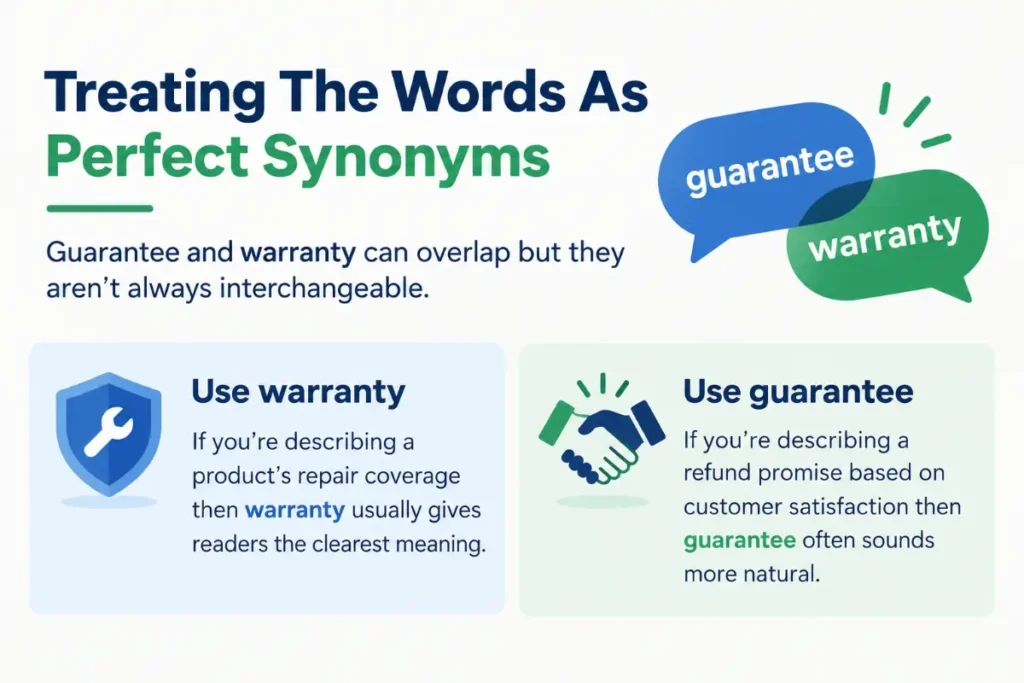
Treating The Words As Perfect Synonyms
Guarantee and warranty can overlap but they aren’t always interchangeable.
If you’re describing a product’s repair coverage then warranty usually gives readers the clearest meaning. If you’re describing a refund promise based on customer satisfaction then guarantee often sounds more natural.
Using Warranty As A Verb
A common grammar mistake is treating warranty as though it were equivalent to guarantee.
Incorrect:
The company warranties customer satisfaction.
Better:
The company guarantees customer satisfaction.
Or:
The company provides a warranty for the product.
Guarantee works naturally as a verb. Warranty generally doesn’t.
Assuming Every Guarantee Has The Same Legal Effect
A casual guarantee between friends isn’t the same thing as a written commercial promise.
Context controls meaning. A legal document may create specific obligations that don’t exist in ordinary conversation.
Assuming Every Warranty Covers Everything
The word warranty doesn’t mean unlimited protection.
A warranty can exclude accidental damage misuse unauthorized repairs normal wear and other conditions. Always check the actual coverage terms.
Confusing Warranty With Insurance
A warranty and insurance can both provide protection but they serve different purposes.
A warranty generally relates to an assurance about a product or service and its stated condition or performance.
Insurance is a separate risk transfer arrangement that protects against covered losses or events under an insurance policy.
The two can sometimes work together but they shouldn’t be treated as identical.
Grammar And Usage
Guarantee As A Noun
Guarantee can name the promise itself.
The store offers a satisfaction guarantee.
The word functions as a noun because it identifies a thing or concept.
Guarantee As A Verb
Guarantee can also describe the action of making a promise.
I guarantee the package will arrive tomorrow.
The verb expresses strong assurance.
Warranty As A Noun
Warranty normally functions as a noun.
The car has a five year warranty.
You can modify it with words such as limited written extended or manufacturer.
Common Sentence Patterns
Guarantee often appears in patterns such as:
Guarantee someone a result.
Warranty commonly appears in patterns such as:
Covered by a warranty.
Under warranty.
Warranty coverage.
Warranty terms.
These patterns can help you choose the correct word quickly when writing.
Punctuation
Neither word has unusual punctuation rules.
If guarantee introduces a clause with that then normal sentence punctuation applies.
I guarantee that the work will be completed on time.
If the word appears in a heading or product description follow the style rules of the document.
The main issue isn’t punctuation. It’s meaning and grammar.
Pronunciation Guide
Guarantee is commonly pronounced /ˌɡærənˈtiː/ in American English.
The strongest stress falls near the end.
A simple pronunciation guide is gar un TEE.
Warranty is commonly pronounced /ˈwɔːrənti/ in American English.
A simple guide is WOR un tee.
The pronunciation difference is useful because the words sound clearly different when spoken naturally.
One common mistake is placing too much stress on the first part of guarantee. Another is trying to pronounce every letter in warranty exactly as it appears in writing.
Native speakers often reduce the middle vowel sounds in both words during fast conversation. Listening for the stressed syllable can make the distinction easier.
Word Origins
Guarantee entered English through French and is connected historically with forms that expressed protection assurance or responsibility. Its spelling reflects the influence of French on English vocabulary.
Warranty has a closely related history. It developed through Anglo French and Middle English forms connected with the idea of warranting or assuring something.
The words share historical connections with ideas of assurance and responsibility. That relationship helps explain why their modern meanings can overlap.
Their different modern roles developed through centuries of legal commercial and everyday usage.
The historical connection is also a useful reminder that English words don’t always stay within one neat meaning. Their uses develop as speakers and writers apply them to new situations.
American And British Usage
American English
Both guarantee and warranty are standard words in American English.
Guarantee is especially common in customer satisfaction promises and everyday speech.
Warranty appears frequently in product documentation business contracts automobile sales electronics purchases and consumer support.
American writers should choose based on the intended meaning rather than trying to avoid one word.
British English
British English also uses both terms.
The basic distinction remains similar. Warranty commonly appears in commercial and product contexts while guarantee can describe a broader promise or assurance.
There can be differences in specific legal terminology but those differences don’t turn one word into an incorrect spelling of the other.
Australian English
Australian English uses both words in ordinary and commercial contexts.
Warranty is common in product and consumer materials. Guarantee also appears in satisfaction and performance promises.
Specific consumer rights depend on Australian law and should not be inferred from the word alone.
Canadian English
Canadian English also uses guarantee and warranty.
The everyday distinction is broadly similar to American usage. Product documentation often uses warranty for defined product protection while guarantee commonly describes a promise or assurance.
Canadian legal rights depend on the relevant provincial or federal rules and the specific agreement.
How To Choose The Right Word
When you’re deciding between the two words ask what kind of promise you’re describing.
- Are you talking about customer satisfaction? Guarantee may be the clearer choice.
- Are you talking about a product defect? Warranty will often be more precise.
- Are you describing a refund promise? Guarantee is commonly used.
- Are you describing repair or replacement coverage? Warranty is usually more natural.
- Are you talking about a person accepting responsibility for another person’s obligation? Guarantee may be the relevant term.
- Are you writing a contract? Don’t rely on the label alone. Define the actual obligation and remedy clearly.
- Are you writing marketing copy? Choose the term your customers will understand most easily and state the conditions plainly.
- Are you writing legal material? Use the terminology required by the applicable law and define the parties’ obligations precisely.
Clarity should always win. If the reader needs to understand the promise then explain what is covered and what remedy is available.
Memory Tips
A simple memory trick can make the distinction easier.
Think of a guarantee as a promise.
Think of a warranty as protection with terms.
That isn’t a complete legal definition but it works well as a writing shortcut.
You can also remember this example:
A store may guarantee your satisfaction.
A manufacturer may warranty a product.
The second sentence isn’t grammatically natural in standard American English because warranty normally functions as a noun. Instead say the manufacturer provides a warranty for the product.
Another useful test is to ask what the reader expects next.
After guarantee you may see a promise.
I guarantee that the work will be finished.
After warranty you may see coverage.
The product is covered by a warranty.
This simple contrast works like a mental signpost.
Related Terms
Assurance
Assurance refers broadly to confidence or a statement intended to remove doubt. It can overlap with guarantee but doesn’t always involve a formal obligation.
Promise
A promise is a commitment to do something or ensure something. Guarantee is often stronger because it can signal responsibility for the stated result.
Coverage
Coverage describes what a protection arrangement includes. It’s especially common when discussing warranties insurance and service plans.
Defect
A defect is a fault or problem that prevents a product from meeting expected or stated standards. Defects are commonly discussed in warranty claims.
Remedy
A remedy is the action available to address a problem. Depending on the agreement it might involve repair replacement refund or another form of relief.
Satisfaction Guarantee
A satisfaction guarantee is a promise focused on the customer’s level of satisfaction. It often appears in retail and service marketing.
Limited Warranty
A limited warranty provides protection subject to stated conditions restrictions or exclusions. The specific limitations depend on the document.
Service Contract
A service contract is an agreement for specified services. It can resemble warranty coverage in some situations but isn’t automatically the same thing.
Understanding these related terms gives you a more complete picture of how businesses describe protection and responsibility.
Expert Editor Insight
An experienced editor would avoid treating guarantee and warranty as interchangeable simply because both involve assurance. The best choice depends on what the sentence promises and how the reader is expected to understand that promise. In customer facing writing I would use plain language first and explain the actual protection rather than relying on a label. I would also check the surrounding contract or policy before making a claim about legal rights. Grammar tools can help catch incorrect uses such as treating warranty as a verb but they can’t determine the legal meaning of an entire agreement.
Key Takeaways
- Guarantee and warranty both relate to assurance but they aren’t always interchangeable.
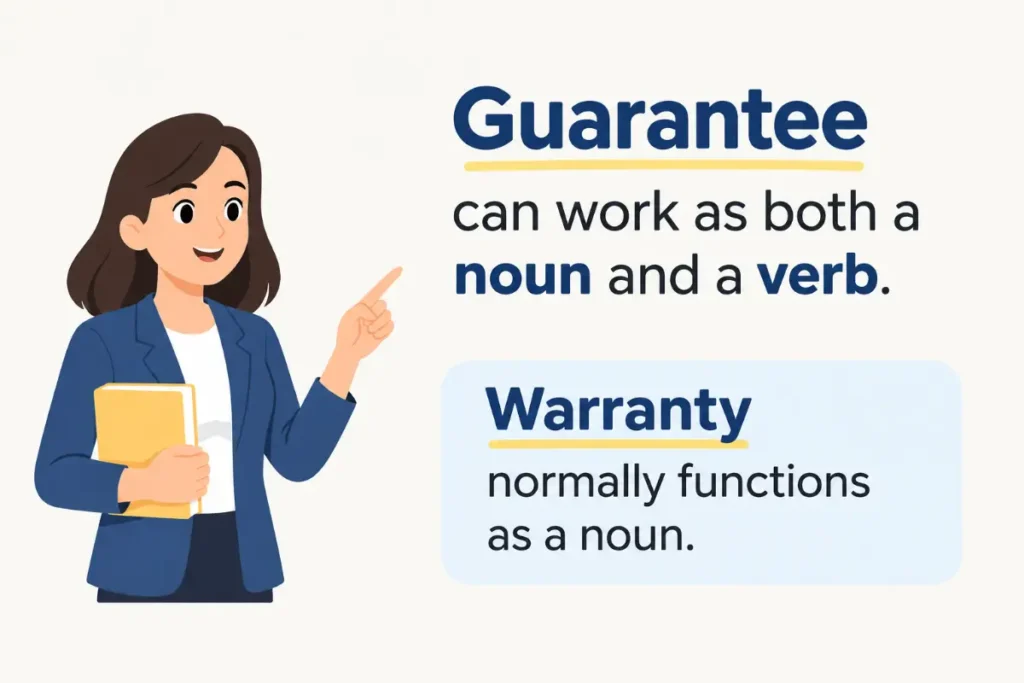
- Guarantee can work as both a noun and a verb.
- Warranty normally functions as a noun.
- Guarantee commonly describes satisfaction performance or responsibility.
- Warranty commonly describes defined protection for a product service or transaction.
- A warranty often includes a coverage period conditions exclusions and remedies.
- A guarantee can also contain detailed conditions so don’t assume it means unlimited protection.
- Legal meaning depends on the wording of the agreement and applicable law.
- For product repair or defect coverage warranty is usually the clearer term.
- For satisfaction or performance promises guarantee is often the more natural choice.
Conclusion
Guarantee vs Warranty is easier to understand once you focus on the type of promise being made. A guarantee generally communicates an assurance about satisfaction performance or responsibility. A warranty commonly describes defined protection connected to a product service or transaction and often includes specific conditions coverage periods exclusions and remedies.
The two terms can overlap in everyday language and business marketing. Still precise writing benefits from choosing the word that matches the reader’s expectation. If you’re discussing a product defect or repair policy warranty will usually be clearer. If you’re describing a satisfaction or performance promise guarantee often fits better.
The simplest memory tip is to think promise for guarantee and defined protection for warranty. For legal documents always read the actual terms because the wording and applicable law determine the real obligation.
FAQs
What is the difference between guarantee and warranty?
The practical difference is that a guarantee generally expresses a promise or assurance while a warranty commonly describes defined protection connected to a product service or transaction. A guarantee may focus on satisfaction performance or responsibility. A warranty often sets out coverage conditions duration and remedies. Still the exact meaning depends on the language of the agreement and applicable law.
Is a guarantee better than a warranty?
Neither is automatically better. A guarantee may provide a useful promise such as a refund or satisfaction commitment while a warranty may provide valuable protection against specific defects. What matters is the actual coverage. Before choosing a product or service look at the conditions duration exclusions and available remedies rather than assuming one label provides greater protection.
Is a warranty the same as a guarantee?
No. The terms overlap but they aren’t identical in every context. A guarantee usually describes a promise or assurance while a warranty often describes specific protection related to a product service or transaction. Businesses sometimes use the terms differently in marketing. For legal purposes the wording of the agreement and the applicable law matter more than the label.
Can guarantee be used as a verb?
Yes. Guarantee can function as both a noun and a verb in standard English. You can say that a company guarantees a result or guarantees that something will happen. For example a business might guarantee delivery within a stated period. Warranty generally functions as a noun so using warranty as a verb can sound incorrect in standard American English.
Is a warranty always limited to one year?
No. A warranty can have different coverage periods depending on the product agreement and provider. Some warranties last for a short period while others provide longer protection. Some may cover different components for different lengths of time. Never assume the duration from the word warranty alone. Check the actual warranty terms for the applicable period and exclusions.
What does a satisfaction guarantee mean?
A satisfaction guarantee is a promise connected to customer satisfaction. A business may offer a refund replacement or another remedy if the customer isn’t satisfied under the stated conditions. The exact promise depends on the company’s policy. A satisfaction guarantee doesn’t automatically mean a customer can return anything at any time. The terms should explain eligibility and available remedies.
Can guarantee and warranty be used interchangeably?
Sometimes people use the words interchangeably in everyday conversation because both can express assurance. In precise writing that approach can create confusion. Warranty is usually clearer for defined product coverage while guarantee often works better for promises about satisfaction performance or responsibility. In contracts you should focus on the actual obligation rather than assuming either label has one universal meaning.
Which word should I use in professional writing?
Choose the word that accurately describes the promise. Use guarantee for an assurance or commitment and warranty for defined protection connected to a product service or transaction. If the document has legal consequences use the terminology required by the agreement and applicable law. When possible explain the actual coverage so readers don’t have to guess what the promise includes.

Confusing Words, Spelling & Word Choice
Claire Whitmore is a U.S.-based English editor who writes about commonly confused words, spelling differences, and word choice. Her work helps readers understand subtle distinctions between similar-looking words through simple definitions, practical examples, and modern usage guidance in both American and British English.