
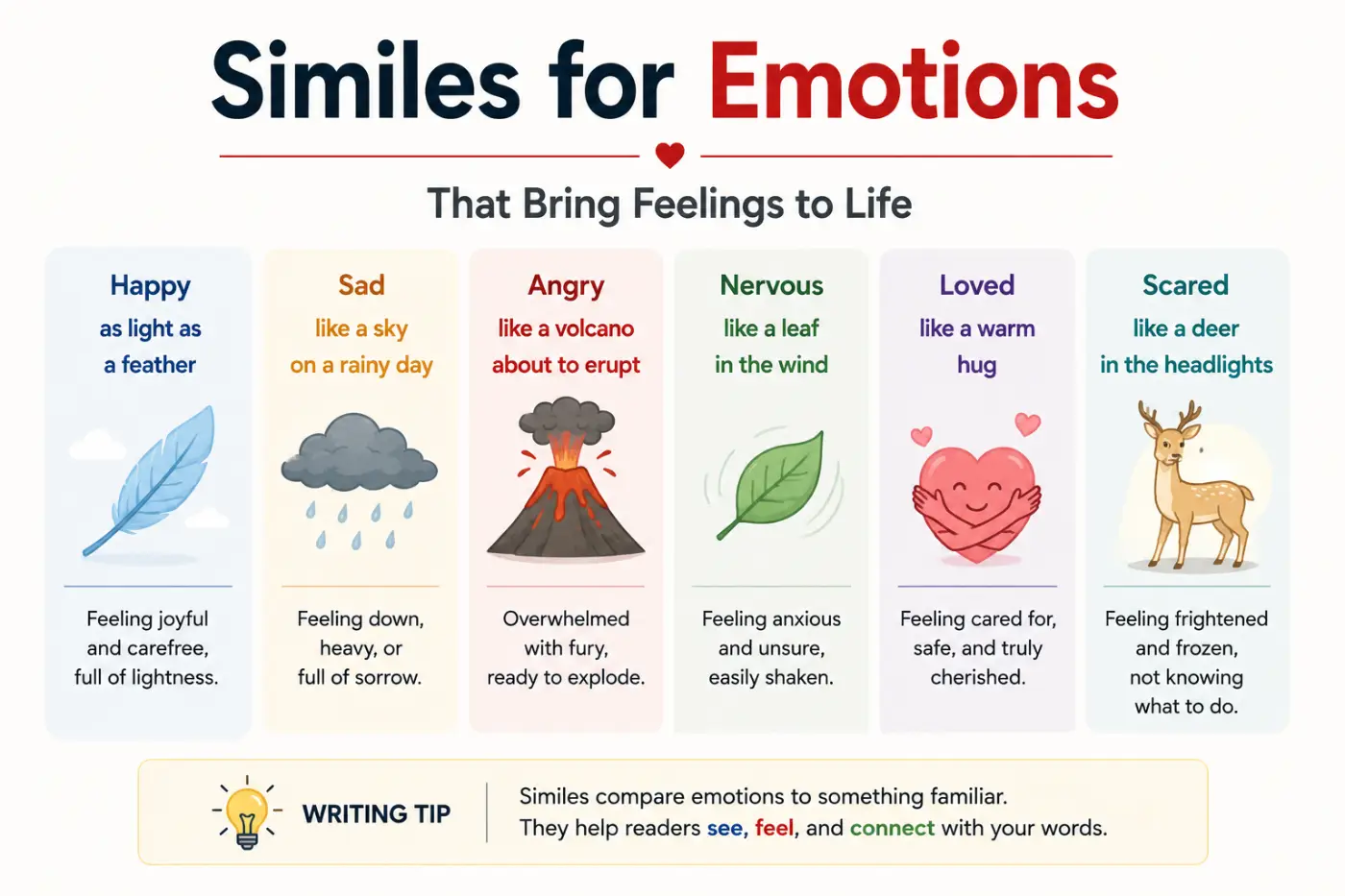
Similes for emotions can turn a plain sentence into something readers can actually feel. Saying that someone is nervous tells us the emotion. Saying that their nerves were like birds fluttering inside a cage gives us an image. The second version creates movement and tension in the reader’s mind.
That’s why similes work so well in stories poems personal essays speeches and everyday descriptions. Emotions are invisible. You can’t hold sadness in your hand or point to anger across a room. A strong comparison gives that invisible feeling a shape sound texture or movement.
The best emotional similes also sound natural. They don’t need complicated vocabulary or dramatic language. A simple comparison can sometimes hit harder than an elaborate one. This guide gives you more than 120 original examples for happiness sadness anger fear love anxiety excitement loneliness embarrassment jealousy hope disappointment confidence and other powerful feelings. Each one includes a short explanation so you can understand the image and use it effectively.
Short Answer
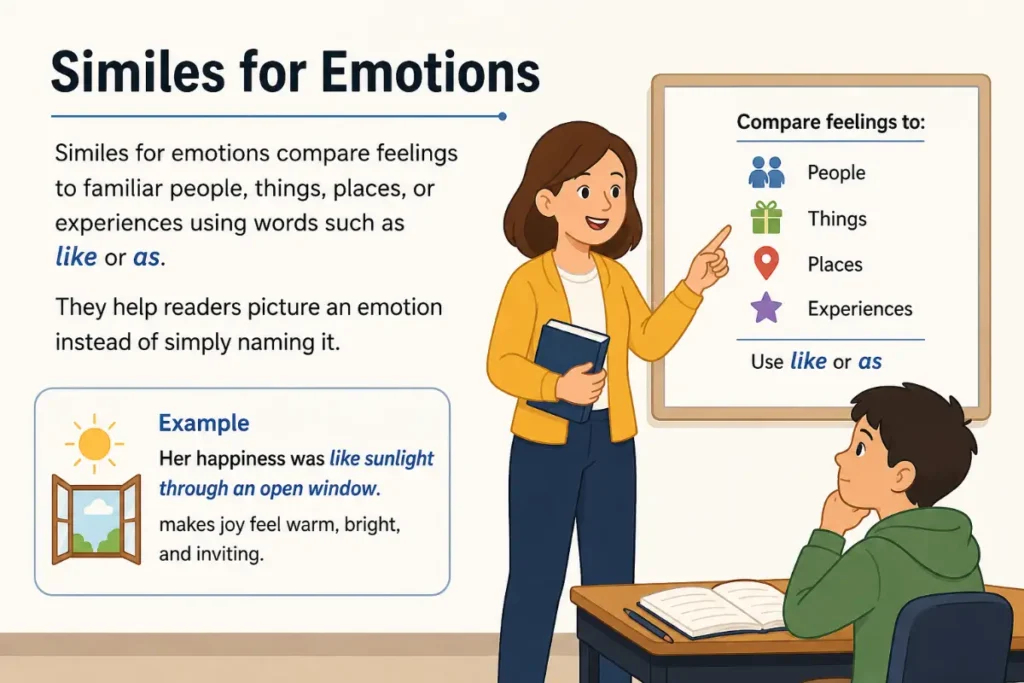
Similes for emotions compare feelings to familiar people things places or experiences using words such as like or as. They help readers picture an emotion instead of simply naming it. For example Her happiness was like sunlight through an open window makes joy feel warm bright and inviting.
Table Of Contents
- What an emotional simile does.
- Similes for happiness.
- Similes for sadness.
- Similes for anger.
- Similes for fear.
- Similes for love.
- Similes for anxiety.
- Similes for excitement.
- Similes for loneliness.
- Similes for embarrassment.
- Similes for jealousy.
- Similes for hope.
- Similes for disappointment.
- Similes for confidence.
- Similes for confusion.
- Similes for relief.
- Similes for guilt.
- Similes for pride.
- Similes for frustration.
- Similes for nervousness.
- Similes for emotional intensity.
- How to create your own emotional similes.
- Common mistakes.
- Memory tips.
- Related usage notes.
- Frequently asked questions.
- Key takeaways.
- Conclusion.
What An Emotional Simile Does
A simile compares one thing with another to make an idea easier to picture. Emotional similes apply that technique to feelings.
Instead of saying He was extremely angry you might write His anger burned like a fire trapped behind a locked door.
The emotion remains anger but the comparison gives it physical qualities. The reader can imagine heat pressure and restrained energy.
A good simile usually contains two parts.
- The first part introduces the subject or emotion.
- The second part provides the comparison.
Words such as like and as often connect the two parts.
For example:
Her sadness hung over her like a gray cloud.
The sadness is the subject. The gray cloud is the comparison. The image suggests heaviness and gloom.
A simile doesn’t have to use the word emotion. It can describe a person’s face voice movement thoughts or behavior while still communicating the feeling.
Similes For Happiness
Happiness can feel light warm energetic peaceful or overwhelming. These comparisons give joy different shades.
- Her happiness was like sunlight spilling through the curtains. This suggests warm and gentle joy.
- He smiled like a child seeing snow for the first time. This creates an image of fresh excitement.
- Their laughter bubbled like soda in a glass. The comparison suggests playful energy.
- His heart felt as light as a balloon. This presents happiness as freedom from emotional weight.
- She was glowing like a lamp in a dark room. The image makes her happiness seem visible.
- His joy spread like ripples across a pond. This shows happiness affecting people nearby.
- The good news hit her like warm sunshine. The comparison suggests sudden pleasant relief.
- He was as cheerful as a bird singing at sunrise. This creates a bright and lively mood.
- Her excitement danced like sparks in the air. The image suggests energetic happiness.
- His smile opened like a flower in spring. This suggests a natural release of joy.
Similes For Sadness
Sadness can be quiet and heavy or sharp and overwhelming. These examples focus on different forms of grief and sorrow.
- Her sadness settled over her like evening fog. This suggests a feeling that slowly surrounds someone.
- His heart felt as heavy as a stone. The image communicates emotional weight.
- She cried like rain falling from a broken cloud. This creates an image of tears that seem difficult to stop.
- His loneliness stretched like an empty road. The comparison suggests distance and isolation.
- Her memories hurt like salt on an open wound. This presents emotional pain as something that becomes sharper when touched.
- The room felt as empty as a house after everyone leaves. The image communicates absence.
- His grief moved through him like a slow winter wind. This suggests coldness and persistence.
- Her smile was as fragile as thin ice. The comparison shows happiness barely covering sadness.
- His disappointment fell on him like a curtain. This suggests sadness blocking out light.
- She carried her sorrow like a stone in her pocket. The image suggests a private burden that stays with her.
Similes For Anger
Anger often feels hot fast and powerful. It can also build slowly before finally breaking through.
- His anger burned like a furnace. This emphasizes intense inner heat.
- She was as angry as a storm trapped at sea. The comparison suggests powerful energy with nowhere to go.
- His words struck like sparks from a hammer. This makes his speech feel sharp and explosive.
- Her temper flared like a match in dry grass. The image suggests anger that spreads quickly.
- His face turned red like a warning light. This shows anger through a visible physical reaction.
- Her frustration boiled like water in a covered pot. The comparison suggests pressure building inside.
- He stood as tense as a wire pulled tight. This shows restrained anger.
- Her voice cracked like thunder across the room. The comparison gives her voice force and impact.
- His anger rolled through him like a summer storm. This suggests an emotion that arrives with great power.
- She glared like a cat guarding its territory. The comparison suggests defensiveness and hostility.
Similes For Fear
Fear can freeze a person or make the body react quickly. These comparisons capture both responses.
- His fear crept over him like a shadow. This suggests fear arriving quietly.
- She was as frightened as a rabbit caught in headlights. The image communicates helplessness and shock.
- His heart pounded like a drum. This reflects the physical rush of fear.
- Her hands shook like leaves in a strong wind. The comparison shows nervous physical movement.
- Fear gripped him like an icy hand. This makes fear feel physical and controlling.
- She froze like a statue. The image shows how fear can stop movement.
- His thoughts raced like horses out of control. This presents panic and mental confusion.
- Her voice was as thin as a whisper in the dark. The image suggests vulnerability.
- The warning sounded like thunder in his mind. This shows sudden emotional impact.
- His stomach twisted like a rope being pulled tight. The comparison captures physical anxiety caused by fear.
Similes For Love
Love can feel warm peaceful exciting protective or overwhelming. The right image depends on the kind of love you want to show.
- Her love was like a warm blanket on a cold night. This suggests comfort and safety.
- His heart opened like a door left unlocked. The image suggests trust and emotional openness.
- Their love grew like a tree in spring. This presents love as something living and developing.
- She looked at him like he was the only star in the sky. The comparison suggests deep admiration.
- His affection was as steady as a lighthouse. This communicates reliability and care.
- Their connection felt like two rivers meeting. The image suggests two lives becoming closely joined.
- Her love warmed him like morning sunlight. This gives love a comforting physical quality.
- His feelings spread like music through a quiet room. The comparison suggests something that gradually fills the space.
- She held his hand like it was something precious. The image communicates tenderness.
- Their bond was as strong as an old oak tree. This suggests lasting strength.
Similes For Anxiety
Anxiety often involves anticipation movement uncertainty and physical tension.
- Her anxiety buzzed like a trapped fly. The comparison shows persistent mental irritation.
- His thoughts spun like clothes in a washing machine. This suggests repetitive and uncontrolled thinking.
- She felt as restless as a bird inside a small cage. The image shows a desire to escape.
- His stomach fluttered like paper caught in the wind. This describes nervous physical sensations.
- Her worries piled up like books on a crowded desk. The image suggests too many concerns competing for attention.
- His mind raced like a car with no brakes. This shows thoughts moving too quickly to control.
- She was as tense as a spring ready to snap. The comparison communicates stored pressure.
- His uncertainty hung over him like thick fog. The image suggests a lack of clarity.
- Her nervousness crawled through her like cold water. This presents anxiety as an uncomfortable physical sensation.
- His worries followed him like a shadow. The comparison shows anxiety that refuses to leave.
Similes For Excitement
Excitement often creates movement energy and anticipation.
- Her excitement sparkled like fireworks. The image suggests bright and energetic emotion.
- His heart jumped like a fish out of water. This shows sudden excitement.
- She was as eager as a runner waiting for the starting signal. The comparison communicates anticipation.
- His thoughts raced like motorcycles on a track. The image suggests speed and energy.
- Excitement rushed through her like a wave. This shows a powerful emotion that arrives quickly.
- His smile spread like sunrise across the horizon. The comparison suggests growing happiness.
- She felt like a kite pulled high by the wind. This gives excitement a feeling of lift and freedom.
- His energy crackled like electricity. The comparison suggests intense physical excitement.
- Her anticipation grew like thunder in the distance. This shows excitement building before a major event.
- He was as restless as a puppy before a walk. The image creates playful anticipation.
Similes For Loneliness
Loneliness can feel empty distant quiet or invisible.
- Her loneliness was like an empty chair at a crowded table. This shows feeling alone despite being around people.
- He felt as isolated as an island in the ocean. The image communicates separation.
- Her silence stretched like an abandoned hallway. This suggests emptiness and distance.
- His loneliness followed him like a long shadow. The comparison shows an emotion that remains close.
- She felt as alone as a single star in a dark sky. This creates a strong image of isolation.
- His room felt like a station after the last train. The image suggests quiet abandonment.
- Her heart felt as empty as a house with no furniture. This presents emotional emptiness.
- He moved through the party like a ghost. The comparison suggests being present but disconnected.
- Her loneliness settled like dust on an unused chair. This shows stillness and neglect.
- His thoughts echoed like footsteps in an empty building. The image suggests solitude and silence.
Similes For Embarrassment
Embarrassment often appears through heat blushing silence and the desire to disappear.
- Her face turned red like a ripe tomato. The image makes blushing obvious.
- He felt as exposed as a spotlight on an empty stage. This suggests intense attention.
- She wanted to disappear like smoke in the wind. The comparison captures the desire to escape.
- His embarrassment burned like hot sand under his feet. The image gives discomfort a physical quality.
- Her confidence dropped like a stone. This shows a sudden emotional fall.
- He stood as awkward as a penguin on roller skates. The playful comparison emphasizes discomfort.
- Her words came out like tangled thread. This shows difficulty speaking clearly.
- His face was as warm as a heated stove. The image communicates physical embarrassment.
- She shrank back like a turtle into its shell. This shows withdrawal.
- His embarrassment hung over him like a bright spotlight. The image suggests feeling intensely visible.
Similes For Jealousy
Jealousy can grow quietly or become intense. These comparisons show both forms.
- Her jealousy grew like a weed in a garden. The image suggests something unwanted that keeps spreading.
- His jealousy burned like a small fire. This shows an emotion that can continue growing.
- She watched them like a hawk. The comparison suggests close and suspicious attention.
- His envy was as sharp as a thorn. This gives jealousy a painful quality.
- Jealousy crawled through her thoughts like a dark vine. The image suggests an emotion slowly taking over.
- His suspicion spread like ink in water. This shows how one concern can affect everything.
- Her jealousy clung to her like wet clothing. The comparison suggests discomfort that is hard to shake.
- His envy followed him like a shadow. This shows a persistent feeling.
- Her jealousy simmered like soup left on low heat. The image suggests anger that remains beneath the surface.
- His insecurity rose like smoke. The comparison suggests a feeling that gradually fills the mind.
Similes For Hope
Hope often feels like light warmth movement or something small that survives difficult conditions.
- Her hope was like a candle in a dark room. The image shows a small source of light during difficulty.
- His optimism grew like a seed after rain. This presents hope as something that develops with care.
- She held onto hope like a climber gripping a rope. The comparison suggests determination.
- His hope shone like a distant star. The image suggests something small but visible.
- Her faith in the future was as steady as sunrise. This communicates consistency.
- Hope returned like spring after a long winter. The comparison suggests renewal.
- His courage flickered like a candle but never went out. This shows fragile yet persistent hope.
- Her dreams rose like birds into the morning sky. The image suggests freedom and possibility.
- His hope grew like green leaves on a bare branch. This presents recovery after hardship.
- She carried hope like a small lantern. The image suggests guidance during uncertainty.
Similes For Disappointment
Disappointment can feel heavy sudden empty or deflating.
- His disappointment fell like a heavy curtain. The image suggests joy being blocked.
- Her excitement deflated like a balloon with a slow leak. This shows happiness gradually disappearing.
- He felt as empty as an unopened gift with nothing inside. The image communicates emotional emptiness.
- Her hopes broke like thin glass. The comparison shows sudden emotional damage.
- His confidence sank like a stone in deep water. This suggests a rapid loss of confidence.
- The news hit her like cold rain. The image shows unpleasant emotional impact.
- His dreams faded like footprints washed away by the tide. This suggests plans disappearing.
- Her disappointment lingered like smoke after a fire. The comparison shows an emotion that remains after the event.
- He felt as flat as a balloon after the air escapes. This creates an image of lost energy.
- Her smile disappeared like sunlight behind clouds. The comparison shows happiness being replaced by sadness.
Similes For Confidence
Confidence can feel solid calm bright or powerful.
- She stood as steady as a mountain. The image suggests strength and stability.
- His confidence shone like a polished mirror. The comparison suggests clarity and self assurance.
- She walked like someone who knew exactly where she was going. The image communicates certainty.
- His voice was as firm as a locked door. This suggests strength and decisiveness.
- Her confidence grew like a tree reaching for sunlight. The image suggests gradual development.
- He faced the challenge like a boxer stepping into the ring. The comparison suggests readiness.
- Her posture was as strong as an oak trunk. This shows physical and emotional strength.
- His courage rose like a wave. The image suggests increasing power.
- She spoke with the calmness of a deep lake. The comparison suggests emotional control.
- His belief in himself was like a compass in his hand. The image suggests direction and certainty.
Similes For Confusion
Confusion often feels like being lost surrounded by noise or unable to connect ideas.
- His thoughts were like a drawer full of tangled wires. The image suggests disorder.
- She felt as lost as a traveler without a map. The comparison communicates uncertainty.
- His mind spun like a wheel stuck in mud. This suggests effort without progress.
- Her ideas collided like cars at a busy intersection. The image suggests too many thoughts arriving at once.
- He looked as confused as a cat in a room full of mirrors. The comparison creates a vivid image of uncertainty.
- The instructions were like a puzzle missing half its pieces. This shows why understanding was difficult.
- Her thoughts drifted like leaves on a stream. The image suggests a lack of direction.
- His understanding was as cloudy as a foggy window. The comparison communicates unclear thinking.
- She felt like a person trying to read a map upside down. This suggests difficulty making sense of information.
- His reasoning moved like a car searching for the right road. The image shows uncertainty.
Similes For Relief
Relief often arrives after pressure disappears.
- The relief washed over her like warm water. The image suggests comfort spreading through the body.
- His worry lifted like fog under the morning sun. This shows anxiety disappearing gradually.
- She felt as free as a bird after leaving its cage. The comparison communicates release.
- His shoulders relaxed like a rope finally released. The image shows physical relaxation.
- Relief came over him like a cool breeze. This suggests refreshing emotional calm.
- Her heart felt light like a feather. The comparison communicates freedom from worry.
- His tension disappeared like snow under sunlight. The image suggests rapid relief.
- She breathed like someone finally reaching shore. This communicates safety after difficulty.
- His fear faded like a distant storm. The comparison suggests danger moving away.
- Her relief settled over her like a soft blanket. The image communicates comfort and safety.
Similes For Guilt
Guilt can feel heavy persistent and difficult to escape.
- His guilt sat on his shoulders like a heavy backpack. The image communicates emotional weight.
- She carried guilt like a stone in her chest. This presents guilt as a constant burden.
- His regret followed him like a shadow. The comparison suggests an emotion that stays close.
- Her conscience was as loud as an alarm. This shows guilt demanding attention.
- Guilt burned inside him like a coal. The image suggests persistent discomfort.
- Her mistake hung over her like a dark cloud. This shows guilt affecting her mood.
- His regret pressed on him like a heavy door. The image suggests emotional pressure.
- She felt as restless as a person waiting for a difficult answer. The comparison creates tension.
- His guilt spread through his thoughts like ink through water. This suggests guilt affecting everything he thinks about.
- Her remorse stayed with her like an unwelcome guest. The image suggests something difficult to remove.
Similes For Pride
Pride can be warm and healthy or excessive and boastful. These examples focus mainly on positive pride.
- Her pride rose like a flag in the wind. The image suggests visible satisfaction.
- He stood as tall as a tower after hearing the news. This communicates confidence and achievement.
- Her smile shone like a medal. The comparison connects happiness with accomplishment.
- His heart swelled like a sail catching wind. This suggests growing pride.
- She felt as proud as a parent watching a child succeed. The comparison emphasizes deep satisfaction.
- His achievement sparkled like sunlight on water. The image presents success as bright and rewarding.
- Her confidence stood like a wall behind her. This suggests strong self belief.
- His pride warmed him like a fire. The comparison communicates comfort and satisfaction.
- She carried her accomplishment like a trophy. The image suggests something she values greatly.
- His face glowed like sunrise. The comparison shows visible pride and happiness.
Similes For Frustration
Frustration often comes from repeated failure blocked progress or unmet expectations.
- Her frustration boiled like water in a kettle. The image suggests pressure building.
- His patience wore thin like an old piece of cloth. This shows patience gradually disappearing.
- She felt like a runner facing a locked gate. The comparison shows effort being blocked.
- His thoughts bounced like a ball against a wall. This suggests repeated mental effort without progress.
- Her irritation buzzed like a mosquito near her ear. The image captures persistent annoyance.
- He was as frustrated as a person trying to open a stuck door. The comparison shows effort without success.
- Her patience snapped like a dry twig. This suggests a sudden emotional break.
- His anger simmered like a pot left on low heat. The image shows frustration beneath the surface.
- She felt trapped like a car stuck in mud. This communicates helpless frustration.
- His efforts seemed to vanish like footprints in rain. The image shows discouragement after repeated work.
Similes For Nervousness
Nervousness is often lighter than fear but can still create strong physical reactions.
- Her nerves fluttered like butterflies. The image captures familiar nervous energy.
- His hands shook like leaves in the wind. This shows visible nervousness.
- She felt as jumpy as a cat near a loud noise. The comparison suggests sensitivity and tension.
- His heart raced like a runner nearing the finish line. This presents nervous excitement.
- Her voice trembled like a candle flame in a breeze. The image shows fragile control.
- His stomach twisted like a knot being pulled tight. This describes physical nervousness.
- She waited like a student outside the principal’s office. The comparison creates anticipation and tension.
- His thoughts bounced around like popcorn in a hot pan. The image suggests restless mental energy.
- Her fingers moved like small birds looking for somewhere to land. This shows nervous movement.
- He felt as restless as a dog waiting for its owner. The image suggests anxious anticipation.
Similes For Emotional Intensity
Some emotions are difficult to classify as simply happy or sad. These comparisons describe feelings that arrive with unusual force.
- Her emotions crashed over her like a giant wave. The image suggests an overwhelming feeling.
- His feelings burned like a wildfire. This communicates intense and expanding emotion.
- Her heart raced like a train leaving the station. The image suggests sudden emotional momentum.
- His emotions moved through him like electricity. This presents a powerful physical sensation.
- She felt as overwhelmed as a swimmer caught in strong waves. The comparison communicates loss of control.
- His feelings were like thunder beneath a quiet sky. The image suggests strong emotion hidden beneath calm behavior.
- Her emotions shifted like clouds in a fast wind. This shows rapid changes in mood.
- His heart felt like a room filled with echoes. The comparison suggests complicated feelings.
- She carried emotion like a cup filled to the edge. The image suggests that one more event could cause an emotional spill.
- His feelings surged like a river after heavy rain. The comparison communicates growing intensity.
How To Create Your Own Emotional Similes
Writing original comparisons becomes easier once you stop searching for fancy language and start thinking about physical experiences.
Begin with the emotion.
Ask yourself what the feeling does to the body.
Does it make the heart race?
Does it make someone want to hide?
Then find something in everyday life that behaves in a similar way.
For example anxiety can move constantly. A trapped fly also moves constantly. That gives you:
Her anxiety buzzed like a trapped fly.
Anger can build under pressure. Water inside a covered pot also builds pressure as it heats. That gives you:
His frustration boiled like water in a covered pot.
Sadness can surround a person and reduce visibility. Fog does something similar.
Her sadness settled over her like fog.
This approach creates stronger similes because the comparison has a clear reason behind it.
Match The Image To The Emotion
A cheerful emotion usually works well with images of light warmth color movement and growth.
A painful emotion may work better with images of weight darkness coldness distance or damage.
Fear can connect with shadows storms falling heights sudden sounds or trapped spaces.
Love can connect with warmth shelter growth light music or steady natural forces.
Anger can connect with fire heat storms pressure sparks and explosions.
The goal isn’t to force an image. The goal is to find something that behaves emotionally like the feeling.
Avoid Predictable Comparisons
Common comparisons have their place but original writing often becomes stronger when the image feels specific.
Instead of:
He was as nervous as a cat.
You could write:
His nerves fluttered like receipts caught in a revolving door.
The second image is unusual and visual. It gives the reader something concrete to picture.
Originality doesn’t mean making a comparison strange for the sake of being strange. The image still needs to make sense.
Real Life Examples
Emotional similes can appear in many kinds of writing.
Everyday Conversation
People naturally use comparisons when they want to make a feeling easier to understand.
I was so nervous that my stomach felt like a washing machine.
The speaker compares nervous physical sensations with the movement inside a machine.
After the test ended I felt as light as a feather.
The image communicates relief.
School Writing
A student writing a story can use a simile to show emotion without simply naming it.
Maria stood at the classroom door with her heart pounding like a drum.
The comparison shows nervousness through physical action.
When she saw her name on the winners list her smile spread like sunlight.
The comparison turns happiness into a visible image.
Creative Writing
Fiction writers can use emotional comparisons to build mood.
His grief followed him like a shadow that never reached the wall.
The unusual image suggests sadness that feels impossible to escape.
Hope flickered inside her like a tiny candle in a storm.
The comparison presents hope as fragile but persistent.
Speeches And Personal Essays
Similes can also make personal writing more memorable.
Fear can feel like standing at the edge of a bridge before taking the first step.
The comparison connects an abstract emotion with a familiar physical situation.
Confidence can grow like a tree when you give it enough time and care.
The image communicates gradual personal development.
Common Mistakes
Using A Simile Without A Clear Connection
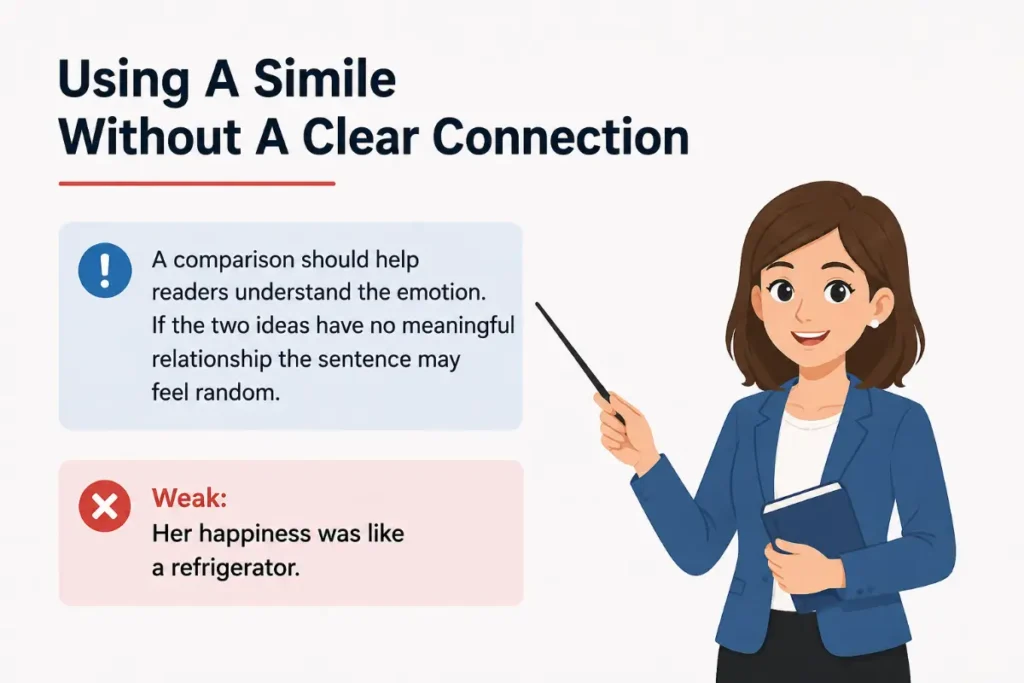
A comparison should help readers understand the emotion. If the two ideas have no meaningful relationship the sentence may feel random.
Weak:
Her happiness was like a refrigerator.
There’s no obvious emotional connection.
Stronger:
Her happiness was like sunlight filling a cold room.
The relationship is clear. Both the sunlight and happiness bring warmth and brightness.
Mixing Simile And Metaphor
A simile usually makes an explicit comparison with like or as.
His anger was like a fire.
A metaphor states the comparison directly.
His anger was a fire.
Both devices can work. Just understand the difference so you can choose the effect you want.
Overusing Similes
Even excellent comparisons lose power when they appear in every sentence.
Give important images room to breathe. One strong emotional simile can do more work than five ordinary ones.
Using Clichés Too Often
Expressions such as busy as a bee or cold as ice are familiar. They aren’t automatically wrong but they may feel predictable.
For creative writing try creating an image that fits the specific character and situation.
Making The Comparison Too Complicated
A simile should clarify rather than create another puzzle.
If readers need several sentences to understand the comparison the image probably needs simplifying.
Clear language usually has more impact.
Memory Tips
Remember the basic formula:
Emotion + like or as + vivid comparison.
For example:
Her fear was like a shadow.
You can make it stronger by adding a specific quality.
Her fear followed her like a shadow at noon.
You can also remember emotional categories through physical qualities.
- Happiness often feels light warm bright or energetic.
- Sadness often feels heavy cold empty or quiet.
- Anger often feels hot sharp explosive or pressured.
- Fear often feels cold fast trapped or frozen.
- Love often feels warm safe steady or growing.
- Anxiety often feels restless tangled buzzing or uncertain.
- Excitement often feels fast bright electric or rising.
- Loneliness often feels empty distant silent or isolated.
- Relief often feels light cool soft or freeing.
- Confidence often feels steady strong clear or grounded.
These associations can help you create new comparisons instead of memorizing a fixed list.
Related Grammar And Usage Notes
Similes usually function as part of a larger sentence rather than standing alone.
For example:
Her excitement was like fireworks.
The comparison follows the verb was.
You can also place a simile after an action.
He ran through the hallway like a frightened deer.
Here the comparison describes how he ran.
You can begin a sentence with an as comparison.
As quiet as a mouse she slipped through the doorway.
This structure can sound more literary and may require careful punctuation depending on the complete sentence.
The word like is usually followed by a noun or noun phrase in a standard simile.
She cried like a child.
The phrase compares her crying with the crying of a child.
The word as often appears in paired structures.
He was as nervous as a student before an exam.
The comparison connects two qualities.
The important point is simple. Grammar supports the image but meaning remains the heart of the simile.
How To Choose The Best Simile
The best comparison depends on the emotion and the situation.
Suppose your character is mildly nervous before giving a presentation.
His nerves were like butterflies in his stomach.
That works because the feeling is uncomfortable but not terrifying.
Now imagine someone hiding during a dangerous situation.
Fear gripped him like an icy hand.
That comparison fits the higher intensity.
The emotional temperature matters.
A playful comparison can work for a light scene. A darker image may suit a serious scene.
Think about the character too. A child may naturally compare fear with a monster under the bed. An engineer might describe nervous thoughts as circuits running too fast. A farmer might compare hope with the first green shoot after rain.
Specific images can make characters feel more real.
How Similes Improve Emotional Writing
A direct statement tells the reader what to feel.
An effective comparison gives the reader a way to experience the feeling.
Compare these two sentences.
She was lonely.
She felt like a single porch light glowing on an empty street.
The first sentence communicates information. The second creates an image.
Neither approach is always better. Direct language is useful when clarity matters most. Similes become valuable when you want mood texture personality or emotional depth.
Strong writing often uses both.
A story might first state the emotion and then deepen it with a comparison.
He was nervous before the interview. His thoughts raced like cars at a crowded intersection.
The first sentence gives the fact. The second gives the feeling.
Key Takeaways
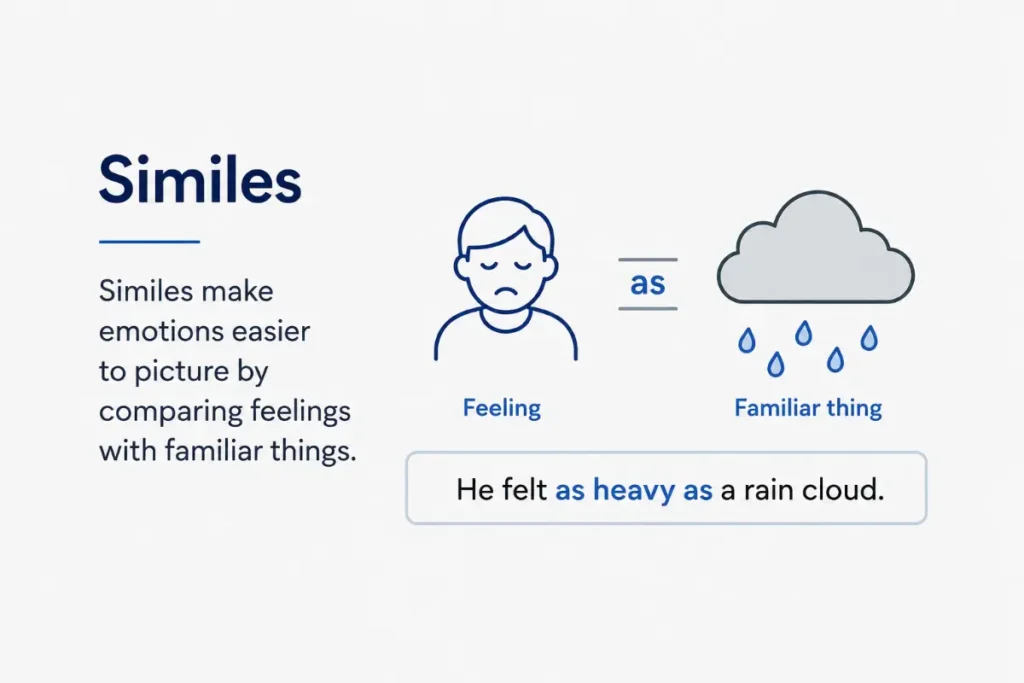
- Similes make emotions easier to picture by comparing feelings with familiar things.
- Strong emotional comparisons focus on a shared quality such as heat weight movement darkness light or pressure.
- Happiness can be compared with sunlight flowers music birds and fireworks.
- Sadness can be compared with fog rain heavy stones empty rooms and fading light.
- Anger often works well with fire storms sparks heat and boiling water.
- Fear can be compared with shadows icy hands trapped animals and sudden storms.
- Love can be compared with warmth shelter sunlight growing trees and steady lights.
- Anxiety can be compared with buzzing insects tangled wires spinning wheels and restless movement.
- Original comparisons usually work better than forced or overly familiar clichés.
- The best simile fits the emotion the character and the situation.
Conclusion
Similes for emotions give invisible feelings a visible shape. They can turn happiness into sunlight sadness into fog fear into an icy grip and hope into a small candle that refuses to go out. That simple shift can make ordinary writing feel more vivid and personal.
The strongest emotional similes don’t rely on complicated words. They use familiar images and connect them to a clear emotional quality. Think about what the feeling does to the body or mind and then find something in the real world that behaves in a similar way.
When you need a fresh comparison remember to start with the emotion and look for its physical quality. Ask if it feels heavy bright hot cold restless quiet or overwhelming. Then build an image around that quality. A well chosen simile can make a reader understand a feeling without needing to explain it twice.
Frequently Asked Questions
What are similes for emotions?
Similes for emotions compare feelings with familiar images using words such as like or as. They make abstract emotions easier to picture. Instead of simply saying someone is scared you might describe their fear as like an icy hand gripping their heart. The comparison gives the emotion physical shape and helps readers connect with the character.
What is a good simile for happiness?
A strong simile for happiness is Her happiness was like sunlight spilling through the curtains. It works because sunlight suggests warmth brightness and comfort. You can also use images involving laughter flowers music birds fireworks or warm weather. The best choice depends on the kind of happiness you want to express.
What is a simile for sadness?
One useful example is Her sadness settled over her like evening fog. The image suggests that sadness surrounds the person and makes everything feel less clear. Other effective images include heavy stones empty rooms rain dark clouds and fading light. Choose an image that matches the intensity and mood of the scene.
What are some similes for anger?
Anger can be compared with fire heat storms sparks boiling water or tightly stretched objects. For example His anger burned like a furnace presents anger as intense heat. Her frustration boiled like water in a kettle suggests pressure building slowly. The strongest comparison matches the way the character actually behaves.
What is a simile for fear?
A useful example is Fear gripped him like an icy hand. This comparison makes fear feel physical and controlling. You can also compare fear with shadows storms freezing water trapped animals or sudden sounds. The image should fit the situation. Quiet fear may need a different comparison from sudden panic.
What is a simile for love?
A simple and effective example is Her love was like a warm blanket on a cold night. The comparison communicates comfort safety and care. Love can also be compared with sunlight growing trees steady lights music or shelter. Choose an image that reflects the type of love you want readers to feel.
How many similes for emotions should I use in an essay?
Use only enough to strengthen the writing. One strong simile can be more effective than several weak ones. In a short paragraph one carefully chosen comparison may be enough. In a longer story you can use more but avoid placing them in every sentence. Let direct statements and concrete details carry some of the emotional weight.
Can similes describe negative emotions?
Yes. Similes can describe sadness anger fear jealousy guilt anxiety frustration embarrassment and disappointment. Negative emotions often become especially vivid when compared with physical experiences such as weight coldness pressure darkness or distance. The comparison helps readers understand how the emotion affects the character instead of simply giving the emotion a name.
Can I create my own emotional similes?
Absolutely. Start by identifying what the emotion feels like physically or mentally. Then find an object or experience that behaves in a similar way. If anxiety feels restless you might compare it with a trapped insect. If hope feels small but persistent you might compare it with a candle that continues burning in a dark room.
What is the difference between a simile and a metaphor?
A simile makes a direct comparison using words such as like or as. For example Her sadness was like rain is a simile. A metaphor makes the comparison directly by saying Her sadness was rain. Both can create vivid imagery but they produce slightly different effects.

Idioms, Expressions & Figurative Language
Mason Ellsworth is an American language writer with a passion for English expressions, figurative language, and everyday communication. He explains idioms, similes, popular phrases, and commonly misunderstood expressions in a straightforward, engaging style that helps readers improve both their writing and spoken English.