
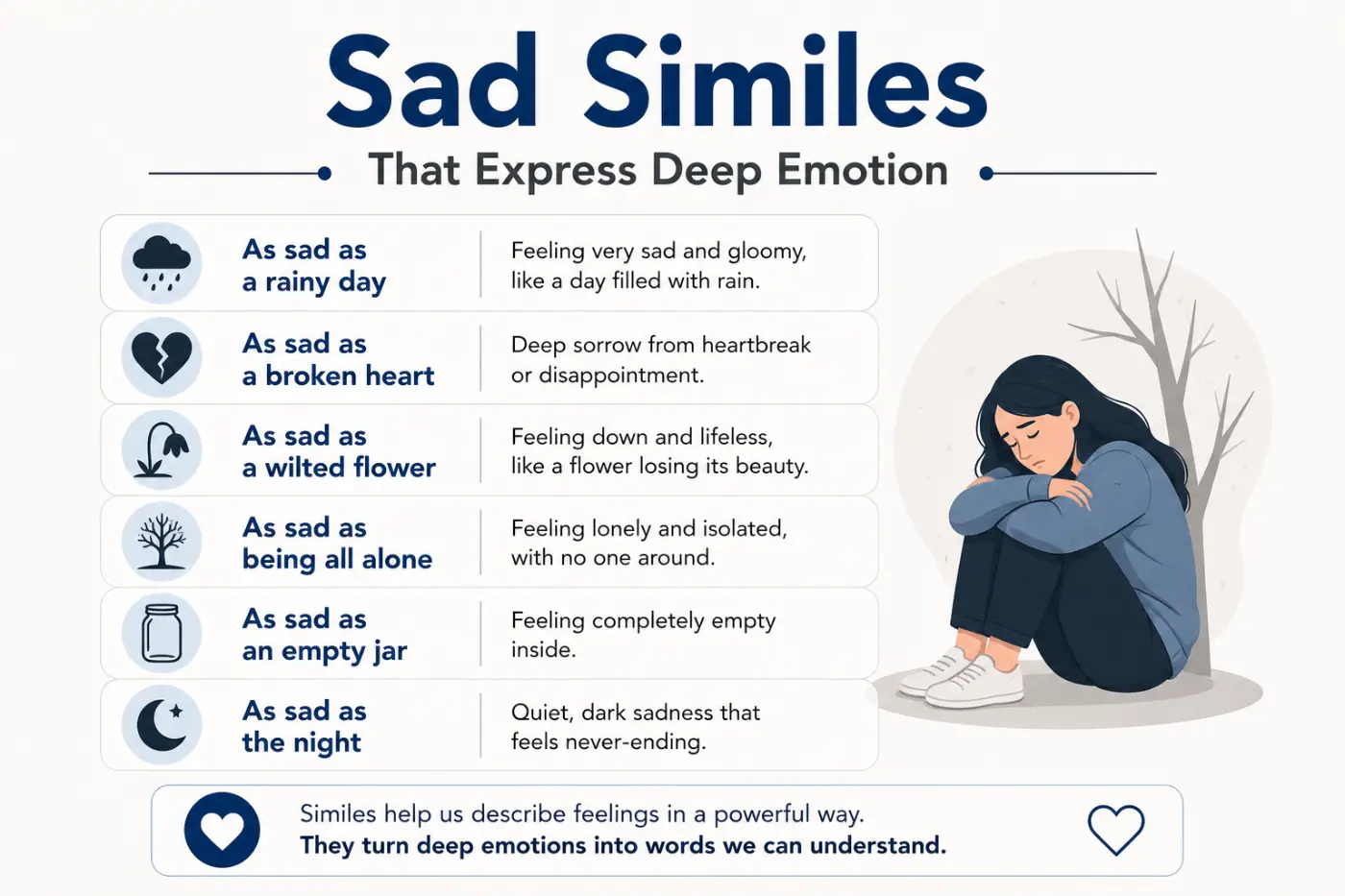
Sad similes give an invisible feeling a shape readers can see and understand. Instead of simply saying someone feels sad, you can compare that emotion to a fading flower, an empty room, a rainy afternoon, or a candle slowly losing its light.
The best comparisons don’t just make writing sound more poetic. They help readers experience an emotion. A simple sentence such as “She felt sad” tells us what happened. A sentence such as “Her heart felt as empty as an abandoned house” gives us an image and lets us sense the emptiness.
Writers use these comparisons in poems, novels, short stories, personal essays, songs, speeches, school assignments, and everyday conversation. The right comparison can communicate quiet disappointment just as effectively as deep grief.
This collection brings together more than 120 original examples organized by emotional theme. You’ll find gentle comparisons for ordinary sadness, stronger ones for heartbreak and grief, and vivid choices for loneliness, disappointment, and emotional exhaustion.
Short Answer
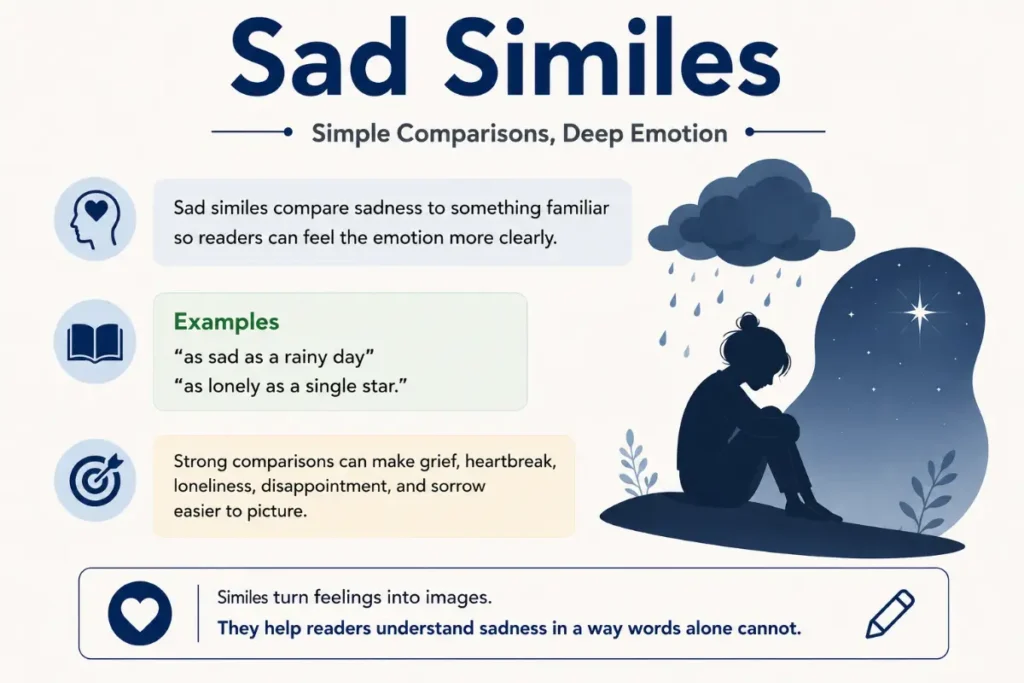
Sad similes compare sadness to something familiar so readers can feel the emotion more clearly. Examples include “as sad as a rainy day” and “as lonely as a single star.” Strong comparisons can make grief, heartbreak, loneliness, disappointment, and sorrow easier to picture.
Table Of Contents
- What A Sad Simile Is.
- How Similes Express Sadness.
- The Best Sad Similes.
- Similes For Loneliness.
- Similes For Heartbreak.
- Similes For Grief And Loss.
- Similes For Disappointment.
- Similes For Quiet Sadness.
- Similes For Deep Emotional Pain.
- Similes For Sad Eyes And Tears.
- Similes For Sadness In Nature.
- Similes For Sad Characters.
- Similes For Sad Writing.
- Common Mistakes.
- Memory Tips.
- Related Grammar And Usage Notes.
- Key Takeaways.
What A Sad Simile Is
A simile is a figure of speech that compares two different things using words such as like or as. The comparison creates a mental picture that helps readers understand an idea or emotion.
For example:
“His sadness was like a dark cloud.”
The sentence doesn’t mean his sadness is literally a cloud. The cloud represents the heavy and gloomy feeling surrounding him.
Another example is:
“She was as lonely as a house with no lights.”
The comparison helps readers picture isolation. The empty house gives the feeling of someone being alone and disconnected.
A strong simile has two important parts. First, it contains the subject or emotion being described. Second, it connects that subject to a familiar image.
The comparison should also make sense emotionally. A sad simile works best when the image naturally suggests sorrow, emptiness, loneliness, loss, silence, darkness, or emotional pain.
How Similes Express Sadness
Sadness can be difficult to describe because it isn’t something readers can physically see. A writer can solve that problem by comparing the emotion with something visible.
Rain can suggest gloom.
An empty room can suggest loneliness.
A fading flower can suggest loss.
A dying flame can suggest fading hope.
A broken window can suggest damage.
A silent house can suggest absence.
These images allow readers to understand emotion without being told exactly what to feel.
The strongest comparisons also match the intensity of the scene. A character who feels mildly disappointed doesn’t need an image associated with devastating grief. A small gray cloud may work better than a collapsing storm.
That balance matters. Good figurative language supports the emotion instead of overpowering it.
The Best Sad Similes
The following examples are designed for creative writing, poems, stories, essays, captions, and personal reflections. Each one focuses on a slightly different shade of sadness.
Similes For General Sadness
- As sad as a rainy afternoon. This suggests a soft and familiar sadness that hangs quietly over the day. Example: “He felt as sad as a rainy afternoon after the visitors left.”
- Like a cloud covering the sun. This compares sadness to something that blocks happiness and warmth. Example: “Her sadness was like a cloud covering the sun.”
- As gloomy as an empty street. This creates a feeling of silence and emotional heaviness. Example: “The room felt as gloomy as an empty street at midnight.”
- Like winter without snow. This suggests a cold and colorless kind of sadness. Example: “His days felt like winter without snow.”
- As gray as an overcast sky. This comparison presents sadness as dull and difficult to escape. Example: “Her mood was as gray as an overcast sky.”
- Like a song played in a minor key. This connects sadness with music and emotional tone. Example: “The memory felt like a song played in a minor key.”
- As heavy as a rain filled cloud. This suggests emotional weight building inside someone. Example: “His heart felt as heavy as a rain filled cloud.”
- Like a garden after a storm. This creates an image of beauty damaged by difficult circumstances. Example: “Her life looked like a garden after a storm.”
- As dull as a room without windows. This suggests sadness mixed with a lack of hope. Example: “The afternoon felt as dull as a room without windows.”
- Like a candle behind thick glass. This suggests happiness that exists but cannot shine freely. Example: “Her smile was like a candle behind thick glass.”
Similes For Loneliness
- As lonely as a single star. This suggests isolation despite being surrounded by a huge world. Example: “He felt as lonely as a single star in the night.”
- Like an empty chair at the table. This represents someone’s absence in a personal setting. Example: “Her silence felt like an empty chair at the table.”
- As alone as a tree in a field. This creates a simple image of separation. Example: “He stood as alone as a tree in a field.”
- Like a house with no lights. This suggests a place that feels empty and lifeless. Example: “His heart felt like a house with no lights.”
- As lonely as a forgotten road. This suggests isolation and neglect. Example: “She felt as lonely as a forgotten road.”
- Like a voice no one hears. This describes the pain of feeling ignored. Example: “His sadness was like a voice no one hears.”
- As empty as a deserted station. This creates an image of people having left and nothing remaining. Example: “The room felt as empty as a deserted station.”
- Like a book left unopened. This suggests feeling unseen or forgotten. Example: “She felt like a book left unopened on a dusty shelf.”
- As isolated as an island in a vast sea. This emphasizes emotional distance from others. Example: “He felt as isolated as an island in a vast sea.”
- Like footsteps fading down a hallway. This suggests someone leaving and the connection disappearing. Example: “Their friendship felt like footsteps fading down a hallway.”
Heartbreak Similes
- Like a glass heart dropped on stone. This represents sudden emotional damage. Example: “The breakup left her feeling like a glass heart dropped on stone.”
- As broken as a mirror after a fall. This suggests something once whole becoming difficult to restore. Example: “His trust was as broken as a mirror after a fall.”
- Like a door closing forever. This represents the painful end of a relationship or opportunity. Example: “Her goodbye felt like a door closing forever.”
- As painful as an old wound reopening. This suggests past emotional pain returning. Example: “Seeing him again was as painful as an old wound reopening.”
- Like a photograph torn in half. This creates an image of a relationship divided by loss. Example: “Their friendship ended like a photograph torn in half.”
- As empty as a room after someone moves away. This captures the emptiness left by a loved one. Example: “Her heart felt as empty as a room after someone moves away.”
- Like a bridge collapsing between two people. This suggests a connection that can no longer carry them. Example: “Their trust disappeared like a bridge collapsing between two people.”
- As cold as a goodbye without a hug. This suggests emotional distance at the moment of separation. Example: “His farewell felt as cold as a goodbye without a hug.”
- Like a favorite song suddenly stopping. This suggests an ending that feels abrupt and incomplete. Example: “Their relationship ended like a favorite song suddenly stopping.”
- As hollow as an abandoned home. This suggests emotional emptiness after losing someone important. Example: “She felt as hollow as an abandoned home.”
Similes For Grief And Loss
- Like a shadow that never leaves. This suggests grief that remains present over time. Example: “Her grief followed her like a shadow that never leaves.”
- As heavy as a stone in the chest. This represents the physical feeling of emotional weight. Example: “His grief felt as heavy as a stone in the chest.”
- Like a missing page in a favorite book. This suggests a permanent absence in something once complete. Example: “Life felt like a missing page in a favorite book.”
- As deep as an ocean at night. This presents grief as vast and difficult to measure. Example: “Her sorrow was as deep as an ocean at night.”
- Like an echo after the voice is gone. This represents memories that remain after someone has left. Example: “His memories were like an echo after the voice is gone.”
- As quiet as an empty church. This suggests grief through silence rather than dramatic emotion. Example: “The house was as quiet as an empty church.”
- Like a photograph fading in sunlight. This suggests memories changing slowly over time. Example: “His memories felt like a photograph fading in sunlight.”
- As endless as a night without dawn. This suggests grief that seems to have no immediate ending. Example: “The first weeks felt as endless as a night without dawn.”
- Like a chair left empty for someone who won’t return. This creates a direct image of absence. Example: “The dining room looked like a chair left empty for someone who won’t return.”
- As cold as a graveyard before sunrise. This creates a solemn image of deep loss. Example: “The morning felt as cold as a graveyard before sunrise.”
Similes For Disappointment
- Like opening an empty gift box. This represents expecting something meaningful and finding nothing. Example: “The result felt like opening an empty gift box.”
- As disappointing as rain on a planned picnic. This describes a simple hope ruined by circumstances. Example: “The cancellation was as disappointing as rain on a planned picnic.”
- Like reaching for a door that suddenly locks. This represents an opportunity disappearing at the last moment. Example: “The lost opportunity felt like reaching for a door that suddenly locks.”
- As flat as a balloon after the air escapes. This suggests excitement disappearing quickly. Example: “His excitement became as flat as a balloon after the air escapes.”
- Like waiting for a letter that never arrives. This captures anticipation followed by disappointment. Example: “Her hope was like waiting for a letter that never arrives.”
- As empty as a promise left unkept. This connects disappointment with broken expectations. Example: “His words felt as empty as a promise left unkept.”
- Like a finish line moved farther away. This represents effort followed by another obstacle. Example: “The setback felt like a finish line moved farther away.”
- As bitter as cold coffee. This gives disappointment a familiar unpleasant quality. Example: “The ending was as bitter as cold coffee.”
- Like building a sandcastle before the tide. This suggests effort that is undone by circumstances. Example: “Their plans disappeared like building a sandcastle before the tide.”
- As discouraging as a locked gate. This suggests being stopped after hoping to move forward. Example: “The rejection felt as discouraging as a locked gate.”
Quiet Sadness Similes
- Like rain tapping softly on a window. This represents sadness that remains gentle and private. Example: “Her thoughts came like rain tapping softly on a window.”
- As quiet as falling snow. This suggests sadness that arrives without noise. Example: “His grief was as quiet as falling snow.”
- Like a dim lamp at the end of a hallway. This suggests weak hope surrounded by darkness. Example: “Her happiness felt like a dim lamp at the end of a hallway.”
- As soft as a fading whisper. This represents an emotion that is present but barely expressed. Example: “His sadness was as soft as a fading whisper.”
- Like an autumn leaf drifting away. This suggests gentle loss and acceptance. Example: “Her goodbye felt like an autumn leaf drifting away.”
- As still as a pond before rain. This creates an image of quiet emotional tension. Example: “The room was as still as a pond before rain.”
- Like a window covered with morning mist. This suggests emotions that make everything harder to see clearly. Example: “Her thoughts were like a window covered with morning mist.”
- As faint as the last light of evening. This represents sadness mixed with fading hope. Example: “His smile was as faint as the last light of evening.”
- Like a quiet room after laughter ends. This captures the sudden contrast between happiness and silence. Example: “The house felt like a quiet room after laughter ends.”
- As gentle as a tear falling unnoticed. This suggests private sadness that others don’t see. Example: “Her grief was as gentle as a tear falling unnoticed.”
Similes For Deep Emotional Pain
- Like a storm trapped inside a small room. This represents intense feelings with no place to escape. Example: “His anger and grief felt like a storm trapped inside a small room.”
- As painful as a wound no one can see. This captures emotional suffering that remains invisible. Example: “Her sadness was as painful as a wound no one can see.”
- Like carrying a mountain on your back. This represents an overwhelming emotional burden. Example: “He felt like he was carrying a mountain on his back.”
- As crushing as a collapsing ceiling. This suggests intense pressure and emotional overwhelm. Example: “The news was as crushing as a collapsing ceiling.”
- Like a wave pulling someone beneath the surface. This represents an emotion that becomes difficult to control. Example: “Grief hit her like a wave pulling someone beneath the surface.”
- As sharp as broken glass. This suggests sudden and intense emotional pain. Example: “His memories were as sharp as broken glass.”
- Like fire without a flame. This represents pain that burns internally but cannot be seen. Example: “Her anger felt like fire without a flame.”
- As heavy as an iron door. This suggests an emotion that feels difficult to move past. Example: “His regret was as heavy as an iron door.”
- Like a storm that refuses to pass. This represents prolonged emotional suffering. Example: “Her sadness was like a storm that refuses to pass.”
- As deep as a canyon hidden in darkness. This suggests pain that reaches far below the surface. Example: “His grief was as deep as a canyon hidden in darkness.”
Similes For Sad Eyes And Tears
- Eyes like rain clouds. This suggests eyes filled with sadness and tears. Example: “She looked at him with eyes like rain clouds.”
- As wet as leaves after a storm. This compares tearful eyes with wet natural objects. Example: “His eyes were as wet as leaves after a storm.”
- Like glass covered in rain. This suggests tears making the world appear blurred. Example: “Her eyes looked like glass covered in rain.”
- As red as the sky after sunset. This can describe eyes after crying. Example: “His eyes were as red as the sky after sunset.”
- Like two small lakes under a cloudy sky. This gives tears a calm but sorrowful image. Example: “Her eyes looked like two small lakes under a cloudy sky.”
- As bright with tears as stars behind clouds. This suggests sadness mixed with a small spark of hope. Example: “Her eyes were as bright with tears as stars behind clouds.”
- Like rain gathering on a window. This describes tears forming slowly. Example: “Tears gathered in her eyes like rain gathering on a window.”
- As fragile as a tear on a fingertip. This suggests emotional vulnerability. Example: “Her expression was as fragile as a tear on a fingertip.”
- Like morning dew on a dying flower. This creates an image of beauty mixed with sadness. Example: “A tear rested on her cheek like morning dew on a dying flower.”
- As silent as tears behind a smile. This describes hidden emotional pain. Example: “Her sadness was as silent as tears behind a smile.”
Sadness In Nature Similes
- Like leaves falling from a bare tree. This suggests loss and gradual change. Example: “His friendships disappeared like leaves falling from a bare tree.”
- As dark as a storm cloud. This represents a heavy and gloomy mood. Example: “Her thoughts were as dark as a storm cloud.”
- Like a flower bending beneath the rain. This suggests vulnerability under emotional pressure. Example: “She felt like a flower bending beneath the rain.”
- As cold as winter wind. This suggests emotional distance and discomfort. Example: “His response was as cold as winter wind.”
- Like a river running dry. This represents something once full becoming empty. Example: “Her hope felt like a river running dry.”
- As lifeless as a field after harvest. This suggests emptiness after something important has ended. Example: “The town felt as lifeless as a field after harvest.”
- Like the last leaf of autumn. This suggests loneliness and approaching change. Example: “He felt like the last leaf of autumn.”
- As lonely as a moonless sky. This creates an image of darkness and absence. Example: “The night felt as lonely as a moonless sky.”
- Like a flower losing its color. This suggests happiness gradually fading. Example: “Her excitement disappeared like a flower losing its color.”
- As silent as a forest after snowfall. This represents deep quiet and isolation. Example: “The village was as silent as a forest after snowfall.”
Similes For Sad Characters
- He moved like a candle running out of wax. This suggests fading energy and hope.
- She smiled like someone hiding a storm behind a curtain. This suggests happiness being used to conceal pain.
- He looked as tired as an old road after a long winter. This suggests emotional exhaustion.
- She sat like a flower forgotten in a dark room. This suggests neglect and loneliness.
- He spoke like a radio losing its signal. This suggests a voice becoming weak and uncertain.
- She walked as slowly as clouds crossing a winter sky. This suggests heaviness and a lack of energy.
- He stared ahead like a traveler who had lost the map. This suggests confusion and emotional uncertainty.
- She looked as pale as morning light through fog. This suggests exhaustion and sadness.
- He stood like a tree stripped bare by winter. This suggests loss and emotional exposure.
- She laughed like a bell with a crack in it. This suggests happiness that sounds damaged beneath the surface.
Similes For Sad Writing
- The silence was like an empty theater after the audience leaves. This creates a strong sense of absence.
- His memory was like an old photograph kept in a drawer. This suggests something precious from the past.
- Her hope was like a candle fighting the wind. This suggests fragile optimism.
- The goodbye was like the final page of a favorite book. This suggests an ending that feels difficult to accept.
- His heart felt like a room after the furniture has been removed. This creates an image of emptiness.
- Her childhood seemed like a summer that ended too soon. This suggests nostalgia and loss.
- The friendship faded like writing left in the sun. This suggests a relationship disappearing gradually.
- His dreams were like paper boats sinking in the rain. This suggests hopes that cannot survive difficult circumstances.
- The old house stood like a memory no one visited. This suggests abandonment and the passage of time.
- Her words fell like leaves in late autumn. This creates a gentle image of fading connection.
More Creative Similes For Sadness
- Like a clock that stopped before midnight. This suggests an unfinished moment.
- As empty as a mailbox waiting for a letter that never comes. This represents anticipation followed by silence.
- Like a photograph with the person cut out. This suggests absence from a once complete memory.
- As fragile as a snowflake in a warm hand. This represents something beautiful that cannot last.
- Like a road disappearing into fog. This suggests uncertainty about the future.
- As lonely as a porch light burning for someone who never arrives. This represents waiting and disappointment.
- Like a shadow separated from its person. This suggests feeling disconnected from life or identity.
- As tired as an old song played too many times. This represents emotional exhaustion.
- Like a letter written but never sent. This suggests feelings left unspoken.
- As distant as a star seen from the bottom of the sea. This represents something that feels unreachable.
- Like a photograph left face down. This suggests avoiding a painful memory.
- As fragile as a promise whispered in the dark. This suggests hope that feels uncertain.
- Like footsteps disappearing in fresh snow. This represents memories or relationships slowly fading.
- As heavy as a suitcase filled with old memories. This suggests carrying emotional baggage.
- Like an empty swing moving in the wind. This creates a strong image of absence.
- As cold as a room after the fire goes out. This represents warmth and connection disappearing.
- Like a letter arriving after the person has gone. This suggests painful timing and missed opportunities.
- As distant as yesterday seen through a rainy window. This represents memories that feel unreachable.
- Like a flower pressed between the pages of an old book. This suggests beauty preserved alongside loss.
- As quiet as a goodbye no one wanted to say. This captures restrained grief and emotional pain.
How To Choose The Right Simile
Not every comparison works for every kind of sadness. The emotional situation should guide your choice.
If the character feels lonely, choose an image involving emptiness, distance, silence, or isolation. An empty chair or a single star can work well.
If the character has suffered heartbreak, use images involving something broken, separated, closed, or lost. A shattered mirror or a closing door can communicate the emotional damage quickly.
If the scene involves grief, quieter images often carry more weight. An empty chair, fading photograph, or silent house can feel more powerful than an exaggerated image.
If the character feels disappointed, choose a comparison involving expectations that failed. An empty gift box or a letter that never arrives can communicate that feeling clearly.
If the sadness is mild, don’t reach for the darkest possible image. A rainy afternoon may fit better than a graveyard. Matching the strength of the image to the strength of the emotion makes writing feel more believable.
How Writers Use Sad Similes
Writers use comparisons for several reasons.
First, they make emotions concrete. Readers cannot physically see sadness, but they can picture an empty room or a fading flower.
Second, they create atmosphere. A sentence about a gray sky can make an entire scene feel gloomy before the character even speaks.
Third, they reveal character. A lonely character might describe sadness as an empty road. Another character might compare it to a broken instrument. The choice of image can tell readers something about the person thinking it.
Fourth, similes can control emotional intensity. A gentle comparison creates quiet sadness. A violent or dramatic comparison creates stronger emotional pain.
The best writers don’t add figurative language to every sentence. They choose the right moment and let the image do its work.
Common Mistakes
Using The Same Comparison Too Often
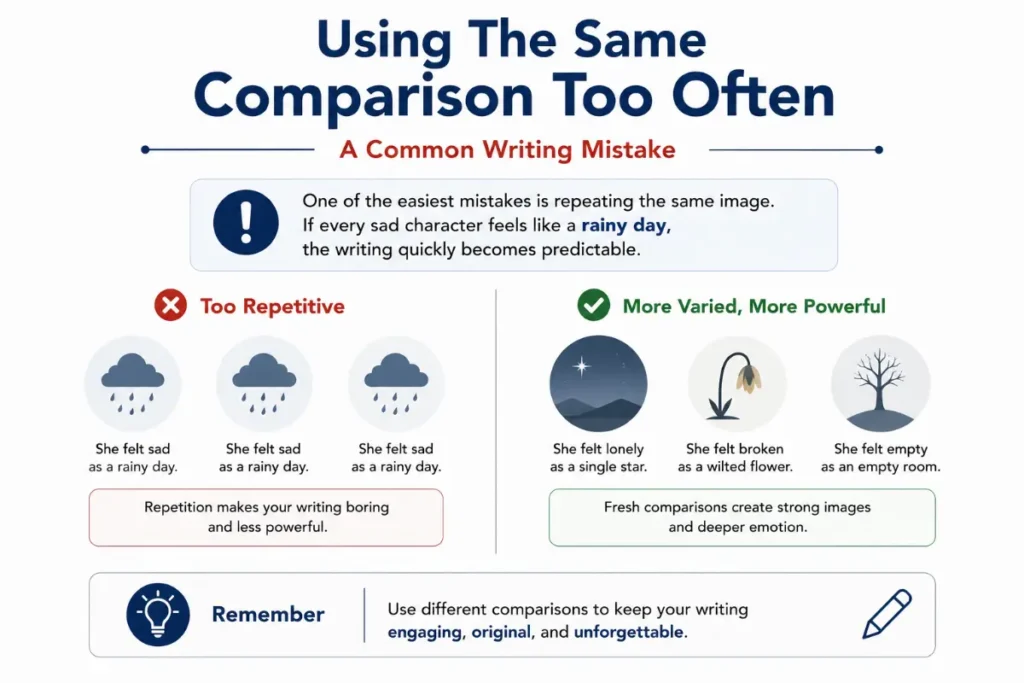
One of the easiest mistakes is repeating the same image. If every sad character feels like a rainy day, the writing quickly becomes predictable.
Try changing the source of the comparison. Use weather in one scene, an empty room in another, and a fading photograph in another.
Making The Comparison Too Dramatic
A small disappointment doesn’t always need an image of total destruction.
If a character misses a bus, saying their heart shattered may sound exaggerated unless the situation has deeper emotional meaning.
Match the comparison to the emotion.
Choosing An Image That Doesn’t Fit
A simile should support the feeling.
For example, comparing deep grief to a cheerful summer morning creates a confusing emotional signal unless the contrast is intentional.
Think about the emotional quality of the image before using it.
Explaining The Simile Too Much
Once you’ve created a strong comparison, trust the reader.
For example:
“Her heart felt like an empty house.”
You don’t always need three more sentences explaining that the house represents loneliness. The image already communicates a lot.
Mixing Too Many Comparisons
Using several unrelated similes in one sentence can weaken all of them.
Choose one strong image and give it room to work.
Using Clichés Without Purpose
Some comparisons are so familiar that readers barely notice them. Rain and tears are classic examples.
They aren’t automatically bad. The key is presentation. A familiar image can still work if the context gives it a fresh meaning.
Memory Tips
Remember the basic structure of a simile:
Subject + like + comparison.
For example:
“Her sadness was like a fading flower.”
You can also use the as structure:
“Her sadness was as deep as the ocean.”
The comparison should help the reader picture the emotion.
A useful way to create your own comparisons is to ask three questions.
- What does the emotion feel like physically?
- What object or scene has a similar quality?
- Can I connect the two with like or as?
Suppose a character feels emotionally exhausted. You might think about something that has run out of energy.
A candle near the end of its life fits.
You could write:
“He felt like a candle running out of wax.”
Now the reader can picture fading energy instead of simply being told that the character is tired.
Another useful trick is to think in emotional qualities.
Loneliness connects with emptiness and distance.
Grief connects with absence and fading memories.
Heartbreak connects with damage and separation.
Disappointment connects with failed expectations.
Quiet sadness connects with silence and fading light.
Once you identify the emotional quality, finding a fitting image becomes much easier.
Related Grammar And Usage Notes
A simile is not the same as a metaphor.
A simile usually makes a comparison using like or as.
“She was like a fading flower.”
A metaphor makes the comparison directly.
“She was a fading flower.”
The two devices can create similar emotional effects, but their grammatical structures differ.
Similes can also appear in ordinary conversation. You don’t have to write poetry to use them.
For example:
“I feel like a balloon after the air is gone.”
“That room was as quiet as a library.”
“She looked like she hadn’t slept in days.”
Some comparisons become so familiar that people use them without thinking about them as literary devices. That’s one reason similes are useful in everyday English.
When writing for school, make sure the comparison actually adds meaning. Teachers usually value a clear and purposeful figure of speech more than a complicated one.
In professional writing, use figurative language carefully. A vivid comparison can work in an article, speech, personal essay, or creative piece, but technical and legal writing usually benefits more from direct language.
Using Sad Similes In Creative Writing
Creative writers can use these comparisons in several places.
In Character Description
A comparison can reveal emotion without stating it directly.
Instead of:
“She was sad.”
You could write:
“She sat by the window like a flower forgotten in a dark room.”
The second sentence gives the reader something to picture.
In Dialogue
Characters can use similes when speaking naturally.
For example:
“I feel like a house with all the lights turned off.”
The comparison sounds personal because it reflects how the character understands their own emotion.
In Poetry
Poetry gives similes more room to become imaginative.
A poet might compare grief to weather, distance, silence, seasons, water, or fading light.
The goal isn’t simply to make the poem sound beautiful. The image should deepen the feeling.
In Personal Essays
A personal essay can use one carefully chosen comparison to describe a difficult experience.
For example:
“The silence after her departure felt like a house after everyone has gone home.”
The comparison communicates absence without overexplaining it.
In Storytelling
A well placed comparison can shape the mood of an entire scene.
If a story opens with a character watching rain slide down a window, the image can quietly establish sadness before the writer explains what happened.
Choosing Between Simple And Poetic Similes
Simple comparisons are often more powerful than complicated ones.
“As sad as a rainy day” is easy to understand.
“Like a forgotten letter resting beneath the dust of an abandoned century” is much more elaborate.
The second image may work in a particular poem or literary scene, but it doesn’t automatically make the writing better.
Clarity matters.
Think about the reader’s experience. Can they understand the comparison quickly? Does it fit the character? Does it match the mood?
If the answer is yes, the simile is doing its job.
How To Make A Simile Feel Original
Originality doesn’t mean inventing an image nobody has ever imagined. It means using a comparison in a way that feels natural and specific to your writing.
Start with an ordinary object.
A cup.
A window.
A chair.
A street.
A photograph.
A lamp.
Then connect it to the emotion.
For example:
“Her sadness was like a cup left untouched until the tea went cold.”
The object is ordinary. The emotional connection makes it meaningful.
You can also use setting to create originality.
A lonely character in a city might feel like a single window glowing in a tower.
A grieving character near the ocean might compare memory to footprints disappearing from wet sand.
A disappointed student might compare hope to a test paper returned with a failing grade.
Specific details make comparisons feel lived in rather than generic.
Key Takeaways
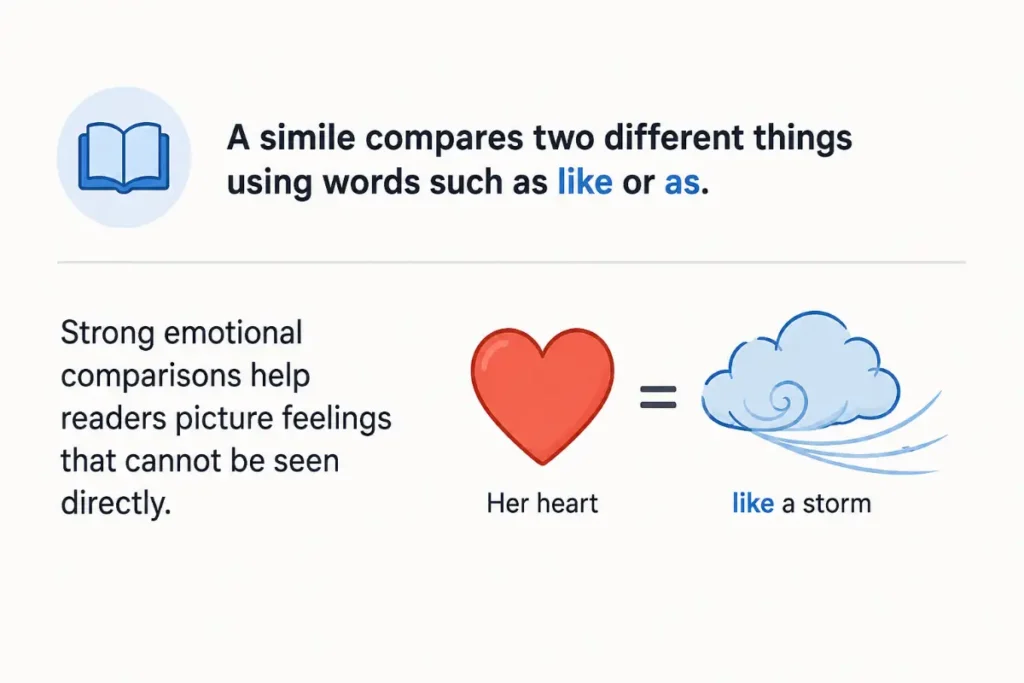
- A simile compares two different things using words such as like or as.
- Strong emotional comparisons help readers picture feelings that cannot be seen directly.
- Sad similes can describe loneliness, grief, heartbreak, disappointment, regret, emptiness, and emotional exhaustion.
- The best comparison matches the intensity of the emotion.
- Familiar images such as rain and darkness can work well when used with purpose.
- Avoid repeating the same comparison throughout a piece of writing.
- Don’t make a mild emotion sound devastating unless the context supports that intensity.
- One clear image is usually stronger than several unrelated comparisons.
- You can create your own similes by identifying an emotion and finding an object or scene with a similar quality.
- The strongest figurative language doesn’t simply decorate writing. It helps readers feel what the character feels.
Conclusion
Sad similes help writers turn difficult emotions into images readers can see and feel. A rainy afternoon can represent quiet sadness. An empty chair can suggest loneliness. A fading photograph can represent loss. A broken mirror can capture heartbreak.
The best comparisons aren’t necessarily the most dramatic. They are the ones that fit the emotion and the situation. Keep the image clear, choose details that readers recognize, and avoid using the same comparison repeatedly.
If you want to create your own similes, start with the emotion and ask what object, place, sound, or natural scene shares its qualities. Then connect the two with like or as. A thoughtful comparison can turn a simple sentence into an image that stays with the reader.
FAQs
What Is A Sad Simile?
A sad simile compares sadness or another painful emotion to something familiar using words such as like or as. For example, “Her heart felt like an empty room” compares emotional emptiness with a physical space. The comparison helps readers picture and feel an emotion instead of simply being told that someone is sad.
What Is A Good Simile For Sadness?
A good choice is “Her sadness was like a cloud covering the sun.” It suggests that sadness has temporarily blocked happiness and warmth. Another option is “His heart felt as empty as an abandoned house.” The best comparison depends on the kind and intensity of sadness you want to express.
What Is A Simile For Feeling Lonely?
A useful comparison is “He felt as lonely as a single star.” The image suggests someone existing alone in a huge space. You could also write “She felt like an empty chair at the table.” That version works especially well when loneliness comes from someone’s absence.
What Is A Simile For Heartbreak?
“Her heart felt like a glass ornament dropped on stone” can represent sudden emotional damage. Another strong choice is “Their relationship ended like a favorite song suddenly stopping.” The second comparison works well when the ending feels abrupt and unfinished.
Can Sad Similes Be Used In Poems?
Yes. Poetry often benefits from figurative language because a strong comparison can communicate several emotions at once. A poet might compare grief with fading light or loneliness with an empty road. The most effective choice should support the poem’s mood and avoid overwhelming the central idea.
Can I Use These Similes In A School Essay?
Yes. You can use an appropriate simile in a school essay when it helps explain an emotion, event, character, or experience. Keep the comparison clear and relevant. Avoid adding figurative language simply to make the essay sound complicated. A simple comparison that fits the topic is usually more effective.
How Do I Create My Own Sad Simile?
Start by naming the emotion. Then think of something that shares its quality. Loneliness might remind you of an empty house. Grief might remind you of a fading photograph. Finally connect the two with like or as. For example, “His grief was like an old photograph slowly losing its color.”
What Is The Difference Between A Simile And A Metaphor?
A simile usually signals a comparison with like or as. For example, “Her sadness was like rain.” A metaphor makes the comparison directly by saying, “Her sadness was rain.” Both can create vivid images, but the grammatical structure and style are different.
Are Sad Similes Only Used In Creative Writing?
No. People use comparisons in conversation, essays, speeches, journalism, advertising, and personal writing. Creative writing simply gives them more room to become imaginative. Even in everyday speech, someone might say that a room was as quiet as a library or that they felt like a balloon with no air.
What Makes A Sad Simile Powerful?
A powerful comparison connects an emotion with an image readers already understand. It should feel natural, specific, and relevant to the situation. Strong comparisons also avoid unnecessary explanation. If the image immediately creates the intended emotional response, the simile has done its job.
Can A Simile Be Too Dramatic?
Yes. A comparison can become ineffective if it makes a small emotion sound enormous. Saying someone feels as though their entire world has collapsed after missing a casual appointment may seem exaggerated. Match the strength of the image to the strength of the emotion so the writing feels believable.
How Many Similes Should I Use In One Paragraph?
There is no fixed number. One strong comparison can be enough. Several can work in a longer creative passage if they support the same mood. Avoid filling every sentence with figurative language because the writing can start to feel forced. Give your strongest images enough space to make an impression.

Idioms, Expressions & Figurative Language
Mason Ellsworth is an American language writer with a passion for English expressions, figurative language, and everyday communication. He explains idioms, similes, popular phrases, and commonly misunderstood expressions in a straightforward, engaging style that helps readers improve both their writing and spoken English.