
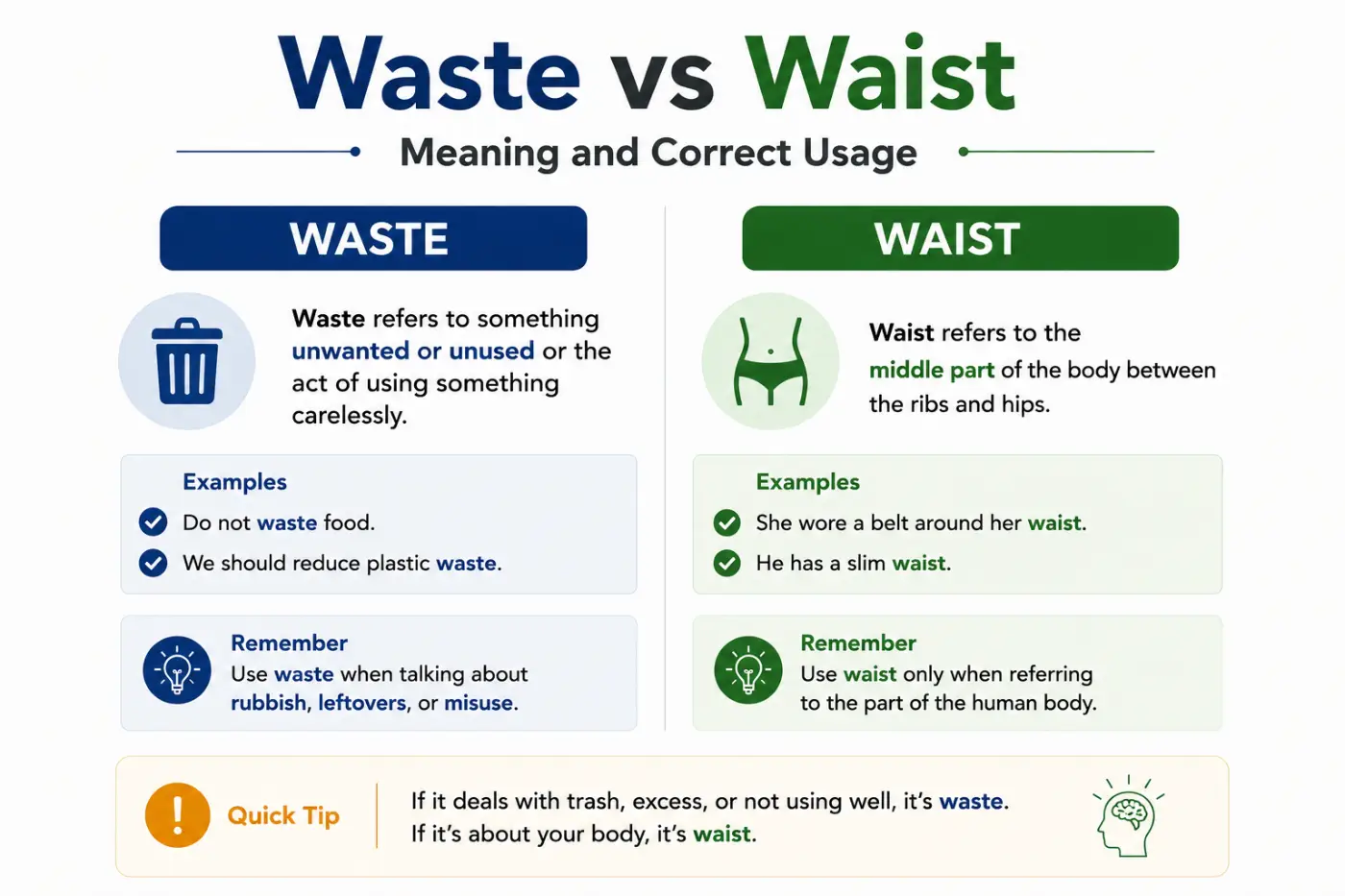
Waste vs Waist is a common English confusion because the two words sound almost identical in many accents but mean completely different things. If you use the wrong one in a sentence the reader may understand your intention from context but the sentence can still be incorrect. The key difference is simple. Waste relates to something thrown away or used carelessly while waist refers to the middle part of the human body.
The confusion comeyukyus mainly from pronunciation. Both words are commonly pronounced with the same long a sound and the same final st sound. That makes them homophones in standard English. Their spellings give you the clue that pronunciation can’t provide. Waste contains the idea of something being wasted or discarded while waist refers to a physical body area or the part of clothing that fits around it.
This guide will help you tell these words apart without memorizing a complicated rule. You’ll learn their meanings word origins grammar roles pronunciation common mistakes and natural examples. You’ll also see how native speakers use each word in everyday conversation professional writing academic contexts news writing and other situations. By the end you should be able to choose the right word quickly and confidently.
Quick Definition
Waste refers to something that isn’t used properly or is discarded. It can also mean to use something carelessly or unnecessarily. Waist refers to the middle part of the human body between the ribs and hips. The two words usually sound alike but their meanings spelling and grammatical uses are different.
Quick Answer
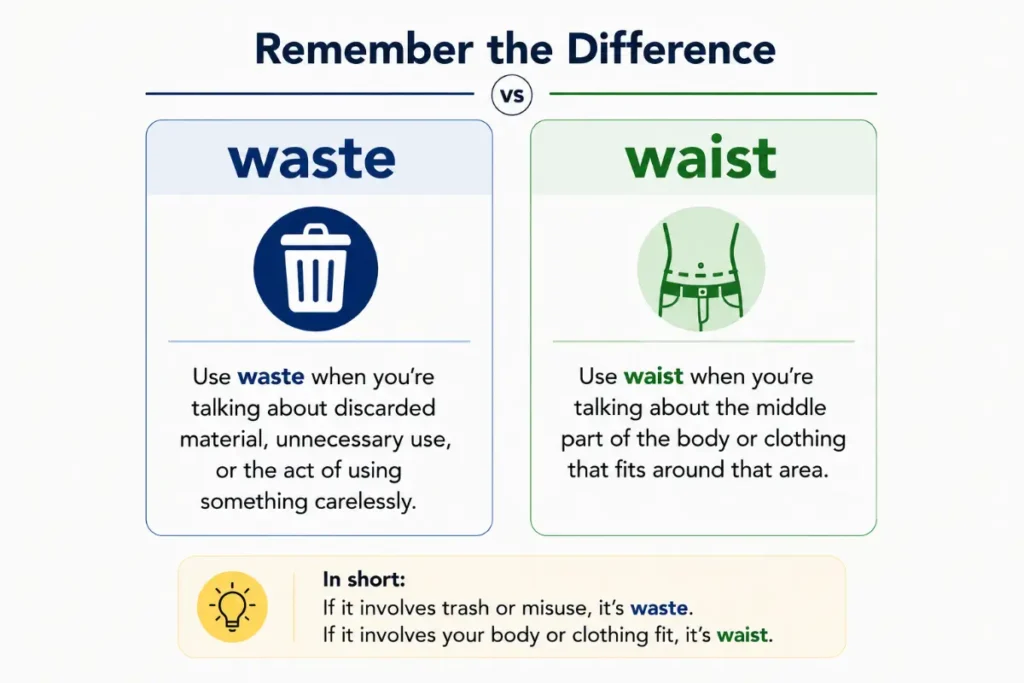
Use waste when you’re talking about discarded material unnecessary use or the act of using something carelessly. Use waist when you’re talking about the middle part of the body or clothing that fits around that area.
For example you can say Do not waste food. You can also say The belt fits around my waist.
Comparison Table for Waste vs Waist
| Correct Form | Meaning | Part of Speech | Origin | Usage Frequency | Formality | Common Contexts | Example |
|---|---|---|---|---|---|---|---|
| waste | Something discarded or the careless use of something | Noun verb and adjective | Old North French and Latin roots | Very common | Neutral and formal | Trash food time money resources and effort | Don’t waste your time. |
| waist | The middle part of the human body | Noun | Old English and Germanic roots | Common | Neutral | Body clothing measurements fitness and health | The belt fits around my waist. |
Meaning and Definition
Meaning of Waste
Waste has several meanings but they all connect to the basic idea of something being used poorly or left over after useful material has been removed.
As a noun waste can mean unwanted material that people throw away.
For example:
The city collects household waste every Tuesday.
In this sentence waste means discarded material.
Waste can also refer to unnecessary use.
Food waste is a major concern for many communities.
Here waste refers to food that isn’t eaten or used.
As a verb waste means to use something without getting a useful result.
Don’t waste your money on something you don’t need.
She wasted several hours scrolling through her phone.
You can waste time energy money food opportunities and resources.
Waste can also mean to gradually weaken or destroy something.
Illness had wasted his strength.
This use is less common in everyday conversation but remains standard English.
As an adjective waste can describe something intended for disposal or something left over.
For example:
The factory produces waste material.
The central idea stays consistent across these uses. Waste involves something that has been discarded left unused or used without good purpose.
Meaning of Waist
Waist has a much narrower meaning.
It refers to the part of the human body between the ribs and hips. It is also commonly used when talking about the measurement around that part of the body.
For example:
She tied a belt around her waist.
My waist measurement has changed.
The word can also describe clothing designed around that part of the body.
The dress has a narrow waist.
Waist is normally a noun. Unlike waste it doesn’t commonly function as a verb in standard everyday English.
You can remember the meaning by connecting waist with the body. If you’re talking about a belt a pair of pants a dress a body measurement or the middle of a person’s body then waist is usually the word you need.
Key Differences Explained
Spelling
The spelling is the first major clue.
Waste contains the letters w a s t e.
Waist contains w a i s t.
The extra i in waist is the easiest visual difference to remember.
Grammar Role
Waste can be a noun a verb or an adjective.
Waist is primarily a noun.
This grammatical difference makes waste much more flexible in a sentence.
For example:
We waste water.
Water waste is a problem.
The waste container is full.
The word waist doesn’t normally work in those grammatical patterns.
Meaning
Waste relates to disposal unnecessary use loss or careless use.
Waist refers to a part of the body or the area where clothing fits around the body.
The meanings don’t overlap.
Tone
Both words are neutral. You can use them in casual conversation academic writing business communication journalism and formal documents.
Waste can appear in technical language related to environmental science manufacturing economics and public policy.
Waist appears frequently in clothing fitness anatomy and everyday descriptions of the body.
Context
Context usually makes the intended word obvious.
If someone says I need to lose weight around my waist you know the subject is the body.
If someone says We need to reduce food waste you know the subject is unnecessary or discarded food.
The surrounding words provide a strong semantic clue.
Which Word Is Correct?
Both waste and waist are correct English words. The important point is that they aren’t interchangeable.
Use waste when the meaning involves something discarded or something used unnecessarily.
Use waist when the meaning involves the middle section of the body.
Major English dictionaries treat the two words as separate lexical items with different meanings and histories. Their similar pronunciation is the reason learners often confuse them but their definitions are clearly distinct.
A useful editor’s approach is to ignore the sound for a moment and ask what the sentence means. If you’re discussing trash food money time or resources you probably need waste. If you’re discussing the body clothing or measurements you probably need waist.
This meaning first approach is more reliable than trying to remember the spelling from pronunciation alone.
Sentence Examples
Examples with Waste
- Please don’t waste food.
- We shouldn’t waste clean water.
- He wasted an entire afternoon waiting for the wrong bus.
- The factory produces too much industrial waste.
- Don’t waste your energy on an argument that won’t change anything.
- The city has introduced a new waste collection program.
- She didn’t want to waste her opportunity.
- Food waste can be reduced through better planning.
- We need to dispose of chemical waste safely.
- It would be a waste of money to replace the device when it still works.
Examples with Waist
- The belt fits comfortably around my waist.
- She measured her waist before ordering the dress.
- The jacket has a narrow waist.
- He wore a belt around his waist.
- The trousers are too tight around my waist.
- The dress reaches just below the waist.
- She adjusted the waistband at her waist.
- The tailor took a measurement around my waist.
- The shirt is loose around the waist.
- The exercise targets the muscles around your waist.
Common Incorrect Uses
The following sentences show how the words can be confused.
- Incorrect: Don’t waist your time.
Correct: Don’t waste your time. - Incorrect: The belt fits around my waste.
Correct: The belt fits around my waist. - Incorrect: We need to reduce food waist.
Correct: We need to reduce food waste. - Incorrect: She measured her waste.
Correct: She measured her waist. - Incorrect: Don’t waist this opportunity.
Correct: Don’t waste this opportunity.
These errors are easy to make because the pronunciation gives you little help.
Common Mistakes and Misspellings
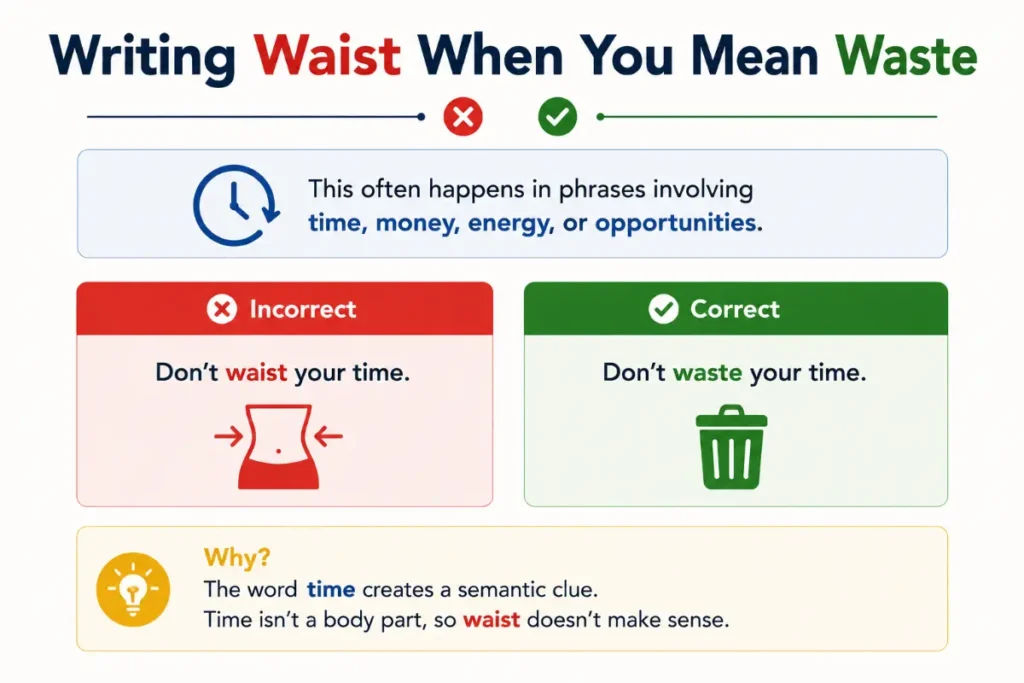
Writing Waist When You Mean Waste
This often happens in phrases involving time money energy or opportunities.
Don’t waist your time is incorrect.
Don’t waste your time is correct.
The word time creates a semantic clue. Time isn’t a body part so waist doesn’t make sense.
Writing Waste When You Mean Waist
This mistake appears in sentences about clothing or body measurements.
The pants are tight around my waste is incorrect.
The pants are tight around my waist is correct.
The word pants provides the context needed to choose the correct form.
Treating Them as Different Pronunciations
Many learners assume that the two words must sound different because their meanings are different. In standard English they are generally homophones.
That means pronunciation alone won’t reliably distinguish them.
Relying Only on Spellcheck
Spellcheck can identify many mistakes but it may not catch a wrong word that happens to be spelled correctly.
If you write Don’t waste your belt a spellchecker may not flag the sentence because waste is spelled correctly. The problem is meaning rather than spelling.
Choosing by Sound
This is perhaps the biggest issue. If you hear someone say waste or waist you may not have enough information to identify the spelling.
The solution is to look at meaning and context.
From an NLP perspective this is a classic homophone confusion. The writer selects the wrong lexical item because two words share a similar sound representation while carrying different semantic meanings.
Pronunciation Guide
Waste and waist are usually pronounced the same.
Waste Pronunciation
US IPA: /weɪst/
UK IPA: /weɪst/
A simple audio style spelling is:
WAYST.
The word contains one syllable.
Waist Pronunciation
US IPA: /weɪst/
UK IPA: /weɪst/
The pronunciation is also:
WAYST.
Again the word contains one syllable.
This identical pronunciation is why the pair causes so many mistakes.
The sound begins with the long a sound found in words such as day and say. It ends with the st sound.
There is no reliable pronunciation trick that will help you distinguish the words in normal speech. You need to use context.
If you hear someone say I need to buy a belt you can reasonably expect waist because belts relate to the body.
If you hear someone say We need to reduce it you need more context. The object could be waste or something else.
Etymology and Word Origin
The two words look similar but their histories are different.
Waste entered English through Old North French and developed from Latin roots associated with being empty desolate or unused. The historical family behind waste is connected with ideas such as devastation emptiness and unnecessary loss.
Over time English developed several related meanings. Waste came to describe discarded material because discarded material has no useful purpose in its current form. The verb sense developed around using something unnecessarily or allowing something valuable to be lost.
The history of waist is different. Waist comes from Old English and Germanic roots associated with the body. Its early meaning referred to the middle or central part of the body.
This difference in origin explains why the words shouldn’t be treated as spelling variants. They developed separately even though modern English pronunciation brought them together.
Regional Usage in the US
American English uses both waste and waist in their standard forms.
Waste appears frequently in discussions about garbage food environmental protection money time and resources. It is also common in government policy scientific writing and business communication.
Waist is common in conversations about clothing body measurements fitness and anatomy.
There isn’t an American spelling variation that changes one into the other. The difference remains semantic rather than regional.
Regional Usage in the UK
British English also uses both words with the same basic meanings.
Waste can refer to household rubbish unwanted material or unnecessary use. Waist refers to the middle part of the body.
Pronunciation can vary slightly across British accents but the two words remain homophones in standard pronunciation.
British writers should choose the word according to meaning rather than pronunciation.
Regional Usage in Australia
Australian English follows the same standard distinction.
Waste is used in environmental discussions as well as everyday phrases involving time money food and effort.
Waist is used for the body and clothing.
There is no standard Australian variant that treats waste and waist as interchangeable.
Regional Usage in Canada
Canadian English also maintains the same distinction.
Waste is common in environmental policy recycling business and ordinary conversation.
Waist is used for anatomy clothing and measurements.
Canadian pronunciation may vary by speaker but the spelling distinction remains unchanged.
Across these major varieties of English the rule is stable. Waste and waist are separate words with different meanings.
Grammar Rules and Part of Speech
Understanding the grammar of each word makes the distinction much easier.
Waste as a Noun
Waste can refer to discarded material.
The waste was collected in large containers.
It can also refer to unnecessary use or loss.
That would be a waste of money.
The phrase a waste of is especially common.
For example:
It was a waste of time.
That structure is worth remembering because it appears constantly in everyday English.
Waste as a Verb
Waste can describe careless or unnecessary use.
Don’t waste your time.
Don’t waste water.
She wasted her chance.
The verb can take a direct object.
In these sentences time water and chance receive the action of wasting.
Waste as an Adjective
Waste can modify another noun in certain compounds.
Examples
Waste management is a major public concern.
Waste products require careful handling.
Waist as a Noun
Waist is normally a noun.
Her waist is 28 inches.
The belt sits around his waist.
The dress has a fitted waist.
It can be singular or possessive depending on the sentence.
Common Phrases with Waste
Several phrases make the meaning obvious.
Waste time.
Waste money.
A waste of time.
Reduce waste.
Food waste.
Household waste.
These phrases all involve unnecessary use or discarded material.
Common Phrases with Waist
Waist also appears in predictable combinations.
Waist size.
Waistline.
Waistband.
Around the waist.
At the waist.
High waist.
Low waist.
These expressions point toward the body or clothing.
Real Life Usage Examples
Daily Talk
Waste is extremely common in everyday speech.
- Don’t waste your time arguing about it.
- We have too much food waste in this house.
Waist is also common. - These jeans feel tight around my waist.
- I need to measure my waist before buying the trousers.
The surrounding nouns and verbs usually make the intended meaning clear.
Both words appear naturally in professional messages.
- Please don’t waste time sending the same document twice.
- The supplier has reduced packaging waste.
For waist: - Please provide your waist measurement for the uniform.
- The design should fit comfortably around the waist.
Academic Writing
Waste appears often in research and formal analysis.
- The study examines household food waste.
- Researchers measured industrial waste levels.
Waist can appear in medical exercise or clothing research. - The researchers recorded each participant’s waist measurement.
- The study compared waist circumference across age groups.
News Writing
Waste is common in environmental and economic reporting.
- Officials announced new measures to reduce plastic waste.
- The report estimates that food waste costs households millions of dollars.
Waist appears in health and fashion coverage. - The new study examined waist circumference.
- The designer introduced a higher waist for the new collection.
Literature
Writers can use both words in descriptive ways.
- The river carried waste toward the sea.
- She tied the ribbon around her waist.
In literary writing waste can also carry symbolic meanings connected with loss or emptiness.
Waist tends to remain connected to the physical body unless the writer uses it metaphorically.
Related and Confused Terms
Garbage
Garbage refers to discarded material. It is closely related to one meaning of waste.
Trash
Trash is another common American English term for unwanted material.
Rubbish
Rubbish is widely used in British English and can refer to waste or nonsense.
Waistline
Waistline refers to the line or measurement around the waist.
Waistband
A waistband is the part of clothing that fits around the waist.
Wasteful
Wasteful describes someone or something that uses resources carelessly.
Wasted
Wasted is the past tense and past participle of waste. It can also describe something that has been used without good purpose.
Reduce
Reduce is commonly associated with waste because reducing unnecessary consumption can lower the amount of material that gets discarded.
These related terms can reinforce the semantic distinction. Words around waste tend to involve disposal consumption loss and resources. Words around waist tend to involve the body clothing measurement and physical shape.
Waste in Environmental English
Waste has become an important term in environmental discussions.
Food waste refers to food that is discarded or left unused.
Plastic waste refers to discarded plastic materials.
Electronic waste describes unwanted electronic devices and components.
Industrial waste comes from manufacturing and industrial processes.
Waste management covers the collection treatment transportation recycling and disposal of unwanted material.
In these contexts waist would make no sense.
For example:
The city wants to reduce plastic waste.
Replacing waste with waist would completely change the word but wouldn’t create a meaningful sentence.
This is why learning vocabulary through context is powerful. Instead of memorizing isolated spellings you can associate waste with a whole semantic field.
Waist in Clothing and Body Language
Waist is strongly connected with clothing and the human body.
You may hear phrases such as waist size waist measurement waistline waistband high waist and low waist.
For example:
These pants have a high waist.
The shirt fits tightly around the waist.
The tailor measured my waist.
The word can also appear in descriptions of posture and movement.
He placed his hands on his waist.
She wore a scarf around her waist.
When you see words such as belt pants dress measurement or clothing you should immediately consider waist.
The Fastest Way to Remember the Difference
A simple meaning based trick can save you from this confusion.
Think of the i in waist as standing inside the body word family.
Waist is about your body.
Waste is about things that get used up or thrown away.
You can also remember two short examples.
Don’t waste your time.
Measure your waist.
The first involves something valuable that shouldn’t be used carelessly. The second involves a part of the body.
If you remember those two sentences the spelling distinction becomes much easier.
Another useful trick is to connect waste with wasteful and wasted.
Waste.
Wasteful.
Wasted.
All three belong to the same meaning family.
For waist think about waistband and waistline.
Waist.
Waistband.
Waistline.
Those word families create a semantic map in your memory.
Why Homophones Cause Spelling Problems
Homophones are words that sound the same but have different meanings or spellings. Waste and waist are a classic example.
When people hear a homophone they don’t receive the spelling from the sound itself. They have to choose the correct word based on context.
This is why a spellchecker can sometimes miss homophone errors. If you type Don’t waist your time the word waist is spelled correctly. The problem is that it doesn’t fit the meaning of the sentence.
Human editing still matters because good writing requires more than correct individual spellings. It requires the right word for the intended meaning.
The same issue appears with many familiar English pairs.
Right and write.
Know and no.
There and their.
Your and you’re.
Waste and waist.
The solution is similar in every case. Stop relying on sound alone and ask what the sentence actually means.
Expert Editor Insight
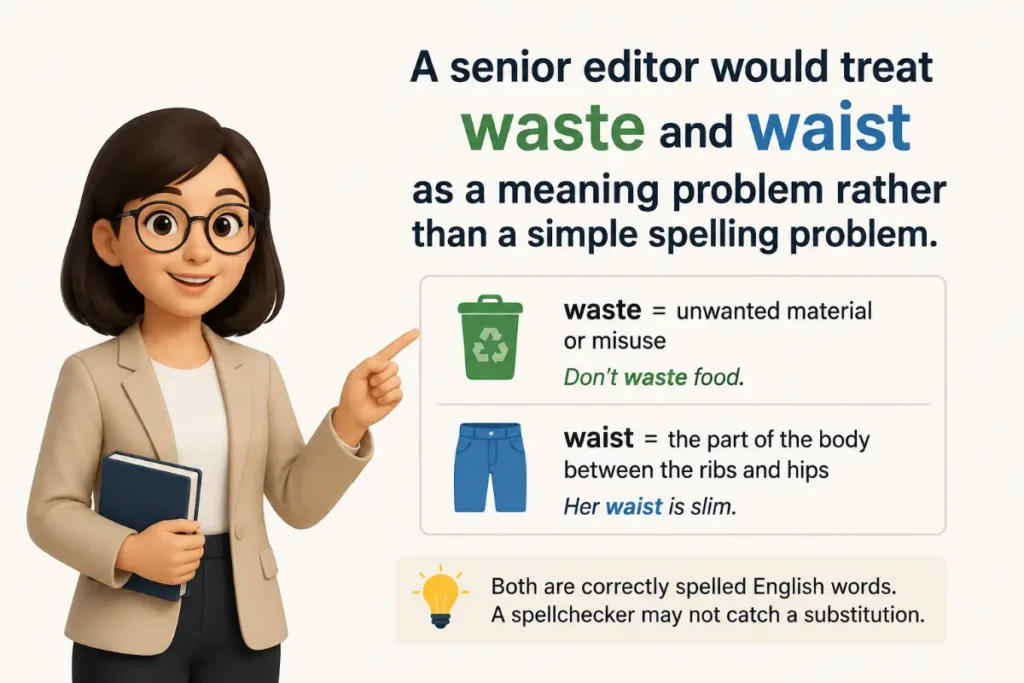
A senior editor would treat waste and waist as a meaning problem rather than a simple spelling problem. Both forms are correctly spelled English words so a basic spellchecker may not catch a substitution. Native speakers usually resolve the difference instantly through context. If the sentence involves time money food resources garbage or unnecessary use then waste is the natural choice. If it involves the body clothing measurement or a belt then waist is the right word. The strongest editing habit is to read the whole sentence rather than checking individual words in isolation.
Expert Tip
When you’re unsure between waste and waist don’t pronounce the sentence again. Instead replace the word with a simple synonym.
If you can replace it with garbage discarded material loss or unnecessary use you need waste.
If you can replace it with the middle of the body or body measurement you need waist.
This test works because it checks meaning instead of sound.
For example:
Don’t waste your time.
Replace waste with misuse and the meaning still works.
The belt fits around my waist.
Replace waist with middle of the body and the meaning remains clear.
That is a practical editing test you can use in seconds.
Conclusion
When you compare Waste vs Waist remember that both are correct English words but they carry completely different meanings. Waste relates to discarded material unnecessary use loss or careless use of resources. Waist refers to the middle part of the human body and the measurement or clothing area around it. Their identical pronunciation makes them easy to confuse but context provides the answer.
The simplest way to remember the difference is to build two word families. Think of waste with wasteful wasted food waste and waste management. Think of waist with waistband waistline and waist measurement. These connections give your brain a meaning based clue instead of forcing you to rely on sound.
When you’re unsure read the sentence and ask what you’re describing. If the idea involves something being thrown away or used carelessly choose waste. If you’re talking about the body or clothing choose waist. That quick check will keep this common homophone mistake out of your writing.
Frequently Asked Questions
What is the difference between waste and waist?
Waste relates to discarded material or unnecessary use of something. Waist refers to the middle part of the human body. The two words usually sound the same but their meanings and spellings are different. Use waste for things such as time money food and trash. Use waist for body measurements clothing and the area between the ribs and hips.
Is waste or waist correct?
Both are correct words but they belong in different contexts. Waste is correct when you mean discarded material or unnecessary use. Waist is correct when you mean the middle part of the body. For example Don’t waste your time is correct while The belt fits around my waist is also correct. The sentence meaning determines the right choice.
How do you pronounce waste and waist?
Waste and waist are normally pronounced exactly the same in standard English. Both use the IPA pronunciation /weɪst/ and contain one syllable. They sound like WAYST. Because pronunciation doesn’t distinguish them you need to use the sentence meaning to choose the correct spelling. This makes them classic English homophones.
Why do people confuse waste and waist?
People confuse these words because they have the same common pronunciation and very similar spellings. When someone hears the word without seeing it they cannot reliably know which spelling the speaker means. Context provides the missing information. Words connected with trash time and resources point toward waste while body and clothing terms point toward waist.
Is waist a body part?
Yes. The waist is the middle part of the human body between the ribs and hips. The word is also used for the measurement around this area and for clothing that fits there. Common expressions include waist size waist measurement waistline and waistband. If you’re talking about belts trousers dresses or body measurements waist is usually the correct word.
What does waste mean in English?
Waste can mean discarded material or the careless use of something valuable. As a noun it can refer to garbage or unwanted material. As a verb it can mean using time money food energy or resources unnecessarily. For example We should reduce food waste and Don’t waste your time both use the same word with related meanings.
Can waste and waist be used interchangeably?
No. They are not interchangeable even though they sound alike. Waste refers to discarded material unnecessary use or loss while waist refers to a body area or clothing measurement. Replacing one with the other can create an incorrect or confusing sentence. Always choose the word based on meaning rather than pronunciation.
How can I remember waste and waist?
Connect waste with wasteful wasted garbage time money and resources. Connect waist with waistband waistline belts clothing and the human body. A quick pair of examples can help. Don’t waste your time. Measure your waist. If you remember those two sentences you can usually choose the correct spelling without hesitation.

Confusing Words, Spelling & Word Choice
Claire Whitmore is a U.S.-based English editor who writes about commonly confused words, spelling differences, and word choice. Her work helps readers understand subtle distinctions between similar-looking words through simple definitions, practical examples, and modern usage guidance in both American and British English.