
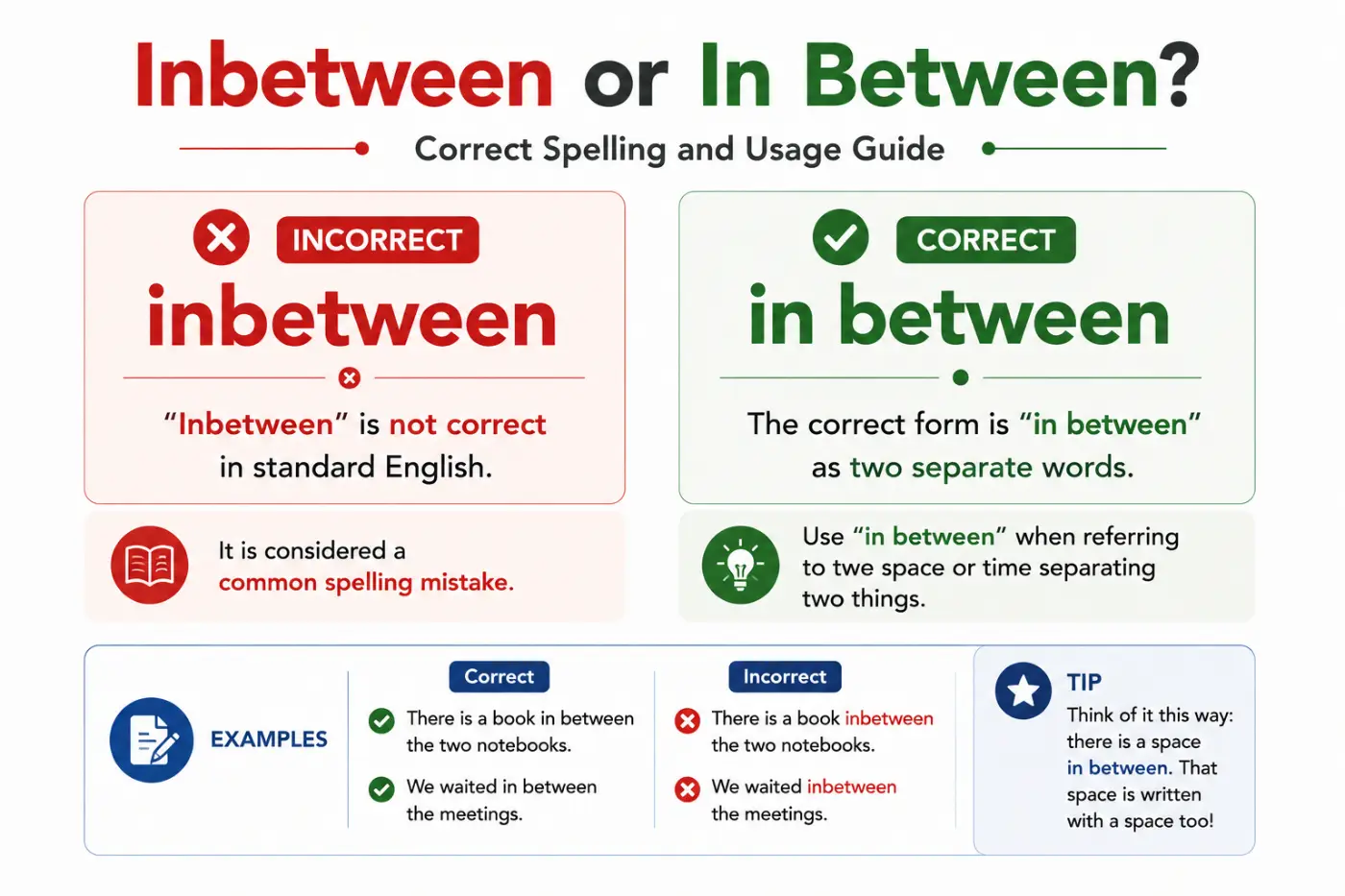
Inbetween or In Between can look like a tiny spelling choice but that small space changes the answer. The standard form is in between when the expression functions as a phrase. Inbetween is not the normal standard English spelling. If you’re writing an email an article a school assignment or a professional document you should generally write the words separately.
The confusion makes sense because English contains many expressions that started as separate words and later developed other forms. Readers also see in between used so often that the phrase can begin to feel like one solid word. That visual familiarity can make inbetween look reasonable even though standard dictionaries treat the ordinary expression as in between. Cambridge lists in between as a phrase and also recognizes in between as an adjective form in certain uses.
This guide explains the difference in plain English. You’ll learn the correct spelling the meaning grammar role pronunciation sentence placement punctuation common mistakes regional usage and related expressions. You’ll also see when a hyphenated form can appear and why the one word form should normally be avoided. By the end you’ll have a simple rule you can use without second guessing yourself.
Quick Definition
In between is the standard two word form used to describe a position or period separating two people things places events or times. It can also describe something that falls between two clear stages or qualities. Inbetween is not the standard spelling for the ordinary phrase. A hyphenated form can appear before a noun in some adjective uses.
Quick Answer
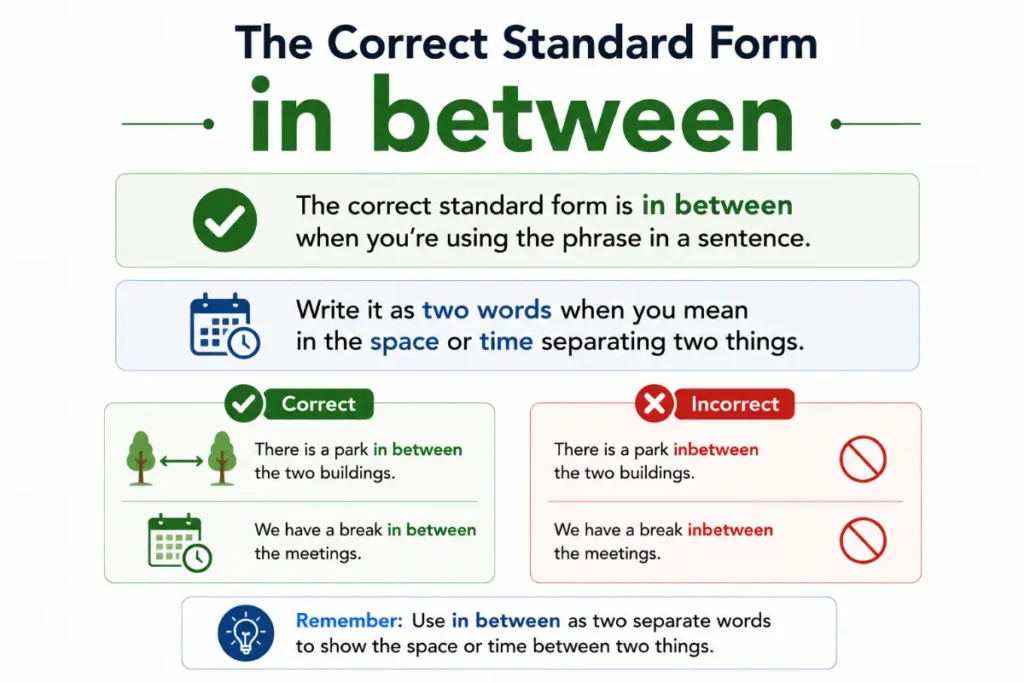
The correct standard form is in between when you’re using the phrase in a sentence. Write it as two words when you mean in the space or time separating two things.
For example you can write There was a small table in between the chairs. You can also write I had a meeting in between lunch and dinner.
Comparison Table for Inbetween or In Between
| Correct Form | Meaning | Part of Speech | Origin | Usage Frequency | Formality | Common Contexts | Example |
|---|---|---|---|---|---|---|---|
| inbetween | Not the standard spelling of the ordinary phrase | Not normally treated as a standard phrase | Nonstandard one word form | Uncommon in edited English | Avoid in standard writing | Spelling errors and informal typing | The chair is inbetween the desks. |
| in between | In the space or time separating two things | Phrase with prepositional or adverbial use | Built from in and between | Very common | Neutral and widely accepted | Space time sequence conversation writing | The chair is in between the desks. |
| in between | At an intermediate stage or position | Adjectival phrase in some uses | Built from in and between | Common | Neutral | Stages qualities positions and states | She is in between jobs right now. |
Meaning and Definition
Meaning of Inbetween
Inbetween is generally considered a nonstandard one word spelling when you mean the ordinary expression in between.
A reader will usually understand it immediately. The problem isn’t comprehension. The problem is standard usage.
If you write The store is inbetween the bank and the library most readers will know exactly what you mean. Still a careful editor would normally change the sentence to The store is in between the bank and the library.
This distinction is useful because not every spelling error creates confusion. Some errors are easy to understand but still need correction in polished writing.
You may occasionally find inbetween as part of a creative name a username a product name or another invented label. Names can use unusual spellings. That doesn’t establish inbetween as the normal English form.
The safest rule is simple. If you’re describing something located between two points or occurring between two events write in between as two words.
Meaning of In Between
In between refers to a position or period that lies between two other points.
The idea can involve physical space.
The lamp is in between the two chairs.
It can involve time.
I had a short break in between meetings.
It can also describe an intermediate state.
He’s in between jobs right now.
Cambridge defines in between as a phrase referring to the time between two mentioned times. The dictionary also recognizes in between as an adjective idea for something that falls between clear stages or states.
The expression is flexible because between itself can describe space time relationships quantities and connections. Cambridge also lists in between as an adverbial use of between when something occupies the space or period separating other points.
The central idea stays the same. Something is neither at the first point nor at the second point. It occupies the middle space or period.
Key Differences Explained
Spelling
The standard phrase is in between with a space between the two words. Writing inbetween as one word is normally considered incorrect in standard English.
Grammar Role
In between can function within a prepositional phrase or an adverbial phrase. Its exact grammatical role depends on the sentence.
For example:
The shop is in between the bank and the pharmacy.
Here in between introduces a relationship involving location.
In this sentence:
We met in between.
The expression works adverbially and tells us where or at what point something happened.
Meaning
In between means in the middle of two points or during the period separating two events. It can also describe an intermediate condition.
Tone
The phrase is completely natural in everyday English. You don’t need a more formal replacement in professional writing.
For example:
I’ll call you in between meetings.
That sentence sounds perfectly normal.
Context
You can use in between when discussing physical location time stages relationships quantities and abstract states.
It works in conversation email academic writing journalism instructions and creative writing.
Which Form Is Correct?
In between is the standard form for the ordinary phrase.
The reason is grammatical as well as lexical. The expression is made from the preposition or adverb between with the word in modifying or forming the phrase. Major learner dictionaries list in between as two words. Oxford describes between as an adverb that is usually used in the phrase in between and defines it as referring to the space or period separating points objects dates or events.
That dictionary treatment gives you a reliable editorial guide. When you’re using the normal expression in a sentence write in between.
There is one wrinkle worth knowing. English sometimes uses in between as an adjective before a noun. In that position you may encounter the hyphenated form in between or in-between depending on the style and dictionary. Cambridge lists in-between as an adjective and gives examples such as an in-between stage.
That doesn’t make inbetween the preferred one word form.
So you have three forms that can appear in different grammatical situations:
- in between for the ordinary phrase.
- in-between in some adjective uses before a noun.
- inbetween generally avoided as a one word spelling in standard English.
For most everyday writing the first form is the one you need.
Sentence Examples
Here are ten natural examples using the standard phrase.
- The pharmacy is in between the bank and the grocery store.
- I usually drink coffee in between meals.
- She called me in between meetings.
- There was a narrow path in between the two buildings.
- We stopped for gas in between the two cities.
- He found himself caught in between two different opinions.
- I’ll finish the report in between my other assignments.
- The children sat in between their parents.
- There wasn’t much time in between the two appointments.
- She worked part time in between college and graduate school.
Here are five examples showing the common one word mistake. - The pharmacy is inbetween the bank and the grocery store.
- I called him inbetween meetings.
- The house sits inbetween two large trees.
- We had lunch inbetween the two sessions.
- She felt stuck inbetween two choices.
Each sentence becomes standard when you separate in and between.
Common Mistakes and Misspellings
Writing Inbetween as One Word
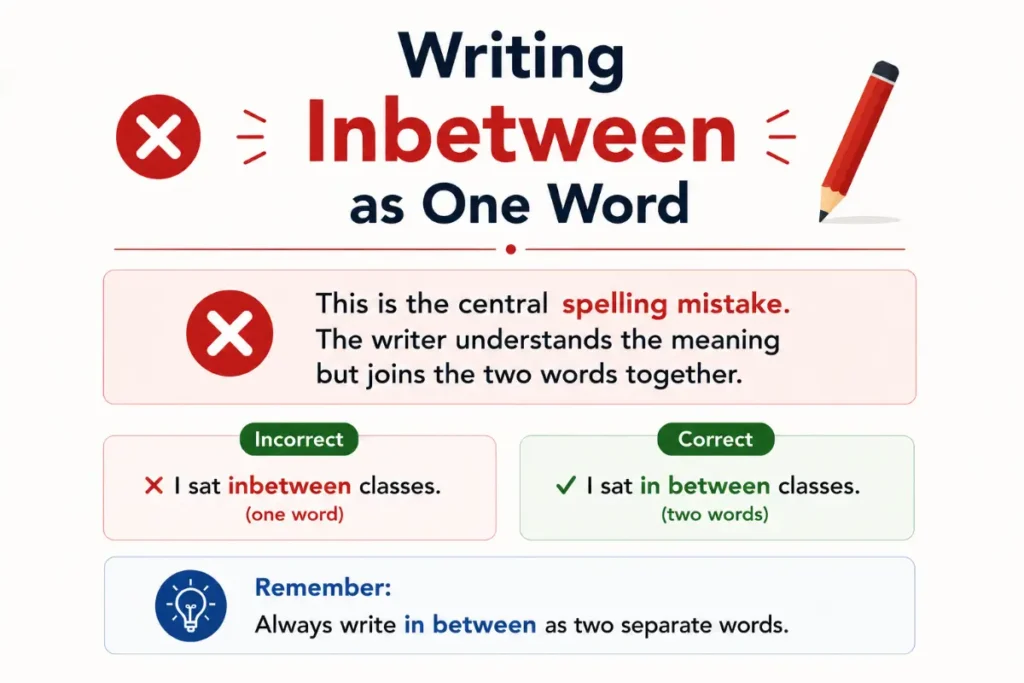
This is the central spelling mistake. The writer understands the meaning but joins the two words together.
Confusing a Phrase With a Compound Word
English has many compounds that are written as one word. That pattern can tempt writers to turn in between into a single word. Standard usage doesn’t support that spelling for the ordinary phrase.
Using In Between When Between Alone Is Better
Sometimes writers add in unnecessarily.
For example:
The store is between the bank and the pharmacy.
This is already complete.
You don’t need:
The store is in between the bank and the pharmacy.
The second version isn’t necessarily wrong. It simply uses a fuller expression.
Confusing In Between With In The Middle
In the middle often refers to a central position. In between emphasizes the relationship between two points.
The chair is in the middle of the room.
The chair is in between the two desks.
These sentences describe different relationships.
Treating In Between and Between as Exact Matches
They overlap but aren’t always interchangeable.
Between can work directly as a preposition:
The shop is between two buildings.
In between often emphasizes the intervening space or period:
There is a small café in between.
From an NLP perspective the confusion is mainly orthographic. The writer has the correct lexical meaning but represents the expression with the wrong word boundary. Word boundary errors are common because fluent readers often process familiar expressions as complete chunks rather than examining every individual word.
Pronunciation Guide
The standard pronunciation of in between is straightforward.
US IPA: /ˌɪn bɪˈtwiːn/
UK IPA: /ˌɪn bɪˈtwiːn/
Cambridge gives this pronunciation for the phrase and the related adjective form.
You can think of the pronunciation as:
in buh TWEEN
The strongest stress falls on between.
The first word is usually pronounced lightly. In natural speech the phrase may sound like one smooth unit even though it contains two written words. That smooth pronunciation can help explain why some people write inbetween.
The word between itself is pronounced /bɪˈtwiːn/. Oxford gives the same basic pronunciation and identifies the historical form as coming from Old English betwēonum.
A common spelling mistake happens when writers trust the sound more than the written structure. Since in between flows naturally in speech it can feel like a single word. English has many phrases that sound connected even though they remain separate in writing.
The best approach is to remember the phrase visually. Think:
in + between
Two words. One expression.
Etymology and Word Origin
The history of between goes much further back than modern English.
Oxford traces between to Old English betwēonum. The historical form developed from elements associated with being by or near two things. The underlying concept was connected with two points and the space or relationship separating them.
Modern English inherited that core meaning. Between can now describe space time relationships comparison and division.
The word in has its own Old English history and has long been used to express position within a place period or condition.
When English speakers combine in and between they create a phrase that emphasizes something located within the space or period separating two points.
That history also helps explain why the modern phrase remains two words. It isn’t simply an adjective with a suffix attached. It is a combination of established words functioning together.
English does develop compound words over time. Some expressions move from separate words to hyphenated forms and sometimes to solid forms. That process is gradual and depends on usage. Writers shouldn’t assume that every frequently used phrase eventually becomes one word.
In this case standard dictionary usage still favors in between for the ordinary phrase.
Regional Usage in the US
American English commonly uses in between as two words.
You’ll hear it in everyday speech when people talk about time space relationships and intermediate situations.
For example:
I’ll call you in between appointments.
The school is in between two neighborhoods.
American English also uses in between as an adjective idea. Cambridge’s American Dictionary includes in-between as an adjective for something that has qualities of two different things.
The one word spelling inbetween isn’t a standard American alternative.
Regional Usage in the UK
British English also uses in between as the normal phrase.
British speakers use it for space time and intermediate states. Oxford lists between as an adverb and notes that it is usually used in the phrase in between.
British English also uses the hyphenated adjective in-between in some contexts.
There isn’t a recognized British spelling rule that changes in between into inbetween.
Regional Usage in Australia
Australian English follows the same general pattern. In between is used as the standard phrase.
Australian writers may encounter in-between as an adjective depending on sentence structure and editorial style. That doesn’t establish inbetween as a standard one word form.
If you’re writing for an Australian audience the safest standard choice is still in between when you’re using the ordinary phrase.
Regional Usage in Canada
Canadian English also uses in between as the standard phrase.
Canadian writing follows the same broad pattern found in American and British English. You can use the expression naturally in conversation academic writing business communication and general prose.
The one word form inbetween isn’t normally accepted as a standard spelling.
Grammar Rules and Part of Speech
Understanding the grammar behind in between makes the spelling much easier to remember.
In Between as a Prepositional Phrase
Consider this sentence:
The café is in between the bank and the library.
The phrase identifies the location of the café in relation to two other places.
The basic structure is:
in between + noun phrase
For example:
in between the buildings
in between the meetings
in between two events
In Between as an Adverbial Phrase
The expression can also stand without an object.
For example:
There was a short break in between.
Here in between refers back to two points already understood from the context.
Oxford specifically identifies between as an adverb that is usually used in the phrase in between.
In Between for Time
In between is very common when discussing periods between events.
I read in between classes.
We talked in between meetings.
There was a short pause in between.
Cambridge gives examples of in between referring to periods separating two times or events.
In Between for Physical Space
The phrase can describe a physical position.
The dog slept in between the two chairs.
A small tree grew in between the houses.
The meaning is similar to in the space separating two things.
In Between for States
The expression can also describe an intermediate condition.
He is in between jobs.
She is in between apartments.
The student is in between two levels.
These uses can describe a transition rather than a physical location.
In Between and In The Middle
These expressions overlap but they aren’t always identical.
In the middle can describe the central part of one space.
The table is in the middle of the room.
In between usually describes the position relative to two points.
The table is in between the two chairs.
That distinction is small but useful.
Punctuation Rules
In between doesn’t require special punctuation.
Use punctuation based on the overall sentence.
For example:
I called her in between meetings.
No comma is needed.
If the phrase appears as part of an introductory clause the normal punctuation rules of the sentence apply.
For example:
In between meetings, I checked my email.
The comma separates the introductory phrase from the main clause.
When To Use Between Instead
Sometimes the shorter word between is the better choice.
Compare:
The hotel is between the station and the airport.
The hotel is in between the station and the airport.
Both can work. The first is more direct.
Between is especially useful when it directly connects two points.
She sat between her parents.
The meeting is between two departments.
The train runs between New York and Boston.
Cambridge explains that between can refer to space time shared relationships connections and separation.
In between often adds emphasis to the intervening space or period.
There was nothing in between.
I had a quick snack in between.
The distinction isn’t always dramatic. Native speakers choose based on rhythm emphasis and context.
In Between Versus Among
Between and among are sometimes confused because both can describe relationships involving several things.
Between generally highlights distinct relationships or clearly separated points. Among often emphasizes being part of a group or surrounded by multiple things.
For example:
The house sits between the trees and the road.
She walked among the trees.
Cambridge explains that between commonly refers to clearly separated things while among tends to describe something surrounded by or included within a group.
This distinction matters when you’re trying to write precisely.
In Between Versus Within
Within means inside a particular area limit or period. In between means located between two points.
For example:
Please respond within three days.
This means no later than the end of a three day period.
Now compare:
Please call me in between meetings.
This means during the time separating meetings.
The two expressions can sometimes appear in similar conversations but their meanings are different. Cambridge defines within as inside or not beyond a particular area limit or period.
In Between Versus In The Middle
These expressions often overlap.
In the middle usually focuses on the center.
The child stood in the middle of the room.
In between focuses on two reference points.
The child stood in between the two adults.
If you have two clear points use in between when you want to emphasize their relationship. If you mean the central area of a larger space use in the middle.
Real Life Usage Examples
Daily Talk
In between is extremely natural in conversation.
- I usually eat something in between meals.
- I’ll see you in between classes.
These sentences sound relaxed and ordinary.
The phrase works naturally in professional communication.
- I’ll review the document in between meetings.
- Please send any questions in between the scheduled calls.
You don’t need to replace it with a complicated formal expression.
Academic Writing
Academic writers can use in between when describing stages relationships or intervals.
- The participants completed a short task in between the two assessments.
- The results fell in between the values predicted by the two models.
In technical writing clarity matters more than trying to avoid familiar words.
News Writing
News writing often uses the phrase when describing events or periods.
- Officials met twice in between the two major negotiations.
- The region experienced several smaller storms in between the larger systems.
The phrase makes the timeline easy to understand.
Literature
Creative writers use in between to describe physical and emotional spaces.
- She stood in between the doorway and the window.
- He felt caught in between two worlds.
The second example shows how the phrase can move beyond literal space and express emotional or symbolic uncertainty.
Related and Confused Terms
Between
Between is the core word in the expression. It can describe relationships involving space time comparison connection and separation.
In The Middle
In the middle refers to a central position or point. It often overlaps with in between when two reference points are involved.
In The Midst
In the midst means surrounded by or deeply involved in something. It doesn’t simply mean between two points.
Among
Among describes something surrounded by or included within a group. It differs from between in how the relationship is framed.
Amid
Amid means surrounded by or in the middle of a situation or group. It often appears in more formal writing.
In Between Times
In between times refers to periods separating events or activities. It can emphasize the gaps rather than the events themselves.
Intermediate
Intermediate describes something located between two levels stages or extremes. It is often useful when describing ability stages or positions.
Liminal
Liminal describes a transitional or threshold state. It can overlap conceptually with in between but has a more specialized meaning and tone.
In Between as an Adjective
One of the most interesting parts of this topic is adjective usage.
Cambridge lists in-between as an adjective meaning something between two clear or accepted stages or states. It gives the example of an in-between stage where someone has progressed beyond one level but hasn’t reached another.
For example:
She is at an in-between stage in her training.
He chose an in-between color.
The phrase describes something that doesn’t fit neatly into either of two categories.
This is different from the ordinary phrase:
The chair is in between the tables.
Here in between describes location.
The adjective use comes before a noun:
an in-between stage
an in-between color
an in-between size
Style guides can differ on punctuation for compound modifiers. If you’re writing for a specific publication follow its style guide. If no house style applies the dictionary form is a useful guide.
What you shouldn’t do is assume that the adjective use makes the solid spelling inbetween correct. It doesn’t.
Why People Write Inbetween
There are several reasons this error appears.
First the phrase is pronounced as a smooth unit. In rapid speech the boundary between in and between can become less noticeable.
Second English contains many compound words. Writers naturally expect frequently used expressions to become solid words.
Third visual familiarity can be misleading. Once you’ve seen inbetween online a few times it can begin to look normal.
Fourth typing habits matter. When people type quickly they may combine words that normally remain separate.
Fifth the expression is semantically unified. It expresses one clear idea even though it contains two words.
This last point is particularly interesting. English speakers often think in chunks. A phrase can function as one meaningful unit without becoming one written word. For example a lot of familiar expressions remain multiple words.
The brain cares about meaning. Spelling conventions care about written form. Those systems don’t always line up perfectly.
A Simple Memory Trick
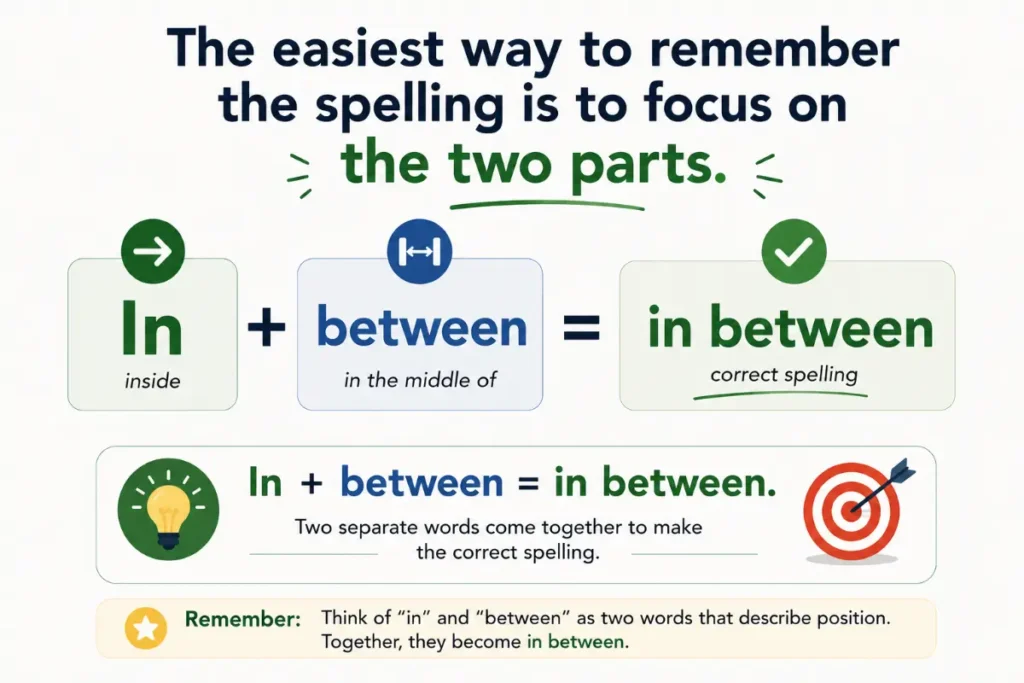
The easiest way to remember the spelling is to focus on the two parts.
In + between = in between.
Think of it as two doors with a space between them. The word in stays separate from between.
You can also connect it with another familiar expression:
in the middle
The words are separate there too.
Another useful check is to ask yourself if the phrase describes something located between two reference points. If the answer is yes you probably need in between.
For example:
The café is in between the bank and the library.
The meeting happens in between lunch and dinner.
The child sat in between her parents.
The structure stays visible in every sentence.
Expert Editor Insight
A senior editor would normally correct inbetween to in between in standard prose because the solid form doesn’t match the established treatment of the ordinary phrase. Native speakers understand inbetween instantly but familiarity shouldn’t be confused with acceptance. Spellcheck tools may catch the solid form but good editing goes further by checking the grammatical role and the sentence around it. If the phrase comes before a noun as an adjective you may encounter in-between depending on the chosen style. If it describes location time or an intervening point the safest standard form is in between. The expert habit is to check function first and spelling second.
Conclusion
When comparing Inbetween or In Between the standard answer is clear. In between is the correct form for the ordinary phrase. The one word spelling inbetween should generally be avoided in edited English. You can use in between for physical space time intervals and intermediate situations. For example you can write The store is in between two buildings or I’ll call you in between meetings.
The key is to remember that a phrase can express one idea without becoming one word. In between works as a natural unit of meaning but its words normally remain separate. You may also see in-between when the expression works as an adjective before a noun.
For a quick editing check think in plus between. If you’re describing something that sits or happens between two points write the phrase as two words. That simple habit will keep your spelling clean and natural.
Frequently Asked Questions
Is Inbetween a real word?
Inbetween isn’t the standard spelling of the ordinary English phrase. Standard dictionaries list in between as two words. You may encounter inbetween in usernames creative names or informal writing but those uses don’t establish it as the standard form. For polished English use in between when you’re describing something located between two points or occurring during the interval separating two events.
What does In Between mean?
In between means in the space or period separating two points things people or events. It can describe physical location such as a chair in between two desks. It can also describe time such as a break in between meetings. The phrase can also describe an intermediate state where something doesn’t fit clearly into one category or another.
Inbetween or In Between which is correct?
In between is the standard form. Write it as two separate words when you’re using the ordinary phrase. Inbetween is generally treated as a nonstandard spelling. You may also see in-between when the expression functions as a compound adjective before a noun. That hyphenated form is different from the solid one word spelling.
How do you pronounce In Between?
In between is commonly pronounced /ˌɪn bɪˈtwiːn/ in both American and British English. The main stress falls on between. In natural conversation the phrase can sound like a smooth single unit even though it is written as two words. That connected pronunciation is one reason writers sometimes mistakenly combine the words when typing.
Can In Between start a sentence?
Yes. In between can begin a sentence when the phrase works as an introductory expression. For example you can write In between meetings, I checked my email. The comma is often used because the phrase introduces the main clause. The punctuation depends on the sentence structure rather than the expression itself.
What is a synonym for In Between?
Useful alternatives include between, in the middle, amid, among, intermediate and in the midst depending on the context. They aren’t exact replacements in every sentence. Between is usually the closest simple alternative. In the middle emphasizes a central position. Intermediate describes a level or stage between two others. Choose the alternative that preserves the original relationship.
Why do people misspell In Between?
People often write inbetween because the phrase sounds connected when spoken naturally. English also contains many common compound words so writers may assume that frequent expressions should become one word. Fast typing can make the problem worse. The easiest fix is to remember that the phrase contains two independent words. Think in plus between rather than one combined spelling.
Is In Between suitable for formal writing?
Yes. In between is perfectly acceptable in formal writing when it accurately expresses the intended meaning. You can use it in academic papers professional emails reports journalism and technical explanations. You don’t need to replace it with a complicated synonym. If the expression functions as an adjective before a noun a hyphenated form may be appropriate depending on style.

Confusing Words, Spelling & Word Choice
Claire Whitmore is a U.S.-based English editor who writes about commonly confused words, spelling differences, and word choice. Her work helps readers understand subtle distinctions between similar-looking words through simple definitions, practical examples, and modern usage guidance in both American and British English.