
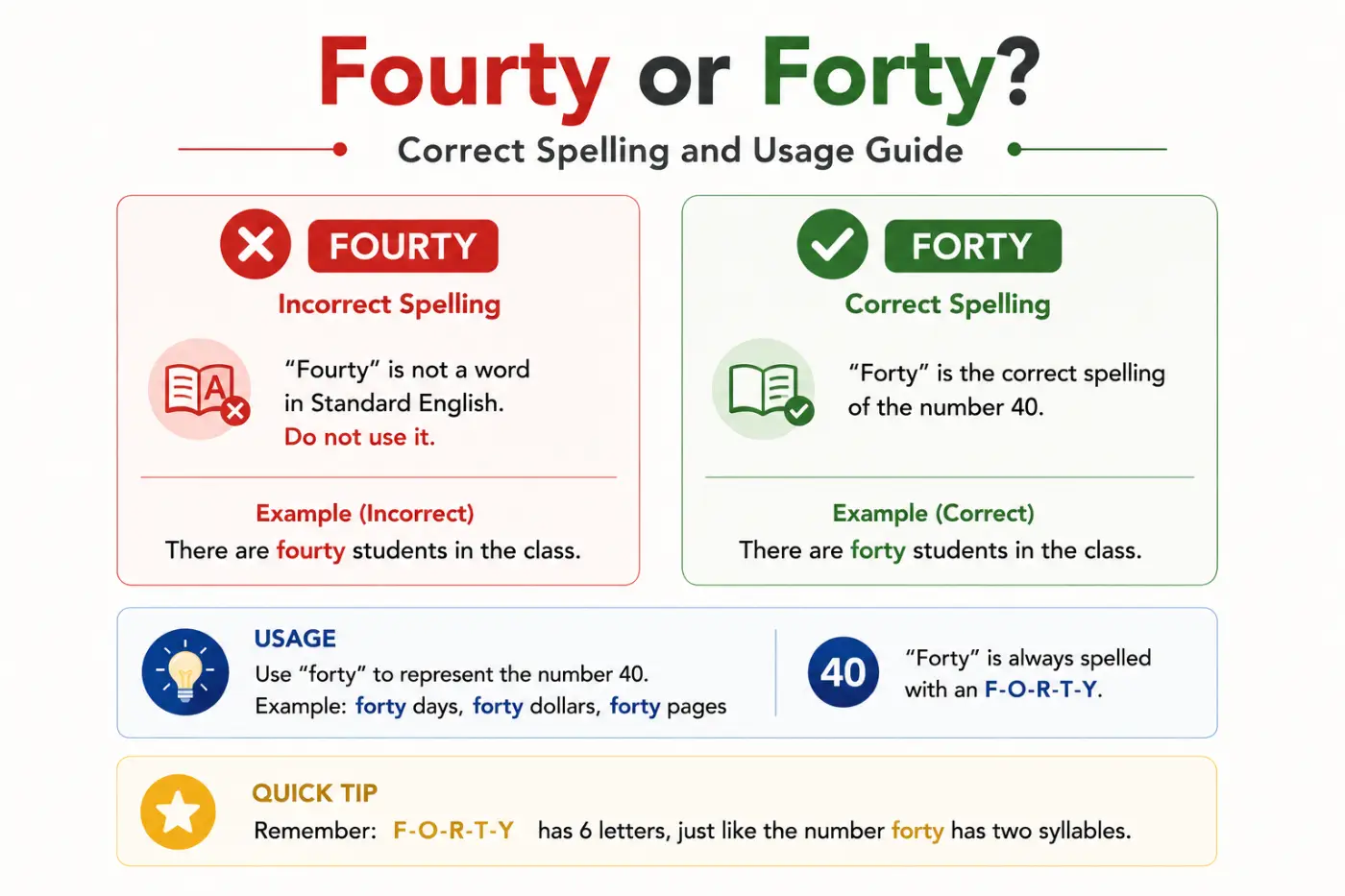
Fourty or Forty is a common spelling question because the number looks like it should follow the pattern of four. If you know how to spell four then writing forty with confidence can feel surprisingly awkward. The extra u seems natural because it appears in four and several related words. The correct spelling is forty. The spelling fourty is incorrect in standard English. If you’re writing a school assignment a business email a report or any other form of edited English use forty.
The confusion comes mainly from the relationship between four and forty. The number four keeps its u but forty drops it. That makes the spelling unusual compared with what many people expect. English has several number words that don’t follow a perfectly predictable pattern and forty is one of the most memorable examples.
This guide explains the difference between Fourty or Forty in plain English. You’ll learn the correct spelling meaning pronunciation grammar usage history common mistakes and useful examples. You’ll also learn why the u disappears and how to remember the correct form without second guessing yourself every time.
Quick Definition
Forty is the correct spelling of the number 40. Fourty is a common spelling mistake caused by the connection between forty and the word four. The correct form drops the u from four before adding the ending. Forty can function as a number word and can also appear in compounds such as forty five and fortieth.
Quick Answer
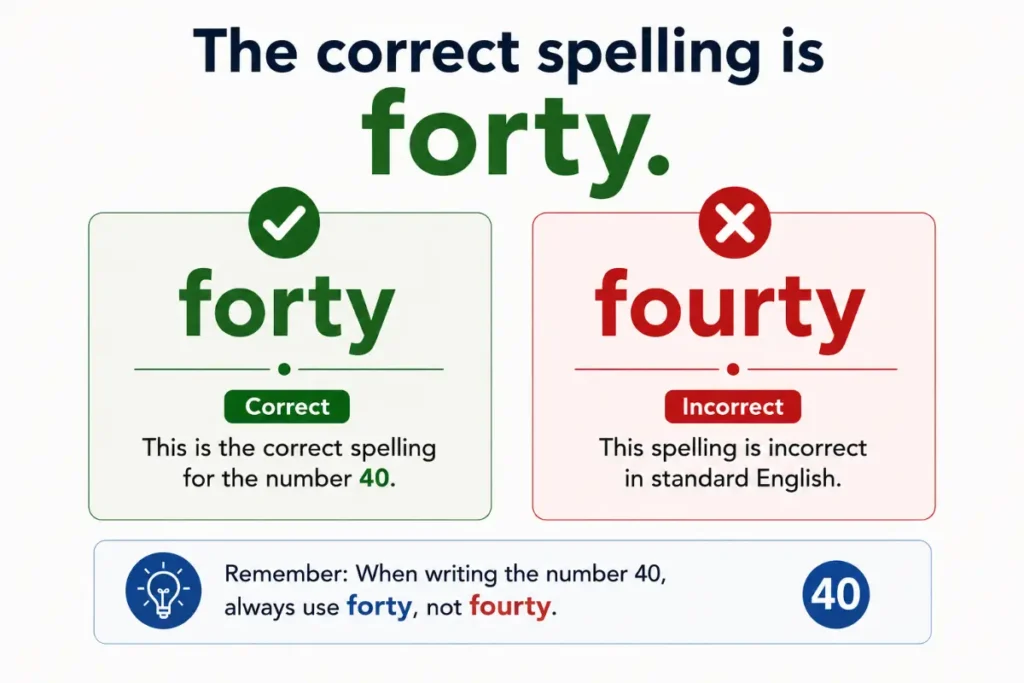
The correct spelling is forty. The form fourty is incorrect in standard English. Forty means the number 40. The easiest way to remember it is to think of the word as having no u after the f. Write forty rather than fourty.
Comparison Table for Fourty or Forty
| Correct Form | Meaning | Part of Speech | Origin | Usage Frequency | Formality | Common Contexts | Example |
|---|---|---|---|---|---|---|---|
| fourty | Incorrect spelling of forty | Not standard | Misspelling influenced by four | Common as an error | Not standard | Spelling mistakes and informal typing | She is fourty years old. |
| forty | The number 40 | Number word | Old English roots related to four | Very common | Neutral | Age money counting dates measurements and quantities | She is forty years old. |
Meaning and Definition
Meaning of Fourty
Fourty is not the standard spelling of the number 40. In ordinary English it is considered a misspelling of forty.
The error is easy to understand. The word four is spelled with a u. When people form the name of the next related number they often assume the u should remain:
Four
Fourty
That looks logical at first glance. Unfortunately English spelling doesn’t follow that pattern here.
The accepted spelling is:
Forty.
The u disappears.
You might occasionally encounter fourty in a username a personal project a fictional name or another invented label. A person can create a proper name using an unusual spelling. That doesn’t make fourty an accepted spelling of the number.
For normal English writing the rule is simple. Use forty.
Meaning of Forty
Forty means the number 40. It comes after thirty nine and before forty one.
You can use forty to describe a quantity.
There are forty students in the class.
You can use it to describe age.
My father is forty years old.
You can use it with money.
The book costs forty dollars.
You can also use it with measurements.
The building is forty feet tall.
Forty can appear by itself or as part of a larger number.
Forty five.
The spelling stays forty throughout these forms.
When forty becomes an ordinal number the form changes to fortieth.
She finished in fortieth place.
Notice that fortieth also doesn’t contain the u. This gives you another useful clue. The number family follows the spelling pattern fort rather than four in these forms.
Key Differences Explained
Spelling
The most obvious difference is the letter u.
Forty is correct.
Fourty is incorrect.
The correct spelling contains five letters. The incorrect version contains six.
Meaning
Forty refers to the number 40. Fourty doesn’t have a separate standard meaning. It is normally an incorrect attempt to spell forty.
Grammar Role
Forty is a number word. More specifically it can function as a cardinal number when it tells you how many things exist.
Forty people attended the event.
It can also appear in ordinal forms when you discuss position.
He finished fortieth.
Pronunciation
The pronunciation doesn’t make the spelling obvious because forty doesn’t sound exactly like four plus ty.
The standard pronunciation is commonly represented as /ˈfɔːrti/ in British English and /ˈfɔːrti/ in American English with regional differences in the vowel and r sound.
The word is generally pronounced with two syllables.
FOR tee.
Context
Forty appears in everyday speech and writing. You’ll see it when people discuss ages prices quantities measurements scores dates statistics and percentages.
Fourty appears mainly as a spelling error.
Which Spelling Is Correct?
Forty is the correct spelling. Fourty is incorrect.
This isn’t a US versus UK spelling difference. Both American English and British English use forty.
Major dictionaries list forty as the standard word for the number 40. Dictionary definitions identify it as the cardinal number that follows thirty nine and comes before forty one.
The spelling has a historical explanation. Forty developed from older forms connected with the word for four. Over time the spelling changed and eventually settled into the modern form forty. The relationship with four remained obvious in meaning but the spelling became different.
This is a useful lesson about English spelling. Words that are historically related don’t always preserve exactly the same letters.
Think about the pattern this way:
Four means 4.
Forty means 40.
Fortieth means position 40.
None of the latter forms uses the u from four.
An editor would always change fourty to forty in standard English.
Sentence Examples
Here are ten natural examples using the correct form.
- My mother turned forty this year.
- The school has forty teachers.
- We waited for forty minutes.
- The package weighs forty pounds.
- He saved forty dollars during the sale.
- About forty people attended the meeting.
- The bridge is almost forty years old.
- She ran forty miles over the weekend.
- The company hired forty new employees.
- The temperature reached forty degrees in the afternoon.
Here are five examples showing the common misspelling. These forms are incorrect.
- My mother turned fourty this year.
- We waited for fourty minutes.
- The school has fourty classrooms.
- He paid fourty dollars for the ticket.
- The building is fourty years old.
In every example the correction is simple. Replace fourty with forty.
Common Mistakes and Misspellings
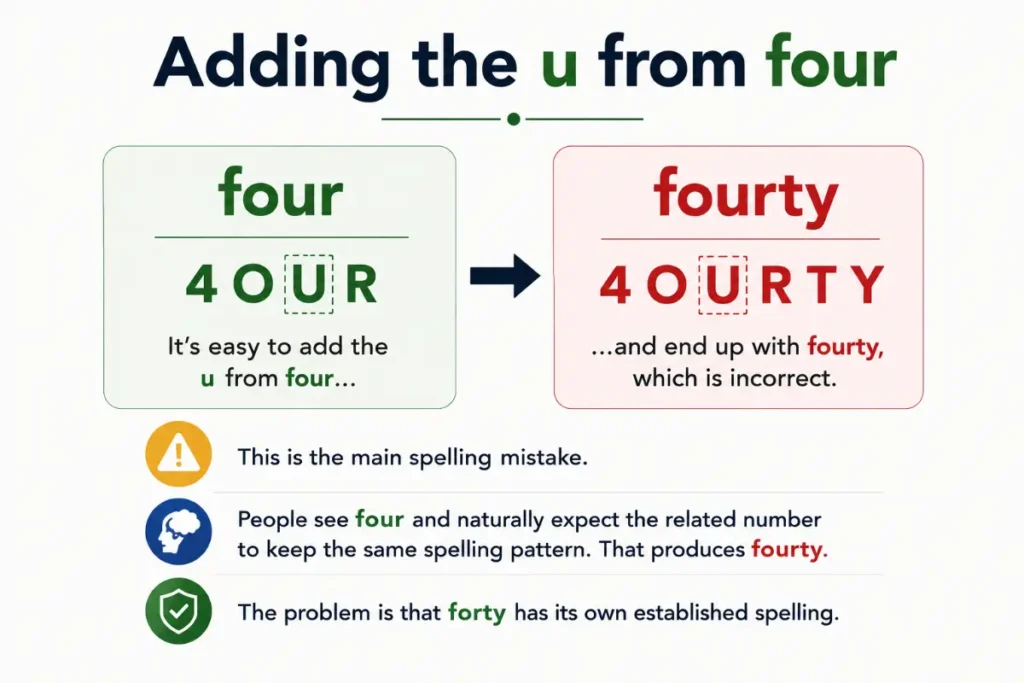
Adding the u from four
This is the main spelling mistake.
People see four and naturally expect the related number to keep the same spelling pattern. That produces fourty.
The problem is that forty has its own established spelling.
Writing fourty because it sounds logical
English spelling often contains patterns that look logical but don’t work consistently. Forty is one of those words that you simply need to learn as a fixed form.
Confusing forty and fortieth
The ordinal form is fortieth.
Correct:
He finished fortieth.
Incorrect:
He finished fourtieth.
The u remains absent.
Adding an extra letter when writing quickly
Fast typing can make familiar number words vulnerable to mistakes. Because four is deeply familiar your fingers may automatically reproduce its spelling when you begin writing forty.
Treating fourty as a regional spelling
Fourty isn’t the accepted spelling in American English British English Australian English or Canadian English. It isn’t a regional alternative.
From an NLP perspective this is a form of orthographic interference. The brain recognizes the semantic connection between four and forty but transfers the spelling pattern of the base word into the related number. This creates a predictable spelling error.
Pronunciation Guide
Forty has two syllables.
A simple pronunciation guide is:
FOR tee
The first syllable receives the main stress.
In American English the pronunciation is commonly represented as:
/ˈfɔrti/
In British English it is commonly represented as:
/ˈfɔːti/
Regional accents can change the exact vowel and r sound. The spelling remains the same.
The word doesn’t sound like someone simply saying four and then adding a separate syllable. That difference can make the spelling harder to predict.
The incorrect spelling fourty doesn’t represent a standard pronunciation difference. You shouldn’t pronounce the word differently simply because you see the incorrect form.
A useful pronunciation and spelling connection is this:
Forty sounds roughly like FOR tee.
It doesn’t need to sound like four tee with the complete vowel pattern of four.
This is another reason spelling from pronunciation alone can lead you astray. English has many words whose spoken form doesn’t reveal every detail of their written form.
Etymology and Word Origin
The history of forty helps explain why its spelling differs from four.
The modern word developed from Old English forms connected with the number four and the concept of forty. Old English used forms such as feowertig. That older form was built from a word related to four and a suffix meaning a group or collection of ten.
Over centuries English spelling changed dramatically. Middle English writers used several forms. Eventually the modern spelling forty became established.
The relationship with four remained obvious in meaning but the spelling became shorter.
This is why it isn’t useful to assume that every English number must be created by simply attaching an ending to the modern spelling of its smaller number.
Four became four.
Forty developed into forty.
The modern spelling is the result of historical language change rather than a simple mathematical formula.
The word fortieth follows the same modern pattern. It means the ordinal position associated with forty.
Understanding the history can make the spelling feel less random. You’re not dealing with a strange modern exception that appeared overnight. You’re seeing the result of centuries of pronunciation and spelling changes.
Regional Usage in the US
American English uses forty as the standard spelling.
The word is extremely common in American writing and speech. You can use it for age money distance quantity time and many other measurements.
For example:
She is forty years old.
The trip took forty minutes.
The ticket costs forty dollars.
American English doesn’t use fourty as an accepted spelling.
The same applies to fortieth. American writers use fortieth rather than fourtieth.
Regional Usage in the UK
British English also uses forty.
There is no standard British spelling fourty. British dictionaries and edited publications use forty for the number 40.
Pronunciation can vary across British accents but spelling does not change.
This is worth remembering because some English words do have different American and British spellings. Forty isn’t one of them.
Regional Usage in Australia
Australian English follows the standard spelling forty.
Australian writers use forty in school materials business documents journalism everyday messages and formal writing.
There isn’t an Australian variant spelled fourty.
The same spelling applies to related forms such as fortieth and forty five.
Regional Usage in Canada
Canadian English also uses forty.
Canadian spelling can differ from American spelling in some areas but this number isn’t one of those cases.
Writers in Canada use forty in formal and informal English. Fourty should be corrected.
Across the major English varieties the answer stays consistent. Forty is the standard spelling.
Grammar Rules and Part of Speech
Forty is primarily a number word. It is a cardinal number because it tells you how many things there are.
For example:
Forty students attended the class.
The word tells us the quantity of students.
Forty as a modifier
Forty commonly appears before a noun.
Examples:
Forty people arrived.
Forty pages remain.
In these examples it gives information about quantity.
Forty as a standalone number
You can also use forty without a following noun when the context makes the meaning clear.
How many did you buy?
Forty.
The number can stand on its own because the listener understands what you’re counting.
Forty with compound numbers
Forty combines with numbers from one through nine.
Examples:
Forty one to Forty nine
In standard American English style these number names are normally written as separate words. The spelling of forty itself doesn’t change.
Forty in ages
Forty commonly appears in age expressions.
She is forty.
He turned forty last month.
They are both forty years old.
When writing a person’s age in formal prose you can use the word form or the numeral depending on the style guide and context.
Forty as an ordinal
The ordinal form is fortieth.
This describes position rather than quantity.
She finished fortieth in the race.
It was his fortieth birthday.
Notice that fortieth does not contain the u.
Real Life Usage Examples
Daily Talk
Forty is common in everyday conversation.
- I’ll be there in forty minutes.
- She just turned forty.
People use it naturally when talking about time age money distance and quantities.
Forty appears often in professional messages.
- We received forty applications for the position.
- The project needs forty additional hours of work.
These sentences sound completely natural in workplace communication.
Academic Writing
Researchers use forty when reporting sample sizes measurements and quantities.
- The study included forty participants.
- The researchers analyzed forty separate samples.
In academic writing accuracy matters. A spelling mistake in a number can make an otherwise polished sentence look careless.
News Writing
News articles often use forty when reporting statistics or events.
- Forty residents attended the public meeting.
- Officials reported forty cases during the investigation.
The number is useful because news writing frequently communicates exact quantities.
Literature
Authors can use forty to describe age time quantity or symbolism.
- After forty years he returned to his hometown.
- The story follows a family across forty generations.
In literature the number can be factual or symbolic depending on the writer’s purpose.
Number Words That Cause Similar Confusion
Forty isn’t the only English number that can create spelling questions.
Fourteen
Fourteen keeps the u from four.
That contrast can make forty even more confusing because the related words don’t behave identically.
Fourteen versus forty
Fourteen means 14.
Forty means 40.
The first keeps the u while the second drops it.
This difference is one reason learners often transfer the spelling of fourteen into forty.
Fourth
Fourth means number four in an ordinal position.
She came fourth.
It contains the u.
Fortieth
Fortieth means position 40.
He finished fortieth.
It doesn’t contain the u.
These contrasts show why the spelling of forty must be learned as its own established form.
Related and Confused Terms
Four
Four is the number 4 and is the base word that causes most of the spelling confusion.
Fourteen
Fourteen is 14. Unlike forty it keeps the u from four.
Fourth
Fourth is the ordinal form connected with four.
Forty
Forty is the correct spelling of 40.
Fortieth
Fortieth is the ordinal form of forty.
Thirty
Thirty is the number immediately before forty.
Forty One
Forty one means 41. The word forty keeps its standard spelling.
Fifty
Fifty means 50. Like forty it doesn’t simply follow the spelling pattern of its smaller number.
These related number words show an important point about English. Number spelling is systematic in many places but not perfectly predictable in every detail.
Why People Misspell Forty
The biggest reason is the word four.
When you see forty your brain immediately recognizes its connection with four. That connection is semantic and visual. The two words clearly belong to the same number family.
The problem starts when you try to construct the spelling instead of recalling it.
You may think:
Four plus ty equals fourty.
That reasoning feels natural.
English doesn’t work that way here.
The established spelling is:
Forty.
The u disappears.
Another factor is the influence of other related forms.
Fourteen keeps the u.
Fourth keeps the u.
Four hundred keeps the u.
Because several related forms retain it the brain can expect forty to do the same.
That’s why the mistake is so persistent. It isn’t random. It comes from applying a reasonable pattern to an irregular spelling.
This kind of error is common in language learning. People often build new words from familiar forms. When the language contains historical exceptions the logical construction can produce the wrong result.
A Simple Memory Trick
The easiest trick is:
Forty has no u.
You can make the rule even more memorable by connecting it with another word:
Four has u. Forty does not.
Don’t try to remember fourty as a rejected version. Instead memorize the correct visual shape:
F O R T Y.
Five letters.
No u.
You can also connect forty with fortieth.
Forty.
Fortieth.
Both forms begin with fort.
This gives you a strong visual family.
Another useful technique is to write the number sequence:
Thirty.
Forty.
Fifty.
Notice that the middle group follows its own spelling pattern.
Forty in Formal Writing
Forty is completely appropriate in formal writing.
You can use it in academic papers business reports legal documents professional emails news stories and technical writing.
For example:
The survey included forty participants.
That sentence is perfectly suitable for a research report.
You don’t need to replace forty with the numeral 40 simply to make the writing look more professional. The choice between a numeral and a spelled out number depends on the relevant style guide and context.
The spelling itself is never informal.
What matters is accuracy.
Writing fourty in a formal document can distract the reader because it looks like a basic spelling error. A single incorrect number word can weaken the impression of careful editing.
Forty and Forty Five
When forty combines with another number from one through nine the spelling remains forty.
Correct forms include:
Forty one.
Forty five.
The same rule applies to the spelling of the first word in each combination.
You should never write:
Fourty five.
Fourty six.
The correct form is always forty.
This is useful when writing ages prices scores measurements and quantities.
She is forty five years old.
The package costs forty five dollars.
The team scored forty five points.
Forty Versus Fortieth
These two forms are closely related but have different grammatical functions.
Forty is a cardinal number.
It tells you how many.
Forty students attended.
Fortieth is an ordinal number.
It tells you position.
She finished fortieth.
The spelling difference is also useful for remembering the missing u.
Neither form uses four inside the written word.
Forty.
Fortieth.
If you’re tempted to write fourty or fourtieth remember that the number family uses fort in these forms.
Expert Editor Insight
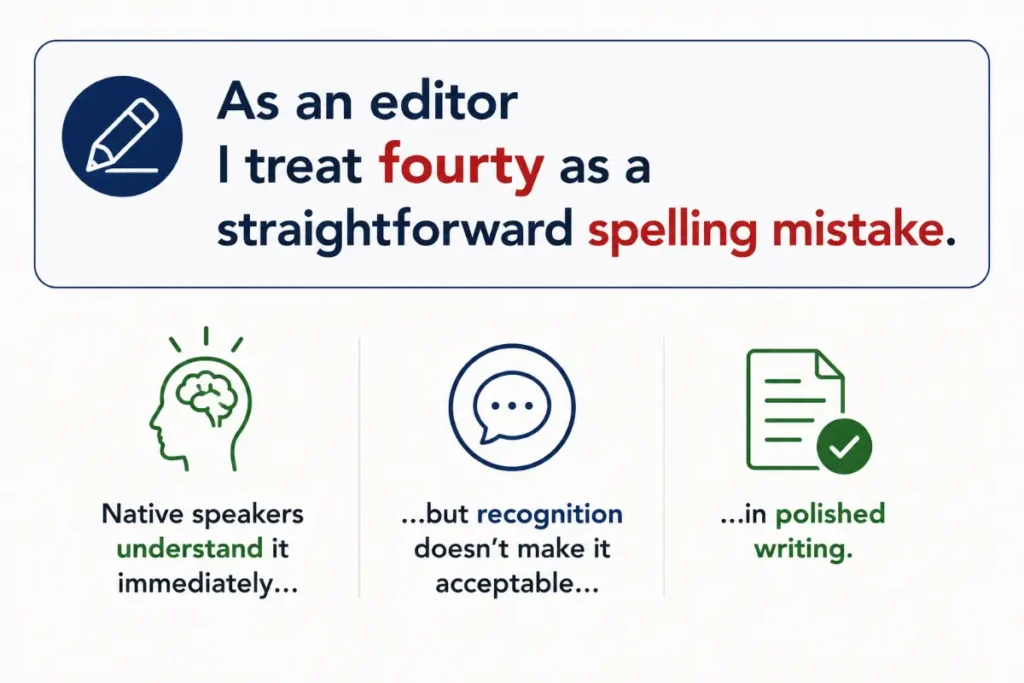
As an editor I treat fourty as a straightforward spelling mistake. Native speakers understand it immediately but recognition doesn’t make it acceptable in polished writing. The error usually comes from transferring the spelling of four into a related number. A spellchecker will often catch fourty but a good writer shouldn’t need software to solve this particular problem. The stronger habit is to memorize the correct word as a fixed spelling and connect it with fortieth. My expert tip is simple: when you see forty in your draft check that no u has slipped into the middle.
Conclusion
When comparing Fourty or Forty the answer is simple. Forty is the correct spelling of the number 40 while fourty is a common spelling mistake. The confusion happens because forty is closely connected with four and several related number words keep the u. Still the modern standard form drops it completely.
The easiest practical tip is to remember that forty begins with fort and contains no u. The same pattern appears in fortieth. If you pause for a moment before writing the word you can avoid one of the most common English number spelling mistakes. Remember four has u but forty does not.
Frequently Asked Questions
Is fourty a real word?
Fourty is not the standard spelling of the number 40. In ordinary English writing it is considered a misspelling of forty. Most readers will understand what you mean because the incorrect form looks very similar to the correct one. You may see fourty in an invented name or username but that doesn’t make it an accepted spelling in standard English.
What does forty mean?
Forty means the number 40. It comes after thirty nine and before forty one. You can use it to describe quantities ages measurements prices time and many other things. For example you might say forty students attended the class or the package weighs forty pounds. The word can also appear in larger numbers such as forty five.
Fourty or Forty which is correct?
Forty is correct and fourty is incorrect in standard English. The key spelling difference is the missing u. Although forty is closely related to four the modern spelling does not keep the u. A useful memory rule is to remember that forty contains five letters and begins with fort rather than four.
How do you pronounce forty?
Forty is usually pronounced with two syllables. A simple pronunciation guide is FOR tee. Standard dictionary pronunciations vary slightly by accent but the first syllable receives the main stress. The word does not require a pronunciation that matches the spelling of four exactly. Learning the spoken form separately can help prevent you from adding the u when writing.
Why is forty spelled without a u?
Forty developed from older English forms related to four but its spelling changed over time. The modern form eventually settled as forty without the u. English spelling often preserves historical patterns rather than following a simple rule where every related word keeps the same letters. That is why four has a u while forty does not.
What is the correct spelling of 40?
The correct spelling of 40 is forty. It should not be written as fourty. The same spelling appears in compound numbers such as forty one and forty nine. When you need the ordinal form the correct word is fortieth. Neither forty nor fortieth contains the u found in four.
Is forty spelled the same in American and British English?
Yes. Both American English and British English use forty as the standard spelling. The pronunciation may differ slightly because of regional accents but the written form stays the same. Australian and Canadian English also use forty. Fourty isn’t an accepted regional spelling in these major varieties of English.
Is forty used in formal writing?
Yes. Forty is completely appropriate in formal writing. You can use it in academic research business reports professional emails journalism and official documents. The word itself isn’t casual. If a style guide requires numerals for certain numbers you may write 40 instead but when the number is spelled out the correct form is always forty.

Confusing Words, Spelling & Word Choice
Claire Whitmore is a U.S.-based English editor who writes about commonly confused words, spelling differences, and word choice. Her work helps readers understand subtle distinctions between similar-looking words through simple definitions, practical examples, and modern usage guidance in both American and British English.