
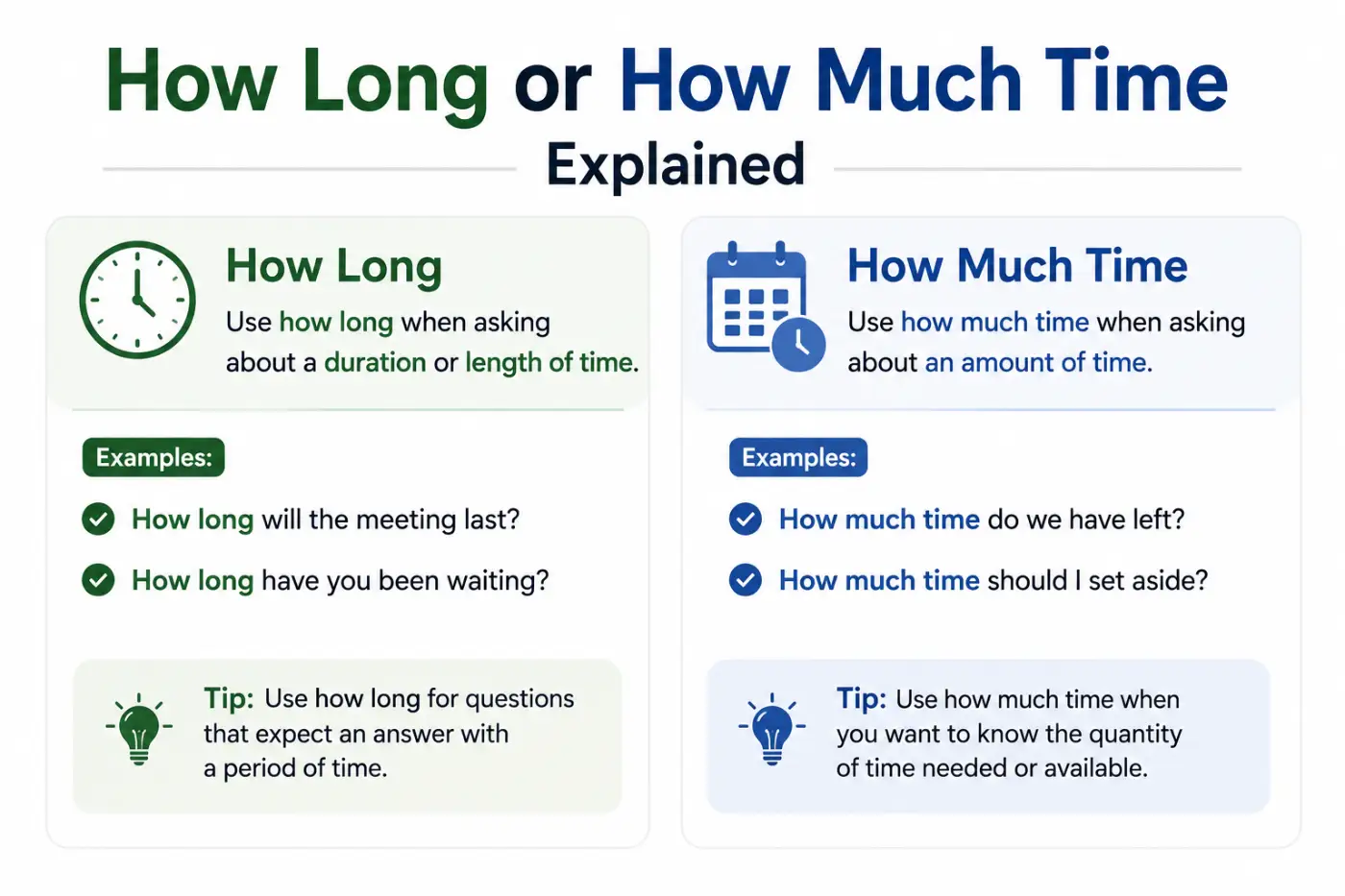
How Long or How Much Time is a common English question because both expressions deal with duration. If you want to ask about the duration of a movie you’ll normally say How long is the movie. If you want to ask about the amount of time someone has available you might say How much time do you have. Both forms are grammatical but they serve slightly different purposes.
The main difference comes down to focus. How long asks about duration and is usually the shorter and more natural expression. How much time treats time as an amount or quantity and often appears when someone has a limited amount of time or needs a certain amount of time to complete something.
That distinction is easy once you see it in real sentences. You’ll learn how native American English speakers choose between the two forms how to build questions correctly and how to avoid common mistakes. You’ll also see examples from everyday conversation professional writing school settings travel and practical situations.
Short Answer
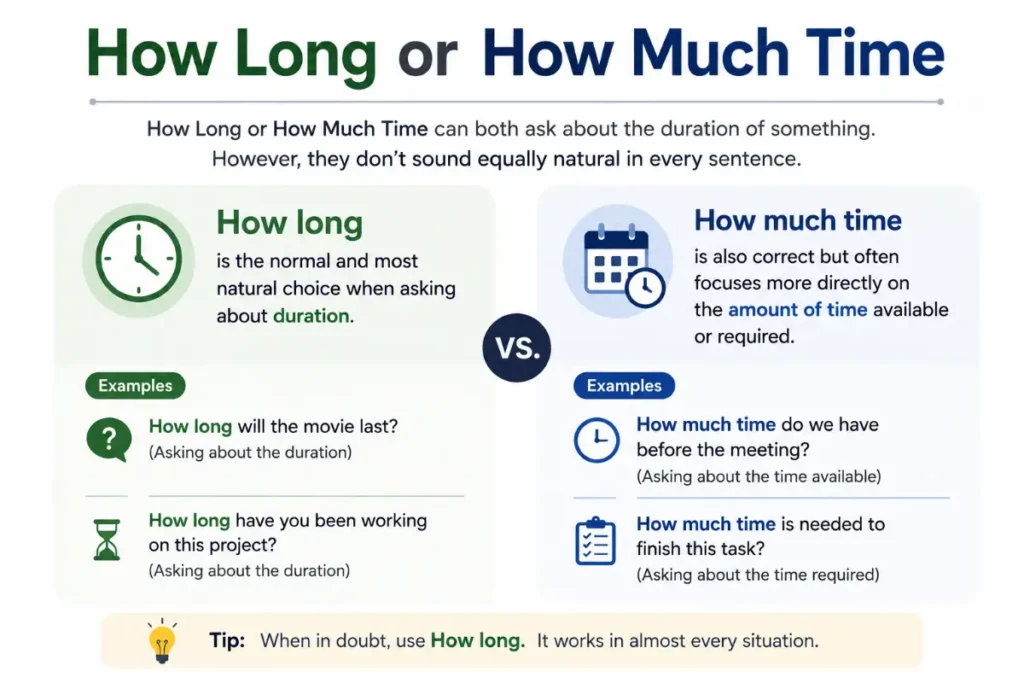
How Long or How Much Time can both ask about the duration of something. However they don’t sound equally natural in every sentence. How long is the normal and most natural choice when asking about duration. How much time is also correct but often focuses more directly on the amount of time available or required.
Table of Contents
- The Main Difference
- How Long Explained
- How Much Time Explained
- How Long or How Much Time in Questions
- Comparison Table
- When To Use How Long
- When To Use How Much Time
- Questions About Duration
- Questions About Available Time
- Questions About Required Time
- Grammar Patterns
- Real Life Examples
- Common Mistakes
- Formal And Informal Usage
- American English Usage
- Memory Tips
- Related Expressions
- Expert Editor Advice
- Frequently Asked Questions
- Key Takeaways
The Main Difference
The simplest rule is this. How long usually asks about duration. How much time usually asks about the amount of time available or needed.
Consider these two questions.
How long is the meeting.
How much time do we have for the meeting.
The first question asks for the meeting’s duration. The answer could be thirty minutes. The second asks about the amount of time available to the speakers. The answer could be twenty minutes.
The difference is small but meaningful.
Think of how long as a measurement question. You’re measuring duration. Think of how much time as a quantity question. You’re asking about an amount.
This distinction also explains why how long often sounds more natural in everyday English. English speakers generally prefer the shorter form when duration is the only information they need.
How Long Explained
How long is an interrogative phrase used to ask about duration.
You can use it with events activities situations actions and periods.
How long is the flight.
How long does the class last.
In each sentence the speaker wants to know the duration of something.
The answer can be expressed with minutes hours days weeks months years or other periods.
How long is the movie.
It’s two hours.
How long have you worked here.
I’ve worked here for six years.
How long does the trip take.
It takes about three days.
Notice that how long works with several verb structures. The grammar changes depending on the meaning and tense but the central idea remains duration.
How Much Time Explained
How much time asks about an amount of time.
The noun time is treated as an uncountable noun in this expression. That means English normally uses much rather than many.
How much time do you need.
How much time should I allow.
These questions often have a practical feeling. The speaker wants to know how much time is available or how much time an activity requires.
For example a teacher might ask How much time do you need to finish the assignment.
A traveler might ask How much time do we have before the train leaves.
A manager might ask How much time will the project require.
In each case the amount of available or required time matters.
How Long or How Much Time in Questions
The choice depends on what you want the listener to tell you.
Use how long when the answer should describe duration.
How long is the concert.
Two hours.
Use how much time when the answer should describe an amount of time available or required.
How much time do you have.
About thirty minutes.
There are situations where both questions can receive similar answers.
How long will the project take.
About three months.
How much time will the project take.
About three months.
The second sentence is grammatical but many speakers would prefer how long in ordinary conversation. How much time puts more emphasis on the quantity of time involved.
This is why grammar alone doesn’t tell the whole story. Natural word choice also depends on focus.
Comparison Table
| Expression | Main Purpose | Typical Meaning | Naturalness | Example | Typical Answer |
|---|---|---|---|---|---|
| How long | Ask about duration | What is the duration | Very natural | How long is the meeting | One hour |
| How much time | Ask about an amount | What amount of time is available or needed | Very natural in the right context | How much time do you need | Twenty minutes |
| How many hours | Ask about a number of hours | How many individual hours | Natural when counting hours | How many hours will you work | Eight hours |
| What length of time | Ask about duration | What duration | Formal | What length of time is required | Six weeks |
| For how long | Ask about duration | During what period | Formal or less conversational | For how long will you stay | Three days |
When To Use How Long
How long is the best choice when duration is the main point.
You can use it with simple questions.
How long is the lesson.
How long is the flight.
You can also use it with actions.
How long does it take.
How long have you known him.
The phrase also works with states and situations.
How long has the store been open.
How long will the weather stay this cold.
The expression is especially common in everyday American English because it is concise and flexible.
If someone asks How long does it take to drive from Dallas to Austin they aren’t asking for an amount of time in an abstract sense. They simply want the duration of the drive. The answer might be about three hours.
When To Use How Much Time
How much time works best when the amount of available or required time matters.
Imagine you’re working on an assignment and you need more time. You might say I need more time. A teacher might ask How much time do you need.
That question focuses on the quantity required.
The same pattern works for available time.
How much time do we have before dinner.
We have about forty minutes.
It also works when time is being allocated.
How much time should we spend on this section.
How much time can you give me.
That last example is particularly useful because it shows that how much time can describe an amount that has already been used.
The phrase often sounds slightly more deliberate than how long. That doesn’t make it formal. It simply gives time itself more attention.
Questions About Duration
Duration means the length of time that something continues.
English commonly uses how long for these questions.
How long is the meeting.
How long is the movie.
The expected answer usually gives a period.
Ten minutes.
Two hours.
Three days.
Several weeks.
Five years.
You can also answer with a phrase beginning with for.
I’ve lived here for five years.
The movie lasts for two hours.
The class runs for ninety minutes.
English often leaves out for in simple duration answers.
How long is the class.
Ninety minutes.
That answer is completely natural.
Questions About Available Time
When the question concerns time that someone has at their disposal how much time is often the better choice.
How much time do you have.
How much time do we have before the store closes.
The context makes the difference.
Imagine you’re at an airport and your connecting flight leaves soon. Asking How much time do we have means you want to know how much time remains before you need to board.
Asking How long is the connection could mean something different. It might ask about the duration of the connection itself.
The two expressions can overlap but the speaker’s focus changes.
Questions About Required Time
Both expressions can ask about the time needed for an activity.
How long will it take.
How much time will it take.
Both are grammatical.
Still how long is usually the more natural everyday choice when you simply want to know the duration.
How much time becomes especially useful when you’re emphasizing the amount needed.
How much time will you need to finish the report.
I’ll need another hour.
The question sounds practical because the speaker is thinking about allocating time.
You can also say How much time does this task require. This is common in professional and academic contexts.
Grammar Patterns
How Long With Be
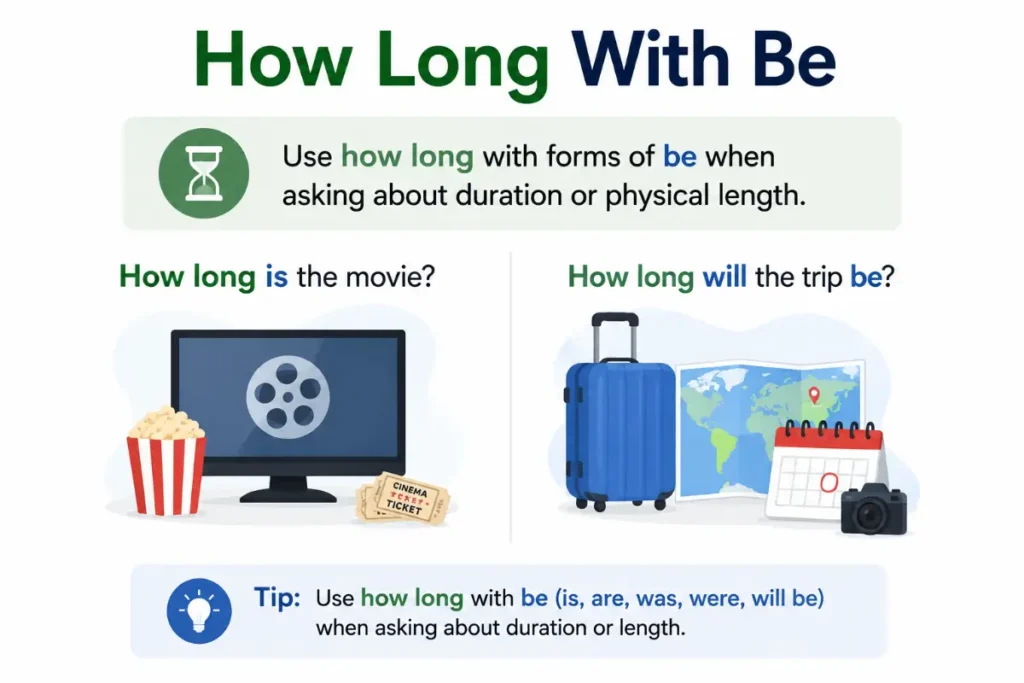
Use how long with forms of be when asking about duration or physical length.
How long is the movie.
How long will the trip be.
The answer can describe duration.
The movie is two hours long.
The meeting was ninety minutes long.
How Long With Do
Use how long with do when asking about the duration of an action.
How long does the lesson take.
How long will the process take.
The structure is especially common with take.
How long does it take.
How Much Time With Need
This is one of the most useful patterns.
How much time do you need.
How much time does the project need.
The question focuses directly on the amount required.
Real Life Examples
Everyday Conversation
How long is the movie.
It’s about two hours.
The speaker wants the movie’s duration.
How much time do we have before dinner.
We have about twenty minutes.
The speaker wants to know the amount of time remaining.
At Work
How long will the meeting take.
Probably forty five minutes.
The question asks for the meeting duration.
How much time do you need to finish the presentation.
I need another hour.
The second question focuses on the amount required.
At School
How long is the exam.
It lasts ninety minutes.
The student wants to know the duration.
How much time do we have left.
You have fifteen minutes.
The second question focuses on remaining time.
While Traveling
How long is the flight.
It’s about six hours.
The traveler wants the duration.
How much time do we have before boarding.
We have about thirty minutes.
The speaker wants the remaining available time.
At Home
How long should I cook the chicken.
About thirty minutes.
How much time do you need before we leave.
Give me ten minutes.
Both forms sound natural because they serve different purposes.
Common Mistakes
Using How Many Time
A frequent mistake is saying How many time.
That form is incorrect because time is uncountable when it means duration or an amount.
Say How much time do you need.
Say How long do you need.
Do not say How many time do you need.
Using How Much Long
How much long is not standard English.
Use How long.
How long is the trip.
How long will it take.
Using How Long Time
Another common error is adding time after how long.
How long time will it take is not standard English.
Say How long will it take.
Or say How much time will it take.
English does not normally combine how long and time in that structure.
Using How Much Time For Duration
How much time is grammatical but sometimes unnecessarily wordy.
How much time is the movie.
This sounds unnatural.
Say How long is the movie.
The problem isn’t that much time is always wrong. The problem is that is the wrong structure for this particular question.
Confusing Available Time With Duration
Consider these questions.
How long is the meeting.
How much time do we have for the meeting.
The first asks about the planned duration. The second asks about the time available.
Keeping that distinction in mind makes many confusing examples much easier.
Formal And Informal Usage
How long is completely normal in formal and informal English.
You can use it in conversation academic writing business communication reports interviews and instructions.
How much time is also standard in every major variety of English. The difference is not about correctness. It is about meaning and emphasis.
In professional writing you may choose how long when the goal is simple and direct communication.
How long will the review process take.
That sentence is clear and efficient.
You might choose how much time when discussing resources.
How much time should the team allocate to testing.
The second sentence emphasizes time as a resource.
This distinction is useful in business writing because time is often treated as something that can be allocated measured saved or spent.
American English Usage
American English uses how long very frequently for duration.
How long is the drive.
How long does it take.
These forms are natural in everyday speech.
How much time is equally normal when the speaker is thinking about an amount.
How much time do you have.
There is no American English rule that makes one expression universally correct and the other universally wrong.
The situation controls the choice.
Memory Tips
A simple memory trick is to connect long with length.
How long asks about the length of a period.
How much time asks about the amount of time.
Think about a ruler. If you want to measure something you ask how long.
Think about a container. If you want to know the amount inside you ask how much.
Time isn’t a physical object in this comparison but the mental picture helps.
Another useful test is to imagine the answer.
If the answer sounds like two hours long then how long is probably the natural choice.
If the answer sounds like I have two hours available then how much time may fit better.
Try these pairs.
How long is the class.
The class is two hours.
How much time do you have.
I have two hours.
The number is identical but the question focuses on different information.
Related Grammar And Usage Notes
Time As An Uncountable Noun
When time means duration or an amount of time English usually treats it as uncountable.
That is why we say much time rather than many time.
How much time do you need.
We don’t normally say How many time do you need.
However time can be countable when it means an occurrence.
I called three times.
She visited twice.
Here times means separate occasions rather than duration.
Time As A Countable Noun
The difference between time as duration and time as an occurrence is important.
I don’t have much time.
Here time means an amount or period.
I’ve seen that movie three times.
Here times means three separate occasions.
The grammar changes because the meaning changes.
For And Since
How long questions often connect with for and since.
How long have you lived here.
I’ve lived here for ten years.
I’ve lived here since 2016.
For introduces a duration.
Since introduces the starting point.
This distinction is useful when answering duration questions.
Take And Last
Take and last are common verbs for talking about duration.
How long does the trip take.
The trip takes four hours.
How long does the class last.
The class lasts two hours.
Take often focuses on the time needed to complete something. Last focuses on how long something continues.
Long And Lengthy
Long and lengthy are related but they aren’t interchangeable in every situation.
A long meeting describes duration.
A lengthy meeting often suggests that the meeting was unusually or unnecessarily long.
This difference matters in professional writing because lengthy can carry a negative tone.
Choosing The Most Natural Expression
When you’re unsure which expression sounds right start with the simplest question.
Are you asking about duration.
Use how long.
How long is the presentation.
Are you asking about the amount available.
Use how much time.
How much time do we have.
Are you asking about the amount required.
How much time do you need.
Are you asking how long an action takes.
How long does it take.
This four part test handles most everyday situations.
Native speakers often make the choice automatically because they hear the difference in focus. Learners can make the same choice by identifying the information they want from the answer.
Professional Writing Tips
Clear writing usually favors the shortest correct expression.
If you simply want to ask about duration there is little reason to use a longer construction.
Instead of How much time is the meeting.
Write How long is the meeting.
Instead of How much time is the flight.
Write How long is the flight.
However don’t shorten everything to how long. Doing so can change the focus.
If you want to know how much time someone has available ask How much time do you have.
That question is more precise than How long do you have.
The difference becomes especially useful when writing instructions.
How long should the presentation be.
This asks about the presentation’s required duration.
How much time should we give the speaker.
This asks about the amount of time allocated to the speaker.
Good editing isn’t only about grammar. It’s also about choosing the expression that matches the intended meaning.
Common Search Questions
Is How Long Or How Much Time More Correct
Neither expression is automatically more correct. Both are standard English. How long is normally preferred for direct questions about duration. How much time is natural when the focus is on an amount of time that someone has uses or needs.
Can I Say How Much Time Will It Take
Yes. How much time will it take is grammatically correct. However How long will it take is usually shorter and more natural when you simply want to know the duration of an activity. The choice depends on emphasis rather than basic grammatical correctness.
Is How Long Time Correct
No. How long time is not the standard structure for asking about duration. Say How long will it take or How much time will it take. English does not normally place time directly after how long in this question pattern.
Is How Much Time Do You Need Correct
Yes. How much time do you need is completely correct. It asks about the amount of time someone requires. For example a student might ask a teacher How much time do we have to finish the test. The expression is common in American English and works in casual and professional settings.
Key Takeaways
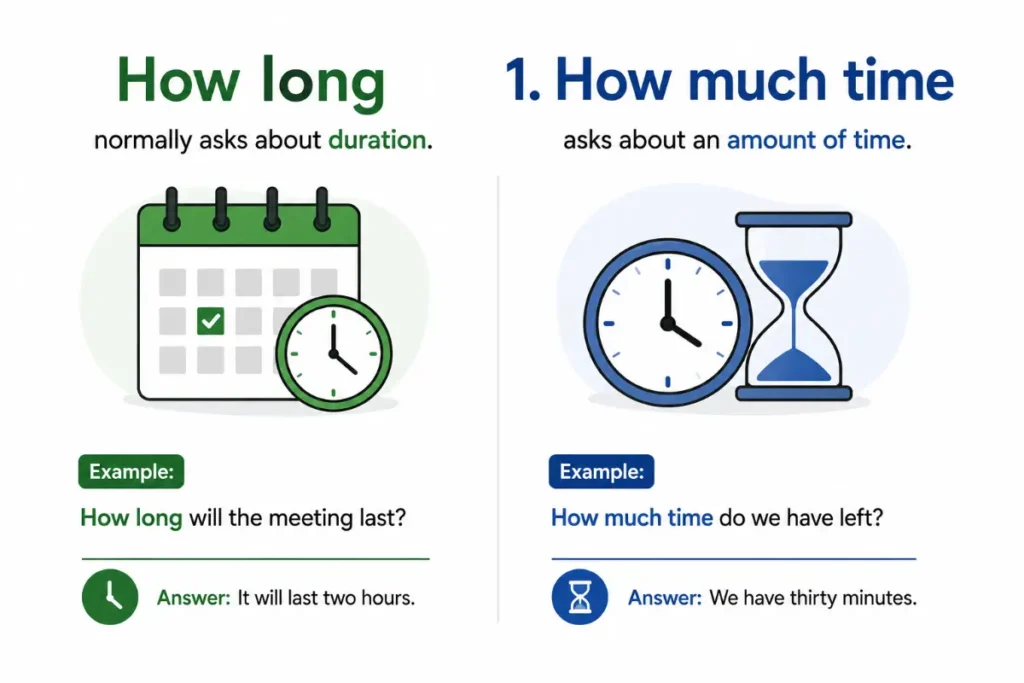
- How long normally asks about duration.
- How much time asks about an amount of time.
- How long is usually the more natural choice for simple duration questions.
- How much time is especially useful for available or required time.
- How many time is incorrect when time means duration.
- How long time is not a standard question structure.
- Time is usually uncountable when it means duration.
- Time becomes countable when it means separate occasions such as three times.
- Both expressions are standard American English.
- The best choice depends on the meaning you want to communicate.
Conclusion
How Long or How Much Time are both correct expressions but they ask for slightly different information. How long is the natural choice when you want to know the duration of an event activity or situation and how much time works best when you’re asking about the amount of time someone has available needs or has used.
The easiest way to remember the difference is to connect how long with duration and how much time with quantity. Say How long is the movie when you want its running time. Say How much time do we have when you want to know how much time remains.
Good English isn’t always about choosing one phrase and rejecting another. It’s about matching the words to your meaning. Once you focus on that distinction the choice becomes simple and your questions sound more natural.
Frequently Asked Questions
What is the difference between How Long or How Much Time?
How long normally asks about duration. How much time asks about an amount of time available used or needed. For example How long is the meeting asks for its duration while How much time do we have asks about the amount available. Both expressions are correct but the focus changes.
Should I say How Long Or How Much Time?
Use how long when you simply want to know the duration of something. Use how much time when you want to know the amount available or required. How long is the movie sounds more natural than How much time is the movie. How much time do you need is completely natural.
Is How Long Or How Much Time grammatically correct?
Yes. Both expressions are grammatically correct when used in the right structure. The difference comes from meaning and emphasis. How long usually measures duration. How much time treats time as an amount. Choosing the right expression makes the question sound more natural and precise.
Can How Long And How Much Time Have The Same Answer?
Yes. They can sometimes produce the same answer even though the questions focus on different ideas. How long will the trip take and How much time will the trip take might both receive three hours as an answer. The first emphasizes duration while the second emphasizes the amount involved.
Why Do We Say How Much Time Instead Of How Many Time?
Time is normally uncountable when it means duration or an amount. That is why English uses much rather than many. We say How much time do you need. We use many with countable nouns such as minutes or hours when counting individual units. For example How many hours do you need.
Can How Long Be Used For Years?
Yes. How long can ask about periods measured in years. You can say How long have you lived here. The answer might be I’ve lived here for twelve years. The same structure works with months weeks days hours and minutes. How long is flexible because it asks about duration rather than a specific unit.
Is How Much Time Formal English?
Yes. How much time is standard English and is appropriate in formal writing. It can be especially useful when discussing time as a resource. For example a report might ask How much time should employees spend on training. The expression is also completely normal in everyday conversation.
What Is The Easiest Way To Remember The Difference?
Connect how long with duration and how much time with quantity. Ask how long when you want to know the length of an event or activity. Ask how much time when you want to know how much time someone has needs uses or can give. This simple distinction covers most common situations.

English Grammar & Usage
Nathan Holloway is an American grammar writer and language researcher who specializes in English grammar, sentence structure, verb usage, and common writing mistakes. He enjoys breaking down confusing grammar rules into practical explanations with clear examples, making English easier for students, professionals, and everyday writers.