
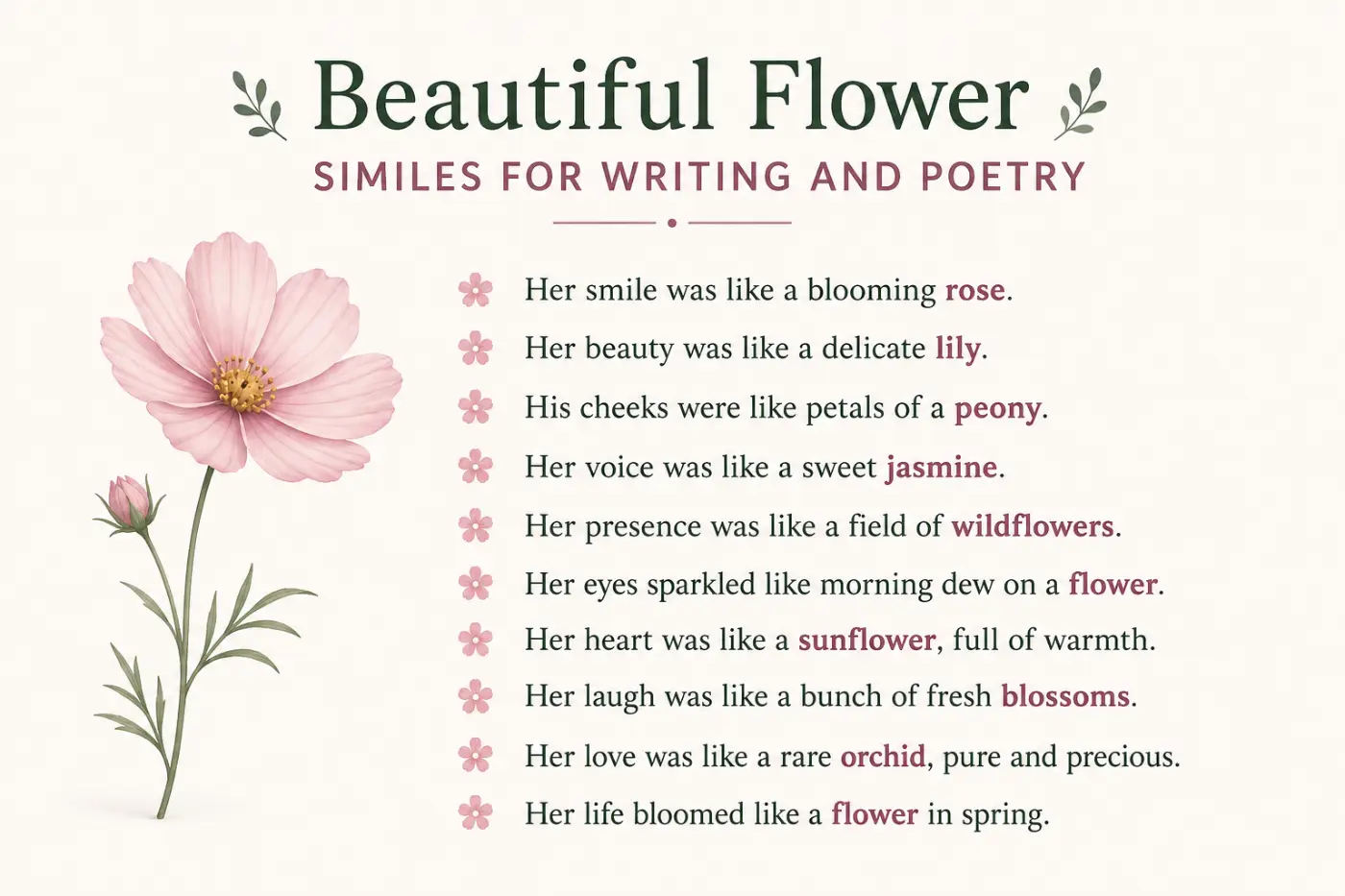
Beautiful flower similes can turn a simple description into an image that readers can almost see, smell, or feel. Instead of saying that a garden is attractive, you might write that it is “like a living painting filled with soft colors.” The comparison gives the sentence more personality and helps the reader picture the scene.
Flowers work especially well in similes because they already carry strong associations with beauty, growth, love, innocence, freshness, fragility, and renewal. A rose can suggest romance, while a daisy can suggest innocence. A sunflower can create a feeling of warmth and optimism, and a lotus can suggest calmness or resilience.
This guide explains how flower similes work and gives you more than 120 original examples for poems, stories, essays, cards, captions, speeches, and everyday writing. You will also learn how to choose the right flower comparison, avoid weak comparisons, and make your own similes sound natural.
Short Answer
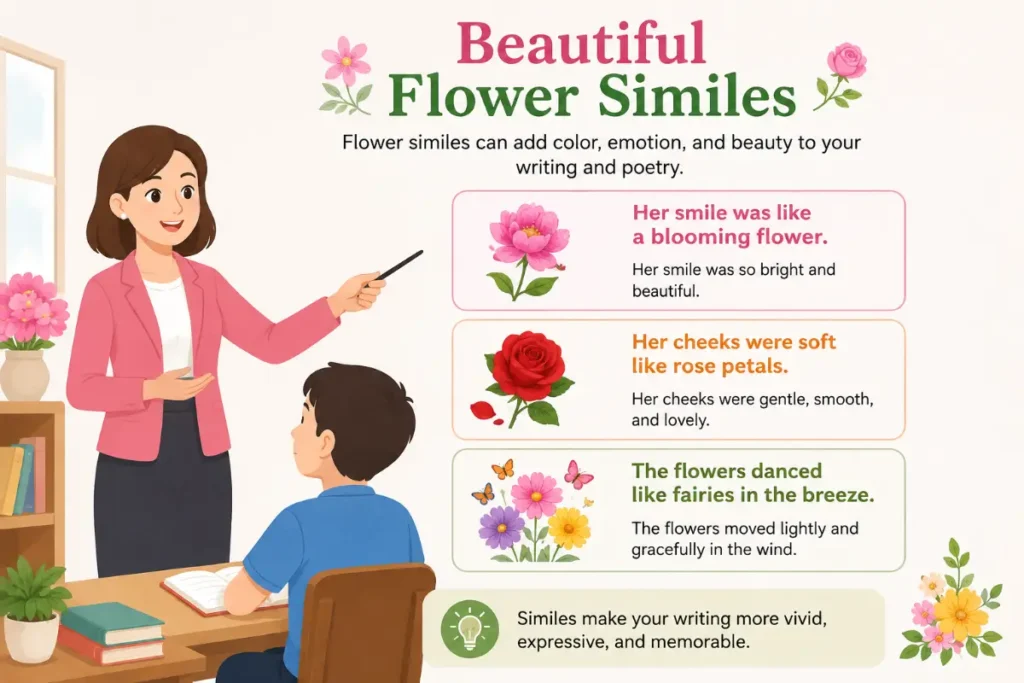
Beautiful flower similes can add color, emotion, and beauty to your writing and poetry. You can say, “Her smile was like a blooming flower,” “Her cheeks were soft like rose petals,” or “The flowers danced like fairies in the breeze.” These simple comparisons make your writing more vivid and expressive.
Table Of Contents
- What Is A Flower Simile
- Why Flower Similes Are Effective
- How To Write A Strong Flower Simile
- Beautiful Flower Similes About Beauty
- Similes About Love And Romance
- Similes About Happiness And Joy
- Similes About Innocence And Purity
- Similes About Grace And Elegance
- Similes About Fragility And Delicacy
- Similes About Growth And Change
- Similes About Strength And Resilience
- Similes About Nature And Gardens
- Similes About Colors
- Similes For People
- Similes For Smiles And Faces
- Similes For Eyes
- Similes For Hair And Appearance
- Similes For Feelings
- Similes For Poetry And Creative Writing
- Common Mistakes
- Memory Tips
- Related Language Notes
- Key Takeaways
- FAQs
- Conclusion
What Is A Flower Simile
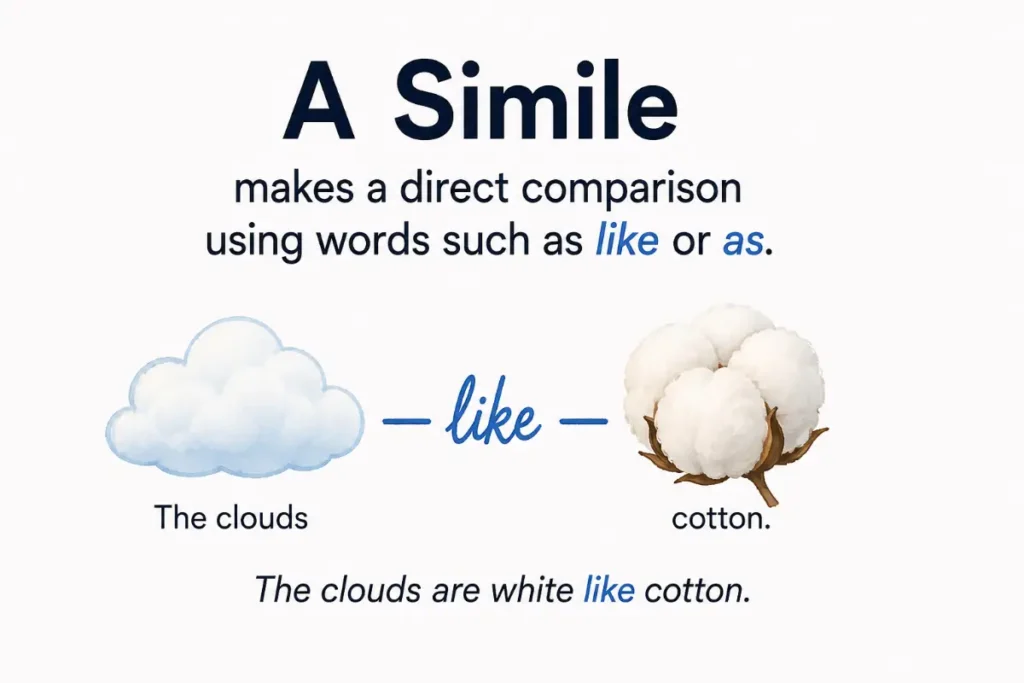
A simile is a figure of speech that compares two different things using a comparison word such as like or as. Flower similes use flowers or flower related images as one side of that comparison.
For example:
- “Her voice was like a rose blooming in the quiet.”
The voice is not literally a rose. The writer compares the voice with the gentle and beautiful image of a blooming rose.
- “The children were as cheerful as sunflowers.”
The children are not sunflowers. The comparison emphasizes their brightness and happiness.
- “The garden looked like a sea of flowers.”
The garden is not actually a sea. The comparison suggests a large and colorful area filled with flowers.
A simile differs from a metaphor because a simile usually makes the comparison directly with words such as like or as. A metaphor states the comparison more directly.
Simile: “Her smile was like a sunflower.”
Metaphor: “Her smile was a sunflower.”
Both can be effective. The simile simply makes the comparison more explicit.
Why Flower Similes Are Effective
Flowers are visually rich subjects. They come in different shapes, colors, sizes, scents, and seasons. Writers can use these qualities to create precise comparisons.
A rose can communicate romance or classic beauty. Lavender can suggest softness and calm. Sunflowers can suggest warmth and optimism. Lilies can create an impression of elegance or purity. Wildflowers can suggest freedom and natural beauty.
The strongest comparisons usually connect a specific flower quality with a specific idea.
For example, “She was like a flower” is understandable but vague. It does not tell the reader what quality the writer means.
“She was like a wildflower growing beside an empty road” creates a stronger picture. The comparison can suggest independence, natural beauty, and resilience.
A good simile does more than decorate a sentence. It gives the reader a reason to imagine something differently.
How To Write A Strong Flower Simile
Start with the quality you want to communicate.
Ask yourself what you are describing. Is it beauty, kindness, sadness, confidence, youth, love, calmness, strength, or change?
Next, choose a flower whose common visual or cultural associations support that quality.
Then connect the two ideas naturally.
For example, if you want to describe someone who brings happiness into a room, a sunflower can work well.
“She entered the room like a sunflower bringing summer into a gray garden.”
The comparison works because the flower image supports warmth and brightness.
Avoid choosing a flower simply because it sounds pretty. A strong comparison should have a clear connection between the subject and the image.
Beautiful Flower Similes About Beauty
These comparisons work well when you want to describe physical beauty, attractive surroundings, artistic scenes, or something visually pleasing.
- Her face was like a rose opening beneath the morning sun. The image suggests fresh and natural beauty.
- The garden was like a painting filled with blooming flowers. This emphasizes color and visual richness.
- Her beauty was like a field of wildflowers after spring rain. The comparison suggests freshness and abundance.
- The sunset was like a giant flower unfolding across the sky. The image connects changing colors with a blooming blossom.
- His kindness was like a flower appearing in a dry field. The comparison makes kindness seem rare and precious.
- The room looked like a garden in full bloom. This suggests that the space was colorful and lively.
- Her dress was like a delicate petal floating on water. The comparison highlights softness and elegance.
- The landscape was as beautiful as a valley covered with wildflowers. This creates an expansive natural image.
- Her presence was like a fresh flower beside an old stone wall. The contrast makes her seem vibrant and memorable.
- The morning was like a garden opening one blossom at a time. This gives the scene a gentle sense of awakening.
Beautiful Flower Similes About Love And Romance
Flowers have long appeared in romantic language. Roses are especially associated with love, but other flowers can create less familiar and more specific images.
- His love was like a rose that continued blooming through every season. The comparison suggests lasting affection.
- Her heart opened like a flower touched by warm sunlight. The image suggests trust and emotional openness.
- Their love was like two roses growing from the same garden. This emphasizes closeness and shared growth.
- Her kiss was like the soft scent of roses drifting through an evening breeze. The comparison creates a gentle romantic atmosphere.
- Their first meeting was like a flower opening after a long winter. The image suggests something beautiful beginning unexpectedly.
- His affection was as gentle as lavender swaying in a quiet field. This suggests tenderness and calmness.
- Their relationship grew like flowers after spring rain. The comparison emphasizes gradual growth.
- Her love was like a garden that became more beautiful with every season. This suggests a relationship that develops over time.
- Their memories were like rose petals scattered across an old love letter. The image combines romance with nostalgia.
- His smile was like a flower turning toward the sun. The comparison suggests warmth and attraction.
Beautiful Flower Similes About Happiness And Joy
Flowers can make excellent comparisons for happiness because blooming often suggests energy, life, and positive change.
- Her laughter was like a field of sunflowers dancing in the breeze. The image creates a sense of movement and happiness.
- His smile was like a sunflower greeting the morning. The comparison suggests warmth and optimism.
- The children were as joyful as flowers after spring rain. This connects happiness with renewal.
- Her excitement spread like wildflowers across a meadow. The comparison suggests happiness moving quickly from person to person.
- The celebration was like a garden bursting into bloom. This creates a vivid picture of energy and color.
- His happiness was like a sunflower soaking up golden sunlight. The image suggests simple and genuine joy.
- Their laughter floated like flower petals on a warm breeze. This creates a light and peaceful mood.
- The party felt like a garden filled with flowers in every color. The comparison emphasizes variety and celebration.
- Her cheerful personality was like a bright daisy in a field of grass. The image suggests freshness and friendliness.
- The morning felt like a flower opening to welcome the sun. The comparison creates an optimistic tone.
Beautiful Flower Similes About Innocence And Purity
Delicate flowers often work well when describing innocence, youth, sincerity, or gentle character.
- The baby was as innocent as a white flower in a quiet garden. The comparison emphasizes purity.
- Her smile was like a small daisy appearing through the grass. The image suggests simple and natural charm.
- His heart was as pure as a lily floating on clear water. The comparison focuses on innocence.
- The child looked like a fresh blossom untouched by the summer heat. This suggests youth and delicacy.
- Her laughter was like petals falling from a white flower. The comparison gives the sound a soft quality.
- His words were as gentle as lavender petals. The image suggests kindness and softness.
- Her expression was like a flower opening in the early morning. This suggests freshness and innocence.
- The little girl moved like a butterfly among spring flowers. The comparison creates a playful and delicate image.
- Their friendship was like a simple daisy growing beside a garden path. The comparison suggests uncomplicated affection.
- Her kindness was like a white blossom shining after rain. This emphasizes sincerity and purity.
Beautiful Flower Similes About Grace And Elegance
Flower imagery can also describe graceful movement, refined appearance, and calm confidence.
- She moved like a lily floating across a quiet pond. The comparison suggests effortless grace.
- Her hands were as delicate as flower petals. This highlights softness.
- She walked into the room like a rose carried by a gentle breeze. The image suggests elegance.
- Her movements were like petals drifting slowly through the air. This creates a graceful visual effect.
- His manners were as refined as a flower arranged in a quiet garden. The comparison gives a sense of careful elegance.
- Her dress flowed like petals unfolding in spring. The image focuses on movement and beauty.
- She stood as gracefully as a lily beside still water. The comparison suggests calm confidence.
- Her voice was like jasmine opening after sunset. The image connects sound with softness and atmosphere.
- His smile appeared like a single flower in a peaceful field. This gives the expression a subtle quality.
- Her presence was as elegant as a rose in a glass vase. The comparison emphasizes classic beauty.
Beautiful Flower Similes About Fragility And Delicacy
Flower imagery can express vulnerability, tenderness, and temporary beauty.
- Her hopes were like delicate petals in a strong wind. The comparison suggests vulnerability.
- His confidence was as fragile as a young flower after heavy rain. This emphasizes uncertainty.
- Their friendship was like a small blossom that needed careful attention. The comparison suggests something precious that requires care.
- Her heart felt like a flower exposed to a cold night. The image suggests emotional vulnerability.
- The old photograph was as delicate as a dried flower between book pages. This connects memory with fragility.
- His dream was like a flower growing through a crack in glass. The comparison suggests vulnerability mixed with determination.
- Her voice trembled like a petal in the wind. The comparison makes the sound seem delicate.
- Their happiness was like a flower that could disappear with the first frost. The image suggests temporary joy.
- The memory remained like a pressed flower inside an old notebook. The comparison suggests something preserved from the past.
- Her trust was as delicate as a newly opened blossom. This emphasizes the need for care.
Beautiful Flower Similes About Growth And Change
Flowers naturally represent development because they move through stages of growth and blooming.
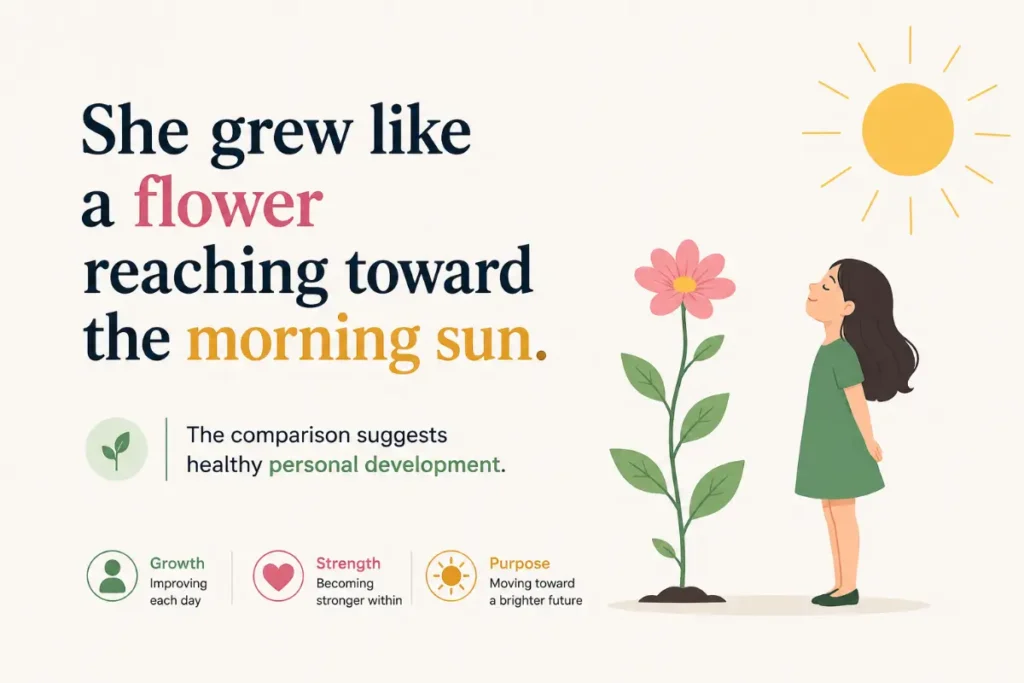
- She grew like a flower reaching toward the morning sun. The comparison suggests healthy personal development.
- His confidence opened like a rose after a long winter. The image suggests gradual emotional growth.
- Their friendship blossomed like flowers after spring rain. The comparison shows a relationship becoming stronger.
- Her ideas spread like wildflowers across a summer field. This suggests creativity and abundance.
- The young artist developed like a flower slowly unfolding its petals. The comparison emphasizes gradual improvement.
- His courage grew like a small flower pushing through hard soil. The image suggests persistence.
- Her personality blossomed like a garden after years of careful work. This suggests long term development.
- Their dreams grew like seedlings beneath warm sunlight. The comparison emphasizes nurturing and progress.
- His talent emerged like a flower opening at dawn. The image suggests something becoming visible for the first time.
- She changed like a garden moving from winter into spring. The comparison emphasizes transformation.
Beautiful Flower Similes About Strength And Resilience
Flowers are not always fragile. Some grow in difficult conditions, which makes them useful images for perseverance.
- She was like a wildflower growing through a crack in the pavement. The comparison suggests resilience.
- His spirit was as strong as a flower surviving a harsh winter. The image connects beauty with endurance.
- Her courage stood like a sunflower against a strong wind. This emphasizes determination.
- Their hope was like a small blossom growing in dry soil. The comparison suggests persistence despite difficulty.
- He recovered like a flower returning after the first spring rain. The image communicates renewal.
- Her determination was like roots holding a flower firmly during a storm. This suggests inner strength.
- His dreams were like wildflowers that refused to disappear from the field. The comparison emphasizes persistence.
- She remained bright like a sunflower beneath a cloudy sky. This suggests optimism during difficulty.
- Their friendship survived like flowers returning every spring. The image emphasizes endurance.
- His courage was like a stubborn little flower growing beside a broken wall. The contrast makes resilience memorable.
Beautiful Flower Similes About Nature And Gardens
These comparisons are useful for descriptive writing, travel writing, fiction, and poetry.
- The meadow was like a colorful carpet woven from wildflowers. The image emphasizes variety.
- The garden looked like a sea of blossoms beneath the morning light. The comparison creates a broad visual image.
- The flowers moved like dancers in the summer breeze. This gives the garden movement.
- The field was as bright as a thousand sunlit petals. The comparison emphasizes brightness.
- The garden smelled like roses after a gentle rain. The image focuses on scent and freshness.
- The trees stood around the flowers like quiet guardians. This gives the landscape a protective feeling.
- The flower beds looked like islands floating in a green sea. The comparison creates a strong spatial image.
- The petals scattered like colorful confetti across the grass. This suggests abundance and movement.
- The garden was as peaceful as a field of lavender at sunset. The comparison creates calmness.
- The wildflowers appeared like tiny stars scattered across the hillside. This emphasizes small bright points across a large landscape.
Beautiful Flower Similes About Colors
Flower comparisons can make descriptions of color more precise.
- Her dress was red like a freshly opened rose. The comparison creates a rich red image.
- The sky was pink like cherry blossoms at dawn. The image suggests soft color.
- His shirt was yellow like a sunflower under summer sunlight. This emphasizes brightness.
- The walls were purple like lavender fields at sunset. The comparison creates a calm and elegant tone.
- Her scarf was white like a lily beside clear water. The image suggests clean brightness.
- The sunset was orange like marigolds glowing in a garden. The comparison creates warmth.
- The lake reflected colors like petals floating across glass. The image emphasizes changing shades.
- The clouds were soft pink like roses touched by evening light. The comparison creates a gentle visual effect.
- The meadow was green and colorful like a garden after spring rain. This suggests freshness and life.
- The horizon looked golden like a field of sunflowers beneath the setting sun. The comparison emphasizes warmth.
Beautiful Flower Similes For People
Flower comparisons can describe personality as well as appearance. The key is to connect the flower with a specific character trait.
- She was like a sunflower because she brought warmth wherever she went. The comparison focuses on positive energy.
- He was like a wildflower growing freely beyond the garden wall. This suggests independence.
- She was as calm as lavender resting in a quiet field. The comparison highlights peacefulness.
- He was like a rose with thorns beneath its beauty. This suggests someone attractive but guarded.
- She was as gentle as a daisy bending beneath a soft breeze. The image suggests tenderness.
- He was like a lotus rising cleanly from muddy water. This suggests strength and dignity despite difficult circumstances.
- She was like a blooming garden after a long winter. The comparison suggests renewed energy.
- He was as steady as the roots beneath an old flowering tree. This emphasizes reliability.
- She was like a rare flower hidden among ordinary grass. The comparison suggests uniqueness.
- He was as bright as a field of sunflowers in summer. This emphasizes cheerful personality.
Beautiful Flower Similes For Smiles And Faces
A smile can be compared with flowers to create warmth, freshness, or emotional depth.
- Her smile was like a rose opening in the morning light. The image suggests beauty and warmth.
- His smile was like a sunflower turning toward the sun. This suggests happiness and openness.
- Her smile appeared like a daisy in a field after rain. The comparison suggests simple joy.
- His face was like a garden coming alive in spring. The image suggests renewed energy.
- Her cheeks were pink like rose petals in the morning. This creates a soft visual image.
- His expression was like a flower opening after a cloudy day. The comparison suggests happiness returning.
- Her smile was as bright as sunflowers beneath a clear sky. The image emphasizes cheerfulness.
- His face softened like petals opening in warm sunlight. This suggests emotional relaxation.
- Her grin spread like wildflowers across a summer meadow. The comparison emphasizes a broad and infectious smile.
- His smile was like one bright flower in an otherwise quiet field. This gives the expression a memorable quality.
Beautiful Flower Similes For Eyes
Eyes often invite comparisons involving color, brightness, depth, and emotion.
- Her eyes were like blue flowers beneath a clear morning sky. The image emphasizes color and calmness.
- His eyes shone like sunflowers catching the first light of day. The comparison suggests warmth.
- Her eyes were as soft as petals after rain. This focuses on gentleness.
- His eyes were like dark roses beneath moonlight. The image creates mystery.
- Her eyes opened like flowers greeting the sunrise. The comparison suggests awakening.
- His eyes were as bright as a garden filled with spring blossoms. This emphasizes liveliness.
- Her eyes were like tiny flowers growing beside a quiet stream. The comparison creates a peaceful image.
- His eyes held sadness like petals carrying drops of rain. The image connects emotion with delicate beauty.
- Her eyes sparkled like sunlight scattered across flower petals. This suggests brightness and energy.
- His gaze was like a single flower standing calmly in a crowded field. The comparison suggests quiet focus.
Beautiful Flower Similes For Hair And Appearance
Flower imagery can also describe texture, color, movement, and style.
- Her hair flowed like petals carried by a warm spring breeze. The comparison emphasizes movement.
- His dark hair was like deep rose petals beneath evening light. This creates a rich visual image.
- Her golden hair shone like a field of sunflowers. The comparison emphasizes brightness.
- Her curls were like flower petals unfolding in different directions. This creates a playful visual image.
- His hair was as soft as fresh flower petals. The comparison emphasizes texture.
- Her hairstyle was like a carefully arranged bouquet. This suggests beauty and deliberate styling.
- Her red hair glowed like roses beneath the afternoon sun. The comparison emphasizes color.
- His silver hair looked like pale flowers touched by moonlight. The image creates an elegant impression.
- Her loose hair moved like wildflowers bending in the wind. This suggests freedom and natural movement.
- His appearance was like a flower standing out in a quiet garden. The comparison suggests distinctiveness.
Beautiful Flower Similes For Feelings
Flower comparisons can make abstract emotions easier to imagine.
- Hope was like a small flower growing through cracked earth. The comparison shows hope surviving difficulty.
- Sadness felt like a flower bending beneath heavy rain. The image communicates emotional weight.
- Joy spread through her like wildflowers across a meadow. The comparison suggests quick and abundant happiness.
- Anger burned like red flowers beneath a summer sun. The image gives the emotion visual intensity.
- Peace settled over him like lavender across a quiet field. The comparison creates a calm atmosphere.
- Fear was like a delicate flower trembling in a storm. The image suggests vulnerability.
- Her confidence bloomed like a rose after years of winter. This emphasizes personal growth.
- His loneliness was like a single flower standing in an empty field. The comparison creates emotional isolation.
- Gratitude grew in her heart like flowers after gentle rain. The image suggests something developing naturally.
- Her memories were like dried flowers kept carefully inside an old book. The comparison connects memory with preservation.
Beautiful Flower Similes For Poetry And Creative Writing
Poetry benefits from comparisons that combine visual detail with emotion. A strong poetic simile should create an image without explaining every part of the comparison.
- The moon hung above the garden like a pale flower in the night.
- Her words drifted through the room like petals carried by a quiet breeze.
- The stars appeared like tiny flowers scattered across a dark field.
- His memories returned like spring flowers after a long winter.
- The old house stood like a forgotten flower beneath the trees.
- Her dreams opened like blossoms beneath an unseen sun.
- The river moved like a ribbon of petals through the valley.
- The morning arrived like a flower slowly unfolding its colors.
- His grief rested on his heart like rain on a fragile blossom.
- Her hope remained like one small flower beneath a cloudy sky.
These examples work because the flower image supports the emotional or visual purpose of the sentence. A poetic comparison becomes weaker when the flower appears only for decoration.
How To Choose The Right Flower
Different flowers can create different impressions. These associations are common writing conventions rather than strict rules. Context can change the meaning.
| Flower | Common Writing Association | Useful For |
|---|---|---|
| Rose | Love and beauty | Romance and appearance |
| Sunflower | Warmth and optimism | Happiness and confidence |
| Daisy | Innocence and simplicity | Youth and friendliness |
| Lily | Elegance and purity | Grace and calm |
| Lavender | Calmness and softness | Peace and gentleness |
| Lotus | Renewal and resilience | Growth and strength |
| Wildflower | Freedom and individuality | Independence and natural beauty |
| Jasmine | Sweetness and fragrance | Romance and atmosphere |
| Marigold | Warm color and brightness | Energy and celebration |
| Tulip | Freshness and affection | Spring and relationships |
| Orchid | Elegance and rarity | Sophistication and uniqueness |
| Cherry Blossom | Beauty and seasonal change | Youth and transformation |
These associations can guide your choice, but they do not limit your creativity. A writer can deliberately use a flower against its usual association to create contrast.
How To Make Flower Similes Sound Natural
A common problem with similes is forcing a comparison into a sentence that does not need one.
Compare these examples.
Weak: “She was like a beautiful flower and was very nice.”
Stronger: “Her kindness was like a wildflower growing where nobody expected it.”
The second sentence gives the reader a specific image. It also connects kindness with unexpected beauty.
Specific details usually create stronger similes than general adjectives.
Weak: “The garden was beautiful like flowers.”
Strong: “The garden looked like a sea of roses beneath the afternoon sun.”
The stronger version tells the reader what to visualize.
Common Mistakes With Flower Similes
Using A Weak Comparison
“She was like a flower” is grammatically acceptable but vague. The reader does not know which quality matters.
Improve it by naming the flower or quality.
“She was like a sunflower bringing warmth into a quiet room.”
Mixing A Simile And Metaphor
Avoid confusing structures such as “She was like a flower is blooming.” The comparison becomes grammatically awkward.
Use a clear simile.
“She was like a flower blooming after rain.”
Or use a metaphor.
“She was a flower blooming after rain.”
Adding Too Many Comparisons
A sentence can become crowded when it contains several unrelated similes.
For example, “Her smile was like a rose, her eyes were like stars, and her voice was like a river flowing through a garden” may feel excessive if all three comparisons appear without a clear purpose.
Choose the comparison that contributes most to the scene.
Using The Same Flower Repeatedly
Roses are familiar and useful, but repeating rose comparisons throughout an article or story can make the writing predictable.
Try sunflowers, daisies, lilies, wildflowers, lavender, lotuses, orchids, tulips, jasmine, or cherry blossoms when the context supports them.
Choosing A Flower Without Considering Meaning
A flower may carry cultural or emotional associations that conflict with your intended message. Always consider the surrounding sentence and audience.
A flower comparison should support the mood instead of fighting against it.
Memory Tips
Remember the basic structure:
Subject + comparison word + flower image.
For example:
“She is like a sunflower.”
You can then make the image more specific.
“She is like a sunflower turning toward the morning light.”
An easy way to build stronger similes is to think in five categories.
- Color.
Think about red roses, yellow sunflowers, purple lavender, or white lilies.
- Shape.
Think about petals, blossoms, stems, leaves, and bouquets.
This method gives you many possible comparisons without repeating the same idea.
Related Grammar And Usage Notes
The word like commonly introduces similes.
“She is like a rose.”
“As” can also form a simile when paired with an adjective or adverb.
“She is as graceful as a lily.”
The structure “as + adjective + as” is especially common in descriptive comparisons.
“She was as bright as a sunflower.”
“She was as calm as a lavender field.”
Do not assume that every sentence containing like is a simile. Like can have several grammatical functions.
“I like roses.”
Here, like is a verb meaning enjoy or have a positive feeling toward.
“She looks like a rose.”
Here, like introduces a comparison.
The surrounding grammar determines the meaning.
Simile Or Metaphor
Similes and metaphors are closely related but use different structures.
| Feature | Simile | Metaphor |
|---|---|---|
| Comparison | Direct comparison | Direct identification |
| Common signal | Like or as | Often no comparison word |
| Example | Her smile was like a sunflower | Her smile was a sunflower |
| Effect | Clearly signals comparison | Often sounds stronger or more poetic |
Neither form is automatically better. Writers choose the form that fits the desired tone.
Simile Or Personification
A simile compares one thing with another.
“The flowers danced like children.”
Personification gives a human quality to something nonhuman.
“The flowers danced in the wind.”
The first sentence uses a simile. The second uses personification because flowers are described as performing a human action.
Both devices can appear together.
“The flowers danced like children celebrating the first day of spring.”
This sentence gives flowers human movement and then compares that movement with children.
Simile Or Hyperbole
A hyperbole uses deliberate exaggeration.
“The garden had a million flowers.”
A simile makes a comparison.
“The garden looked like a sea of flowers.”
The two devices can work together, but they have different purposes.
Professional Writing Tips
Use flower similes selectively in professional writing. They can work well in speeches, marketing copy, personal essays, creative nonfiction, greeting cards, and descriptive introductions.
Academic writing usually benefits from more precise language. A flower comparison may be useful in an essay about literature, symbolism, art, culture, or language, but it should not replace a necessary factual explanation.
Creative writing gives you more freedom. Still, precision matters.
Instead of writing:
“She was beautiful like a flower.”
Try:
“She had the quiet beauty of a wildflower growing beside an old stone wall.”
The second version creates a setting, mood, and personality at the same time.
How To Create Your Own Flower Similes
You can create original comparisons with a simple process.
- Identify the subject.
Choose the person, place, object, feeling, or event you want to describe.
- Identify its strongest quality.
Ask what makes it noticeable. It may be bright, fragile, calm, bold, rare, warm, graceful, or resilient.
- Choose a flower that matches the quality.
A sunflower may work for brightness. Lavender may work for calmness. A wildflower may work for freedom.
- Add an action or setting.
Instead of “Her smile was like a sunflower,” write “Her smile was like a sunflower turning toward the first light.”
- Remove unnecessary words.
The best simile usually delivers its image quickly.
Real Life Uses For Flower Similes
Flower comparisons appear naturally in several types of writing.
Poetry
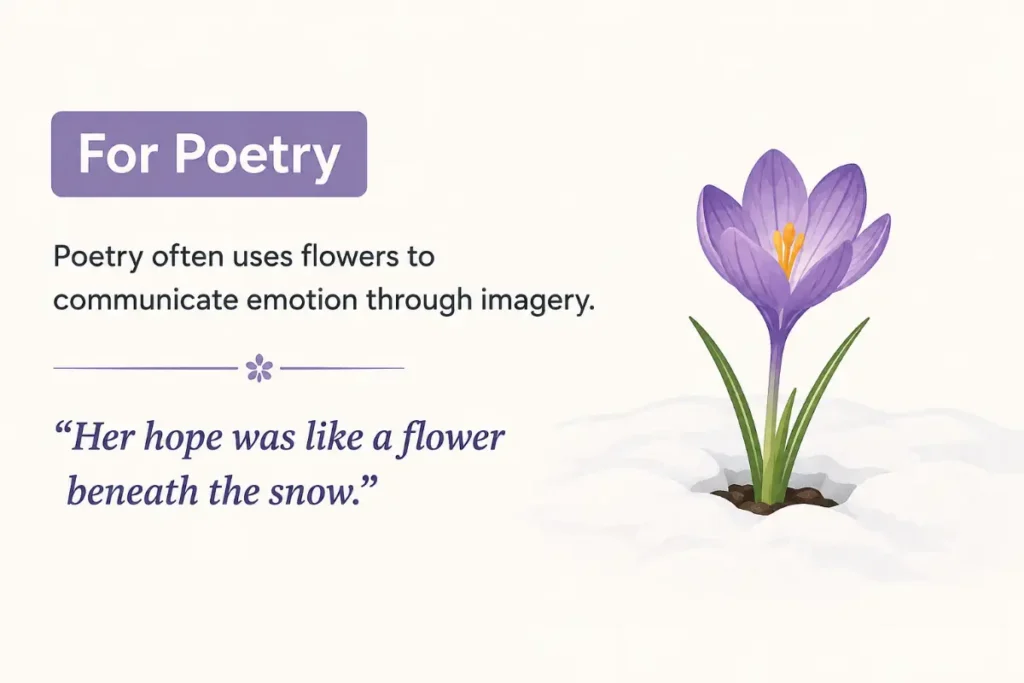
Poetry often uses flowers to communicate emotion through imagery.
“Her hope was like a flower beneath the snow.”
The reader understands that hope is present despite difficult circumstances.
Fiction
A novelist can use a flower simile to reveal personality.
“She entered the kitchen like a sunflower bringing summer with her.”
The comparison suggests warmth without directly stating that she was cheerful.
Greeting Cards
Flower comparisons can make messages sound personal.
“Your friendship is like a flower that becomes more beautiful with time.”
Social Captions
Short comparisons can make captions memorable.
“Growing like a wildflower.”
“Bright like a sunflower.”
“Soft as spring petals.”
Speeches
A flower image can make an abstract idea easier to remember.
“Hope can be like a small flower growing through difficult ground.”
The comparison turns an abstract concept into something visual.
How Flower Similes Affect Tone
The same subject can feel different depending on the flower.
Consider these descriptions of a person.
“She was like a rose.”
This may suggest beauty or romance.
“She was like a wildflower.”
This may suggest independence or natural charm.
“She was like a sunflower.”
This may suggest warmth and optimism.
“She was like a lily.”
This may suggest elegance or purity.
“She was like a lotus.”
This may suggest resilience and renewal.
The flower changes the emotional direction of the sentence. That makes flower selection an important part of effective descriptive writing.
Why Specificity Matters
Good similes often contain one clear point of comparison.
Consider:
“His voice was like a flower.”
The image is unclear because flowers have many qualities.
Now consider:
“His voice was as soft as lavender moving in a summer breeze.”
The comparison gives the reader a specific quality to notice.
The goal is not to make every simile complicated. Simple comparisons can be powerful when they are precise.
How To Avoid Clichés
Some flower comparisons have become extremely familiar.
“She is as beautiful as a rose.”
This is understandable but predictable.
You can make the idea fresher by changing the image.
“She had the quiet beauty of a wildflower growing beyond the garden fence.”
The second comparison gives the reader something more specific to imagine.
Originality often comes from combining a familiar flower with an unexpected setting.
A sunflower in a storm.
A daisy beside a railway track.
A rose growing through an old wall.
A lotus beneath gray rain.
A field of wildflowers under city lights.
These combinations can create stronger images because they contain contrast.
Using Flower Similes In Different Tones
Romantic Tone
Use roses, jasmine, lilies, and soft petals.
“Her voice was like jasmine opening in the evening.”
Cheerful Tone
Use sunflowers, daisies, tulips, and bright gardens.
“His laughter was like sunflowers dancing beneath summer light.”
Sad Tone
Use falling petals, fading flowers, empty gardens, or flowers beneath rain.
“Her memories were like petals carried away by autumn wind.”
Peaceful Tone
Use lavender, lilies, quiet gardens, ponds, and gentle blossoms.
“His thoughts settled like lavender beneath a calm evening sky.”
Strong Tone
Use wildflowers, roots, storm battered blossoms, and flowers growing through difficult ground.
“She stood like a wildflower refusing to surrender to the storm.”
Key Takeaways
- A simile makes a direct comparison using words such as like or as.
- Flower similes are effective because flowers offer rich images involving color, shape, scent, growth, beauty, and emotion.
- The strongest comparisons have a clear connection between the subject and the flower.
- Roses often work well for romance and beauty.
- Sunflowers often work well for warmth and optimism.
- Daisies can suggest innocence and simplicity.
- Lilies can suggest elegance and purity.
- Lavender can create a peaceful and gentle mood.
- Wildflowers can suggest freedom, individuality, and resilience.
- Lotuses can work well for renewal and strength.
- Avoid vague comparisons such as “She was like a flower” when a more specific image would help.
- Avoid repeating the same flower and comparison throughout a piece.
- Use flower similes to create an image rather than simply adding decoration.
- Specific details make comparisons more memorable.
- A strong simile should support the meaning and mood of the sentence.
Conclusion
Beautiful flower similes give writers a simple way to turn ordinary descriptions into vivid images. A flower can represent beauty, love, happiness, innocence, elegance, fragility, growth, hope, or resilience depending on the context. The strongest comparisons do not simply mention a flower. They connect a recognizable flower quality with the exact idea the writer wants to communicate.
The key is specificity. A rose can suggest romance, a sunflower can suggest warmth, a daisy can suggest innocence, lavender can suggest calmness, and a wildflower can suggest independence. You can also create fresh imagery by placing familiar flowers in unexpected settings such as storms, old gardens, city streets, quiet rooms, or open fields.
Use the 120 plus examples in this guide as inspiration rather than formulas. When you understand the quality behind a comparison, you can create your own original images that fit the mood, audience, and purpose of your writing. A well chosen flower simile can make a sentence bloom without making it feel forced.
FAQs
What Are Beautiful Flower Similes?
Beautiful flower similes are comparisons that use flowers to describe beauty, feelings, people, places, or experiences. They commonly use like or as. An example is “Her smile was like a sunflower opening to the morning.”
What Is A Good Flower Simile For A Beautiful Girl?
“She was like a wildflower blooming beside a quiet road” is a strong option. It suggests natural beauty and individuality without relying on a basic comparison such as “beautiful as a rose.”
What Is A Simile For A Beautiful Flower?
“A beautiful flower is like a small painting created by nature” is a clear simile. It compares the flower with a painting to emphasize color and visual beauty.
What Is A Simile For A Rose?
A simple example is “The rose was like a velvet jewel in the garden.” The comparison highlights the flower’s rich appearance and delicate texture.
What Is A Simile For A Sunflower?
“Her smile was like a sunflower turning toward the sun” is a natural comparison. It connects the sunflower with warmth, brightness, and happiness.
What Is A Simile For Love Using A Flower?
“Their love was like a rose that continued blooming through every season” compares lasting affection with continued flowering. It works especially well in romantic or reflective writing.
Can A Flower Simile Describe A Person?
Yes. Writers often compare people with flowers to describe appearance, personality, emotions, or growth. The flower should match the quality the writer wants to emphasize.
What Is The Difference Between A Flower Simile And A Flower Metaphor?
A flower simile makes the comparison using like or as. A metaphor makes the comparison directly. “Her smile was like a sunflower” is a simile, while “Her smile was a sunflower” is a metaphor.
What Flower Is Best For A Simile About Happiness?
Sunflowers are a strong choice because their bright appearance can support images of warmth, optimism, and cheerful energy. Daisies can also work well for simple and lighthearted happiness.
What Flower Is Best For A Simile About Strength?
A wildflower growing through difficult ground can create a powerful image of resilience. A lotus can also suggest renewal and strength in descriptive writing.
Are Flower Similes Good For Poetry?
Yes. Flowers provide strong visual and emotional imagery, which makes them useful in poetry. The most effective poetic comparisons usually connect the flower with a specific emotion or sensory detail.
How Do I Make A Flower Simile More Creative?
Choose a specific quality first, then select a flower that supports it. Add a setting, action, or sensory detail. For example, instead of “She was like a flower,” write “She was like a wildflower growing through a crack in an old stone wall.”

Idioms, Expressions & Figurative Language
Mason Ellsworth is an American language writer with a passion for English expressions, figurative language, and everyday communication. He explains idioms, similes, popular phrases, and commonly misunderstood expressions in a straightforward, engaging style that helps readers improve both their writing and spoken English.