
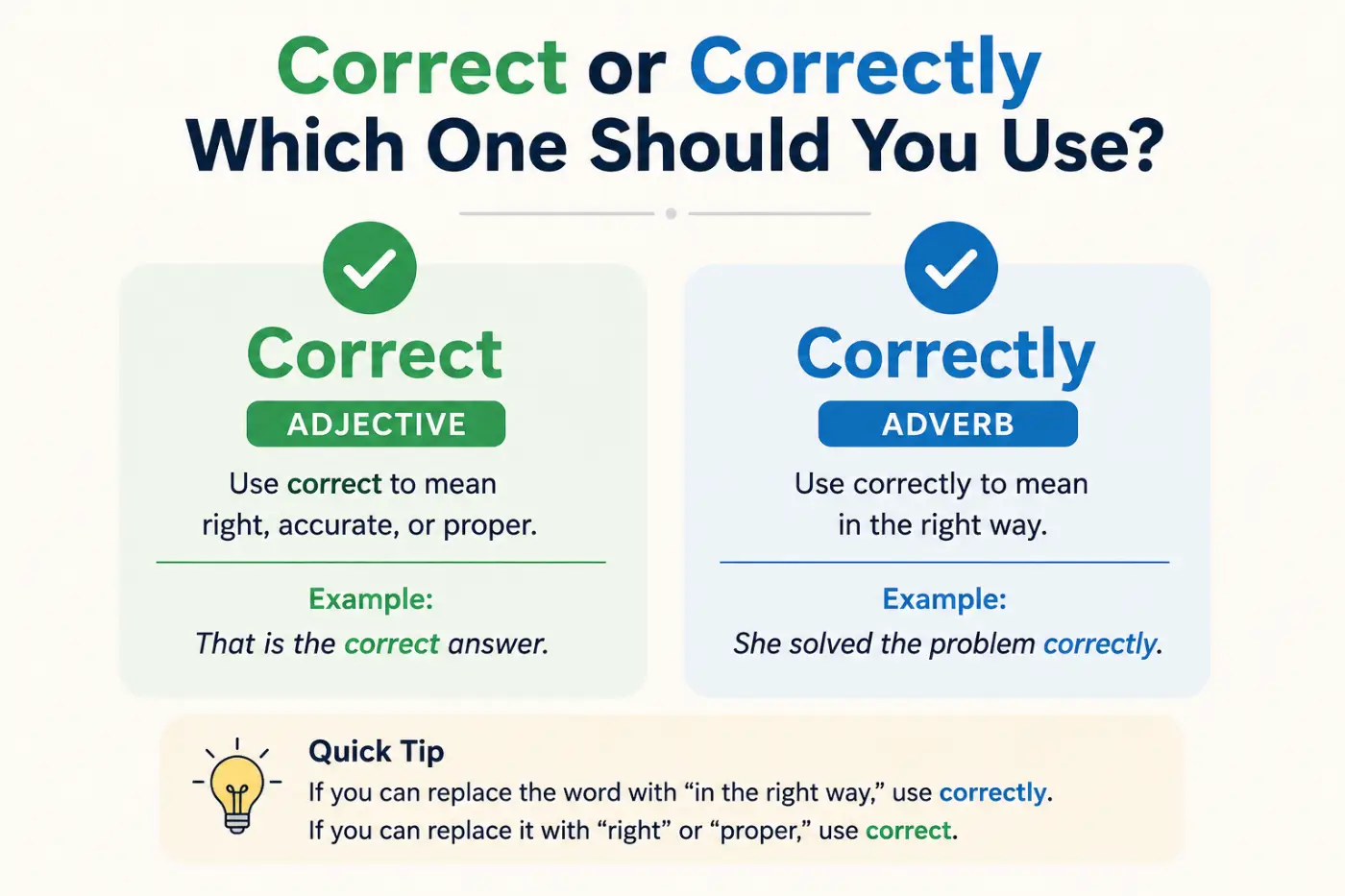
Correct or correctly can seem like interchangeable choices because both words express the idea of being right, accurate, or free from mistakes. They are closely related, but they do different jobs in a sentence. The main difference is grammatical: correct is most often an adjective, while correctly is an adverb.
This distinction becomes much easier once you look at what each word modifies. If you are describing a person, thing, answer, statement, action, or result, correct may be the word you need. If you are explaining how someone performs an action, correctly usually fits better.
For example, “She gave the correct answer” describes the answer. “She answered the question correctly” describes how she performed the action of answering. Both sentences communicate accuracy, but the words have different grammatical functions.
Short Answer
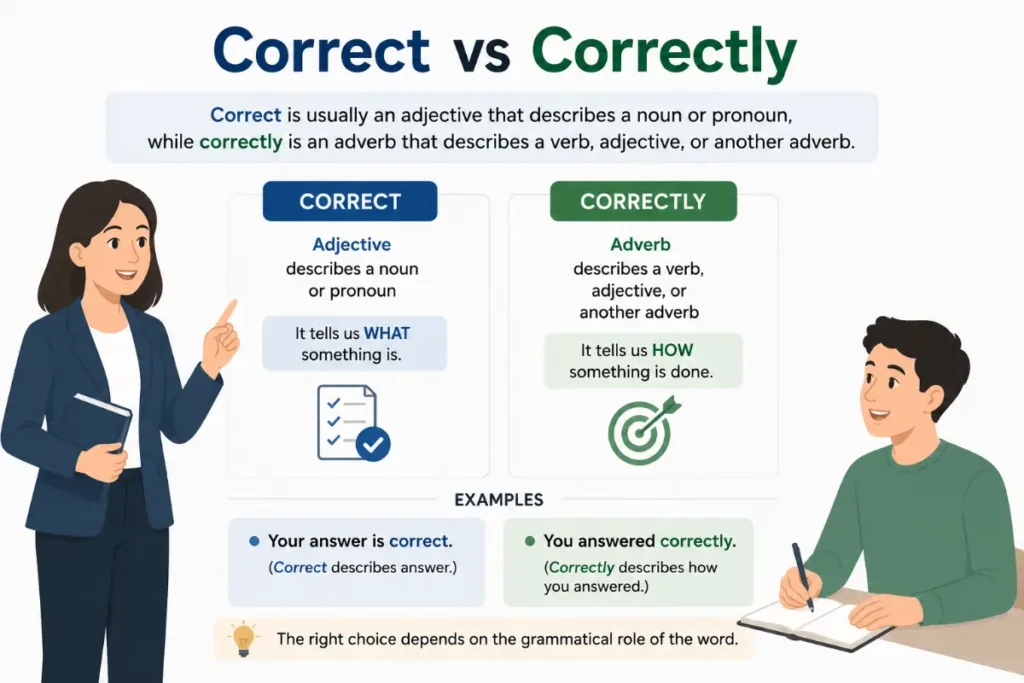
Correct is usually an adjective that describes a noun or pronoun, while correctly is an adverb that describes a verb, adjective, or another adverb. Say “Your answer is correct” because correct describes answer. Say “You answered correctly” because correctly describes how you answered. The right choice depends on the grammatical role of the word.
What Correct Means
Correct is primarily an adjective. An adjective describes or gives information about a noun or pronoun. When something is correct, it is accurate, right, true, or free from an error.
Consider these examples:
“Your answer is correct.”
The word correct describes your answer. Since answer is a noun, an adjective is appropriate.
“That is the correct address.”
Correct describes address. It tells us that the address is the right one.
“She gave me the correct information.”
Correct describes information and tells us that the information is accurate.
“The correct spelling is receive.”
Correct describes spelling. It identifies the accepted spelling of the word.
Correct can also appear after linking verbs such as be, seem, appear, look, and sound.
“Your explanation sounds correct.”
What Correctly Means
Correctly is an adverb. Adverbs commonly describe verbs by explaining how an action happens.
When correctly describes an action, it means in a right, accurate, or proper way.
“She answered correctly.”
Correctly tells us how she answered.
“He spelled the word correctly.”
Correctly explains how he spelled the word.
“They installed the software correctly.”
The Main Difference
The simplest distinction is this:
Correct describes something. Correctly describes how something is done.
Compare these sentences:
“Your answer is correct.”
“Your answer is written correctly.”
In the first sentence, correct describes answer. In the second sentence, correctly describes the action of writing.
Another useful comparison is:
“He is correct.”
“He answered correctly.”
The first sentence describes him or his position as being right. The second explains how he answered.
This difference is based on grammatical function rather than meaning alone. Both words relate to accuracy, but they operate differently inside the sentence.
A common mistake is to choose the word simply because it sounds natural. Instead, look at the word that needs description.
If you are describing a noun, use the adjective correct.
If you are describing an action, use the adverb correctly.
Correct or Correctly in a Sentence
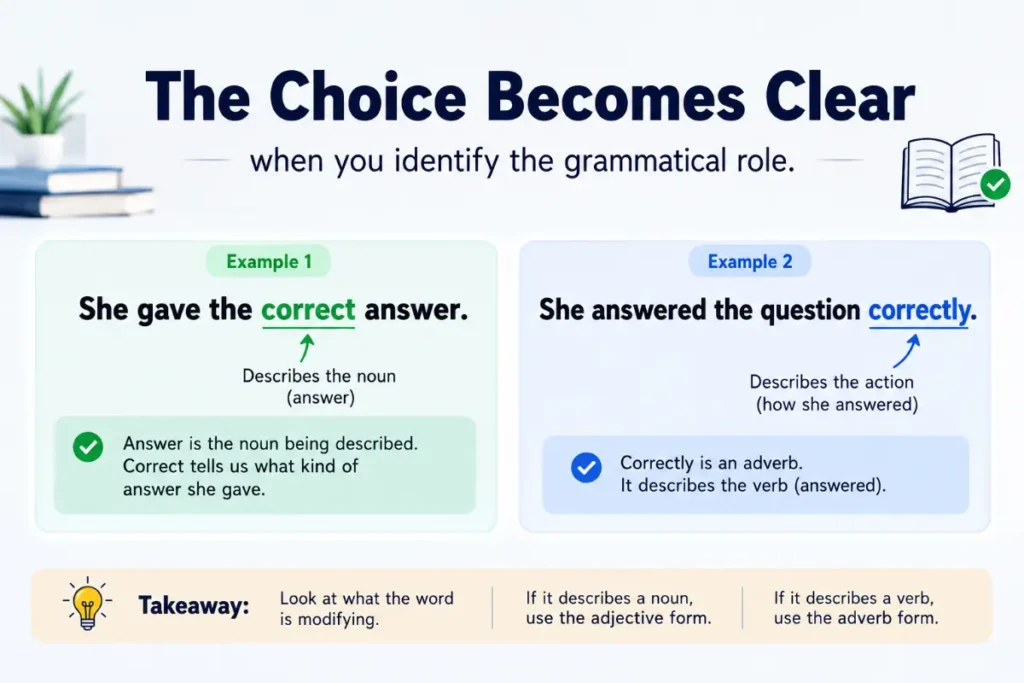
The choice becomes clear when you identify the grammatical role.
Consider “She gave the correct answer.”
Answer is the noun being described. Correct tells us what kind of answer she gave.
Now compare it with “She answered the question correctly.”
Answered is the action. Correctly tells us how she performed that action.
The same idea appears in many everyday sentences.
“The information is correct.”
Here, correct describes information.
“He entered the information correctly.”
Here, correctly describes the action of entering information.
“The spelling is correct.”
Correct describes spelling.
“She spelled the word correctly.”
Correctly describes the action of spelling.
“The pronunciation is correct.”
Correct describes pronunciation.
“She pronounced the word correctly.”
Correctly describes the action of pronouncing.
This pattern is one of the most reliable ways to choose between the two words.
Grammar Rules
Correct normally works as an adjective.
An adjective can appear before a noun.
“The correct answer was easy to find.”
It can also appear after a linking verb.
“The answer was correct.”
“Her explanation seems correct.”
“The result looks correct.”
Correctly normally works as an adverb.
An adverb can modify an action verb.
“He completed the form correctly.”
“She understood the instructions correctly.”
“They measured the room correctly.”
The grammatical difference can be summarized by asking what the word modifies.
If correct modifies a noun or pronoun, its adjective function is clear.
If correctly modifies a verb and explains the manner of an action, its adverb function is clear.
There is another useful point. English sometimes allows an adjective after certain verbs even though the adjective describes the subject. This is why “He is correct” is grammatical while “He answered correct” is generally considered nonstandard in formal American English.
The verb be is a linking verb. It connects the subject with information about that subject.
Answered is an action verb. An adverb is normally needed to explain how the action happened.
Comparison Table
| Feature | Correct | Correctly |
|---|---|---|
| Main part of speech | Adjective | Adverb |
| Basic meaning | Right or accurate | In a right or accurate way |
| Main function | Describes a noun or pronoun | Describes an action or verb |
| Common position | Before a noun or after a linking verb | Usually near the verb it modifies |
| Example | The answer is correct | She answered correctly |
| Question it can answer | Which one or what kind | How |
| Common pattern | correct answer | answer correctly |
| Related noun | correctness | correctness |
| Related verb | correct | correct |
The table shows the central distinction, but context still matters. Correct has several grammatical uses beyond the basic adjective pattern, and correctly is specifically useful when accuracy describes the manner of an action.
Real Life Examples
Understanding the difference becomes easier when you see how these words appear in ordinary communication.
School And Education
“Your answer is correct.”
Correct describes answer. The sentence evaluates the answer itself.
“You answered the question correctly.”
Correctly describes answered. The sentence evaluates the way the student answered.
“She chose the correct option.”
Correct describes option.
“He solved the equation correctly.”
Correctly describes solved.
“The spelling is correct.”
Correct describes spelling.
“She spelled the difficult word correctly.”
Correctly describes spelled.
These patterns are especially common in classrooms, tests, homework, tutoring, and educational writing.
Work And Business
“Please make sure the information is correct.”
Correct describes information.
“Please enter the information correctly.”
Correctly describes the action of entering information.
“The report contains the correct figures.”
Correct describes figures.
“The figures were calculated correctly.”
Correctly describes calculated.
“Your contact details are correct.”
Correct describes details.
“You entered the contact details correctly.”
Correctly describes entered.
The distinction is useful in professional writing because it prevents vague or grammatically awkward sentences.
Technology
“The password is correct.”
Correct describes password.
“You entered the password correctly.”
Correctly describes entered.
“The settings are correct.”
Correct describes settings.
“You configured the settings correctly.”
Correctly describes configured.
“The file name is correct.”
Correct describes file name.
“You named the file correctly.”
Correctly describes named.
Everyday Conversation
“That is the correct street.”
Correct describes street.
“You turned correctly at the intersection.”
Correctly describes turned.
“Your phone number is correct.”
Correct describes phone number.
“You typed the number correctly.”
Correctly describes typed.
“His pronunciation is correct.”
Correct describes pronunciation.
“He pronounced the name correctly.”
Correctly describes pronounced.
These examples show why the two words can appear close together in meaning while still performing different grammatical jobs.
Common Mistakes
One of the most common errors is using correct after an ordinary action verb when an adverb is needed.
A nonstandard sentence in formal American English would be:
“She answered the question correct.”
The standard form is:
“She answered the question correctly.”
Correctly modifies answered, so the adverb is appropriate.
Another common mistake is using correctly after a linking verb.
For example:
“Your answer is correctly.”
That sentence is not standard because is connects the subject answer with a description of the answer. The adjective correct is needed.
“The answer is correct.”
This is the standard construction.
A third mistake happens when writers focus only on meaning and ignore grammar. Since correct and correctly both relate to accuracy, it can be tempting to use them interchangeably. English grammar does not work that way.
Compare:
“He gave the correct response.”
“He responded correctly.”
Correct describes response.
Correctly describes responded.
Another mistake occurs in questions.
“Did I do it correct?”
In casual speech, some speakers use correct in this pattern, but standard edited American English generally prefers:
“Did I do it correctly?”
The adverb describes the action of doing.
The same principle applies to writing intended for school, work, professional communication, publishing, or formal documents.
Correct And Correctly With Verbs
The easiest way to understand the difference is to look at the verb. With an action verb, correctly often describes how the action is performed.
“He completed the task correctly.”
“Please pronounce the word correctly.”
“She calculated the amount correctly.”
“They followed the procedure correctly.”
“We interpreted the instructions correctly.”
In each sentence, correctly gives information about the action.
Now look at adjective constructions:
“He gave the correct answer.”
“She selected the correct option.”
“They used the correct procedure.”
“We received the correct information.”
In these examples, correct describes a noun.
A useful transformation can help you see the relationship.
“She gave the correct answer.”
“She answered correctly.”
These sentences have similar meanings but different structures.
“He made the correct decision.”
“He decided correctly.”
“The technician performed the correct procedure.”
“The technician performed the procedure correctly.”
The last pair is especially useful because both forms can appear in the same sentence.
“The technician performed the correct procedure correctly.”
The first correct describes procedure. The second correctly describes performed.
This kind of sentence is grammatically possible, although repeating the same idea can make it sound less elegant. A writer might instead say:
“The technician followed the proper procedure accurately.”
Correct And Correctly With Be
Be is one of the most important verbs to understand in this comparison. Use correct after be when correct describes the subject.
“The answer is correct.”
“Your calculation is correct.”
“His statement was correct.”
“The information appears correct.”
“Her pronunciation seems correct.”
Correct works because these are descriptions of the subject.
Do not automatically replace correct with correctly just because the sentence contains a verb.
The question is not simply “Is there a verb?” Every complete English sentence normally contains a verb. The useful question is “What kind of verb is it, and what is being described?”
With linking verbs such as be, seem, appear, become, remain, and look, an adjective can describe the subject.
“The result seems correct.”
“The answer looks correct.”
“The information remains correct.”
In each example, correct is linked to the subject.
Correctly As An Adverb
Correctly describes an action performed in an accurate or proper manner. it can appear in many positions, depending on the sentence.
“She correctly identified the problem.”
“She identified the problem correctly.”
Both sentences are grammatical. The first places correctly before the main verb, while the second places it after the object.
“He correctly entered the number.”
“He entered the number correctly.”
Again, both forms work.
In short sentences, correctly often appears after the verb.
“You did it correctly.”
“She answered correctly.”
“They understood correctly.”
In longer sentences, its position can change for emphasis or clarity.
“The student correctly identified the main argument in the passage.”
Here correctly comes before identified.
The choice of position is usually a matter of style and sentence rhythm rather than a change in meaning.
Correctly can also modify a participle or another adverbial idea in more complex structures.
“He was correctly identified as the author.”
Here correctly modifies identified and indicates that the identification was accurate.
Correct As An Adjective
Correct can appear before nouns.
“Use the correct form.”
“Choose the correct answer.”
“Find the correct spelling.”
“Enter the correct number.”
“Give the correct address.”
In each case, correct tells us which form, answer, spelling, number, or address is right.
Correct can also appear after linking verbs.
“The form is correct.”
“The answer seems correct.”
“Your interpretation is correct.”
“His conclusion was correct.”
This position is called the predicative use of an adjective. The adjective follows a linking verb and describes the subject.
Correct can also be used with degree words.
“Completely correct.”
“Absolutely correct.”
“Almost correct.”
“Partly correct.”
“Technically correct.”
These expressions show that correctness can sometimes be discussed in degrees.
For example:
“Your answer is technically correct.”
This can mean that the answer meets the technical requirement even though it may not be the most useful or complete answer in context.
Correct And Correctly In Questions
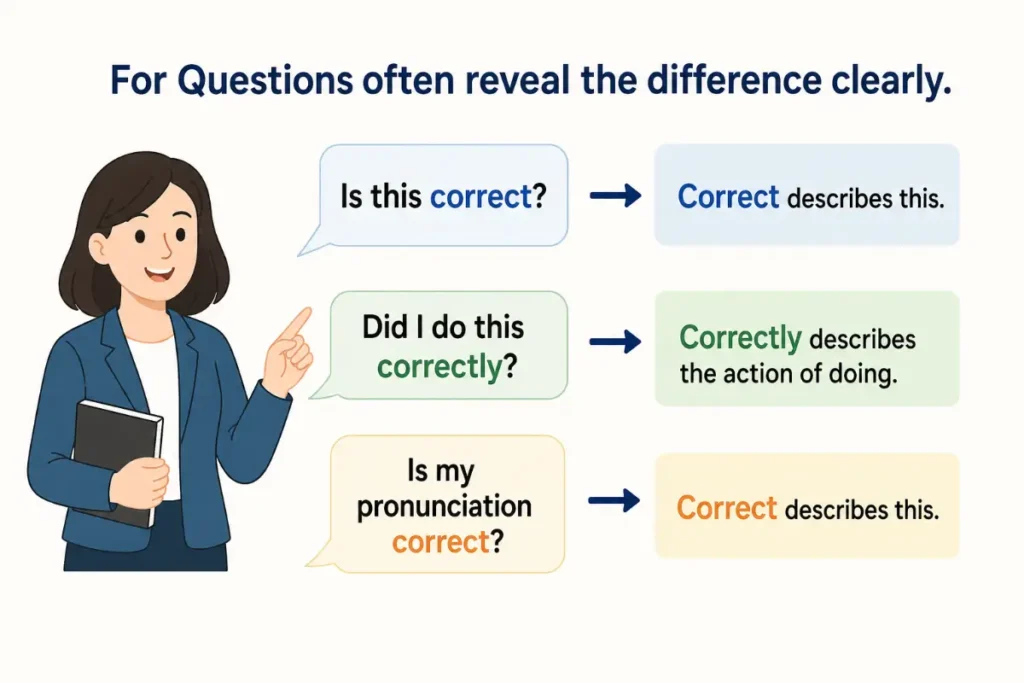
Questions often reveal the difference clearly.
“Is this correct?”
Correct describes this.
“Did I do this correctly?”
Correctly describes the action of doing.
“Is my pronunciation correct?”
Correct describes pronunciation.
“Did I pronounce it correctly?”
Correctly describes pronounce.
“Is this the correct address?”
Correct describes address.
“Did I enter the address correctly?”
Correctly describes enter.
This distinction is useful when checking work because the question can focus on the result or the action.
If you are checking the result, ask if it is correct.
If you are checking the performance of an action, ask if it was done correctly.
Pronunciation
Correct is commonly pronounced /kəˈrekt/ in American English.
Correctly is commonly pronounced /kəˈrektli/.
The main stress falls on the second syllable in correct.
The pronunciation difference is not usually the source of confusion. The greater challenge is grammatical function. When speaking, correctly contains the same core sound as correct followed by the adverb ending ly.
Word Origin
Correct ultimately comes from Latin roots associated with making straight, putting right, or setting right. English developed the word through French influence, and it has been used for ideas of accuracy and freedom from error for centuries.
Correctly is simply the adverbial form of correct.
The relationship between the words is therefore straightforward. One is primarily an adjective, while the other is the corresponding adverb.
Understanding their word family can make other related forms easier to recognize.
Correct can be a verb.
Correct is commonly an adjective.
Correctly is an adverb.
Correctness is a noun.
Correction is a noun.
Corrective is an adjective.
These words are related, but each one has its own grammatical role.
American And British English
Correct and correctly are standard in both American and British English. There is no major regional spelling difference between the two forms. The grammatical distinction is also essentially the same in both varieties.
American English uses:
“Your answer is correct.”
“You answered correctly.”
British English uses the same structures.
“The answer is correct.”
“She answered correctly.”
Informal speech can sometimes differ from formal written English in both varieties. Some speakers may use an adjective after an action verb in casual conversation, but edited writing generally follows the standard adjective and adverb distinction.
For learners of English, the safest approach is to use correct for descriptions and correctly for the manner of an action.
Formal And Informal Usage
Correct is common in both casual and formal English.
“You’re correct.”
“That information is correct.”
“This is the correct answer.”
Correctly is also common in both styles.
“You did it correctly.”
“She correctly explained the issue.”
“Please complete the form correctly.”
The difference is not mainly about formality. It is about grammar.
In professional writing, the distinction becomes particularly important because edited English expects adjectives and adverbs to perform their appropriate roles.
For example:
“Please ensure that the information is correct.”
This focuses on the information.
“Please ensure that you enter the information correctly.”
This focuses on the action.
Both sentences can be appropriate in a professional setting, but they communicate slightly different things.
Correct Or Correctly In Common Expressions
Several common expressions use correct because the word describes a noun or follows a linking verb.
“the correct answer”
“the correct spelling”
“The answer is correct.”
“Your interpretation is correct.”
“His statement was correct.”
Common expressions with correctly often describe actions.
“spell it correctly”
“pronounce it correctly”
“answer correctly”
“use it correctly”
“write it correctly”
“enter it correctly”
“calculate it correctly”
“follow the instructions correctly”
“understand it correctly”
These patterns are worth learning as complete phrases. Once you recognize them, choosing the right form becomes much more automatic.
When Correct Can Describe A Person
Correct can describe a person’s statement, opinion, answer, or judgment.
“You are correct.”
This means that what you said or believe is right.
“She was correct about the cause.”
This means her statement or judgment was accurate.
“He is correct.”
This can mean that his answer, claim, interpretation, or position is right in the context.
Some learners incorrectly assume that an adverb must describe the person because a person is involved. That is not how the grammar works.
In “You are correct,” correct does not describe an action. It describes the subject through the linking verb are.
In “You answered correctly,” correctly describes the action of answering.
The difference becomes obvious once the verb is considered.
Correctly With Different Types Of Actions
Correctly can describe many kinds of actions.
Speaking
“She pronounced the word correctly.”
Correctly describes pronounced.
Writing
“He wrote the sentence correctly.”
Correctly describes wrote.
Reading
“She read the instructions correctly.”
Correctly describes read.
Calculating
“They calculated the total correctly.”
Correctly describes calculated.
Entering Information
“I entered the number correctly.”
Correctly describes entered.
Following Directions
“We followed the directions correctly.”
Correctly describes followed.
Understanding
“He understood the question correctly.”
Correctly describes understood.
Using Something
“She used the word correctly.”
Correctly describes used.
These examples show how broadly useful the adverb is.
How To Choose The Right Word
Use a simple three step test.
First, identify the word you want to describe.
Second, ask if that word is a noun or pronoun.
Third, ask if you are describing an action.
If you are describing a noun or pronoun, correct is usually appropriate.
If you are describing how an action happens, correctly is usually appropriate.
For example:
“The answer is correct.”
What is being described?
Answer.
Answer is a noun.
Use correct.
“She answered correctly.”
What is being described?
Answered.
Answered is an action.
Use correctly.
This test works in most everyday situations.
A Useful Sentence Transformation
One of the best ways to understand this distinction is to transform sentences.
Start with:
“He gave the correct answer.”
Now focus on the action rather than the noun:
“He answered correctly.”
Start with:
“She gave the correct pronunciation.”
Now focus on the action:
“She pronounced it correctly.”
Start with:
“They used the correct method.”
Now focus on the action:
“They used the method correctly.”
Notice that the meaning remains closely related, but the grammatical structure changes.
This technique can help English learners recognize the relationship between adjectives and adverbs.
Common Incorrect Patterns
Here are several patterns that often cause trouble.
“Please do it correct.”
Standard edited English prefers:
“Please do it correctly.”
“Did I write it correct?”
Standard edited English prefers:
“Did I write it correctly?”
“She answered correct.”
Standard edited English prefers:
“She answered correctly.”
Now consider the opposite problem:
“The answer is correctly.”
The standard form is:
“The answer is correct.”
“Your spelling is correctly.”
The standard form is:
“Your spelling is correct.”
“His explanation seems correctly.”
The standard form is:
“His explanation seems correct.”
The important point is not to memorize isolated corrections. Learn the grammatical pattern behind them.
Can Correct And Correctly Be Interchanged
Usually, no.
They are related forms, but they are not normally interchangeable.
“The answer is correct.”
This is standard.
“The answer is correctly.”
This is not standard.
“She answered correctly.”
This is standard.
“She answered correct.”
This is generally nonstandard in formal American English.
However, English has many dialectal and conversational patterns, and informal speech can sometimes differ from edited written standards. That does not change the recommended form for formal writing.
For schoolwork, professional documents, articles, business communication, and careful writing, follow the adjective and adverb distinction.
Memory Tips
A simple memory trick is:
Correct describes a thing. Correctly describes an action.
Think of these pairs:
“correct answer”
“answer correctly”
“correct spelling”
“spell correctly”
“correct pronunciation”
“pronounce correctly”
“correct information”
“enter information correctly”
Another trick is to ask a question.
If you can ask “Which answer?” or “What kind of answer?” you probably need correct.
If you can ask “How did she answer?” you probably need correctly.
For example:
Which answer?
The correct answer.
How did she answer?
She answered correctly.
This small test can prevent many common mistakes.
Related Grammar Notes
Correct and correctly belong to the same word family, but English uses related forms for different grammatical purposes. Correct is an adjective when it describes a noun or pronoun. It can also be a verb meaning to fix an error.
Correctly is an adverb meaning in a correct or accurate manner. Correctness is a noun referring to the quality of being correct. Correction is a noun referring to an act of correcting an error. Corrective is an adjective describing something intended to correct a problem. These relationships are useful because English frequently changes word forms to show grammatical function.
Consider:
“Her answer was correct.”
“Her answer was written correctly.”
“The teacher corrected her answer.”
“The correction was helpful.”
“The teacher explained the correctness of the result.”
Each sentence uses a related form for a different purpose.
Correctness And Accuracy
Correct and correctly are closely connected to the ideas of accuracy and precision, but the words are not always identical in every context. Correct usually means that something agrees with a standard, fact, rule, answer, or accepted form. Accurate often emphasizes factual precision or closeness to the truth.
For example:
“The answer is correct.”
“The measurement is accurate.”
Both words can overlap, but context determines the best choice.
Correctly can describe an action performed according to the proper rule or method.
“She correctly identified the error.”
Accurately can emphasize precise representation.
“She accurately described the error.”
The difference is subtle, but useful for advanced writers.
Professional Writing Tips
Professional writing benefits from choosing the form that clearly identifies the intended meaning.
Compare:
“Make sure the address is correct.”
This asks the reader to verify the address.
“Make sure you enter the address correctly.”
This asks the reader to perform the entry accurately.
The second sentence is more useful when the concern is the process.
Another example:
“Please confirm that the figures are correct.”
This focuses on the figures.
“Please check that the figures were calculated correctly.”
This focuses on the calculation.
Good writing often depends on these small distinctions. A precise word can make an instruction clearer without making the sentence longer.
Why Learners Confuse These Words
The confusion is understandable because correct and correctly share the same root and almost the same basic meaning.
Many languages form adjectives and adverbs differently, so learners may not immediately recognize the English pattern.
English also has some unusual adjective and adverb pairs. Not every adverb follows a simple rule, and not every word ending in ly is an adverb.
Still, correct and correctly are relatively straightforward because their relationship is regular.
Correct is the adjective.
Correctly is the adverb.
Once you connect each form to its grammatical function, the difference becomes much easier to remember.
Quick Practice
Choose the appropriate word in each sentence.
“The answer is correct.”
“You answered correctly.”
“Please use the correct form.”
“Please complete the form correctly.”
“Her pronunciation is correct.”
“She pronounced the word correctly.”
“The information is correct.”
“He entered the information correctly.”
“The calculation looks correct.”
“She calculated the total correctly.”
The pattern should now be clear. Correct describes a result, object, person, statement, or other noun based on context. Correctly describes the manner in which an action is performed.
Key Takeaways
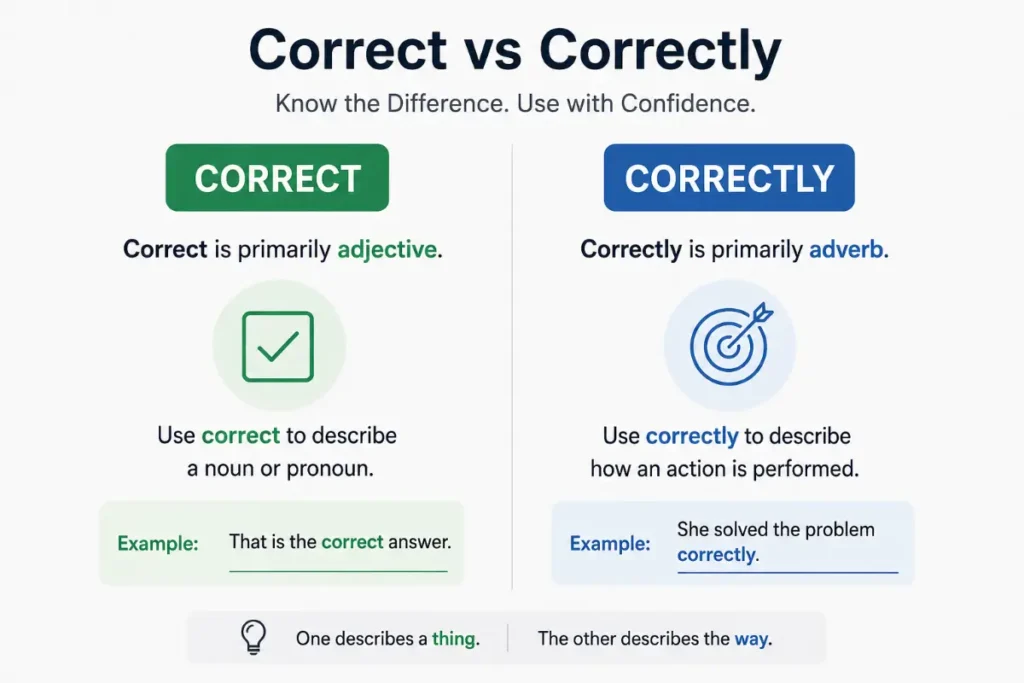
Correct is primarily an adjective.
Correctly is an adverb.
Use correct to describe a noun or pronoun.
Use correctly to describe how an action is performed.
Say “The answer is correct.”
Say “She answered correctly.”
Correct can also function as a verb meaning to fix an error. Correct and correctly are standard in both American and British English. The easiest memory rule is simple: correct describes something, while correctly describes how something is done.
Conclusion
Correct or correctly becomes much easier once you focus on grammar instead of meaning alone. Both words express accuracy, but correct is primarily an adjective and correctly is an adverb.
Use correct when you describe a noun or pronoun, as in “the correct answer” or “Your answer is correct.” Use correctly when you describe an action, as in “She answered correctly” or “He spelled the word correctly.”
The best way to remember the distinction is to connect each form with its job. Correct describes the thing. Correctly explains how the action happens. Once you recognize that pattern, sentences such as “The information is correct” and “You entered the information correctly” become easy to construct naturally and accurately.
Frequently Asked Questions
Is correct an adjective or an adverb?
Correct is primarily an adjective. It describes a noun or pronoun, as in “the correct answer” or “The answer is correct.” Correct can also function as a verb, meaning to fix or point out an error.
Is correctly an adjective or an adverb?
Correctly is an adverb. It commonly describes a verb and explains that an action was performed in the right or accurate way. For example, “She answered correctly” uses correctly to describe answered.
Should I say I did it correct or I did it correctly?
For standard edited American English, say “I did it correctly.” Correctly describes the action of doing. Correct is normally used as an adjective, not as the standard adverb in this sentence.
Is it correct or is it correctly?
Say “It is correct” when you are describing something as right or accurate. Correct follows the linking verb is and describes the subject. “It is correctly” is normally incomplete or ungrammatical because correctly is an adverb.
Is the answer correct or correctly?
Say “The answer is correct.” Correct describes the noun answer after the linking verb is. If you want to describe the action of answering, say “She answered correctly.”
Can correct be used as a verb?
Yes. Correct can be a verb meaning to fix an error or make something right. For example, “Please correct the spelling mistake.” The past tense is corrected.
What is the easiest way to remember correct and correctly?
Remember this pattern: correct answer and answer correctly. Correct describes a thing, while correctly describes how an action is performed. You can also ask “What kind?” for correct and “How?” for correctly.
Are correct and correctly used differently in British English?
The basic grammatical distinction is the same in British and American English. Correct is primarily an adjective, while correctly is an adverb. Both forms are standard in both varieties.
Is correct formal English?
Yes. Correct is standard in casual, professional, academic, and formal English. Its level of formality depends on the sentence rather than the word itself.
Is correctly always placed after the verb?
No. Correctly can appear before or after the main verb, depending on sentence structure and emphasis. “She correctly answered the question” and “She answered the question correctly” are both grammatical.

English Grammar & Usage
Nathan Holloway is an American grammar writer and language researcher who specializes in English grammar, sentence structure, verb usage, and common writing mistakes. He enjoys breaking down confusing grammar rules into practical explanations with clear examples, making English easier for students, professionals, and everyday writers.