
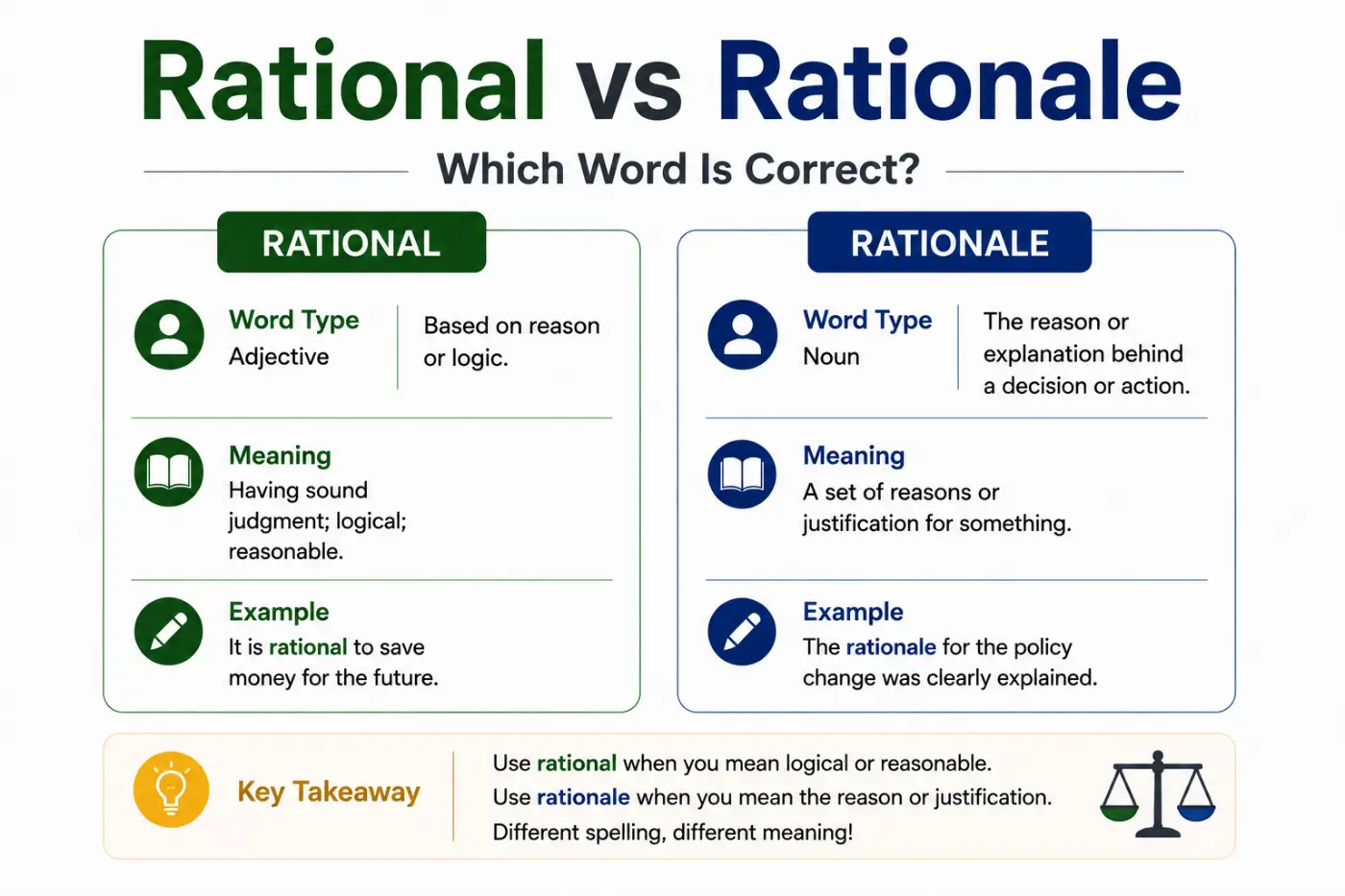
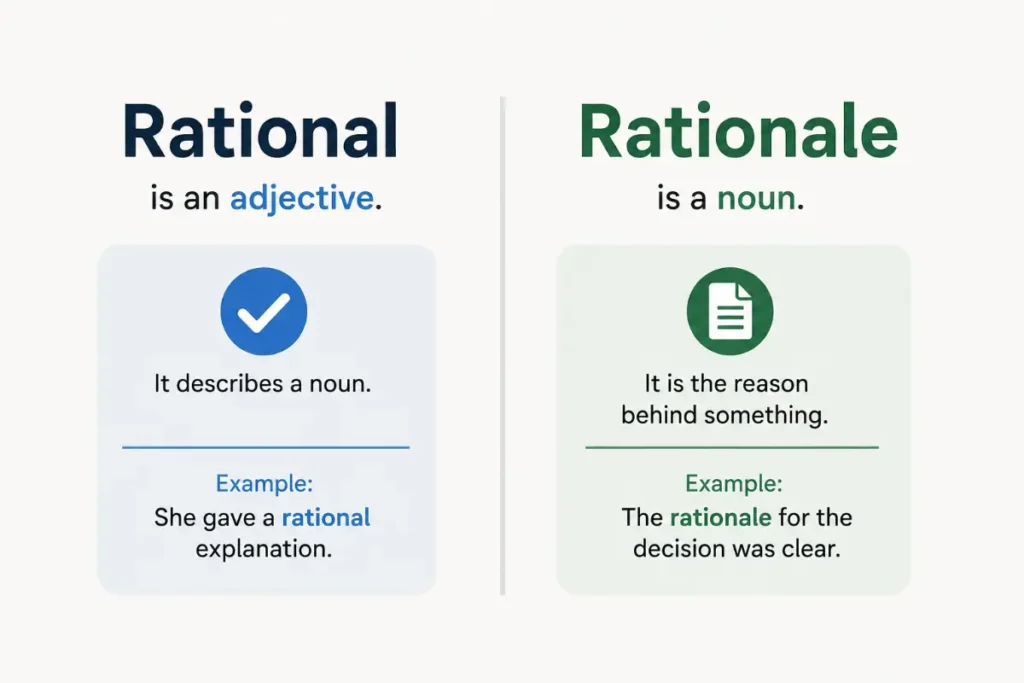
Rational vs rationale is a common word choice problem because both words are connected to reason logic and thoughtful decision making. They even begin with the same letters which makes it easy to reach for the wrong one while writing quickly. The simple rule is this. Rational is an adjective that describes something as reasonable or logical. Rationale is a noun that names the reason or explanation behind a decision or action.
Think of the two words as answering different questions. If you’re asking what kind of decision something is you might call it rational. If you’re asking why someone made that decision you’re looking for the rationale. For example you can write The manager made a rational decision. You can also write The manager explained the rationale for the decision. The first sentence describes the decision. The second identifies its underlying reason.
This distinction matters in everyday writing but it becomes especially useful in reports emails academic papers workplace communication and formal arguments. In this guide you’ll learn exactly how each word works where the terms came from how native speakers use them common mistakes to avoid and practical ways to remember the difference. By the end you’ll be able to choose the right word without stopping to second guess yourself.
Short Answer
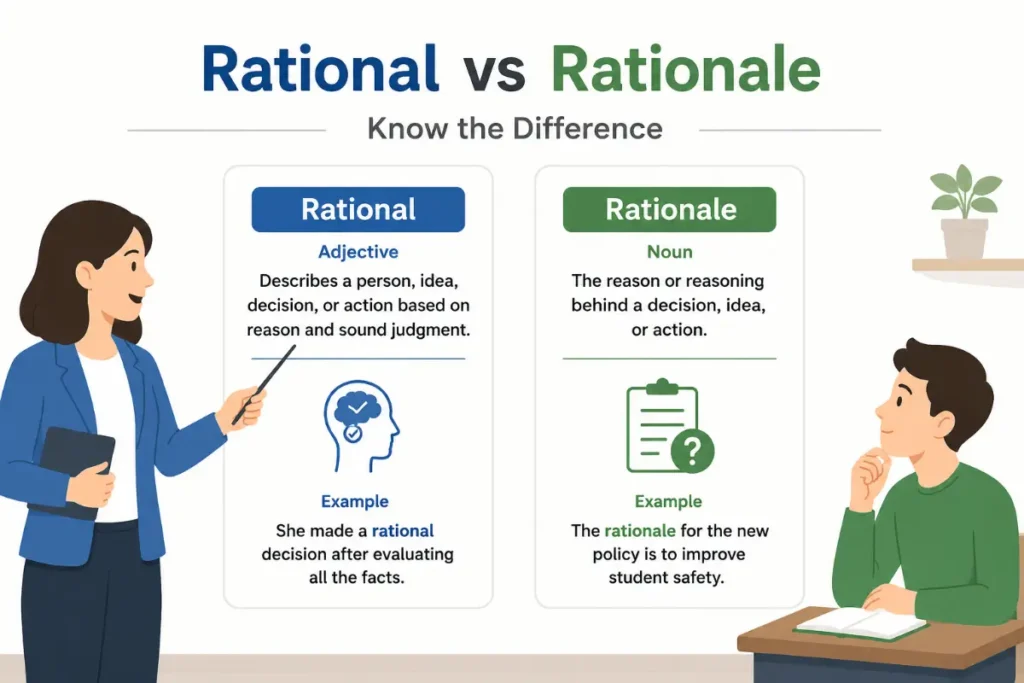
Rational is an adjective that describes a person idea decision or action based on reason and sound judgment. Rationale is a noun that means the reason or reasoning behind a decision idea or action. You can say a decision is rational but you need to explain the rationale behind that decision. The words are related but they don’t have the same grammatical role.
Table Of Contents
- The Basic Difference.
- What Rational Means.
- What Rationale Means.
- How The Two Words Relate.
- Rational vs Rationale In Grammar.
- Comparison Table.
- How To Use Rational Correctly.
- How To Use Rationale Correctly.
- Examples In Real Writing.
- Common Mistakes.
- Rational And Rationale In Professional Writing.
- Rational And Rationale In Academic Writing.
- Pronunciation Guide.
- Word Origin.
- Related Words.
- Memory Tips.
- Expert Editor Advice.
- Key Takeaways.
- FAQs.
- Conclusion.
The Basic Difference
The easiest way to understand the difference is to focus on part of speech.
Rational is an adjective.
Rationale is a noun.
An adjective describes something.
A noun names something.
So you might write:
The proposal is rational.
Here rational describes the proposal.
You might then write:
The proposal has a clear rationale.
Here rationale names the reasoning behind the proposal.
The two words often appear in the same conversation because a rational decision usually has a rationale. Still they cannot simply replace each other.
Compare these sentences:
The committee made a rational choice.
The committee explained its rationale.
The first sentence tells you the quality of the choice. The second tells you the reasoning that produced the choice.
That small grammatical distinction does most of the work.
What Rational Means
Rational means based on reason logic or sensible judgment. It describes something that follows a reasonable thought process rather than impulse confusion or unsupported emotion.
For example:
She made a rational decision.
The sentence describes her decision as reasonable.
You could also say:
His argument was rational and well supported.
Here the adjective describes the argument.
The word can describe people too:
She remained rational during the crisis.
This means she continued to think clearly and make reasonable judgments.
The word can also describe behavior:
The company took a rational approach to the problem.
The focus is on the quality or nature of the approach.
In everyday speech rational often means sensible.
For example:
It isn’t rational to spend twice as much for the same service.
The speaker means that the choice doesn’t make good sense.
In technical contexts the meaning can become more specific. In mathematics a rational number is a number that can be expressed as a ratio of integers. That mathematical meaning is related historically to the broader idea of ratio and reason but it doesn’t mean sensible in the everyday sense.
What Rationale Means
Rationale is a noun. It means the reason reasoning or underlying explanation for a decision policy action argument or choice.
For example:
The manager explained the rationale for the new schedule.
The sentence doesn’t say that the schedule is reasonable. It tells us that the manager explained the reasoning behind it.
Another example:
The report provides a detailed rationale for the recommendation.
Here rationale refers to the explanation supporting the recommendation.
You can think of a rationale as the answer to the question Why?
Why did the company change the policy?
The rationale was that the old policy created unnecessary delays.
Why did the researcher choose this method?
The rationale was that the method produced more reliable results.
This makes the word especially useful in professional and academic writing. It gives you a concise way to refer to the reasoning behind a decision.
How The Two Words Relate
These words share a linguistic family.
Both are connected to the idea of reason and rational thought. Their related meanings explain why writers sometimes confuse them.
But related words don’t always perform the same grammatical job.
Consider the pair:
logical and logic.
Logical is an adjective.
Logic is a noun.
You can say:
The argument is logical.
You can say:
The argument has sound logic.
You can’t normally swap the words.
The same principle applies here.
Rational describes.
Rationale names the reasoning.
This is one reason learning vocabulary by word family can be useful. It helps you see relationships between words while still paying attention to grammar.
Rational vs Rationale In Grammar
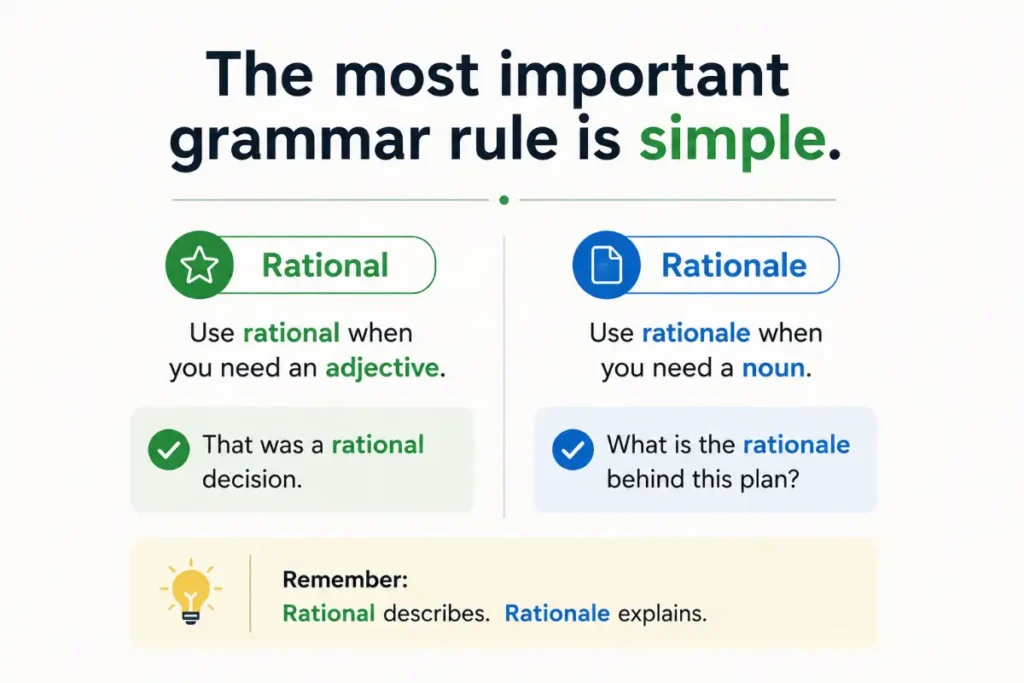
The most important grammar rule is simple.
Use rational when you need an adjective.
Use rationale when you need a noun.
Rational As An Adjective
An adjective can come before a noun.
For example:
She proposed a rational solution.
Here rational modifies solution.
An adjective can also come after a linking verb.
For example:
The solution seems rational.
Here rational describes the subject.
Other common patterns include:
The decision was rational.
His response remained rational.
Their approach is rational.
The argument sounds rational.
Rationale As A Noun
A noun can appear after determiners such as the or a.
For example:
The rationale was clear.
The report included a rationale.
It can also follow possessive words.
For example:
Her rationale was convincing.
The company’s rationale was explained in the report.
The noun often appears with for.
For example:
The rationale for the decision was explained.
The rationale for the policy remains unclear.
This structure is extremely common in professional writing.
A Simple Grammar Test
Try placing is before the word.
If the sentence works naturally with the meaning of reasonable or logical you probably need rational.
For example:
The decision is rational.
That works.
Now try:
The decision is rationale.
That doesn’t work.
Instead you could write:
The rationale for the decision is clear.
The test isn’t a complete grammar rule but it can help you quickly identify the adjective.
Comparison Table
| Word | Part Of Speech | Core Meaning | Common Pattern | Example |
|---|---|---|---|---|
| Rational | Adjective | Reasonable or logical | rational decision | She made a rational decision. |
| Rationale | Noun | Reason or reasoning behind something | rationale for | The rationale for the decision was clear. |
| Rationality | Noun | The quality of being rational | rationality of | The study examined the rationality of the choice. |
| Rationally | Adverb | In a rational way | think rationally | Try to think rationally. |
| Rationalize | Verb | To provide or construct reasons for something | rationalize a decision | He tried to rationalize his choice. |
| Reasonable | Adjective | Fair sensible or acceptable | reasonable decision | That seems like a reasonable decision. |
| Reasoning | Noun | The process of thinking through something | reasoning behind | I understand the reasoning behind it. |
How To Use Rational Correctly
Use rational when you’re describing a person thought decision action argument plan or response as reasonable and based on logic.
Here are several natural examples.
Example One
The board made a rational decision.
Why it works: Rational describes the decision.
Example Two
He remained rational despite the pressure.
Why it works: Rational describes his state of mind and behavior.
Example Three
We need a rational solution to the problem.
Why it works: Rational describes the type of solution being sought.
Example Four
Her explanation sounds rational.
Why it works: Rational comes after the linking verb sounds and describes her explanation.
Example Five
It was rational to postpone the launch.
Why it works: Rational describes the decision to postpone the launch as reasonable.
The word often carries a positive meaning because it suggests careful thought. However the context can change the tone.
For example:
He gave a rational explanation but showed no empathy.
Here rational remains positive in terms of logic but the sentence suggests that logic alone wasn’t enough.
How To Use Rationale Correctly
Use rationale when you’re talking about the reason or reasoning behind something.
Example One
The report explains the rationale for the change.
Why it works: Rationale names the reasoning supporting the change.
Example Two
What is the rationale behind this decision?
Why it works: The speaker is asking why the decision was made.
Example Three
The committee provided a detailed rationale.
Why it works: Rationale is the noun naming the explanation.
Example Four
I understand the rationale for the new policy.
Why it works: The speaker understands the reasoning behind the policy.
Example Five
The rationale wasn’t convincing.
Why it works: Rationale refers to the explanation or reasoning itself.
A useful pattern to remember is:
rationale for something
For example:
The rationale for the investment.
The rationale for the recommendation.
You can also use:
rationale behind something
For example:
The rationale behind the change.
The rationale behind the strategy.
Both patterns are common although rationale for is often the cleaner choice in formal writing.
Examples In Real Writing
Everyday Conversation
- That sounds like a rational choice.
This describes the choice as sensible.
- I understand your rationale.
This means I understand your reason for making the choice.
Workplace Communication
- We need a rational approach to this problem.
The adjective describes the approach.
- Please explain the rationale for the proposed change.
The noun asks for the reasoning behind the change.
Academic Writing
- The researchers adopted a rational method for evaluating the evidence.
The adjective describes the method.
- The paper explains the rationale for selecting this methodology.
The noun identifies the reasoning behind the selection.
Business Writing
- The company made a rational decision based on current demand.
The decision is being described as reasonable.
- The report outlines the rationale for closing the branch.
The report explains why the branch will close.
Formal Reports
- The committee concluded that the proposed strategy was rational.
The adjective evaluates the strategy.
- The committee documented its rationale in the final report.
The noun identifies the committee’s reasoning.
Everyday Decisions
- Buying a cheaper option was the rational choice.
The word describes the choice.
- Her rationale was simple. She wanted to save money.
The word names her reason.
Common Mistakes
Using Rationale As An Adjective
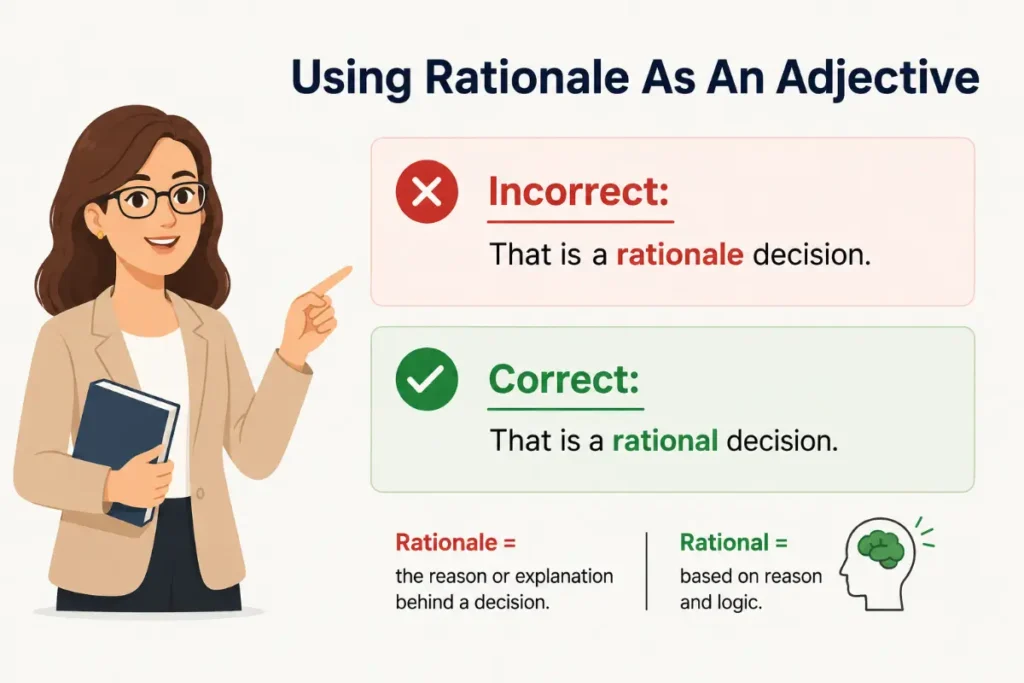
Incorrect:
That is a rationale decision.
Correct:
That is a rational decision.
Why? Decision needs an adjective to describe it. Rational performs that job.
Using Rational As A Noun
Incorrect:
What is the rational for the decision?
Correct:
What is the rationale for the decision?
The speaker is asking for the reasoning behind the decision. That requires the noun rationale.
Confusing Rational With Reasonable
The words often overlap.
A rational decision can be reasonable.
A reasonable decision can be rational.
Still they aren’t always identical in tone.
Rational often emphasizes logic and reason.
Reasonable can also suggest fairness practicality or moderation.
For example:
The price is reasonable.
That usually means the price is fair or acceptable.
The pricing strategy is rational.
That focuses more strongly on the logic behind the strategy.
Confusing Rationale With Reason
Rationale and reason are close in meaning.
You can often replace rationale with reason.
For example:
What is the rationale for the change?
What is the reason for the change?
Both work.
However rationale often sounds more formal and can suggest a structured explanation rather than a simple cause.
Rational And Rationale In Professional Writing
The noun rationale is especially common in workplaces because professionals often need to explain decisions.
You might see it in:
Business reports.
Policy documents.
Project proposals.
Strategy papers.
Performance reviews.
Research reports.
Grant applications.
Technical documentation.
A manager might write:
The rationale for the revised schedule is to reduce delays during peak hours.
This sentence clearly identifies the reason behind the decision.
A weaker version might be:
The rational for the revised schedule is to reduce delays.
That version contains a word choice error.
The adjective rational cannot perform the noun’s job.
Professional writers also use rationale when they need to justify a recommendation.
For example:
The proposal includes a rationale for the recommended investment.
This wording signals that the writer isn’t simply giving a conclusion. The writer is explaining the reasoning that supports it.
Rational And Rationale In Academic Writing
Academic writing frequently distinguishes between a claim and the reasoning that supports it.
You might write:
The researchers used a rational approach to evaluate the evidence.
Here rational describes the approach.
Then:
The study provides a clear rationale for the selected method.
Here rationale identifies the reasoning behind the method choice.
This distinction helps academic writers avoid vague language.
Instead of saying:
The researchers chose this method because it seemed good.
You could write:
The researchers provided a rationale for selecting this method based on its reliability and suitability for the study.
The second version tells the reader that a reasoned explanation supports the choice.
Formal And Informal Usage
Rational is common in both formal and informal English.
You can say:
That sounds rational.
You can also write:
The researchers adopted a rational framework for analysis.
The word doesn’t sound unusually formal.
Rationale is more strongly associated with formal or professional language.
In casual conversation people are often more likely to say reason.
For example:
Why did you do that?
What’s your reason?
These sound natural in conversation.
A professional report might instead say:
What was the rationale for the decision?
That doesn’t make rationale incorrect in casual speech. It simply gives the sentence a more formal tone.
Pronunciation Guide
Rational is commonly pronounced with three syllables.
A simple pronunciation guide is:
RASH uh nul.
The stress normally falls on the first syllable.
Rationale is commonly pronounced:
rash uh NAL.
The final syllable receives the main stress.
The two words sound related because they share the same root and beginning. The difference in their endings helps distinguish them when spoken.
If you’re learning the words for professional communication it can help to practice them in complete phrases.
Say:
A rational decision.
Then:
The rationale for the decision.
The contrast becomes easier to hear and remember.
Word Origin
Both words are connected to Latin ratio which carried meanings related to calculation reason method and thought.
From this Latin root came words associated with reasoning and rational thought.
Rational entered English through French and Latin influences and developed the sense of relating to reason or based on reason.
Rationale developed from the same family and came to refer to the reasoning or explanation supporting something.
The shared origin explains the visual similarity.
English contains many related words that developed from a common root but ended up serving different grammatical roles.
That is exactly what happened here.
The relationship is useful because it gives you a conceptual link:
Reason leads to rational thinking.
Rational thinking produces reasoning.
The reasoning behind a decision can be called its rationale.
Related Words
Learning the word family can make the distinction easier.
Rationality
Rationality is the noun that means the quality or condition of being rational.
Example:
The study questioned the rationality of the decision.
Rationally
Rationally is an adverb.
Example:
We need to think rationally.
Rationalize
Rationalize is a verb that can mean to provide reasons for something or to make something seem reasonable.
Example:
He tried to rationalize his decision.
Reasonable
Reasonable is an adjective that means sensible fair or acceptable.
Example:
That seems like a reasonable request.
Reasoning
Reasoning is the process of thinking through a problem.
Example:
I understand your reasoning.
Reason
Reason is a broad noun referring to a cause explanation or basis for something.
Example:
What’s the reason for the change?
These related words overlap but aren’t interchangeable in every sentence.
Rational vs Rationale In Similar Sentences
Looking at paired examples is one of the fastest ways to understand the distinction.
Pair One
The decision was rational.
The rationale for the decision was clear.
The first sentence describes the decision.
The second explains the reasoning behind it.
Pair Two
Her response was rational.
Her rationale was based on the available evidence.
The adjective describes the response.
The noun identifies the reasoning.
Pair Three
The company adopted a rational strategy.
The company explained the rationale behind the strategy.
Again the grammatical roles are different.
Pair Four
His choice seemed rational.
I didn’t understand his rationale.
The first sentence evaluates the choice.
The second discusses the reason for the choice.
Pair Five
They took a rational approach.
They documented the rationale for that approach.
The pattern is consistent. Once you see it several times the distinction becomes almost automatic.
Memory Tips
The easiest memory trick is to connect rational with reasonable.
Both are adjectives.
You can say:
A rational choice.
A reasonable choice.
Now connect rationale with reason.
Both are nouns.
You can say:
The rationale for the choice.
The reason for the choice.
Another useful trick is to remember the final sound.
Rational describes.
Rationale explains.
If you’re describing something as logical use rational.
If you’re naming the explanation behind it use rationale.
You can also remember the question each word answers.
Rational: What kind of decision is it?
Rationale: Why was the decision made?
That simple question and answer pattern works in most everyday situations.
When To Use Reason Instead Of Rationale
Sometimes reason is the better word.
If you’re writing for a general audience or having a casual conversation reason often sounds more natural.
For example:
What’s the reason for the delay?
This is simple and direct.
A more formal version is:
What is the rationale for the delay?
Both are correct.
The choice depends on tone.
Use reason when you want plain everyday language.
Use rationale when you want to emphasize the reasoning or justification behind a decision.
Neither word is automatically better.
Good editing means choosing the word that fits the audience.
When Rational Does Not Mean Good
One subtle point deserves attention.
Rational doesn’t always mean morally good.
A person can make a rational decision that has an unpleasant outcome.
For example:
The company made a rational decision to reduce costs.
The decision may make financial sense but still hurt employees.
The word describes the logic of the decision. It doesn’t automatically approve the decision from every possible perspective.
This distinction matters in serious writing.
Logic and morality aren’t always the same thing.
A rational choice can be practical without being kind.
A rational argument can be logically structured without being persuasive to everyone.
The context determines the larger judgment.
Why Writers Confuse These Words
There are several reasons.
First, the words share the same root.
Second, they look similar.
Third, both relate to reason.
Fourth, many writers understand the general meaning but don’t recognize the difference in part of speech.
This creates mistakes such as:
The rationale decision.
The rational behind the plan.
Both errors become easy to fix once you identify the grammatical role.
If the blank needs an adjective use rational.
If the blank needs a noun use rationale.
This is a small distinction but it has a big effect on accuracy.
Expert Editor Advice
As an editor I’d teach this pair through sentence structure rather than memorization alone. Look at the word that follows the blank. If you need to describe a decision plan argument response or person use rational. If you’re talking about the explanation or reasoning behind that thing use rationale. In formal writing rationale often appears with for because writers commonly explain the rationale for a policy choice method or recommendation. That pattern is worth remembering because it appears frequently in professional documents.
Key Takeaways
- Rational is an adjective.
- Rationale is a noun.
- Use rational to describe something as logical reasonable or based on sound judgment.
- Use rationale to name the reason or reasoning behind a decision action policy or argument.
- Rational is common in everyday and formal English.
- Rationale is especially common in professional academic and technical writing.
- Reason is often a simpler alternative to rationale in casual conversation.
- The phrase rationale for is extremely useful in formal writing.
- Remember the simple pattern: rational describes while rationale explains.
- When you can ask Why was this decision made? the answer may be its rationale.
Conclusion
Rational vs rationale is easier to master once you separate meaning from grammar. Rational is an adjective that describes something as logical sensible or based on reason. Rationale is a noun that names the reason reasoning or justification behind a decision action policy or argument. They belong to the same word family but they perform different jobs in a sentence.
The quickest test is to ask what you’re trying to say. If you’re describing a decision use rational. If you’re explaining why that decision was made use rationale. You can write a rational decision and then discuss the rationale for the decision. That pattern is natural accurate and widely used in professional academic and everyday English.
Keep one final memory trick in mind. Rational describes. Rationale explains. If you need a plain everyday alternative to rationale you can usually use reason. When you need to describe something as logical or sensible choose rational. Once that distinction becomes familiar you’ll rarely confuse these two words again.
FAQs
What Is The Difference Between Rational And Rationale?
Rational is an adjective that describes something as logical reasonable or based on sound judgment. Rationale is a noun that means the reason or reasoning behind a decision action policy or argument. You can describe a decision as rational and then explain the rationale for that decision. Their shared root makes them look similar but their grammatical roles are different.
Is Rational A Noun Or An Adjective?
Rational is primarily an adjective in ordinary English. It describes a person idea decision argument action or approach as reasonable or logical. For example you can write She made a rational decision or His argument was rational. The related noun is rationality which refers to the quality of being rational.
Is Rationale A Noun Or An Adjective?
Rationale is a noun. It names the reasoning or explanation behind something. For example The report explains the rationale for the new policy uses rationale as a noun. You cannot normally use rationale as an adjective before a noun. The correct adjective is rational so you would write a rational policy rather than a rationale policy.
Can I Say Rational For A Reason?
You can use rational to describe a reason or explanation if you mean that the reason is logical or sensible. For example She gave a rational explanation is correct. However if you’re trying to name the reasoning behind a decision use rationale. For example The rationale for the decision was explained clearly is the natural construction.
Is Rationale The Same As Reason?
The words are closely related and can often be used in the same context. Reason is broader and more common in everyday English. Rationale usually refers to the reasoning or justification behind a decision policy method or argument and often sounds more formal. In a workplace report rationale may fit naturally while ordinary conversation often favors reason.
What Is The Synonym Of Rational?
Depending on context synonyms for rational include reasonable, logical, sensible, sound, practical, and level headed. These words aren’t identical in every situation. Logical emphasizes reasoning. Reasonable can emphasize fairness or acceptability. Sensible often suggests practical judgment. Choose the synonym that matches the exact idea you want to communicate.
What Is The Synonym Of Rationale?
Common alternatives for rationale include reason, reasoning, basis, justification, explanation, and grounds. The best choice depends on context. Reason is the simplest everyday option. Justification can suggest that a decision needs to be defended. Rationale often refers specifically to the reasoning that supports a decision method recommendation or policy.
Is Rational More Formal Than Reasonable?
Not necessarily. Both words are common in formal and everyday English. Rational tends to emphasize logic and reason while reasonable can emphasize fairness practicality or acceptability. For example a rational calculation focuses on logic while a reasonable price usually focuses on fairness. The context determines which adjective communicates your intended meaning more precisely.
How Do You Use Rationale In A Sentence?
Use rationale as a noun when referring to the reason or reasoning behind something. A very common pattern is the rationale for followed by a decision policy recommendation or action. For example The report explains the rationale for the proposed changes. You can also say the rationale behind the decision when discussing the underlying reasoning.
Is Rational Always A Positive Word?
No. Rational usually suggests logical or sensible thinking but it doesn’t automatically mean that a decision is morally good or emotionally appropriate. A person can make a rational financial decision that still has negative effects on others. The word describes the reasoning process or logical quality of something rather than giving it complete moral approval.
Can Rational And Rationale Be Used In The Same Sentence?
Yes. They often work naturally together because one describes the decision while the other identifies the reasoning behind it. For example The committee made a rational decision and clearly explained its rationale. In that sentence rational describes the decision and rationale names the explanation. Their shared meaning makes this combination especially useful.
Rational Or Rationale Which One Should I Use?
Use rational when you need an adjective to describe something as logical or reasonable. Use rationale when you need a noun meaning the reason or reasoning behind something. If you can replace the word with reasonable use rational. If you can replace it with reason or reasoning use rationale.

English Grammar & Usage
Nathan Holloway is an American grammar writer and language researcher who specializes in English grammar, sentence structure, verb usage, and common writing mistakes. He enjoys breaking down confusing grammar rules into practical explanations with clear examples, making English easier for students, professionals, and everyday writers.