
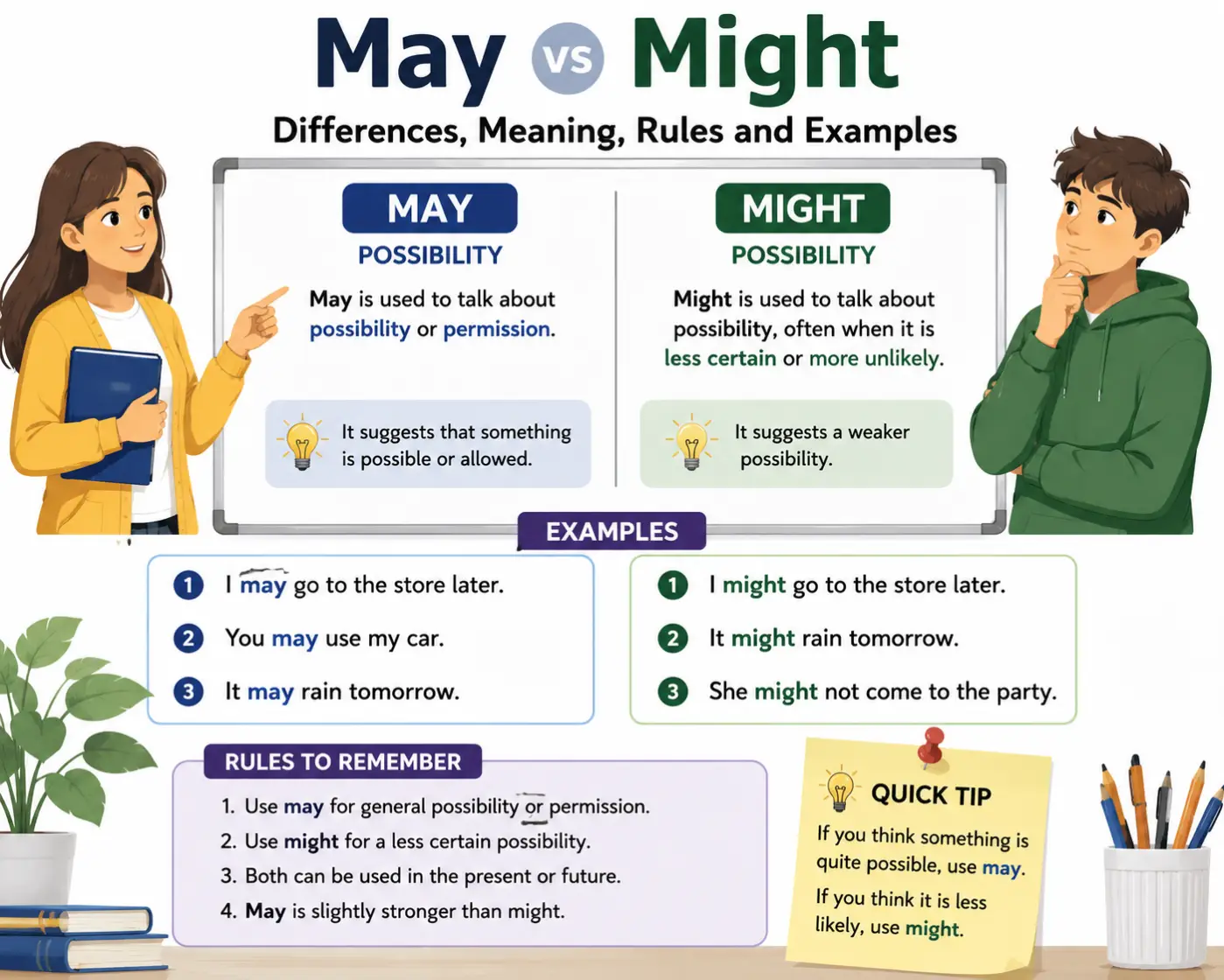
May or Might is one of the most common grammar questions English learners and even native speakers ask. These two modal verbs look similar, often appear in the same kinds of sentences, and sometimes seem interchangeable. That makes them easy to confuse.
The good news is that the difference is easier than many grammar books make it sound. In everyday English, people often use may and might in similar ways, but each word has its own tone and purpose. Knowing when to choose one over the other helps you communicate more clearly and confidently.
This guide explains everything you need to know about May or Might. You’ll learn the meaning of each modal verb, understand the grammar rules, discover when they can replace each other, and see plenty of real examples. By the end, you’ll know exactly which word fits your sentence and why.
Short Answer
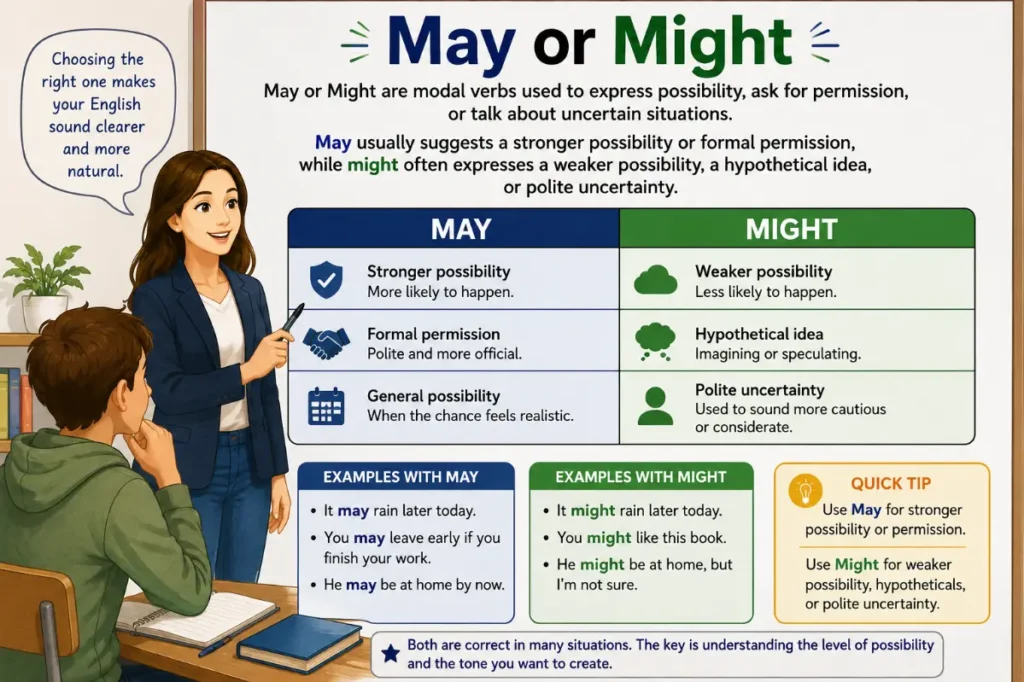
May or Might are modal verbs used to express possibility, ask for permission, or talk about uncertain situations. May usually suggests a stronger possibility or formal permission, while might often expresses a weaker possibility, a hypothetical idea, or polite uncertainty. In modern English, both are correct in many situations, but choosing the right one can make your writing and speech sound more natural.
Table of Contents
- What Does May Mean
- What Does Might Mean
- May or Might Quick Comparison
- The Main Difference Between May and Might
- When to Use May
- When to Use Might
- Can May and Might Be Interchanged
- Possibility and Probability
- Permission and Requests
- Talking About the Future
- Talking About the Past
- Conditional Sentences
- Formal and Informal English
- Common Grammar Rules
- Everyday Examples
What Does May Mean
May is a modal verb that expresses possibility, permission, or wishes. It often suggests that something has a reasonable chance of happening.
Examples include:
- It may rain this evening.
- Your package may arrive tomorrow.
- You may enter the room now.
In these examples, may tells us that something is possible or that permission is being given. Unlike regular verbs, may does not change its form.
Correct:
- She may come later.
- They may visit us tomorrow.
Incorrect:
- She mays come later.
- They mayed visit us.
This is one reason modal verbs are easier to use once you understand their patterns.
What Does Might Mean
Might is also a modal verb. It usually expresses a possibility that seems less certain or more hypothetical than may.
Examples include:
- It might snow tonight.
- She might accept the invitation.
- We might see them next weekend.
Each sentence suggests that something is possible, but the speaker sounds slightly less confident. In many conversations, the difference between may and might is very small. Context often matters more than the word itself.
May or Might Quick Comparison
| Feature | May | Might |
|---|---|---|
| Meaning | Possibility or permission | Possibility or hypothetical situation |
| Level of certainty | Slightly stronger | Slightly weaker |
| Permission | Yes | Rarely |
| Formal writing | Very common | Common |
| Everyday conversation | Common | Very common |
| Past possibility | Yes | Yes |
| Conditional ideas | Sometimes | Very common |
This table provides a quick overview, but each point deserves a closer look.
The Main Difference Between May and Might
The biggest difference between May or Might is the degree of certainty. When you say may, you usually believe there is a fair chance that something will happen.
Example:
- We may finish the project today.
This tells the listener that completing the project seems reasonably possible. When you say might, you usually sound less certain.
Example:
- We might finish the project today.
The speaker believes it is possible but is less confident.
Think of it like this.
May sounds like there is a good possibility. Might sounds like there is a possibility, but the outcome is more uncertain. In real conversations, many native speakers use them almost interchangeably, especially when talking about future events.
Compare these sentences.
- I may call you later.
- I might call you later.
Both are correct. The first suggests the speaker expects the call is fairly likely. The second suggests the speaker is less sure.
When to Use May
To Express Possibility
One of the most common uses of may is to describe something that could happen.
Examples:
- It may be sunny tomorrow.
- The train may arrive early.
- Prices may increase next month.
Explanation:
The speaker believes these events are reasonably possible.
To Give Permission
This is one of the classic grammar uses of may.
Examples:
- You may leave now.
- Students may use calculators.
- You may begin the exam.
Explanation:
Here, may gives official or formal permission.
This use is especially common in schools, workplaces, and official instructions.
To Ask Permission Politely
Although many people say Can I, May I remains the more formal choice.
Examples:
- May I ask a question?
- May I come inside?
- May I borrow your notebook?
Explanation:
These questions sound respectful and polite.
When to Use Might
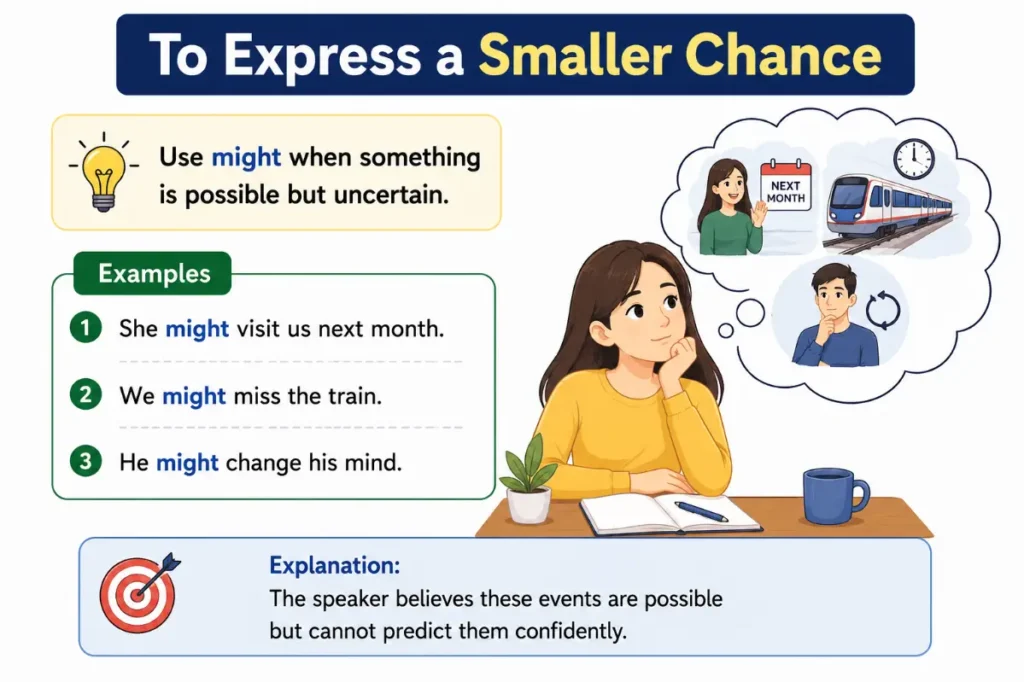
To Express a Smaller Chance
Use might when something is possible but uncertain.
Examples:
- She might visit us next month.
- We might miss the train.
- He might change his mind.
Explanation:
The speaker believes these events are possible but cannot predict them confidently.
To Discuss Hypothetical Situations
Might is especially common when talking about imagined situations.
Examples:
- If I had more time, I might learn Japanese.
- Without your help, we might fail.
- With better weather, they might play outside.
Explanation:
These situations depend on another condition.
To Make Suggestions
Sometimes might introduces a gentle suggestion.
Examples:
- You might try restarting your computer.
- You might want to call customer service.
- You might consider another option.
Explanation:
This sounds polite instead of forceful.
Compare these.
- You should call customer service.
This sounds direct.
- You might call customer service.
This sounds like friendly advice.
Can May and Might Be Interchanged
One reason learners struggle with May or Might is that both words are often acceptable in the same sentence.
Consider these examples.
- It may rain later.
- It might rain later.
Both are grammatically correct. Most native speakers would understand exactly the same message. However, the tone changes slightly. May suggests the speaker believes rain is fairly likely. Might suggests the speaker thinks rain is possible but is less confident.
Here are more examples.
- She may come to dinner.
- She might come to dinner.
Both work well.
The first sounds a little more hopeful.
The second sounds a little more uncertain.
Another pair.
- They may agree.
- They might agree.
Again, both are correct. The difference is subtle rather than dramatic. Modern English has become more flexible than older grammar books suggest. In casual conversation, many native speakers choose either word without changing the meaning very much. In formal writing, however, selecting the more precise modal verb can improve clarity.
Possibility and Probability
Understanding possibility is the key to mastering May or Might. Imagine three different situations.
High Possibility
- The meeting will start at nine.
The speaker is certain.
Medium Possibility
- The meeting may start at nine.
The speaker believes this is quite possible.
Lower Possibility
- The meeting might start at nine.
The speaker thinks it is possible but is less confident. Notice that none of these sentences promise an outcome. Instead, they show different levels of confidence. Here are additional comparisons.
Example 1
- We may see dolphins during the trip.
- We might see dolphins during the trip.
Explanation:
The first sentence sounds more optimistic.
The second sounds more cautious.
Example 2
- The restaurant may still be open.
- The restaurant might still be open.
Explanation:
Both are natural, but might sounds slightly less certain.
Permission and Requests
Permission is one area where may and might are not equal. May is the standard modal verb for giving or asking permission.
Examples:
- You may sit here.
- May I use your phone?
- Employees may park in this area.
These sentences sound natural in both spoken and written English. By contrast, might is rarely used to ask for permission today.
Example:
- Might I ask a question?
This sentence is grammatically correct but sounds very formal, old fashioned, or literary. It is more likely to appear in historical novels, formal speeches, or period dramas than in everyday conversation. Because of this, most English learners should use may when asking permission.
Examples:
- May I leave early today?
- May I speak with the manager?
- May I have another copy?
These are polite, clear, and widely accepted.
In modern casual English, many people simply say Can I, but may remains the preferred choice in formal situations.
Talking About the Future
One of the most common uses of May or Might is to describe future possibilities. Neither modal verb guarantees that something will happen. Instead, they show different levels of confidence.
Using May for Future Possibility
Use may when you believe an event has a reasonable chance of happening.
Examples:
- I may travel to New York next summer.
Explanation: The trip is possible and the speaker thinks it is fairly likely.
- Our team may win the championship.
Explanation: Winning is considered a realistic possibility.
Using Might for Future Possibility
Use might when the event is more uncertain.
Examples:
- I might travel next summer if I save enough money.
Explanation: The trip depends on another condition.
- She might accept the offer.
Explanation: The decision is still uncertain.
Talking About the Past
Both modal verbs can describe past possibilities by using have + past participle.
May Have
May have means something was possibly true in the past.
Examples:
- She may have forgotten the meeting.
Explanation: Forgetting is one possible explanation.
- They may have taken the wrong road.
Explanation: The speaker believes this is fairly likely.
Might Have
Might have also refers to past possibilities, but it often sounds more speculative.
Examples:
- He might have missed the train.
Explanation: This is only one possible explanation.
- We might have made a mistake.
Explanation: The speaker is uncertain.
Comparison
| Expression | Meaning |
|---|---|
| May have | Probably possible in the past |
| Might have | Less certain possibility in the past |
Although many native speakers use them interchangeably, might have often suggests greater uncertainty.
May Have vs Might Have
These expressions deserve extra attention because they appear frequently in speaking and writing.
Compare these examples.
She may have left already.
The speaker thinks this is fairly likely.
She might have left already.
The speaker is less confident.
Another comparison:
The package may have arrived.
There is good reason to believe it has arrived.
The package might have arrived.
Arrival is only one possible explanation.
Using May and Might in Conditional Sentences
Conditional sentences often describe imaginary or uncertain situations.
Second Conditional
- If I had more money, I might buy a bigger house.
Explanation: The situation is imaginary.
Third Conditional
- If we had started earlier, we might have caught the train.
Explanation: The opportunity existed in the past but did not happen.
Although may can appear in some conditional sentences, might is much more common because conditional situations naturally involve uncertainty.
Formal and Informal English
Both modal verbs are acceptable in formal and informal English.
However, they have different strengths.
May in Formal English
Examples:
- Visitors may enter after 9 a.m.
- Candidates may submit applications online.
- Employees may request additional training.
This style is common in official documents, business communication, and academic writing.
Might in Everyday English
Examples:
- I might watch a movie tonight.
- We might order pizza.
- She might be busy.
These sentences sound natural in daily conversation.
Grammar Rules for May and Might
Learning a few grammar rules will help you avoid common mistakes.
Rule 1
Always use the base form of the verb after may and might.
Correct:
- She may come.
- They might leave.
Incorrect:
- She may comes.
- They might leaving.
Rule 2
Do not add to after these modal verbs.
Correct:
- He may go.
- She might stay.
Incorrect:
- He may to go.
- She might to stay.
Rule 3
Negative forms are simple.
- may not
- might not
Examples:
- She may not attend.
- We might not finish today.
Rule 4
Questions begin with the modal verb.
Examples:
- May I help you?
- Might this be the correct answer?
Pronunciation
| Word | IPA | Simple Pronunciation |
|---|---|---|
| May | /meɪ/ | rhymes with day |
| Might | /maɪt/ | rhymes with light |
Practice reading these aloud.
- May I help you?
- It might rain later.
- We may arrive early.
- She might call tomorrow.
Word Origin
Understanding where words come from can make them easier to remember. May comes from Old English magan, meaning “to be able” or “to have power.”
Might developed from the past form of the same verb. Over time, English speakers began using might to express weaker or more uncertain possibilities.
Today, both words function as modal verbs.
May vs Might in American and British English
The basic grammar is the same in both American and British English.
However, British English sometimes uses might a little more frequently in formal writing.
Examples:
American English:
- We may need another meeting.
British English:
- We might need another meeting.
Both are perfectly correct.
Comparison Table
| Situation | May | Might |
|---|---|---|
| Stronger possibility | ✔ | |
| Weaker possibility | ✔ | |
| Formal permission | ✔ | |
| Asking permission | ✔ | Rare |
| Hypothetical situations | Sometimes | ✔ |
| Polite suggestions | Sometimes | ✔ |
| Everyday conversation | ✔ | ✔ |
| Academic writing | ✔ | ✔ |
Real Life Examples
At Work
Manager:
“You may leave after finishing your report.”
Permission is given.
Employee:
“I might stay a little longer.”
The employee is unsure.
At School
Teacher:
“You may begin the exam.”
Permission.
Student:
“I might need extra paper.”
Possibility.
At Home
Mother:
“It may snow tonight.”
Reasonable expectation.
Father:
“We might stay inside if it does.”
Future possibility.
While Traveling
- Our flight may be delayed because of heavy rain.
- We might miss our connecting flight.
- The museum may still be open.
- We might visit the old town tomorrow.
Common Mistakes
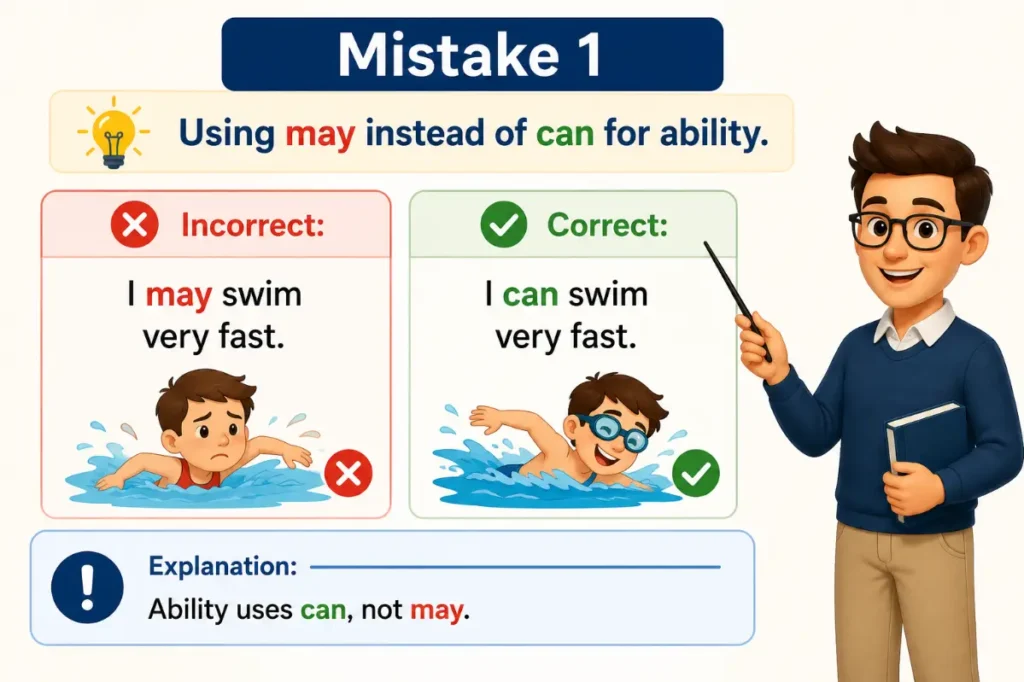
Mistake 1
Using may instead of can for ability.
Incorrect:
- I may swim very fast.
Correct:
- I can swim very fast.
Explanation: Ability uses can, not may.
Mistake 2
Adding to after the modal.
Incorrect:
- She may to leave.
Correct:
- She may leave.
Mistake 3
Using the wrong verb form.
Incorrect:
- He might goes.
Correct:
- He might go.
Mistake 4
Thinking may and might always have different meanings.
In reality, many modern English sentences accept either word.
Memory Tips
Remember these simple tricks.
Think of Confidence
May equals more confidence.
Might equals less confidence.
Permission Starts with M
May is the modal verb most commonly used for permission.
Imagine Possibilities
When imagining situations that depend on something else, might is usually the better choice.
Remember the Formula
May + base verb
Might + base verb
No extra words are needed.
Related Grammar and Usage Notes
Learning similar modal verbs helps strengthen your understanding.
Can vs May
Can usually expresses ability.
- She can drive.
May usually expresses permission.
- She may leave now.
May vs Could
Both express possibility.
- We may arrive late.
- We could arrive late.
Could often suggests one possible option among several.
Might vs Could
These words are very close.
- I might call him.
- I could call him.
In many situations, either choice is natural.
Must vs May
Must expresses certainty or obligation.
- You must wear a seat belt.
May expresses possibility.
- It may rain today.
Key Takeaways
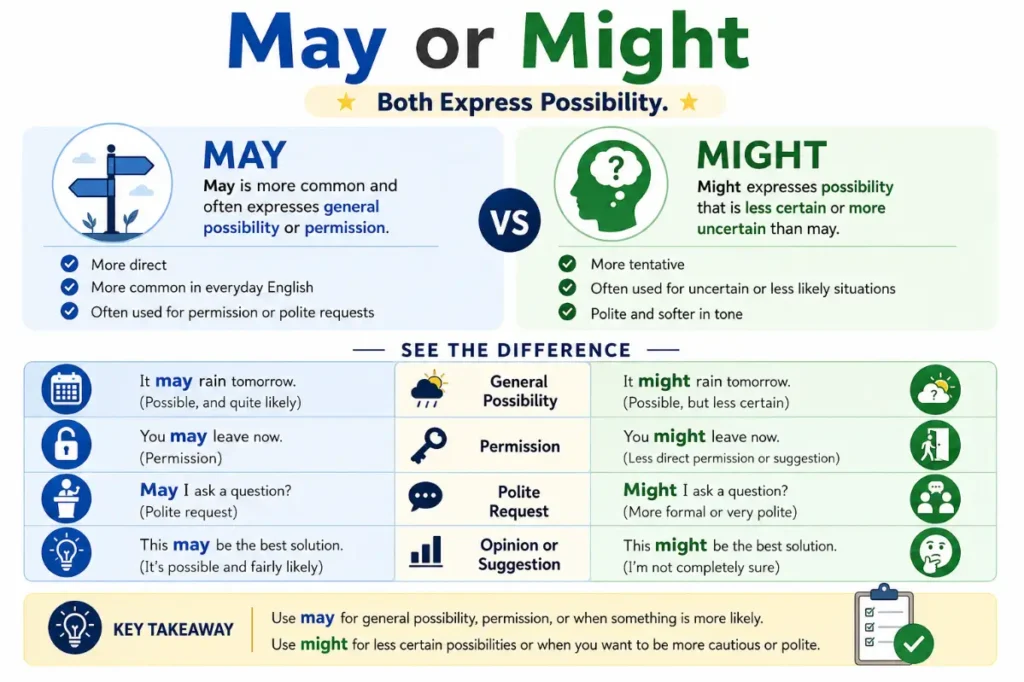
- May or Might both express possibility.
- May usually shows greater confidence.
- Might often suggests more uncertainty.
- Use may when giving or asking permission.
- Use might more often in hypothetical situations.
- Both are followed by the base form of the verb.
- Never use to after may or might.
- Both are common in spoken and written English.
Conclusion
Understanding May or Might is easier once you recognize that both modal verbs express possibility but with different degrees of certainty. May often suggests a stronger chance that something will happen and is the preferred choice for giving or asking permission. Might usually signals greater uncertainty, hypothetical situations, or polite suggestions.
In everyday English, you’ll often hear both words used in similar contexts, and in many cases either one is grammatically correct. The key is to match your choice to the level of confidence you want to express. By practicing the grammar rules, studying real examples, and remembering the simple difference between stronger and weaker possibility, you’ll use May or Might naturally in both speaking and writing.
Frequently Asked Questions
Is May or Might interchangeable?
Yes. In many everyday situations, both are correct. May usually sounds a little more certain, while might sounds slightly less certain.
Which is more formal, may or might?
May is generally considered more formal, especially when asking for or giving permission.
Can I say “May I” and “Might I”?
Yes, but May I is much more common. Might I sounds very formal and is rarely used in everyday conversation.
Is might the past tense of may?
Historically, yes. In modern English, might functions as its own modal verb rather than simply serving as the past tense of may.
Should I use may or might for permission?
Use may. It is the standard choice for asking or granting permission.
Which shows greater certainty?
May usually expresses a stronger possibility than might.
Can may and might be used with have?
Yes.
Examples:
- She may have forgotten.
- He might have called earlier.
Both describe possible past events.
What is the easiest way to remember May or Might?
Think of confidence.
May means the speaker believes something is fairly likely.
Might means the speaker is less certain.
Can may and might be used in business writing?
Yes. Both are common in professional emails, reports, and formal documents. Choose may for stronger possibility or permission and might for cautious statements.
Is it wrong to use might instead of may?
No. In many situations, native speakers use them interchangeably. The difference is usually one of tone rather than grammar.

English Grammar & Usage
Nathan Holloway is an American grammar writer and language researcher who specializes in English grammar, sentence structure, verb usage, and common writing mistakes. He enjoys breaking down confusing grammar rules into practical explanations with clear examples, making English easier for students, professionals, and everyday writers.