
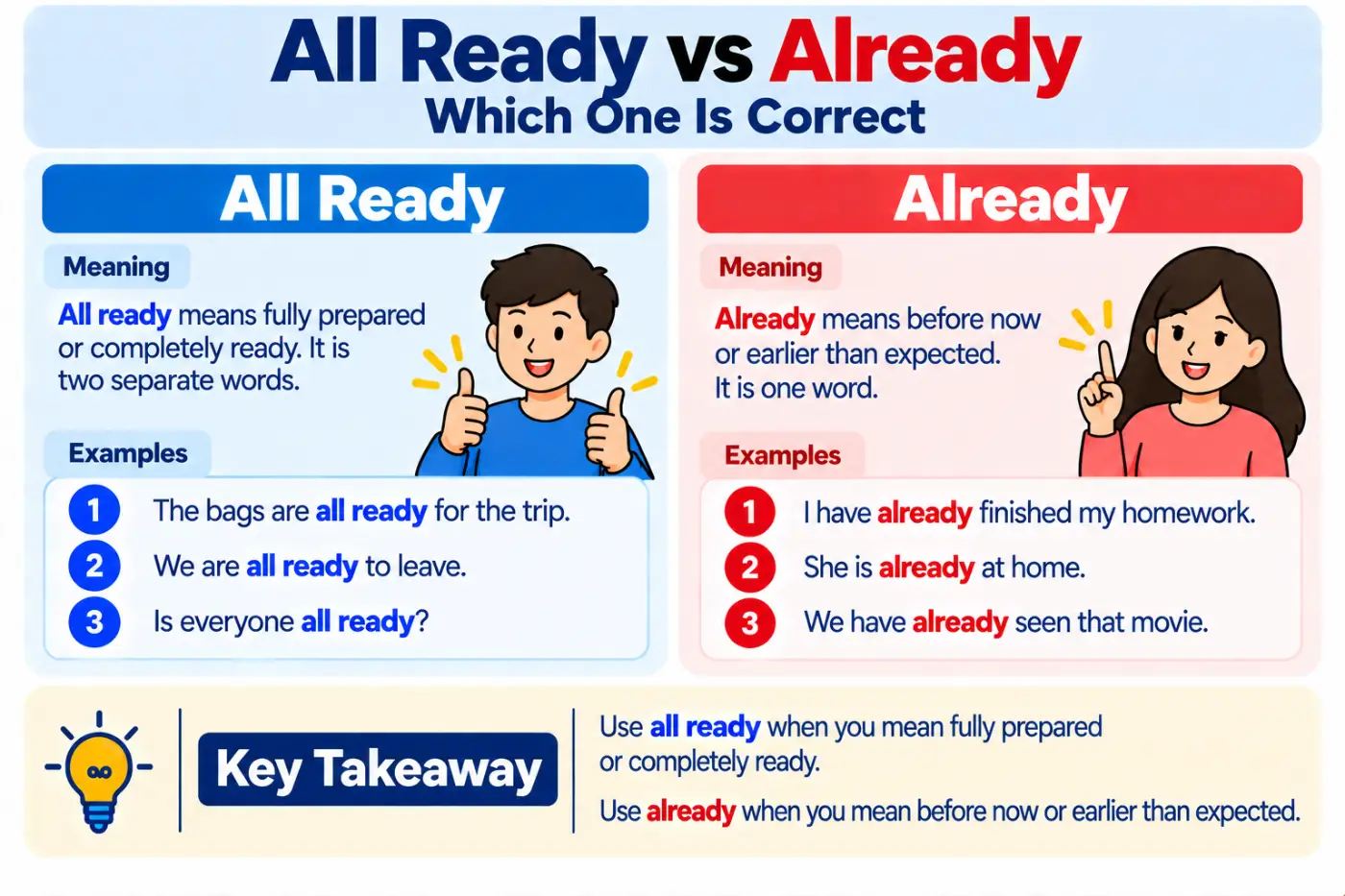
The difference between all ready vs already can seem tiny because the two forms sound very similar when people speak. In writing however the missing space changes the meaning. All ready describes preparation. Already works as an adverb that refers to time.
This small spelling difference can change the message of a sentence. If you write We are already for the meeting you haven’t expressed a complete idea. If you write We are all ready for the meeting you clearly say that everyone is prepared.
The good news is that the rule is simple once you connect each form with its meaning. Think of all ready as a description of being fully prepared. Think of already as a word connected with time. This guide explains the difference with clear examples and practical tests you can use in everyday writing.
Short Answer
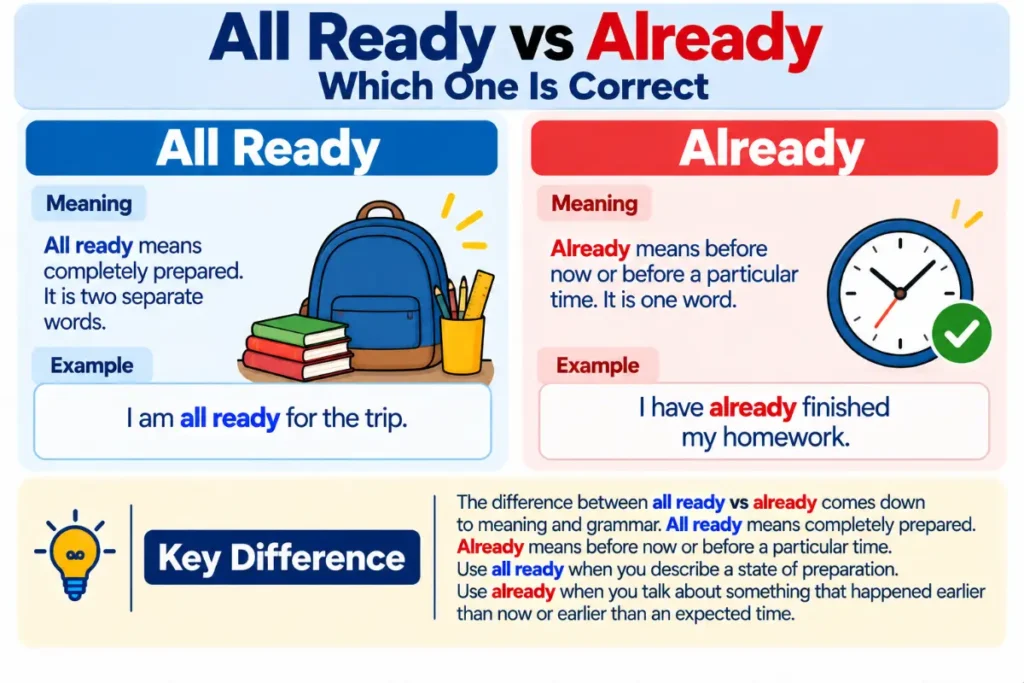
The difference between all ready vs already comes down to meaning and grammar. All ready means completely prepared. Already means before now or before a particular time. Use all ready when you describe a state of preparation. Use already when you talk about something that happened earlier than now or earlier than an expected time.
Table Of Contents
- The main difference.
- What all ready means.
- What already means.
- How the grammar differs.
- How to choose the correct form.
- Real life examples.
- Common mistakes.
- Pronunciation and sound.
- American and British English.
- Word origin.
- Memory tips.
- Related expressions.
- Professional writing tips.
- Frequently asked questions.
- Key takeaways.
The Main Difference
The easiest way to understand all ready vs already is to focus on the question each form answers.
All ready answers a question about preparation. It tells you that someone or something is completely prepared for an activity or event.
Already answers a question about time. It tells you that something happened before now or before a particular point in time. It can also show that something happened sooner than expected.
| Form | Meaning | Grammar role | Example |
|---|---|---|---|
| all ready | completely prepared | Adjective phrase | We are all ready to leave. |
| already | before now or before a particular time | Adverb | We have already left. |
| The difference becomes much easier when you look at the sentence as a whole. | |||
| Consider these two examples. | |||
| We are all ready to leave. | |||
| We have already left. | |||
| The first sentence describes preparation. The second sentence describes an earlier action. | |||
| The words may look related because they actually have a historical connection. Modern English treats them as different forms with different functions. |
What All Ready Means
All ready is a two word phrase that means completely prepared.
The word all adds emphasis to ready. It can suggest that the people involved have finished their preparation and can move forward.
For example:
We are all ready for the trip.
The students are all ready for the exam.
The bags are all ready to go.
Dinner is all ready.
In each sentence the speaker talks about a state of preparation. Nothing in the phrase refers to an earlier time.
You can often replace all ready with ready without destroying the basic meaning.
We are all ready for the trip.
We are ready for the trip.
The second sentence is still logical. The word all simply adds emphasis.
This gives you one of the most useful tests for this spelling problem. Remove all from the sentence. If ready still works and the sentence still expresses preparation then all ready may be the form you need.
All Can Refer To A Group
All ready can also describe a group of people.
For example:
Are you all ready?
They are all ready to begin.
We are all ready for the presentation.
In these sentences all refers to everyone in the group. Ready describes their state.
This point matters because writers sometimes see all ready as a fixed phrase and assume it always has exactly the same structure. In reality all can work as a determiner or pronoun while ready remains an adjective.
Consider this example:
The children are all ready for bed.
Here all refers to the children. Ready tells us that the children have completed their preparation.
All Ready Before A Noun
You can also place all ready before a noun in some constructions.
For example:
The all ready team walked onto the field.
This sentence sounds less natural than The team was all ready. In most everyday writing it is clearer to place all ready after a linking verb or use a more direct expression such as fully prepared.
A natural sentence would be:
The team was all ready for the final practice.
The phrase works best when you want to emphasize a completed state of preparation.
What Already Means
Already is one word. It is an adverb that usually refers to something that happened before now or before a particular point in time.
For example:
I have already eaten.
She has already finished the report.
They had already left when we arrived.
We already know the answer.
In each example already tells us that an action or state existed before a relevant time.
Already can also show that something happened sooner than expected.
For example:
Is it lunchtime already?
You are leaving already?
The store is already closed.
The speaker expected more time to pass before the event happened. Already highlights that the event has happened sooner than expected. Cambridge describes this use as referring to something earlier than the expected time.
Already Refers To Time
A useful mental shortcut is to connect already with time.
If the sentence means before now, by now, before then, or sooner than expected, already is usually the correct form.
Consider:
I already finished my homework.
She had already gone home.
The movie had already started.
They already knew about the change.
Each sentence contains a time idea. The action happened before another point.
Already Can Work With Different Tenses
Already appears naturally with several verb tenses.
With the present perfect:
I have already finished the work.
With the past perfect
Oxford notes that North American English also commonly uses already with the simple past in informal speech. For example an American speaker may naturally say I already ate. In more formal writing the present perfect form I have already eaten is often the safer choice when the context calls for it.
How The Grammar Differs
The biggest grammatical difference in all ready vs already is that all ready is an adjective phrase while already is an adverb.
An adjective describes a person place thing or state.
Ready is an adjective in sentences such as:
The students are ready.
The food is ready.
I am ready.
All ready adds emphasis:
The students are all ready.
The food is all ready.
We are all ready.
An adverb can modify a verb phrase or describe the timing of an action or state.
Already does this job:
She has already finished.
They already know.
He had already arrived.
The store is already open.
That grammatical difference explains why you cannot simply swap the two forms.
How To Choose The Correct Form
Use this simple decision process when you are unsure.
First ask what you mean.
If you mean completely prepared use all ready.
If you mean before now or before a certain time use already.
Now test the sentence.
The guests are all ready.
Remove all.
The guests are ready.
The meaning still works. All ready is correct.
Try another sentence:
The guests have already arrived.
Remove all and replace the form.
The guests have ready arrived.
The sentence no longer works. Already is correct.
This test is quick because it focuses on meaning rather than spelling.
The Preparation Test
Ask yourself if the sentence describes a person or thing that has finished preparing.
If yes use all ready.
Examples:
We are all ready for the interview.
The children are all ready for school.
The equipment is all ready.
The documents are all ready to send.
Each example describes preparation.
The Time Test
Ask yourself if the sentence means before now or before another time.
If yes use already.
Examples:
I have already sent the email.
She already knows the answer.
They had already eaten when we arrived.
The package has already arrived.
Each sentence gives us a time relationship.
Real Life Examples
The difference becomes clearer when you see both forms in natural situations.
At Home
We are all ready for dinner.
This means everyone is prepared for dinner.
Dinner is already on the table.
This means dinner reached that state before the current moment.
The children are all ready for bed.
This describes preparation.
The children have already brushed their teeth.
This describes an action that happened earlier.
At Work
The team is all ready for the meeting.
The team has already received the agenda.
The first sentence describes preparation. The second sentence describes something that happened before now.
The reports are all ready for review.
The manager has already reviewed the first report.
Again the first sentence focuses on preparation while the second focuses on time.
At School
The students are all ready for the test.
The teacher has already handed out the papers.
The students have already read the instructions.
Everyone is all ready to begin.
The first and fourth sentences describe readiness. The middle sentences describe earlier actions.
While Traveling
We are all ready to leave.
The driver has already arrived.
Our bags are all ready.
The train has already left.
This pair of meanings appears naturally in travel conversations because preparation and time often happen close together.
In Everyday Conversation
Are you all ready?
Yes. We are all ready.
Have you already eaten?
Yes. I have already eaten.
These examples show how the two forms can appear in the same conversation without meaning the same thing.
All Ready And Already In The Same Sentence
You can use both forms in one sentence. This is one of the best ways to see the difference.
We are all ready because the bus has already arrived.
The players are all ready even though the referee has already started the clock.
The guests were all ready by the time the host had already prepared the room.
In these examples all ready describes preparation. Already describes timing.
This combination can be especially useful when you want to explain two connected events.
For example:
The family was all ready to leave because the taxi had already arrived.
The family had finished preparing. The taxi arrived earlier and was waiting.
The two expressions work together because they perform different grammatical jobs.
Common Mistakes
Many mistakes happen because the two forms sound almost identical.
Writing Already When You Mean Prepared
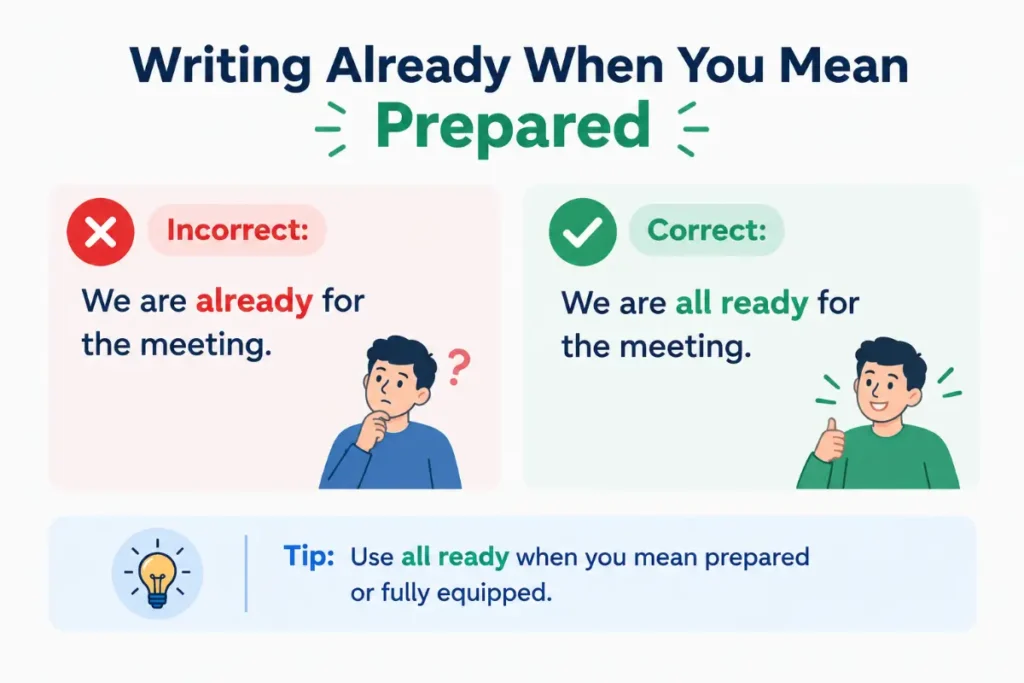
Incorrect:
We are already for the meeting.
Correct:
We are all ready for the meeting.
The incorrect sentence leaves the reader waiting for a verb or another word. Already cannot describe the people as prepared.
Writing All Ready When You Mean Earlier
Incorrect:
I have all ready finished my work.
Correct:
I have already finished my work.
The second sentence tells the reader that the work was finished before now.
Using All Ready To Mean Everyone Has Finished An Action
Consider:
They are all ready.
This means they are all prepared.
It does not normally mean they have all completed a previous action.
For that meaning you need a verb and often already.
They have all finished.
They have already finished.
These sentences have slightly different emphasis but both refer to completion rather than simple readiness.
Confusing Ready With Already
Ready and already are related in appearance but they do different jobs.
Ready means prepared.
Already means before now or sooner than expected.
For example:
I am ready.
I have already eaten.
The first sentence describes a state. The second sentence describes timing.
Pronunciation And Sound
All ready and already are easy to confuse in speech because their sounds overlap.
Cambridge gives American pronunciation for already as approximately /ɑlˈred.i/ and British pronunciation as approximately /ɔːlˈred.i/. Oxford gives a closely related American pronunciation.
The main practical point for learners is that the difference is much easier to see in writing than to hear in normal conversation.
When people speak quickly the boundary between all and ready can become less noticeable. That means context becomes important.
If you hear someone say something that sounds like all ready you need to ask what the speaker means.
Are they saying everyone is prepared?
Or are they saying something happened before now?
Writing removes much of this ambiguity because the space carries meaning.
American And British English
The basic difference between all ready and already is the same in American English and British English.
All ready means completely prepared.
Already refers to something that happened before now or before a particular time.
There is no major regional spelling difference for these two forms.
American and British speakers both use already as an adverb.
American English does have some differences in how speakers combine already with verb tenses. Oxford notes that North American English commonly uses simple past forms with already in informal speech. For example an American speaker may say I already ate.
British English more often uses the present perfect in comparable contexts.
For formal writing American readers will still understand I have already eaten immediately. That form clearly expresses the relationship between the action and the present time.
Word Origin
Already has an interesting history.
Oxford traces the word to Middle English and explains its origin as a combination related to all and ready.
The modern one word form developed from an older expression connected with the idea of being completely ready. Over time the form took on its modern adverbial meaning related to an earlier time.
This history helps explain why all ready and already look so similar today.
The connection is historical. The modern meanings are different.
English has many examples of words that developed from combinations of separate words. Spelling changes over time can turn a phrase into a single word while the resulting word develops a specialized meaning.
Already is one example of that broader pattern.
Why The Space Matters
A space can look insignificant. In English spelling however a space can signal a completely different grammatical structure.
Compare:
all ready.
already.
The first form contains two separate words. The second form is one established word.
This is similar to other English pairs where spacing changes meaning.
All together means everyone or everything in the same place or group.
Altogether means completely or on the whole.
All most is not the normal form. Almost is one word.
All ready and already follow a related historical pattern but you must learn their modern meanings rather than trying to predict them from spelling alone. The Language Portal of Canada specifically notes that the final letter of all is often dropped when all combines with another word and gives all ready and already as an example.
Memory Tips
You don’t need a complicated grammar rule to remember this distinction.
Think About Preparation
If someone is prepared use all ready.
We are all ready.
The bags are all ready.
The students are all ready.
The word ready appears as a complete adjective.
Think About Time
If something happened before now use already.
I have already eaten.
She has already called.
They have already left.
The one word form connects with time.
Use The Ready Test
Remove all.
If the sentence still makes sense with ready then all ready may be correct.
We are all ready.
We are ready.
That works.
Now try:
We have already finished.
We have ready finished.
That does not work.
This simple test catches many spelling mistakes.
Use The Time Question
Ask yourself whether the sentence answers a question such as When did this happen?
If the answer is before now or before then use already.
If the sentence answers Are you prepared? use all ready.
This distinction works like a small signpost. Preparation points to all ready. Time points to already.
Related Grammar And Usage Notes
Already often appears with perfect verb forms.
I have already finished.
She had already left.
They will have already arrived by then.
It can also appear with simple present and simple past forms depending on context and regional usage.
I already know.
I already ate.
The second example is common in informal American speech. Formal writing often favors I have already eaten when the present connection matters.
Already can also appear at the end of a sentence.
I know that already.
We finished that already.
She told me that already.
This position is common in conversation.
Already can also appear before the main verb.
I already know.
They already understand.
She already finished the report.
With auxiliary verbs it commonly appears after the first auxiliary.
I have already finished.
They had already arrived.
She will already know the answer.
The exact position can change with the sentence structure but the meaning remains connected to time.
Already And Yet
Already and yet often appear in related sentences.Yet often appears in questions and negative statements about something that has not happened but remains expected.
For example:
Have you already eaten?
No. I haven’t eaten yet.
The first question asks if the action happened before now. The answer uses yet to show that the action has not happened so far.
In North American English you may hear Did you eat yet? in casual conversation. Formal writing often uses Have you eaten yet? instead. Oxford describes this regional difference in its guidance on already and yet.
Already And Still
Compare:
She is already here.
She is still here.
The first sentence tells us that she arrived by now. The second tells us that she has not left.
Another example:
The store is already open.
The store is still open.
The first can suggest that the opening happened earlier than expected. The second suggests that the store remains open.
Already In Informal American Speech
American English has an informal use of already that adds emphasis or impatience.
Examples include:
Enough already.
Stop already.
Just tell me already.
Cambridge and Oxford both identify this type of usage as informal and especially associated with North American English.
This use does not mean before now in the ordinary sense.
Instead it adds emotional force to the sentence.
For professional writing it is usually better to choose a direct expression that matches the tone you want.
For example:
Please stop.
We need an answer now.
Please tell me the decision.
In casual conversation however this use is familiar to American speakers.
Professional Writing Tips
When writing an email report academic paper or business document check every use of all ready and already.
Ask what the sentence actually says.
If you mean preparation use all ready.
If you mean previous action or earlier timing use already.
For example:
The documents are all ready for review.
The legal team has already reviewed the documents.
Both sentences can appear in the same professional email.
You might write:
The documents are all ready for review. The legal team has already completed its initial check.
The first sentence tells the reader that the documents are prepared. The second gives information about an earlier action.
This kind of precise wording makes professional communication easier to understand.
Examples You Can Copy
Here are natural examples that show the difference clearly.
- We are all ready for the presentation.
- We have already prepared the slides.
- Are you all ready to leave?
- Have you already packed your bag?
- The children are all ready for school.
- The children have already eaten breakfast.
- The room is all ready for the guests.
- The guests have already arrived.
- The team is all ready to begin.
- The coach has already explained the plan.
- My bags are all ready.
- My flight has already been delayed.
- The students are all ready for the test.
- The teacher has already explained the instructions.
- We were all ready when the bus arrived.
- The bus had already arrived when we reached the stop.
Each pair highlights the same basic contrast. One form describes preparation. The other describes timing.
When Both Forms Appear Together
Some of the clearest sentences use both forms.
We were all ready when the guests had already arrived.
The children were all ready because dinner was already on the table.
The team was all ready to play even though the game had already started.
The workers were all ready before the manager had already checked the equipment.
In these sentences the two forms work together because they express two different ideas.
All ready describes a prepared state.
Already places an action or state earlier in time.
This makes the difference easier to remember. You don’t have to choose between two spellings based on sound. Choose based on the message.
A Simple Editing Checklist
When proofreading your writing use this quick checklist.
- Find every instance of already.
- Ask if it refers to time or an earlier event.
- If it does then the one word form is appropriate.
- Find every instance of all ready.
- Ask if it describes preparation.
- Remove all mentally and see if ready still makes sense.
- Read the sentence aloud and check the intended meaning.
- Check the surrounding verb tense.
This process takes only a few seconds and can prevent an easy spelling mistake from changing your meaning.
Key Takeaways
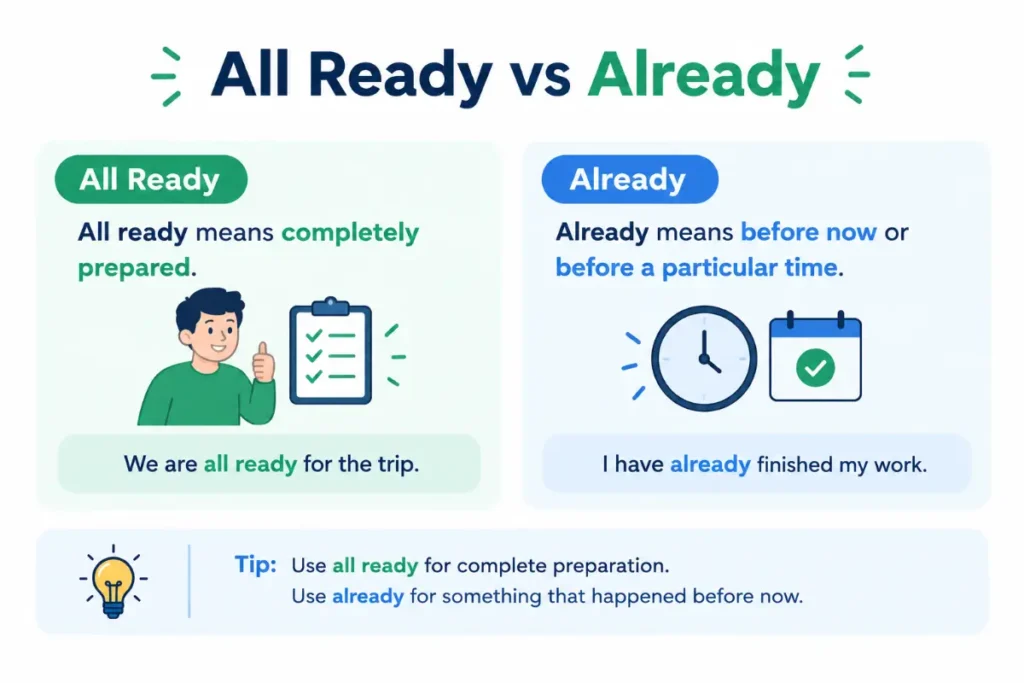
- All ready means completely prepared.
- Already means before now or before a particular time.
- All ready contains two separate words.
- Already is one word.
- All ready works as an adjective phrase.
- Already works as an adverb.
- Use the preparation test when you are unsure.
- Remove all and see if ready still makes sense.
- Use already when the sentence focuses on earlier timing.
- Use all ready when the sentence focuses on preparation.
- Both forms are standard in American and British English.
- The pronunciation can make the forms difficult to distinguish in conversation.
Conclusion
The difference between all ready vs already is simple once you focus on meaning instead of sound. All ready means completely prepared. Already means something happened before now or before a particular time. One describes readiness while the other describes time.
If you’re talking about people who have finished preparing use all ready. If you’re talking about an action that happened earlier use already. The sentence We are all ready means everyone is prepared. The sentence We have already left means the departure happened before now.
Keep one quick test in mind. If you can remove all and still use ready naturally then all ready is likely correct. If the sentence talks about something that happened earlier or sooner than expected use already. Once you connect each form with its job the spelling becomes much easier to remember.
Frequently Asked Questions
Is all ready or already correct?
Both forms are correct. They have different meanings. All ready means completely prepared. Already means before now or before a particular time.
What does all ready mean?
All ready means completely prepared. For example, We are all ready for the trip means everyone has finished preparing for the trip.
What does already mean?
Already is an adverb that usually means before now or before a particular time. It can also show that something happened sooner than expected.
Is all ready two words?
Yes. All ready contains the separate words all and ready. The phrase usually describes a person or thing that is completely prepared.
Is already one word?
Yes. Already is normally written as one word when it means before now, before then, or sooner than expected.
Can all ready and already be used in the same sentence?
Yes. For example, We are all ready because the bus has already arrived. All ready describes preparation while already describes timing.
Is already an adverb?
Yes. Already is an adverb. It commonly modifies a verb phrase and adds information about when something happened or existed.
Is all ready an adjective?
All ready functions as an adjective phrase because ready is an adjective and all adds emphasis or refers to everyone in the group.
How can I remember the difference?
Connect all ready with preparation and already with time. If someone is prepared they are all ready. If something happened before now it already happened.
Do all ready and already sound the same?
They can sound very similar in ordinary speech. This similarity causes many spelling mistakes. Context usually makes the intended meaning clear.
Is already more common in American English?
Already is used in both American and British English. American English also has some informal uses and tense patterns that differ from British usage. The basic meaning and spelling remain the same.

Confusing Words, Spelling & Word Choice
Claire Whitmore is a U.S.-based English editor who writes about commonly confused words, spelling differences, and word choice. Her work helps readers understand subtle distinctions between similar-looking words through simple definitions, practical examples, and modern usage guidance in both American and British English.