
Shall vs should can be confusing because both words belong to the same family of modal verbs and both can relate to future actions. They can also appear in formal rules reported speech questions and conditional sentences. The difference becomes much easier once you focus on the speaker’s purpose.
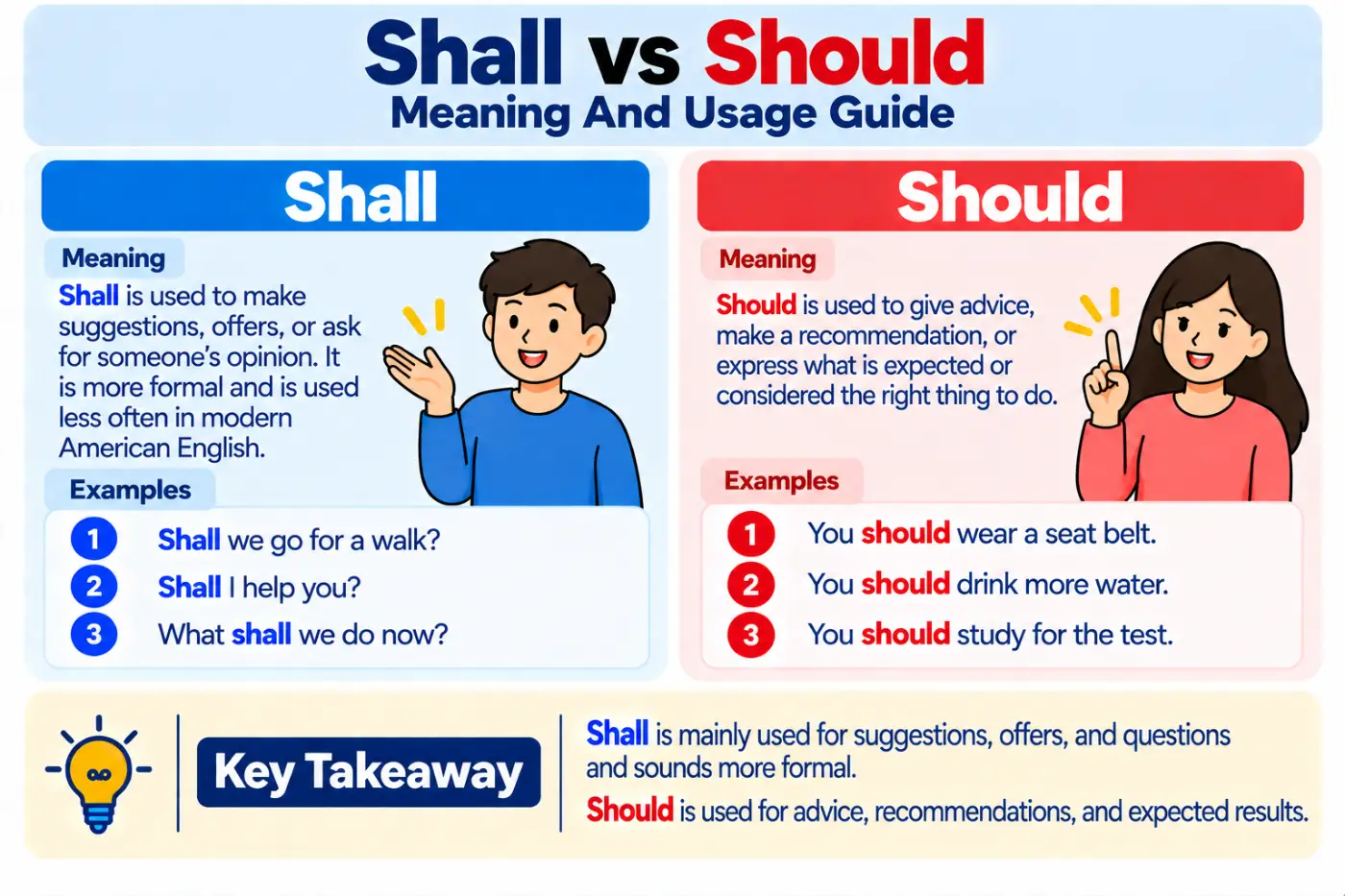
Shall commonly points to a future action or asks for agreement about what happens next. It can also create a strong formal requirement. Should usually gives advice or describes something expected to happen. It can also express probability or refer to a future action from a past point of view.
For most everyday American English situations you will use should far more often than shall. Still shall has not disappeared. It remains useful in formal documents legal language and certain polite questions. Knowing the difference helps you choose the modal verb that matches your meaning instead of relying on a simple rule that does not fit every sentence.
Short Answer
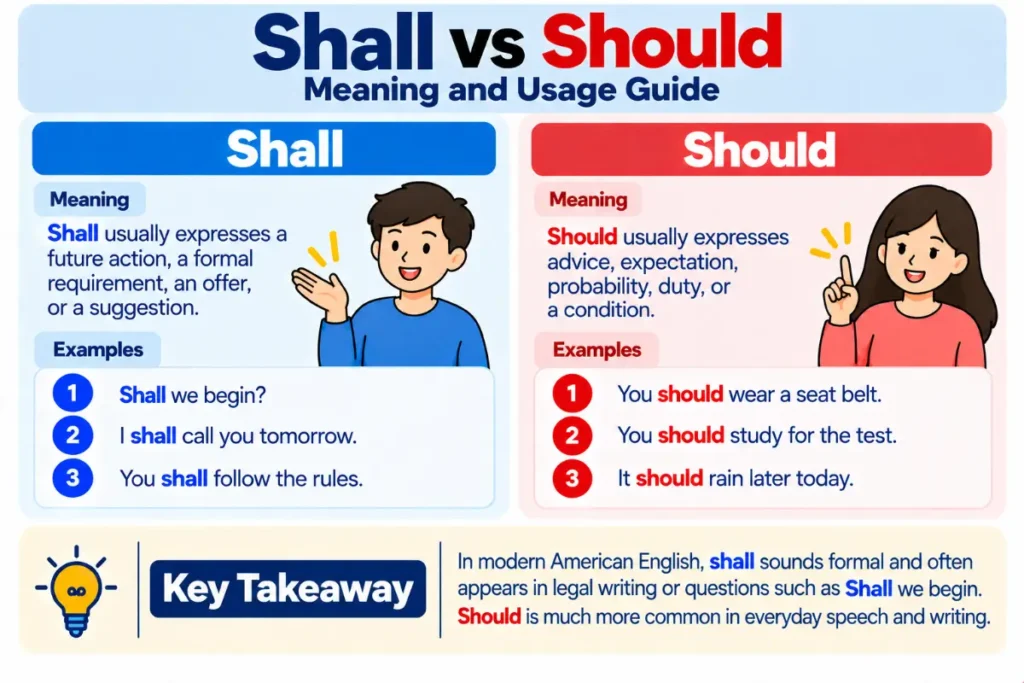
Shall usually expresses a future action a formal requirement an offer or a suggestion. Should usually expresses advice expectation probability duty or a condition. In modern American English shall sounds formal and often appears in legal writing or questions such as Shall we begin. Should is much more common in everyday speech and writing.
Table of Contents
- What Shall Means.
- What Should Means.
- The Main Difference Between Shall And Should.
- When To Use Shall.
- When To Use Should.
- Shall For Future Actions.
- Should For Advice And Expectations.
- Shall In Questions.
- Should In Questions.
- Shall In Formal And Legal Writing.
- Should In Professional Writing.
- American English And British English.
- Pronunciation Of Shall And Should.
- The Grammar Behind Shall And Should.
- Common Mistakes.
- Real Life Examples.
- Memory Tips.
- Related Grammar Notes.
- Frequently Asked Questions.
- Key Takeaways.
- Conclusion.
What Shall Means
Shall is a modal auxiliary verb. It works with a base verb and does not take endings such as s or ed.
You can say:
I shall go.
We shall discuss the matter.
Shall we leave now.
You cannot normally say:
I shalls go.
She shall goes.
The base verb follows shall.
Historically shall had a stronger role in English future expression. Traditional grammar often taught shall with I and we and will with you he she and they. Modern English does not follow that pattern consistently.
Today shall has several important uses.
- It can describe a future action especially with I and we in formal English.
- It can make an offer or suggestion.
- It can express a formal requirement.
- It can show strong determination in certain contexts.
- It can appear in legal and official documents.
- It can create a formal or old fashioned tone.
The meaning depends heavily on context. For example:
I shall return tomorrow.
This sentence sounds formal in modern American English. In ordinary conversation most speakers would say I will return tomorrow.
Now consider:
Shall we start the meeting.
This sounds natural because shall is being used to make a suggestion.
Legal writing gives us another use:
The tenant shall pay the fee within thirty days.
Here shall expresses a formal requirement. The sentence does not simply predict what the tenant will do. It establishes what the agreement requires.
What Should Means
Should is also a modal auxiliary verb. It takes the base form of the main verb.
You can say:
You should study.
She should arrive soon.
They should understand the rule.
You do not say:
You should studies.
She should arrives soon.
Should has several common meanings.
- It can give advice.
- It can express duty or a desirable action.
- It can describe something expected to happen.
- It can express probability.
- It can appear in conditional structures.
- It can report a future action from a past point of view.
- It can make some statements sound less direct.
Advice is one of its most common uses.
You should check your work before submitting it.
The speaker recommends checking the work.
Should can also describe an expectation.
The train should arrive at six.
The speaker expects the train to arrive at six. The sentence does not guarantee that the train will arrive at that exact time.
Should can also express probability.
That should be enough.
The speaker believes the amount is probably sufficient.
This wide range of uses makes should much more common in everyday English than shall.
The Main Difference Between Shall And Should
Shall generally points toward a future action a suggestion an offer or a formal requirement. Should generally points toward advice expectation probability duty or a conditional idea.
The simplest way to remember the difference is to think about purpose.
Use shall when you are asking about or stating what is going to happen in a formal context or when you are making a suggestion with I or we.
Use should when you are telling someone what is advisable or describing what you expect to happen.
Consider these examples.
Shall we order dinner.
This asks for a suggestion or agreement about the next action.
You should order dinner soon.
This gives advice.
The company shall provide written notice.
This establishes a formal requirement.
The company should provide written notice.
This expresses a recommendation or expectation. The exact force depends on the surrounding context.
These sentences may look similar because both modal verbs come before the base verb. Their meanings are different because the speaker has a different purpose.
When To Use Shall
Shall has a smaller role in everyday American English than it once had. Still, it remains useful in several situations.
Use Shall For Suggestions
One of the most natural modern uses appears in questions with I or we.
Shall we begin.
Shall we take a break.
These questions ask what action the speaker and listener should take next.
Shall I call the manager.
This usually means that the speaker is offering to call the manager and wants the listener’s response.
Shall we continue.
This asks for agreement about continuing.
In these cases shall does not simply mean will. It has a conversational function. It invites a decision or suggestion.
Use Shall For Offers
Shall can also introduce an offer.
Shall I send the document now.
The speaker is offering to do something. The listener can accept or reject the offer.
Should does not normally have this same meaning.
Should I carry that for you.
This can ask for advice or permission. It does not naturally sound like a direct offer in the same way.
Use Shall For Formal Requirements
Shall frequently appears in contracts regulations policies and other formal documents.
The applicant shall provide proof of identity.
The employee shall follow all safety procedures.
The buyer shall pay the remaining balance within ten days.
In these examples shall indicates a requirement established by the document.
Still, professional writers should use shall carefully. Some modern legal and plain language guides prefer must when the goal is to state an obligation clearly.
For example:
The applicant must provide proof of identity.
This sentence is often easier for ordinary readers to understand.
Shall can sound more formal than necessary outside legal or official contexts.
Use Shall For Strong Determination
Shall can sometimes express firm determination.
We shall overcome this challenge.
I shall return.
This use often sounds dramatic literary formal or old fashioned. It can be effective when the tone calls for emphasis.
In ordinary American conversation people usually choose will instead.
I will return tomorrow.
That sounds neutral and natural.
When To Use Should
Should is one of the most useful modal verbs in English. It appears in everyday conversation professional writing academic work and many other settings.
Use Should For Advice
This is the most familiar use.
You should get some rest.
You should check the address before sending the package.
The speaker recommends an action.
Should does not always mean that something is compulsory. It usually presents the action as wise desirable or appropriate.
Compare these sentences.
You must wear a helmet.
You should wear a helmet.
The first sentence presents a requirement. The second presents advice or a strong recommendation.
The surrounding context can increase the strength of should. A doctor might say you should take a particular step because it is medically advisable. A friend might say you should try a restaurant simply because they think you will enjoy it.
Use Should For Expectations
Should can describe something that the speaker expects.
The package should arrive tomorrow.
The meeting should finish by five.
The results should be available next week.
The speaker expects these things to happen but does not claim absolute certainty.
This makes should useful when you want to communicate reasonable expectation without making a guarantee.
Use Should For Probability
Should can also suggest that something is likely.
That should be enough food for everyone.
The new software should solve the problem.
She should know the answer.
The speaker has a reason for the expectation.
This use often appears in professional communication because it allows writers to communicate confidence without presenting an uncertain statement as a fact.
Use Should For Duty
Should can express a sense of duty or proper behavior.
People should respect one another.
Students should complete their assignments on time.
Drivers should follow the posted speed limit.
These statements describe what the speaker considers proper or responsible.
The force is usually softer than must.
Drivers must stop at a red light.
Drivers should drive carefully.
The first expresses a rule or requirement. The second expresses good practice.
Use Should In Conditional Sentences
Should can appear in formal conditional sentences.
Should the payment arrive late, additional action may be required.
These structures often sound formal. They have a similar meaning to if you need assistance or if the situation changes.
This use is common in business letters official notices and formal correspondence.
Shall For Future Actions
Traditional English grammar often taught shall as the future form used with I and we.
I shall visit London next month.
We shall return soon.
That pattern still exists but it is not the normal choice for most modern American speakers.
Most Americans would say:
I will visit London next month.
We will return soon.
Shall can make the sentence sound formal or old fashioned.
British English preserves shall more strongly in some contexts. A British speaker may use I shall in a neutral formal statement. Even there, will is also extremely common.
The key point is that grammar books sometimes present the traditional rule more strongly than modern speakers actually follow it.
Should For Advice And Expectations
Should has a different relationship with future time.
You should call tomorrow.
The sentence can mean that calling tomorrow is advisable.
The package should arrive tomorrow.
Here should expresses expectation.
The two meanings are easy to separate by asking what the speaker is doing.
If the speaker recommends an action, should means advice.
If the speaker predicts an expected result, should means expectation.
Consider:
You should leave now.
This can mean I recommend leaving now.
The train should leave now.
This can mean I expect the train to leave now.
The subject and context help reveal the intended meaning.
Shall In Questions
Questions with shall are among the most useful places to recognize this modal verb.
Shall I close the door.
Shall I send you the file.
These questions usually involve a suggestion an offer or a decision about a future action.
Shall I close the door.
The speaker offers to close it.
Shall we order pizza.
The speaker suggests ordering pizza.
Shall we meet after work.
The speaker suggests a meeting.
This structure is still natural in American English even though other uses of shall may sound formal.
Shall In Formal And Legal Writing
Shall has a long history in legal and official English. You may see it in contracts statutes regulations policies and formal rules.
Examples include:
The supplier shall deliver the goods within thirty days.
The parties shall maintain accurate records.
The tenant shall notify the owner of any change of address.
The applicant shall submit all required documents.
In these examples the writer uses shall to establish a duty.
However, readers sometimes misunderstand shall because the word has several meanings in ordinary English. Modern plain language writing often favors must when a clear obligation is intended.
Compare:
The customer shall pay all fees.
The customer must pay all fees.
The second sentence makes the obligation more immediately obvious to most readers.
This does not mean shall is always wrong in legal writing. Its use depends on the drafting style and the legal system involved. The important point is that writers should understand the intended legal effect rather than inserting shall simply because it sounds formal.
Should In Professional Writing
Should works naturally in professional communication.
You should review the report before the meeting.
The team should receive the files by Friday.
We should have enough time to complete the project.
The revised version should address the main concerns.
These sentences sound clear and professional without becoming stiff.
Should is also useful when communicating recommendations.
You should consider updating the policy.
The department should review the current process.
The company should provide clearer instructions.
In these examples the writer makes a recommendation without presenting it as an absolute command.
If a strict requirement exists, must may be more precise.
Employees must complete the training.
If the writer is simply recommending the action, should fits better.
Employees should complete the training before the workshop.
Context determines the exact force.
American English And British English
American and British English use both modal verbs but their frequency and tone can differ.
In modern American English shall is relatively uncommon in ordinary statements about the future. Americans usually use will.
I will call you tomorrow.
We will meet next week.
I will send the report tonight.
Shall remains familiar in questions such as Shall we begin and Shall I help you. It also appears in formal rules and legal writing.
British English preserves some traditional uses of shall more strongly. You may encounter sentences such as I shall see you tomorrow in formal British writing or speech. Still, British speakers also use will frequently for future statements.
The difference is mainly one of frequency style and context rather than a simple rule that one variety uses shall and the other does not.
Should is common in both American and British English.
You should call him.
The train should arrive soon.
We should leave now.
Its core meanings remain stable across both varieties.
Pronunciation Of Shall And Should
Shall is usually pronounced with the short vowel sound found in words such as cat.
In American English the common pronunciation is /ʃæl/.
Should is pronounced with a different vowel sound and ends with a d sound. The common pronunciation is /ʃʊd/.
In connected speech should can have a weaker pronunciation. The vowel may become less distinct when the word receives little stress.
For learners the main pronunciation challenge is often the difference between the vowel sounds rather than the first consonant. Both words begin with the same sh sound.
Practicing them in complete sentences can help.
Shall we go.
You should go.
The first word asks about a shared action. The second gives advice or expresses an expectation depending on context.
The Grammar Behind Shall And Should
Both shall and should are modal auxiliary verbs.
That means they share several grammatical features.
- They do not take s in the third person.
- They are followed by the base form of the main verb.
- They form questions without do.
- They form negatives directly.
- They can express meanings beyond simple time.
For example:
She shall attend the meeting.
She should attend the meeting.
Not:
She shall attends the meeting.
She should attends the meeting.
Questions work in a similar way.
Shall we begin.
Should we begin.
You do not need do before these modal verbs.
Negatives are also direct.
I shall not attend.
You should not worry.
Common contractions include shall not becoming shan’t and should not becoming shouldn’t.
Shan’t is much less common in American English. It is more strongly associated with British English and formal or old fashioned speech.
Shouldn’t is common in everyday English.
You shouldn’t worry.
We shouldn’t leave yet.
Common Mistakes
Several mistakes appear again and again when learners use these modal verbs.
Treating Shall As The Normal Future Verb
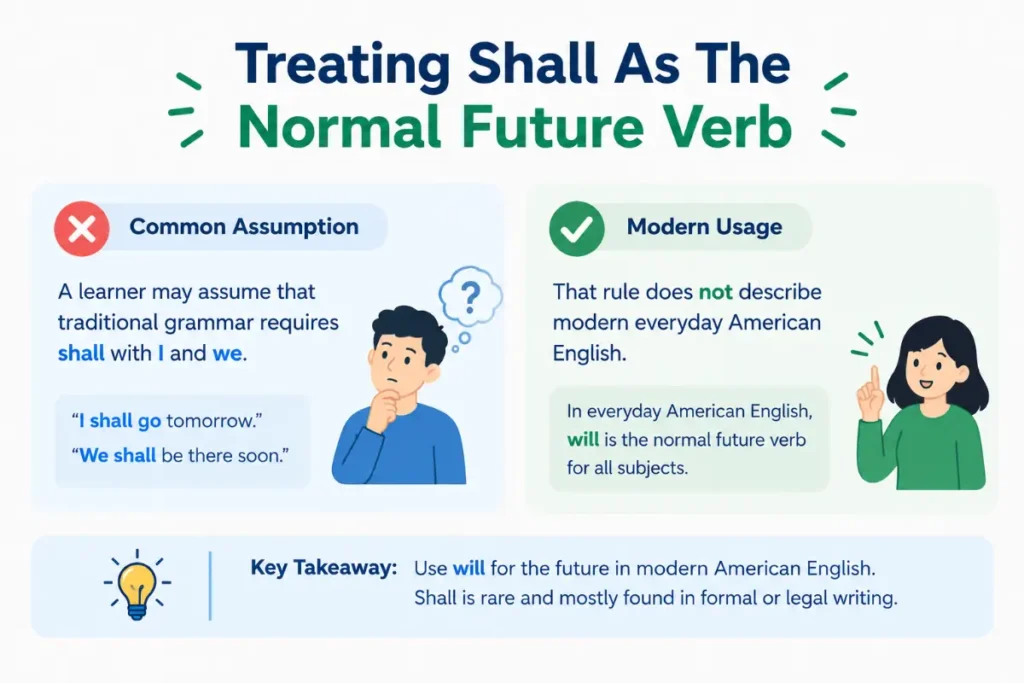
A learner may assume that traditional grammar requires shall with I and we.
That rule does not describe modern everyday American English.
Instead of forcing shall into ordinary future statements, use will when you simply want to describe a future action.
I will call you tomorrow.
Use shall when the context gives it a specific purpose such as a suggestion an offer or a formal requirement.
Using Should For A Simple Future Prediction
Should can express expectation but it does not work as a direct replacement for will in every future sentence.
I will meet Sarah tomorrow.
This simply states a future plan or event.
I should meet Sarah tomorrow.
This can mean I expect to meet Sarah or I believe the meeting is likely. It may also suggest that meeting Sarah is the proper action depending on context.
The meaning changes because should adds an idea of expectation advice or appropriateness.
Confusing Offers With Advice
Compare:
Shall I open the window.
Should I open the window.
The first commonly offers to open it.
The second commonly asks for advice.
This small difference matters in conversation because the speaker’s intention changes.
Using Shall In Casual American Statements
A sentence such as I shall call you tomorrow is grammatically correct. It simply sounds formal to many American speakers.
For a casual message use:
I will call you tomorrow.
Save shall for situations where its formal tone or special function makes sense.
Assuming Should Always Means Weak Advice
Should often gives advice but it can do more.
The package should arrive today.
Here it expresses expectation.
The meeting should finish by noon.
Here it expresses expectation.
Should you need help, contact the office.
Here it appears in a formal conditional structure.
Learning the full range of meanings prevents you from treating should as a one meaning word.
Real Life Examples
The easiest way to understand these modal verbs is to see them in situations that sound natural.
At Home
Shall I make some coffee.
The speaker offers to make coffee.
You should get some sleep.
The speaker gives advice.
Shall we watch a movie.
The speaker suggests an activity.
The movie should start soon.
The speaker expects the movie to start soon.
At Work
Shall we review the report.
The speaker suggests reviewing the report.
You should check the figures again.
The speaker recommends checking the figures.
The manager shall approve the final document.
The sentence presents a formal requirement.
The revised report should be ready tomorrow.
The speaker expects the report to be ready.
At School
Shall we begin the lesson.
The teacher or student suggests beginning.
You should read the instructions carefully.
The speaker gives advice.
The students should finish the exercise by noon.
The speaker expects them to finish.
The school policy shall apply to all students.
The sentence presents a formal rule.
In Customer Service
Shall I connect you with a representative.
The employee offers to make the connection.
You should receive an email shortly.
The employee expects the email to arrive.
Customers shall provide valid identification.
The statement presents a formal requirement.
In Everyday Conversation
Shall we get lunch.
This suggests getting lunch.
Should we get lunch.
This asks if getting lunch is a good idea.
We should get lunch.
This can express a recommendation or expectation.
We shall get lunch.
This sounds unusually formal in most American conversations and may even sound playful or dramatic.
The difference becomes clear when you listen for the speaker’s intention.
Memory Tips
A simple memory trick can make these words easier to remember.
Think of shall as a word that often asks about the next move.
Shall we go.
Shall we begin.
The speaker is discussing what happens next or offering an action.
Think of should as a word connected with good judgment.
You should rest.
You should call your doctor.
The speaker recommends an action.
Another useful trick is to remember these two questions.
Shall I do it.
Should I do it.
The first often means Do you want me to do it.
The second often means Is it a good idea for me to do it.
This is not an absolute rule for every sentence but it works well in everyday conversation.
You can also connect should with expectation.
The package should arrive today.
The meeting should end soon.
The answer should be correct.
If you expect something to happen but do not want to guarantee it then should may be the right choice.
Related Grammar Notes
Understanding shall and should becomes easier when you connect them with other modal verbs.
Shall And Will
Will is the normal future modal in modern American English.
I will call you later.
Shall can also refer to future action but often sounds more formal.
I shall call you later.
In ordinary American conversation will is usually the natural choice.
Shall becomes more useful when making suggestions.
Shall we call him.
This is different from:
Will we call him.
The second question usually asks about a future event or decision. The first actively suggests the action.
Should And Must
Both can express duty but must is usually stronger.
You should wear a seat belt.
This expresses advice or a strong expectation.
You must wear a seat belt.
This expresses a requirement.
The exact force can depend on context but must normally presents a stronger obligation.
Should And Could
Should often asks or tells someone what is advisable.
You should apply for the job.
Could often presents a possible option.
You could apply for the job.
The first gives a recommendation. The second presents an option.
Should And Would
Should can express advice expectation or duty.
You should call her.
Would often expresses a hypothetical situation preference willingness or a future idea viewed from the past.
I would call her if I had her number.
The two verbs can appear together in more advanced structures but they do not have the same basic function.
Shall And May
Shall can make an offer or suggestion.
May can ask for or express permission.
May I help you.
These sentences can overlap in polite situations but their grammatical purpose differs.
A Practical Decision Guide
When you are unsure which modal verb to choose, ask yourself what you want the sentence to accomplish.
- Are you suggesting an action for yourself and another person. Use shall in a question such as Shall we leave.
- Are you offering to do something. Use shall in a question such as Shall I open the door.
- Are you stating a formal requirement. Shall may appear in official language but must may be clearer.
- Are you giving advice. Use should.
- Are you describing something you expect to happen. Use should.
- Are you expressing a likely result. Use should.
- Are you asking for advice. Use should.
- Are you simply stating a future event in modern American English. Use will in most situations.
- Are you writing a formal conditional sentence. Should can work in a structure such as Should you need assistance.
- Are you trying to create a formal or literary tone. Shall may fit depending on the context.
This approach is more useful than memorizing a single rule because modal verbs communicate attitude as well as time.
How Native Speakers Choose Between Them
Native speakers usually do not stop to think about a formal grammar chart before choosing shall or should. They respond to the situation.
If someone is standing near a door and asks Shall I open it, the speaker is offering.
If two coworkers are ready to begin a meeting and one says Shall we start, the speaker is suggesting that they begin.
This difference is subtle but meaningful.
Context also controls tone. Shall can sound polite and natural in Shall we begin but stiff in I shall finish the report tomorrow. Should sounds comfortable in both conversation and professional writing.
That is why learning modal verbs through real examples works better than memorizing isolated definitions.
Formality And Tone
Shall often carries more formal weight than should.
Compare:
I will send the report tomorrow.
I shall send the report tomorrow.
The first sounds neutral. The second sounds formal or old fashioned in many American settings.
Now compare:
Shall we begin.
Should we begin.
The first sounds like a natural suggestion. The second sounds like a request for advice or confirmation.
This shows why you cannot label one word as formal and the other as informal in every situation. The grammatical structure and context affect the tone.
Should is generally more flexible across settings. You can use it in a text message a classroom a business email or an academic paper.
Shall has a narrower modern range but remains valuable when used for the right purpose.
Why Shall Sounds Unusual To Many American Speakers
American English changed over time and largely moved toward will for ordinary future statements.
As a result, sentences using shall outside its common modern patterns may sound formal.
An American speaker is likely to say:
I will be there tomorrow.
An American speaker may still naturally say:
Shall we go.
That difference can seem strange to learners because both sentences involve future action. The key is that shall survives especially well in suggestion and offer questions.
It also remains visible in legal and official language.
Knowing this helps learners avoid an awkward habit. You do not need to use shall simply because a grammar textbook presents it as a traditional future form.
Key Takeaways
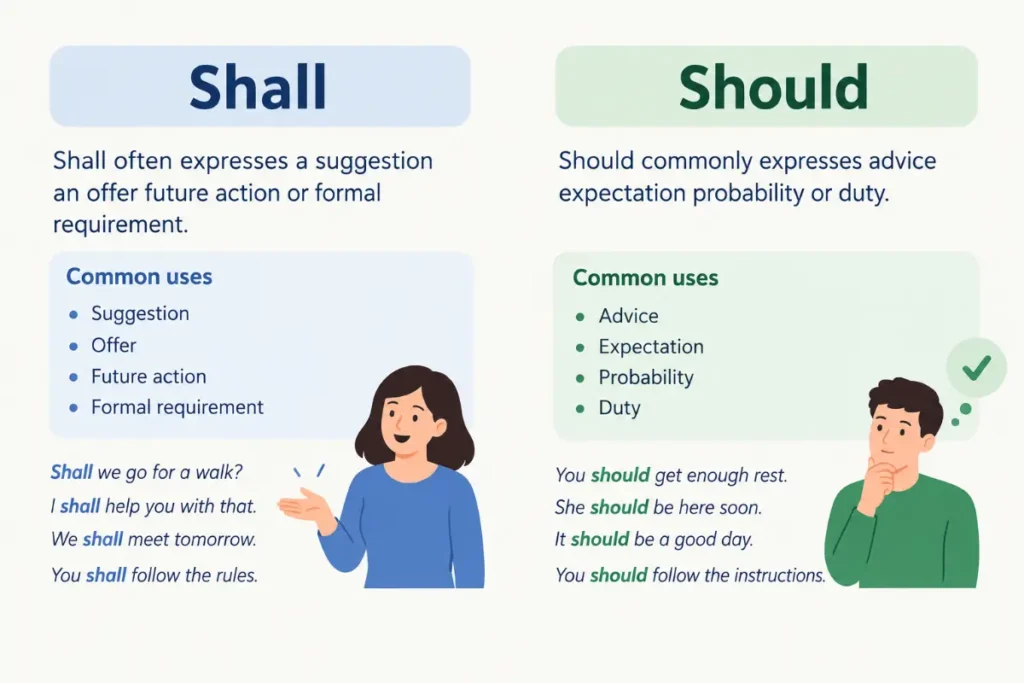
- Shall and should are both modal auxiliary verbs.
- Shall often expresses a suggestion an offer future action or formal requirement.
- Should commonly expresses advice expectation probability or duty.
- Shall I often introduces an offer.
- Shall we often introduces a suggestion.
- Should I usually asks for advice.
- Should can describe something expected to happen.
- Modern American English usually uses will for ordinary future statements.
- Shall remains common in some formal legal and official contexts.
- Should is much more common across everyday American English.
- Both verbs take the base form of the main verb.
- Context determines the exact meaning and tone.
- interchangeable grammar choices and start working as precise tools for expressing meaning.
Conclusion
Shall vs should becomes much easier when you focus on meaning instead of memorizing a traditional future tense rule. Shall commonly helps make suggestions offers and formal requirements. Should usually gives advice or expresses expectation probability or duty.
In modern American English will normally handles ordinary future statements. Shall still has a useful place in questions such as Shall we begin and Shall I help you. It also appears in formal legal and official language. Should remains far more common in everyday speech and writing.
The best way to master these modal verbs is to pay attention to the speaker’s purpose. If someone is offering an action or suggesting what happens next shall may fit. If someone is giving advice or describing an expected result should usually fits. Once you recognize that difference the two words stop looking like interchangeable grammar choices and start working as precise tools for expressing meaning.
Frequently Asked Questions
Is Shall Or Should Correct?
Both are correct modal verbs. The right choice depends on the meaning you want to express. Shall commonly introduces suggestions offers or formal requirements. Should commonly expresses advice expectation probability or duty.
Is Shall More Formal Than Should?
Often yes but context matters. Shall can sound formal in ordinary American statements. It sounds natural in questions such as Shall we begin. Should works comfortably in casual conversation professional writing and academic English.
Can I Use Shall In American English?
Yes. Shall remains part of American English. You will commonly see it in formal documents and hear it in questions such as Shall I help you or Shall we begin. It is less common than will for ordinary future statements.
Is Shall Or Should Better For Advice?
Should is normally the better choice for advice.
You should talk to your manager.
Shall is not normally used to give direct advice in this way.
Can Shall Mean Must?
In formal legal or official writing shall can establish an obligation. For example a contract may state that a party shall provide certain documents. In plain English must often communicates the same requirement more directly.
Is Should The Past Tense Of Shall?
Should is historically connected to shall and can function as its past form in reported speech. However, modern English uses should for many meanings that have nothing to do with simple past time. It commonly expresses advice expectation probability and conditional ideas.
What Is The Difference Between Shall I And Should I?
Shall I usually makes an offer or asks about the next action.
Should I usually asks for advice.
Shall I call the office.
This commonly means Do you want me to call the office.
Should I call the office.
This commonly means Do you think calling the office is a good idea.
What Is The Difference Between Shall We And Should We?
Shall we usually makes a suggestion about doing something together.
Should we usually asks for advice or considers if an action is a good idea.
Shall we leave now.
This suggests leaving now.
Should we leave now.
This asks if leaving now would be appropriate.
Which Is More Common In American English Shall Or Should
Should is much more common in everyday American English. Shall still appears in specific structures especially offers suggestions formal requirements and official writing.
Can Shall And Should Be Used With Any Subject?
Both can technically appear with different subjects but their common modern patterns differ. Shall is especially natural with I and we in questions and formal statements. Should can appear naturally with all subjects.
She should leave.
They should arrive soon.
We should talk.
Shall is less common with third person subjects in ordinary conversation but remains possible in formal writing.
The applicant shall provide identification.
Does Shall Always Refer To The Future?
No. Shall often relates to future action but its meaning depends on context. It can express a suggestion an offer a formal requirement or strong determination. It is better to understand shall by its function rather than treat it as a simple future marker.

English Grammar & Usage
Nathan Holloway is an American grammar writer and language researcher who specializes in English grammar, sentence structure, verb usage, and common writing mistakes. He enjoys breaking down confusing grammar rules into practical explanations with clear examples, making English easier for students, professionals, and everyday writers.