
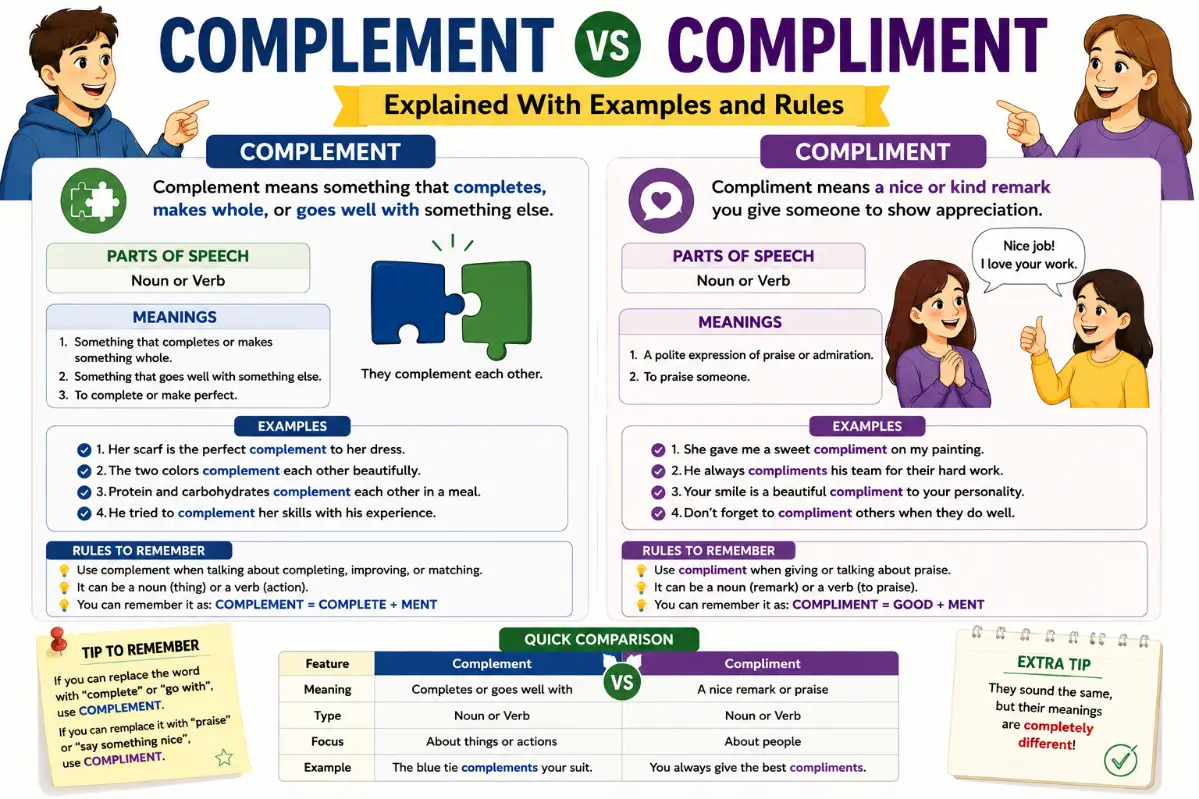
Complement vs Compliment is one of the most confusing word pairs in English because both words are pronounced the same but have completely different meanings. Many people accidentally write compliment when they mean complement, especially in emails, business writing, social media posts, and school assignments.
The confusion happens because only one letter is different, yet that single letter changes the meaning entirely. Choosing the wrong word can make your writing look careless, even if your message is otherwise clear.
The good news is that learning the difference is easier than most people think. Once you understand what each word means and see them used in real sentences, you will rarely confuse them again.
Short Answer
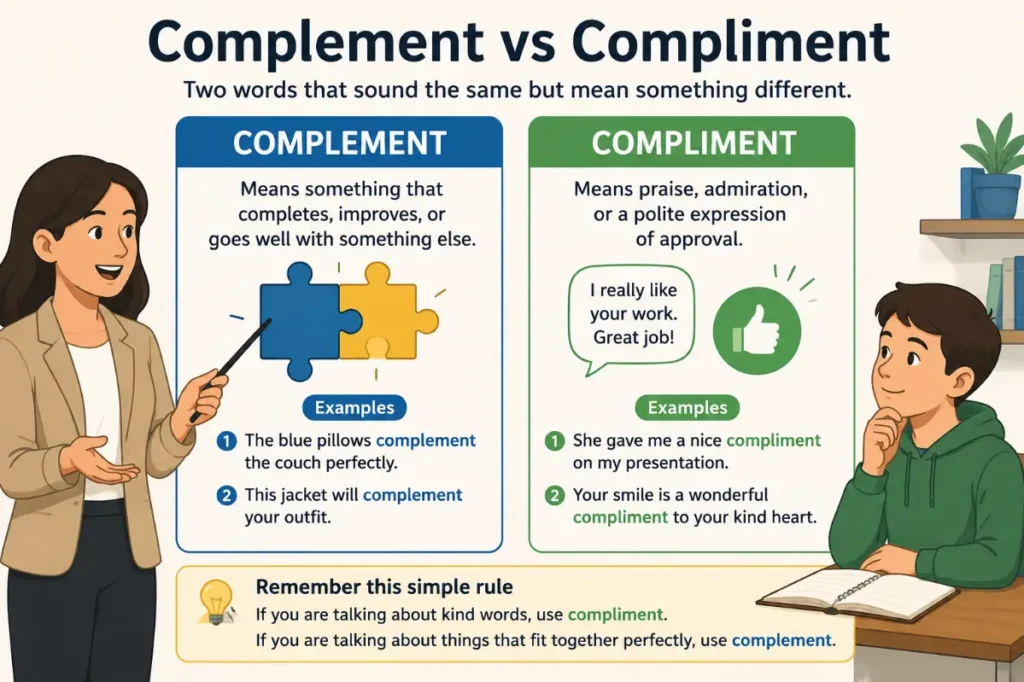
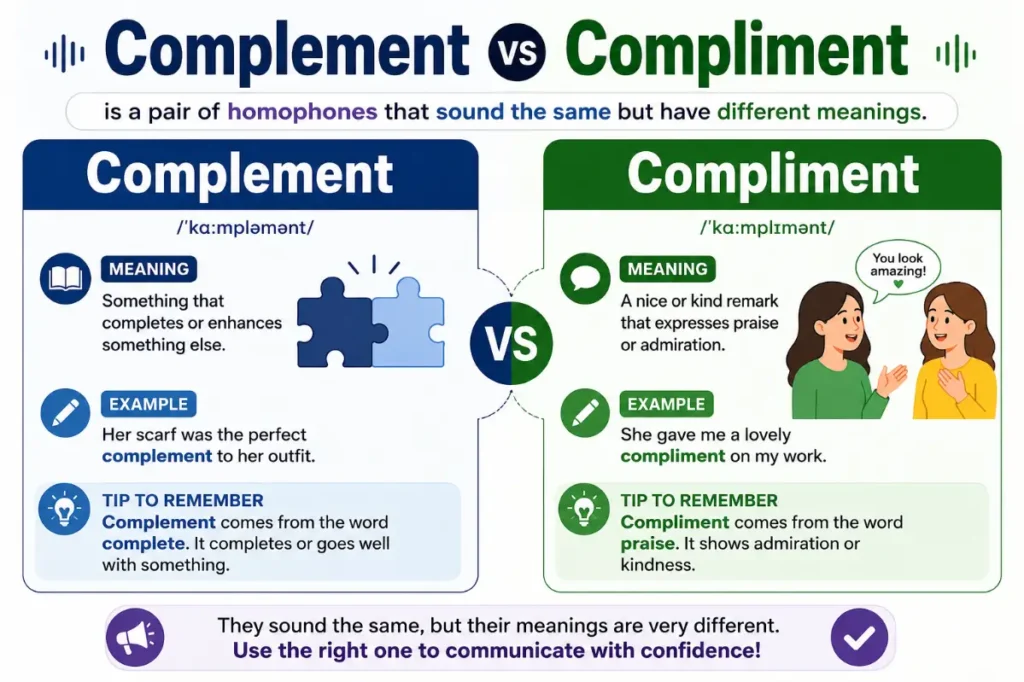
Complement vs Compliment is a common source of confusion because the two words sound exactly alike but have different meanings. Complement means something that completes, improves, or goes well with something else. Compliment means praise, admiration, or a polite expression of approval. Remember this simple rule. If you are talking about kind words, use compliment. If you are talking about things that fit together perfectly, use complement.
Table of Contents
- What Does Complement Mean
- What Does Compliment Mean
- Complement vs Compliment Comparison Table
- Why People Confuse These Words
- When to Use Complement
- When to Use Compliment
- Grammar Rules
- Pronunciation
- Real Life Examples
- Common Mistakes
- Memory Tricks
- Related Grammar Notes
- Frequently Asked Questions
- Key Takeaways
- Conclusion
What Type of Word Pair Is Complement vs Compliment
Complement vs Compliment belongs to several English language categories.
| Category | Applies |
|---|---|
| Confusing Words | Yes |
| Homophones | Yes |
| Word Usage | Yes |
| Common Spelling Mistake | Yes |
| Vocabulary | Yes |
| Grammar | Yes |
They are considered homophones because they sound exactly alike but have different spellings and meanings. This makes them especially difficult for English learners and even native speakers who rely on pronunciation rather than spelling.
What Does Complement Mean
The word complement refers to something that completes, improves, balances, or enhances something else. It often describes two things that work well together.
It can function as both a noun and a verb.
Complement as a Noun
As a noun, complement means something that completes another thing.
Examples
- Fresh basil is the perfect complement to tomato soup.
Explanation. The basil makes the soup taste even better.
- Her calm personality is a great complement to his energetic nature.
Explanation. Their personalities balance each other.
- The blue curtains are an excellent complement to the white walls.
Explanation. The colors match beautifully.
Complement as a Verb
As a verb, complement means to improve or complete something.
Examples
- The scarf complements your jacket perfectly.
Explanation. The scarf matches and improves the overall outfit.
- Strong communication skills complement technical expertise.
Explanation. Both abilities work together effectively.
- The new software complements the existing system.
Explanation. It adds value without replacing it.
What Does Compliment Mean
The word compliment means praise, admiration, or a polite expression that makes someone feel appreciated. Like complement, it can also be a noun or a verb.
Compliment as a Noun
A compliment is a kind or flattering remark.
Examples
- She received a compliment about her presentation.
Explanation. Someone praised her work.
- Thank you for the compliment.
Explanation. The speaker appreciates the praise.
- His compliment made her smile.
Explanation. The kind words made her happy.
Compliment as a Verb
To compliment someone means to praise them.
Examples
- The manager complimented the team for finishing early.
Explanation. The manager praised the team.
- Everyone complimented her cooking.
Explanation. They expressed admiration for the meal.
- I complimented him on his excellent writing.
Explanation. I praised his writing ability.
Complement vs Compliment Comparison Table
| Feature | Complement | Compliment |
|---|---|---|
| Meaning | Completes or improves something | Praise or admiration |
| Part of Speech | Noun and verb | Noun and verb |
| Used For | Matching things, balance, enhancement | Kind words and appreciation |
| Example | The sauce complements the pasta. | She gave me a compliment. |
| Memory Idea | Complete | Praise |
Why People Confuse Complement and Compliment
There are several reasons these words are mixed up so often.
- They have identical pronunciation.
Most people cannot tell the difference simply by hearing them.
Example
“I want to compliment your dress.”
If the speaker is praising the dress, this sentence is correct.
“I want to complement your dress.”
This means you want to wear or add something that matches the dress, which is a completely different meaning.
- Their spellings are almost identical.
Only one letter separates the two words.
Complement
Compliment
Because our eyes recognize familiar word shapes quickly, many writers overlook the difference.
- Both words often appear in positive situations.
A beautiful necklace can complement a dress.
A friend can compliment your dress.
Since both situations involve something pleasant, people sometimes choose the wrong spelling.
- Spell checkers may not catch the mistake.
Since both words are correctly spelled English words, grammar software cannot always detect incorrect usage.
Example
“The flowers compliment the room.”
This sentence is grammatically correct but semantically wrong.
Correct version
“The flowers complement the room.”
The flowers match or enhance the room rather than praise it.
When to Use Complement
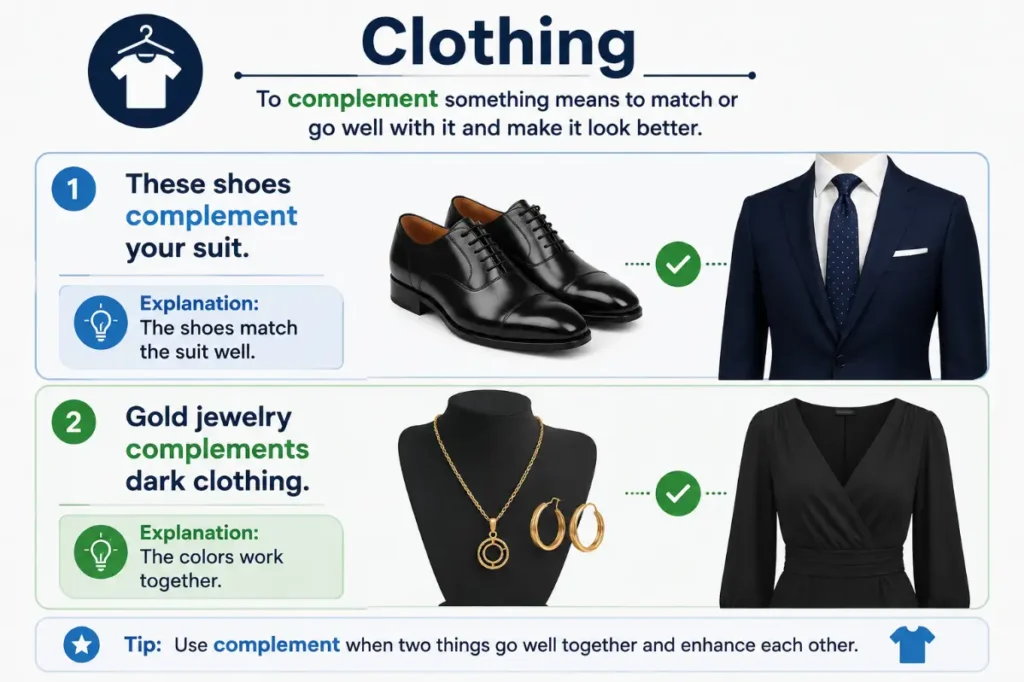
Use complement whenever one thing completes, improves, balances, or matches another. Common situations include fashion, food, design, relationships, music, business, technology, architecture, and color combinations.
Clothing
- These shoes complement your suit.
Explanation. The shoes match the suit well.
- Gold jewelry complements dark clothing.
Explanation. The colors work together.
Food
- Lemon complements grilled fish.
Explanation. The flavor enhances the fish.
- Fresh herbs complement homemade pasta.
Explanation. They improve the overall taste.
Business
- Her leadership skills complement her technical knowledge.
Explanation. Both strengths create a stronger professional profile.
- This service complements our existing products.
Explanation. It adds value to what already exists.
Interior Design
- Wooden furniture complements neutral walls.
Explanation. The materials create a balanced appearance.
- Natural light complements the modern design.
Explanation. It enhances the overall look.
Relationships
- Their personalities complement each other.
Explanation. Each person’s strengths balance the other’s weaknesses.
- His patience complements her creativity.
Explanation. Together they form an effective partnership.
Common Expressions Using Complement
Many English expressions naturally use complement.
- Complement each other
Example
Their skills complement each other perfectly.
Explanation. Each person brings strengths that improve the other.
- Perfect complement
Example
Fresh fruit is the perfect complement to breakfast.
Explanation. It completes the meal.
- Complementary colors
Example
Blue and orange are complementary colors.
Explanation. They create strong visual contrast while looking attractive together.
- Complementary skills
Example
The project succeeded because the team had complementary skills.
Explanation. Different abilities worked together effectively.
- Complementary services
Example
The company offers complementary services to its customers.
Explanation. The services support and enhance one another.
In the next part, we’ll cover When to Use Compliment, grammar rules, pronunciation, detailed real-life examples, professional writing tips, common mistakes, and advanced usage.
When to Use Compliment
Use compliment whenever you are talking about praise, admiration, appreciation, or polite words that make someone feel good. A compliment can be spoken, written, or even expressed through a thoughtful message.
People give compliments every day in conversations, workplaces, schools, and social situations.
Complimenting Someone’s Appearance
Examples
- She complimented her friend on the beautiful dress.
Explanation. She praised the dress.
- Everyone complimented him on his new haircut.
Explanation. They admired how he looked.
- I received several compliments about my new glasses.
Explanation. People expressed approval.
Complimenting Skills or Work
Examples
- The teacher complimented the student for excellent writing.
Explanation. The teacher praised the student’s work.
- Our manager complimented us for meeting the deadline.
Explanation. The manager expressed appreciation.
- Clients often compliment the company for outstanding service.
Explanation. Customers praise the quality of the service.
Complimenting Personal Qualities
Examples
- She complimented him on his patience.
Explanation. She admired his calm behavior.
- I complimented my sister for her kindness.
Explanation. I praised her caring attitude.
- Everyone complimented the volunteers for their dedication.
Explanation. People appreciated their hard work.
Complimenting Achievements
Examples
- The coach complimented the team after the victory.
Explanation. The coach praised the team’s performance.
- His boss complimented him for solving a difficult problem.
Explanation. The boss admired his accomplishment.
- We complimented our neighbor on winning the community award.
Explanation. We congratulated and praised the achievement.
Common Expressions Using Compliment
English speakers frequently use these expressions.
- Pay someone a compliment.
Example
She paid him a compliment after his speech.
Explanation. She praised him politely.
- Receive a compliment.
Example
He received many compliments on his presentation.
Explanation. Many people praised his work.
- Take it as a compliment.
Example
Take it as a compliment because they admire your confidence.
Explanation. Accept the remark as praise.
- Return the compliment.
Example
She returned the compliment by praising his artwork.
Explanation. She responded with praise of her own.
- Compliment someone on something.
Example
I complimented her on her impressive research.
Explanation. The praise focused on a specific achievement.
Grammar Rules for Complement and Compliment
Knowing the meanings is helpful, but understanding how these words function in sentences makes choosing the correct one much easier.
Complement as a Noun
Examples
- This sauce is the perfect complement to grilled chicken.
- The new library is a valuable complement to the school.
Both examples describe something that completes another thing.
Complement as a Verb
Examples
- These colors complement each other.
- His experience complements his education.
The verb means to improve, match, or complete.
Compliment as a Noun
Examples
- Thank you for the compliment.
- That was a thoughtful compliment.
The noun refers to praise.
Compliment as a Verb
Examples
- I complimented her on her success.
- They complimented the chef after dinner.
The verb means to praise someone.
Complement vs Compliment in Everyday Situations
The easiest way to master these words is by seeing them in familiar situations.
At Work
Correct
The designer’s creativity complements the engineer’s technical knowledge.
Explanation. Their abilities work well together.
Correct
The director complimented the team for finishing the project early.
Explanation. The director praised the team.
At School
Correct
Her artistic talent complements her academic achievements.
Explanation. Both strengths improve her overall performance.
Correct
The teacher complimented every student who participated.
Explanation. The teacher praised the students.
Shopping
Correct
This belt complements your outfit.
Explanation. The belt matches the clothing.
Correct
The salesperson complimented your choice of color.
Explanation. The salesperson praised your selection.
At Home
Correct
Fresh flowers complement the living room.
Explanation. They improve the appearance.
Correct
My parents complimented me for cleaning the house.
Explanation. They praised my effort.
Complement vs Compliment in Professional Writing
Using the correct word is especially important in business communication because the wrong choice can make your writing appear less polished.
Correct
Our consulting services complement your existing business strategy.
Explanation. The services add value to the strategy.
Correct
We would like to compliment your staff on their professionalism.
Explanation. The company is expressing praise.
Correct
Your experience complements the qualifications required for this position.
Explanation. Your background fits the role well.
Correct
The interview panel complimented her communication skills.
Explanation. The panel praised her abilities.
Complement vs Compliment in Academic Writing
Students often use these words in essays and research papers.
Correct
The author’s evidence complements the main argument.
Explanation. The evidence strengthens the argument.
Correct
The professor complimented the student’s detailed analysis.
Explanation. The professor praised the student’s work.
Correct
Charts complement written explanations.
Explanation. They make the information more complete.
Correct
The examiner complimented the clarity of the presentation.
Explanation. The presentation received praise.
Complement vs Compliment in Marketing
Marketing materials frequently use both words.
Correct
Our accessories complement every outfit.
Explanation. The accessories match different styles.
Correct
Customers regularly compliment our customer support team.
Explanation. Customers praise the service.
Correct
The new feature complements the existing software.
Explanation. The feature improves the product.
Correct
Many reviewers compliment the product’s simple design.
Explanation. Reviewers express admiration.
Pronunciation
Both words are pronounced exactly the same.
Complement
Pronunciation
KOM pluh ment
Compliment
Pronunciation
KOM pluh ment
Because they sound identical, context is the only reliable way to determine which spelling is correct.
This makes them true homophones.
Word Origins
Learning where these words came from helps explain why their meanings are different.
Complement
The word comes from the Latin word meaning to fill up or to complete.
That original idea still exists today.
A complement completes something.
Compliment
The word developed from expressions connected with courtesy, respect, and polite praise.
Its modern meaning centers on admiration and appreciation.
Although both words have similar spellings, their histories developed in different directions.
Real Life Examples
Conversation
Emma said that my blue jacket really complemented my shoes.
Explanation. The jacket matched the shoes.
Later she complimented me on my sense of style.
Explanation. She praised my fashion choices.
Restaurant
Fresh herbs complement grilled salmon.
Explanation. The herbs improve the flavor.
The customers complimented the chef after dinner.
Explanation. They praised the cooking.
Office
His analytical thinking complements the team’s creativity.
Explanation. Different strengths work together.
The manager complimented everyone for their excellent teamwork.
Explanation. The manager praised the employees.
School
Pictures complement the lesson.
Explanation. They make learning easier.
The principal complimented the students for their behavior.
Explanation. The students received praise.
Common Mistakes
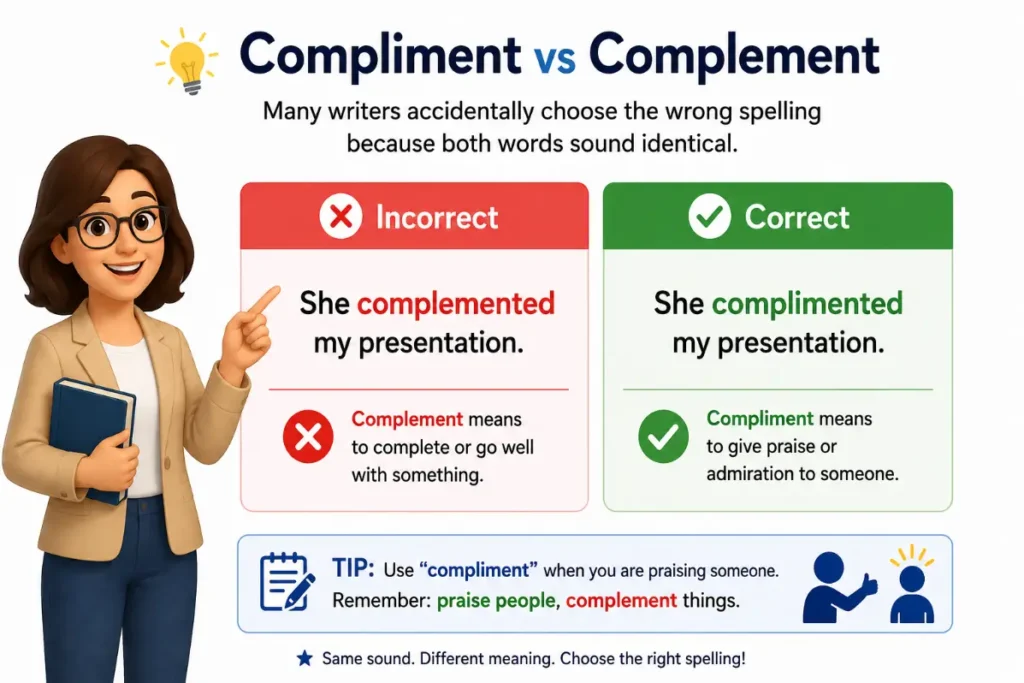
Many writers accidentally choose the wrong spelling because both words sound identical.
Incorrect
She complemented my presentation.
Correct
She complimented my presentation.
Explanation. She praised the presentation rather than completed it.
Incorrect
The curtains compliment the furniture.
Correct
The curtains complement the furniture.
Explanation. The curtains match the furniture instead of praising it.
Incorrect
He gave me a nice complement.
Correct
He gave me a nice compliment.
Explanation. Praise is a compliment.
Incorrect
Your experience is a good compliment to the team.
Correct
Your experience is a good complement to the team.
Explanation. Your experience strengthens the team.
Quick Self Check
Ask yourself one simple question before choosing the word.
Question
Am I talking about praise?
If the answer is yes, choose compliment.
Question
Am I talking about matching, improving, completing, or balancing something?
If the answer is yes, choose complement.
This simple habit prevents most mistakes.
Professional Writing Tips
- In resumes, business reports, and proposals, complement often appears when describing products, services, systems, or skills that work well together.
Example
Our training programs complement your existing processes.
- In customer service, reviews, recommendation letters, and thank you messages, compliment usually refers to praise.
Example
Several clients complimented our support team.
- Read your sentence aloud and replace the word with praise.
If the sentence still makes sense, use compliment.
Example
She praised my work.
She complimented my work.
Both express the same idea.
- Replace the word with complete.
If the sentence still makes sense, use complement.
Example
The new feature completes the software.
The new feature complements the software.
Both describe enhancement or completion.
Memory Tricks to Remember the Difference
Many people learn the meanings of these words but still hesitate when writing. These simple memory tricks make choosing the correct spelling much easier.
Remember the Letter I
The word compliment contains the letter I.
Think of I admire you.
A compliment is something you say to praise someone.
Example
She gave me a compliment about my presentation.
Explanation. She admired the presentation.
Remember the Word Complete
The word complement begins with the same letters as complete.
A complement completes or improves something.
Example
The sauce complements the pasta.
Explanation. The sauce completes the meal.
Think About People and Things
People receive compliments.
Things complement other things.
Examples
My friend complimented my new haircut.
Explanation. My friend praised me.
The new haircut complements my face shape.
Explanation. The haircut suits my appearance.
Use Simple Replacement Words
Replace the word with praise.
If the sentence still makes sense, choose compliment.
Example
The teacher praised the student.
The teacher complimented the student.
Replace the word with complete or match.
If the sentence still makes sense, choose complement.
Example
The curtains match the carpet.
The curtains complement the carpet.
Related Grammar and Usage Notes
Learning similar word pairs helps strengthen your vocabulary and reduce writing mistakes.
Affect vs Effect
Affect is usually a verb meaning to influence.
Effect is usually a noun meaning a result.
Examples
The weather affected our plans.
The effect was noticeable immediately.
Advice vs Advise
Advice is a noun.
Advise is a verb.
Examples
She gave excellent advice.
I advise checking the instructions first.
Principal vs Principle
Principal often refers to a school leader or something most important.
Principle means a rule or belief.
Examples
The principal welcomed the new students.
Honesty is an important principle.
Accept vs Except
Accept means to receive.
Except means excluding.
Examples
She accepted the invitation.
Everyone came except Tom.
Then vs Than
Then relates to time.
Than is used for comparison.
Examples
We ate dinner then watched a movie.
She is taller than her brother.
These word pairs, like Complement vs Compliment, are easier to remember when you focus on their meanings instead of their pronunciation.
Advanced Usage
Although the meanings are straightforward, these words appear in many professional fields.
Business
A product may complement another product.
Example
The mobile app complements the desktop software.
Explanation. Both products work together.
A customer may compliment excellent service.
Example
Several clients complimented our support staff.
Explanation. They expressed appreciation.
Fashion
Designers often describe colors, fabrics, or accessories as complements.
Example
Silver jewelry complements a navy blue dress.
Explanation. The colors work well together.
Customers often compliment clothing.
Example
Everyone complimented her elegant outfit.
Explanation. They praised how she looked.
Food and Cooking
Chefs frequently use complement.
Example
Fresh herbs complement roasted vegetables.
Explanation. They improve the flavor.
Guests often use compliment.
Example
The guests complimented the chef after dinner.
Explanation. They praised the meal.
Sports
Players with different strengths often complement each other.
Example
The striker’s speed complements the midfielder’s passing ability.
Explanation. Their skills create a stronger team.
Coaches often compliment players.
Example
The coach complimented the goalkeeper for making several outstanding saves.
Explanation. The coach praised the performance.
Practice Exercise
Choose the correct word.
Exercise One
The blue tie __________ your gray suit.
Answer
complements
Explanation. The tie matches the suit.
Exercise Two
My manager __________ me for finishing the report early.
Answer
complimented
Explanation. The manager praised the employee.
Exercise Three
Fresh lemon juice is the perfect __________ to grilled fish.
Answer
complement
Explanation. The lemon improves the flavor.
Exercise Four
She received a wonderful __________ after her speech.
Answer
compliment
Explanation. She received praise.
Exercise Five
The designer chose colors that __________ each other perfectly.
Answer
complement
Explanation. The colors match well.
Exercise Six
Several customers __________ the restaurant staff for their kindness.
Answer
complimented
Explanation. They praised the staff.
Practice Quiz Answers
- complements
- complimented
- complement
- compliment
- complement
- complimented
If you answered all six correctly, you have mastered the difference between these two commonly confused words.
Key Takeaways
- Complement vs Compliment is a pair of homophones that sound the same but have different meanings.
- Complement means to complete, improve, balance, or match something.
- Compliment means praise, admiration, or kind words.
- Both words can function as nouns and verbs.
- Use complement for products, colors, food, skills, services, personalities, and anything that works well together.
- Use compliment when someone expresses appreciation, admiration, or respect.
- The easiest memory trick is that complement relates to complete, while compliment relates to I admire you.
- When in doubt, replace the word with match or complete for complement, and praise for compliment.
Conclusion
Understanding Complement vs Compliment becomes much easier once you focus on the meaning instead of the spelling. Although these words are pronounced the same, they serve completely different purposes in English.
Use complement when something completes, improves, balances, or matches something else. Use compliment when expressing praise, admiration, or appreciation. Remember the simple memory trick that complement relates to complete, while compliment relates to I admire you. That single association can help you choose the correct word almost every time.
With regular practice and exposure to real examples, the difference will soon become second nature. The next time you write an email, prepare a report, post on social media, or have a conversation, you can confidently choose the correct word and avoid one of the most common mistakes in English writing.
Frequently Asked Questions
1. What is the main difference between Complement vs Compliment?
Complement means something that completes, improves, or matches another thing. Compliment means praise or an expression of admiration.
2. Is Complement vs Compliment a pair of homophones?
Yes. They are homophones because they have the same pronunciation but different spellings and meanings.
3. Which word should I use when praising someone?
Use compliment because it refers to kind words, admiration, or praise.
Example
She complimented me on my writing.
4. Which word describes two things that work well together?
Use complement.
Example
The artwork complements the modern furniture.
5. Can both words be nouns and verbs?
Yes. Both complement and compliment can be used as nouns and as verbs.
Examples
The dessert is the perfect complement to dinner.
She complimented the chef after the meal.
6. How can I remember the difference between Complement vs Compliment?
Think of complete for complement and I admire you for compliment. This simple memory trick works in most situations.
7. Are both words used in American and British English?
Yes. Both spellings and meanings are standard in American English and British English. There is no regional difference in usage.
8. Can a person complement another person?
Yes. A person’s skills, personality, or strengths can complement another person’s abilities.
Example
Her creativity complements his attention to detail.
9. Is it correct to say someone complemented my shirt?
Only if you mean they made your shirt look better by adding something that matched it.
If you mean they praised your shirt, the correct word is complimented.
10. Why do people confuse Complement vs Compliment so often?
People confuse them because they sound identical, differ by only one letter, and are often used in positive situations. Understanding the meanings instead of relying on pronunciation helps prevent mistakes.

Confusing Words, Spelling & Word Choice
Claire Whitmore is a U.S.-based English editor who writes about commonly confused words, spelling differences, and word choice. Her work helps readers understand subtle distinctions between similar-looking words through simple definitions, practical examples, and modern usage guidance in both American and British English.