
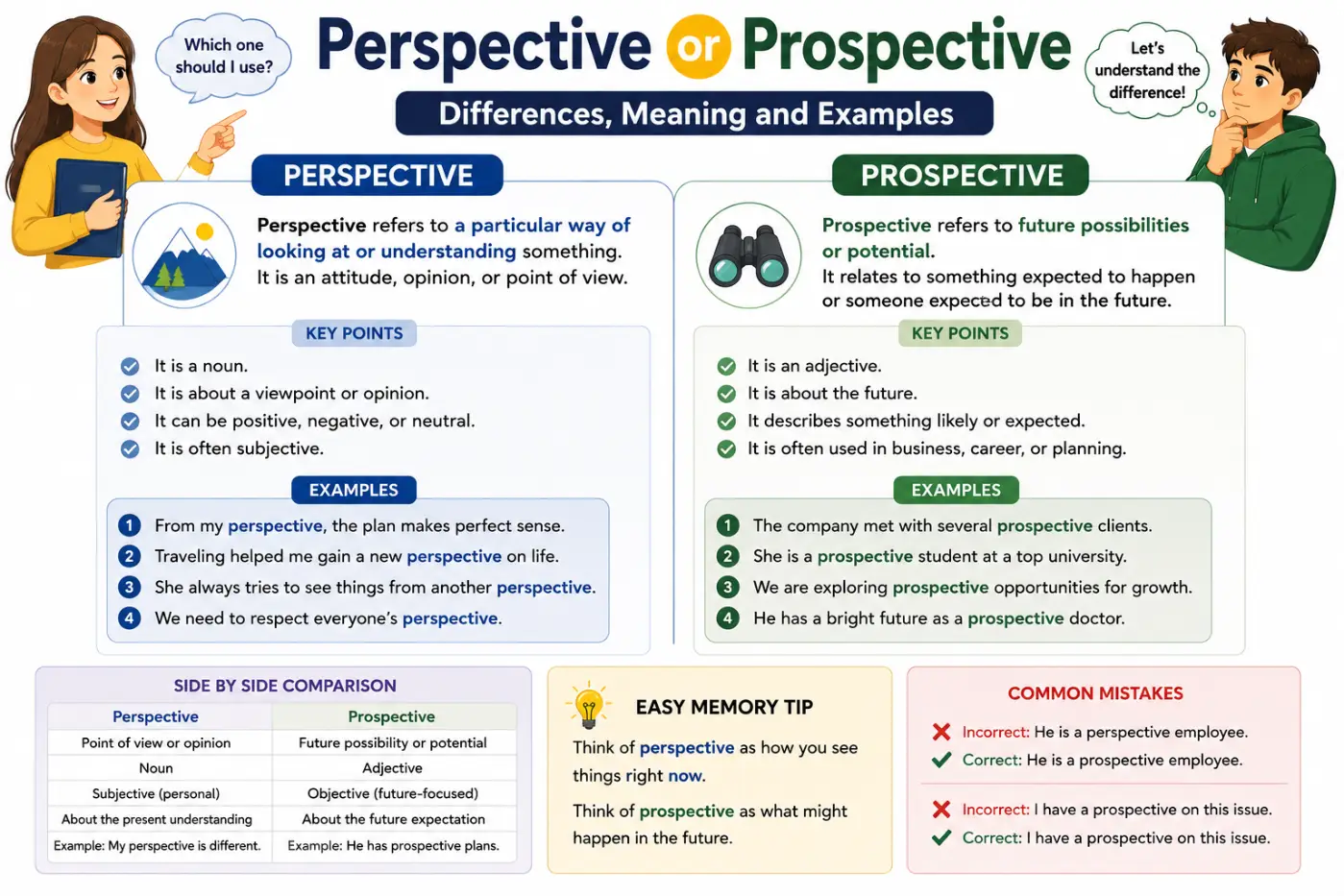
Perspective or Prospective is a confusing word pair that often causes mistakes in writing and speech. Since both words begin with perspect and differ by only a few letters, it’s easy to type the wrong one or misunderstand their meanings. Even experienced writers occasionally confuse them.
The good news is that these words have distinct definitions and are used in very different situations. Perspective is about how someone thinks, sees, or understands something. Prospective, on the other hand, describes someone or something connected with the future. Once you understand this key distinction, choosing the correct word becomes much easier.
This guide explains everything you need to know about Perspective or Prospective. You’ll learn their meanings, pronunciation, grammar, origins, common mistakes, practical examples, and memory tricks that will help you use both words confidently in everyday conversations, academic writing, and professional communication.
Short Answer
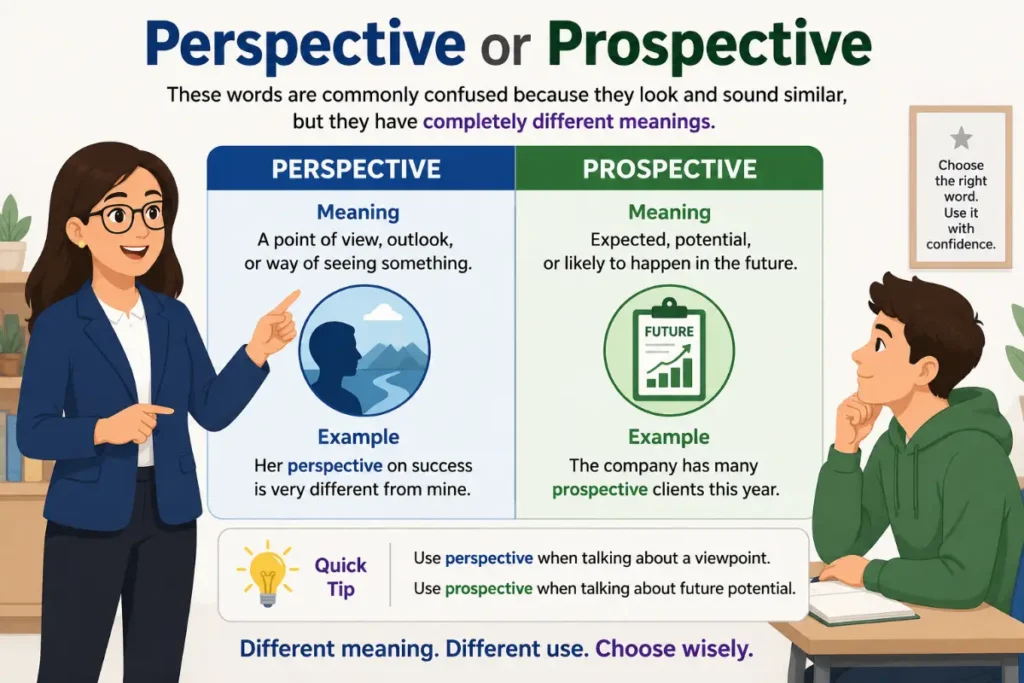
Perspective or Prospective are commonly confused because they look and sound similar, but they have completely different meanings. Perspective refers to a point of view, outlook, or way of seeing something. Prospective means expected, potential, or likely to happen in the future. Choosing the correct word depends on whether you’re talking about a viewpoint or something that may happen.
Table of Contents
- What Does Perspective Mean
- What Does Prospective Mean
- Perspective or Prospective Quick Comparison
- The Main Difference Between Perspective and Prospective
- When to Use Perspective
- When to Use Prospective
- Common Expressions
- Formal and Informal Usage
- Grammar Rules
- Pronunciation
- Word Origins
- Real Life Examples
- Common Mistakes
- Memory Tips
- Related Grammar Notes
What Does Perspective Mean
Perspective is a noun that refers to a person’s point of view, opinion, attitude, or way of understanding something. It can also describe how objects appear in art or photography depending on distance and position.
Examples:
- Everyone has a different perspective on success.
- Try to see the situation from her perspective.
- The artist used perspective to make the road appear longer.
In each sentence, perspective refers to a way of seeing, thinking, or viewing.
Definition
Perspective means:
- A point of view
- An outlook
- A way of thinking
- A particular attitude toward something
- A visual technique that creates depth in art
It is always a noun.
What Does Prospective Mean
Prospective is an adjective that describes something expected, possible, or likely to happen in the future.
It often refers to future people, events, opportunities, or plans.
Examples:
- The university welcomed prospective students.
- We interviewed several prospective employees.
- She spoke with prospective buyers.
Each sentence describes someone who may become something in the future.
Definition
Prospective means:
- Potential
- Future
- Expected
- Likely
- Possible
Unlike perspective, prospective is an adjective.
Perspective or Prospective Quick Comparison
| Feature | Perspective | Prospective |
|---|---|---|
| Part of speech | Noun | Adjective |
| Main meaning | Point of view | Future or potential |
| Talks about | Opinions or viewpoints | Future people or events |
| Time focus | Present or general | Future |
| Common in business | Yes | Yes |
| Common in education | Yes | Yes |
This comparison shows that although the words look alike, their grammar and meanings are completely different.
The Main Difference Between Perspective and Prospective
The easiest way to understand Perspective or Prospective is to focus on what each word answers.
Perspective answers:
How does someone see or think about something?
Prospective answers:
Who or what may exist or happen in the future?
Compare these examples.
Perspective
- From my perspective, the project was successful.
Meaning:
This is my opinion.
Prospective
- We interviewed prospective candidates.
Meaning:
These people may become employees.
Notice that replacing one word with the other changes the meaning completely.
Incorrect:
- We interviewed perspective candidates.
Correct:
- We interviewed prospective candidates.
Likewise:
Incorrect:
- I understand your prospective.
Correct:
- I understand your perspective.
When to Use Perspective
To Describe a Point of View
This is the most common meaning.
Examples:
- Your perspective is interesting.
- She shared her perspective during the meeting.
- I appreciate your perspective on the issue.
Explanation:
The word refers to someone’s opinion or viewpoint.
To Describe a Way of Thinking
Examples:
- Traveling changed my perspective.
- Experience gives people a broader perspective.
- Reading history provides a new perspective.
Explanation:
Here, perspective refers to how someone understands life or events.
In Art and Design
Artists use perspective to create the illusion of depth.
Examples:
- The painting uses linear perspective.
- Good perspective makes the building look realistic.
- Students learned perspective drawing.
Explanation:
This meaning is common in architecture, drawing, photography, and design.
When to Use Prospective
To Describe Future People
This is one of the most common business and academic uses.
Examples:
- Prospective students attended the orientation.
- Prospective customers visited the showroom.
- Prospective employees completed interviews.
Explanation:
These people may become students, customers, or employees later.
To Describe Future Events
Examples:
- We discussed prospective investments.
- The company analyzed prospective markets.
- They considered prospective locations.
Explanation:
Each example describes future possibilities.
To Describe Potential Opportunities
Examples:
- The business has several prospective partners.
- She contacted prospective investors.
- They met with prospective clients.
Explanation:
The relationships have not yet been established.
Perspective in Everyday English
You’ll hear perspective in many conversations.
Examples:
- That’s an interesting perspective.
- Let me offer another perspective.
- Try looking at it from a different perspective.
- His perspective changed after the accident.
This word appears frequently in education, psychology, journalism, leadership, and personal development.
Prospective in Everyday English
Although prospective sounds more formal, it is common in business, education, and professional writing.
Examples:
- Prospective homeowners attended the seminar.
- The company welcomed prospective investors.
- The school invited prospective parents.
- The real estate agent contacted prospective buyers.
Notice that prospective almost always appears before a noun.
Formal and Informal Usage
Perspective
This word works equally well in formal and informal English.
Formal:
- The report presents multiple perspectives on climate policy.
Informal:
- I understand your perspective.
Both sound natural.
Prospective
Prospective appears more often in formal communication.
Examples:
- Prospective applicants should submit all required documents.
- Prospective members must complete the registration form.
- Prospective tenants should schedule a viewing.
In casual speech, many people replace prospective with future or potential.
Example:
Formal:
- Prospective customers.
Informal:
- Future customers.
Grammar Rules
Understanding the grammar makes these words much easier to remember.
Perspective Is a Noun
Correct:
- I respect your perspective.
- Her perspective changed.
Incorrect:
- She is perspective.
Explanation:
A noun names a thing, idea, or concept.
Prospective Is an Adjective
Correct:
- Prospective employees arrived early.
- Prospective students received brochures.
Incorrect:
- The prospective was interesting.
Explanation:
Adjectives describe nouns.
Pronunciation
| Word | IPA | Simple Pronunciation |
|---|---|---|
| Perspective | /pərˈspek.tɪv/ | per SPEK tiv |
| Prospective | /prəˈspek.tɪv/ | pro SPEK tiv |
Notice that only the beginning of the words changes.
Many pronunciation mistakes happen because people speak too quickly.
Reading the words aloud several times helps build confidence.
Word Origins
Understanding the history of these words makes them easier to remember.
Perspective
The word comes from the Latin perspicere, meaning to look through or to see clearly.
That explains why perspective relates to seeing or viewing something.
Prospective
The word comes from the Latin prospicere, meaning to look forward.
That explains why prospective always relates to the future.
The origins perfectly match the modern meanings.
Perspective vs Prospective in Business English
Business communication often uses both words.
Perspective
Examples:
- We value every customer’s perspective.
- Management considered different perspectives before making a decision.
- The consultant offered a fresh perspective.
Here, the word refers to opinions or viewpoints.
Prospective
Examples:
- The company contacted prospective clients.
- Prospective investors attended the presentation.
- Human Resources interviewed prospective employees.
Here, the word describes people who may become customers, investors, or employees in the future.
Understanding this distinction is especially important in emails, reports, presentations, and professional documents.
Perspective vs Prospective in Education
Schools, colleges, and universities frequently use both words, but for different reasons.
Using Perspective
Examples:
- Students shared their perspective on online learning.
- The teacher encouraged everyone to consider different perspectives.
- Reading literature helps develop a broader perspective.
Explanation: In these examples, perspective refers to a person’s opinion, understanding, or point of view.
Using Prospective
Examples:
- The university welcomed prospective students.
- Prospective parents attended the open house.
- The admissions office emailed prospective applicants.
Explanation: Here, prospective describes people who may join the school in the future.
Perspective vs Prospective in Everyday Conversations
Understanding how native speakers use these words makes them easier to remember.
Example 1
Friend:
“Try looking at the problem from another perspective.”
Meaning: Consider another point of view.
Example 2
Employer:
“We’re interviewing prospective employees this week.”
Meaning: These applicants may become employees.
Example 3
Financial Advisor:
“The investment has good prospective returns.”
Meaning: The returns are expected in the future.
Example 4
Coach:
“Keep a positive perspective during difficult times.”
Meaning: Maintain a healthy outlook.
Perspective vs Prospective in Professional Writing
Professional communication requires choosing the correct word because confusing them can change the meaning of a sentence.
Correct Examples
- We appreciate your perspective on the proposal.
- The company invited prospective clients to the conference.
- Every team member contributed a unique perspective.
- Prospective buyers requested additional information.
Each sentence uses the correct word according to its meaning.
Comparison Table
| Feature | Perspective | Prospective |
|---|---|---|
| Part of speech | Noun | Adjective |
| Meaning | Point of view | Future or potential |
| Talks about | Opinions | Future people or events |
| Usually appears | After articles and possessives | Before nouns |
| Common phrases | Different perspective | Prospective customer |
| Time reference | Present or general | Future |
Common Expressions with Perspective
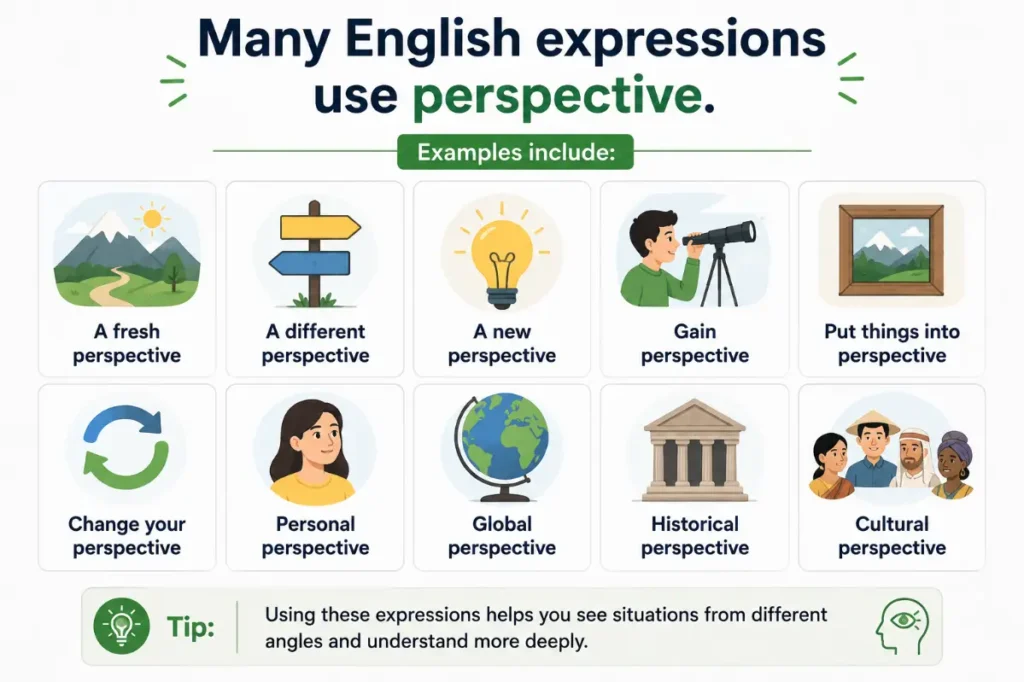
Many English expressions use perspective.
Examples include:
- A fresh perspective
- A different perspective
- A new perspective
- Gain perspective
- Put things into perspective
- Change your perspective
- Personal perspective
- Global perspective
- Historical perspective
- Cultural perspective
Example Sentences
- Traveling gave me a fresh perspective on life.
Explanation: Travel changed the person’s way of thinking.
- We need to put the problem into perspective.
Explanation: We should judge the situation realistically.
Common Expressions with Prospective
Prospective usually appears before nouns.
Common combinations include:
- Prospective employee
- Prospective customer
- Prospective buyer
- Prospective client
- Prospective student
- Prospective employer
- Prospective investor
- Prospective tenant
- Prospective partner
- Prospective member
Example Sentences
- The company welcomed prospective clients.
Explanation: The clients may do business with the company later.
- Prospective buyers visited the property.
Explanation: They may purchase the property.
Common Mistakes
Many English learners confuse these words because they look similar.
Mistake 1
Using perspective when talking about future people.
Incorrect:
- Perspective students attended the orientation.
Correct:
- Prospective students attended the orientation.
Explanation: The students may enroll in the future.
Mistake 2
Using prospective when talking about opinions.
Incorrect:
- I understand your prospective.
Correct:
- I understand your perspective.
Explanation: The sentence refers to someone’s viewpoint.
Mistake 3
Using prospective as a noun.
Incorrect:
- The prospective was interesting.
Correct:
- The perspective was interesting.
Explanation: Prospective is an adjective and needs a noun after it.
Mistake 4
Using perspective before nouns incorrectly.
Incorrect:
- Perspective employee.
Correct:
- Prospective employee.
Explanation: Employees are future workers, not viewpoints.
Memory Tips
Simple memory tricks make these words much easier to remember.
Think About Looking
Perspective comes from the idea of looking at something.
Ask yourself:
How do I see this?
If the answer involves a viewpoint, choose perspective.
Think About the Future
Prospective refers to people or things that may exist later.
Ask yourself:
Is this about the future?
If yes, choose prospective.
Remember the Prefix
Pro often suggests moving forward.
Prospective looks forward.
Perspective looks at a viewpoint.
Picture the Situation
Imagine two people discussing a problem.
Their opinions represent different perspectives.
Now imagine someone applying for a job.
That person is a prospective employee.
Visualizing these situations helps fix the meanings in your memory.
Professional Writing Tips
Using these words correctly makes your writing more precise.
Business Emails
Correct:
- Thank you for sharing your perspective.
Correct:
- We look forward to meeting prospective customers.
Using the wrong word could confuse readers and reduce professionalism.
Academic Writing
Examples:
- Researchers examined multiple perspectives.
- The university contacted prospective applicants.
Academic writing frequently uses both words, but never interchangeably.
Marketing
Businesses often describe future customers as prospective customers.
Examples:
- Prospective buyers.
- Prospective members.
- Prospective subscribers.
Marketing rarely uses perspective unless discussing customer opinions.
Related Grammar and Usage Notes
Learning similar word pairs reduces future mistakes.
Perspective vs Opinion
An opinion is a belief about something.
A perspective is the broader way someone sees or understands a situation.
Example:
Opinion:
- I dislike the proposal.
Perspective:
- I see the proposal differently because of my experience.
Prospective vs Potential
These words are very similar.
- Prospective employee.
- Potential employee.
Both are often interchangeable.
However, prospective is more common in formal writing.
Perspective vs Viewpoint
These words are close in meaning.
Examples:
- My perspective.
- My viewpoint.
Both describe how someone sees something.
Prospective vs Future
Examples:
- Prospective customer.
- Future customer.
The meanings are similar.
Prospective sounds more formal and professional.
Key Takeaways
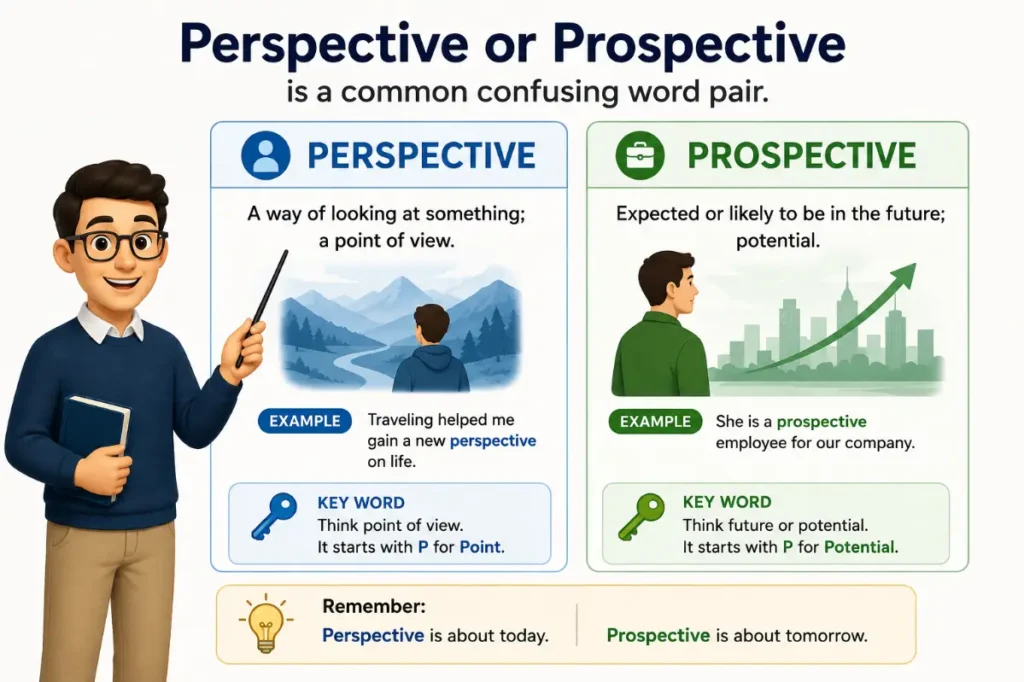
- Perspective or Prospective is a common confusing word pair.
- Perspective is always a noun.
- Prospective is always an adjective.
- Perspective means a point of view or outlook.
- Prospective means future, expected, or potential.
- Perspective often appears after possessive words like my, your, and their.
- Prospective usually appears before nouns such as student, buyer, employee, or customer.
- Learning the Latin origins makes the meanings easier to remember.
- Choosing the correct word improves clarity in academic, business, and everyday writing.
Conclusion
Understanding Perspective or Prospective becomes much easier once you remember their core meanings. Perspective is a noun that refers to a point of view, opinion, outlook, or visual representation of depth. Prospective is an adjective that describes people, opportunities, or events that are expected or likely to exist in the future.
Although these words look and sound similar, they are never interchangeable. Asking yourself one simple question can help you choose correctly. If you’re talking about how someone sees something, use perspective. If you’re talking about someone or something connected with the future, use prospective. With regular practice, real-life examples, and the memory tips in this guide, you’ll use both words confidently in everyday conversations, professional communication, and academic writing.
Frequently Asked Questions
What is the difference between Perspective or Prospective?
Perspective means a point of view, opinion, or way of seeing something. Prospective means future, expected, or potential.
Is perspective a noun or an adjective?
Perspective is a noun.
Example:
- I appreciate your perspective.
Is prospective a noun?
No. Prospective is an adjective.
Example:
- Prospective employees attended the interview.
Can perspective describe future events?
No. Perspective describes viewpoints, opinions, or visual depth, not future events.
What does prospective student mean?
A prospective student is someone who may enroll in a school or university in the future.
Why do people confuse perspective and prospective?
They have similar spelling and pronunciation, but they come from different Latin roots and have different meanings.
Can prospective and potential be used interchangeably?
In many situations, yes. Both describe something that may happen or someone who may become something in the future. However, prospective is generally more formal.
What is the easiest way to remember Perspective or Prospective?
Remember this simple rule:
Perspective = Point of view
Prospective = Potential future
Is prospective used in business English?
Yes. It is very common in business communication.
Examples include:
- Prospective client
- Prospective customer
- Prospective investor
- Prospective employee
Is perspective used in art?
Yes. In art and drawing, perspective refers to techniques that create the illusion of depth and distance on a flat surface.

English Grammar & Usage
Nathan Holloway is an American grammar writer and language researcher who specializes in English grammar, sentence structure, verb usage, and common writing mistakes. He enjoys breaking down confusing grammar rules into practical explanations with clear examples, making English easier for students, professionals, and everyday writers.